
Note: This article contains affiliate links. If you click on these links and make a purchase, we may earn a small commission at no extra cost to you. This helps support our research and content. Read our full affiliate disclosure here.
If you live with cats, finding a robot vacuum that reliably handles kitty litter can save you time and keep floors presentable between deep cleans. The right robot vacuum reduces tracked litter, removes fine grit from carpets and hard floors, and minimizes airborne dust from tracked particles. This guide shortlists the top robot vacuums for kitty litter and evaluates them on the features that matter most for cat owners: suction and agitation, filtration, bin capacity, and navigation accuracy. Read on for concise summaries of our top picks plus clear buying factors and maintenance tips to help you choose the best robot vacuum for your home and your cat.
Top Picks at a Glance
| Best Overall The best all-around choice for most situations | iRobot Roomba Plus 405 Combo |  |
| Best Quality Built to a higher standard if you want something more solid | dreame Matrix10 Pro |  |
| Best Value The sweet spot between price and what you get | roborock Q7 M5 Robot Vacuum |  |
| Best Budget The cheapest option that still gets the job done reliably | ILIFE V2 Robot Vacuum |  |
| Top Rated A top-rated pick with lots of positive feedback | UMMUND T13S Robot Vacuum |  |
| Most Popular A crowd favorite that many people choose with confidence | iRobot Roomba 105 Vac |  |
| Best Seller A high-volume bestseller chosen again and again | roborock Q10 S5+ |  |
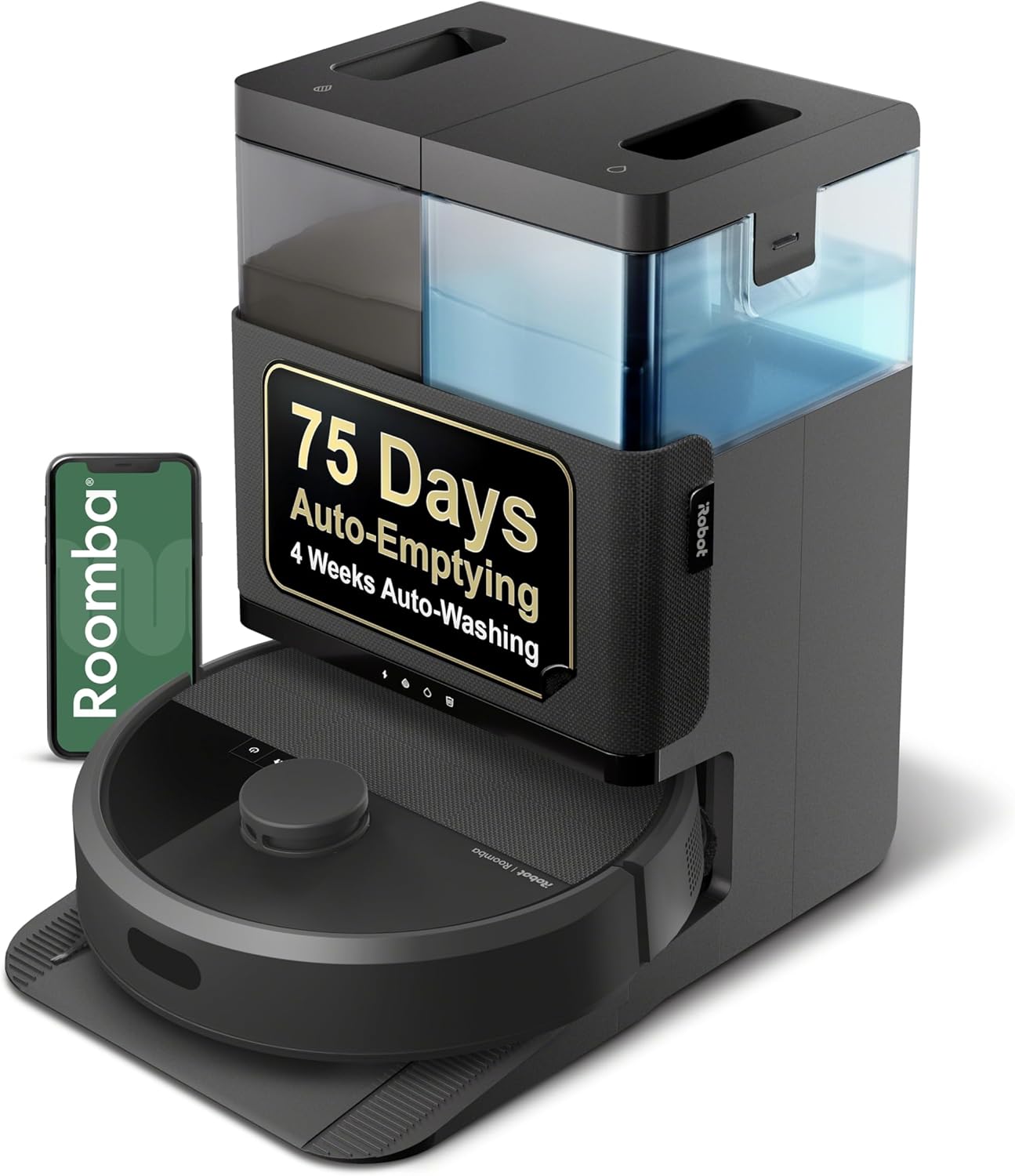
iRobot Roomba Plus 405 Combo
| Battery Life | 120 minutes |
|---|---|
| Capacity | 0.5 liters |
| Control Method | App, Push Button, Voice |
| Surface Recommendation | Carpet & Hard Floor |
The Roomba Plus 405 Combo is a LiDAR-mapped robot that combines vacuuming and powered mopping with a multi-function AutoWash dock that self-empties and washes and dries mop pads. In normal use you set maps and schedules in the Roomba Home app or by voice, then the robot uses ClearView LiDAR and sensors to navigate room-by-room, avoid stairs, and lift its mop pads when it detects carpet. Dual spinning mop pads and SmartScrub give heavier scrubbing on hard floors while the vacuum delivers up to 70x stronger suction than older Roomba 600-series models for lifting debris. The AutoWash dock stores and disposes of debris for up to about 75 days and routinely refreshes and dries mop pads so they are ready for the next run. Practical downsides include the need for occasional maintenance—rinsing dock tanks, changing filters, and cleaning brushes—and that mop-based cleaning is best for spills and grime rather than heavy liquid messes; carpeted areas still require the robot to switch modes to avoid wetting rugs. For homes with pets the combination of strong suction, spot mapping, and the self-emptying dock reduces hands-on maintenance and keeps floors cleaner between manual cleanings.
Best for: Buyers who want an all-in-one robot that minimizes daily maintenance and handles both vacuuming and scrubbing on hard floors, especially households caring about pet hair and tracked litter.
Less Ideal for: If you need a robot strictly for heavy wet spills, industrial-strength liquid pickup, or minimal maintenance with no periodic filter or dock care, choose a different specialty device.
- Combined vacuum and powered dual-spinning mop pads for scrubbing hard floors
- ClearView LiDAR mapping for precise room-by-room navigation and targeted cleans
- AutoWash dock that auto-empties debris and washes and dries mop pads
- Strong suction for lifting pet hair and litter-scale debris compared to older Roombas
- App and voice control with custom schedules and Keep Out/Clean Zone settings
- Mopping is not intended for large liquid spills and requires the robot to lift pads on carpets to avoid wetting rugs
- Regular upkeep required for dock tanks, filters, brushes, and mop pad care
Verdict: For pet owners who want vacuuming plus powered mopping with a self-cleaning dock to cut down on daily upkeep, the Roomba Plus 405 delivers a convenient, hands-off clean.
dreame Matrix10 Pro

| Suction | 30,000Pa Vormax |
|---|---|
| Battery life | 180 minutes |
| Mop cleaning | 212°F mop self-cleaning |
| Navigation | Single-laser 3D structured light with AI RGB |
| Auto-empty | 100-day auto-empty |
The dreame Matrix10 Pro is built for heavy-duty floor care: it combines a 30,000Pa Vormax suction system with a self-cleaning PowerDock that washes mops at 212°F and auto-empties for extended hands-off operation. In daily use it navigates with single-laser 3D structured light plus AI RGB to map rooms, avoid more than 280 object types, and adapt cleaning around carpets by lifting mops or boosting suction. The dock supports three solution compartments and auto-switching mops so you can assign mop types to different rooms, and the DuoBrush design aims to reduce tangles from pet hair. Practical benefits include long 180-minute runtime for large homes, scheduled app or voice control, and features targeted to pet owners such as pet-area logging. Expect a relatively large system footprint and a complex dock that will require occasional maintenance of brushes, mop pads, and cleaning solution. It is a performance-focused machine that prioritizes powerful suction, autonomous upkeep, and smart avoidance over extreme compactness or minimal setup fuss.
Best for: Buyers who prioritize powerful suction, advanced navigation, and autonomous upkeep for heavy messes like kitty litter and pet hair in larger homes.
Less Ideal for: People seeking a compact, low-maintenance robot with minimal accessories or those with very small apartments where docking footprint and supply needs are a disadvantage.
- Very strong 30,000Pa Vormax suction for deep cleaning of litter and debris
- PowerDock provides hot-water mop washing, washboard self-cleaning, and 100-day auto-empty autonomy
- Multi-mop switching and three-solution compartment let you customize cleaning per room
- Advanced navigation with single-laser 3D structured light and AI RGB to avoid many obstacles
- Long 180-minute battery life suitable for large, multi-room homes
- Large dock and robot footprint can be bulky in smaller homes
- Complex dock and consumables (solutions, mop pads) add ongoing maintenance and supplies
Verdict: If you need a high-suction, autonomous robot that handles litter and pet hair at scale while minimizing daily intervention, the Matrix10 Pro is designed for that job.
roborock Q7 M5 Robot Vacuum

| Maximum Suction | 10,000 Pa |
|---|---|
| Battery Life | 150 minutes |
| Capacity | 400 ml |
| Filter Type | Washable |
| Controller Type | App Control |
The roborock Q7 M5 is a lidar-guided robot vacuum that vacuums and mops in one pass while you manage settings from the app. It uses up to 10,000 Pa HyperForce suction and a dual anti-tangle brush design to pull pet hair and tracked litter from carpets and hard floors, and the detachable mop and three water-flow levels let you follow vacuuming with light-to-moderate mopping. PreciSense LiDAR builds precise maps and supports no-go zones and multi-level mapping so the bot avoids litter boxes or fragile areas. A combined dustbin and water tank and a claimed 150-minute runtime let it cover large spaces on a single charge, and washable filters keep maintenance simple. Expect typical limits for this class: it does not self-empty, so frequent litter and fine dust will require manual bin emptying, and noise rises when running at maximum suction. For homes with cats that shed or track litter, the Q7 M5 balances strong suction, tangle-resistant brushes, and mapped cleaning for reliable daily upkeep, provided you are willing to empty the bin regularly.
Best for: Buyers who want a practical, high-suction robot that minimizes brush tangles and can both vacuum and mop daily to manage tracked cat litter and pet hair while allowing mapped, hands-off scheduling.
Less Ideal for: Households that need unattended, very low-maintenance pickup of heavy litter loads or who require a self-emptying system to avoid regular bin emptying should consider models with automatic base-emptying.
- Very strong 10,000 Pa suction for lifting embedded litter and pet hair
- Dual anti-tangle brush system reduces hair wrap and maintenance
- LiDAR navigation with mapping, no-go zones, and multi-level support for targeted cleaning
- App-controlled mopping with three water-flow levels for floor-safe wet cleaning
- Long 150-minute runtime suitable for covering larger homes without recharging
- No self-emptying base, so the dustbin needs frequent manual emptying with litter-heavy homes
- Can get louder at high suction settings compared with quieter, lower-power modes
Verdict: A high-suction, LiDAR-mapped vacuum-mop built to handle cat hair and tracked litter efficiently for buyers who will empty the bin regularly.
ILIFE V2 Robot Vacuum

| Battery Life | 120 minutes |
|---|---|
| Capacity | 300 ml |
| Filter Type | Sponge |
| Control Method | Remote |
| Noise Level | 69 db |
The ILIFE V2 is an entry-level robot vacuum built to keep hardwood and other hard floors tidy without a lot of fuss. Its 2.99-inch slim body fits under low furniture while a tangle-free suction port and sponge filter make it practical for homes with pet hair. You can run scheduled cleanings, switch between auto, spot and edge modes, or start jobs with the included remote control or the single-button on the unit. A 300 ml dustbin and up to 120 minutes of runtime let it cover medium rooms on one charge, and it will automatically return to the dock when the battery is low. Noise is noticeable at 69 dB and there is only one power level, so it lacks adjustable suction or app-based controls, but for straightforward floor maintenance on hardwood and low-pile carpet the V2 delivers solid value at an affordable price.
Best for: Buyers who want an affordable, no-frills robot to maintain hardwood and low-pile carpet cleanliness with simple controls and scheduled runs.
Less Ideal for: Those who need strong adjustable suction, smart app control, or advanced mapping for large or complex homes should consider higher-end models.
- Slim 2.99-inch profile cleans under low furniture
- Tangle-free suction port suited for pet hair
- 120 minutes runtime with automatic return-to-dock
- Multiple cleaning modes (auto, spot, edge) and simple remote control
- Single power level limits suction control for heavier debris
- No smartphone app or advanced navigation features
Verdict: A low-cost, slim robot vacuum that reliably maintains hardwood floors and handles pet hair for budget-focused buyers.
UMMUND T13S Robot Vacuum

| Capacity | 370 ml |
|---|---|
| Battery Type | Lithium Ion |
| Lithium Battery Voltage | 14.4 volts |
| Cleaning Path Width | 5.59 inches |
| Number of Power Levels | 4 |
The UMMUND T13S is a compact robot that vacuums and mops simultaneously using separate dust and water tanks, making it an easy hands-off choice for daily floor maintenance. It connects to the Tuya Smart app (plus remote and voice control) so you can schedule cleanings, switch modes, and change suction levels from four power settings; those settings help the robot adapt from light dusting to deeper pickup for tracked-in debris. Navigation uses infrared sensors for obstacle avoidance, anti-fall protection, and basic edge and spot cleaning, while a slim 3.23-inch profile helps it reach under low furniture. The unit claims up to 160 minutes run time in quiet mode and will auto-return to dock when battery is low. For homes with cats, the vacuum's air-intake design and dual side brushes focus on picking up litter and pet hair without relying on hairy roller brushes, and the washable dust box and filter make maintenance straightforward. Expect sensible performance on hard floors and low-pile rugs, but do not rely on advanced LiDAR mapping or deep carpet agitation for heavy embedded dirt.
Best for: Buyers who want a reliable, low-maintenance device to keep hard floors and low-pile rugs clear of cat litter and pet hair with scheduled, app-driven cleanings and long runtimes.
Less Ideal for: Households needing precision room mapping, advanced obstacle mapping, or heavy-duty carpet shampooing should consider a different model geared to those demands.
- 2-in-1 vacuum and mop with separate water and dust tanks for simultaneous wet/dry cleaning
- Adjustable 4-level suction including high 8000Pa maximum for stronger litter and debris pickup
- Tuya Smart app, remote, and voice control for scheduling and mode changes
- Slim 3.23-inch profile and obstacle/anti-fall sensors let it clean under furniture and avoid drops
- Washable dust box, filter, and mopping cloth simplify maintenance
- Navigation appears sensor-based without advanced mapping, so room coverage may be less efficient in complex layouts
- Not designed for deep-cleaning thick or high-pile carpets where roller agitation is needed
Verdict: A dependable, easy-to-maintain vacuum-and-mop that handles kitty litter and pet hair on hard floors and low-pile rugs with strong suction and app scheduling.
iRobot Roomba 105 Vac

| Surface Recommendation | Carpet & Hard Floor |
|---|---|
| Battery Life | 200 minutes |
| Other Special Features of the Product | Anti-Fall, Bagless, Dirt Detection Sensor, Eco Mode, LiDAR Navigation |
| Controller Type | App Control, Button Control, Voice Control |
| Filter Type | Cartridge |
The Roomba 105 Vac is a compact robotic vacuum built for scheduled, hands-off floor cleaning across carpet and hard floors. It uses ClearView LiDAR to map rooms and navigate in neat rows, offers four suction levels and a three-stage cleaning system with a multi-surface bristle brush and an edge-sweeping tool, and returns to its dock to recharge and resume cleaning. You control it via the Roomba Home App, onboard buttons, or voice assistants, and it supports targeted room or spot cleans for high-traffic messes like entryways. The 200-minute battery life and automated recharge/resume behavior make it suitable for larger sessions without constant supervision. Important limitations are its basic accessory set—only a dock and filter are included—and that it does not include a self-emptying base or mopping capability, so you will need to empty the bin regularly if you deal with fine debris like kitty litter. For households that value predictable navigation, app scheduling, and proven suction performance, this model delivers straightforward, reliable cleaning without advanced premium extras.
Best for: Buyers who want a dependable, easy-to-control robot that maps reliably and runs long between charges, and who prioritize proven suction and predictable navigation over premium extras.
Less Ideal for: People who need unattended debris disposal or integrated mopping, or households that prefer fully hands-off maintenance for heavy litter loads.
- ClearView LiDAR mapping for systematic room coverage and obstacle avoidance
- Four suction levels and a 3-stage cleaning system for multi-surface pickup
- 200-minute battery life with automatic recharge and resume
- App and voice control for scheduled and targeted cleaning
- No hands-free auto-empty dock so the dustbin must be emptied frequently
- No mopping capability or wet-cleaning features
Verdict: A reliable, LiDAR-mapped Roomba that delivers strong, scheduled cleaning and long run times for owners who value predictable navigation and suction over auto-emptying or mopping.
roborock Q10 S5+

| Maximum Suction | 10,000Pa |
|---|---|
| Capacity | 2.7 liters |
| Battery Life | 150 minutes |
| Filter Type | Washable |
| Noise Level | 65 db |
The roborock Q10 S5+ is a combined robot vacuum and mop that focuses on long unattended runs and strong cleaning performance. It uses LiDAR mapping and multi-level maps for consistent coverage, ReactiveTech obstacle avoidance to steer around clutter, and a VibraRise 2.0 sonic mopping module that lifts on carpets. The included auto-empty dock holds a 2.7 liter dust bag for up to roughly 70 days between maintenance, which reduces contact with kitty litter and pet hair. App and voice controls let you set no-go zones, schedule cleanings, and boost suction automatically on carpets. Practical benefits include powerful 10,000 Pa suction that helps lift embedded debris and a dual anti-tangle brush system to limit hair build-up, plus washable filters to lower replacement cost. Trade-offs are typical of feature-rich cleaners: the unit is relatively noisy compared with quiet models and the docking system requires space and occasional bag replacements, and advanced sensors work best on stable, uncluttered floorplans. For cautious buyers who want minimal daily involvement, the Q10 S5+ delivers reliable, automated litter and pet-hair management.
Best for: A buyer who wants a low-touch cleaning solution that handles pet hair and litter with strong suction and hands-free emptying, prioritizing reliability and predictable maintenance over bargain pricing.
Less Ideal for: People who need an ultra-quiet vacuum for use while home all day or who lack a dedicated spot for the self-empty dock should consider simpler or quieter alternatives.
- Large 2.7 L auto-empty dust bag provides long stretches between maintenance
- High 10,000 Pa suction that helps remove embedded dirt and litter granules
- LiDAR-based mapping and multi-level maps for consistent, reliable navigation
- Dual anti-tangle brush design reduces hair wrap and maintenance
- App and voice control with configurable no-go zones and emptying modes
- Noise level around 65 dB can be intrusive during operation
- Auto-empty dock requires replacement dust bags over time
- Advanced sensors and mapping perform best in uncluttered spaces and may struggle in very crowded rooms
Verdict: If you want a risk-averse, low-maintenance robot that tames kitty litter and pet hair with strong suction and a long-lasting auto-empty dock, the Q10 S5+ is a safe, hands-off choice.
Choosing the Right Robot Vacuum for Kitty Litter: Key Factors to Consider
Suction Power and Pickup Design
Strong suction is essential for lifting both coarse litter granules and the finer dust that tracks from litter boxes. Look for units with adjustable suction settings so you can increase power on carpets and reduce it on delicate floors.
Equally important is pickup geometry: a wide intake and a brush or roller designed to agitate grit without scattering it improves first-pass cleanup. For homes with high litter traffic, prioritize robots whose intakes sit close to the floor and pair well with side brushes that channel debris inward rather than outward.
Filtration and Dust Containment
Kitty litter creates fine dust that can aggravate allergies and settle on surfaces. A sealed dust path and a high-efficiency filter help trap small particles instead of releasing them back into the room. Filters rated at capturing submicron particles reduce airborne dust during cleaning.
Also consider the sealing of the dustbin and any transfer mechanism used with automatic emptying docks. Poor seals or flimsy lids can leak dust during operation or when emptying, forcing more frequent manual cleanup and reducing the benefit of a robot vacuum.
Dustbin Size and Emptying Frequency
Litter is bulky and often granular, so a larger dustbin means fewer interruptions to empty the robot. If you have multiple cats or a high-traffic litter box area, bins that support longer intervals between emptying are particularly helpful.
Automatic emptying bases that deposit debris into a larger container reduce hands-on maintenance, but you should check how they handle gritty material. Some bases are optimized for fine dust but clog or scatter larger granules, so consider the emptying method and accessibility for manual cleaning when choosing a model.
Brush Type and Maintenance Needs
Brushes that are designed for grit are less likely to become clogged or worn when exposed to abrasive litter particles. Rubberized rollers or combination brush systems can resist packing and maintain pickup efficiency longer than delicate bristle-only designs.
Maintenance matters: frequent cleaning of brushes and bearings will be necessary when vacuuming litter regularly. Choose robots with easy-to-remove brush modules and clear access to bearings so routine upkeep is quick and does not require tools.
Navigation Accuracy and Edge Cleanup
Good navigation keeps the robot on a steady path and prevents repeated sweeping that spreads litter around. Models with reliable mapping and obstacle avoidance are less likely to bump the litter box or scatter litter across a room.
Edge and corner cleanup are important because litter often lands along baseboards. Look for robots with side brush designs and low-profile intakes that can reach close to edges without pushing debris away from the intake.
Noise, Scheduling, and Daily Use
Running a robot vacuum frequently requires tolerable noise levels, especially in homes with skittish cats. Adjustable cleaning schedules allow you to run the robot when cats are away from the cleaning area to reduce stress and avoid interference.
Also consider runtime and recharge behavior: longer runs reduce partial cleans and the need for frequent manual intervention. Reliable resume-after-charge functionality ensures a complete pass even in larger spaces.
Best Floor Types for Robot Cleanup of Litter
Hard floors are generally the easiest surface for robot vacuums to clear litter from because granules roll and are captured without the need for deep agitation. Low-profile rollers and wide intakes excel on tile, vinyl, and sealed wood. When using a robot primarily on hard surfaces, prioritize strong suction and a low intake profile.
Low-pile carpets can hold granules near the surface where a combination of agitation and suction works well. Deep-pile carpets trap litter more effectively and are harder for robots to clear; if your home has rugs with dense fibers, you may need a more powerful model or supplementary manual vacuuming.
- Hard floors: prioritize suction and a close-to-floor intake.
- Low-pile rugs: choose stronger suction and brush agitation.
- High-pile carpets: expect reduced effectiveness; plan for manual cleaning.
Managing Litter Around the Litter Box Area
Placement and routine matter. Position the litter box away from high-traffic zones if possible, and use a mat to catch excess granules. The robot can handle residual litter, but a containment strategy reduces the load and extends time between bin emptying.
For best results, run the robot on a schedule that follows litter box cleaning or before busy times of day. If your robot supports no-go zones or virtual barriers, define a perimeter that keeps the robot from bumping into the litter box and scattering material while still allowing it access to nearby tracked litter.
- Use a litter mat to reduce spread.
- Run scheduled cleans when cats are not at the box.
- Use virtual barriers to protect the litter box area if needed.
Maintaining the Robot When Vacuuming Litter Often
Regular maintenance extends the life and performance of any robot used frequently on litter. Empty the dustbin promptly, clean filters on the manufacturer-recommended cadence, and inspect brushes and bearings for grit buildup. Replace filters more frequently if you notice increased dust in living spaces.
Keep access points clear and check the intake and sensors for stuck granules. For robots with an automatic emptying base, verify the base's transfer path remains unobstructed and that the larger container is appropriately sealed to prevent dust leaks during disposal.
- Empty bin more often when litter load is high.
- Clean or replace filters on a shortened schedule.
- Inspect and clean brush bearings and roller ends regularly.
Allergy Considerations and Air Quality
Cats and litter can elevate airborne allergen levels when dust is disturbed. Choose robots with sealed dust paths and high-efficiency filters to reduce particles released during cleaning. A model with a tightly sealed bin and a reliable filter capture rate is particularly important in homes with allergy sufferers.
Running the robot while windows are open or when the household is less active can also help dissipate airborne dust. Pair robot cleaning with periodic manual vacuuming that uses a HEPA filter if severe allergies are a concern.
- Prioritize sealed dust paths and HEPA-grade filtration when possible.
- Schedule runs at low-occupancy times to reduce exposure.
- Combine robot cleaning with occasional manual HEPA vacuuming.
When to Use an Automatic Emptying Base
Automatic emptying bases reduce hands-on chores by transferring debris into a larger container. For homes with multiple cats or heavy litter tracking, they can cut the frequency of manual emptying significantly. Confirm that the base is designed to handle gritty debris and that its container seals well to prevent dust leaks.
Consider the space the base occupies and whether you are comfortable with its routine maintenance. Bases reduce daily interaction with dust but introduce a different maintenance interval for the base container and any filters it uses.
- Automatic emptying reduces daily bin emptying but check dust sealing.
- Bases require their own maintenance schedule and storage space.
- Weigh convenience against extra upkeep for base filters and containers.
How We Chose the Best Robot Vacuum for Kitty Litter
We selected products that specifically address the common challenges of cleaning kitty litter: picking up coarse and fine granules from both hard floors and low-pile carpets, minimizing dust escape, and operating with minimal daily maintenance. Our evaluation criteria prioritized measurable performance points such as suction power and brush design that affect litter pickup, filtration effectiveness for pet dust and allergens, bin and brush access for frequent cleaning, and navigation systems that reduce repeat passes and litter scatter. We excluded units with undersized dust bins or weak agitation that require constant emptying, and we filtered out robots without any specified filtration media or with navigation systems known to push debris rather than collect it. Testing considerations focused on real-world user needs: ability to handle mixed surfaces, durability of brush and motor assemblies under gritty debris, and reliability of automated emptying where applicable. The final list balances pickup performance with upkeep requirements and practical day-to-day usability for cat owners.
Our full evaluation process is outlined in our review methodology.
FAQ
Can robot vacuums reliably pick up all types of kitty litter?
Many robot vacuums handle common clumping and non-clumping litters on hard floors and low-pile rugs adequately, but performance varies with particle size and carpet depth. Coarser granules are generally easy to pick up, while very fine silica or dusty litters may require stronger suction and better filtration.
Will frequent robotic cleaning damage my litter box or spread more litter?
Good navigation and careful placement reduce the chance of bumping the litter box. However, robots with side brushes or poor obstacle judgment can scatter litter if they repeatedly contact the box. Using a mat and virtual barriers helps limit spread and protects the box.
How often should I empty the robot if I use it to clean litter daily?
Emptying frequency depends on dustbin size and the amount of tracked litter, but expect to empty more often than with ordinary household dust. For homes with moderate litter tracking, daily or every-other-day emptying is common; larger bins or automatic emptying bases can extend intervals.
Are special filters necessary for homes with cats?
High-efficiency filters that capture fine dust and dander are recommended to reduce airborne particles stirred up during cleaning. A sealed dust path combined with a quality filter helps contain litter dust better than filtration alone.
Should I run the robot when my cat is present?
It depends on your cat's temperament. Some cats tolerate the robot, while others find it stressful. Scheduling runs when the cat is out of the room or when it is resting elsewhere can reduce interactions and the chance the cat will interfere with the robot.
Final Verdict
When choosing a robot vacuum for kitty litter, prioritize suction and pickup design, effective filtration, and a dustbin or base that suits the volume of tracked litter in your home. Expect to perform more frequent maintenance than for occasional household dust: brush cleaning, filter swaps, and bin emptying are part of the tradeoff for the convenience of automated daily cleanup. Decide which tradeoffs matter most to you. If hands-off operation is a priority, favor models that support automatic emptying and have larger sealed containers. If air quality is the main concern, choose a unit with a high-efficiency sealed filter and a dust path designed to minimize leaks. Those priorities will guide you to the best fit for keeping litter under control.