
Note: This article contains affiliate links. If you click on these links and make a purchase, we may earn a small commission at no extra cost to you. This helps support our research and content. Read our full affiliate disclosure here.
Choosing the right Robot Vacuum for Multiple Surfaces matters because homes rarely have just one floor type. A single machine needs to transition between hardwood, tile, low-pile rugs, and thicker carpets without getting stuck or leaving residue behind. That means paying attention to suction, brush design, wheel travel, and navigation intelligence. This guide shortlists seven top options suited to mixed-floor homes and evaluates them against practical criteria like cleaning performance, surface transitions, and upkeep. Read on to find the characteristics that matter most and the situations where each style of robot vacuum shines.
Top Picks at a Glance
| Best Overall The best all-around choice for most situations | Shark Navigator Robot Vacuum RV2120AE |  |
| Best Quality Built to a higher standard if you want something more solid | roborock Saros 20 |  |
| Best Value The sweet spot between price and what you get | roborock Q7 L5 Robot Vacuum |  |
| Best Budget The cheapest option that still gets the job done reliably | ILIFE V2 Robot Vacuum |  |
| Top Rated A top-rated pick with lots of positive feedback | MONSGA MR7 Pro Robot Vacuum |  |
| Most Popular A crowd favorite that many people choose with confidence | iRobot Roomba 105 Vac |  |
| Best Seller A high-volume bestseller chosen again and again | eufy 11S Max Robot Vacuum |  |
Shark Navigator Robot Vacuum RV2120AE

| Battery Life | 120 minutes |
|---|---|
| Navigation | LiDAR SmartPath |
| Power Source | Battery Powered |
| Capacity | 0.22 quarts |
| Filter Type | Pre-Motor Filter |
The Shark Navigator Robot Vacuum RV2120AE is a self-emptying robot designed to handle mixed surfaces without constant supervision. It maps rooms with spot LiDAR and navigates in row-by-row SmartPath patterns for more systematic coverage, and it's intended to work on both carpets and hard floors. The robot offers up to 120 minutes of runtime and a self-emptying, bagless base that stores around 60 days of debris so you rarely need to touch the bin. A self-cleaning brushroll helps reduce hair wrap and improves pickup on carpets while object detection helps avoid small obstacles so you do less tidying before runs. Control is via an app for scheduling and run control. Trade-offs include a relatively standard dust capacity on the robot itself and a heavier unit compared with compact models, which can make manual handling and storage less convenient. For households prioritizing hands-off maintenance and consistent cleaning across different floor types, this model provides a practical balance of features.
Best for: Buyers who want a low-touch robot that reliably cleans both carpets and hard floors and value automated emptying and mapped navigation over ultra-compact design.
Less Ideal for: People seeking the smallest, lightest robot for tight storage spaces or those who prefer a simple budget robot without mapping features.
- LiDAR SmartPath navigation for systematic, room-mapping cleaning
- Self-emptying bagless base holds up to 60 days of debris for low-maintenance use
- Self-cleaning brushroll designed to reduce hair wrap and improve carpet pickup
- Up to 120 minutes runtime suitable for medium to large cleaning sessions
- App control for scheduling and run management
- Robot has limited onboard dust capacity requiring reliance on the base for long-term use
- Unit is heavier and bulkier than some compact robot models
Verdict: Choose this Shark if you want mapped LiDAR navigation plus a self-emptying, low-maintenance system that cleans carpets and hard floors reliably.
roborock Saros 20

| Suction | 36,000 Pa |
|---|---|
| Battery life | 180 minutes |
| Filter type | Washable Filter |
| Control | App, Remote, Voice |
| Noise level | 55 db |
The roborock Saros 20 is built for heavy cleaning across multiple floor types, combining a 36,000 Pa digital motor with an ultra‑slim chassis and adaptive lift to handle carpets, hard floors, and thresholds without interruption. It uses StarSight 3D sensors and an RGB camera to map rooms and avoid or recognize more than 300 obstacles, which reduces gets‑stuck events and improves coverage under furniture as low as 3.13 inches. The multifunctional RockDock automates mop washing with hot water and hot‑air drying, plus extended auto emptying and rewash cycles to minimize hands‑on maintenance. In daily use Saros 20 runs by schedule from the Roborock app, adjusts suction and mop behavior for carpets versus hard floors, and reaches into corners with an extendable side arm. Expect strong pet hair pickup and deep debris extraction, though the aggressive suction and complex dock add size and system complexity compared with simpler models, and full benefit requires using the app and dock features. For buyers prioritizing performance across mixed surfaces, it delivers one of the most capable, mostly hands‑free cleaning setups available.
Best for: Buyers who want top-tier cleaning performance across mixed floor types and pet-friendly power, and who prefer an automated, app-driven system that minimizes daily maintenance.
Less Ideal for: People who want a very simple, lightweight robot or who prefer minimal setup and no connected app features should consider more basic models instead.
- Very high 36,000 Pa suction for deep debris and pet hair pickup
- StarSight 3D navigation and RGB camera detect and avoid 300+ obstacles
- AdaptiLift chassis clears high thresholds and raises for carpets automatically
- RockDock automates mop washing, hot‑water cleaning, hot‑air drying, and long auto emptying
- Slim profile reaches under low furniture to clean hidden dust
- Advanced dock and app features increase system complexity and setup needs
- Strong suction and dock systems make the package larger and heavier than basic robots
Verdict: If you need maximum cleaning power and an automated dock for mostly hands‑free care across multiple surfaces, the Saros 20 is a performance-first choice.
roborock Q7 L5 Robot Vacuum

| Suction | 8,000 Pa |
|---|---|
| Navigation | LiDAR |
| Battery life | 150 minutes |
| Water tank capacity | 270 ml |
| Filter type | Washable |
The roborock Q7 L5 is a LiDAR-guided robot vacuum that vacuums and mops in a single run, using an integrated 270 ml water tank and up to 8,000 Pa suction to handle dust and pet hair on hard floors and low‑pile carpet. It maps rooms with multi-floor support and quick mapping so you can set scheduled cleans, no-go zones, and targeted room runs from the Roborock app or with voice assistants. Practical features include a dual anti-tangle brush system that reduces hair wrap, carpet boost that increases suction where needed, washable filters, and a child lock. For hardwood floors the precise navigation and along-floor-direction cleaning reduce repeated passes and the electronic water control offers three water levels to avoid over-wetting. Limitations to note are the combined dustbin/water-tank design which means you cannot refill water without handling the combo unit, and the robot requires a 2.4 GHz Wi‑Fi connection for full app features.
Best for: Buyers who prioritize reliable, predictable cleaning on hardwood and want a robot that follows precise maps, runs on a schedule, and minimizes hair-related maintenance.
Less Ideal for: People who need separate, large-capacity water or dust tanks for long runs without handling the unit frequently or who cannot provide a 2.4 GHz Wi‑Fi network.
- LiDAR mapping and multi-floor mapping for accurate, efficient coverage
- Strong 8,000 Pa suction with carpet boost for better pickup of dust and pet hair
- Dual anti-tangle brushes minimize hair wrap and maintenance
- Electronic water tank with three water levels lets you control mop moisture
- App control plus Alexa and Google Home compatibility for scheduled, hands-free operation
- Integrated dustbin and water tank is a single combo part, which adds steps when refilling or emptying
- Requires 2.4 GHz Wi‑Fi for app connectivity, which may need router changes for some homes
Verdict: A strong‑suction, LiDAR‑mapped vacuum‑and‑mop that reliably cleans hardwood with low hair maintenance and smart app controls.
ILIFE V2 Robot Vacuum

| Battery Life | 120 minutes |
|---|---|
| Capacity | 300 ml |
| Filter Type | Sponge |
| Control Method | Remote |
| Noise Level | 69 db |
The ILIFE V2 is an entry-level robot vacuum built to keep hardwood and other hard floors tidy without a lot of fuss. Its 2.99-inch slim body fits under low furniture while a tangle-free suction port and sponge filter make it practical for homes with pet hair. You can run scheduled cleanings, switch between auto, spot and edge modes, or start jobs with the included remote control or the single-button on the unit. A 300 ml dustbin and up to 120 minutes of runtime let it cover medium rooms on one charge, and it will automatically return to the dock when the battery is low. Noise is noticeable at 69 dB and there is only one power level, so it lacks adjustable suction or app-based controls, but for straightforward floor maintenance on hardwood and low-pile carpet the V2 delivers solid value at an affordable price.
Best for: Buyers who want an affordable, no-frills robot to maintain hardwood and low-pile carpet cleanliness with simple controls and scheduled runs.
Less Ideal for: Those who need strong adjustable suction, smart app control, or advanced mapping for large or complex homes should consider higher-end models.
- Slim 2.99-inch profile cleans under low furniture
- Tangle-free suction port suited for pet hair
- 120 minutes runtime with automatic return-to-dock
- Multiple cleaning modes (auto, spot, edge) and simple remote control
- Single power level limits suction control for heavier debris
- No smartphone app or advanced navigation features
Verdict: A low-cost, slim robot vacuum that reliably maintains hardwood floors and handles pet hair for budget-focused buyers.
MONSGA MR7 Pro Robot Vacuum

| Suction | 8000Pa |
|---|---|
| Dust bag capacity | 4 liters |
| Battery life | 160 minutes |
| Filter type | HEPA |
| Navigation | LiDAR, 5-map memory |
The MONSGA MR7 Pro is a self-emptying robot vacuum and mop built for hands-off cleaning across multiple floor types. It uses LiDAR navigation to map rooms precisely and stores up to five floor plans, letting you set no-go zones and targeted spot cleans through the app or voice assistants. In daily use the MR7 Pro vacuums and mops in one pass, boosts suction automatically on carpets, and routes row-by-row for thorough coverage; the included auto-empty station collects debris into a 4 L dust bag for up to about 90 days of low-maintenance operation. Practical benefits include a dual anti-tangle brush layout for pet hair, a protective plate to limit mop moisture on sensitive floors, and long runtime with smart recharge-and-resume for larger homes. Important limitations are that smart features require 2.4 GHz Wi-Fi and the mop water tank and dust-bag consumables will need periodic refills and replacement over time, so there is some ongoing maintenance despite the extended auto-empty interval.
Best for: Buyers who prioritize dependable, low-intervention cleaning across varied floor types and want a robot that maps accurately and self-empties for long stretches between maintenance.
Less Ideal for: People who lack a stable 2.4 GHz Wi-Fi network or who prefer fully manual cleaning tools and zero ongoing consumable costs should consider other options.
- Precision LiDAR mapping with multi-floor memory for consistent coverage
- Auto-empty station with 4 L dust bag reduces how often you touch dust
- 8000 Pa suction plus automatic carpet boost for deep cleaning rugs
- Dual anti-tangle brush system designed to handle pet hair effectively
- Combined vacuum-and-mop operation with protective plate to limit excess moisture
- Requires 2.4 GHz Wi-Fi for app and voice features
- Consumable items like dust bags, filters, and mop pads need periodic replacement
Verdict: Choose the MR7 Pro when you want precise LiDAR mapping and a long-interval auto-empty system to minimize hands-on cleaning across multiple floor surfaces.
iRobot Roomba 105 Vac

| Surface Recommendation | Carpet & Hard Floor |
|---|---|
| Other Special Features of the Product | Anti-Fall, Bagless, Dirt Detection Sensor, Eco Mode, LiDAR Navigation |
| Controller Type | App Control, Button Control, Voice Control |
| Battery Life | 200 minutes |
| Filter Type | Cartridge |
The Roomba 105 Vac is a straightforward robot vacuum that maps rooms with ClearView LiDAR and cleans carpets and hard floors using a 3-stage system and selectable suction levels. It is typically set up via the Roomba Home App on a 2.4 GHz network, then scheduled to run automatically or started by voice, button, or app control. Notable features include LiDAR navigation for systematic, row-by-row cleaning, four power levels to match light dusting or heavier debris, and sensors that prevent falls down stairs. The bin and filter are user-serviceable and maintenance is limited to emptying the dust bin, wiping contacts, and occasional brush and filter care. Practical benefits include reliable room coverage, targeted spot cleans, and automatic return-to-dock and recharge so it can resume tasks. Important limitations are that it is a vacuum-only model (no integrated mop or auto-empty dock) and setup requires a 2.4 GHz Wi-Fi network for full app functionality; larger homes may need time for mapping and placement of the dock for best results.
Best for: Buyers who prioritize reliable mapping, predictable room-by-room cleaning, and easy app or voice control backed by broad user feedback will appreciate this model.
Less Ideal for: People who need a vacuum-and-mop combo or a hands-off auto-empty solution should consider alternatives with those specific features instead.
- ClearView LiDAR mapping for systematic navigation and obstacle avoidance
- Selectable suction power with four levels to handle light to heavier debris
- App and voice control plus scheduling for hands-off cleaning
- Long battery life listed for extended runs and automatic return-to-dock and resume
- No built-in mopping capability
- Does not include an auto-empty base
Verdict: Choose the Roomba 105 Vac if you want dependable LiDAR-guided, app-enabled vacuuming across carpets and hard floors without added mop or auto-empty features.
eufy 11S Max Robot Vacuum
| Surface Recommendation | Hard Floor & Tile & Medium carpet |
|---|---|
| Battery Life | 100 minutes |
| Suction Power | 2000 Pa |
| Capacity | 600 ml |
| Noise Level | 55 db |
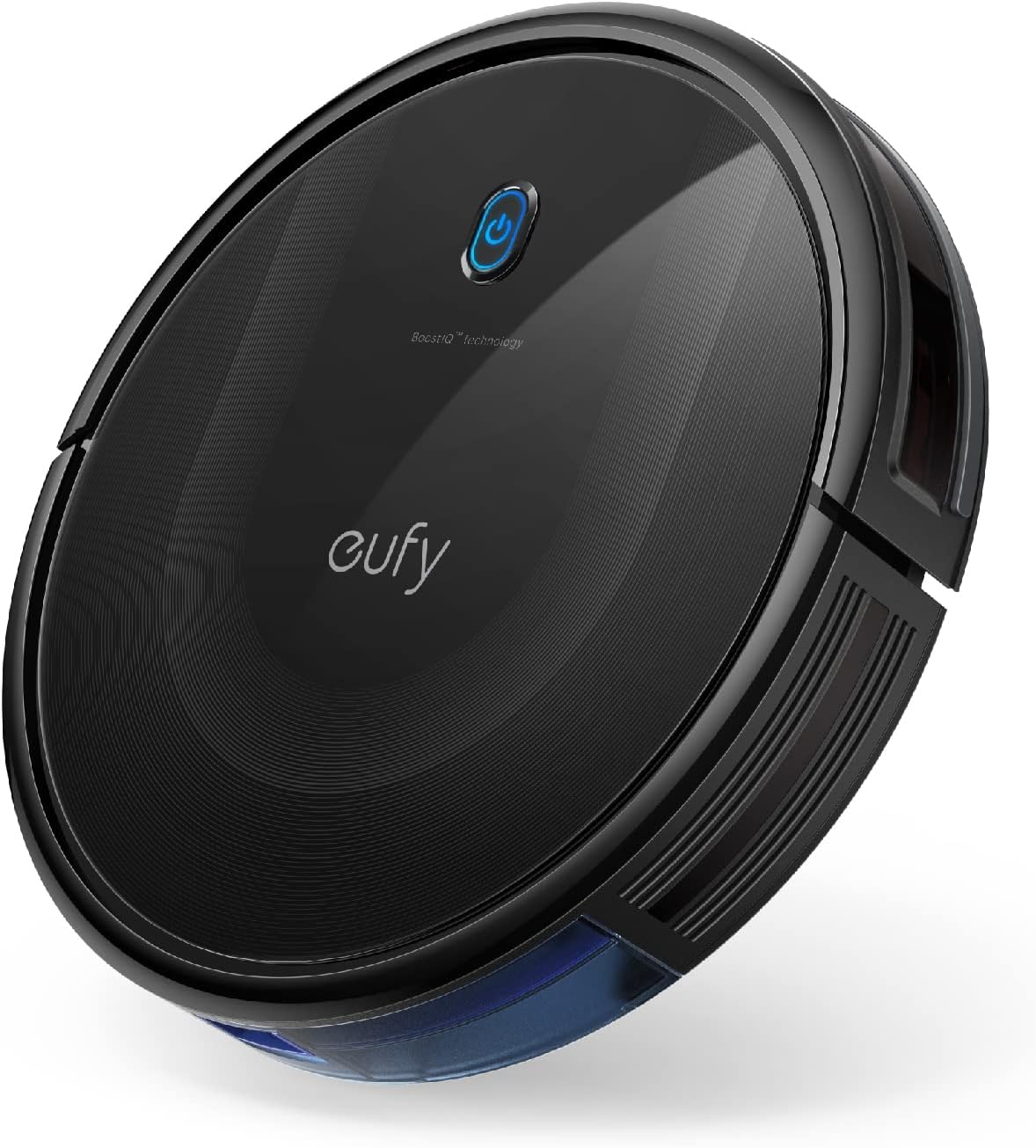
The eufy 11S Max is a low-profile robot vacuum built to clean hard floors and medium-pile carpets without drawing attention. Its 2.85-inch slim body lets it slide under low furniture while 2000Pa suction and a 12.8-inch cleaning path pick up dust, crumbs, and pet hair. It runs up to 100 minutes on hardwood at a reported low 55 dB, and automatic return-to-base means it tops off battery without user intervention. Controls are simple: the included remote and onboard buttons let you start, stop, and switch modes quickly, though there is no Wi-Fi or app control. Practical touches include washable filters, drop-sensing and anti-collision sensors, and a 600 ml dust capacity that reduces how often you empty the bin. The trade-offs are straightforward: navigation is basic rather than lidar or map-based, so room coverage is more random and may miss tight corners, and the single-side-brush design can be less thorough along edges compared with dual-brush models. For routine, quiet cleaning of hardwood, the 11S Max balances strong suction and a slim profile in a simple, reliable package.
Best for: Buyers who prioritize a quiet, no-frills robot that cleans hardwood reliably and fits under low furniture will appreciate this model for regular maintenance cleaning.
Less Ideal for: If you want mapped cleaning, smartphone scheduling, or the most thorough edge-cleaning for complex floorplans, choose a model with advanced navigation and app control instead.
- Slim 2.85" profile reaches under low furniture
- Up to 100 minutes runtime for extended cleaning sessions
- Powerful 2000Pa suction for effective pickup on hard floors
- Quiet operation at about 55 dB suitable for daytime or evening use
- Large 600 ml dust capacity and washable filter lower maintenance frequency
- Random navigation rather than mapping can lead to uneven coverage
- No Wi‑Fi or smartphone app means limited scheduling and remote control options
Verdict: A slim, quiet robot with strong suction made for routine hardwood maintenance when you want reliable, no-frills cleaning.
Choosing the Right Robot Vacuum for Multiple Surfaces: Key Factors to Consider
Suction Power and Debris Pickup
Suction power determines how well a robot vacuum pulls dust and debris out of low-pile rugs and from cracks in hard floors. On mixed floors you need a unit capable of adjusting suction or maintaining enough airflow to clean both loose debris on tile and embedded dirt in carpet fibers.
Look for consistent airflow ratings and brush designs that funnel debris into the path of the suction. If you have pet hair, higher sustained suction combined with anti-tangle brush elements matters more than raw peak numbers, because long-lasting pickup is the practical benefit you will notice.
Brush and Roller Design
Brush geometry affects how effectively a robot dislodges dirt from different surfaces. Soft bristle or combo bristles with a rubberized roller are better at sweeping hard floors, while stiffer, agitated brushes lift dirt from carpets.
Dual-roller or hybrid brush assemblies that limit tangles are especially useful for homes with pets. Removable brush modules that click out without tools make maintenance faster and keep performance steady over time.
Surface Transitioning and Ground Clearance
Mixed-floor homes often have thresholds, area rugs, or slight level differences. A robot vacuum that can climb modest height differences and has compliant wheel suspension will move between surfaces without repeated stalls.
Ground clearance and wheel diameter determine the maximum threshold a robot can cross. For homes with thick rugs or high thresholds, prioritize models explicitly rated for higher climb heights to avoid frequent manual intervention.
Navigation and Room Mapping
Navigation affects coverage efficiency and collision frequency. A machine that builds accurate floor maps and follows logical cleaning paths will spend less time repeating areas and more time cleaning effectively.
Look for mapping features that support room segmentation or no-go zones if you want targeted cleaning. Sensors and obstacle detection that recognize furniture legs and cords reduce entanglements and the need for resets.
Battery Life and Charging Behavior
Battery runtime determines how much square footage a robot can cover in a single run. For multi-room homes or larger houses, choose a robot with longer runtime or reliable return-and-resume behavior so it can finish cleaning after recharging.
Charging speed and whether the unit automatically resumes after charge affect total task time. Also consider whether charging docks are stable and allow the robot to dock easily in your floor layout.
Maintenance, Parts Access, and Consumables
Ease of cleaning dustbins, accessing filters, and replacing brushes influences ongoing satisfaction. A small dustbin will fill quickly on mixed-floor cleaning runs, especially if you have pets, so emptying frequency and filter washability are practical considerations.
Availability of replacement filters and brush replacements and straightforward user-serviceable parts reduce long-term ownership friction.
How Mixed-Floor Cleaning Differs From Single-Surface Cleaning
Robots intended for multiple surfaces must balance brute suction with gentle handling of delicate floors. Hard floors respond well to bristle sweeping and moderate suction, while carpets often need more aggressive agitation to free trapped dust. That difference means a robot optimized for one surface may underperform on another unless it can automatically adapt settings or uses a hybrid brush system.
- Automatic suction adjustment helps maintain pickup on rugs without scattering debris on hard floors.
- Rubberized rollers protect hardwood finishes while still gathering hair from carpets.
- Sensors that detect floor type can trigger mode changes for efficient cleaning.
Setting Up Your Home for Better Robot Performance
A few simple setup steps dramatically improve a robot vacuum's effectiveness across floor types. Clear small objects and cords from transition zones, and use low-profile threshold ramps where practical. Position the charging dock against a wall with a clear approach path so the robot can dock reliably between runs.
If you have area rugs that tend to shift, secure them with non-slip pads or opt for models with edge detection to avoid dragging. Finally, establish virtual no-go zones in the app for areas the robot struggles with, such as high-pile runner rugs or clustered furniture.
- Remove small obstacles like shoes and cords before runs.
- Secure doormats and loose rugs to prevent bunching.
- Use app-based boundaries for fragile or problematic areas.
Pet Hair and High-Debris Areas
Homes with pets present extra challenges across mixed floors. Pet hair sheds onto hard floors and embeds in carpets, so you need brushes and suction that handle both. Anti-tangle brush designs and good bin capacity reduce the need to interrupt runs for emptying.
Placing a robot on a more frequent schedule can prevent buildup and reduce deep-cleaning needs. Consider positioning it to tackle high-debris zones, such as near pet beds or feeding areas, before moving on to other rooms.
- Empty the dustbin more often when pets are present.
- Favor brush systems that advertise tangle resistance.
- Schedule short, frequent runs to keep hair from matting into fibers.
Maintenance Routines That Keep Performance Consistent
Regular maintenance keeps a robot vacuum working smoothly across surfaces. Clean the primary brush and rollers weekly if you have pets or heavy debris, and inspect wheels and sensors for hair wrap or dust buildup. Wash or replace filters per manufacturer guidance to preserve suction performance.
Keep a small toolkit or dedicated brush for maintenance tasks and set calendar reminders for filter replacement and brush inspection. Routine care extends cleaning consistency and helps prevent the robot from losing effectiveness on either hard floors or carpet.
- Inspect brushes and remove hair weekly in high-traffic homes.
- Rinse washable filters and replace disposable ones on schedule.
- Wipe sensor windows and wheel housings to prevent navigation errors.
How We Chose the Best Robot Vacuum for Multiple Surfaces
Our selection focused on real-world usability across mixed flooring in typical homes. We prioritized models that demonstrate consistent suction across hard and soft surfaces, reliable edge and corner pickup, and physical design features that ease transitions between floor heights. Navigation and mapping capabilities were judged for how well they avoid obstacles, adapt cleaning patterns to room layouts, and return to base with minimal intervention. Durability and maintenance were measured by filter and brush access, brush life expectancy, and how straightforward routine cleaning is. Battery life and recharge behavior were considered for house sizes that require longer runs or multi-room coverage. We excluded units that target a single surface type, lack adequate obstacle clearance, or have poor customer service and parts availability histories. In short, filters applied included suction consistency on multiple surfaces, brush and roller design, navigation and mapping reliability, build and maintenance convenience, and battery/runtime performance. These concrete dimensions are reflected in the scoring metrics used for each shortlisted robot vacuum.
Our full evaluation process is outlined in our review methodology.
FAQ
Will a single robot vacuum really clean both hardwood and carpet well?
Often it depends on the model. Many robots can handle both if they offer adaptive suction and a brush system that works on hard floors and carpets. Expect better results from robots that explicitly list multi-surface capability and include transitions support.
How high a rug can a typical robot vacuum cross?
Most consumer robot vacuums can climb thresholds of about 0.5 to 1.6 centimeters. Higher-pile rugs or thick thresholds may require models with larger wheels or higher climb specifications. Check specs for maximum obstacle height if you have tall rugs.
How often should I empty the dustbin when cleaning multiple surfaces?
Frequency varies by home, but for mixed-floor homes with moderate traffic, emptying after every one to two runs is common. Homes with pets or heavy debris may need emptying after each run to maintain suction and avoid messes when switching surfaces.
Do mapping and navigation features improve multi-surface cleaning?
Yes, mapping helps the robot choose efficient paths and avoid trouble spots, which improves overall coverage. Advanced navigation also reduces repeated passes and can restrict cleaning to specific rooms or floor types when needed.
Can robot vacuums damage hardwood floors or delicate finishes?
Most robots are safe on sealed hardwood when used properly. Avoid models with abrasive brush heads and ensure wheels are clean to prevent scratches. Using models with rubberized rollers and gentle brush settings reduces risk.
Final Verdict
Prioritize the specific performance traits that matter most for your floor mix. Suction and brush design determine cleaning effectiveness on carpets and hard floors, while transition capability and navigation affect how often you have to intervene. Balance runtime and maintenance needs with the size of your home and any pets or high-debris areas. Choose a robot vacuum that matches your dominant surface and offers adaptive features for secondary floors. That approach minimizes tradeoffs and gives you confident, consistent cleaning across multiple surfaces.