
Note: This article contains affiliate links. If you click on these links and make a purchase, we may earn a small commission at no extra cost to you. This helps support our research and content. Read our full affiliate disclosure here.
If you have rooms separated by low door thresholds or rugs with raised edges, a standard robot vacuum can stall or get stuck, leaving areas uncleaned. Choosing a robot vacuum designed for going over thresholds matters because it reduces manual intervention and keeps cleaning routines consistent across different floor transitions. This guide shortlists the top robot vacuum options optimized for climbing small obstacles and handling common home thresholds. We evaluated each candidate for climbing capability, navigation reliability, battery endurance, and run-time consistency so you can pick a model that keeps cleaning moving from room to room. Read on for our top picks and the criteria behind them.
Top Picks at a Glance
| Best Overall The best all-around choice for most situations | ILIFE A30 Pro Robot Vacuum |  |
| Best Quality Built to a higher standard if you want something more solid | roborock Saros 20 |  |
| Best Value The sweet spot between price and what you get | ROPVACNIC S1 Robot Vacuum |  |
| Best Budget The cheapest option that still gets the job done reliably | ILIFE V2 Robot Vacuum |  |
| Top Rated A top-rated pick with lots of positive feedback | Shark Matrix Clean AV2511AE |  |
| Most Popular A crowd favorite that many people choose with confidence | roborock Q10 S5+ |  |
| Best Seller A high-volume bestseller chosen again and again | eufy C28 Robot Vacuum |  |
ILIFE A30 Pro Robot Vacuum

| Max suction | 10000 Pa |
|---|---|
| Battery life | 150 minutes |
| Dust bag capacity | 2.5 liters |
| Filter type | Hepa |
| Control types | App, Remote, Voice |
The ILIFE A30 Pro combines strong suction and LiDAR mapping into a self-emptying robot that handles daily floor maintenance with minimal intervention. It vacuums and mops simultaneously using an integrated dual tank and offers four suction levels from quiet to a 10000Pa max for heavy debris and pet hair. LiDAR navigation produces accurate maps, supports multi-floor mapping, and lets you set no-go zones and schedules through the ILIFEClean app or voice assistants, while the included remote provides basic control without a phone. The self-empty station uses 2.5L disposable bags (five included) for extended hands-free operation, and runtime up to 150 minutes reduces the need for frequent recharges on medium-to-large homes. Practical limits include a relatively low water tank/dustbin combo capacity per cycle (200ml each) for extensive mopping sessions and the requirement for 2.4GHz Wi-Fi for smart features. The robot's low profile and navigation should help it cross most indoor thresholds, but very high door lips or uneven transitions may still slow or block it.
Best for: Buyers who want a low-maintenance, all-around robot that vacuums and mops daily traffic areas and prioritizes mapping accuracy and long hands-off intervals.
Less Ideal for: Homes with very tall thresholds, frequent steep transitions, or large hard-floor-only areas that need prolonged mopping without refilling the tank.
- Strong maximum suction (up to 10000Pa) for deep cleaning of carpets and pet hair
- LiDAR-based mapping with multi-floor maps and support for no-go zones via the app
- Self-emptying base with 2.5L dust bags that extend hands-free intervals
- Long runtime up to 150 minutes suitable for larger areas
- App, remote, and voice control offer flexible control options
- Integrated 200ml water tank and dustbin per cycle limit extended mopping without refills
- Smart features require a 2.4GHz Wi-Fi network only
Verdict: Choose the A30 Pro when you want a LiDAR-mapped, self-emptying robot that delivers strong suction and long hands-free cleaning for everyday mixed floor care.
roborock Saros 20

| Suction | 36,000 Pa |
|---|---|
| Threshold clearance | Up to 3.46 in double‑layer |
| Minimum height | As low as 3.13 in |
| Battery life | 180 minutes |
| Noise level | 55 db |
The roborock Saros 20 is built for heavy cleaning tasks in homes with pets and varied floor transitions. It uses a 36,000 Pa digital motor and a dual anti‑tangle system to pull hair and deep debris from carpets and gaps while its ultra‑slim 3.13 inch profile lets it glide under low furniture. StarSight 3D navigation with RGB camera and ToF sensors builds accurate maps, recognizes obstacles, and plans efficient routes so the robot misses fewer spots. The AdaptiLift Chassis 3.0 dynamically raises the body to climb double‑layer thresholds up to 3.46 inches, keeping runs uninterrupted across rooms with steps or rugs. The RockDock auto‑maintenance station washes mops with hot water, dries, and offers extended auto dust emptying for hands‑free upkeep. App control, voice commands, and SmartPlan learning make scheduling and zone control straightforward. Tradeoffs are a relatively high noise level under load and a bulky overall unit when moving by hand, and the feature set is aimed at larger budgets and users who want deep automated care rather than a budget basic cleaner.
Best for: Buyers who prioritize powerful cleaning performance and reliable threshold crossing for homes with multiple floor types and pets, and who want an automated maintenance workflow to minimize hands‑on upkeep.
Less Ideal for: People seeking a budget compact robot for very small apartments or those who prioritize the quietest possible operation should consider simpler models instead.
- Extremely strong 36,000 Pa suction for pulling deep debris and pet hair
- AdaptiLift Chassis climbs up to 3.46 in double‑layer thresholds for uninterrupted room-to-room cleaning
- StarSight 3D navigation and RGB camera reduce missed spots and improve route efficiency
- RockDock auto‑maintenance with hot water wash, hot air drying, and long auto dust‑emptying for low hands‑on care
- Higher noise level around 55 dB under normal operation
- Large and heavier chassis makes occasional manual handling less convenient
Verdict: If you need a performance‑focused robot that reliably climbs high thresholds and delivers deep suction with hands‑free maintenance, the Saros 20 is a top choice.
ROPVACNIC S1 Robot Vacuum
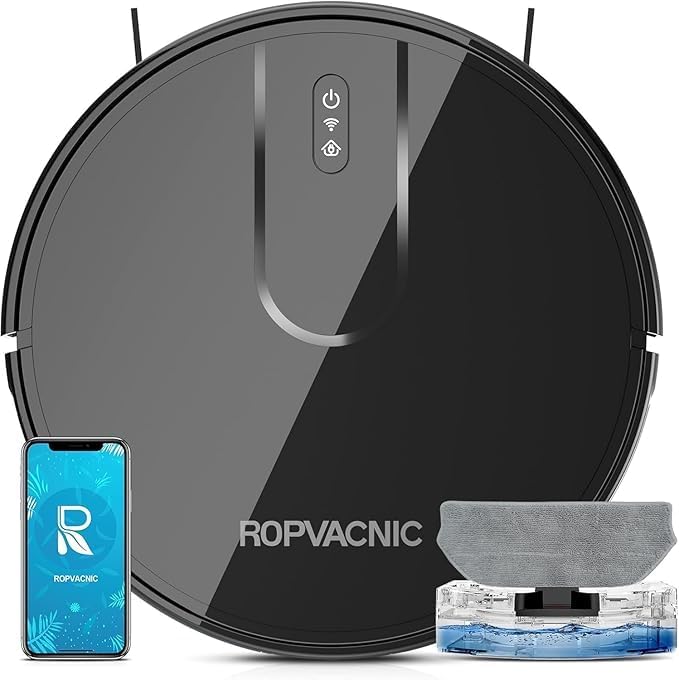
| Suction power | 5200Pa |
|---|---|
| Battery life | 120 minutes |
| Form factor | round |
| Filter type | Multi-layer HEPA filtration |
| Included components | Charging base, water tank, mop pad, spare HEPA filter, 4 side brushes |
The ROPVACNIC S1 is a compact round robot that combines vacuuming and electronically controlled mopping for routine floor care in homes with pets. It uses a 5200Pa suction motor, dual rotating side brushes, and a three-point cleaning system to lift dirt from hardwood and low‑pile carpet, while a four-stage water adjustment on the powered water tank tailors mopping intensity. Navigation is handled by an advanced sensing system with obstacle avoidance and automatic return-to-dock charging when battery drops below 20 percent, and you can control schedules and modes via app, remote, or voice assistants. Practical benefits include a low 2.99 inch profile to reach under furniture, a 4400mAh battery for long runs, and included spare HEPA filter and side brushes for maintenance. Trade-offs to note are the round form factor, which can miss tight corners compared with D-shaped models, and mopping is best for light stains rather than heavy soiling or grout lines.
Best for: Buyers who want a practical, hands‑off cleaner that handles daily vacuuming and light mopping across thresholds and open-plan rooms and who prioritize long runtime and easy scheduling.
Less Ideal for: People who need aggressive deep mopping, heavy-duty wet cleaning, or a robot designed to reach every tight corner should consider other solutions.
- Strong 5200Pa suction suitable for pet hair and debris
- Electronically controlled mopping with four-stage water adjustment for tailored damp cleaning
- Long 120‑minute runtime with automatic return-to-dock for large-area cleaning
- App, remote, and voice control let you schedule and adjust cleaning without bending down
- Round design may leave narrow corner edges less thoroughly cleaned than D‑shaped robots
- Mopping function is for surface maintenance and not a replacement for deep scrubbing
Verdict: A long‑runtime, threshold‑capable vacuum‑and‑mop that delivers strong suction and practical app control for busy homes that need routine floor maintenance.
ILIFE V2 Robot Vacuum

| Battery Life | 120 minutes |
|---|---|
| Capacity | 300 ml |
| Filter Type | Sponge |
| Control Method | Remote |
| Noise Level | 69 db |
The ILIFE V2 is an entry-level robot vacuum built to keep hardwood and other hard floors tidy without a lot of fuss. Its 2.99-inch slim body fits under low furniture while a tangle-free suction port and sponge filter make it practical for homes with pet hair. You can run scheduled cleanings, switch between auto, spot and edge modes, or start jobs with the included remote control or the single-button on the unit. A 300 ml dustbin and up to 120 minutes of runtime let it cover medium rooms on one charge, and it will automatically return to the dock when the battery is low. Noise is noticeable at 69 dB and there is only one power level, so it lacks adjustable suction or app-based controls, but for straightforward floor maintenance on hardwood and low-pile carpet the V2 delivers solid value at an affordable price.
Best for: Buyers who want an affordable, no-frills robot to maintain hardwood and low-pile carpet cleanliness with simple controls and scheduled runs.
Less Ideal for: Those who need strong adjustable suction, smart app control, or advanced mapping for large or complex homes should consider higher-end models.
- Slim 2.99-inch profile cleans under low furniture
- Tangle-free suction port suited for pet hair
- 120 minutes runtime with automatic return-to-dock
- Multiple cleaning modes (auto, spot, edge) and simple remote control
- Single power level limits suction control for heavier debris
- No smartphone app or advanced navigation features
Verdict: A low-cost, slim robot vacuum that reliably maintains hardwood floors and handles pet hair for budget-focused buyers.
Shark Matrix Clean AV2511AE

| Battery Life | 120 minutes |
|---|---|
| Capacity | 0.27 gallons |
| Compatible Devices | Amazon Alexa, Google Assistant |
| Control Method | Voice |
| Surface Recommendation | Carpet & Hard Floors |
The Shark Matrix Clean AV2511AE is a LIDAR-mapped robot vacuum and mop designed for hands-off, whole-home cleaning. It navigates in a precision grid pattern to make multiple passes over messes, combines strong suction with a self-cleaning brushroll for pet hair, and uses sonic mopping for hard floors. The XL bagless base holds up to 60 days of debris so you only need to empty the base occasionally, and app and voice controls let you schedule, target rooms, and monitor progress. For homes with thresholds, the robot's mapping and navigation help it plan routes, but its 13.08-inch width and wheel configuration mean very tall or irregular thresholds may still block passage; it does support recharge-and-resume for long runs. Practical benefits include reduced maintenance from the self-emptying base, consistent coverage from the Matrix Clean pattern, and useful pet-hair handling. Important limitations are its physical clearance over high door thresholds and that a few homes may require threshold ramps or manual transfers to get the robot between rooms.
Best for: Buyers who prioritize a reliable, low-maintenance robot that consistently covers whole rooms and reduces hands-on dirt disposal will appreciate this model.
Less Ideal for: If you need a robot that frequently crosses high door thresholds or very narrow gaps without modifications, consider options with lower clearance or use ramps to assist transitions.
- LIDAR-based mapping and Matrix Clean grid navigation for thorough, repeatable coverage
- Bagless self-empty base with up to 60 days capacity reduces how often you touch dirt
- Self-cleaning brushroll and strong suction handle pet hair and debris across carpets and hard floors
- App control plus Alexa and Google Assistant voice control for scheduling and room targeting
- Physical clearance and wheel design can struggle with high or irregular thresholds
- Relatively wide body may limit passage through narrow openings
Verdict: Choose the Shark Matrix Clean AV2511AE when you want a dependable, low-maintenance robot that delivers consistent whole-room cleaning with a long-lasting self-empty base.
roborock Q10 S5+

| Maximum Suction | 10,000 Pa |
|---|---|
| Capacity | 2.7 liters |
| Battery Life | 150 minutes |
| Filter Type | Washable |
| Control Method | App, Voice |
The roborock Q10 S5+ combines strong suction and a sonic mopping system with multi-level LiDAR mapping to run long, autonomous cleaning cycles with minimal intervention. It uses a 10,000 Pa HyperForce motor plus an ultrasonic carpet sensor that raises the mop and boosts suction when it detects rugs, so it vacuums carpets and mops hard floors in one pass without manual swapping. The VibraRise 2.0 mop module adds high-frequency scrubbing and the mop auto-lifts for carpet transitions, which helps when the robot crosses thresholds between floor types. ReactiveTech structured-light obstacle avoidance and precise LiDAR mapping produce predictable paths and let you set no-go zones in the app. The included auto-empty dock holds a 2.7 L bag for up to about 70 days of typical use, reducing maintenance. Expect noticeable noise during high-power modes and the product supports only 2.4 GHz Wi‑Fi, so smart features require a compatible network. For homes with pets and mixed floors the Q10 S5+ is aimed at delivering thorough, largely hands-off cleaning with good threshold and carpet-handling behavior.
Best for: Buyers who want a mostly hands-off cleaning setup that handles pet hair and mixed hard-floor-to-carpet transitions reliably, and who prioritize proven performance and long auto-empty intervals.
Less Ideal for: People who need the quietest possible robot for noise-sensitive spaces or who require 5 GHz Wi‑Fi compatibility for smart home integration.
- Very high 10,000 Pa suction for embedded dirt and pet hair.
- Auto-empty dock with 2.7 L bag reduces manual emptying for weeks.
- VibraRise 2.0 sonic mopping plus auto-lift preserves carpets while mopping hard floors.
- Ultrasonic carpet detection and auto-boost improve carpet cleaning without wetting rugs.
- LiDAR navigation and obstacle avoidance enable reliable mapping and predictable runs.
- Only supports 2.4 GHz Wi‑Fi which limits some smart setups.
- Higher noise level in powerful modes compared with quieter budget robots.
Verdict: Choose the Q10 S5+ when you want powerful suction, sonic mopping, and reliable LiDAR-guided crossings so your robot can handle thresholds and mixed floors with minimal intervention.
eufy C28 Robot Vacuum

| Suction | 15,000 Pa |
|---|---|
| Battery Life | 140 minutes |
| Capacity | 3 liters |
| Filter Type | Washable |
The eufy C28 is a full-featured robot vacuum and mop designed to reduce hands-on maintenance. It uses LiDAR navigation to map rooms and avoid obstacles without cameras while its HydroJet roller mop spins and self-cleans into a separate dirty-water tank, and the included Omni station automatically empties dust into a 3 L container, refills and washes the mop, and dries it with hot air. In daily use it handles hard floors and short-pile carpet, boosts suction on carpets, and its zero-tangle DuoSpiral brush is built to manage pet hair without frequent brush cleaning. The unit reports long runtimes for multi-room jobs and can lift the mop on rugs to protect carpets. Practical limitations include the robot's overall size and weight for homes with very low clearances and the dependence on the docking station for the hands-free features to work as advertised. For buyers who prioritize low-maintenance cleaning and reliable navigation, the C28 delivers measurable time savings but it is best suited to households that can accommodate the Omni station footprint.
Best for: A cautious buyer who wants dependable mapping, strong suction, and near hands-off vacuuming and mopping with minimal daily maintenance.
Less Ideal for: Homes with very limited floor space for the docking station or users who need a compact robot that performs primarily without a large base station.
- 15,000 Pa suction with automatic carpet boost for stronger pickup on rugs
- All-in-one Omni station auto-empties dust, washes and hot-dries the mop, and collects wastewater for up to 75 days
- LiDAR navigation avoids obstacles using laser mapping without cameras to protect privacy
- Zero-tangle DuoSpiral roller reduces hair wrap and simplifies pet-hair maintenance
- Large station and robot size may be difficult to place in tight or low-clearance homes
- Hands-free features require the Omni station, so benefits are reduced if you only use the robot standalone
Verdict: Buy this if you want a privacy-safe LiDAR robot that combines strong suction with a station that largely automates emptying, mop washing, and drying for low-maintenance floor care.
Choosing the Right Robot Vacuum for Going Over Thresholds: Key Factors to Consider
Threshold Height and Angle
Measure the typical thresholds and rug edges in your home before shopping. Some robot vacuums can only handle a small vertical rise, so a precise understanding of your threshold height helps narrow choices.
Also consider the angle of the ramp over the threshold. A gradual bevel is easier for wheels to climb than a sharp ledge. If you have multiple doorway types, prioritize models with higher climb specs and documented success on steeper edges.
Drive System and Wheel Design
Robots with larger diameter wheels, flexible suspension, and stronger drive motors typically perform better over small obstacles. Wheel traction and the ability to maintain grip while pivoting are important when climbing raised thresholds.
Look for designs that allow wheel articulation or independent wheel travel so the machine can lift one side slightly to negotiate an edge. Sealed wheel housings and durable treads also reduce long-term wear, which preserves threshold performance.
Navigation Intelligence and Mapping
A vacuum that knows where it has been and plans efficient paths is less likely to get stuck at transitions. Mapping-capable units can learn doorways and approach thresholds at angles that make climbing easier.
Advanced obstacle detection helps the robot assess whether a threshold is negotiable and retry with a different approach. Consider models with reliable sensors and mapping routines that record problem spots so subsequent runs avoid repeat failures.
Battery Capacity Relative to Home Size
Crossing many thresholds multiplies power use because the drive motors work harder. Choose a battery size and run time that cover your entire cleaning zone in one cycle or that supports efficient partial returns for recharging.
If your home requires multiple room-to-room passes, look for units with longer run times and quick recharge behavior so threshold crossings do not leave the robot stranded mid-clean.
Brush and Roller Clearance
Brushes and rollers that sit too low can bind on high edges or pick up debris when the robot is halfway over a threshold. A roller and brush geometry that maintains contact without catching is preferable.
Removable, easy-to-clean brush assemblies also matter because hair and grit can accumulate and reduce the robot's ability to climb over time. Consider how easy it is to clear tangles and inspect the underside.
Recovery Behavior and Remote Control
Some robots have built-in routines to back away, retry a different angle, or request assistance via an app when stuck. These recovery behaviors reduce the frequency of manual rescues after failed threshold crossings.
Remote-control features and clear status alerts are useful so you can quickly intervene or guide the robot over a tricky doorway. Also check whether the robot resumes cleaning effectively after a recovery or recharge.
Common Threshold Types and What They Mean
Thresholds come in several common forms: low metal or wood strips, raised hardwood transitions, and thick area rug edges. Each type interacts differently with a robot vacuum's wheels and brushes. Low, beveled thresholds are usually easiest to cross, while vertical lips and thick rug edges are the most challenging.
Understanding the specific threshold types in your home helps you evaluate spec sheets and user feedback more effectively. For example, a model rated for a 20 mm climb may handle most rugs but struggle with a 25 mm raised wood strip. Pay attention to both height and edge profile.
- Beveled thresholds: Easier for most robots
- Vertical lips: Highest chance of getting stuck
- Thick rugs: Require brush clearance and traction
How Mapping Helps Cross Doorways
Mapping-capable robots approach doorways using planned paths rather than random bumps. That means the unit can line up with a threshold at an angle or momentum that improves the chance of a clean crossing. Mapping also allows the robot to remember trouble spots so it can alter approach on future runs.
If crossing a threshold reliably is a priority, favor models with proven mapping and obstacle-detection systems. Mapping can reduce repeated stalls and help the robot complete whole-house cleaning cycles more consistently.
- Planned approaches reduce failed crossings
- Stored problem spots allow smarter retries
Maintenance Habits That Preserve Climbing Performance
Regular maintenance prolongs threshold performance. Clean wheels, remove hair from brushes, and inspect suspension points so traction and clearance remain optimal. Clogged rollers or worn treads reduce climbing ability over time.
Set a simple maintenance routine: wipe sensors, clear brush tangles weekly, and check wheel housings monthly. These small steps keep drive torque and sensing consistent so threshold crossings stay reliable.
- Weekly brush and wheel checks
- Monthly underside inspection
- Keep sensors free of dust for accurate detection
When to Use External Solutions
If thresholds are consistently taller than a robot can handle, consider inexpensive physical solutions such as low-profile ramps or beveled transition strips. These alter the edge geometry so even lower-climb robots can pass through without modification.
Ramps and profile strips are a practical option for hallway entries or thresholds that impede daily cleaning. They are a simple, nontechnical way to improve whole-home coverage without changing robots.
- Low-profile ramps smooth sharp edges
- Beveled strips reduce vertical lift required
- Test a temporary ramp before permanent changes
App Controls and Manual Intervention Options
App control, manual remote drive, and scheduled cleaning zones let you minimize interventions. Some apps let you spot-clean or manually guide the robot over a threshold for a one-time assist. Others will reattempt crossings automatically based on stored behaviors.
If you expect to occasionally help the robot across a tricky doorway, look for models with responsive remote control and clear status alerts so you can act swiftly and resume cleaning with minimal delay.
- Remote drive for manual assists
- Clear alerts for stuck events
- Zone scheduling to avoid problematic thresholds
How We Chose the Best Robot Vacuum for Going Over Thresholds
We selected products that demonstrate reliable obstacle negotiation and consistent mapping to ensure the vacuum can cross typical interior thresholds without frequent user rescue. Our editorial filters prioritized measurable hardware and software features that affect real-world threshold performance. Key evaluation criteria included climbing clearance and wheel/drive design, navigation and mapping accuracy for predictable pathing across doorways, battery capacity and run time to finish multi-room cleaning cycles, suction and brush clearance so debris is captured even when crossing seams, and recovery behaviors such asAutomatic unstuck routines and remote intervention support. We also considered build quality and ease of maintenance because worn drive components or clogged rollers reduce threshold performance over time. We excluded units without clear documentation of climbing specs or those relying solely on user reports with inconsistent results. We did not factor in brand popularity or price alone; instead we focused on objective features and user-facing behaviors that determine success crossing thresholds.
Our full evaluation process is outlined in our review methodology.
FAQ
How high a threshold can most robot vacuums cross?
It depends on the model, but many robots handle small rises between 10 and 20 millimeters. Actual performance varies with wheel size, edge shape, and surface traction.
Will rugs with thick edges stop robot vacuums?
Thick rugs and high-pile edges are a common challenge. Some robots can climb low-pile rugs reliably, while high-pile or very dense edges may require a ramp or different cleaning strategy.
Can mapping software prevent the robot from getting stuck at thresholds?
Mapping reduces the chance by enabling planned approaches and storing trouble spots, but it does not guarantee success on every threshold. Recovery behaviors and physical edge geometry also play major roles.
Are there simple fixes if my robot keeps getting stuck?
Yes. Try adding a low-profile ramp or bevel, clear brush and wheel tangles, and adjust the robot's cleaning map or approach angle if the app allows. Regular maintenance often resolves recurring stalls.
Does battery life affect threshold-crossing ability?
Indirectly. Crossing many thresholds increases motor load and can shorten effective run time. Longer battery capacity helps the robot finish multi-room cycles and reduces mid-run interruptions.
Final Verdict
Prioritize climbing ability, reliable navigation, and easy maintenance when choosing a robot vacuum for going over thresholds. Threshold height, wheel design, and mapping intelligence will determine how consistently a robot moves room to room. Balance battery life and recovery features against the types of thresholds in your home. If thresholds exceed a robot's spec, consider simple physical transitions like ramps to improve coverage. With the right combination of features, you can minimize manual rescues and keep cleaning routines running smoothly.