
Note: This article contains affiliate links. If you click on these links and make a purchase, we may earn a small commission at no extra cost to you. This helps support our research and content. Read our full affiliate disclosure here.
If you have multiple floor types and raised door lips between rooms, choosing the right robot vacuum matters for everyday convenience. A model that can climb small thresholds and transition smoothly between surfaces will actually clean more of your floors and reduce the number of interruptions for manual rescues. This guide shortlists the top robot vacuums for thresholds that combine competent obstacle negotiation with dependable navigation and cleaning coverage. We evaluated machines on climb capability, navigation, and cleaning consistency to narrow the field to seven strong options. Read on to find the features and tradeoffs that matter most when you need a robot that can handle thresholds without frequent human help.
Top Picks at a Glance
| Best Overall The best all-around choice for most situations | iRobot Roomba 415X |  |
| Best Quality Built to a higher standard if you want something more solid | roborock Saros 20 |  |
| Best Value The sweet spot between price and what you get | ILIFE A30 Pro |  |
| Best Budget The cheapest option that still gets the job done reliably | ILIFE V2 Robot Vacuum |  |
| Top Rated A top-rated pick with lots of positive feedback | iRobot Roomba 105 Combo |  |
| Most Popular A crowd favorite that many people choose with confidence | roborock Q10 S5+ |  |
| Best Seller A high-volume bestseller chosen again and again | eufy 11S Max Robot Vacuum |  |
iRobot Roomba 415X

| Surface Recommendation | Carpet & Hard Floor |
|---|---|
| Battery Life | 6 hours |
| Controller Type | App Control, Button Control, Voice Control |
| Other Special Features | AutoWash Dock, Self-Emptying, Obstacle Avoidance, Intelligent Mop Lifting |
The Roomba 415X is a vacuum-and-mop robot built to do regular floor maintenance with minimal intervention. It vacuums and mops in a single run with four cleaning modes so you can choose vacuum-only, mop-only, both together, or vacuum then mop for a deeper pass. Strong suction and SmartScrub mopping apply extra pressure to loosen dried spots while tangle-free rubber brushes handle pet hair without frequent tangles. The AutoWash Dock automatically empties debris for up to 90 days, refills water, washes and heat-dries mop pads, and reduces daily upkeep. LiDAR mapping and obstacle recognition let the robot navigate around shoes, cords, and toys and it lifts the mop when crossing rugs to avoid wetting carpets. For homes with thresholds, the low-profile design helps it reach under furniture, though higher thresholds may still block movement. The combination of automated dock maintenance and targeted cleaning makes it a practical choice for busy households that want consistent daily cleaning without constant babysitting.
Best for: Buyers who want a hands-off, all-in-one floor cleaner that handles everyday dirt, pet hair, and spot mopping with automated dock maintenance to reduce routine chores.
Less Ideal for: Homes with very high or uneven thresholds, multiple steep door lips, or layouts requiring the robot to regularly climb over tall transitions should consider a different mobility-focused model.
- Combined vacuum and mop modes let you run single-pass or multi-pass cleaning tailored to messes
- AutoWash Dock auto-empties debris for up to 90 days and washes and heat-dries mop pads after each run
- LiDAR mapping with obstacle recognition enables reliable navigation around common household items
- Tangle-free rubber brushes capture pet hair without frequent brush maintenance
- Low-profile body improves under-furniture reach but may still struggle with taller thresholds or deep door lips
- Relatively heavy docking system increases footprint and may require more floor space for installation
Verdict: Choose the Roomba 415X if you want a dependable, low-maintenance vacuum-and-mop that cleans daily messes and largely manages its own dock and mop care.
roborock Saros 20

| Surface Recommendation | Hardwood Floors, Tile, Marble, Carpet, Laminate |
|---|---|
| Battery Life | 180 minutes |
| Filter Type | Washable Filter |
| Control Method | App, Push Button, Voice |
| Power | Battery Powered |
The roborock Saros 20 is built for heavy-duty floor care where performance matters most. It pairs a 36,000 Pa digital motor with a dual anti-tangle system to pull deep debris and pet hair from carpets and gaps, while a slim 3.13 inch profile lets it reach under low furniture. StarSight Autonomous System 2.0 uses 3D ToF sensors and an RGB camera to map rooms and avoid over 300 common obstacles, which reduces interruptions during cleaning. The AdaptiLift Chassis 3.0 dynamically raises the robot to cross double-layer thresholds up to 3.46 inches, making it one of the better options for homes with tall door sills. The RockDock auto-dock adds hands-free maintenance with hot-water mop washing, hot-air drying, and extended auto-emptying, so upkeep is less frequent. Downsides to expect are a relatively large, heavier docking system footprint and the complexity of advanced features that may require app setup to unlock full benefits. For buyers focused on raw cleaning power and reliable threshold crossing, the Saros 20 delivers practical, high-performance results.
Best for: Buyers who prioritize cleaning power and reliable threshold crossing in multi-level or uneven-floor homes and want a mostly hands-free, performance-focused robot.
Less Ideal for: People who need a minimal, compact dock or who prefer a plug-and-play robot without app configuration or advanced automated maintenance features.
- Very high 36,000 Pa suction for deep cleaning of carpet fibers and gaps
- AdaptiLift Chassis crosses double-layer thresholds up to 3.46 inches
- StarSight 3D navigation and RGB camera detect and avoid 300+ obstacles
- RockDock auto-dock provides hot-water mop washing, hot-air drying, and long auto-empty intervals
- Slim 3.13 inch body cleans under low furniture and reaches hidden dust
- Large dock and maintenance system takes up more floor space than basic docks
- Advanced setup and features require using the app to access full functionality
Verdict: Choose the Saros 20 when you need a threshold-capable robot with top-tier suction and automated dock maintenance for hands-free, deep cleaning.
ILIFE A30 Pro

| Max suction | 10000 Pa |
|---|---|
| Battery life | 150 minutes |
| Navigation | LiDAR (SLAM) |
| Dust capacity (bag) | 2.5 liters |
| Filter type | Hepa |
The ILIFE A30 Pro is a robotic vacuum and mop designed for regular household cleaning with minimal intervention. It uses LiDAR mapping and the SLAM algorithm to create accurate floor plans, supports no-go zones and scheduled runs via the ILIFEClean app, and connects to voice assistants for hands-free control. The A30 Pro combines vacuuming and mopping with an integrated dual tank and offers four suction levels up to a claimed 10000Pa for lifting dirt and pet hair from both hard floors and low-to-medium pile carpets. Its self-emptying base and included 2.5L bags extend time between maintenance for true hands-off operation. Practical limits to expect: the simultaneous vacuum-and-mop system has modest water capacity, so large continuous mopping sessions will require refills, and extreme 10000Pa claims reflect a max setting that will shorten runtime. Its low profile helps it pass under many furniture thresholds but very high door lips may still block it. For buyers who want mapped cleaning and long stretches between emptying, the A30 Pro is a useful, feature-rich option.
Best for: Buyers who want a largely hands-off cleaning routine with mapped room control and long intervals between dust disposal, and who prioritize automated maintenance and flexible scheduling.
Less Ideal for: Homes that need heavy-duty mopping coverage without refills or locations with very high door thresholds that exceed the robot's low-profile clearance.
- LiDAR mapping with SLAM enables accurate room mapping and no-go zones
- Self-emptying base with 2.5L dust bags reduces manual emptying frequency
- Vacuum and mop combo lets it vacuum and mop simultaneously
- Four adjustable suction levels including a high-power Max mode for pet hair and debris
- Integrated water tank capacity is limited, so extended mopping requires refilling
- Maximum suction mode will reduce runtime compared with lower settings
Verdict: If you want mapped, low-maintenance cleaning with a self-emptying base and combined vacuuming and mopping, the A30 Pro delivers strong automation for everyday floors.
ILIFE V2 Robot Vacuum

| Battery Life | 120 minutes |
|---|---|
| Capacity | 300 ml |
| Filter Type | Sponge |
| Control Method | Remote |
| Noise Level | 69 db |
The ILIFE V2 is an entry-level robot vacuum built to keep hardwood and other hard floors tidy without a lot of fuss. Its 2.99-inch slim body fits under low furniture while a tangle-free suction port and sponge filter make it practical for homes with pet hair. You can run scheduled cleanings, switch between auto, spot and edge modes, or start jobs with the included remote control or the single-button on the unit. A 300 ml dustbin and up to 120 minutes of runtime let it cover medium rooms on one charge, and it will automatically return to the dock when the battery is low. Noise is noticeable at 69 dB and there is only one power level, so it lacks adjustable suction or app-based controls, but for straightforward floor maintenance on hardwood and low-pile carpet the V2 delivers solid value at an affordable price.
Best for: Buyers who want an affordable, no-frills robot to maintain hardwood and low-pile carpet cleanliness with simple controls and scheduled runs.
Less Ideal for: Those who need strong adjustable suction, smart app control, or advanced mapping for large or complex homes should consider higher-end models.
- Slim 2.99-inch profile cleans under low furniture
- Tangle-free suction port suited for pet hair
- 120 minutes runtime with automatic return-to-dock
- Multiple cleaning modes (auto, spot, edge) and simple remote control
- Single power level limits suction control for heavier debris
- No smartphone app or advanced navigation features
Verdict: A low-cost, slim robot vacuum that reliably maintains hardwood floors and handles pet hair for budget-focused buyers.
iRobot Roomba 105 Combo
| Surface Recommendation | Carpet & Hard Floor |
|---|---|
| Battery Life | 100 minutes |
| Other Special Features | LiDAR Navigation, Self-Emptying, Simultaneous Vacuuming & Mopping, Smart Mapping |
| Controller Type | App Control, Button Control, Voice Control |
| Filter Type | Cartridge |
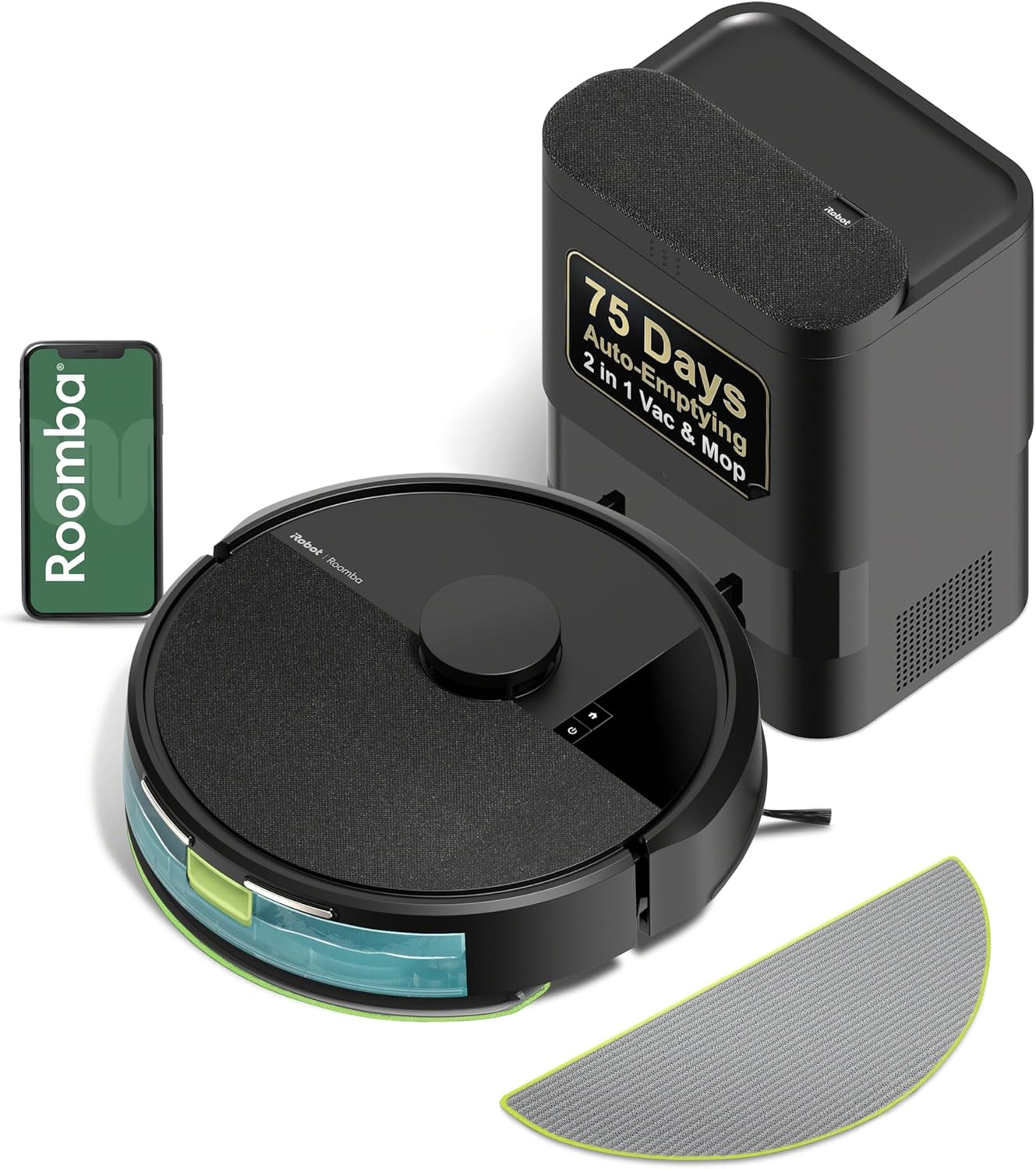
The Roomba 105 Combo pairs a vacuum and wet-mop system with an AutoEmpty dock to reduce maintenance and keep floors clean for long stretches. It maps rooms with ClearView LiDAR for efficient navigation and avoids carpets while mopping, so thresholds between hard floors and rugs stay dry during mop cycles. The robot offers three modes—vacuum, mop, or both—plus adjustable suction levels and a micro-pump that meters liquid to the microfiber pad and enables SmartScrub for deeper scrubbing on high-traffic spots. The included AutoEmpty dock holds up to 75 days of debris in a bag, cutting down on frequent bin handling and allergen exposure. Battery runtime is listed around 100 minutes, which is adequate for most single-level homes but may require recharges on very large layouts. Users should expect routine brush and filter maintenance and occasional wiping of the mop pad after wet runs. For homes with low thresholds and predictable floor transitions, the Roomba 105 Combo provides reliable, low-effort cleaning with strong suction and dependable mapping.
Best for: Buyers who prioritize a dependable, low-maintenance robot that reliably maps rooms and reduces hands-on emptying for routine cleaning of hard floors and mixed surfaces.
Less Ideal for: Homes that need very long continuous runtime or multi-level cleaning without manual relocations should consider models with longer battery life or multi-floor docking solutions.
- AutoEmpty dock holds up to 75 days of debris to minimize bin emptying
- ClearView LiDAR mapping enables accurate room mapping and obstacle avoidance
- Vacuum-plus-mop modes with metered water flow and SmartScrub for deeper scrubbing
- Automatically detects and avoids carpets while mopping to keep rugs dry
- 100-minute battery life may be short for very large homes or multi-level cleaning
- Mopping uses a shared microfiber pad that requires manual cleaning and periodic replacement
Verdict: Choose the Roomba 105 Combo when you want a dependable LiDAR-mapped robot that vacuums and mops while minimizing hands-on emptying through a long-lasting AutoEmpty dock.
roborock Q10 S5+

| Maximum Suction | 10,000 Pa |
|---|---|
| Battery Life | 150 minutes |
| Capacity | 2.7 liters |
| Filter Type | Washable |
| Noise Level | 65 db |
The roborock Q10 S5+ is a robot vacuum and mop designed for hands-off cleaning in homes with mixed surfaces and pets. It pairs LiDAR-based mapping and ReactiveTech structured-light obstacle avoidance to build detailed maps, set no-go zones, and navigate around clutter. The included auto-empty dock holds a 2.7 L dust bag for extended maintenance-free periods and the unit offers up to 10,000 Pa suction with automatic carpet boost for deeper cleaning where needed. VibraRise 2.0 delivers sonic scrubbing for mopping and the mop module lifts to avoid wetting carpets while crossing thresholds. App and voice control let you schedule cleanings, adjust suction and mopping modes, and set emptying behaviors. Practical strengths are strong suction and long runtime for thorough passes, smart carpet detection, and the anti-tangle brush design that reduces brush maintenance. Important limitations are that it runs at about 65 dB which may be noticeable during operation and it supports only 2.4 GHz Wi‑Fi for smart features. Buyers with very tall thresholds should verify clearance, since threshold performance depends on floor-to-floor height rather than mapping alone.
Best for: Buyers who want a mostly hands-free robot that navigates precisely, handles pet hair and mixed floors, and minimizes how often you empty the vacuum.
Less Ideal for: People who need near-silent overnight cleaning or who rely on 5 GHz Wi‑Fi-only smart home networks should consider other options.
- Self-emptying dock with 2.7 L bag for long periods between maintenance
- 10,000 Pa suction and auto carpet boost for stronger dirt pickup on rugs
- LiDAR mapping and multi-level maps for consistent navigation across floors
- VibraRise 2.0 sonic mopping with auto-lift to avoid wetting carpets
- Dual anti-tangle brush design reduces hair wrap and maintenance
- Noise level around 65 dB can be noticeable during cleaning
- Wi‑Fi connectivity limited to 2.4 GHz networks only
Verdict: Choose the Q10 S5+ when you want powerful suction, LiDAR navigation, and a long-lasting self-emptying dock to minimize upkeep around thresholds and mixed-floor homes.
eufy 11S Max Robot Vacuum
| Surface Recommendation | Hard Floor & Tile & Medium carpet |
|---|---|
| Battery Life | 100 minutes |
| Suction Power | 2000 Pa |
| Capacity | 600 ml |
| Noise Level | 55 db |
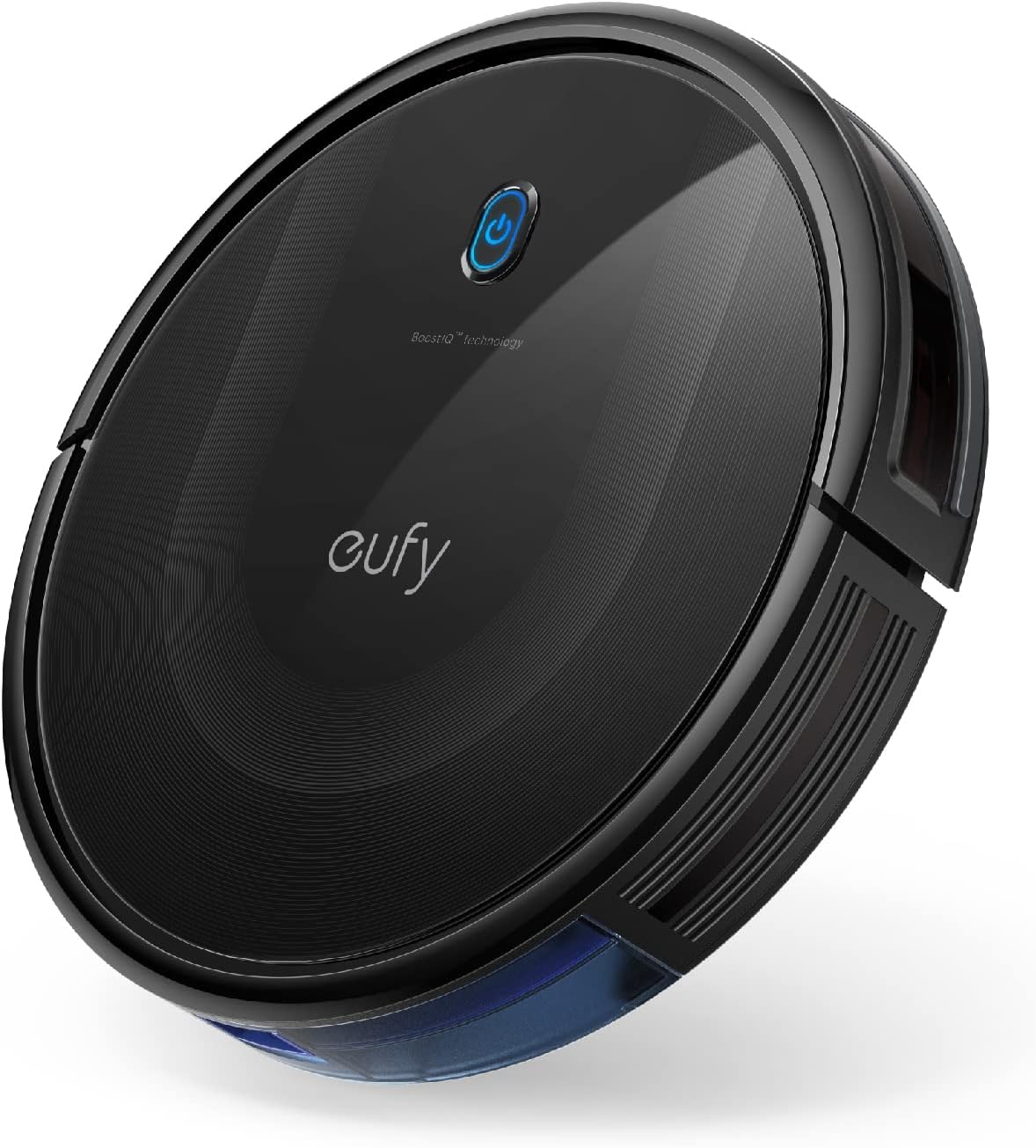
The eufy 11S Max is a low-profile robot vacuum built to clean hard floors and medium-pile carpets without drawing attention. Its 2.85-inch slim body lets it slide under low furniture while 2000Pa suction and a 12.8-inch cleaning path pick up dust, crumbs, and pet hair. It runs up to 100 minutes on hardwood at a reported low 55 dB, and automatic return-to-base means it tops off battery without user intervention. Controls are simple: the included remote and onboard buttons let you start, stop, and switch modes quickly, though there is no Wi-Fi or app control. Practical touches include washable filters, drop-sensing and anti-collision sensors, and a 600 ml dust capacity that reduces how often you empty the bin. The trade-offs are straightforward: navigation is basic rather than lidar or map-based, so room coverage is more random and may miss tight corners, and the single-side-brush design can be less thorough along edges compared with dual-brush models. For routine, quiet cleaning of hardwood, the 11S Max balances strong suction and a slim profile in a simple, reliable package.
Best for: Buyers who prioritize a quiet, no-frills robot that cleans hardwood reliably and fits under low furniture will appreciate this model for regular maintenance cleaning.
Less Ideal for: If you want mapped cleaning, smartphone scheduling, or the most thorough edge-cleaning for complex floorplans, choose a model with advanced navigation and app control instead.
- Slim 2.85" profile reaches under low furniture
- Up to 100 minutes runtime for extended cleaning sessions
- Powerful 2000Pa suction for effective pickup on hard floors
- Quiet operation at about 55 dB suitable for daytime or evening use
- Large 600 ml dust capacity and washable filter lower maintenance frequency
- Random navigation rather than mapping can lead to uneven coverage
- No Wi‑Fi or smartphone app means limited scheduling and remote control options
Verdict: A slim, quiet robot with strong suction made for routine hardwood maintenance when you want reliable, no-frills cleaning.
Choosing the Right Robot Vacuum for Thresholds: Key Factors to Consider
Maximum Threshold Height
Measure the height of the door lips and transitions in your home before buying. The maximum threshold height a robot can climb depends on wheel diameter, wheel travel, and chassis clearance. A machine rated to climb higher lips will handle common wooden thresholds and tile-to-carpet transitions with fewer rescues.
If you have several raised thresholds or thicker transition strips, prioritize models with larger wheels and documented climb specs. Keep in mind that manufacturers' climb figures are often measured under ideal conditions; real-world obstacles such as worn thresholds or uneven flooring can reduce effective climb height.
Wheel and Suspension Design
The wheels and suspension determine how a robot negotiates sudden vertical changes. Soft, grippy tires and a degree of suspension travel let the robot pull itself up onto a lip instead of getting hung up. Look for robots with rubberized wheels and visible articulation between the wheel modules and chassis.
Robots with limited wheel travel tend to stall or spin in place when meeting a threshold. A smoother ramping action reduces strain on the drive motors and lowers the risk of tipping or scraping the bumper repeatedly against the threshold edge.
Navigation Sensors and Path Planning
Strong navigation reduces stuck incidents at thresholds by allowing the robot to choose smoother approach angles and detect when a threshold is too high to climb. Lidar, visual simultaneous localization and mapping (vSLAM), or high-quality inertial sensors give more accurate maps and better obstacle avoidance than simple bump-only systems.
Good mapping also means the vacuum can avoid repeatedly attempting the same failed crossing. If a model can mark an area as non-traversable or adapt routes, you will see fewer rescue events and more consistent cleaning coverage across rooms.
Cleaning Performance Across Surfaces
A robot that climbs thresholds also needs to maintain cleaning contact when it transitions between floor types. Brushroll geometry, suction modulation, and side brush placement affect how well debris is picked up at the seam between two surfaces.
If your home has low-pile carpet abutting hard floors, prioritize robots that sustain suction and keep the brushroll engaged during transitions. Models that can dynamically adjust power or brush height will typically leave fewer crumbs along thresholds and reduce the need for touch-up cleaning.
Anti-Stuck Features and Recovery Behavior
Anti-stuck design elements include drop sensors, bumper feedback, wheel slip detection, and automatic back-off routines. These features let the robot detect when it cannot surmount a threshold and take corrective action like reversing, approaching at a different angle, or skipping the crossing and marking it in the map.
Reliable recovery behavior prevents the vacuum from repeatedly attempting the same unsuccessful crossing, which saves battery and reduces mechanical wear. Also consider how easy it is to free the robot when it does get stuck; accessible wheels and a clear undercarriage cut down rescue time.
Battery Life and Charge Management
Longer battery runtimes reduce the chance that a robot will deplete power mid-clean and leave one side of the house undone. For threshold-heavy homes with many rooms, look for units with enough runtime to complete at least one full pass or that support automatic recharge and resume.
Charge management also affects how often the robot must travel across thresholds to return to the dock. A dock placed on the same floor with accessible approach paths minimizes additional crossings and reduces the risk of getting stranded at a doorway.
Preparing Your Home for Robot Thresholds
Simple changes at doorways can improve a robot's success rate. Replace worn or uneven transition strips with smoother, lower-profile options when possible. Where you can, align rugs so their edges lie flat against the threshold rather than stacking on top.
Also consider the dock placement. Position the charging base on the same floor and in a low-traffic corridor with a clear approach so the robot does not need to cross multiple thresholds to recharge. Keeping entryways clear of clutter reduces accidental entanglement at common choke points.
- Measure and note the height of high-traffic thresholds.
- Lay rugs flat and avoid layered mats at doorways.
- Place the dock on the same level and near frequently used rooms.
When to Use Physical Threshold Ramps
If you have a few problem thresholds that a robot cannot handle, small adhesive ramps or beveled transition strips can bridge the gap. These simple hardware fixes change the approach angle and reduce the effective climb height without altering the robot.
Choose ramps designed for foot traffic and indoor use so they stay flush and do not create a new tripping hazard. Test ramp placement first in a limited area to ensure the robot can drive up, clean the adjacent space, and return to the dock smoothly.
- Opt for low-profile, non-slip ramp materials.
- Secure ramps to prevent shifting during cleaning cycles.
Mapping Troubleshooting Tips
If the robot repeatedly gets stuck at the same doorway, clear the surrounding area and run a fresh mapping or calibration cycle. Dirt, cords, and low-contrast thresholds can confuse sensors, so reducing visual and physical clutter helps.
Some robots allow you to mark no-go zones or forbidden edges in their mapping app. Use these features to prevent futile crossing attempts while still letting the device clean accessible areas effectively.
- Run a new mapping pass after moving furniture or rugs.
- Use app-based no-go zones to block known problem thresholds.
Design Tradeoffs: Climb Vs. Low Profile
Higher wheels and more suspension travel improve threshold handling but often add to overall device height. If you need the robot to clean under low furniture, a compromise may be necessary. Decide which is more important in your home: getting under low-clearance furniture or reliably crossing tall transitions.
Also consider maintenance. Robots built for tougher climbs might have more exposed wheel components that collect dust and require occasional cleaning. Factor in how much upkeep you are willing to perform when choosing a design.
- Compare required under-furniture clearance with stated device height.
- Expect slightly more maintenance on units with larger, articulated wheels.
Layout Patterns That Reduce Rescues
Open floor plans with wide doorways let robots take gradual approach angles, which reduces the chance of getting hung up. Where possible, leave doors open during cleaning cycles or use magnetic or virtual barriers to control the robot's path.
Grouping rooms by floor type helps too. If possible, let the robot finish all hard-floor areas before attempting rooms with higher thresholds, or schedule separate runs for different floor groups to limit the number of transitions per cycle.
- Keep interior doors open during scheduled cleaning runs.
- Group rooms by floor type for targeted runs.
How We Chose the Best Robot Vacuum for Thresholds
We focused on attributes that directly affect a robot vacuum's ability to handle thresholds and deliver usable cleaning with minimal intervention. Key evaluation criteria included mechanical climb capability, wheel and suspension design, and obstacle clearance, which determine the maximum threshold height a unit can surmount. Navigation reliability and localization were assessed because stable mapping and route planning reduce the chance of the robot getting stuck at doorways or repeating the same missed area. Cleaning performance across surface transitions was considered to ensure the device maintains suction and brush contact when moving from hard floors to low-pile carpet. Battery life and return-to-dock behavior were also important, since longer runs and predictable docking reduce failures in multi-room homes. Finally, build quality and edge/bumper design were checked for durability where repeated impacts with thresholds occur. We excluded specialty or industrial floor machines, handhelds, and devices lacking autonomous navigation entirely. The remaining candidates met minimum standards for climb geometry, navigation sensors, and cleaning consistency relevant to threshold-heavy layouts.
Our full evaluation process is outlined in our review methodology.
FAQ
How high of a threshold can a typical robot vacuum climb?
It depends on wheel size and suspension. Many consumer robots manage thresholds around 5 to 15 millimeters reliably, while models with larger wheels and better articulation can handle slightly higher lips. Always verify manufacturer specs and test in your home when possible.
Will a robot vacuum damage my threshold or door trim?
Most robots use rubberized bumpers and low-impact contact strategies, so minor scuffs are uncommon. Repeated scraping against a rough threshold can cause wear over time, so smoothing or adding a beveled transition can protect both the floor and the robot.
Should I move my charging dock to avoid threshold crossings?
Yes. Placing the dock on the same floor and in an area with an easy approach reduces the number of threshold crossings required and lowers the chance of the robot getting stranded between rooms.
Do mapping features help with threshold problems?
Often they do. Mapping and no-go zone features let the robot learn which areas are hard to cross and avoid repeated attempts. Good mapping also enables route adjustments that approach thresholds at safer angles.
Are physical ramps a permanent solution?
They can be effective but are best used as a practical workaround rather than a permanent structural change. Low-profile ramps reduce effective climb height but must be secured to avoid shifting and creating a trip hazard.
Final Verdict
Prioritize the features that matter most for your floorplan when choosing a robot vacuum for thresholds. If you have many raised transitions, emphasize climb ability, wheel design, and anti-stuck recovery. If under-furniture access is essential, compromise on device height and seek the best climb performance within that constraint. Ultimately, pick a model that balances reliable navigation, consistent cleaning through transitions, and serviceable wheel and bumper design. That approach will minimize rescues and keep thresholds from becoming cleaning bottlenecks in your home.