
Note: This article contains affiliate links. If you click on these links and make a purchase, we may earn a small commission at no extra cost to you. This helps support our research and content. Read our full affiliate disclosure here.
If you own a large house, a robot vacuum can save hours of routine cleaning by handling daily debris and high-traffic areas without constant supervision. Choosing the right unit matters because coverage, battery life, and mapping accuracy determine whether a single run clears multiple rooms or leaves you restarting cycles mid-clean. This guide presents five shortlisted robot vacuums built for large homes and explains why each made the cut. We evaluate long-run battery performance, navigation and mapping, dust-bin capacity, floor-surface handling, and maintenance needs so you can pick a model that suits your layout and cleaning habits.
Top Picks at a Glance
| Best Overall The best all-around choice for most situations | Shark AV2501AE AI Robot Vacuum |  |
| Best Quality Built to a higher standard if you want something more solid | roborock Saros 20 |  |
| Best Value The sweet spot between price and what you get | roborock Q7 L5 Robot Vacuum |  |
| Top Rated A top-rated pick with lots of positive feedback | WSUANE D15S Max Robot Vacuum |  |
| Most Popular A crowd favorite that many people choose with confidence | iRobot Roomba 105 Combo |  |
Shark AV2501AE AI Robot Vacuum

| Battery Life | 120 minutes |
|---|---|
| Filter Type | HEPA |
| Other Special Features of the Product | Bagless, LiDAR Navigation |
| Control | App Control, Voice Control |
| Capacity | 60 days |
The Shark AV2501AE is a self-emptying robot vacuum built for sustained, whole-home cleaning in larger homes. It uses 360° LiDAR for precision home mapping and Matrix Clean Navigation to make multiple passes over dirty areas, which helps reduce missed spots on both carpet and hard floors. The XL bagless self-empty base with true HEPA filtration holds up to 60 days of debris, locking in dust and allergens between empties, and the self-cleaning brushroll helps reduce hair wrap from pets. App and voice control with Alexa or Google Assistant make scheduling and on-demand cleans simple, and Recharge and Resume plus up to 120 minutes of runtime mean it can cover more ground in a single job. Expect a relatively tall docked profile and a heavier base unit compared with slim models, and while the system focuses on vacuuming it does not include mopping capability. For buyers who want systematic coverage, long runtime, and low-maintenance emptying, this model delivers; if you need a hybrid mop-and-vac or the absolute quietest unit, consider other options.
Best for: Buyers who want a low-maintenance vacuum that methodically cleans large floorplans and minimizes hands-on emptying while handling pet hair and allergens.
Less Ideal for: Households that need an integrated mop-and-vac solution or those prioritizing the most compact, ultra-low-height robots for tight furniture clearances.
- 360° LiDAR and Precision Home Mapping for methodical, room-aware cleaning
- XL bagless self-empty base with 60-day capacity and true HEPA filtration
- Matrix Clean Navigation that makes multiple passes to reduce missed spots
- Up to 120 minutes runtime with Recharge and Resume for large-area coverage
- Self-cleaning brushroll reduces hair wrap, helpful for pet owners
- No mopping function included
- Larger, heavier base and robot profile may be less suitable for very low-clearance furniture
Verdict: A strong choice for large homes that need methodical, long-run cleaning with minimal maintenance thanks to LiDAR mapping and a 60-day HEPA self-empty base.
roborock Saros 20

| Suction | 36,000 Pa |
|---|---|
| Battery Life | 180 minutes |
| Obstacle Avoidance | 3D ToF sensors with RGB camera (300+ obstacles) |
| Filter Type | Washable Filter |
| Noise Level | 55 db |
The roborock Saros 20 is built for heavy-duty floor care in larger homes where suction power and autonomy matter. It uses a 36,000 Pa digital motor and a dual anti-tangle system to pull deep dirt and pet hair from carpets and hard floors, while an ultra-slim 3.13 inch profile helps it reach under low furniture. StarSight AI Navigation with 3D ToF sensors and an RGB camera maps rooms and recognizes more than 300 obstacles to reduce interruptions and missed spots. The AdaptiLift chassis raises the robot to cross tall thresholds and treat thicker carpets without losing suction, and the RockDock base adds hot-water mop washing, hot-air drying, and long auto-empty intervals for hands-free upkeep. App control with SmartPlan learning and voice control provide scheduling and remote management. Trade-offs include a relatively high device weight and potentially higher complexity for users who prefer a simpler plug-and-play robot, and a noise level around 55 dB that may be noticeable in quiet rooms.
Best for: Buyers who prioritize top-tier cleaning performance and autonomous maintenance for large homes with pets and mixed flooring, and who are comfortable using app-driven smart features to optimize routines.
Less Ideal for: Those who want a very lightweight, minimal robot or who prefer a simple, ultra-quiet device with no advanced dock or learning-based setup.
- Very high suction (36,000 Pa) for deep cleaning on carpets and floors
- Advanced 3D ToF and RGB camera navigation that recognizes 300+ obstacles
- AdaptiLift chassis crosses high thresholds and handles thicker carpets
- RockDock auto-dock provides hot-water mop washing, hot-air drying, and extended auto-emptying
- Ultra-slim 3.13 inch profile reaches under low furniture
- Heavier unit which may be less portable for moving between levels
- Feature-rich dock and app increase complexity for users who prefer simple operation
- Noise level around 55 dB that can be noticeable in quiet environments
Verdict: Choose the Saros 20 when you need maximum cleaning power and hands-free maintenance for a large, pet-friendly home.
roborock Q7 L5 Robot Vacuum

| Suction | 8,000 Pa |
|---|---|
| Navigation | LiDAR |
| Battery life | 150 minutes |
| Water tank capacity | 270 ml |
| Filter type | Washable |
The roborock Q7 L5 is a LiDAR-guided robot vacuum that vacuums and mops in a single run, using an integrated 270 ml water tank and up to 8,000 Pa suction to handle dust and pet hair on hard floors and low‑pile carpet. It maps rooms with multi-floor support and quick mapping so you can set scheduled cleans, no-go zones, and targeted room runs from the Roborock app or with voice assistants. Practical features include a dual anti-tangle brush system that reduces hair wrap, carpet boost that increases suction where needed, washable filters, and a child lock. For hardwood floors the precise navigation and along-floor-direction cleaning reduce repeated passes and the electronic water control offers three water levels to avoid over-wetting. Limitations to note are the combined dustbin/water-tank design which means you cannot refill water without handling the combo unit, and the robot requires a 2.4 GHz Wi‑Fi connection for full app features.
Best for: Buyers who prioritize reliable, predictable cleaning on hardwood and want a robot that follows precise maps, runs on a schedule, and minimizes hair-related maintenance.
Less Ideal for: People who need separate, large-capacity water or dust tanks for long runs without handling the unit frequently or who cannot provide a 2.4 GHz Wi‑Fi network.
- LiDAR mapping and multi-floor mapping for accurate, efficient coverage
- Strong 8,000 Pa suction with carpet boost for better pickup of dust and pet hair
- Dual anti-tangle brushes minimize hair wrap and maintenance
- Electronic water tank with three water levels lets you control mop moisture
- App control plus Alexa and Google Home compatibility for scheduled, hands-free operation
- Integrated dustbin and water tank is a single combo part, which adds steps when refilling or emptying
- Requires 2.4 GHz Wi‑Fi for app connectivity, which may need router changes for some homes
Verdict: A strong‑suction, LiDAR‑mapped vacuum‑and‑mop that reliably cleans hardwood with low hair maintenance and smart app controls.
WSUANE D15S Max Robot Vacuum

| Capacity | 3.5 liters |
|---|---|
| Suction | 10000Pa |
| Navigation | dToF LIDAR |
| Compatible Devices | Google Home, Smartphones |
| Filter Type | Three-layer high-efficiency (washable) + filter cotton (not washable) |
The WSUANE D15S Max is a long-run robot vacuum and mop built for large homes that need minimal intervention. It uses dToF LiDAR to build accurate maps and supports custom no-go zones via the app, which helps it clean multiroom layouts without getting lost. A 3.5 liter self-emptying base stores weeks of debris so you do not have to empty the bin frequently, and the anti-tangle roller with blade design reduces hair wrap from pets. Suction ranges up to 10000Pa with automatic boost on carpets, and the unit offers multiple power modes to balance runtime and cleaning intensity. Runtime in the quiet profile is listed at up to 160 minutes, letting it cover larger areas on a single charge and return to the dock to recharge when needed. Practical limitations include a reported noise level around 70 dB on higher settings and a washable plus non-washable filter combination that requires occasional maintenance. For reliability-focused homeowners with pets and large floor plans, this model emphasizes autonomous operation and robust mapping to keep floors clean with little hands-on upkeep.
Best for: Homeowners who prioritize a hands-off, reliable cleaning routine for large multiroom houses and want strong mapping, long runtime, and a self-emptying base to reduce maintenance.
Less Ideal for: People who need a whisper-quiet machine for noise-sensitive environments or those who prefer fully washable filter systems.
- Large 3.5L self-emptying dustbin reduces how often you need to empty the base
- dToF LiDAR mapping with multi-level maps and no-go zone control for reliable navigation in large homes
- High peak suction up to 10000Pa with auto-boost on carpet for stronger pickup
- Anti-tangle roller with cutting blades designed to minimize hair wrap from pets
- Long runtime options up to 160 minutes in quiet mode for extended coverage
- Noise level can reach about 70 dB on higher power settings
- Filter system mixes washable and non-washable elements, requiring periodic replacements
Verdict: If you want a dependable, low-maintenance robot vacuum for large homes with pets, the D15S Max delivers long runtime, robust LiDAR mapping, and a big self-emptying bin to minimize intervention.
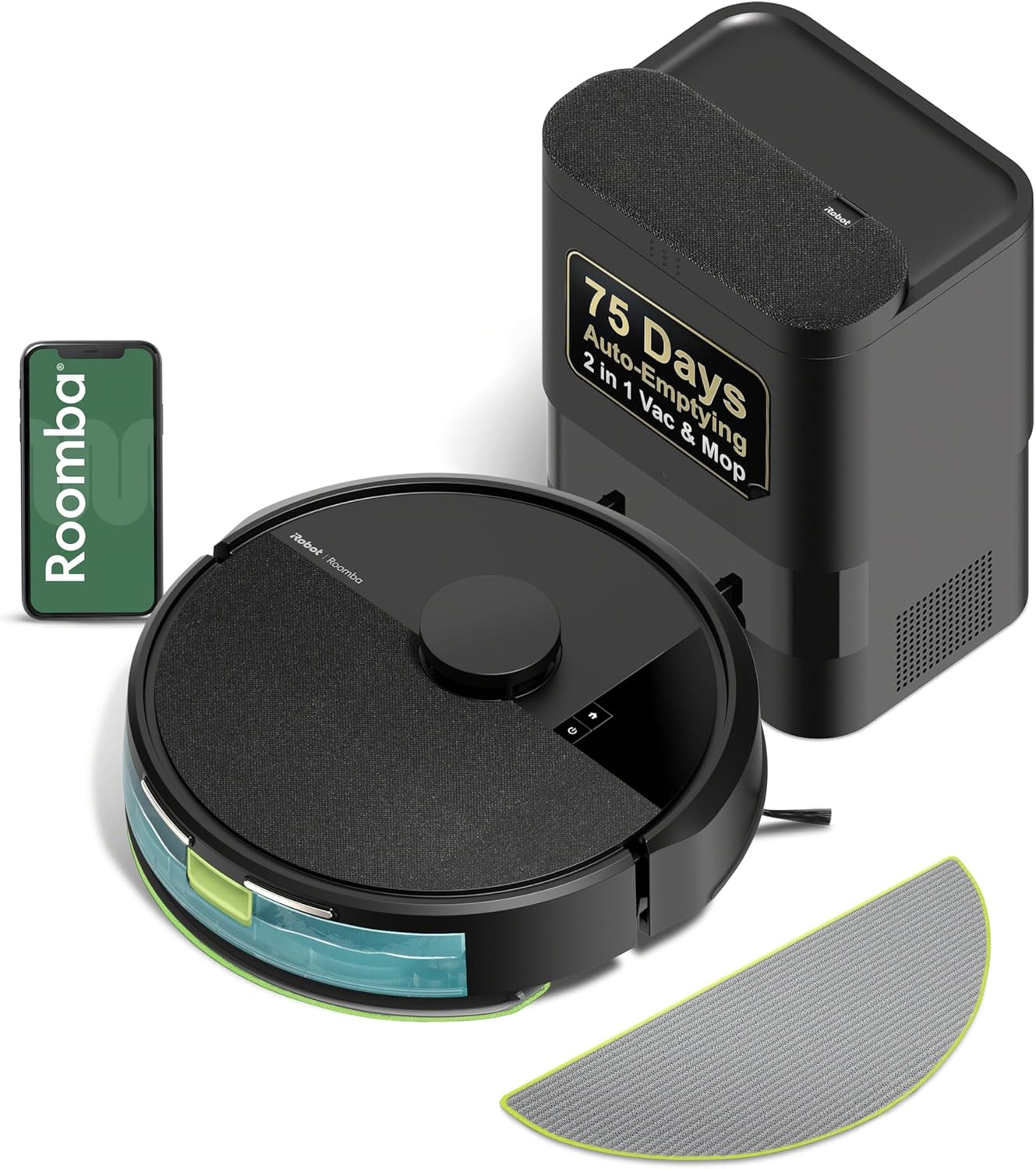
iRobot Roomba 105 Combo
| Surface Recommendation | Carpet & Hard Floor |
|---|---|
| Battery Life | 100 minutes |
| Controller Type | App Control, Button Control, Voice Control |
| Filter Type | Cartridge |
The Roomba 105 Combo is a disc-shaped robot that vacuums and mops hard floors while avoiding carpets, and it pairs with an AutoEmpty dock that holds up to 75 days of debris. It uses ClearView LiDAR to map rooms for predictable navigation, offers three cleaning modes (vacuum, mop, or vacuum-and-mop), and provides adjustable suction and mopping solution flow for targeted cleans. The four-stage cleaning system combines power-lifting suction with an edge-sweeping brush, a multi-surface brush, and a reusable microfiber pad for scrubbing high-traffic spots. App control, voice commands, and scheduling make hands-off operation simple, and the dock's sealed bag helps contain allergens during disposal. Important limitations to weigh: battery life is listed at about 100 minutes which can be tight for very large homes on a single run, and the model relies on a 2.4 GHz Wi-Fi network for setup and app features. Maintenance still includes regular brush cleaning and periodic filter changes.
Best for: Buyers who prioritize low-maintenance, evidence-backed cleaning performance and want a robot that handles both vacuuming and mopping with reliable mapping and a hands-off dirt disposal routine.
Less Ideal for: Large-home owners who need single-run coverage of very expansive floorplans without recharging or who require heavy-duty wet-mopping systems for large-scale scrubbing.
- AutoEmpty dock holds debris up to 75 days for less frequent disposal
- ClearView LiDAR mapping creates reliable room maps and smooth navigation
- Combined vacuum-and-mop capability with SmartScrub for deeper scrubbing
- Multiple control options including app, buttons, and voice assistants
- Edge-sweeping and multi-surface brushes improve corner and carpet-edge pickup
- 100-minute battery life may require multiple charges for very large homes
- Mopping uses a microfiber pad and limited tank capacity requiring occasional refills
Verdict: Choose the Roomba 105 Combo when you want a mapped, low-maintenance vacuum-and-mop system with a self-emptying dock that minimizes day-to-day upkeep.
Choosing the Right Robot Vacuum for Large House: Key Factors to Consider
Battery Life and Recharge Strategy
Long battery life is essential for larger floorplans because a single charge must power cleaning across many rooms. Look for runtime estimates that align with the square footage of your home and machines that support recharge-and-resume so the unit can return to its dock, recharge, and continue where it left off.
Also consider how the vacuum handles low-battery situations. Smart units map cleaned areas and pick up at the correct spot after charging, which avoids repeated coverage or missed zones. Faster recharge times reduce total cleaning duration for very large homes.
Navigation, Mapping, and Room Control
Accurate mapping and robust navigation determine how efficiently a robot travels through multiroom layouts. Systems that build and store maps let you set virtual boundaries, prioritize rooms, and schedule targeted cleans without manual intervention.
For large houses, features such as multi-floor maps, obstacle recognition, and room-by-room scheduling are valuable because they prevent wasted runtime and ensure full-coverage passes. Reliable path planning minimizes backtracking and reduces the total runtime needed to clean broad areas.
Coverage Per Charge
Coverage per charge ties battery life and navigation together into a practical metric: how much actual floor area the robot can clean before recharging. Manufacturer runtime numbers are useful only when paired with realistic coverage figures, which depend on floor types, furniture density, and cleaning modes.
Estimate your home's square footage and compare it to reported coverage capabilities. In homes with many obstacles, expect lower coverage; choose a unit with a buffer so it completes larger jobs without frequent manual restarts.
Dust-Bin and Waste Handling
Larger homes collect more debris between emptyings, so dust-bin capacity and waste-handling features matter. A small bin will require frequent manual emptying, negating some convenience gains from automation.
Consider models with larger onboard bins or automatic emptying docks. Also assess filter type and ease of emptying because frequent maintenance can become a chore in big households. HEPA-style filters are beneficial for homes with allergy concerns.
Floor Type Performance
Different floor surfaces affect suction, brush performance, and run time. Carpets, especially deep-pile rugs, require more power and can shorten battery life, while hard floors tend to be easier to traverse and cleaner with less suction.
If your house mixes wood, tile, and carpet, prioritize models known for adaptive power control and effective edge cleaning. Brushroll design and suction modulation help the unit clean diverse surfaces without excessive passes.
Maintenance and Consumables
Maintenance frequency scales with home size and occupant activity. Brushes, filters, and wheels will need periodic cleaning or replacement; evaluate how accessible those parts are and how often consumables must be swapped.
Choose a machine with straightforward access to brushes and filters, clear instructions for routine care, and readily available replacement parts. Lower-maintenance designs save time and preserve performance in the long term.
Planning Cleaning Zones for Big Layouts
Break your home into logical cleaning zones to maximize efficiency. Use the robot's mapping tools to create room-specific schedules so high-traffic areas receive daily attention while lower-traffic rooms are cleaned less often.
Setting virtual no-go zones around fragile areas and pet beds reduces interruptions and prevents the unit from getting trapped. For multi-level homes, upload and name separate floor maps to keep schedules organized.
- Map each floor separately and label rooms for targeted runs
- Schedule high-traffic areas for more frequent cleaning
- Set no-go zones around cords, delicate decor, or pet feeding stations
Managing Battery and Runtime on Cleaning Days
If your robot supports recharge-and-resume, let it handle long runs automatically. For models without that feature, schedule multiple shorter runs for different zones and plan docking times between sessions.
Keep the dock in an open area with clear access so the robot can return easily. Avoid placing the charging station in tight corners or behind furniture that can block docking during low-battery returns.
- Place the dock centrally relative to common cleaning paths
- Charge fully overnight before large scheduled cleans
- Monitor first few runs to refine zone sizes and runtime estimates
Dealing with Pets and High-Traffic Mess
Homes with pets or heavy foot traffic require more frequent emptying and filter maintenance. Choose cleaning modes or schedules that run during quieter times to avoid disturbing occupants while maintaining consistent floor cleanliness.
Brushes and intake pathways can clog faster in these scenarios, so check for tangle-resistant brush designs and easy-to-clean inlet grills.
- Increase schedule frequency in pet areas
- Empty bin more often during shedding seasons
- Keep extra filters on hand if household load is heavy
Maintaining Peak Performance Over Time
Regular maintenance keeps cleaning performance steady across the life of the robot. Clean brushes, clear sensors, and replace filters on the intervals recommended by the manufacturer to avoid suction loss and navigation errors.
Inspect wheels and edge brushes for hair and debris that can impair movement. Periodic firmware updates can also improve navigation and efficiency, so enable automatic updates when available.
- Wipe sensors monthly to maintain mapping accuracy
- Clean main brush and side brushes weekly in high-use homes
- Follow recommended schedules for filter replacement
Accessory Docks and Auto-Empty Stations
Auto-empty docks reduce the frequency of manual interaction by transferring debris from the onboard bin to a larger base container. For large homes, these docks can be a major convenience because they permit multiple cleaning cycles without intervention.
When considering an auto-empty system, check how full indicators and replacement bags or cartridges are handled. Some docks use reusable containers, while others rely on disposable liners.
- Verify how the dock signals when it needs attention
- Check if the dock supports reusable or disposable waste liners
- Confirm dock dimensions fit your intended placement area
How We Chose the Best Robot Vacuum for Large House
We focused on features that matter for large homes and used practical filters to narrow the field. Primary evaluation criteria included battery life and recharge behavior, mapping and navigation accuracy, cleaning coverage per charge, dust-bin capacity and waste handling, and maintenance demands. We gave extra weight to navigation systems that support room-by-room cleaning and to units with recharge-and-resume capability so one cleaning cycle can cover extended floorplans. We excluded compact or specialty robot vacuums designed only for small apartments, single-room cleaners, and devices lacking reliable mapping or automatic recharge. We did not consider accessories or add-on-only solutions; included products needed to function autonomously across large areas. The final selection favors machines that balance long runtime with intelligent navigation, sufficient debris capacity, and accessible upkeep so they perform dependably in bigger homes.
Our full evaluation process is outlined in our review methodology.
FAQ
How large an area can a single charge typically cover?
Coverage per charge varies by model and cleaning mode. Many long-run robots can cover several thousand square feet on a single charge in standard mode, but obstacles and heavy carpeting reduce coverage and may require recharge-and-resume.
Do robot vacuums handle multiple floors?
Robots can clean multiple floors, but most require you to move the unit between levels. Models with multi-floor mapping store separate maps so you can recall the correct layout for each floor and schedule cleans accordingly.
How often will I need to empty the dust bin in a large house?
Emptying frequency depends on bin size and household debris. In a large, busy home you may need to empty after each full-house run unless the robot uses an auto-empty dock. Homes with pets or heavy shedding will require more frequent emptying.
Can robot vacuums avoid specific rooms or areas?
Yes. Most modern robots let you create no-go zones or exclude specific rooms using the stored map. This feature is useful for protecting fragile items or preventing the robot from entering areas with cables or clutter.
Will a robot vacuum damage rugs or small items?
Robots are designed to transition over typical rugs and thresholds without damage. However, delicate items on the floor or low-lying cords can get caught. Use virtual boundaries or move small items before cleaning to reduce the risk of entanglement.
Final Verdict
For large houses, prioritize long runtimes, reliable mapping, and sufficient debris capacity so a robot can clean whole areas with minimal intervention. Expect tradeoffs between suction power and runtime; higher cleaning intensity shortens coverage per charge, while gentle modes extend runtime but may require repeat passes. Choose a model that supports reliable recharge-and-resume, offers robust mapping tools, and is easy to maintain. Those features together create the best experience for keeping broad floorplans consistently clean without constant oversight.