
Note: This article contains affiliate links. If you click on these links and make a purchase, we may earn a small commission at no extra cost to you. This helps support our research and content. Read our full affiliate disclosure here.
Buying a budget robot vacuum can free you from daily sweeping and quicken your home cleaning routine without a big investment. For many households, an affordable robot vacuum that reliably picks up dust, hair, and crumbs while fitting under furniture is more useful than an expensive model with advanced smart features. This guide highlights a shortlist of the top-rated options under $200, chosen for real-world cleaning, battery life, and ease of upkeep. We evaluate each pick on suction and navigation, battery and runtime, and how simple it is to maintain and live with day to day. Read on to find the best affordable robot vacuum that fits your floor types and cleaning habits.
Top Picks at a Glance
| Best Overall The best all-around choice for most situations | ILIFE A30s Robot Vacuum |  |
| Best Quality Built to a higher standard if you want something more solid | roborock Q7 L5 Robot Vacuum |  |
| Best Value The sweet spot between price and what you get | ROPVACNIC S1 Robot Vacuum |  |
| Best Budget The cheapest option that still gets the job done reliably | ILIFE V2 Robot Vacuum |  |
| Top Rated A top-rated pick with lots of positive feedback | Tikom L8000 Pro Robot Vacuum |  |
| Most Popular A crowd favorite that many people choose with confidence | iRobot Roomba 105 Vac |  |
| Best Seller A high-volume bestseller chosen again and again | eufy 11S Max Robot Vacuum |  |
ILIFE A30s Robot Vacuum

| Max Suction | 10000 Pa |
|---|---|
| Battery Life | 150 minutes |
| Capacity | 450 ml |
| Navigation | LiDAR |
| Compatible Devices | Amazon Echo, Google Home, Smartphones |
The ILIFE A30s is a feature-packed budget robot vacuum that targets thorough weekly cleaning on hard floors and low- to medium-pile carpets. It uses LiDAR navigation and SLAM mapping to build home maps, run logical cleaning paths, and let you set no-go zones and room-specific schedules from the ILIFE Clean app. The vacuum offers strong suction up to 10,000Pa with selectable power levels and an auto carpet boost for tougher areas, while dual anti-tangle brushes help pick up pet hair. Controls are flexible: the app (2.4 GHz), voice assistants, or the included remote. Runtime is up to 150 minutes so it can cover multiple rooms on a single charge and it auto-docks to recharge. Practical limits include no mop function and a modest 450 ml dustbin that will need regular emptying in homes with heavy shedding, and noise listed around 72 dB. For its price point the A30s balances advanced navigation, solid suction, and smart controls, making it a strong option for routine maintenance in budget-conscious households.
Best for: Buyers who want a capable, budget-friendly robot that prioritizes reliable mapping, strong suction, and smart app or voice control for routine whole-home cleaning.
Less Ideal for: People who need a combined vacuum-and-mop solution or who prefer a very large dustbin for infrequent emptying.
- LiDAR navigation with SLAM mapping enables efficient room mapping and no-go zones via the app
- High claimed suction up to 10,000Pa with selectable power levels and carpet boost for deeper pickup
- Long runtime up to 150 minutes for extended cleaning sessions
- Multiple control options: ILIFE Clean app, Alexa/Google voice, and included remote
- Dual anti-tangle brush design helps manage pet hair
- No mopping capability — vacuum only
- 450 ml dustbin can fill quickly in homes with heavy pet shedding
Verdict: If you want LiDAR mapping and strong suction in a sub-$200 robot, the ILIFE A30s delivers the best balance of navigation, pet-hair performance, and smart control for routine cleaning.
roborock Q7 L5 Robot Vacuum

| Suction | 8,000 Pa |
|---|---|
| Navigation | LiDAR |
| Battery life | 150 minutes |
| Water tank capacity | 270 ml |
| Filter type | Washable |
The roborock Q7 L5 is a LiDAR-guided robot vacuum that vacuums and mops in a single run, using an integrated 270 ml water tank and up to 8,000 Pa suction to handle dust and pet hair on hard floors and low‑pile carpet. It maps rooms with multi-floor support and quick mapping so you can set scheduled cleans, no-go zones, and targeted room runs from the Roborock app or with voice assistants. Practical features include a dual anti-tangle brush system that reduces hair wrap, carpet boost that increases suction where needed, washable filters, and a child lock. For hardwood floors the precise navigation and along-floor-direction cleaning reduce repeated passes and the electronic water control offers three water levels to avoid over-wetting. Limitations to note are the combined dustbin/water-tank design which means you cannot refill water without handling the combo unit, and the robot requires a 2.4 GHz Wi‑Fi connection for full app features.
Best for: Buyers who prioritize reliable, predictable cleaning on hardwood and want a robot that follows precise maps, runs on a schedule, and minimizes hair-related maintenance.
Less Ideal for: People who need separate, large-capacity water or dust tanks for long runs without handling the unit frequently or who cannot provide a 2.4 GHz Wi‑Fi network.
- LiDAR mapping and multi-floor mapping for accurate, efficient coverage
- Strong 8,000 Pa suction with carpet boost for better pickup of dust and pet hair
- Dual anti-tangle brushes minimize hair wrap and maintenance
- Electronic water tank with three water levels lets you control mop moisture
- App control plus Alexa and Google Home compatibility for scheduled, hands-free operation
- Integrated dustbin and water tank is a single combo part, which adds steps when refilling or emptying
- Requires 2.4 GHz Wi‑Fi for app connectivity, which may need router changes for some homes
Verdict: A strong‑suction, LiDAR‑mapped vacuum‑and‑mop that reliably cleans hardwood with low hair maintenance and smart app controls.
ROPVACNIC S1 Robot Vacuum
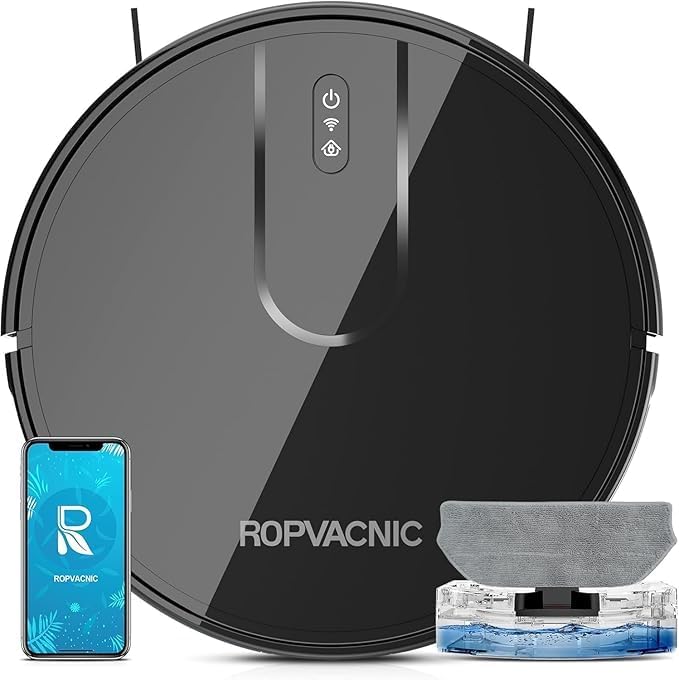
| Battery Life | 120 minutes |
|---|---|
| Suction Power | 5200Pa |
| Filter Type | Multi-layer Optimized High-Efficiency Filtration |
| Controller Type | App, Remote, Touchpad, Voice |
| Surface Recommendation | Hardwood Floors, Low Pile Carpets |
The ROPVACNIC S1 is a budget-friendly robot vacuum that combines powered suction and an electronically controlled mopping system to handle everyday dirt on hard floors and low-pile carpets. Setup follows a typical app-pairing flow and the unit supports remote, app, and voice control so you can schedule cleanings or start spot jobs hands-free. Its 5200Pa suction and a three-point cleaning system make it competent at picking up pet hair and crumbs, while the adjustable four-stage water control helps tune wet cleaning for different messes. The S1 is thin enough to reach under low furniture and returns to its dock automatically when battery gets low. Practical touches include a spare HEPA filter, extra side brushes, and multiple cleaning modes to tailor performance. Expect straightforward, no-frills operation rather than advanced mapping or obstacle-crossing for complex layouts, and mopping is best for light stains rather than heavy scrubbing. For the price it delivers solid suction, useful mopping control, and easy automation for routine home cleaning.
Best for: Buyers who want a practical, budget-conscious robot that reliably vacuums and offers configurable mopping and app-driven scheduling for everyday home cleaning.
Less Ideal for: People who need high-precision mapping, heavy-duty wet scrubbing, or advanced obstacle-crossing for complex multiroom layouts should consider higher-end models.
- Strong 5200Pa suction effective on crumbs and pet hair
- Electronically controlled adjustable mopping with four water levels
- 120-minute battery life for extended cleaning sessions
- App, remote, and voice control allow scheduled and hands-free operation
- Includes spare HEPA filter and extra side brushes for maintenance
- No advanced room mapping features mentioned for precise navigation
- Mopping is suited to light stains and may not replace manual scrubbing
Verdict: A cost-effective robot that pairs strong suction with adjustable electronic mopping and simple app/voice control for reliable everyday cleaning under $200.
ILIFE V2 Robot Vacuum

| Battery Life | 120 minutes |
|---|---|
| Capacity | 300 ml |
| Filter Type | Sponge |
| Control Method | Remote |
| Noise Level | 69 db |
The ILIFE V2 is an entry-level robot vacuum built to keep hardwood and other hard floors tidy without a lot of fuss. Its 2.99-inch slim body fits under low furniture while a tangle-free suction port and sponge filter make it practical for homes with pet hair. You can run scheduled cleanings, switch between auto, spot and edge modes, or start jobs with the included remote control or the single-button on the unit. A 300 ml dustbin and up to 120 minutes of runtime let it cover medium rooms on one charge, and it will automatically return to the dock when the battery is low. Noise is noticeable at 69 dB and there is only one power level, so it lacks adjustable suction or app-based controls, but for straightforward floor maintenance on hardwood and low-pile carpet the V2 delivers solid value at an affordable price.
Best for: Buyers who want an affordable, no-frills robot to maintain hardwood and low-pile carpet cleanliness with simple controls and scheduled runs.
Less Ideal for: Those who need strong adjustable suction, smart app control, or advanced mapping for large or complex homes should consider higher-end models.
- Slim 2.99-inch profile cleans under low furniture
- Tangle-free suction port suited for pet hair
- 120 minutes runtime with automatic return-to-dock
- Multiple cleaning modes (auto, spot, edge) and simple remote control
- Single power level limits suction control for heavier debris
- No smartphone app or advanced navigation features
Verdict: A low-cost, slim robot vacuum that reliably maintains hardwood floors and handles pet hair for budget-focused buyers.
Tikom L8000 Pro Robot Vacuum

| Suction | 6000 Pa |
|---|---|
| Navigation | LiDAR |
| Dustbin Capacity | 450 ml |
| Battery Life | 150 minutes |
| Filter Type | Hepa Filter |
The Tikom L8000 Pro is a budget-friendly robot vacuum that combines LiDAR mapping, strong suction, and a mopping option to handle daily dirt, pet hair, and light carpet cleaning. It builds a map of your home using LiDAR, saves up to five maps, and supports no-go and no-mop zones via the app for targeted cleaning; it also works with Alexa and Google Home. Suction ramps up automatically on carpets and the 6000 Pa rating plus a 450 ml dustbin help reduce trips to the trash, while the 300 ml water tank enables paired mopping passes. Runtime reaches about 150 minutes in quiet mode and the robot will return to charge and resume cleaning where it left off. Practical benefits include Hepa filtration for finer dust capture and relatively quiet operation at low power. Limitations to note are only two power levels rather than more granular control, and some buyers may prefer larger water capacity or more advanced app features found on higher-priced models.
Best for: Buyers who prioritize dependable, hands-off cleaning on a budget and want reliable navigation and resume behavior for daily upkeep in multiroom homes.
Less Ideal for: Households that need highly customizable power presets, very large continuous mopping capacity, or advanced app integrations found on premium models should consider higher-end options.
- LiDAR navigation with smart mapping and ability to store up to five maps
- Strong 6000 Pa suction that boosts on carpets for deeper cleaning
- Combined vacuum and mop with separate dustbin (450 ml) and water tank (300 ml)
- Long runtime around 150 minutes with automatic return and resume
- Hepa filter and relatively low noise in quiet mode (~45 dB)
- Only two power levels limit fine-tuning between quiet and max modes
- Water tank and dustbin sizes are adequate but not large for very big homes
Verdict: A reliable, well‑navigating robot vacuum with strong suction and mopping capability that delivers dependable daily cleaning on a budget.
iRobot Roomba 105 Vac

| Battery Life | 200 minutes |
|---|---|
| Navigation | ClearView LiDAR |
| Control | App, Button, Voice |
| Surface Recommendation | Carpet & Hard Floor |
| Filter Type | Cartridge |
The Roomba 105 Vac is a straightforward robot vacuum that uses ClearView LiDAR to map rooms and navigate in neat rows while avoiding obstacles and stairs. It performs a 3-stage clean with a multi-surface bristle brush and an edge-sweeping brush and offers four suction levels so you can dial power up for heavy messes or back it off to save runtime. Setup and scheduling are handled in the Roomba Home App and it also responds to voice commands from common assistants. The unit returns to its dock to recharge and resumes cleaning when needed, and the rated 200-minute battery life supports multiple-room runs on a single charge. Important limitations: it is vacuum-only (no mop), relies on a 2.4 GHz Wi-Fi connection for app features, and some users will need to perform routine brush and filter upkeep to maintain performance. For buyers focused on reliable mapping and easy app/voice control under $200, this delivers core Roomba convenience without premium extras.
Best for: Buyers who want a dependable, easy-to-use robot vacuum that maps reliably and offers app and voice control without paying for high-end extras, and who value social proof and proven performance when choosing a budget model.
Less Ideal for: Households that need a robot that both vacuums and mops, those who require hands-free auto-emptying, or users who want top-tier obstacle recognition and advanced floor-care extras.
- ClearView LiDAR mapping for consistent room-by-room navigation
- Four suction levels plus a 3-stage cleaning system for multi-surface pickup
- Long 200-minute battery life supports extended cleaning sessions
- App and voice control allow scheduling, targeted cleans, and keep-out zones
- No mopping capability or wet-cleaning features
- Requires 2.4 GHz Wi-Fi for full app functionality
- Basic accessory bundle and periodic manual maintenance required
Verdict: A reliable, mapping-focused Roomba that gives proven suction, long runtime, and app/voice convenience for buyers seeking a trusted robot vacuum under $200.
eufy 11S Max Robot Vacuum
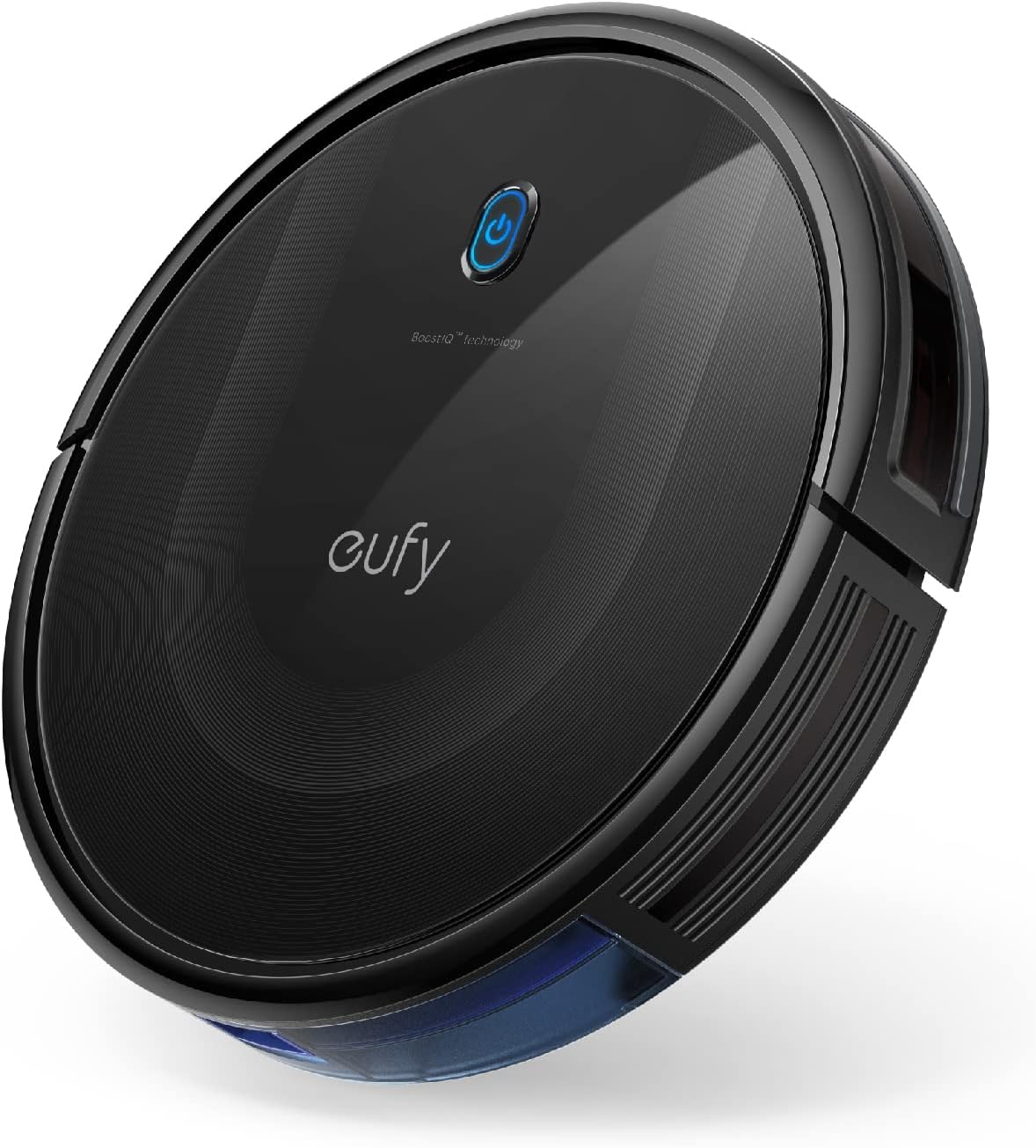
| Surface Recommendation | Hard Floor & Tile & Medium carpet |
|---|---|
| Battery Life | 100 minutes |
| Suction Power | 2000 Pa |
| Capacity | 600 ml |
| Noise Level | 55 db |
The eufy 11S Max is a low-profile robot vacuum built to clean hard floors and medium-pile carpets without drawing attention. Its 2.85-inch slim body lets it slide under low furniture while 2000Pa suction and a 12.8-inch cleaning path pick up dust, crumbs, and pet hair. It runs up to 100 minutes on hardwood at a reported low 55 dB, and automatic return-to-base means it tops off battery without user intervention. Controls are simple: the included remote and onboard buttons let you start, stop, and switch modes quickly, though there is no Wi-Fi or app control. Practical touches include washable filters, drop-sensing and anti-collision sensors, and a 600 ml dust capacity that reduces how often you empty the bin. The trade-offs are straightforward: navigation is basic rather than lidar or map-based, so room coverage is more random and may miss tight corners, and the single-side-brush design can be less thorough along edges compared with dual-brush models. For routine, quiet cleaning of hardwood, the 11S Max balances strong suction and a slim profile in a simple, reliable package.
Best for: Buyers who prioritize a quiet, no-frills robot that cleans hardwood reliably and fits under low furniture will appreciate this model for regular maintenance cleaning.
Less Ideal for: If you want mapped cleaning, smartphone scheduling, or the most thorough edge-cleaning for complex floorplans, choose a model with advanced navigation and app control instead.
- Slim 2.85" profile reaches under low furniture
- Up to 100 minutes runtime for extended cleaning sessions
- Powerful 2000Pa suction for effective pickup on hard floors
- Quiet operation at about 55 dB suitable for daytime or evening use
- Large 600 ml dust capacity and washable filter lower maintenance frequency
- Random navigation rather than mapping can lead to uneven coverage
- No Wi‑Fi or smartphone app means limited scheduling and remote control options
Verdict: A slim, quiet robot with strong suction made for routine hardwood maintenance when you want reliable, no-frills cleaning.
Choosing the Right Robot Vacuum: Key Factors to Consider
Suction Power and Brush Design
Suction strength determines how effectively the robot vacuum pulls dirt from cracks and short carpet fibers. On hard floors, a well-tuned airflow combined with an appropriate brush or rubberized roller lifts fine dust and larger debris. On carpet, especially short-pile, higher suction helps dislodge embedded particles and pet hair.
Brush design matters too. A two-stage system with side brushes to sweep edges and a center roller to agitate and collect debris performs better than a single, shallow agitator. For budget models, look for clear descriptions of brush type and suction rating to estimate real-world pickup performance.
Navigation Accuracy and Obstacle Handling
How the robot maps and moves through rooms affects both cleaning thoroughness and how often you need to intervene. Reliable navigation reduces missed spots, repeated coverage of the same area, and getting stuck under furniture. Good obstacle handling means the unit can gently bump into obstacles, detect drop-offs like stairs, and resume where it left off after pauses.
Simple random-drive robots can work in small, uncluttered homes, but predictable navigation systems are preferable if you have many furniture legs, rugs, or tight pathways. Also consider whether the vacuum returns to a dock when battery runs low and how it handles partial-charge resumptions.
Battery Capacity and Real-World Runtime
Battery size and how efficiently the robot uses power determine how much floor area it can cover in one cycle. Manufacturer runtime claims are useful as a baseline, but real-world runtime depends on suction setting, floor type, and frequency of obstacle encounters.
For most apartments and average-sized rooms, aim for a runtime that comfortably covers a single session without multiple returns to the dock. Also check how the vacuum behaves when the battery dips low: does it save progress and resume, or does it abort cleaning and require a full restart?
Ease of Maintenance and Consumables
Routine maintenance affects the total cost of ownership and how much effort you spend supporting the robot. Clear access to the dustbin, washable filters, and removable brush assemblies make quick upkeep painless. Filter replacement frequency and availability of spare parts matter when evaluating long-term cost.
Budget robots sometimes use proprietary parts or filters that are harder to find. Look for models with straightforward, tool-free cleaning steps and transparency about how often consumables should be replaced under normal use.
Noise Output and Daytime Use
Noise matters if you plan to run the robot while you are at home. Higher-suction modes typically produce more noise, which can be disruptive during work calls or quiet evenings. Noise profiles vary widely among affordable models, and measured decibel values are useful but context-dependent.
If you need silent daytime operation, favor models that offer eco or quiet modes that still provide acceptable pickup on hard floors. Balance the noise level against cleaning speed and suction power to match your household habits.
Which Floor Types Work Best With Budget Robot Vacuums
Most robots under $200 are optimized for hard surfaces like hardwood, tile, and linoleum. These surfaces let the suction and brush rollers pick up dust and debris without the resistance of deep fibers. Short-pile carpets and area rugs are usually handled acceptably, but thick or high-pile carpets will reduce cleaning performance and runtime.
If your home is primarily hardwood with a few small rugs, focus on suction and edge-brush design. For carpeted apartments, look for models with stronger advertised pickup and brushes designed to manage hair. Remember that rugs with tassels or high edges can trip or tangle brushes on basic navigation platforms.
- Hard floors: expect the best performance from budget units.
- Short-pile carpets: acceptable with higher suction settings.
- High-pile carpets: not ideal for low-cost robots.
- Rugs with fringes may require manual pre-treatment.
Setup, App Controls, and Voice Integration
Affordable robot vacuums vary in the sophistication of their apps and smart features. Some offer simple scheduled runs and basic status indicators, while others include room segmentation or cleaning-history logs. For users who want minimal fuss, a reliable onboard schedule and a physical start button can be preferable to a buggy app.
Voice assistant integration is convenient but not essential. If you rely on voice control, verify that the model supports basic commands like start, stop, and dock. Keep in mind that advanced mapping or no-go zone settings are rare on budget models and may not be as precise as higher-end alternatives.
- Check whether the app reliably connects and stays connected.
- Look for basic scheduling and status notifications.
- Confirm voice commands cover the actions you use most.
- Expect limited mapping features in this price range.
Maintenance Routine and Troubleshooting Tips
A short, regular maintenance routine keeps performance high. Empty the dustbin after heavy runs, clean or tap the filter weekly if you have pets, and remove hair from the brush roll to prevent clogging. Inspect the side brushes periodically and replace them when they bend or wear.
When a robot repeatedly gets stuck, identify recurring obstacles and either block off that area or adjust furniture placement. If battery runtime noticeably declines over months, check for firmware updates and make sure the unit has a clean battery contact and dock placement. Simple troubleshooting steps often restore reliable performance without needing specialist help.
- Empty and inspect the dustbin after major runs.
- Clean filters and brush rolls weekly for homes with pets.
- Replace consumable parts before performance drops sharply.
- Use boundary strips or physical barriers for persistent trouble spots.
Managing Expectations for Dirt Types and Stubborn Messes
Budget robot vacuums handle daily dust, crumbs, and pet fur well when used routinely. They are not substitutes for occasional deep cleaning or targeted spot treatment of sticky spills. Large debris, wet messes, and caked-on dirt will require manual intervention or a follow-up pass with a traditional vacuum or mop.
For households with frequent heavy soiling, run the robot daily on high-traffic zones and schedule periodic manual cleaning for corners, upholstery, and high-pile carpeting. Treat the robot as a maintenance tool that reduces the frequency of full cleanings rather than a single solution for all messes.
- Best for routine upkeep and light to medium debris.
- Not designed for wet messes or very large debris.
- Complement with periodic manual cleaning for deep dirt.
When to Consider Upgrading Beyond the Budget Tier
If you need advanced room mapping, precise no-go zones, stronger suction for deep carpets, or seamless multi-room coverage with automatic recharge and resume, higher tiers offer features that materially improve convenience and cleaning quality. Also consider upgrading if you frequently rely on voice control with fine-grained room commands or need quieter operation while at home.
Budget models are great value, but recognize the tradeoffs: simpler navigation, fewer smart features, and sometimes higher long-term consumable costs. If those tradeoffs matter for your household, budgeting for a more capable unit can be a smarter long-term choice.
- Upgrade for advanced mapping and zone control.
- Consider higher suction if you have thick carpets.
- Choose quieter premium units for home-office environments.
- Evaluate total ownership costs, not just up-front price.
How We Chose the Best Robot Vacuum
We focused on attributes that actually matter for budget robot vacuums and filtered out models that relied primarily on gimmicks. Selection began with current market offerings priced within the under $200 constraint, keeping only units that deliver consistent cleaning for common household surfaces. We prioritized measurable performance factors: suction effectiveness on both hard floors and short-pile carpet, navigation stability and obstacle avoidance, battery capacity and real-world runtime, and the cost and frequency of routine maintenance like filter and brush replacement. Excluded were devices that had frequent reliability complaints, lacked spare-part availability, or had minimal user controls that make day-to-day use frustrating. We also deprioritized models that required frequent manual intervention to finish a basic cleaning cycle. Final inclusion required a balance of cleaning results, dependable navigation behavior, reasonable battery life, and straightforward upkeep. Those dimensions are reflected in our scoring criteria and guided the editorial choices used to build the shortlist.
Our full evaluation process is outlined in our review methodology.
FAQ
How often should I run a robot vacuum to keep floors reasonably clean?
Often running the robot once a day in high-traffic areas keeps dust and crumbs from building up. For homes with pets, daily runs or every-other-day cycles are common to control hair accumulation.
Can budget robot vacuums handle pet hair effectively?
They usually handle loose pet hair well on hard floors and short rugs, but hair can tangle around brushes over time. Frequent brush maintenance and a model with a tangle-resistant roller improve results.
Will a robot vacuum replace my upright vacuum?
Usually not completely. A robot is designed for routine maintenance and light debris. Periodic manual vacuuming is still recommended for deep cleaning, upholstery, and tight corners.
How long do batteries typically last before needing replacement?
Battery longevity varies, but many units maintain useful capacity for 1 to 3 years depending on usage patterns and charging habits. Gradual runtime decline is normal; replacing the battery restores original run times if the model supports replacements.
Are replacement parts and consumables easy to find for budget models?
Often yes, but availability depends on the specific design. Look for models that use standard filter sizes and readily available brush assemblies to avoid long-term sourcing issues.
Final Verdict
For most households, the best robot vacuum under $200 is the one that reliably cleans your primary floor surfaces with minimal daily fuss. Prioritize strong pickup on your dominant floor type, stable navigation to avoid frequent unsticking, and a maintenance routine you will actually follow. Expect tradeoffs in mapping precision and deep-carpet performance, and weigh whether quieter operation or longer battery life is worth stretching your budget. With clear priorities on suction, runtime, and upkeep, you can confidently pick an affordable robot vacuum that reduces routine cleaning time and keeps floors looking better between manual cleans.