
Note: This article contains affiliate links. If you click on these links and make a purchase, we may earn a small commission at no extra cost to you. This helps support our research and content. Read our full affiliate disclosure here.
If you have multiple floor heights, area rugs, or warped boards, a standard robot vacuum can struggle. Choosing a robot vacuum for uneven floors matters because mobility and consistent suction determine whether the machine actually cleans or repeatedly stalls. This guide highlights seven shortlisted options chosen for obstacle handling, ride height tolerance, and airflow consistency so you can pick the right unit for your home. Below we summarize why each pick made the list and how we evaluated them across practical factors like threshold climb, brush design, and mapping behavior. Read on to find a model that will navigate your floors with fewer interruptions.
Top Picks at a Glance
| Best Overall The best all-around choice for most situations | dreame D30 Ultra CE |  |
| Best Quality Built to a higher standard if you want something more solid | roborock Saros 20 |  |
| Best Value The sweet spot between price and what you get | ILIFE A30 Pro |  |
| Best Budget The cheapest option that still gets the job done reliably | Lefant M210 Robot Vacuum |  |
| Top Rated A top-rated pick with lots of positive feedback | WSUANE D15S Max Robot Vacuum |  |
| Most Popular A crowd favorite that many people choose with confidence | iRobot Roomba 105 Combo |  |
| Best Seller A high-volume bestseller chosen again and again | roborock Q10 S5+ Robot Vacuum |  |
dreame D30 Ultra CE

| Suction | 25,000Pa |
|---|---|
| Dust capacity | 3.2 liters |
| Battery life | 180 minutes |
| Mop lift height | 0.41 in |
| Control | App, Voice |
The dreame D30 Ultra CE is a robot vacuum and mop designed to handle routine cleaning with minimal user intervention. It pairs 25,000Pa suction with a pressurized DuoScrub mopping system and an all-in-one base station that auto-empties dust, washes and dries the mop pads, and speeds charging. Laser-guided mapping and obstacle avoidance build reliable room maps and let you set no-go zones or room schedules through the app, while carpet detection lifts the mops 0.41 inches to protect soft flooring. The 3.2 liter dust bag and 100-day auto-empty capability reduce hands-on maintenance, and multiple suction and mop levels let you tune performance for pet hair, hard floors, or deeper carpet cleaning. Important limits include support for 2.4 GHz Wi-Fi only and a relatively large dock footprint compared with compact docks, and performance on very uneven or highly textured floors will depend on threshold and obstacle profiles despite good navigation. For buyers who want powerful cleaning plus automated upkeep, this model cuts down routine chores significantly.
Best for: Buyers who want a powerful, low-maintenance robot that handles both vacuuming and mopping with smart mapping and automated upkeep for everyday cleaning.
Less Ideal for: Homes with very small rooms or where the docking station cannot fit in a dedicated corner, or buyers who need 5 GHz Wi-Fi support or an ultra-compact dock solution.
- Very strong 25,000Pa suction for lifting dust, debris, and pet hair
- All-in-one base station that auto-empties, washes mops, and hot-air dries for low maintenance
- Laser mapping with obstacle avoidance and multi-map support enables targeted room cleaning
- Carpet detection that lifts mops to prevent moisture on carpets and specialized pet mode
- Only supports 2.4 GHz Wi-Fi which limits modern network setups
- Base station is relatively large and requires dedicated floor space
Verdict: Choose the D30 Ultra CE if you want a powerful, mapping robot that largely automates vacuuming and mopping maintenance so you can spend less time on chores.
roborock Saros 20

| Suction | 36,000 Pa |
|---|---|
| Battery Life | 180 minutes |
| Filter Type | Washable Filter |
| Control Type | App, Remote, Voice |
| Noise Level | 55 db |
The roborock Saros 20 is a performance-focused robot vacuum and mop designed to handle uneven floors and pet hair with minimal intervention. It uses a 36,000 Pa digital motor and a dual anti-tangle system to pull debris from gaps and carpets, while the AdaptiLift Chassis 3.0 raises the body to cross double-layer thresholds up to 3.46 inches and clean carpets without losing suction. StarSight AI Navigation with 3D ToF sensors and an RGB camera builds accurate maps, recognizes obstacles, and reduces missed spots, and the slim 3.13 inch profile lets the unit reach under low furniture. The RockDock automated dock adds hot water washing, hot air drying, rewash/re-mop cycles, and long auto-empty intervals for hands-free maintenance. Typical use is whole-home scheduled cleaning via the Roborock app or voice control, with targeted edge and corner cleaning courtesy of FlexiArm. Trade-offs include a relatively high noise level and the complexity of a large automated dock that requires space and occasional maintenance. For buyers prioritizing power and thorough coverage on uneven homes, the Saros 20 delivers robust results.
Best for: Owners who need a high-performance robot that tackles uneven floors, deep carpets, and pet hair while minimizing hands-on cleaning time.
Less Ideal for: Apartment dwellers or small-space buyers who lack room for a large automated dock or who prefer an ultra-quiet unit for late-night cleaning.
- Very strong 36,000 Pa suction for deep cleaning and pet hair removal
- AdaptiLift chassis crosses double-layer thresholds up to 3.46 in without losing suction
- Advanced StarSight AI Navigation with 3D ToF and RGB camera reduces collisions and missed areas
- One-piece RockDock supports hot water wash, hot air dry, auto rewash and long auto-empty cycles for hands-free upkeep
- Large multifunctional dock requires floor space and periodic maintenance
- Reported noise level around 55 dB can be noticeable during operation
Verdict: Buy this if you want a powerful, navigation-smart robot that reliably climbs thresholds and delivers near hands-free deep cleaning for uneven, pet-friendly homes.
ILIFE A30 Pro

| Battery Life | 150 minutes |
|---|---|
| Filter Type | Hepa |
| Capacity | 2.5 liters |
| Power Source | Battery Powered |
The ILIFE A30 Pro is a robot vacuum and mop designed for regular floor maintenance in mixed hard-floor and low- to medium-pile carpet homes. It navigates with LiDAR mapping to build room maps and plan efficient routes, and supports multi-floor mapping plus no-go zones through the ILIFEClean app. The unit offers four suction levels up to a 10000 Pa Max for spot or deep cleaning and can vacuum and mop simultaneously using its integrated 200 ml water tank and 200 ml dustbin. A major convenience is the self-emptying dock that uses replaceable 2.5 L bags for extended hands-free operation. Runtime is rated up to 150 minutes, which suits larger rooms and multi-room cycles. Practical limits include a fairly low mop tank volume for heavy mopping jobs and a relatively shallow dustbin/water capacity that relies on the dock for longer unattended periods. The A30 Pro works on 2.4 GHz Wi-Fi for app features and integrates with voice assistants for basic control. Its LiDAR navigation and suction range make it a solid choice for homes with uneven transitions and mixed floor types, provided rugs are not excessively thick.
Best for: Practical buyers who want a low-maintenance robot that handles mixed flooring and reduces daily upkeep through reliable mapping and a self-emptying dock.
Less Ideal for: Homes that need heavy, continuous mopping or very deep-clean cycles without access to the self-empty dock should consider a model with larger onboard tanks or commercial-grade mopping.
- LiDAR mapping with multi-floor support and no-go zones for predictable, efficient cleaning
- Very high max suction mode (up to 10000 Pa) for picking up embedded dirt and pet hair
- Self-emptying base with 2.5 L disposable bags for long stretches of hands-free use
- App, remote, and voice control offer scheduling, room selection, and suction/water adjustments
- Dual vacuum-and-mop capability lets it clean both hard floors and carpets without swapping tanks
- Small on-board water tank and dustbin capacity require frequent dock use for sustained mopping or heavy debris loads
- Max suction 10000 Pa likely consumes more battery and may reduce runtime in high-power modes
Verdict: Choose the A30 Pro if you want LiDAR-guided, hands-off cleaning across uneven floors with powerful suction and an automatic self-emptying dock.
Lefant M210 Robot Vacuum

| Battery Life | 120 minutes |
|---|---|
| Capacity | 500 cubic centimeters |
| Filter Type | Cartridge |
| Compatible Devices | Amazon Echo, Google Home, Smartphones |
| Other Special Features of the Product | Anti-Fall, Auto-Docking, Obstacle Avoidance, Pet Hair Pick Up, Scheduling |
The Lefant M210 is a small, app-controlled robot vacuum aimed at regular upkeep on hardwood and other hard floors. Its low 3-inch profile slips under furniture, and a brushless suction port helps pick up pet hair without brush tangles. You can run scheduled cleans, pick from six modes including edge and spot, and control the unit via the Lefant app or Alexa/Google voice commands. The listed 120-minute runtime (quiet mode) covers mid-size rooms on a single charge, and the 500ml dustbin reduces how often you empty it. Navigation relies on infrared anti-collision and anti-drop sensors rather than LIDAR, so it follows zigzag or randomized patterns rather than tightly mapped routes; that makes coverage fine for open hardwood areas but less precise in cluttered rooms. Noise is moderate at about 52 dB and suction is tuned for surface dirt rather than deep carpet extraction. For buyers wanting a straightforward, affordable hardwood-focused cleaner, the M210 delivers solid basic performance, but expect simpler navigation and fewer advanced mapping features than higher-end models.
Best for: Buyers on a tight budget who need a dependable, easy-to-use robot for regular hardwood and low-pile cleaning and value app/voice scheduling over advanced mapping.
Less Ideal for: Homes that require precise room mapping, systematic multi-room navigation, or deep-cleaning on high-pile carpets should consider more advanced models.
- Slim profile fits under low furniture for hidden-dirt pickup
- Brushless suction port reduces hair tangles for pet owners
- App scheduling plus Alexa and Google voice control for hands-free operation
- 500ml dustbin and up to 120 minutes runtime support longer cleaning cycles
- Navigation uses infrared sensors and randomized or zigzag patterns rather than LIDAR mapping, so room coverage can be less efficient in cluttered spaces
- Suction and cleaning are optimized for hard floors and low-pile carpet, not deep-cleaning thick carpet
Verdict: If you want an affordable, compact robot that handles daily hardwood and pet hair cleaning with app and voice scheduling, the Lefant M210 is a practical pick.
WSUANE D15S Max Robot Vacuum

| Suction | 10000Pa max |
|---|---|
| Dustbin Capacity | 3.5 liters |
| Navigation | dToF LiDAR |
| Battery Runtime | Up to 160 minutes |
| Filter Type | Three-layer high-efficiency (washable) + filter cotton |
The WSUANE D15S Max is a robot vacuum and mop combo designed to minimize hands-on maintenance while keeping floors clear. It maps rooms with dToF LiDAR and creates multi-level maps and no-go zones through the app, then runs up to 160 minutes on its battery before returning to the self-emptying base that holds 3.5 liters of debris for roughly 90 days of use. Suction ranges up to 10,000Pa with automatic boost on carpets, and an anti-tangle roller with blade elements helps cut and clear pet hair during or after cleaning. The unit offers multiple cleaning modes, app control, and compatibility with Google Home for scheduled or targeted cleaning. Practical benefits include long runtimes for larger spaces, strong suction for stubborn dirt, and a large dust bin that cuts down on emptying chores. Trade-offs to consider are a reported noise level around 70 dB at higher power, and the mop function is a combo-style tank rather than a dedicated damp-mopping system, so expect basic mopping rather than deep scrubbing on very uneven or heavily soiled floors.
Best for: Buyers who prioritize a reliable, low-maintenance cleaning routine for mixed floor types and want a vacuum that maps accurately and holds a large amount of debris between emptying.
Less Ideal for: If you need a very quiet machine for late-night runs or a robot that performs heavy-duty wet mopping on deeply uneven floors, this model is not the best match.
- Large 3.5L self-emptying dustbin reduces how often you touch dirt
- dToF LiDAR mapping with no-go zones enables precise navigation in complex layouts
- High peak suction (up to 10,000Pa) and auto-boost for better carpet cleaning
- Anti-tangle roller with blade design reduces hair wrap for pet owners
- App control and Google Home compatibility make scheduling and zone control convenient
- Noise can reach about 70 dB on higher suction settings
- Mop is a combination water/dust tank offering basic mopping rather than heavy wet cleaning
Verdict: Choose the D15S Max when you want strong suction, precise LiDAR mapping, and a large self-emptying bin to minimize upkeep on mixed and uneven flooring.
iRobot Roomba 105 Combo
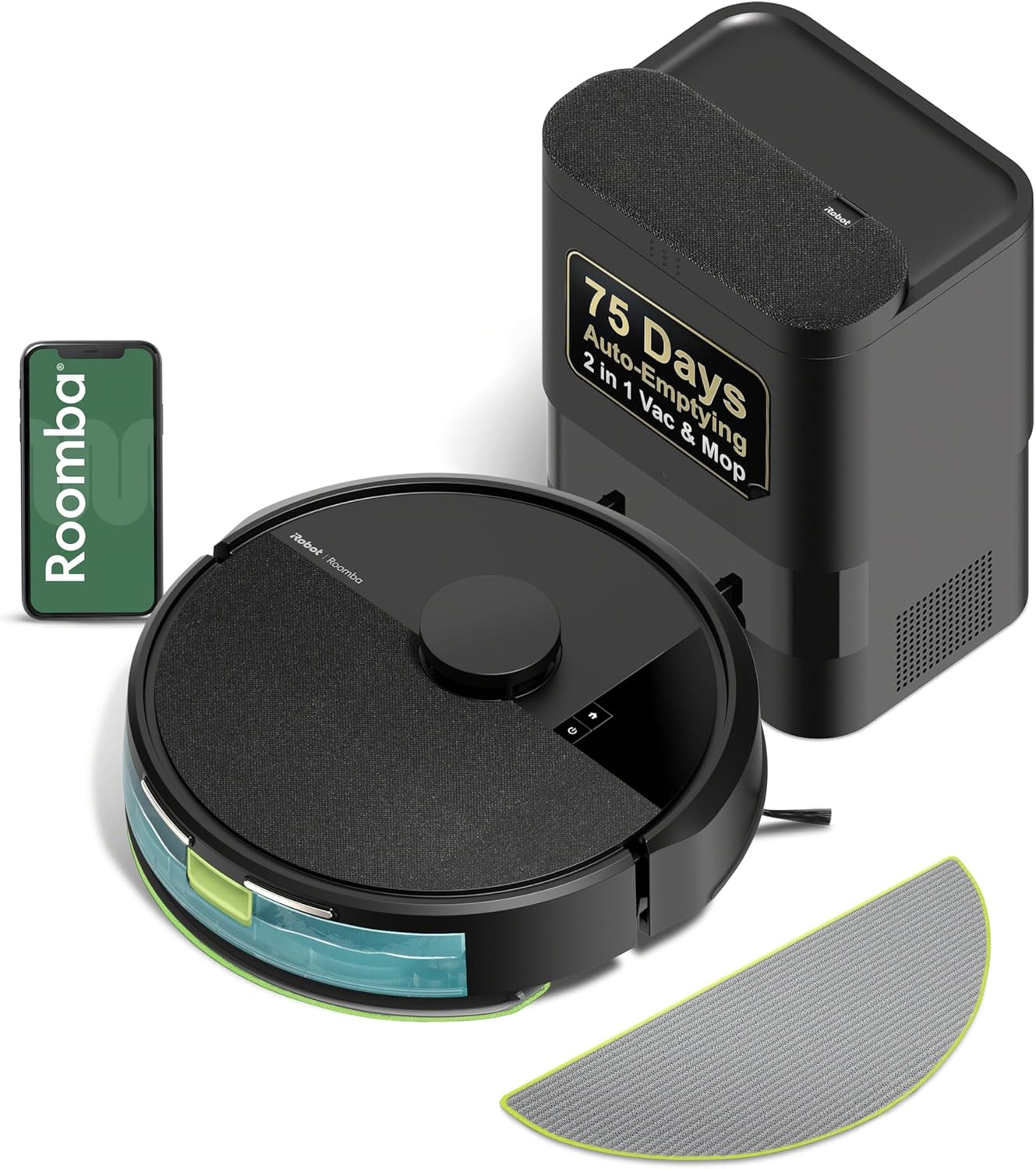
| Battery Life | 100 minutes |
|---|---|
| Navigation | ClearView LiDAR |
| Other Features | Self-Emptying, Vacuum & Mopping, Smart Mapping, Obstacle Avoidance |
| Filter Type | Cartridge |
The Roomba 105 Combo pairs a LiDAR-mapped robot with an AutoEmpty dock to deliver hands-off vacuuming and mopping for mixed floor homes. It uses ClearView LiDAR to build maps and navigate around obstacles while offering three cleaning modes: vacuum, mop, or vacuum-and-mop together; the mop system meters water and provides a SmartScrub option for deeper scrubbing. The four-stage cleaning system combines intense suction, an edge-sweeping brush and a multi-surface brush to lift dirt from carpets and hard floors, and the dock collects debris into a bag rated for about 75 days of use so you do not handle dust often. Battery life is listed at about 100 minutes, and setup and scheduling are handled through the iRobot Home app or voice assistants. For uneven floors, the LiDAR mapping and obstacle avoidance help the robot navigate transitions, but its low-profile disc form and standard wheels may struggle with very high thresholds or deep pile. Maintenance requires occasional filter and brush cleaning and replacing the dock bag when full.
Best for: Buyers who prioritize low-maintenance cleaning and reliable mapping across a mix of hard floors and low-to-medium pile carpets and want social-proof features like hands-free emptying and a large user base.
Less Ideal for: Homes with frequent very high thresholds, deep-pile rugs, or extensive multi-level layouts where stronger climbing ability and longer runtime are required.
- AutoEmpty dock holds up to 75 days of debris for reduced hands-on emptying
- ClearView LiDAR mapping provides precise navigation and obstacle avoidance
- Combined vacuum-and-mop modes with metered water flow and SmartScrub for deeper scrubbing
- Multi-surface brush and edge-sweeping brush improve pickup on carpets and along edges
- 100-minute battery life may be short for large homes without a mid-run recharge option
- Low-profile disc design and standard wheels can have trouble with very high door thresholds or irregular floor transitions
Verdict: Choose the Roomba 105 Combo for hassle-reducing, LiDAR-guided vacuum-and-mop cleaning with a 75-day AutoEmpty dock when you want reliable, low-touch floor care on mixed surfaces.
roborock Q10 S5+ Robot Vacuum

| Maximum Suction | 10,000 Pa |
|---|---|
| Capacity | 2.7 liters |
| Battery Life | 150 minutes |
| Filter Type | Washable |
| Noise Level | 65 db |
The roborock Q10 S5+ is a hybrid robot vacuum and mop that combines strong suction, LiDAR mapping, and a 70-day self-emptying dock for low-maintenance cleaning across multiple floors. In daily use it vacuums with up to 10,000 Pa to pull pet hair and debris from carpets and hard floors, while VibraRise 2.0 sonic mopping scrubs stains and automatically lifts the mop module over carpets. LiDAR navigation builds detailed maps and supports no-go zones and multi-level mapping so the robot handles uneven floorplans and transitions reliably. ReactiveTech obstacle avoidance and ultrasonic carpet detection reduce incidents and protect rugs, and the washable filter plus app and voice controls make scheduling and adjustments straightforward. Expect about 150 minutes of runtime between charges, a 2.7 L dust bag for long stretches between emptying, and a couple of practical limits: noise is noticeable under load and the system only supports 2.4 GHz Wi‑Fi. For buyers who want a dependable, mostly hands-free cleaner for varied flooring, the Q10 S5+ strikes a strong balance of power, mapping, and mop capability.
Best for: Homeowners who prioritize a low-maintenance, reliable robot that handles mixed flooring and pet hair with robust mapping and powerful suction.
Less Ideal for: People who need near-silent operation or who require 5 GHz Wi‑Fi support for smart-home devices.
- Powerful 10,000 Pa suction removes embedded dirt and pet hair
- 70-day self-emptying 2.7 L dust bag reduces maintenance frequency
- LiDAR navigation with multi-level mapping produces reliable routes on uneven floorplans
- VibraRise 2.0 sonic mopping cleans stains and lifts on carpets for seamless transitions
- App and voice control allow scheduling, no-go zones, and suction/mop adjustments remotely
- Operates at a fairly high noise level under load
- Only supports 2.4 GHz Wi‑Fi, limiting some network setups
Verdict: Choose the Q10 S5+ if you want a hands-off, high-suction robot that reliably navigates multi-level and uneven floors while minimizing routine maintenance.
Choosing the Right Robot Vacuum for Uneven Floors: Key Factors to Consider
Threshold and Ramp Climb
How high the vacuum can climb and the angle it can manage directly affects whether it will transition cleanly between rooms. Even a few millimeters of lip on a rug can stop a weak drivetrain, so check specifications or descriptions for maximum threshold height when evaluating options.
Beyond raw height, the entry angle and approach behavior matter. Some robots use a short, forceful push to surmount edges while others approach gradually with sensing that adjusts speed. For uneven floors, models that slow before impact and then apply steady acceleration typically fare better and reduce the chance of scrapers or stuck wheels.
Wheel Travel and Suspension
Wheel diameter, travel distance, and whether the wheels have any passive suspension influence how well a robot negotiates warped boards or uneven transitions. Larger wheels and greater vertical travel let the robot bridge gaps without the chassis dragging against the floor.
Tread pattern and material also affect traction on different surfaces. Softer, grippier treads maintain forward motion on sloped or slick transitions. When possible, choose a design with independent wheel articulation so each wheel can follow the floor rather than forcing the whole chassis to conform to a single plane.
Navigation System and Sensors
Robots that rely on a combination of cliff sensors, bump sensors, and optical or lidar-based mapping typically handle varied floors more intelligently. Good navigation reduces the number of head-on impacts that can wedge the vacuum on an edge or corner.
Sensor fusion helps the robot detect a change in plane and select an appropriate response, such as re-routing or adjusting speed. For uneven floors, look for systems that let you set virtual barriers and adjust cleaning patterns so the unit does not repeatedly attempt risky transitions.
Brush Design and Debris Path
Brushes and the pathway to the dustbin determine how well debris is collected after the robot climbs a threshold. A clogged brush or narrow intake can cause a machine to lose suction right when it needs to recover from an edge.
Roller brushes that combine rubber flaps with bristles tend to clear hair and fibers better across height changes. A straight, short debris path from brush to bin reduces the chance of jams when the robot pitches slightly while traversing an uneven surface.
Suction Consistency and Airflow
Suction must remain effective when the brush head angle or floor gap changes. Some machines compensate with automatic suction adjustments or sealed pathways that maintain airflow even when the chassis tilts.
Consider systems with consistent airflow and filters that do not restrict suction. On uneven floors, transitory gaps can let air leak, so a design that preserves negative pressure across variable geometries will clean more reliably without repeated passes.
Recoverability and User Intervention
No robot is immune to getting stuck, so how easy it is to free the unit matters. Consider features like a prominent grab handle, easily accessible wheels, and visible indicators that show why the robot paused.
Also evaluate how the robot reports issues to the user. Clear alerts, map-based stuck-location notifications, and a sensible return-to-base routine can cut the time you spend rescuing the robot and reduce frustration on homes with many transitions.
Preparing Your Home for Reliable Robot Cleaning
Small changes to thresholds and floor transitions can dramatically reduce stuck events. Secure loose rug edges with tape or rug grippers and consider low-profile transition strips where possible to smooth the path between different floor heights.
Remove small clutter and power cables from likely travel routes and keep narrow gaps near doorframes closed. A consistent cleaning path and a few preventive fixes let a capable robot finish jobs with fewer interruptions.
- Use low-profile transition strips between flooring types
- Secure rug corners and edges to prevent snagging
- Tidy cables and small objects from robot pathways
Placement Tips for the Charging Base
Base location affects how the robot approaches transitions. Place the charging dock on a level area with a clear approach so the unit starts from a predictable position. Avoid locating the base on top of mats or uneven surfaces that change its reference plane.
Leave open space on both sides of the dock to allow the robot multiple approach angles. This flexibility helps the robot re-enter cleaning mode and choose a route that minimizes challenging climbs early in a cycle.
- Keep at least 1 meter of clearance on either side of the dock
- Avoid placing the dock on rugs or sloped surfaces
- Position the dock near the largest, flattest area of the home
When to Use Mapping Versus Random Walk Modes
Mapping modes that learn your floorplan let the robot avoid repeatedly attempting problematic transitions. If your home has a complex mix of rugs, thresholds, and step changes, a mapped route reduces unnecessary attempts at risky edges and returns the robot to areas it can clean effectively.
Random or zoned modes can still be useful for quick spot cleaning in single rooms. However, for uneven-floor homes, mapping with custom no-go lines or area restrictions can significantly lower the chance of the vacuum getting stuck.
- Use mapping to set no-go lines at risky thresholds
- Reserve random modes for small, obstacle-free rooms
- Update maps after making home modifications
Maintenance Practices to Keep Mobility High
Regularly inspect wheels, wheel wells, and brush housings for hair and debris that reduce travel range. Cleaning out trapped material restores wheel articulation and prevents the chassis from sitting lower, which makes climbs harder.
Replace worn treads and brushes on schedule. Worn components may reduce grip and decrease effective clearance, both of which increase the chance of the robot failing to cross uneven surfaces.
- Clean wheel wells and brush chambers weekly in high-use homes
- Check and replace worn treads or rollers when traction drops
- Keep filters and airflow channels free of dust to maintain suction
Smart Home Integrations and Scheduling for Tough Floors
Integrations with voice assistants and smart-home routines let you schedule runs when the home is clear and you can supervise the first few transitions. Scheduling cleaning when areas are less cluttered reduces the chance of early stuck events.
Some systems allow conditional schedules, like cleaning certain rooms only when people are away. Use these features to run the robot in quieter windows so manual intervention is easier if needed.
- Schedule runs during low-traffic times for fewer obstructions
- Use room-based schedules to avoid risky transitions in one run
- Leverage notifications to quickly rescue the unit if it stalls
How We Chose the Best Robot Vacuum for Uneven Floors
We focused on machines designed to handle mixed and uneven-floor environments without frequent manual intervention. Primary evaluation criteria included threshold climb capability, suspension or wheel travel and grip, navigation and obstacle detection, suction consistency on variable surfaces, and brush and debris pathway design. We prioritized units that demonstrate reliable traction over small height changes, maintain airflow across transitions, and use sensors or mapping logic that minimize repeated collisions or stuck events. Our process filtered out units with poor wheel travel, minimal obstacle sensing, or brush chambers that clog easily when crossing edges. We excluded products intended only for single-level, perfectly even floors. We also considered real-world operational factors such as ease of retrieving the robot from a stuck position and how the cleaning system handles loose debris after a climb. The included criteria align with the scoring metrics used for each pick so readers can compare mobility, cleaning stability, and day-to-day reliability directly.
Our full evaluation process is outlined in our review methodology.
FAQ
How high a threshold can a robot vacuum for uneven floors typically climb?
Typical threshold climb varies by model, but many machines handle lips of several millimeters to about a centimeter. Look for specifications or user feedback on maximum threshold height; wheel size and drive torque are decisive factors.
Will a robot vacuum damage warped or uneven hardwood?
Most robots are designed to roll over minor unevenness without causing damage. The main risk is the robot getting stuck and repeatedly striking a weak seam. Reducing aggressive impacts by smoothing transitions or securing boards reduces potential wear.
Are larger wheels always better for uneven floors?
Larger wheels generally help because they provide more travel to bridge gaps and better traction. However, wheel design and suspension matter too. A well-designed smaller wheel with good travel can outperform a larger, rigid wheel.
Should I use virtual boundaries around thresholds?
Yes. Virtual boundaries or no-go lines prevent the robot from repeatedly attempting risky climbs. They are especially helpful in homes with a few troublesome transitions you do not want the robot to cross during regular cycles.
How often should I check wheels and brushes if I have uneven floors?
Inspect wheels and brush housings at least weekly in high-traffic homes. Uneven floors pick up more hair and debris around thresholds, so frequent checks prevent reduced wheel travel and brush jams that make climbs more difficult.
Final Verdict
Pick a robot vacuum for uneven floors by balancing mobility and cleaning stability. Prioritize units with proven threshold-climb ability, sufficient wheel travel, and navigation systems that avoid repeated risky attempts. Also favor brush and airflow designs that maintain suction during pitch and roll changes. Accept tradeoffs: the most aggressive climbers may use more power or make louder efforts, while gentle navigators may skip tight transitions. Decide whether you prefer a machine that forces a climb or one that routes around problem spots, then choose based on the factors outlined above for a reliable, low-intervention cleaning experience.