
Note: This article contains affiliate links. If you click on these links and make a purchase, we may earn a small commission at no extra cost to you. This helps support our research and content. Read our full affiliate disclosure here.
Choosing the right robot vacuum for tile and carpet matters because these floor types demand different cleaning actions. Hard floors need strong suction and good dust collection, while carpets require agitation and higher airflow to lift embedded dirt. A well-chosen robot vacuum reduces daily maintenance, shortens deep-clean sessions, and keeps both surfaces looking their best. This guide covers seven shortlisted robot vacuums that perform well across hard surfaces and low-to-mid pile carpets. We evaluated models on suction and debris pickup, navigation and mapping, battery life, and how easy they are to maintain. Read on to find the features and tradeoffs that matter for maintaining tile and carpeted rooms, and then check the product list below for our top picks.
Top Picks at a Glance
| Best Overall The best all-around choice for most situations | Dreame D20 Pro Plus |  |
| Best Quality Built to a higher standard if you want something more solid | roborock Saros 20 |  |
| Best Value The sweet spot between price and what you get | dreame D20 Air Plus |  |
| Best Budget The cheapest option that still gets the job done reliably | ILIFE V2 Robot Vacuum |  |
| Top Rated A top-rated pick with lots of positive feedback | WSUANE D15S Max Robot Vacuum |  |
| Most Popular A crowd favorite that many people choose with confidence | iRobot Roomba 105 Combo |  |
| Best Seller A high-volume bestseller chosen again and again | roborock Q10 S5+ |  |
Dreame D20 Pro Plus

| Suction | 13,000Pa |
|---|---|
| Battery Life | 180 minutes |
| Dust Bag Capacity | 5L |
| Onboard Dustbin Capacity | 500 ml |
| Control Method | App, Voice |
The Dreame D20 Pro Plus is a laser-guided robot vacuum that vacuums and mops hard floors and carpets with a focus on low-maintenance operation. It uses LDS navigation to build editable maps and avoids obstacles while following edge-tracking sensors to clean corners more completely. The unit delivers up to 13,000Pa suction and a DuoBrush system designed to reduce hair tangles, and it supports two adjustable power levels plus app and voice control for scheduling and custom cleaning. Mopping is integrated with a 350ml water tank and multiple moisture settings, and the 5L auto-dust collection base holds bags for about 150 days between emptying. Runtime is long thanks to a 5,200mAh battery and the robot handles mixed surfaces like tile and low- to medium-pile carpet well. Trade-offs include only 2.4GHz Wi‑Fi support and a modest 500ml onboard dustbin that relies on the base for extended convenience, and very tall thresholds or thick rugs may still impede access.
Best for: Buyers who want a low-maintenance robot that handles both tile and carpet, values reliable mapping and strong suction, and prefers long stretches between dust maintenance.
Less Ideal for: People who need 5GHz Wi‑Fi support, have many very high thresholds or deep-pile carpets, or want a robot with a large onboard dustbin for base-free operation.
- Strong 13,000Pa suction for effective dirt pickup on tile and low- to medium-pile carpet
- LDS laser mapping with editable maps and reliable obstacle avoidance for efficient coverage
- 5L self-emptying base supports up to 150 days of hands-free dust disposal
- DuoBrush detangling brush design reduces hair wrap and improves pet-hair pickup
- Integrated vacuum-and-mop with adjustable moisture levels for combined cleaning passes
- Only supports 2.4GHz Wi-Fi which limits smart-home network options
- Onboard dustbin is relatively small and depends on the base for extended capacity
Verdict: Choose the D20 Pro Plus when you want powerful suction and laser mapping with a 150-day self-emptying base to minimize maintenance on tile and carpet.
roborock Saros 20

| Suction | 36,000 Pa |
|---|---|
| Battery Life | 180 minutes |
| Filter Type | Washable Filter |
| Control Method | App, Push Button, Voice |
The roborock Saros 20 is built for heavy-duty cleaning on mixed surfaces, pairing a 36,000 Pa digital motor with an ultra-slim body and advanced navigation to handle tile, hardwood, and carpet. In daily use it maps your home with StarSight AI and a 3D ToF sensor suite so it avoids hundreds of common obstacles while following efficient routes, and the low profile lets it reach under sofas and beds. Key practical features include AdaptiLift chassis that climbs double-layer thresholds, a dual anti-tangle system for pet hair, and flex-extended brushes and mop for better edge and corner coverage. The RockDock provides hot-water washing, hot-air drying, and extended auto-emptying for long stretches of hands-free operation. Expect very strong suction and good carpet pickup, long runtime for large homes, and simplified upkeep thanks to the self-cleaning dock, but be aware the full system is relatively large and its advanced features require app setup and occasional maintenance of the dock and brushes. For performance-focused buyers who need thorough cleaning across tile and carpet, the Saros 20 delivers a potent, mostly hands-off solution.
Best for: Buyers who prioritize top-tier cleaning power and smart navigation for mixed floors and pet hair and want a mostly hands-free maintenance cycle.
Less Ideal for: People who need a very compact, budget-focused robot or who prefer a plug-and-play unit with minimal app interaction should consider simpler models.
- Very high suction (36,000 Pa) for deep pickup on tile and carpet
- Advanced StarSight navigation and 3D ToF sensors reduce missed spots and collisions
- AdaptiLift chassis crosses high thresholds and cleans deep carpets without losing suction
- RockDock automates hot-water wash, hot-air dry, and extended auto-emptying for low-maintenance care
- Large, heavier system means the dock and robot require more space and occasional dock maintenance
- Advanced features depend on app setup and periodic upkeep of brushes and filters
Verdict: If you want maximum cleaning performance on tile and carpet with smart obstacle avoidance and a largely hands-free dock, the Saros 20 is a top choice.
dreame D20 Air Plus

| Suction | 20,000Pa |
|---|---|
| Dust bag capacity | 4 liters |
| Battery life | 150 minutes |
| Navigation | LiDAR |
| Control | App, Button, Voice |
The dreame D20 Air Plus is a robot vacuum and mop designed to reduce hands-on maintenance while cleaning both hard floors and carpets. It uses LiDAR navigation to build maps and follow efficient routes, and its 20,000Pa Vormax suction and dual anti-tangle brush design target pet hair and embedded dirt; the electronic water tank lets the robot vacuum and mop simultaneously with adjustable water flow. The included auto-empty dock holds a 4L dust bag that the brand rates for up to 120 days of hands-free debris collection, which keeps you from emptying dust frequently. Runtime is listed at 150 minutes so it can cover medium to larger homes on a charge, and app plus voice controls make scheduling and no-go zones straightforward. Practical buyers should note the unit is focused on indoor floor care and only supports 2.4GHz Wi-Fi for smart features, and deep-pile rugs may require spot-cleaning or extra passes. For tile and mixed-floor homes the D20 balances strong suction, mapping accuracy, and low-maintenance operation.
Best for: Buyers who want a low-maintenance robot that reliably cleans both tile and carpet and prioritize long intervals between emptying and simple, mapped scheduling.
Less Ideal for: People who need multi-band Wi-Fi compatibility or who primarily have very thick high-pile carpets that require upright or specialty carpet cleaners.
- High 20,000Pa suction for deep carpet and tile cleaning
- 120-day auto-emptying system with a 4L dust bag reduces manual maintenance
- LiDAR navigation and mapping for efficient, repeatable coverage
- Vacuum and mop simultaneously with adjustable electronic water tank
- Only supports 2.4GHz Wi-Fi which may limit smart-home network options
- May need extra passes or spot-cleaning on very deep-pile carpets
Verdict: If you want powerful suction, reliable LiDAR mapping, and long stretches of hands-free cleaning for mixed tile and carpet floors, the D20 Air Plus is a practical, low-maintenance choice.
ILIFE V2 Robot Vacuum

| Battery Life | 120 minutes |
|---|---|
| Capacity | 300 ml |
| Filter Type | Sponge |
| Control Method | Remote |
| Noise Level | 69 db |
The ILIFE V2 is an entry-level robot vacuum built to keep hardwood and other hard floors tidy without a lot of fuss. Its 2.99-inch slim body fits under low furniture while a tangle-free suction port and sponge filter make it practical for homes with pet hair. You can run scheduled cleanings, switch between auto, spot and edge modes, or start jobs with the included remote control or the single-button on the unit. A 300 ml dustbin and up to 120 minutes of runtime let it cover medium rooms on one charge, and it will automatically return to the dock when the battery is low. Noise is noticeable at 69 dB and there is only one power level, so it lacks adjustable suction or app-based controls, but for straightforward floor maintenance on hardwood and low-pile carpet the V2 delivers solid value at an affordable price.
Best for: Buyers who want an affordable, no-frills robot to maintain hardwood and low-pile carpet cleanliness with simple controls and scheduled runs.
Less Ideal for: Those who need strong adjustable suction, smart app control, or advanced mapping for large or complex homes should consider higher-end models.
- Slim 2.99-inch profile cleans under low furniture
- Tangle-free suction port suited for pet hair
- 120 minutes runtime with automatic return-to-dock
- Multiple cleaning modes (auto, spot, edge) and simple remote control
- Single power level limits suction control for heavier debris
- No smartphone app or advanced navigation features
Verdict: A low-cost, slim robot vacuum that reliably maintains hardwood floors and handles pet hair for budget-focused buyers.
WSUANE D15S Max Robot Vacuum

| Suction | 10000Pa max |
|---|---|
| Dustbin Capacity | 3.5 liters |
| Navigation | dToF LiDAR |
| Run Time | Up to 160 minutes |
| Compatibility | Google Home, Smartphones |
The WSUANE D15S Max is a LiDAR-guided robot vacuum and mop designed for hands-off cleaning on tile and carpet. It builds detailed maps with dToF LIDAR and supports app control and no-go zones so you can schedule targeted cleanings and protect sensitive areas. Suction ranges up to 10,000Pa with automatic boost on carpet, and the brush system includes an anti-tangle, blade-equipped roller that helps cut and evacuate hair during runs. The included 3.5L dust collection station holds many weeks of debris, reducing emptying frequency for busy homes and pet owners. Runtime is substantial on lower settings (up to 160 minutes in silent mode) and the robot returns to the dock to recharge between jobs. Practical limitations include a reported noise level up to 70 dB on higher power settings and the washable/non-washable filter mix which requires attention to maintenance; also, very high-pile rugs or dense tassels may still challenge any robot. For tile and low- to medium-pile carpet this model offers strong suction, reliable mapping, and true hands-free intervals for routine upkeep.
Best for: Buyers who prioritize dependable, low-maintenance floor care and need a robot that reliably maps large tile and carpeted areas for regular automated cleaning.
Less Ideal for: People who need an ultra-quiet machine for night cleaning or who have very high-pile rugs and thick tassels that overwhelm robot brushes.
- dToF LiDAR mapping for accurate room maps and no-go zones
- Up to 10,000Pa suction with auto-boost for carpets
- Large 3.5L self-emptying dustbin reduces how often you must empty
- Anti-tangle, blade-equipped roller helps manage pet and human hair
- Long runtime up to 160 minutes on silent setting
- Can reach about 70 dB on high-power modes which is noticeable in occupied rooms
- Filter system mixes washable and non-washable elements that need periodic replacement or care
Verdict: If you want a reliable, hands-free vacuum for tile and carpet that maps precisely and empties itself for weeks at a time, the D15S Max is a strong pick.
iRobot Roomba 105 Combo
| Surface Recommendation | Carpet & Hard Floor |
|---|---|
| Battery Life | 100 minutes |
| Controller Type | App Control, Button Control, Voice Control |
| Filter Type | Cartridge |
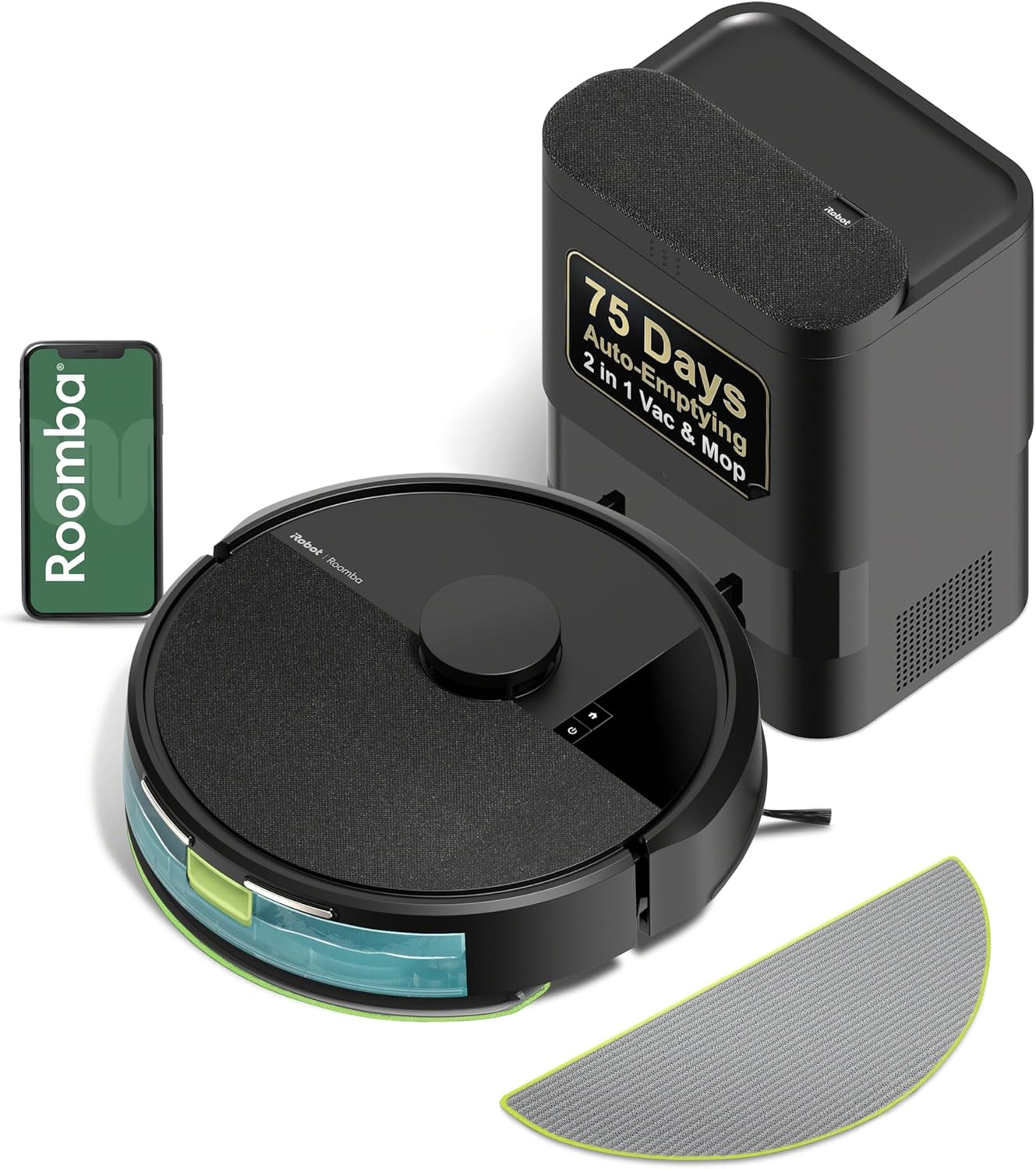
The Roomba 105 Combo pairs vacuuming and mopping in a compact disc-shaped robot that maps rooms with ClearView LiDAR and returns dirt to a self-emptying AutoEmpty dock that holds up to 75 days of debris. It offers three cleaning modes—vacuum, mop, or simultaneous vacuum-and-mop—with a 4-stage cleaning system that combines intensified suction, an edge-sweeping brush, a multi-surface brush, and a reusable microfiber mop pad. App, touch, or voice controls let you schedule room-by-room cleans and set suction and mopping levels, while carpet detection prevents rugs from getting wet during mopping. Typical use is hands-off: set schedules or ask a voice assistant for on-demand cleaning and let the robot navigate around furniture, stairs, and obstacles. Practical benefits include long unattended operation thanks to the large AutoEmpty capacity, effective edge cleaning, and LiDAR-based mapping for consistent coverage. Limitations are the modest 100-minute battery run time for larger homes and the reliance on a 2.4 GHz Wi-Fi connection for setup and operation.
Best for: Buyers who want a low-intervention robot that reliably vacuums and mops tile and carpet in daily use and value proven navigation and long intervals between emptying.
Less Ideal for: People with very large homes who need continuous multi-room cleaning on a single charge or who prefer a fully automated pad-washing and drying dock system.
- Self-emptying AutoEmpty dock holds up to 75 days of debris for low-maintenance operation
- ClearView LiDAR mapping provides precise navigation and consistent room coverage
- Combined vacuum-and-mop modes with microfiber pad and adjustable water flow for tiled floors
- Edge-sweeping brush and multi-surface brush improve corner and carpet pickup
- Multiple control methods including app, voice, and onboard buttons for flexible scheduling
- 100-minute battery life may require recharges on very large floorplans
- Mopping uses a reusable pad and manual refill of the water/solution tank rather than a sealed cartridge system
Verdict: Choose the Roomba 105 Combo if you want a proven LiDAR-mapped robot that vacuums and mops tile and carpet with minimal hands-on emptying thanks to its 75-day AutoEmpty dock.
roborock Q10 S5+

| Maximum Suction | 10,000Pa |
|---|---|
| Dustbin Capacity | 2.7 liters |
| Battery Life | 150 minutes |
| Filter Type | Washable |
| Noise Level | 65 db |
The roborock Q10 S5+ combines powerful suction, automated emptying, and a sonic mopping system to handle tile and carpet in one unit. It navigates with 360° LiDAR mapping and ReactiveTech obstacle avoidance to create multi-level maps, let you set no-go zones, and run scheduled cleans from the app or by voice. The large auto-empty dock holds a 2.7 L bag for extended hands-off operation, while a dual anti-tangle brush design reduces hair build-up for pet households. VibraRise 2.0 delivers high-frequency scrubbing for tougher floor stains and the mop module lifts automatically over carpets, with ultrasonic carpet detection to avoid wetting. Battery life and cleaning modes support longer runs and carpet boost increases suction where needed. Practical limitations are that advanced features require the app and 2.4 GHz Wi-Fi, noise can reach higher levels during heavy suction, and the system adds complexity compared with simpler vacuums, which may mean occasional app setup or maintenance for reliable results.
Best for: Buyers who prioritize reliable, low-intervention floor care for mixed tile and carpet and want a system that intelligently maps spaces and minimizes daily upkeep.
Less Ideal for: People who prefer a very quiet, simple standalone vacuum with minimal app setup or households without compatible 2.4 GHz Wi-Fi should consider simpler models instead.
- Strong 10,000 Pa suction for deep cleaning on carpets and effective pickup on hard floors
- Large 2.7 L auto-empty bag supports about 70 days of hands-off use
- LiDAR navigation with multi-level mapping and no-go zones enables precise pathing and repeatable cleaning
- VibraRise sonic mopping and automatic mop lift let it scrub hard floors and avoid carpets
- Dual anti-tangle design reduces hair wrap and maintenance for pet owners
- Requires 2.4 GHz Wi-Fi and app control for full feature set
- Reported noise level can be noticeable at peak suction settings
- More complex system means more parts to maintain compared with basic robot vacuums
Verdict: If you want an intelligent, hands-off robot that cleans both tile and carpet thoroughly and reduces daily maintenance, the Q10 S5+ is a strong choice.
Choosing the Right Robot Vacuum for Tile and Carpet: Key Factors to Consider
Suction Power and Carpet Boost
Suction strength is the single most important factor for removing dirt from both tile and carpet. Tile benefits from steady suction to pick up fine dust and debris, while carpet needs higher airflow or a dedicated carpet-boost mode to pull particles from fibers.
Look for robots that adjust suction automatically when they detect a rug or that provide manual modes you can schedule. Strong suction reduces the need for frequent manual vacuuming, but higher power can reduce run time and increase noise. Consider whether the unit balances power with runtime for your typical room sizes.
Brush Type and Hair Management
Brushroll design influences how well a robot handles mixed debris. Soft rubberized rollers or hybrid brush systems often work better on tile without scattering dust and can engage carpet fibers effectively. Open-bristle brushes may tangle with pet hair more easily.
If you have pets or long hair in the home, prioritize models with anti-tangle features or easily removable brush assemblies. Brush accessibility affects daily upkeep time; quick-release components and washable brush parts make maintenance faster and reduce downtime.
Navigation and Mapping Accuracy
Good navigation ensures efficient coverage and fewer missed spots across rooms that mix tile and carpet. Mapping systems let you set no-go zones, schedule room-by-room cleaning, and ensure the robot returns to cover missed areas rather than randomly bumping around.
Robots with lidar or camera-based mapping usually provide more consistent room coverage. Consider whether multi-floor maps or zone cleaning are valuable in your home layout. Reliable navigation also prevents repeated transitions over thresholds that can frustrate cleaning consistency.
Battery Life and Real-World Coverage
Battery life determines how much continuous area a robot can clean before returning to dock. Longer run times are especially important in homes with large open areas or many rooms combining tile and carpet.
Check the estimated coverage time based on the robot's standard cleaning mode rather than eco numbers. Some robots offer quick-charge or resume-and-return features that let them finish large jobs across multiple charge cycles. Consider the time between full charges and how that aligns with your cleaning schedule.
Dustbin Capacity and Filter Type
Dustbin size affects how often you need to empty the robot, which matters when cleaning hard floors that generate lots of fine dust. A larger bin or a robot that supports auto-empty stations reduces hands-on maintenance frequency.
Filter quality matters for capturing fine particles and allergens. HEPA-equivalent filters trap smaller particulates but usually require replacement over time. Think about maintenance costs and the frequency of emptying and filter swaps when choosing a model.
Threshold Handling and Transition Performance
How a robot handles transitions between tile and carpet impacts both cleaning effectiveness and reliability. Low-profile thresholds and short pile rugs are usually no problem, but higher transitions or thick area rugs can stall some units.
If your home has many thresholds, look for robots with robust wheel travel and ramping ability. Good transition performance minimizes jams and ensures the robot can routinely move from one surface to another without manual intervention.
How Tile and Carpet Cleaning Needs Differ
Tile and carpet demand different cleaning mechanics. Tile often hides fine dust, grit, and debris in grout lines and along edges, so suction and edge cleaning matter more. Carpet traps dirt deeper in fibers, requiring higher airflow and active agitation to lift particles.
Understanding these differences helps you prioritize features. For mixed-floor homes, aim for a robot that can increase suction on rugs and uses a brush system that adapts to both hard floors and textile surfaces.
- Tile: priorities are suction, edge cleaning, and fine-dust capture.
- Carpet: priorities are airflow, brush agitation, and hair management.
- Mixed floors need reliable transitions and adjustable cleaning modes.
Mapping Features That Improve Mixed-Floor Cleaning
Mapping features let you confine cleaner runs to specific rooms and prevent unnecessary passes over delicate rugs or hard floors. You can set higher suction in bedrooms with carpets and schedule lighter passes on tile in entryways.
Look for zone cleaning, virtual boundaries, and room naming in the app. These controls let you apply different cleaning intensities to tile and carpet areas without manually moving the unit.
- Zone cleaning for targeted high-suction carpet runs.
- No-go lines to protect delicate areas or cords on tile.
- Multi-map support if you have different floor plans across levels.
Managing Pet Hair and Frequent Debris
Homes with pets need robots that resist hair wrap and collect larger debris without clogging. Brushless roller systems or rubberized rollers often reduce tangles and maintain consistent pickup on both tile and carpet.
Also consider how easy it is to empty the dustbin and clean the intake path. A model that demands minimal hands-on maintenance will keep cleaning routines predictable even with heavy shedding.
- Anti-tangle brush designs for long hair and pet fur.
- Larger dustbins or auto-empty options for high-debris homes.
- Washable filters and removable brush assemblies for fast upkeep.
Noise, Cleaning Time, and Scheduling
Higher suction and carpet-boost modes increase noise and shorten runtime. If you plan to run the robot during the day, consider lower-noise settings for light maintenance on tile and reserve boosted modes for weekly deep cleans on carpeted areas.
Use scheduling to balance noise and effectiveness. For example, schedule boosted carpet passes when you are out, and quieter tile maintenance while you are home to avoid disruption.
- Use quiet modes for daytime tile maintenance.
- Schedule high-power carpet passes during off-hours.
- Check run-time estimates in real-world modes rather than eco claims.
Maintenance Habits That Keep Performance Consistent
Regular maintenance preserves suction and brush efficiency. Empty the dustbin before it hits the max fill line, clean brushrollers of hair, and replace or wash filters per the manufacturer's timeline to maintain suction and filtration.
Inspect wheels and sensors for hair and dust buildup that can degrade navigation over time. Consistent upkeep extends the unit's effective life and reduces the chance of missed spots on both tile and carpet.
- Empty bin after heavy runs on tile or pet areas.
- Clean brush and wheels weekly for moderate-use homes.
- Replace filters on the recommended interval to sustain airflow.
How We Chose the Best Robot Vacuum for Tile and Carpet
We focused on the capabilities that matter most when a single robot has to clean both tile and carpet. Our selection filters prioritized models with adjustable suction or carpet-boost modes, brush configurations that prevent hair tangles, and reliable sensors or mapping systems for consistent edge and corner coverage. Battery capacity and run time were considered so devices can finish typical room layouts without frequent recharges. Dustbin capacity and filter type were reviewed for how often you must empty and maintain the unit, especially in homes with pets or heavy foot traffic. We excluded units clearly optimized only for one surface type or those lacking basic navigation features such as multi-room mapping or scheduled cleaning. We also removed models with poor user feedback on durability or excessive maintenance needs. The final list favors robots that balance suction, brush design, navigation intelligence, and upkeep effort so you get practical, repeatable cleaning results on both tile and carpet.
Our full evaluation process is outlined in our review methodology.
FAQ
Can one robot vacuum really handle both tile and carpet effectively?
Often, yes. Many robots offer adjustable suction or carpet-boost modes and brush setups designed for mixed floors. Performance depends on how well the model switches modes and manages transitions.
How often should I run a robot vacuum on tile versus carpet?
It depends on activity and traffic. High-traffic tile areas may need daily light passes, while carpeted rooms often require several passes per week, including occasional boosted runs to extract embedded dirt.
Will pet hair clog the dustbin or brush on these robots?
Pet hair can accumulate, but robots with anti-tangle brush designs and larger bins manage hair better. Regularly removing hair from the brush and emptying the bin reduces clogs and keeps suction consistent.
Do robots damage tile grout or carpet fibers?
Properly designed robots do not damage tile or carpet under normal use. Avoid repeated heavy passes with high brush agitation on delicate rugs, and check that wheels and brushes are free of rough debris that could cause abrasion.
How important is an auto-empty station for mixed-floor homes?
Auto-empty stations reduce hands-on maintenance, especially in homes with tile that produces lots of fine dust or heavy pet shedding. They are not essential but increase convenience for busy households.
Final Verdict
When choosing a robot vacuum for tile and carpet, prioritize models that offer adjustable suction, a brush system that resists tangles, and reliable navigation. Balance run time against the power levels you will need for regular carpet maintenance and routine tile cleaning. Tradeoffs are unavoidable: stronger suction shortens run time and increases noise, while gentler modes extend battery life but may require more frequent boosted passes on rugs. Focus on the features that match your home layout and maintenance habits so you can pick a robot that keeps both floors consistently cleaner with minimal fuss.