
Note: This article contains affiliate links. If you click on these links and make a purchase, we may earn a small commission at no extra cost to you. This helps support our research and content. Read our full affiliate disclosure here.
A robot vacuum with remote control makes it easy to trigger cleaning cycles, spot-clean specific areas, or send the unit back to its dock without pulling out your phone. For homes where you want simple, immediate control from the couch or from guests who do not use an app, a physical remote restores straightforward operation. This guide covers six shortlisted robot vacuums with remote controls that balance suction, navigation, battery life, and usability. Below you will find quick decision criteria, what to expect from different designs, and clear guidance to match a remote-controlled model to your floor types and daily routine.
Top Picks at a Glance
| Best Quality Built to a higher standard if you want something more solid | uninell UR1 Robot Vacuum |  |
| Best Value The sweet spot between price and what you get | ILIFE A30 Pro Robot Vacuum |  |
| Best Budget The cheapest option that still gets the job done reliably | Livvi Robot Vacuum and Mop G100C PRO |  |
| Top Rated A top-rated pick with lots of positive feedback | Tikom G8000 Max Robot Vacuum |  |
| Most Popular A crowd favorite that many people choose with confidence | ILIFE A30s Robot Vacuum |  |
| Best Seller A high-volume bestseller chosen again and again | Bagotte G6 Robot Vacuum |  |
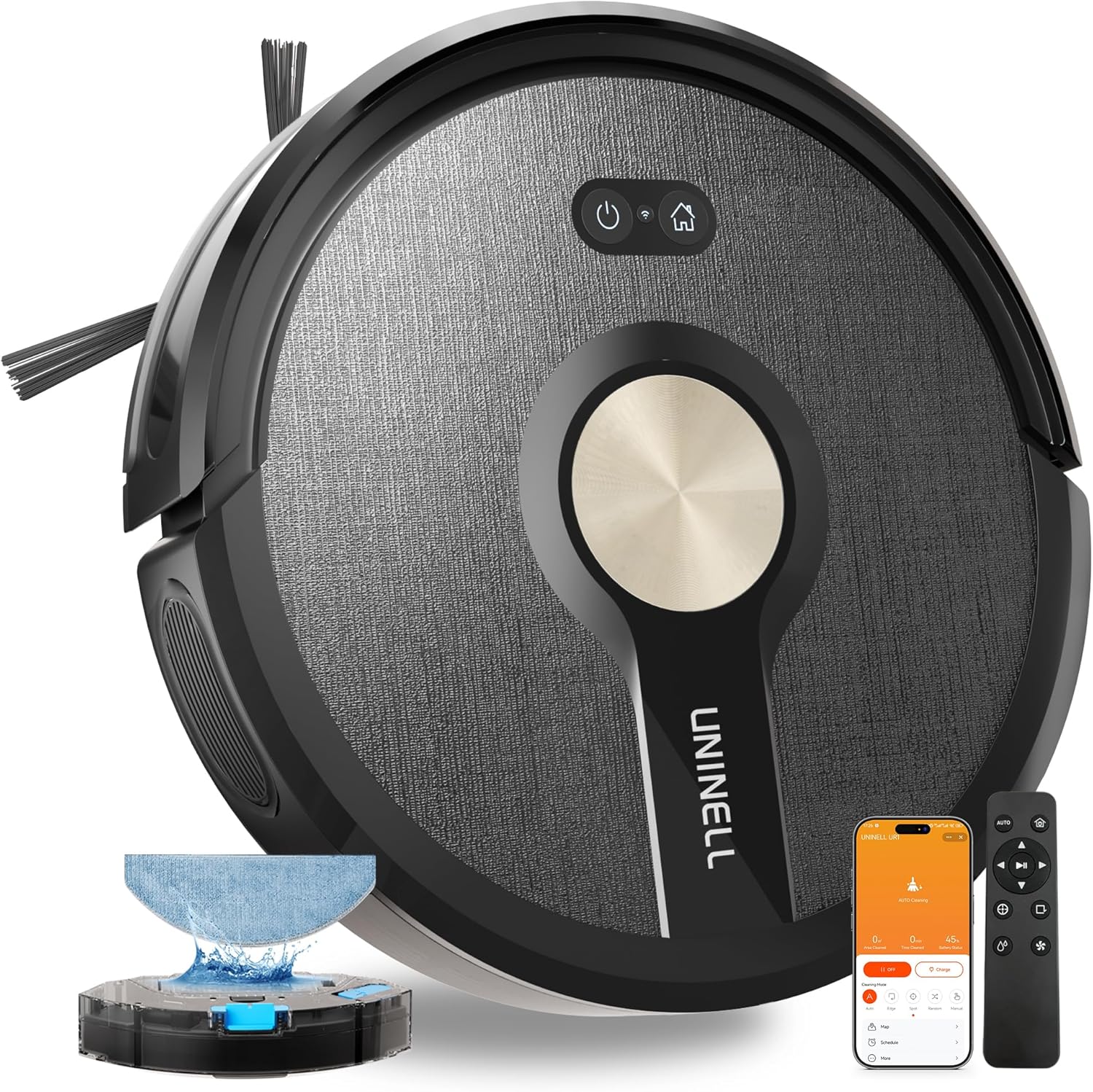
uninell UR1 Robot Vacuum
| Battery Life | 180 minutes |
|---|---|
| Capacity | 450 ml |
| Water Tank | 250 ml |
| Maximum Suction | 5000Pa |
| Filter Type | HEPA Filter, Sponge |
The uninell UR1 is a performance-focused robot vacuum that combines sweeping, vacuuming, and mopping in a very low 2.99-inch profile. It is typically used for whole-home maintenance on hard floors and low- to mid-pile carpets, where its 5000Pa suction and automatic carpet-boost deliver stronger pickup for embedded dirt and pet hair. The dual-function dust and water tank lets you run vacuum-only, mop-only, or both at once, while three suction and three water-flow settings let you tune cleaning intensity versus runtime. Navigation relies on gyro mapping with obstacle avoidance and anti-drop sensors for methodical passes rather than random wandering, and the 2600mAh battery claims up to 180 minutes for large coverage per charge. Control options include the Smartlife app, voice assistants, onboard buttons, and a physical remote for users who prefer no-account setup. Practical limits are the modest dust and water capacities relative to very large homes and that gyro navigation is less detailed than LiDAR mapping for complex floorplans, so performance in cluttered multi-room layouts may be more variable.
Best for: Buyers who prioritize suction performance and flexible controls and want a slim robot that handles pet hair and long cleaning runs across open floorplans.
Less Ideal for: Homes with many small rooms, complex layouts, or buyers who need the most advanced LiDAR mapping and largest bin/water capacities available.
- Strong 5000Pa suction with automatic carpet boost for deeper cleaning of rugs and pet hair
- Ultra-thin 2.99-inch body reaches under low furniture and tight spaces
- Multiple control methods including app, remote, voice, and physical buttons
- Long runtime up to 180 minutes for larger area coverage on a single charge
- Anti-tangle roller and HEPA filter help manage pet hair and improve air quality
- 450ml dustbin and 250ml water tank may require frequent emptying on very large or pet-heavy homes
- Gyro-based navigation is less precise than LiDAR mapping in complex, multi-room layouts
Verdict: If you want a slim, performance-oriented robot that combines strong suction, long runtime, and multiple control options including a physical remote, the UR1 is a solid choice.
ILIFE A30 Pro Robot Vacuum

| Battery Life | 150 minutes |
|---|---|
| Filter Type | Hepa |
| Capacity | 2.5 liters |
| Power Source | Battery Powered |
| Controller Type | App Control, Remote Control, Voice Control |
The ILIFE A30 Pro is a robot vacuum that combines LiDAR navigation, a self-emptying base, and simultaneous vacuum-and-mop capability for hands-off floor care. It maps rooms with laser guidance to create efficient cleaning routes, supports scheduling, no-go zones, and voice control through the ILIFEClean app and remote, and offers four suction levels up to a claimed 10000 Pa for tackling pet hair and embedded dirt. The self-empty station uses replaceable 2.5 L dust bags (five included) to extend hands-free intervals, while the integrated 200 ml water tank and mop holder let the unit vacuum and mop in a single pass or remove the mop for vacuum-only runs. Runtime tops out at 150 minutes for larger coverage and the HEPA filter helps capture fine dust. Expect practical benefits like reduced daily maintenance, good navigation in multi-room homes, and useful remote control when you need one-off clean cycles. Limitations include modest water tank size for intensive mopping, reliance on replaceable dust bags for the self-emptying system, and that advanced features require the 2.4 GHz Wi-Fi band.
Best for: Buyers who want a practical, low-maintenance robot vacuum that emphasizes reliable navigation, long hands-off intervals, and flexible control options for whole-home cleaning routines.
Less Ideal for: Homes that need heavy-duty mopping coverage or very large continuous wet-cleaning runs without frequent refills should consider a robot with a larger water reservoir or a dedicated mop system.
- LiDAR-based mapping with SLAM for reliable room mapping and navigation
- Self-emptying station with multiple 2.5 L dust bags for extended hands-free periods
- Vacuum and mop simultaneously with an integrated water tank and removable mop holder
- App, remote, and voice control plus scheduled cleaning and no-go zones for convenience
- HEPA filter and multiple suction levels, including a high-power mode for pet hair
- Small 200 ml water tank limits mopping runtime and coverage per fill
- Self-emptying relies on replaceable dust bags that need periodic replacement
Verdict: Choose the A30 Pro if you want a LiDAR-mapped, self-emptying robot that minimizes hands-on maintenance while giving remote and app control for routine whole-home cleaning.
Livvi Robot Vacuum and Mop G100C PRO

| Maximum Suction | 3500Pa |
|---|---|
| Battery Life | 120 minutes |
| Dustbin Capacity | 300 ml |
| Control Method | App, Remote, Voice |
The Livvi G100C PRO is a budget-friendly robot that combines vacuuming and mopping for everyday floor maintenance. It offers up to 3500Pa suction, three power levels, four cleaning modes (Auto, Edge, Spot, Random) and adjustable water output so you can switch between light touch-ups and stronger cleaning sessions. Navigation uses a 360° 3D sensor system and app mapping via the Tuya app, and the unit supports voice assistants plus a physical remote for simple control. A 2600mAh battery provides up to 120 minutes run time and the robot auto-docks to recharge when finished. The slim 2.9-inch profile helps it reach under furniture and the anti-collision features reduce bumps during routine runs. Trade-offs include a relatively small dustbin and water tank for frequent heavy messes and mixed user feedback on long-term reliability, but for daily maintenance on hard floors this model covers the basics and adds mopping in a single device.
Best for: Buyers wanting an affordable, easy-to-control robot that handles routine sweeping and mopping on hard floors and light carpets with remote and app options.
Less Ideal for: Homes that need heavy daily vacuuming, large dustbin capacity, or the most durable long-term commercial-grade reliability should consider a larger or higher-end model instead.
- 2-in-1 vacuum and mop combo saves time by sweeping and mopping in one pass
- Multiple cleaning modes and three suction levels let you tailor cleaning to mess type
- App, voice, and included physical remote give flexible control options
- Slim 2.9-inch profile reaches under low furniture and quiet operation is suitable for daytime use
- Up to 120 minutes runtime with automatic return-to-dock increases usable cleaning area
- Dustbin and water tank capacities are modest for large homes or heavy shedding pets
- Some buyers report inconsistent long-term reliability and performance across varied homes
Verdict: A cost-conscious pick that combines vacuuming and mopping with app, voice, and remote control for straightforward everyday floor care.
Tikom G8000 Max Robot Vacuum

| Suction | 5000Pa |
|---|---|
| Battery Life | 150 minutes |
| Dustbin Capacity | 450 ml |
| Water Tank | 300 ml |
| Noise Level | 45 db |
The Tikom G8000 Max is a low-profile robot vacuum that combines strong suction with mopping to keep hard floors and low-pile carpets tidy with minimal user effort. In use it maps and navigates with anti-collision and anti-fall sensors, and supports app, remote, voice, and onboard button control so you can schedule cleanings and start runs from a phone or the included remote. Notable features include a 5000Pa suction motor for lifting pet hair and debris, a combined 450 ml dustbin plus 300 ml water tank for simultaneous vacuuming and mopping, and a runtime up to 150 minutes with automatic recharge. Its 3-inch height lets it access under furniture and the Zig-zag cleaning mode improves coverage on open floor areas. Limitations to keep in mind are that higher-pile carpets may not get deep cleaning compared with upright vacuums and mopping is best for maintenance rather than heavy wet cleaning; occasional emptying of the dustbin and refilling the water tank are still required. For routine hardwood maintenance the G8000 Max offers a practical balance of suction, run time, and smart controls.
Best for: Buyers who want a practical, time-saving floor care solution for hardwood and low-pile carpets and prioritize long runtime, reliable navigation, and flexible control options.
Less Ideal for: Households that need deep carpet extraction, heavy wet mopping, or commercial-grade cleaning should consider a dedicated upright or standalone mop system instead.
- Strong 5000Pa suction effective on hard floors and short-pile carpets
- Simultaneous vacuuming and mopping with combined dustbin and water tank saves time
- Long run time up to 150 minutes with auto-recharge for larger homes
- Slim 3-inch profile reaches under low furniture
- Multiple control options including app, remote, voice, and onboard button
- Mopping function is for light maintenance and not heavy wet cleaning
- May be less effective on high-pile carpets compared with full-size vacuums
Verdict: A slim, long-running robot that combines powerful suction and light mopping to keep hardwood floors clean with minimal hands-on work.
ILIFE A30s Robot Vacuum

| Max Suction | 10000 Pa |
|---|---|
| Battery Life | 150 minutes |
| Dust Capacity | 450 ml |
| Navigation | LiDAR (SLAM) |
| Compatible Devices | Amazon Echo, Google Home, Smartphones |
The ILIFE A30s is a robot vacuum focused on mapping accuracy and suction power rather than mopping. It uses LiDAR navigation and SLAM to build a map of your home, supports no‑go zones and room scheduling through the ILIFE Clean app, and also accepts voice commands and a simple handheld remote for one‑step operation. In use the A30s handles hard floors and carpets, with a dual anti‑tangle brush and selectable suction levels that can be increased for pet hair or deep cleaning. Runtime is rated up to 150 minutes and the vacuum auto‑recharges between jobs, so it can cover larger areas without manual intervention. Practical limits include a vacuum‑only design (no mopping) and a moderately loud noise level reported around 72 dB; the app requires 2.4 GHz Wi‑Fi. For buyers who value reliable mapping, strong suction, and the option to control the robot with a physical remote, the A30s provides a capable, pet‑friendly cleaning tool at a midrange position in ILIFE's lineup.
Best for: Buyers who want a reliable, mapped cleaning experience and the reassurance of multiple control methods and visible social proof when choosing a midrange robot for pet‑hair and mixed‑floor homes.
Less Ideal for: Households that need a vacuum and mop combo or those who require very quiet operation for noise‑sensitive environments.
- LiDAR navigation with SLAM for accurate mapping and efficient cleaning paths
- Up to 10,000 Pa suction with adjustable power for carpets and pet hair
- Dual anti‑tangle brush designed to reduce hair wrap
- Multiple control options: app, voice assistants, and included remote
- Long run time up to 150 minutes with auto recharge
- Does not include a mopping function
- App requires 2.4 GHz Wi‑Fi and will not work on 5 GHz networks
- Reported noise level around 72 dB during operation
Verdict: Choose the A30s if you want strong suction, LiDAR mapping, and versatile control including a physical remote for dependable pet‑friendly floor cleaning.
Bagotte G6 Robot Vacuum

| Maximum Suction | 6000 picometer |
|---|---|
| Battery Life | 120 minutes |
| Filter Type | H13 |
| Capacity | 300 ml |
| Control Method | App, Remote, Voice |
The Bagotte G6 is a robot vacuum and mop designed for regular home cleaning on hard floors and low-pile carpet. It uses 360° LiDAR navigation to create maps and plan efficient routes, supports virtual no-go zones in the app, and offers several control methods including a physical remote, smartphone app, and voice through smart speakers. The unit combines sweeping, vacuuming and mopping via a 2-in-1 dust and water tank and runs up to about 120 minutes on a charge, which is long enough for medium to large rooms. Notable performance features are an H13 filter for finer dust capture and a high reported suction rating (listed as 6000Pa) that helps lift pet hair and embedded dirt. Practical limits include a relatively modest 300 ml tank that may need frequent emptying for heavy debris and the round form factor that can struggle with tight corners. The included mapping and no-go features reduce the chance of repeated errors, making it simpler for someone who prefers a hands-off routine with predictable behavior.
Best for: Buyers who want a reliable, low-intervention robot that maps their home, supports remote and voice control, and prioritizes predictable, thorough daily cleaning.
Less Ideal for: Homes that need large-capacity debris handling or detailed corner cleaning where handheld or edge tools are required.
- LiDAR 360° mapping for accurate room maps and efficient cleaning routes
- Multiple control options: app, remote, and voice integration with smart speakers
- High suction performance (claimed 6000Pa) for picking up pet hair and embedded dirt
- Long runtime around 120 minutes for extended cleaning cycles
- H13 filter helps capture fine dust and allergens
- 300 ml dust/water tank is relatively small and may need frequent emptying during heavy use
- Round design can miss tight corners compared with corner-focused cleaners
Verdict: Choose the Bagotte G6 if you want a mapping robot with remote and voice control that reliably cleans mixed floors with strong suction and long runtime.
Choosing the Right Robot Vacuum with Remote Control: Key Factors to Consider
Suction and Surface Pickup
Suction strength and brush design determine how well a robot vacuum removes dust, hair, and debris from both hard floors and carpets. Higher suction helps with embedded dirt on low-pile rugs and pet hair, while a combination of a main brush and side brushes addresses edges and corners. Consider how suction interacts with surface type because a powerful motor on a unit with poor brush geometry can still underperform. If you have lots of pet hair or deep-pile carpeting, prioritize models with stronger airflow and a brushroll designed to resist tangling.
Suction also affects runtime and noise. The more powerful the motor, the shorter the battery will last under heavy cleaning modes, and the louder the unit will be while running. Think about the cleaning modes you will use most often and whether intermittent spot cleaning or whole-room cycles are your priority.
Navigation Accuracy and Mapping
Navigation determines how efficiently a robot covers your home and avoids obstacles. Systems that follow methodical patterns or use visual/laser mapping complete rooms faster and with fewer missed spots than random-bounce designs. Good navigation reduces redundant passes and prevents the vacuum from getting stuck under furniture or tangled in cords.
When remote control is part of the experience, navigation affects how responsive directional or spot-clean commands feel. A well-mapped robot will accept a manual nudge from the remote and then resume an intelligent cleaning route. Also consider whether the robot supports virtual barriers, no-go zones, or room-based cleaning modes that work in tandem with remote-initiated spot runs.
Battery Runtime and Charging Behavior
Battery life dictates how much area a robot can clean on a single charge. For open-plan living areas you may need longer continuous runtime, while smaller apartments tolerate shorter cycles. Equally important is how the robot behaves when the battery runs low. Models that automatically return to the dock, recharge, and resume cleaning finish larger jobs without user intervention.
Consider the reported runtime for the cleaning mode you use most often, as heavy suction settings will drastically reduce run time. Also check typical recharge times and whether the robot fully recharges before resuming, as partial recharges sometimes limit effectiveness on follow-up passes.
Dustbin Capacity and Filter Access
Dustbin size affects how frequently you must empty the robot—important if you plan to run daily cycles or have pets. A larger dustbin reduces interruptions but can add weight and bulk. Filter type and accessibility are also important for maintenance. HEPA-style or high-efficiency filters capture fine particles and allergens, which matters for allergy concerns.
Easy access to the dustbin and washable pre-filters simplifies upkeep. Look for designs where the bin pops out cleanly and filters are reachable without tools. If the robot supports replaceable filters, check the ease and frequency of replacement as part of long-term ownership costs.
Remote Control Features and Ergonomics
A physical remote should provide straightforward, reliable control without the need for a smartphone. Useful remote functions include start/stop, spot or zone commands, directional pads for manual steering, cleaning mode selection, scheduling presets, and a return-to-dock button. The layout and tactile feedback influence how comfortable and fast it is to use the remote.
Consider battery type and range for the remote, as some use simple infrared and require line of sight while others use radio frequency for longer reach. If multiple users in the household will operate the unit, look for remotes with clear labels and durable buttons that resist accidental presses.
Noise Levels and Daily Use
Noise matters if you run the robot while working from home, during naps, or overnight. Manufacturers list decibel levels that vary by cleaning mode; quiet modes lower suction and extend battery life. Evaluate the tradeoff between quieter operation and cleaning effectiveness based on when you will run the robot.
Also consider how the robot sounds when docking and when running on hard floors versus carpet. Some units emit chimes or voice prompts; if you prefer minimal noise, prioritize units with subdued audio cues or the option to mute notifications.
Remote Control Basics and What to Expect
Physical remotes vary from simple single-button controllers to multi-function units that mimic app features. At minimum expect start, stop, and return-to-dock commands. More advanced remotes add directional controls, spot or edge cleaning commands, and simple scheduling presets.
Understand whether the remote uses infrared or radio-frequency transmission. Infrared typically requires a clear line of sight and short range, while radio-frequency remotes work through walls and from farther away. This affects where you can sit when you manually steer the robot.
- Minimum controls: start/stop, dock return
- Useful extras: directional pad, spot-clean, scheduled presets
- Transmission type affects range and line-of-sight needs
Matching a Robot to Your Floor Plan
Large open spaces and multiroom homes benefit from models with reliable navigation and longer runtimes, while small apartments can get by with simpler pathing systems. If you have multiple rooms separated by thresholds, consider how the robot transitions between floor heights and whether you will need to manually move it.
For homes with many narrow furniture gaps, low-profile robots that can reach under sofas are helpful, but check that low height does not compromise dustbin capacity or battery size.
- Open floor plans: prioritize battery life and methodical navigation
- Multiroom layouts: look for resume-after-charge behavior
- Tight spaces: prefer slim profiles and reliable bumper sensors
Pet Hair and Allergy Considerations
If you have pets, choose a robot with tangle-resistant brush design and strong suction. Frequent hair pickup fills dustbins faster, so larger capacity or a frequent-empty routine is important. Also prioritize high-efficiency filtration if allergens are a concern.
Remotes can make spot-cleaning pet messes fast and unobtrusive, allowing you to target an area immediately without app access. That immediacy is useful for quick cleanups between guests or before visitors arrive.
- Tangle-resistant brushes and strong suction for pet hair
- Larger dustbins reduce emptying frequency
- High-efficiency filters help with allergens
Maintaining a Remote-Controlled Robot
Routine maintenance keeps performance predictable. Empty the dustbin after heavy sessions, wash or replace filters per the manufacturer guidance, and clear hair or debris from brushrolls and wheels. Regular checks of cliff sensors and bumper function reduce the chance of unexpected behavior during remote steering.
Keep the remote powered with fresh batteries and store it where it will not be accidentally pressed. If the remote uses infrared, avoid storing it in a cabinet that blocks line-of-sight when you want quick access to control the robot.
- Empty bin and clean brushes frequently
- Maintain filters and sensor cleanliness
- Store remote where it will be accessible and protected
When a Remote Is Better Than an App
A physical remote is ideal when you want instant control without unlocking a phone or when multiple household members do not want to install an app. Remotes are also useful for guests who need to operate the robot briefly.
However, remotes usually provide fewer granular controls than apps. If you want advanced mapping, room naming, or integration with voice assistants, check whether the model offers those features separately or whether the remote complements app-based control.
- Pros: immediate access, simple operation, good for shared households
- Cons: fewer advanced features than an app, may require line-of-sight
How We Chose the Best Robot Vacuum with Remote Control
We focused on models that include a dedicated physical remote as part of the standard package and assessed each unit against performance and usability dimensions that matter to everyday users. Key evaluation criteria included suction and airflow for pickup effectiveness across bare floors and carpet, navigation accuracy for complete room coverage and minimal repeated passes, battery runtime and recharge behavior for practical coverage of typical living spaces, and dustbin capacity and filter access for low-maintenance upkeep. We also evaluated build quality and control ergonomics to ensure the remote offers intuitive functions such as directional control, zone or spot cleaning, scheduling, and return-to-dock commands. Noise levels were considered for households where quiet operation matters. Units without an included remote, or those that required an additional purchase to enable basic remote functions, were excluded to keep the list focused and immediately usable. The final selection favors balanced machines that perform well across these dimensions rather than excelling in a single metric at the cost of core usability.
Our full evaluation process is outlined in our review methodology.
FAQ
Will a remote-controlled robot still return to its dock automatically?
Often, yes. Many units that include a remote also support automatic return-to-dock when the battery is low. Confirm that the model resumes cleaning after recharging if you want uninterrupted whole-room cleaning.
Can I manually steer the robot with the remote without disrupting navigation?
Usually you can nudge or direct the robot via the remote and then let it resume its mapping or cleaning pattern. The effectiveness depends on the robot's navigation system; methodical mappers handle manual intervention more gracefully than random-path models.
Do remotes require direct line of sight to control the robot?
It depends on the remote type. Infrared remotes need a clear path and short range, while radio-frequency remotes generally work through obstacles and at longer ranges. Check the transmission method when evaluating ergonomics.
How often will I need to empty the dustbin if I have pets?
That depends on pet size, shedding level, and how frequently you run the robot. Homes with multiple shedding pets often need to empty the bin after each heavy session, while light-shedding households can go several cycles between emptying.
Are replacement filters and brush parts easy to find and replace?
Many models use standardized filter shapes and accessible brush assemblies to simplify maintenance. Look for designs where the dustbin and filters are tool-free to access and where brushrolls can be removed for cleaning without disassembly.
Final Verdict
Choosing a robot vacuum with remote control comes down to balancing cleaning performance with the convenience of a physical controller. Prioritize suction and brush design for your dominant floor types, and match navigation and battery life to your home layout so the robot covers the intended area with minimal intervention. If instant, phone-free control is important, favor models with well-designed remotes, clear button labels, and reliable transmission. For larger homes or heavy-duty cleaning needs, emphasize runtime and dustbin capacity. These tradeoffs will help you pick a unit that delivers consistent cleaning without creating extra maintenance work.