
Note: This article contains affiliate links. If you click on these links and make a purchase, we may earn a small commission at no extra cost to you. This helps support our research and content. Read our full affiliate disclosure here.
If you prefer a robot vacuum without Internet access, you still expect consistent cleaning, easy setup, and dependable navigation. Offline machines remove the complexity of accounts, cloud services, and network dependencies while delivering automated floor maintenance for homes that prioritize privacy, simplicity, or limited connectivity. This guide covers our top shortlisted robot vacuums that work fully or primarily without cloud connections. We evaluated each option for how well it cleans, how consistently it navigates your rooms, and how simple it is to operate and maintain. Read on to find the offline robot vacuum that best fits your floors and lifestyle.
Top Picks at a Glance
| Best Quality Built to a higher standard if you want something more solid | bObsweep bObi Pet |  |
| Best Budget The cheapest option that still gets the job done reliably | DTFRLD SDJ-1 Robot Vacuum |  |
| Top Rated A top-rated pick with lots of positive feedback | iRobot Roomba 614 |  |
| Most Popular A crowd favorite that many people choose with confidence | ILIFE V2 Robot Vacuum |  |
| Best Seller A high-volume bestseller chosen again and again | eufy 11S Max Robot Vacuum |  |
bObsweep bObi Pet

| Power Source | Battery Powered |
|---|---|
| Battery Type | Lithium Ion |
| Lithium Battery Voltage | 14.8 volts |
| Form Factor | Robotic |
| Recommended Uses For Product | cleaning pet hair, cleaning carpets |
The bObi Pet is a self-contained robotic vacuum pitched at pet owners who want a cordless cleaner that does not rely on Wi‑Fi. It runs on a 14.8V lithium‑ion battery and offers around 65–75 minutes of runtime, returns to its charging dock automatically, and can be scheduled with the included FullCommand remote. Twin bristle and rubber brushes plus a TurboLift vacuum help pull pet hair from carpets and hard floors, while a washable dustbin makes cleanup straightforward. Navigation uses bumper and wall sensors rather than cloud mapping, and the package includes a blOck accessory to set virtual boundaries without an app. Additional features such as a cartridge filter, illuminated touch controls, and a mini‑mop attachment add versatility for mixed floor types. The trade offs are its simpler non‑mapping navigation and a single power level, which can make coverage less efficient in complex layouts compared with modern mapping robots, but those same design choices keep it usable entirely offline and easy to operate for routine pet‑hair cleanup.
Best for: Buyers who prioritize reliable offline operation and strong pet‑hair pickup without needing app control, and who want a simple remote‑scheduled robot they can operate right out of the box.
Less Ideal for: Users who need precise mapped cleaning, multi‑room route optimization, or multiple suction modes for spot‑deep cleaning should consider mapping robots instead.
- Designed for pet hair with dual bristle and rubber brushes and TurboLift suction
- Washable dustbin for easy maintenance
- Includes remote scheduling and a blOck accessory to set no‑go zones without a smartphone
- Automatic recharge and cordless operation for untethered cleaning sessions
- Runtime sufficient for single‑room to medium coverage on a charge
- Navigation relies on bumper and wall sensors rather than room mapping, so cleaning paths may be less efficient
- Single power level limits control over suction for heavy messes
Verdict: If you want a straightforward, offline robotic vacuum built for pet hair pickup and remote scheduling without any internet or app setup, the bObi Pet is a practical choice.
DTFRLD SDJ-1 Robot Vacuum

| Surface Recommendation | Wood |
|---|---|
| Battery Life | 1.5 hours |
| Battery Type | Lithium Ion |
| Control Method | Push Button |
| Other Special Features of the Product | 360-Degree Swivel |
The DTFRLD SDJ-1 is an inexpensive, no-app robot cleaner designed for straightforward floor maintenance. You control it with on-unit buttons rather than Wi-Fi or mapping, and it combines sweeping, vacuuming, and a manual mop attachment so it can handle dust, pet hair, and light spills in living rooms and bedrooms. The unit claims strong suction and an anti-tangle roller to reduce hair clogs, and a larger dust cup means fewer trips to empty it during a cleaning cycle. Run time is listed around 90 minutes, which is long enough to cover medium to large rooms in a single session. Expect simple obstacle navigation using 360-degree swivel rather than advanced mapping, so it may miss tight corners or retrace paths. The mop function is manual to attach and best for light mopping rather than deep scrubbing. For the price you get basic cordless cleaning without network setup, but do not expect the scheduling, remote control, or suction refinement of higher-end mapped vacuums.
Best for: Buyers on a tight budget who want a simple, cordless robot that cleans floors and pet hair without dealing with apps or Wi-Fi setup.
Less Ideal for: People who need precise room mapping, advanced scheduling, remote control, or heavy-duty mopping performance should look at smarter, higher-end models.
- Three-in-one cleaning: sweeping, vacuuming, and mopping in a single unit.
- No app or Wi-Fi required so setup is quick and control is simple via buttons.
- Anti-tangle roller brush helps limit hair clogs for pet owners.
- Long run time around 90 minutes covers medium to large rooms in one cycle.
- Larger dust cup reduces frequency of emptying during use.
- Basic navigation without mapping can miss edges and trap-prone areas.
- Mop attachment is manual and suited to light stains rather than heavy soiling.
- Cloth filter may be less effective than HEPA for fine allergens.
Verdict: If you want an affordable, app-free robot that vacuums and mops basic messes with simple button control, this model delivers practical cordless cleaning without network setup.
iRobot Roomba 614

| Battery Life | 90 minutes |
|---|---|
| Battery Type | Lithium Ion |
| Capacity | 6 liters |
| Surface Recommendation | Carpets, Hard Floors |
| Compatible Devices | Amazon Echo |
The Roomba 614 is a straightforward robot vacuum built to do scheduled or on-demand floor cleaning without relying on internet connectivity. It uses a 3-stage cleaning system with dual multi-surface brushes, an edge-sweeping brush, and a self-adjusting head to transition between carpets and hard floors, while Dirt Detect sensors focus extra cleaning on high-traffic spots. The unit returns to its home base to recharge and runs on a lithium-ion battery with about 90 minutes of runtime. Controls are local and simple, and it includes a remote control and compatibility with Alexa as an option, though it functions fully offline. Practical benefits include reliable, automated pickup of pet hair and everyday debris, quiet operation for daytime or nighttime use, and a compact form that reaches under furniture. Limitations are its basic navigation compared with newer mapping robots and a modest dust bin capacity, so very large homes or highly cluttered spaces may need supplemental cleaning or more frequent emptying.
Best for: Buyers who prioritize a dependable, offline robot vacuum that consistently removes pet hair and daily debris with simple, no-frills operation.
Less Ideal for: Homes that need advanced room mapping, zone cleaning, or the most efficient coverage in very large or highly cluttered floorplans should consider mapping-capable models instead.
- 3-stage cleaning with dual multi-surface brushes for effective pickup on carpets and hard floors
- Dirt Detect sensors concentrate cleaning on soiled areas
- Self-charging home base and about 90-minute runtime for unattended cleaning cycles
- Compact profile and edge-sweeping brush help clean under furniture and along edges
- Basic navigation without advanced mapping can lead to less efficient coverage in complex layouts
- Relatively small dust capacity requires more frequent emptying in homes with heavy shedding
Verdict: Choose the Roomba 614 when you want a reliable, internet-free robot vacuum that quietly handles pet hair and everyday floor cleaning with simple local controls.
ILIFE V2 Robot Vacuum

| Battery Life | 120 minutes |
|---|---|
| Capacity | 300 ml |
| Filter Type | Sponge |
| Control Method | Remote |
| Noise Level | 69 db |
The ILIFE V2 is an entry-level robot vacuum built to keep hardwood and other hard floors tidy without a lot of fuss. Its 2.99-inch slim body fits under low furniture while a tangle-free suction port and sponge filter make it practical for homes with pet hair. You can run scheduled cleanings, switch between auto, spot and edge modes, or start jobs with the included remote control or the single-button on the unit. A 300 ml dustbin and up to 120 minutes of runtime let it cover medium rooms on one charge, and it will automatically return to the dock when the battery is low. Noise is noticeable at 69 dB and there is only one power level, so it lacks adjustable suction or app-based controls, but for straightforward floor maintenance on hardwood and low-pile carpet the V2 delivers solid value at an affordable price.
Best for: Buyers who want an affordable, no-frills robot to maintain hardwood and low-pile carpet cleanliness with simple controls and scheduled runs.
Less Ideal for: Those who need strong adjustable suction, smart app control, or advanced mapping for large or complex homes should consider higher-end models.
- Slim 2.99-inch profile cleans under low furniture
- Tangle-free suction port suited for pet hair
- 120 minutes runtime with automatic return-to-dock
- Multiple cleaning modes (auto, spot, edge) and simple remote control
- Single power level limits suction control for heavier debris
- No smartphone app or advanced navigation features
Verdict: A low-cost, slim robot vacuum that reliably maintains hardwood floors and handles pet hair for budget-focused buyers.
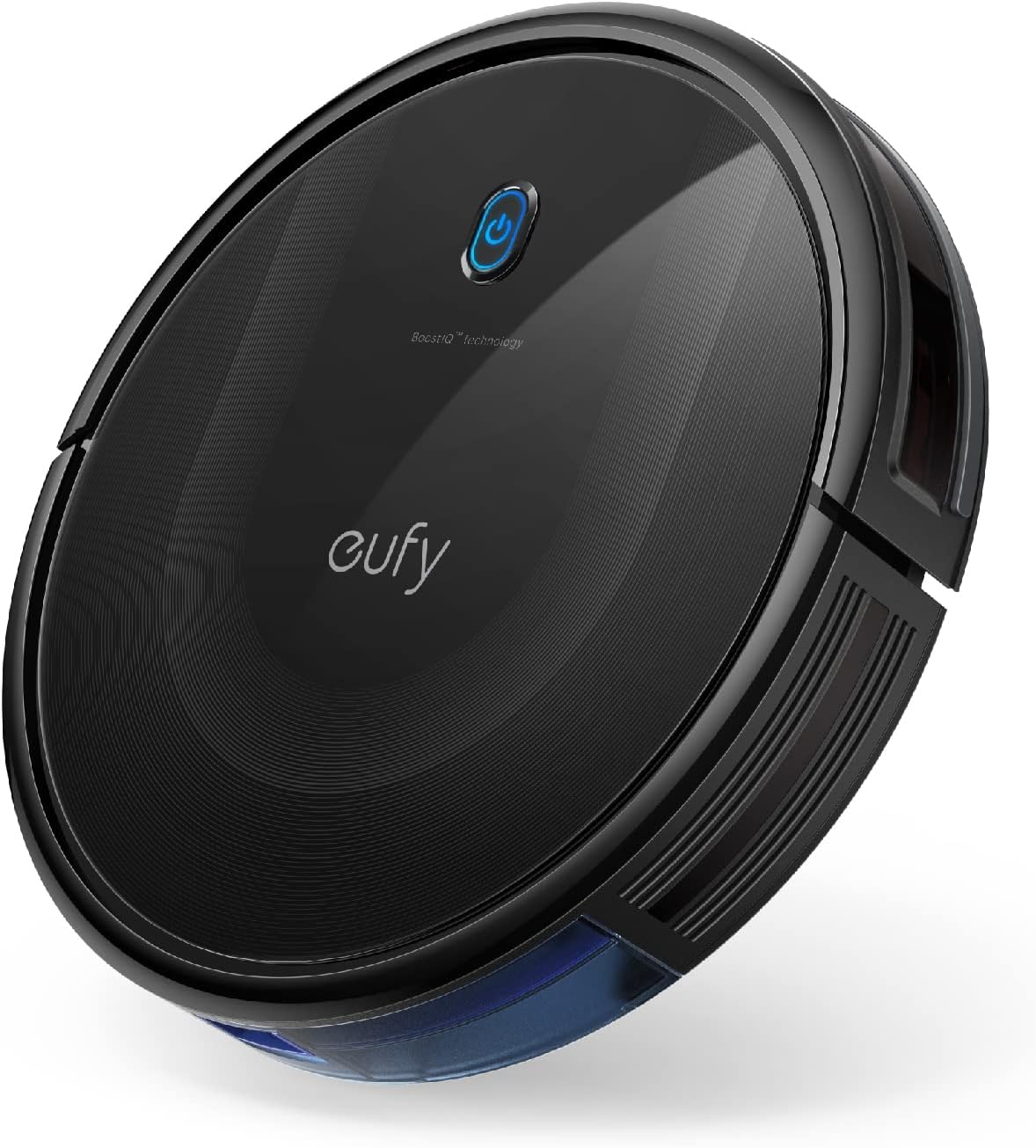
eufy 11S Max Robot Vacuum
| Surface Recommendation | Hard Floor & Tile & Medium carpet |
|---|---|
| Battery Life | 100 minutes |
| Suction Power | 2000 Pa |
| Capacity | 600 ml |
| Noise Level | 55 db |
The eufy 11S Max is a low-profile robot vacuum built to clean hard floors and medium-pile carpets without drawing attention. Its 2.85-inch slim body lets it slide under low furniture while 2000Pa suction and a 12.8-inch cleaning path pick up dust, crumbs, and pet hair. It runs up to 100 minutes on hardwood at a reported low 55 dB, and automatic return-to-base means it tops off battery without user intervention. Controls are simple: the included remote and onboard buttons let you start, stop, and switch modes quickly, though there is no Wi-Fi or app control. Practical touches include washable filters, drop-sensing and anti-collision sensors, and a 600 ml dust capacity that reduces how often you empty the bin. The trade-offs are straightforward: navigation is basic rather than lidar or map-based, so room coverage is more random and may miss tight corners, and the single-side-brush design can be less thorough along edges compared with dual-brush models. For routine, quiet cleaning of hardwood, the 11S Max balances strong suction and a slim profile in a simple, reliable package.
Best for: Buyers who prioritize a quiet, no-frills robot that cleans hardwood reliably and fits under low furniture will appreciate this model for regular maintenance cleaning.
Less Ideal for: If you want mapped cleaning, smartphone scheduling, or the most thorough edge-cleaning for complex floorplans, choose a model with advanced navigation and app control instead.
- Slim 2.85" profile reaches under low furniture
- Up to 100 minutes runtime for extended cleaning sessions
- Powerful 2000Pa suction for effective pickup on hard floors
- Quiet operation at about 55 dB suitable for daytime or evening use
- Large 600 ml dust capacity and washable filter lower maintenance frequency
- Random navigation rather than mapping can lead to uneven coverage
- No Wi‑Fi or smartphone app means limited scheduling and remote control options
Verdict: A slim, quiet robot with strong suction made for routine hardwood maintenance when you want reliable, no-frills cleaning.
Choosing the Right Robot Vacuum Without Internet: Key Factors to Consider
Navigation System and Mapping
How a robot vacuum navigates determines how effectively it cleans without supervision. Offline units may use simple random bounce algorithms, line-following sensors, or local SLAM that runs on the device rather than in the cloud. Random-pattern robots can still work well in small, uncluttered rooms but often miss spots and take longer. Systematic or locally processed mapping delivers more predictable coverage and shorter run times because the vacuum remembers room boundaries and avoids repeating areas.
For buyers focused on offline operation, check whether the vacuum stores maps locally and lets you set no-go lines or room schedules without an online account. Also consider obstacle sensors and cliff detection; better sensing reduces the chance of stuck runs, which is especially important when you cannot intervene remotely.
Suction Power and Brush Design
Suction rating and the design of the main brush determine pickup on hard floors and different carpet piles. Higher airflow and well-designed brushes lift embedded dirt and pet hair more effectively, reducing the need for repeated passes. Brushrolls with anti-tangle features or rubberized fins help with hair management and reduce maintenance frequency.
Since you may not have app-based boost modes or surface-aware profiles, look for vacuums that have reliable default cleaning power or simple onboard modes for carpets and hard floors. Physical settings or multi-step cleaning cycles let you adapt performance without relying on remote controls.
Battery Capacity and Auto-Recharge Behavior
Battery capacity affects how much floor area a robot can cover per run and whether it needs to return to base mid-clean. For offline use, predictable battery behavior is crucial because you cannot monitor runs remotely. A larger battery and efficient pathing reduce the chance of partially cleaned rooms. Auto-recharge and resume features that operate locally allow the robot to finish a job in multiple segments without intervention.
Also consider actual runtime in real-world conditions rather than manufacturer runtime claims. Units that perform well on mixed surfaces and promptly return to the dock when low on power will complete cleaning cycles more reliably in homes without constant oversight.
Local Controls and Scheduling
When you choose an offline robot, local controls become the primary way to start jobs and set routines. Some models provide onboard buttons for start, spot clean, and dock, plus physical timers or remote controls that do not require network access. Others include basic onboard programming that stores recurring schedules in internal memory.
Evaluate whether the scheduling interface is intuitive and flexible enough for your needs. If you want weekday schedules for multiple rooms, confirm the vacuum can store those schedules locally. Remote controls that transmit IR or RF are a useful alternative when apps are not an option.
Maintenance Ease and Consumables
Maintenance affects long-term ownership experience, especially when you cannot access vendor help via an app. Look for easy-to-remove dustbins, washable filters, and brush access that does not require tools. Clear service indicators on the robot itself make it easier to address clogs and replace parts on schedule.
Also consider the availability and lifespan of consumables like filters, side brushes, and replacement brush rolls. Models that use common-size filters or standard parts simplify upkeep and lower the chance of downtime.
Noise Levels and Runtime Comfort
Noise matters if you plan to run the robot while you are at home. Offline vacuums without app control are often run manually or on a schedule, so their sound profile during typical runtime should fit your household routine. Measured decibel levels and perceived loudness affect whether you can work, sleep, or have conversations while the unit runs.
Also account for how noise changes with suction modes. A quieter baseline that still cleans effectively may be preferable to a loud high-suction mode that you rarely use because it is disruptive.
How Offline Navigation Affects Coverage
Offline navigation approaches have distinct tradeoffs. Simple random or wall-following algorithms require less processing and are robust in homes with few obstacles, but they are less efficient and can miss corners. Local mapping that runs on the robot provides many of the benefits of cloud-based mapping—like room-by-room cleaning and systematic passes—without sending data off the device.
If you have a complex floorplan, pay attention to how the robot stores and recalls maps locally. For straightforward layouts, a well-tuned random pattern can still provide acceptable results when paired with adequate suction and runtime.
- Random-pattern navigation: low-tech, works in simple spaces
- Onboard SLAM: systematic cleaning without cloud dependence
- Wall-following and edge-clean modes improve corner pickup
- Local no-go settings are ideal for offline room control
Setting Up and Scheduling Without an App
Many offline robots include physical remotes or onboard scheduling that let you program recurring cleanings. Setup typically involves positioning the dock, charging the unit, and teaching the robot its initial boundaries through manual runs or simple perimeter markers.
Look for models that retain schedule information during power cycles and that provide clear status LEDs or audible confirmations. If you plan to rely entirely on local controls, test whether the clock and schedule survive a battery drain or a manual restart.
- Onboard buttons for start, spot, and dock
- Infrared or radio remotes as app-free control options
- Local schedule memory that persists through power cycles
Pet Homes and Hair Management Offline
In households with shedding pets, hair management is a top concern. Offline robots that combine higher airflow with tangle-resistant brush designs and a large dustbin will reduce how often you intervene. Solid suction and a rubberized brush can prevent hair wrap better than nylon bristles in many cases.
Also consider how easy it is to clean the brush and empty the bin without tools. Clear access and washable parts make maintenance faster when you do not have app-based maintenance reminders.
- Wide mouth dustbins minimize clogs from hair
- Anti-tangle brush designs lower brush maintenance
- Accessible filters and washable parts speed upkeep
Troubleshooting and Offline Diagnostics
When a robot lacks cloud connectivity, the troubleshooting workflow is local. Good offline models provide clear LED codes, audible error tones, or display panels that indicate why a run stopped. Basic error feedback helps you resolve stuck wheels, brush jams, or blocked filters without needing online support.
Keep the user manual handy and learn common reset procedures. A model with straightforward error signals and an easy-to-remove belly pan will save time when you need to clear a sensor or replace a brush.
- LED/error codes for common faults
- Simple reset and recovery procedures
- Accessible components for quick fixes
Integrating Offline Robots Into a Smart Home
Even without Internet connectivity, some robots can coexist with smart-home setups via local remotes, RF plugs, or infrared hubs. If you want limited automation, consider a vacuum that can be powered on or off by a local timer or integrated into a non-cloud automation controller.
Avoid solutions that require cloud-based bridges for basic automation. Local integration keeps routines reliable and preserves the offline privacy benefits that motivated your choice.
- Power scheduling via local timers or smart plugs
- Infrared hubs that operate devices locally
- Avoid cloud bridges for basic automation
How We Chose the Best Robot Vacuum Without Internet
We prioritized robots designed to operate independently of cloud services and mobile accounts, focusing on features that matter for offline, everyday use. Key evaluation criteria included navigation reliability, defined as how well the vacuum maps or follows systematic routes without requiring online processing; cleaning effectiveness across hard floors and common carpets; battery life and recharge behavior to ensure coverage of typical living spaces; and ease of use, covering onboard controls, scheduling without an app, and simple physical interfaces. Durability and maintenance were also considered, including filter and brush access, replacement part availability, and straightforward troubleshooting without vendor support. We excluded robots that require mandatory cloud activation, persistent Internet connections, or account sign-ins for basic operation. Our shortlist favors machines that let you start cleaning, set schedules, and maintain performance using only local controls or optional offline modes.
Our full evaluation process is outlined in our review methodology.
FAQ
Can a robot vacuum work well without Wi-Fi?
Yes. Many robot vacuums are designed to operate entirely offline using onboard controls, a physical remote, or local mapping. Performance varies by navigation method and battery life, but basic cleaning functions do not require Wi-Fi.
How do I set schedules if the vacuum has no app?
Offline vacuums typically offer onboard scheduling, physical remotes, or built-in timers. Check that schedule memory persists through power cycles and that the control interface supports the frequency and timing you need.
Will a robot without Internet still map my home?
Some offline models perform mapping locally using onboard processors, enabling room-based cleaning and systematic passes without cloud services. Other basic models use random or wall-following patterns and do not create persistent maps.
Are offline robots harder to maintain?
Not necessarily. Offline robots can be easier to maintain because they rely on straightforward local diagnostics rather than app-based alerts. The important factors are accessible filters, easy brush removal, and clear error indicators on the unit.
Can I integrate an offline robot into automation systems?
Yes, but integration is usually limited to local methods such as power timers, infrared hubs, or RF controllers. Avoid solutions that require cloud bridges if you want to remain fully offline.
Final Verdict
Choosing an offline robot vacuum narrows the field to models that emphasize reliable local control, sturdy navigation, and easy maintenance. Prioritize navigation that matches your floorplan, sufficient suction for your surface types, and onboard scheduling or a physical remote so you can run cleanings without cloud services. Balance battery runtime against your home size and favor machines with simple, serviceable components to minimize downtime. With those tradeoffs in mind, you can confidently pick a robot vacuum that delivers automated cleanliness while keeping your network and data preferences intact.