
Note: This article contains affiliate links. If you click on these links and make a purchase, we may earn a small commission at no extra cost to you. This helps support our research and content. Read our full affiliate disclosure here.
If you want to cut down on daily sweeping and emptying chores, a self-emptying robot vacuum can deliver a hands-off clean with minimal upkeep. These vacuums automatically deposit collected dirt into a docking station, reducing how often you need to handle dust and pet hair. This guide covers our top shortlisted self-emptying robot vacuums for everyday homes. We evaluated each option on practical criteria that matter to daily use, including suction performance, dust-bin capacity at the dock, navigation reliability, and upkeep needs. Read on to see which designs fit different floor plans and cleaning priorities.
Top Picks at a Glance
| Best Overall The best all-around choice for most situations | Shark AV2501AE Robot Vacuum |  |
| Best Quality Built to a higher standard if you want something more solid | roborock Saros 20 |  |
| Best Value The sweet spot between price and what you get | iRobot Roomba 105 Vac |  |
| Top Rated A top-rated pick with lots of positive feedback | ILIFE A30 Pro Robot Vacuum |  |
| Most Popular A crowd favorite that many people choose with confidence | roborock Q10 S5+ |  |
| Best Seller A high-volume bestseller chosen again and again | eufy C28 Robot Vacuum & Mop |  |
Shark AV2501AE Robot Vacuum

| Filter Type | HEPA |
|---|---|
| Battery Life | 120 minutes |
| Other Special Features of the Product | Bagless, LiDAR Navigation |
| Controller Type | App Control, Voice Control |
| Recommended Uses For Product | Cleaning homes with pets, Carpet, Hard Floor |
The Shark AV2501AE is a self-emptying robot vacuum that uses LiDAR-based Precision Home Mapping and Matrix Clean Navigation to methodically cover rooms and take multiple passes where dirt accumulates. It pairs a self-cleaning brushroll and strong suction with a bagless XL HEPA base that holds up to about 60 days of debris while capturing fine particles. You control cleaning through the app, voice assistants, or scheduled runs, and the robot can recharge and resume to finish larger jobs thanks to its 120-minute runtime. In practice the LiDAR mapping and object avoidance make navigation reliable day or night, and the HEPA base is a clear benefit for homes with shedding pets or allergy concerns. The main compromises are the unit weight and footprint compared with no-base models and the need to empty or maintain the base and brushes periodically, but for buyers prioritizing hands-off maintenance and complete floor coverage the AV2501AE delivers a strong, practical mix of features.
Best for: Buyers who want a low-maintenance, whole-home cleaning solution that reliably maps and repeats passes for deeper cleaning and captures allergens without constant bin emptying.
Less Ideal for: People who need the smallest, lightest robot or who prefer a model without a self-emptying base or the occasional maintenance tasks that come with one.
- LiDAR Precision Home Mapping and Matrix Clean Navigation for methodical, repeat-pass cleaning
- XL bagless HEPA self-empty base with roughly 60-day capacity traps fine dust and allergens
- Up to 120 minutes runtime with recharge-and-resume for whole-home jobs
- Self-cleaning brushroll and strong suction that handle pet hair and mixed floor types
- App and voice control for scheduling and hands-free operation
- Larger, heavier unit and base compared with simpler robot vacuums
- Requires periodic base and brush maintenance despite long self-empty intervals
Verdict: Choose the AV2501AE if you want a self-emptying robot that prioritizes thorough, mapped cleaning and HEPA-level allergen capture with minimal daily intervention.
roborock Saros 20

| Suction | 36,000 Pa |
|---|---|
| Battery Life | 180 minutes |
| Filter Type | Washable Filter |
| Control Type | App, Remote, Voice |
| Noise Level | 55 db |
The roborock Saros 20 is a high-performance robot vacuum and mop designed to handle pet hair, deep carpet cleaning, and multi-room homes with minimal user intervention. It uses a 36,000 Pa digital motor for strong suction, an AdaptiLift chassis that raises the body to cross thresholds and clean deep carpets, and an ultra-slim profile that reaches under low furniture. Navigation is driven by StarSight 3D sensors and an RGB camera to detect hundreds of obstacle types and build accurate maps for targeted cleaning via the Roborock app. The RockDock base adds hands-free maintenance with hot water mop washing, hot-air drying, and up to 65 days of automatic dust emptying for long stretches between service. In practice this means fewer interruptions, thorough edge and corner cleaning thanks to FlexiArm, and effective hair management from a dual anti-tangle system. Trade-offs include a relatively high noise level during powerful modes and a large, heavier unit compared with compact budget robots, so it is best where raw cleaning power and autonomy matter more than absolute quiet or ultra-compact size.
Best for: Buyers who prioritize raw cleaning performance and long stretches of hands-free maintenance in homes with pets, carpets, and many thresholds will appreciate this model.
Less Ideal for: Those seeking the quietest or smallest robot for tight spaces or strictly budget-focused shoppers should consider other options.
- Very strong 36,000 Pa suction for deep pickup on carpets and gaps
- Adaptive lift chassis crosses high thresholds and raises for carpet cleaning
- StarSight 3D sensors and RGB camera reduce collisions and improve mapping
- RockDock base provides hot-water mop wash, hot-air dry, and long auto-empty intervals
- Dual anti-tangle system and FlexiArm improve pet hair handling and edge reach
- Noticeable noise in high-suction modes
- Physically large and heavier than many compact robot vacuums
Verdict: Choose the Saros 20 if you want a high-suction, self-emptying robot that prioritizes powerful deep cleaning and long autonomous operation.
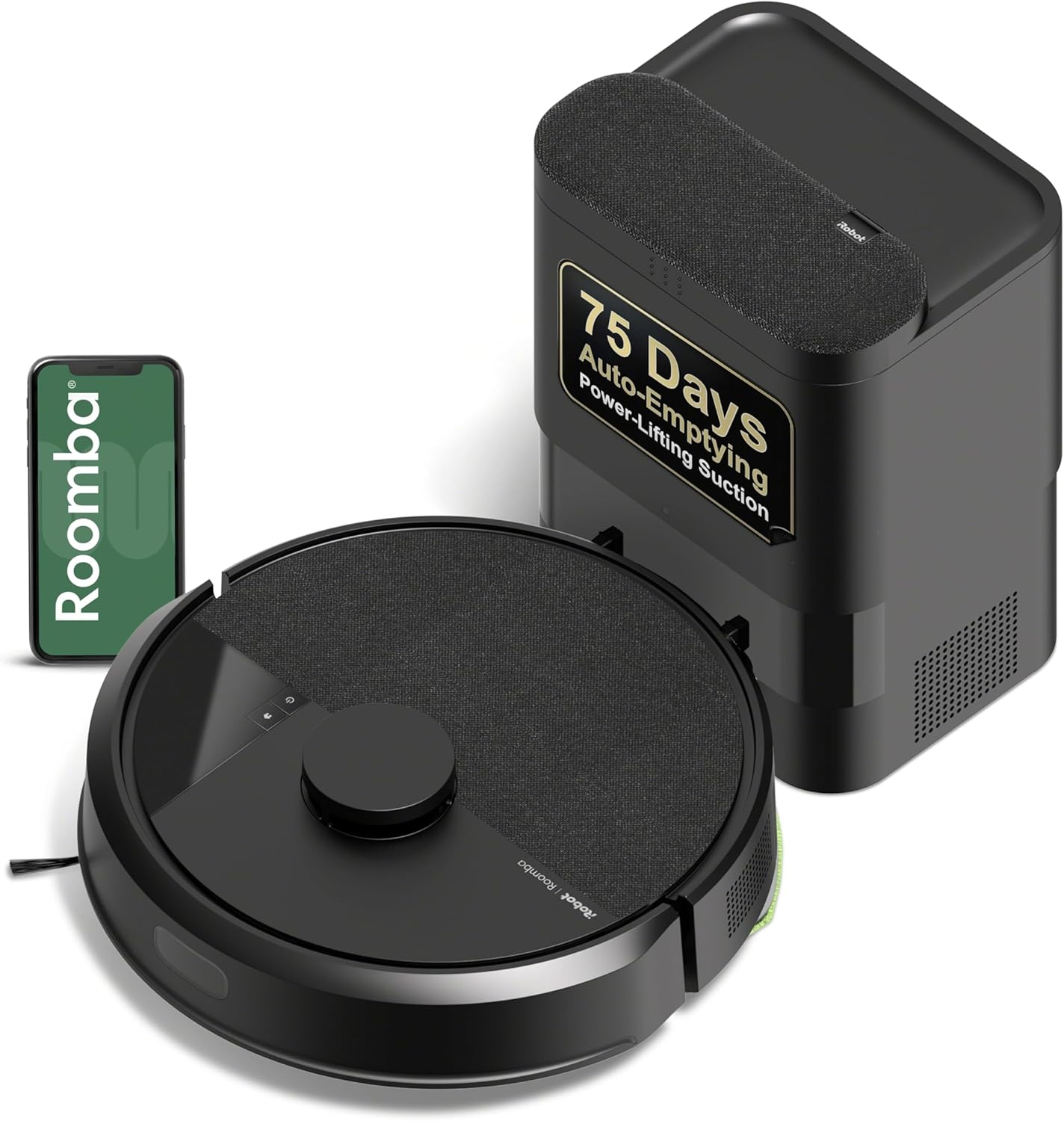
iRobot Roomba 105 Vac
| Battery Life | 200 minutes |
|---|---|
| Surface Recommendation | Carpet & Hard Floor |
| Control Method | App, Push Button, Voice |
| Capacity | 0.1 gallons |
| Filter Type | Cartridge |
The Roomba 105 Vac pairs a compact robot vacuum with a hands-free AutoEmpty dock to reduce how often you handle dirt. It uses ClearView LiDAR to map rooms and clean in neat rows, and the three-stage system combines a multi-surface brush, edge-sweeping brush, and high-suction motor for stronger pickup on carpets and hard floors. Control comes via the Roomba Home app, onboard buttons, or voice assistants for scheduled, spot, or targeted room cleans, and the dock's disposable bag traps allergens while storing up to 75 days of debris. Practical maintenance is straightforward: wipe the bin, clean brushes occasionally, and replace the cartridge filter per the schedule. Limitations to note are that this model focuses on vacuuming only (no mop function) and it requires a 2.4 GHz network for setup and operation, which may complicate some Wi-Fi environments. The robot's smaller cleaning path and compact size make it best for regular upkeep rather than heavy-duty deep-cleaning of very large homes in a single run.
Best for: Buyers who want a low-maintenance vacuuming solution that reduces daily chores and prefer scheduled, app-driven cleaning with reliable navigation.
Less Ideal for: Homes needing combined vacuum-and-mop cleaning or users who want a single device to deep-clean very large areas without frequent recharge cycles.
- AutoEmpty dock holds debris for up to 75 days to minimize manual emptying
- ClearView LiDAR mapping enables orderly navigation and room targeting
- Three-stage cleaning with multi-surface and edge brushes improves pickup on carpets and hard floors
- Multiple control options: app, push button, and voice assistants
- No mopping capability; vacuum-only model
- Requires a 2.4 GHz Wi-Fi network for setup and operation
Verdict: Choose the Roomba 105 Vac if you want a reliable, self-emptying robot that minimizes hands-on maintenance and keeps daily floors tidy with mapped, targeted cleaning.
ILIFE A30 Pro Robot Vacuum

| Max Suction | 10000 Pa |
|---|---|
| Battery Life | 150 minutes |
| Dust Capacity | 2.5 liters |
| Filter Type | Hepa |
| Power Source | Battery Powered |
The ILIFE A30 Pro is a self-emptying robot vacuum and mop designed for low-effort maintenance on mixed floors. It uses LiDAR mapping and the SLAM algorithm to build accurate maps, let you set no-go zones, and run targeted room cleaning from the ILIFEClean app or voice/remote controls. The unit offers four suction levels up to a stated 10000 Pa and a 2-in-1 dust and water module so it can vacuum and mop simultaneously. A dedicated self-emptying base with 2.5 L disposable bags automates dirt disposal for long intervals between maintenance. Run time is listed at 150 minutes, which is enough for most single-level homes, and the included HEPA filter helps trap fine dust. Practical limitations include the use of disposable dust bags rather than a washable bin and the 2.4 GHz Wi-Fi requirement for smart features, which may complicate setup on some networks. The A30 Pro works best for routine, hands-off cleaning where mapping accuracy and an extended self-emptying interval are priorities.
Best for: Buyers who prioritize reliable, low-maintenance cleaning and want accurate mapping and long intervals between manual emptying for regular upkeep of mixed floor homes.
Less Ideal for: People who prefer a reusable dust bin to avoid ongoing bag purchases or who need multi-band Wi-Fi smart device support.
- LiDAR navigation with SLAM for accurate mapping and efficient coverage
- Self-emptying base with 2.5 L disposable bags for extended hands-free operation
- Combined vacuum and mop module allows simultaneous cleaning without swapping tanks
- Multiple suction modes up to high-power setting to tackle pet hair and debris
- HEPA filter for finer dust capture
- Relies on disposable dust bags rather than a reusable bin
- Smart features require 2.4 GHz Wi-Fi which may not work with all routers
Verdict: Choose the A30 Pro if you want accurate LiDAR mapping plus a long-interval self-emptying system for hands-off, reliable floor care.
roborock Q10 S5+

| Maximum Suction | 10,000 Pa |
|---|---|
| Capacity | 2.7 liters |
| Battery Life | 150 minutes |
| Filter Type | Washable |
| Compatible Devices | Amazon Echo, Google Home, Smartphones |
The roborock Q10 S5+ is a high‑capacity robot vacuum and mop designed for long stretches of hands‑free cleaning. It pairs precise LiDAR mapping and ReactiveTech obstacle avoidance for efficient navigation and multi‑level maps, while the 2.7 L auto‑empty dock can hold weeks of debris to reduce maintenance. In practice the VibraRise 2.0 sonic mopping scrubs hard floors and the system automatically lifts the mop and boosts suction on carpets to avoid wetting. Dual anti‑tangle brushes and strong 10,000 Pa suction make it effective at pulling pet hair and embedded dirt from carpets. Control is via the Roborock app, voice assistants, or onboard buttons, and you can set no‑go zones and emptying modes for tailored routines. Trade‑offs are typical for powerful robot combos: it is relatively loud at higher suction levels and the sonic mop adds complexity compared with a vacuum‑only unit, and only 2.4 GHz Wi‑Fi is supported. For buyers prioritizing low maintenance and thorough cleaning across floors, it delivers a convincing hands‑free experience.
Best for: Buyers who want a low‑maintenance, self‑emptying robot that reliably cleans mixed flooring and reduces hands‑on upkeep, especially households with pets or busy schedules seeking social‑proof performance.
Less Ideal for: People who prioritize ultra‑quiet operation or who need dual‑band Wi‑Fi compatibility should consider other options.
- Large 2.7 L auto‑empty dock reduces how often you need to empty the bin
- 10,000 Pa suction with automatic carpet boost for stronger cleaning where needed
- LiDAR navigation and multi‑level mapping produce accurate, repeatable cleaning routes
- VibraRise 2.0 sonic mopping with auto mop lift for scrubbing hard floors without wetting carpets
- Dual anti‑tangle brush design reduces hair buildup and maintenance
- Higher suction and mopping functions can be noticeably loud
- Only supports 2.4 GHz Wi‑Fi which may limit some network setups
Verdict: If you want a truly low‑touch cleaning setup with powerful suction and reliable LiDAR navigation, the Q10 S5+ is built to keep multi‑floor, pet‑friendly homes cleaner with minimal intervention.
eufy C28 Robot Vacuum & Mop

| Suction | 15,000 Pa |
|---|---|
| Capacity | 3 liters |
| Battery Life | 140 minutes |
| Filter Type | Washable |
| Control Method | App, Push Button, Voice |
The eufy C28 is a self-emptying robot that combines vacuuming and active mopping for homes with pets and mixed floors. It navigates with LiDAR to map rooms and avoid obstacles while a 15,000 Pa turbo suction boosts carpet pickup and the DuoSpiral roller resists hair tangles. The included Omni station automates maintenance by emptying dust into a 3 L collection, hot-washing and drying the mop, and collecting wastewater so the robot can run unattended for up to about 75 days between major tasks. The HydroJet roller spins and scrapes to remove paw prints and dried spills rather than just smearing them, and the mop auto-lifts on short carpets. Battery life and a washable filter support extended, repeated cleans. Downsides are the unit size and weight implied by the all-in-one station and robot, and its heavier reliance on the station for the hands-free promise means you need space for the base and occasional consumables like collection bags and cleaning solution.
Best for: Buyers who want a low-maintenance, hands-off cleaning solution for pet-friendly homes and mixed hard-floor and short-carpet layouts and prioritize automated upkeep over minimal upfront footprint.
Less Ideal for: People with very small homes, tight storage, or who need a compact robot without a large station or who prefer minimal ongoing consumable costs.
- Self-emptying 3 L Omni station that auto-washes and hot-dries the mop
- Strong 15,000 Pa suction for picking up pet hair and debris
- HydroJet roller mop with scraper for active cleaning of spots and paw prints
- Zero-tangle DuoSpiral brush reduces manual brush maintenance
- LiDAR navigation with obstacle avoidance and automatic mop lift on carpets
- Requires floor space and installation for the Omni station
- Ongoing cost and replacement of collection bags and mop consumables
- Larger, heavier system compared with simple robot-only units
Verdict: If you want a largely hands-free vacuum-and-mop system that handles emptying, mop washing, and drying for weeks at a time, the eufy C28 is a strong choice.
Choosing the Right Self-Emptying Robot Vacuum: Key Factors to Consider
Suction Strength and Pickup Performance
Stronger suction and effective brush design determine how well the robot removes embedded dirt, pet hair, and fine dust from carpets and hard floors. Suction matters more on deep-pile carpets and in homes with shedding pets, where the robot must overcome fibers and move debris into the internal bin.
Consistent pickup across floor types reduces the need for manual spot-cleaning and repeat passes. When evaluating suction, also consider how the dock's emptying mechanism transfers collected debris from the robot to the sealed container; poor transfer can negate high onboard suction.
Capacity and Dock Emptying Frequency
The docking station's dustbin capacity sets how often you must service the system. Larger dock containers let the robot run for weeks between emptying events, which is the main convenience benefit of a self-emptying design.
Think about household size and mess patterns: a one- or two-person home with minimal shedding needs far less emptying than a multi-person home with pets. Also consider how consistently the dock captures fine dust and whether it seals well to limit airborne dust during disposal.
Navigation Accuracy and Coverage
Reliable mapping and obstacle avoidance determine how much of your floor gets cleaned on the first pass and whether the robot avoids getting stuck. Accurate navigation reduces redundant cleaning, saves battery, and ensures predictable schedules.
Look for robots that support room mapping, zoned cleaning, and multi-floor profiles if you have multiple levels. Good navigation also minimizes the number of times the robot needs human rescue, which preserves the low-maintenance promise of self-emptying systems.
Battery Runtime and Recharge Behavior
Battery capacity and the robot's ability to resume a job after recharging affect effective cleaning time on larger homes. Longer run times mean fewer mid-clean returns to the dock and faster completion of scheduled jobs.
Consider how the robot handles recharge-and-resume cycles and whether it can finish a cleaning map after topping up. Efficient power management also reduces wear on the battery over time, which impacts long-term convenience.
Ease of Upkeep and Consumable Access
Even self-emptying robots require regular tasks like removing hair from brushes, changing filters, and replacing the dock waste bag or emptying its canister. Easier access to brushes and a straightforward filter replacement process reduces the time you spend on maintenance.
Check how intuitively parts detach and whether replacement consumables are standard shapes. The fewer special tools or awkward procedures required, the closer the system will be to truly low-effort operation.
Dust Containment and Allergy Considerations
How well the dock seals and contains dust during transfer and disposal is important for allergy sufferers and for avoiding dusty air when servicing the bin. A sealed transfer system or bagged dock decreases airborne particles compared with open canister designs.
Evaluate the dock's sealing, the bag-change procedure, and whether the system includes HEPA or high-efficiency filters to trap fine particulates. Good containment reduces cleaning after disposal and supports indoor air quality.
How Self-Emptying Docks Work
Self-emptying docks use a vacuum or mechanical agitation to pull debris from the robot's internal bin into a larger container at the docking station. The dock is activated automatically when the robot returns after a run or reaches a fill threshold, so the robot can resume cleaning with an empty onboard bin.
Different docks handle the transfer differently. Some use sealed bags to trap dust, while others collect into a removable canister. The transfer method affects how often you must touch dust and how much containment you can expect during disposal.
- Automatic transfer reduces daily emptying to once every few weeks for many households.
- Sealed bags generally offer better dust containment but add a consumable to replace.
- Canister-style docks avoid bags but may require more careful emptying to avoid dust exposure.
Maintenance Routines That Keep the System Low-Work
Even the most autonomous robots need simple routine care to stay effective. Weekly checks usually include emptying the dock when full, inspecting brushes for hair wrap, and tapping or replacing filters on a recommended cadence.
Set a calendar reminder for basic tasks and rotate deeper maintenance tasks monthly. Doing small steps regularly prevents performance decline and keeps the robot running without requiring long service sessions.
- Brushes and rollers: remove hair and debris every 1 to 2 weeks depending on shedding.
- Filters: inspect weekly and replace according to manufacturer guidance, often every 2 to 6 months.
- Dock bin or bag: check capacity monthly and replace or empty when indicated.
Setting Up Zones and Scheduled Cleaning
Mapping features let you define rooms, restricted zones, and no-go lines. Use them to prioritize high-traffic areas and avoid fragile items or pet bowls. Scheduled routines can run overnight or during work hours to keep floors consistently tidy without manual starts.
For best results, run several mapping cycles initially so the robot learns furniture positions and common obstacles. Fine-tune zones based on missed spots or recurring trouble areas.
- Create a high-frequency schedule for entryways and living rooms, lower frequency for guest rooms.
- Use no-go lines to protect cluttered areas or cords.
- Name and save room maps for easy one-touch cleaning sessions.
Managing Pet Hair and High-Shed Households
Homes with dogs or cats benefit most from stronger suction, tangle-resistant brush systems, and larger dock capacity. Hair can quickly fill small bins and wrap around rollers, so choose configurations that simplify hair removal.
Consider increasing cleaning frequency and using scheduled empty cycles during peak shedding seasons. Plan for more frequent filter changes and bag or canister servicing in heavy-shed households.
- Increase cleaning cadence to prevent hair buildup in brush bearings.
- Inspect roller bearings and brush mounts monthly for entanglement.
- Select docks with higher capacity to lengthen time between interactions.
Noise and Daily Living Considerations
Self-emptying systems add occasional dock noise during the empty cycle. If noise during daytime or night is a concern, check how loud the dock is when active and whether you can schedule emptying for less disruptive times.
Robots themselves vary in noise depending on suction mode. Use quieter modes in the evening or when people are home, and stronger modes when the house is empty for deeper cleaning.
- Schedule deep or turbo clean modes during work hours or away times.
- Place the dock in a semi-enclosed area to dampen empty-cycle noise.
- Test quiet modes on hard floors to see if their pickup meets your needs.
How We Chose the Best Self-Emptying Robot Vacuum
We focused on features and real-world behaviors that determine how little time you spend maintaining the system and how well it cleans between deep cleans. Our selection emphasized measurable performance factors like sustained suction power, reliability of the auto-empty docking mechanism, run time and recharge behavior, and ease of maintenance for brushes and filters. We also considered navigation and mapping features that reduce missed areas and unnecessary re-runs, plus how well the docking system contains dust to limit exposure during empty cycles. Excluded items included robots that lack an integrated self-emptying dock, units with unserviceable filters or brushes, and designs whose maintenance workflow requires frequent hands-on intervention. We prioritized products that balance cleaning effectiveness with low ongoing chores, and we favored solutions with clear documentation for routine upkeep. The resulting shortlist represents models that deliver dependable autonomous cleaning while keeping dust handling simple and sanitary.
Our full evaluation process is outlined in our review methodology.
FAQ
How often will I need to change the dock bag or empty the dock container?
Frequency depends on household size and shedding. Many homes can go several weeks between changes, but heavy-shed households may need to service the dock every 1 to 2 weeks. Check the dock indicator and your cleaning cadence to set a schedule that avoids overfill.
Will a self-emptying robot vacuum still need brush and filter maintenance?
Yes. The robot's brushes, rollers, and filters require periodic attention to maintain performance. Self-emptying reduces how often you touch collected dust, but routine brush detangling and filter replacement remain important for effective cleaning.
Are self-emptying docks better for allergy sufferers?
They can be, especially if the dock uses sealed bags and high-efficiency filters. These features reduce airborne dust during disposal. Still, proper protocol when changing bags and choosing models with strong containment are important to minimize exposure.
Does the dock affect the robot's runtime or performance?
The dock itself does not change in-run suction, but the emptying behavior can influence when the robot returns to the dock and resumes cleaning. Reliable auto-emptying helps maintain peak onboard capacity across sessions, which supports consistent performance over time.
Can these robots handle multiple floors in my home?
Many robots support multi-floor mapping but typically require manually moving the robot and dock setup between floors or creating separate map profiles. Check whether the unit supports saved maps and how it handles recharging and resume behavior across different floor plans.
Final Verdict
A self-emptying robot vacuum reduces routine chores by minimizing how often you handle dust and debris, but true low-maintenance ownership depends on matching features to your household. Prioritize strong and consistent suction if you have carpet or pets, and choose a dock with the capacity and containment level that fits your allergy and servicing preferences. Balance navigation accuracy, battery endurance, and upkeep ease to find the best fit for your home. With the right combination of those factors, you can automate most floor care and limit hands-on maintenance to simple, periodic tasks.