
Note: This article contains affiliate links. If you click on these links and make a purchase, we may earn a small commission at no extra cost to you. This helps support our research and content. Read our full affiliate disclosure here.
If you sew regularly, a self-threading serger sewing machine can shave minutes off every project and reduce frustration from fiddly loopers. These machines streamline thread routing so you spend less time threading and more time finishing seams, rolled hems, and decorative edges. In this guide we shortlisted the top options that balance reliable stitch quality, straightforward threading, and practical features for home sewers. Below you will find compact picks chosen for easy setup and consistent results, plus clear buying criteria to help you choose based on the way you sew. The list focuses on units that simplify looper threading while keeping common serger capabilities intact.
Top Picks at a Glance
| Best Overall The best all-around choice for most situations | Janome 8002D Overlock Machine |  |
| Best Quality Built to a higher standard if you want something more solid | Janome MyLock 634D |  |
| Best Value The sweet spot between price and what you get | Juki MO-50E Serger |  |
| Best Budget The cheapest option that still gets the job done reliably | FEIYUE FY505 Serger |  |
| Top Rated A top-rated pick with lots of positive feedback | Brother AIR1800 Air Serger |  |
| Most Popular A crowd favorite that many people choose with confidence | SINGER S0230 Serger |  |
| Best Seller A high-volume bestseller chosen again and again | Brother 1034D Serger |  |
Janome 8002D Overlock Machine
| Power Source | ac |
|---|---|
| Material | Metal, Plastic |
| Included Components | Foot Controller, Power Cord, Needle Pack, Screwdrivers, Tweezers, Manual |
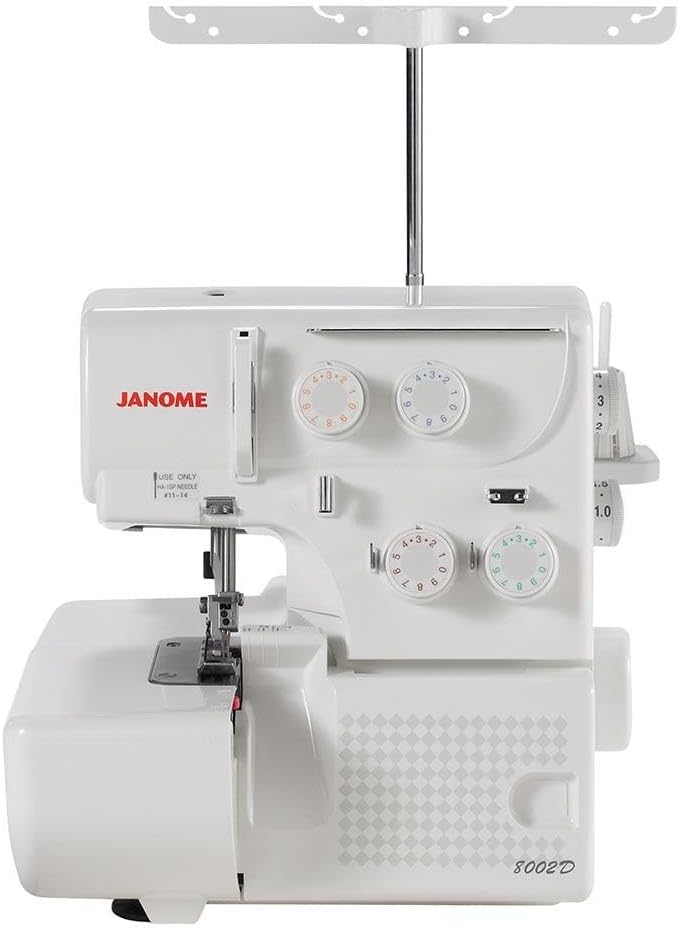
The Janome 8002D is a home serger designed to deliver professional seam finishes by trimming, stitching, and overlocking edges in one pass. It converts between 3- and 4-thread overlock stitches and also makes rolled hems, making it useful for garment construction, knitwear, and lightweight home projects. The adjustable differential feed helps control fabric movement so knits do not stretch and lightweight fabrics do not pucker, and speeds up to 1,300 stitches per minute let you finish seams quickly. Threading and tension are simplified with color-coded guides and clearly marked controls, which shortens setup time and reduces guesswork. The machine is mechanically straightforward and built from metal and plastic components for reliable everyday use. Limitations include a manual serger workflow without advanced auto-threading features and a learning curve for those new to overlocking, and the unit is relatively heavy for moving between workspaces.
Best for: Sewists who want a reliable, fast home serger that produces professional seam finishes and gives control over fabric handling without advanced automated threading features.
Less Ideal for: If you need a lightweight, highly portable machine or require automatic self-threading, this model is not the best choice.
- Converts between 3- and 4-thread overlock stitches for versatility
- Adjustable differential feed for better handling of knits and lightweight fabrics
- Fast sewing speeds up to 1,300 stitches per minute for quick finishing
- Color-coded threading and marked tension controls simplify setup
- Included accessories (foot controller, tools, needle pack) provide ready-to-use setup
- No built-in automatic self-threading feature so threading is manual
- Heavier, less portable unit compared with compact sergers
Verdict: Choose the Janome 8002D when you want a sturdy, fast home serger that delivers professional overlock finishes and strong fabric control.
Janome MyLock 634D

| Power Source | AC |
|---|---|
| Maximum speed | 1,300 spm |
| Differential feed ratio | 0.5 to 2.25 |
| Adjustable stitch length | 1mm to 5mm |
| Adjustable cutting width | 3.1mm to 7.3mm |
The Janome MyLock 634D is a performance-focused serger built for sewists who want professional overlock finishes without a steep learning curve. It delivers 2-, 3-, and 4-thread overlock stitching and includes a lay-in thread tension dial, color-coded thread guides, and an easy lower looper threading system that speeds setup. Adjustable stitch length, differential feed (0.5 to 2.25) and cutting width (3.1mm to 7.3mm) let you fine-tune results for knits, wovens, and rolled hems, while adjustable foot pressure and a retractable upper knife help when working with varying fabric weights. The unit reaches up to 1,300 spm for efficient seaming, and the bonus accessory kit (beading, blind hem, piping feet and extra needles) increases versatility. Practical limitations include its basic control set compared with computerized models and its 20-pound metal construction, which reduces portability. For sewists focused on speed, neat thread management, and precise differential feeding, the 634D balances capability and straightforward operation.
Best for: Sewists who prioritize high-speed, professional overlock finishes and precise feed control and want a straightforward, performance-oriented mechanical serger.
Less Ideal for: If you need a lightweight portable unit or want touchscreen/computerized features, this mechanical model is not the best choice.
- Supports 2-, 3- and 4-thread overlock stitches for a range of seam finishes
- Color-coded guides and easy lower looper threading simplify setup
- Adjustable differential feed and stitch length for handling knits and preventing puckering
- Adjustable cutting width and retractable knife allow rolled hems without plate changes
- Includes accessory kit (beading, blind hem, piping feet) that expands functionality
- No computerized controls or advanced stitch memory
- Relatively heavy metal body reduces portability
Verdict: A durable, performance-oriented mechanical serger that delivers fast, professional overlock finishes with easy self-threading and precise feed adjustment.
Juki MO-50E Serger

| Thread options | 3 or 4 threads |
|---|---|
| Power source | Corded Electric |
| Material | Aluminum |
The Juki MO-50E is a straightforward home serger built on Juki's industrial know-how, offering 3- or 4-thread overlocking with lay-in tensions and a built-in rolled hem. It is typically used to finish garment edges, create narrow hems, and sew stretch fabrics quickly; the automatic lower looper threader noticeably reduces setup frustration when changing threads. Practical controls such as adjustable calibrated knife and differential feed let you control seam finish and prevent wavy or stretched seams, making it useful for knits and lightweight wovens. The machine is corded electric and relatively compact, so it fits a dedicated sewing table or a small craft area. Limitations include a basic lay-in tension system rather than advanced digital tensioning and a no-frills feature set aimed at reliability rather than extensive automated stitch options, so it is best for sewers who want durable, workhorse performance rather than gadget-heavy convenience.
Best for: Buyers who prioritize reliable, workhorse performance and want a self-threading lower looper to speed setup for regular serging tasks in a small home studio.
Less Ideal for: If you want a feature-packed serger with touchscreen controls, automated tensioning, or many decorative overlock stitches, look at higher-end models instead.
- Automatic lower looper threader reduces manual threading time and frustration
- Adjustable calibrated knife for cleaner, customizable edge finishes
- Differential feed helps prevent stretching or puckering on knits
- Built-in rolled hem for quick narrow hem finishes
- Compact footprint suitable for small sewing spaces
- Lay-in tension system lacks the precision of digital tension controls
- Feature set is utilitarian with few advanced automated stitch options
Verdict: Choose the Juki MO-50E when you want a compact, reliable serger with an automatic lower looper and practical controls for everyday garment finishing.
FEIYUE FY505 Serger

| Power Source | Corded Electric |
|---|---|
| Number of Items | 1 |
| Included Components | Embroiderer Plate |
The FEIYUE FY505 is a straightforward serger that handles 2/3/4-thread overlocking and rolled hems while offering a durable metal frame for heavier use. It is typically used to finish garment seams, trim fabric edges, and produce professional-looking hems; the color-coded thread guides and numbered loopers make threading and setup easier for beginners. Notable features include an extra-hard carbon steel blade for clean cutting, an adjustable differential feed and stitch length dial for working with knits and lightweight fabrics, and a portable handle with ventilation for heat dissipation. The unit can run up to 1,100 stitches per minute, which speeds through long projects, though that top speed may be more than a novice needs. Practical limitations are modest tooling and accessory detail compared with higher-end machines and the heavier 13.6 pound weight makes it less convenient to move frequently despite the carry handle. For a budget-focused buyer wanting an entry-level serger with solid cutting and feeding controls, the FY505 delivers capable, no-frills performance.
Best for: Home sewists on a budget who want a capable serger to finish seams and create rolled hems with reliable cutting and feeding controls and who value straightforward setup over premium automation.
Less Ideal for: Professional studios needing the lightest portable unit or fully automated, feature-rich sergers should consider higher-end models with more accessories and advanced automation.
- Supports 2/3/4-thread overlocking and built-in rolled hem for versatile seam finishes
- Durable metal frame and extra-hard carbon steel blade for precise, long-lasting cutting
- Color-coded thread guides and numbered loopers simplify threading for beginners
- Adjustable differential feed and stitch length dial help handle knits and varying fabrics
- Maximum sewing speed up to 1,100 stitches per minute speeds production
- Heavier than some portable sergers, which reduces ease of frequent transport
- Fewer high-end accessories and automated conveniences compared with more expensive models
Verdict: A budget-friendly, no-frills serger that gives home sewists reliable overlocking, clean cutting, and easy threading for everyday garment finishing.
Brother AIR1800 Air Serger

| Power Source | ac |
|---|---|
| Input Voltage | 120 volts_of_alternating_current |
The Brother AIR1800 is a purpose-built air serger that speeds threading with one-touch jet air looper technology while delivering common serger stitches like 2/3/4-thread overlock, flatlock, and rolled hems. It is used for finishing seams and edge treatments on knits, stretchy fabrics, and garment projects where clean, durable edges matter; the machine trims and finishes in one pass and offers adjustable stitch width/length and differential feed for handling lightweight to stretch fabrics. Notable conveniences include the one-touch needle threader, color-coded thread guides for multi-thread setups, quick-change levers for rolled hems, a knife lock lever to engage or disengage cutting, and a bright LED work area plus an error LED for basic safety checks. The AIR1800 runs up to 1,300 stitches per minute and is described as moderately noisy. Trade-offs are its size and weight for a home studio and that it is intended for 120V US use only; advanced sewists will appreciate its semi-professional feature set but beginners may need time to learn serger techniques.
Best for: Sewists who prioritize reliable, time-saving threading and professional serger finishes for garment and stretch-fabric projects and want a durable midweight machine they can depend on.
Less Ideal for: Casual hobbyists looking for the smallest, quietest countertop machine or users outside the 120V US electrical region who need a different voltage model.
- Jet air one-touch looper threading makes changing thread colors very fast
- Handles 2-, 3-, and 4-thread stitches including rolled hems and flatlock for professional finishes
- Color-coded thread guides and one-touch needle threading simplify multi-thread setups
- Adjustable stitch width/length and differential feed improve handling of knits and stretchy fabrics
- Bright LED work area and safety/error LED help with visibility and basic troubleshooting
- Moderate noise level may be noticeable during long sessions
- Designed for 120V US electrical systems only
- Relatively heavy and sizable compared with compact home sewing machines
Verdict: Buy this if you want a dependable, time-saving serger with true air-assisted looper threading that speeds setup and delivers professional edge finishes.
SINGER S0230 Serger

| Power Source | Electric |
|---|---|
| Stitch Speed | 1300 stitches/min |
| Thread Capability | 2–4 threads |
The SINGER S0230 is a straightforward mechanical serger built to give garment-level seam finishes without a steep learning curve. It handles 2-, 3-, and 4‑thread stitches, runs up to 1300 stitches per minute, and trims as it sews so hemming, seam finishing, and rolled edges are faster than on a standard sewing machine. The color‑coded threading and included tweezers, needles, and screwdriver make setup and routine threading easier, which helps newer users get productive quickly. Differential feed is adjustable, so knits and lightweight fabrics sew smoothly with less stretching or puckering, and the built-in free arm is useful for cuffs and sleeves. Practical trade-offs are that it is a mechanical, not computerized, machine so advanced automation features are absent, and it is a compact home model rather than an industrial unit, so very heavy or continuous high-volume use may push its limits. For most home sewists wanting professional finishes, it balances capability and approachable setup well.
Best for: Buyers who value proven performance and clear user feedback and want a reliable, easy-to-thread serger for garment sewing, rolled hems, and stretch fabrics.
Less Ideal for: People who need industrial‑grade continuous use or want computerized, automated serger features should look at higher‑end commercial models.
- Supports 2, 3, and 4‑thread stitches for versatile seam and edge finishes
- Color‑coded threading simplifies setup and reduces threading errors
- Differential feed prevents stretching on knits and reduces puckering on light fabrics
- Operates up to 1300 stitches per minute for faster project completion
- Includes essential accessories stored on the machine for convenience
- Mechanical design lacks computerized automation and advanced stitch programming
- Compact home design is not intended for industrial continuous heavy use
Verdict: If you want a dependable, beginner‑friendly serger that produces professional seam finishes with simple color‑coded threading, the SINGER S0230 is an excellent choice.
Brother 1034D Serger

| Stitch speed | Up to 1,300 stitches per minute |
|---|---|
| Thread functions | 3- and 4-thread |
| Power source | Corded Electric |
| Input voltage | 120 volts |
The Brother 1034D is a user-friendly 3- and 4-thread serger built around a metal frame and a color-coded lay-in threading system that simplifies setup. It produces up to 1,300 stitches per minute and includes snap-on presser feet for standard, gathering, and blind-hem work, making it useful for finishing seams, rolled hems, narrow hems, and stretch fabrics. The machine also offers a differential feed to reduce waviness on knits and a removable trim trap for clean workspace. Practical benefits include strong construction for longer life, a relatively fast sewing speed for efficient production, and easy lower looper threading that reduces downtime when changing threads. Limitations are its mechanical lay-in threading (not fully automatic) which still requires some manual threading steps, and the feature set is focused on basic serging rather than advanced specialty presser feet or built-in automated functions. It runs on 120V US power and ships with useful accessories and consumables so new serger buyers can start sewing right away.
Best for: Buyers who want a reliable, easy-to-set-up serger that delivers professional edge finishes and consistent results without needing advanced automation.
Less Ideal for: Sewers seeking a serger with fully automatic needle threading, extensive built-in specialty functions, or high-end computerized controls should consider other models.
- Durable metal frame for long-term reliability.
- Color-coded lay-in threading and F.A.S.T. lower looper to simplify threading.
- Up to 1,300 stitches per minute for quick finishing.
- Differential feed improves results on stretch and thin fabrics.
- Includes snap-on feet and accessories to start sewing out of the box.
- Threading is lay-in style rather than a fully automatic needle threader.
- Feature set is focused on core serging tasks with fewer advanced automated options.
Verdict: Choose the Brother 1034D if you want a robust, fast, and easy-to-thread serger that reliably finishes garments for everyday sewing projects.
Choosing the Right Self-Threading Serger Sewing Machine: Key Factors to Consider
Threading System Design
How a self-threading mechanism is engineered directly affects how reliable and fast setup will be. A clear, guided looper path with color coding or built-in thread hooks reduces mistakes and makes rethreading after a bobbin change or thread break trivial. Mechanisms that allow single-action looper threading are generally faster for everyday use.
Consider whether the system requires additional adjustments after threading or whether it locks threads in place. Designs that minimize manual fine-tuning are preferable for hobbyists and frequent sewists who value quick transitions between projects.
Stitch Options and Stability
A serger must form clean stitches across various fabric weights to be genuinely useful. Look for stable stitch forming that holds under stretch, lightweight chiffons, and thicker knits without pulling or loosening. The number of available stitch types matters if you plan to do decorative work or professional finishings.
Stitches should remain even across speed changes and when chaining multiple layers. Machines that let you fine-tune stitch length and width give you more control to adapt to different fabrics and seam types.
Differential Feed Performance
Differential feed prevents puckering on knits and stretches when sewing lightweight fabrics, while enabling subtle gathers on other materials. The range and smoothness of differential feed adjustment determine how versatile the machine is for different projects.
A unit with a clearly marked, easy-to-reach control for differential feed makes on-the-fly corrections practical. Consistent feed performance also helps preserve edge finishes and reduces the need for extra handling or stabilizers.
User Controls and Ergonomics
Sewing sessions are easier when controls are intuitive and accessible. Large, labeled dials or digital displays help you confirm settings at a glance. Ergonomic placement of the thread cutters, presser foot lever, and tension dials reduces hand movement and speeds common tasks.
Consider lighting around the throat plate and how easy it is to change feet or presser attachments. Well-thought-out ergonomics lower the learning curve and reduce fatigue during longer projects.
Maintenance, Serviceability, and Parts Access
Self-threading systems add mechanical complexity, which makes straightforward maintenance and accessible parts important. Look for machines with removable covers that allow easy cleaning of lint and stray threads. Clear access to loopers and knives simplifies routine upkeep and troubleshooting.
Availability of replacement needles, knives, and standard service parts matters for long-term ownership. Machines designed for easy periodic maintenance reduce downtime and preserve stitch reliability over years of use.
Footprint and Noise Level
Where you plan to sew can constrain the machine choices. Compact units suit small workspaces or portable setups, while larger beds offer more working area for bulky projects. Noise level also affects comfort; quieter mechanisms are friendlier to open living areas and shared spaces.
Also consider weight and stability. Lightweight models are easy to move but should still have enough mass or rubber feet to prevent shifting during fast serging.
How Self-Threading Works
Self-threading sergers use guided looper channels, color coding, or mechanical routing aids to position threads into the loopers with minimal manual threading. Some designs let you insert thread into a single opening and then drive it through the looper path with a lever or motorized assist.
Understanding this mechanism helps you anticipate how rethreading will feel in practice. Machines that combine visual guides with tactile locks provide the most confidence when changing threads quickly between colors or projects.
- Color-coded thread paths reduce confusion for multi-thread setups
- Single-action or lever-assisted looper insertion speeds setup
- Clear access windows help you verify correct thread seating
Common Setup and Maintenance Tips
Routine cleaning is essential for consistent performance. Remove lint from the feed dogs, loopers, and knife housing after several hours of use to prevent build-up that interferes with thread paths. Use a soft brush and avoid compressed air that can force debris deeper into cavities.
Regularly check knife sharpness and needle condition, because dull components affect stitch quality as much as tension. Keep spare needles and a small screwdriver in your sewing kit to handle quick adjustments or minor servicing.
- Clean loopers and thread paths weekly with regular use
- Replace needles frequently when sewing dense fabrics
- Keep a small oil dropper for recommended lubrication points
Best Uses for a Self-Threading Serger
These machines excel at finishing raw edges, constructing knit garments, and producing durable, stretch-friendly seams. The reduced threading time is especially valuable for sewists who change thread colors often or work on multiple small projects in a session.
They are also useful for home hemming, activewear repairs, and any task where neat, consistent edge finishes speed up the overall workflow. If you sew a lot of knits or want professional-looking hems without a lot of fiddly setup, a self-threading serger is a practical investment.
- Edge finishes and rolled hems
- Knit garment construction and finishing
- Quick color changes for decorative work
Common Limitations to Watch For
Self-threading mechanisms add moving parts that can occasionally require service. Expect a slightly higher maintenance vigilance compared with the simplest manual loopers. Familiarize yourself with the access points so you can clear jams quickly.
Also, some self-threading machines limit advanced customization of looper tension or route compared with manual-only designs. If you require highly tuned tensions for complex decorative effects, verify the machine allows the level of control you need.
- Potential for added maintenance versus simplest mechanical units
- Some designs may restrict extreme custom tensioning
- Not all self-threading systems suit very heavy industrial workloads
Accessories and Extras That Help
Practical accessories can improve daily use: an auxiliary table for larger pieces, additional presser feet for specialty seams, extra knives, and a set of high-quality needles covering common sizes. A clear threading diagram stored near the machine speeds setup for infrequent users.
Consider a dedicated storage case or cover to keep dust off when the machine is idle. Replacement consumables and a basic maintenance toolkit extend the machine's useful life and reduce interruptions.
- Auxiliary work surface for bulky projects
- Extra presser feet for decorative and utility stitches
- Spare needles and knives for quick replacement
How We Chose the Best Self-Threading Serger Sewing Machine
We prioritized machines that demonstrably reduce the time and complexity of looper threading while preserving the core functions buyers expect from a serger. Our selection filters emphasized mechanical and user-experience dimensions that matter day to day: threading system design, stitch consistency under varied fabrics, differential feed reliability, user controls and accessibility, and overall build quality for routine home use. We also evaluated ease of maintenance, availability of basic accessories, and clarity of documentation because those factors directly affect long-term usability. Excluded were models that sacrifice essential serging features to achieve self-threading functionality or units with extremely limited stitch options unsuitable for typical home sewing tasks. We also omitted machines that rely heavily on proprietary consumables that constrain typical home projects. The included criteria reflect what most home sewers need: fast, reliable threading; consistent stitch formation across fabric weights; adjustable feed mechanics; straightforward controls and maintenance; and durable construction for regular use.
Our full evaluation process is outlined in our review methodology.
FAQ
Are self-threading sergers harder to maintain?
Often they require slightly more attention because of additional moving parts in the threading mechanism. Regular cleaning of loopers and knife housings and following the manufacturer's lubrication schedule usually keeps maintenance straightforward.
Can I use a self-threading serger for heavy fabrics?
It depends on the machine's build and the needle/knife specifications. Many home sergers handle medium-weight denim and canvas with appropriate needles and slow, steady feeding, but check the machine's recommendations for heavier industrial materials.
Will a self-threading system limit stitch customization?
Some systems simplify looper routing in ways that reduce extreme manual adjustments, but most offer enough tension and stitch-length controls for common customization. If you need highly specialized tensioning, confirm the model's adjustment range before buying.
Do self-threading sergers work well with stretchy knits?
Yes, these machines are typically well suited for knits because they form secure, elastic seams. The combination of differential feed and proper stitch choice is what ensures a stable finish on stretch fabrics.
How much space does a serger need on a sewing table?
Plan for a footprint slightly larger than a standard domestic sewing machine, including extra room behind for thread stands. A stable surface and good lighting are more important than a large table; portable or compact models help when space is limited.
Final Verdict
Prioritize threading reliability and stitch consistency when choosing a self-threading serger sewing machine. Focus on machines that pair an intuitive threading path with solid differential feed and easy access for maintenance, because those factors determine everyday speed and finish quality. Balance footprint and noise considerations against the stitch options you need, and keep routine upkeep in mind. Overall, select the unit that matches how you sew: favor threading ease and consistent stitch formation if you value quick setup and frequent color changes, or choose a sturdier feed and broader adjustment range if you work with diverse fabrics. That approach will deliver the most practical and satisfying ownership experience.