
Note: This article contains affiliate links. If you click on these links and make a purchase, we may earn a small commission at no extra cost to you. This helps support our research and content. Read our full affiliate disclosure here.
If you want more control than an automatic machine but still need a reliable, repeatable workflow, a semi-automatic espresso machine is the common-sense upgrade. These machines let you manage grind, dose, and shot timing while providing stable brewing pressure and consistent temperature to produce cafe-style espresso at home. Choosing the right unit matters because differences in boiler design, pump consistency, and portafilter ergonomics affect real-world shot quality and daily usability. This guide highlights the seven shortlisted semi-automatic espresso machines we consider top choices for home use. We assess each option across extraction consistency, build and serviceability, and everyday convenience to help you pick a machine that fits your routine. Read on for focused buying guidance before the product details below.
Top Picks at a Glance
| Best Overall The best all-around choice for most situations | Breville Barista Express BES870BSXL |  |
| Best Quality Built to a higher standard if you want something more solid | Gaggia Classic Evo Pro RI9380/46 |  |
| Best Value The sweet spot between price and what you get | Gevi 20 Bar Espresso Machine ECMG0 | 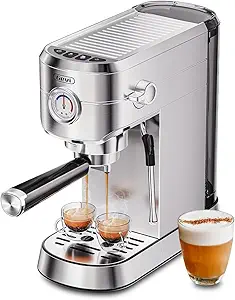 |
| Best Budget The cheapest option that still gets the job done reliably | SHARDOR 3.5 Bar Espresso Machine 5006 |  |
| Top Rated A top-rated pick with lots of positive feedback | Aromaster AREM26 Espresso Machine |  |
| Most Popular A crowd favorite that many people choose with confidence | Breville Barista Express BES870XL |  |
| Best Seller A high-volume bestseller chosen again and again | CASABREWS CM5418 Espresso Machine |  |
Breville Barista Express BES870BSXL

| Wattage | 1600 watts |
|---|---|
| Voltage | 120 volts |
| Operation Mode | Semi-Automatic |
| Coffee Input Type | whole_beans |
| Filter Type | Reusable |
The Breville Barista Express is a countertop semi-automatic espresso machine that grinds, doses, and brews in a single workflow for home baristas. It combines an integrated conical burr grinder with 16 grind settings and a 54mm portafilter so you can grind directly into the portafilter, hand-tamp, and extract shots using low-pressure pre-infusion and PID temperature control. A thermocoil heating system and powerful steam wand let you texture milk for lattes and cappuccinos, while reusable filter baskets and included tools make setup and maintenance straightforward. In practice it is well suited to users who want hands-on control over grind, dose, and milk texturing without needing separate equipment, and the stainless steel construction feels durable on the counter. The machine requires some learning for consistent shots and regular cleaning to keep the grinder and group working at their best, and the manual tamping and dosing mean it is not fully automatic for users who prefer push-button simplicity.
Best for: Buyers who want a single machine that handles grinding through steaming and are willing to learn manual dosing and milk texturing to produce café-quality espresso at home.
Less Ideal for: People who want fully automatic, one-touch espresso or who prefer a fuss-free machine with minimal hands-on operation.
- Built-in conical burr grinder with 16 grind settings for fresh grinding and dose control
- Thermocoil PID temperature control supports stable, balanced extractions
- Powerful steam wand capable of producing microfoam for latte art
- 54mm stainless steel portafilter and reusable filter baskets match café-style workflow
- Includes useful tools and accessories for setup and cleaning
- Manual dosing and tamping require practice to achieve consistent results
- Regular cleaning and maintenance needed to keep grinder and group performing well
Verdict: Choose this machine if you want an all-in-one semi-automatic that grinds and steams to produce café-style espresso with hands-on control.
Gaggia Classic Evo Pro RI9380/46
| Operation Mode | Semi-Automatic |
|---|---|
| Output Pressure | 9 bar |
| Wattage | 1200 watts |
| Coffee Input Type | ground, pod |
| Capacity | 2.1 liters |
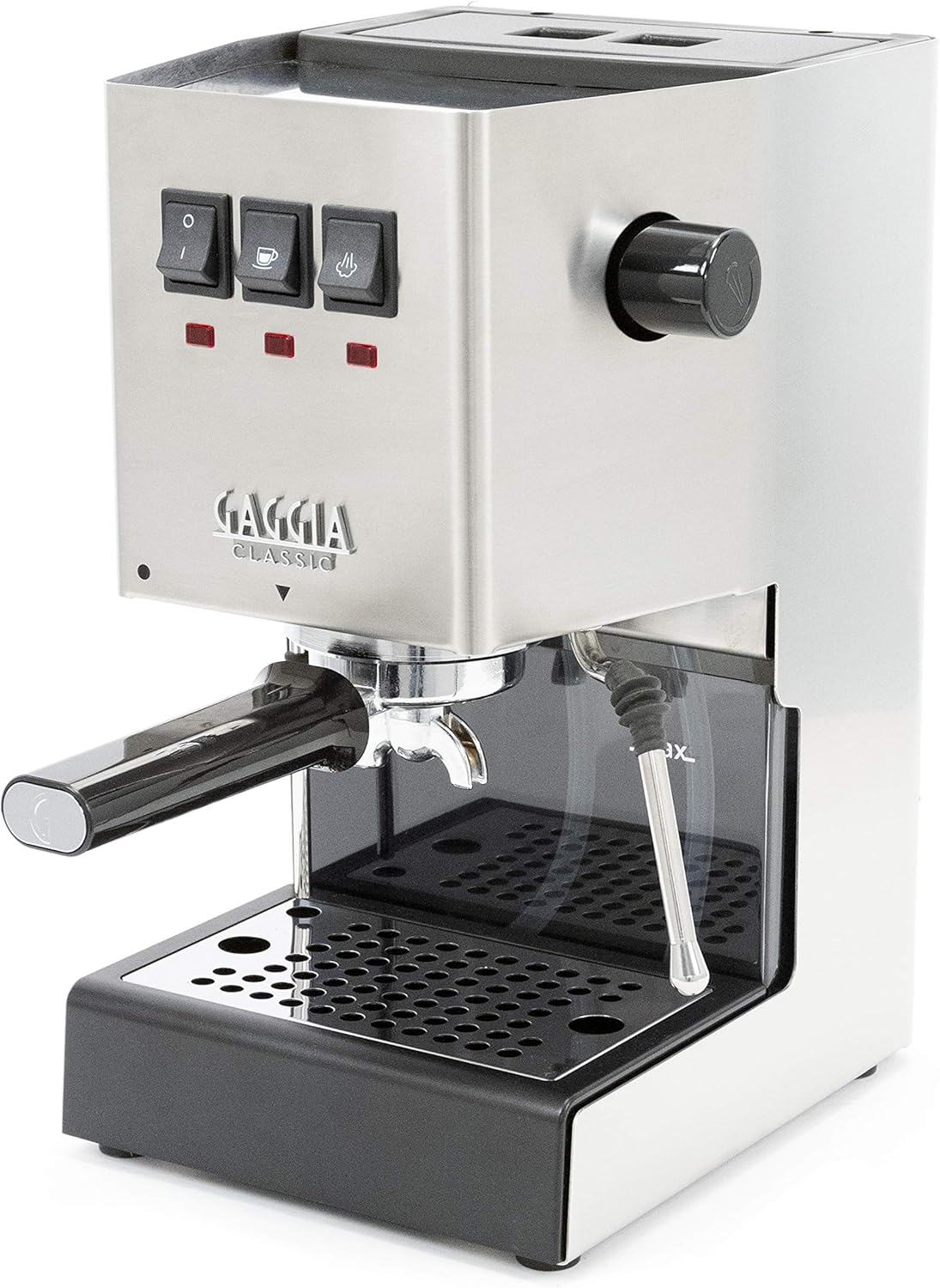
The Gaggia Classic Evo Pro is a compact, performance-focused semi-automatic espresso machine that brings commercial-style parts to the home kitchen. It brews espresso using a 9-bar pump and a stainless-steel 58 mm portafilter with both commercial single and double-shot baskets, and it also accepts pressurized baskets for pods or preground coffee. The machine includes a commercial steam wand for manual milk texturing and updated internals for quieter pumping and improved resistance to scale. In daily use it performs like a small prosumer unit: quick heat-up, tight shots when you dial in grind and dose, and the steam wand produces velvety microfoam for latte art with a little technique. The solid steel housing and serviceable components mean it is built to last, but it expects an engaged user — there is no automatic dosing or programmable profiles, and maintenance like descaling and routine steaming is manual. If you want café-level control and durable, commercial-grade parts in a home footprint, this delivers; if you prefer push-button convenience, it is not the right fit.
Best for: Buyers who prioritize shot quality and control and are willing to learn basic barista technique to extract café-style espresso at home.
Less Ideal for: Users who want fully automatic, push-button convenience or minimal hands-on maintenance should consider super-automatic or pod-style machines instead.
- Commercial 58 mm stainless-steel portafilter with single and double baskets for shot control
- 9-bar pump extraction tuned for consistent espresso shots
- Commercial steam wand capable of producing microfoam for latte art
- Robust steel housing and serviceable commercial components for long-term reliability
- Requires manual dialing of grind, dose, and technique so there is a learning curve
- No programmable dosing or automatic shot profiles for hands-off operation
Verdict: Choose the Gaggia Classic Evo Pro if you want a durable, prosumer-level semi-automatic that delivers café-quality shots and professional milk steaming in a home machine.
Gevi 20 Bar Espresso Machine ECMG0
| Output Pressure | 20 bar |
|---|---|
| Wattage | 1350 watts |
| Operation Mode | Semi-Automatic |
| Water Tank Capacity | 34 OZ |
| Filter Type | Reusable |
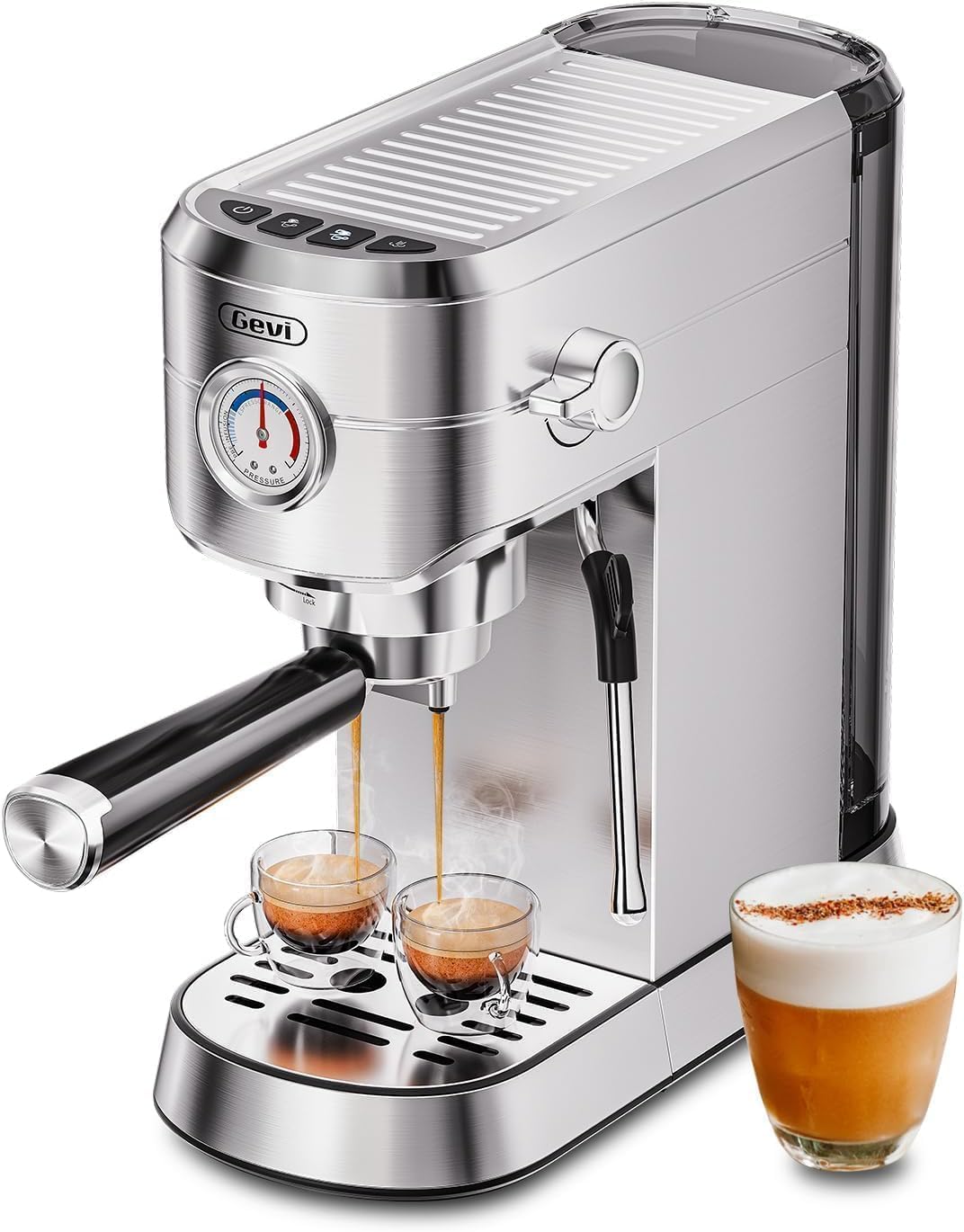
The Gevi 20 Bar Espresso Machine is a semi-automatic countertop unit aimed at making espresso-based drinks and Americanos with consistent pressure and milk texturing. It uses a 20-bar pump together with NTC temperature control, pre-infusion, and a built-in pressure gauge to help stabilize extraction, and a powerful steam wand plus removable froth nozzle for frothing milk. Typical use is straightforward: fill the 34 oz removable water tank, dose ground coffee into the 51 mm portafilter, adjust shot volume, and monitor the gauge during extraction; the hot water function doubles for Americanos or cup preheating. Practical touches include a cup warmer, removable drip tray for cleaning, and a reusable filter. Limitations to expect are the compact single-boiler arrangement common to machines in this class, occasional pump vibration noise, and the manual maintenance required for the portafilter and steam wand; this is not a fully automated or commercial-scale machine. For buyers who value control and daily cafe-style drinks without a large footprint, it delivers solid capability for the price point.
Best for: A practical buyer who wants a compact semi-automatic machine that gives hands-on control for daily espresso and milk-based drinks without taking much counter space.
Less Ideal for: Not a good choice for high-volume commercial use or users who want a fully automatic, push-button single-step brewing and milk prep system.
- 20-bar pump with built-in pressure gauge supports consistent extraction and makes dialing shots easier
- NTC temperature control and pre-infusion improve shot stability and flavor extraction
- Powerful steam wand with removable froth nozzle produces fine microfoam for milk drinks
- Compact stainless steel build with removable water tank and drip tray simplifies countertop placement and cleaning
- Includes 51 mm portafilter, filters, tamper and cleaning tools so you can start brewing out of the box
- Single-boiler/compact thermal system limits back-to-back steaming and brewing speed
- Machine can produce noticeable pump vibration and noise during extraction
- Portafilter and filter baskets are not dishwasher-safe and require regular manual cleaning
Verdict: Choose this Gevi if you want a compact, hands-on semi-automatic espresso machine that brings reliable 20-bar extraction and strong steam performance for daily home or small-office use.
SHARDOR 3.5 Bar Espresso Machine 5006

| Output Pressure | 3.5 bar |
|---|---|
| Wattage | 800 watts |
| Operation Mode | Semi-Automatic |
| Coffee Input Type | Ground |
| Capacity | 4 cups |
The SHARDOR 3.5 Bar Espresso Machine is a compact semi-automatic unit aimed at making espresso-style drinks and milk beverages at home. It uses an 800W fast-heating system and a die-cast aluminum boiler to reach brewing temperature quickly, while a 3.5-bar pump extracts an easy-drinking espresso with light crema. Controls are simplified to a single knob for switching between brew and steam, and the adjustable steam wand produces frothed milk suitable for cappuccinos and lattes. The machine includes a reusable filter and a small carafe, and its BPA-free construction and overheat/overpressure protections add routine safety. Practical benefits are quick startup, small footprint for tight counters, and straightforward operation for beginners. Important limitations are the modest 3.5-bar output, which is lower than commercial-level pumps and may produce milder extraction, and the plastic-heavy construction that reduces perceived durability. The 4-cup capacity is fine for one to two users but not suited to high-volume use.
Best for: Buyers wanting an affordable, easy-to-use espresso machine that fits small counters and makes simple espresso and milk drinks without a steep learning curve.
Less Ideal for: People seeking true café-grade extraction, high-volume home use, or a metal-heavy, long-lasting chassis should consider higher-end models instead.
- Fast 800W heating with die-cast aluminum boiler for quick startup
- Adjustable steam wand that creates usable milk froth for lattes and cappuccinos
- Compact footprint that fits small kitchens, dorms, or offices
- Reusable filter and simple one-knob controls make daily use and cleaning straightforward
- 3.5-bar pump delivers a milder, less intense espresso than higher-pressure machines
- Primarily plastic construction may feel less durable than metal-bodied units
Verdict: A compact, budget-friendly semi-automatic that delivers quick, easy espresso-style drinks and decent milk froth for everyday home use.
Aromaster AREM26 Espresso Machine

| Power | 1400W |
|---|---|
| Pressure | 20-Bar Pressure Pump |
| Water Tank Capacity | 37 fluid ounces |
| Special Features | PID Temperature Control, Pre-Infusion, One-Touch Descaling |
The Aromaster AREM26 is a compact semi-automatic espresso maker aimed at everyday home use, offering café-style drinks without a large footprint. It uses a 20-bar pressure pump with PID and NTC temperature control plus low-pressure pre-infusion to produce consistent extraction and crema, and its 1400W heater brings the unit up to brewing temperature quickly. The machine includes a 360° steam wand with a heat-resistant grip for milk-based drinks and supports back-to-back brewing thanks to a dual-circuit design. Practical touches include a removable 37 oz water tank, a cup warmer, one-touch descaling, and removable parts for easier cleaning. Trade-offs are its compact size, which limits capacity for high-volume shared kitchens, and as a semi-automatic it requires a bit of technique to dial in shots compared with fully automatic models. For buyers who prioritize dependable temperature control and routine maintenance features, this machine delivers reliable, repeatable espresso and simple milk frothing in a small package.
Best for: Home users who want a reliable, compact espresso machine that emphasizes temperature stability and easy maintenance for regular single- or small-household use.
Less Ideal for: Those who need high-volume commercial output or want a fully automatic, hands-off espresso experience should consider larger or automated alternatives.
- PID and NTC temperature control for stable, repeatable brewing temperatures
- 20-bar pump with low-pressure pre-infusion for consistent extraction and crema
- Fast 1400W heating and dual-circuit design for quick back-to-back drinks
- Removable 37 oz water tank and one-touch descaling for easier maintenance
- 360° swivel steam wand with heat-resistant grip for effective milk frothing
- Compact footprint and 37 oz tank limit capacity for heavy daily shared use
- Semi-automatic operation requires practice to achieve consistently dialed shots
Verdict: Choose the AREM26 if you want a compact, maintenance-friendly semi-automatic that delivers consistent, café-style espresso with reliable temperature control.
Breville Barista Express BES870XL

| Wattage | 1600 watts |
|---|---|
| Voltage | 120 |
| Coffee Input Type | whole_beans |
| Filter Type | Reusable |
| Capacity | 1 cups |
The Breville Barista Express BES870XL combines an integrated conical burr grinder, 54mm portafilter, and a thermocoil heating system to take you from whole beans to espresso in one workflow. You grind directly into the portafilter with 16 grind settings and dose trimming to control extraction, then use the dial controls and low-pressure pre-infusion to develop balanced shots. The steam wand produces manual microfoam for lattes and cappuccinos, while the PID temperature control helps keep brew temperature stable. Practical benefits include quicker single-step workflow compared with separate grinder plus machine, reliable temperature control, and stainless steel construction that cleans up easily. Limitations are typical for a manual/semi-auto: it requires learning tamping and steaming technique to get consistent café-style results and it is sized as a single-group home machine with a moderate water tank and hopper that need regular refilling for heavy use.
Best for: Buyers who want a durable, all-in-one home espresso setup that prioritizes fresh grinding, temperature stability, and hands-on control while relying on broad user feedback for proven performance.
Less Ideal for: People seeking a fully automatic or touch-button commercial machine that needs no user technique or those needing high-capacity commercial output.
- Built-in conical burr grinder with 16 grind settings for fresh dosing
- Thermocoil PID temperature control for more consistent extractions
- Powerful steam wand for manual milk texturing and latte art
- 54mm stainless steel portafilter and reusable filter baskets for durable, café-style shots
- Requires hands-on skill for consistent tamping and steaming results
- Not intended for high-volume commercial use due to home-oriented capacity
Verdict: Choose the Barista Express if you want a single, well-regarded semi-automatic machine that grinds, doses, and steams to deliver café-style espresso at home.
CASABREWS CM5418 Espresso Machine
| Output Pressure | 20 bar |
|---|---|
| Wattage | 1350 watts |
| Operation Mode | Semi-Automatic |
| Coffee Input Type | ground_coffee |
| Filter Type | Reusable |
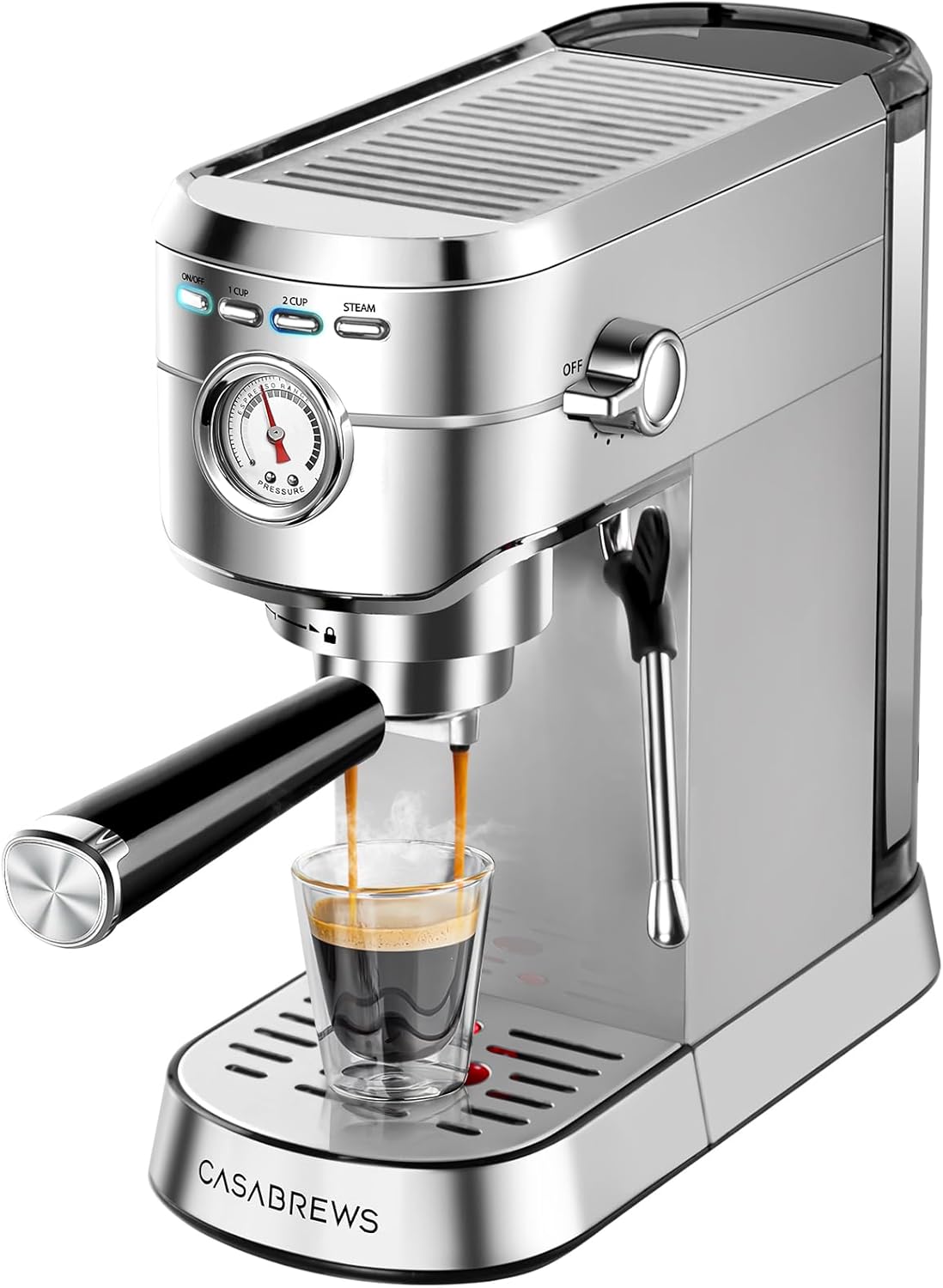
The CASABREWS CM5418 is a compact home espresso machine that aims to deliver café-style shots and milk drinks without taking much counter space. It uses a 20-bar Italian pump with a built-in pressure gauge and pre-infusion to help dial in extraction, and the 51mm portafilter and reusable filters let you pull single or double shots from ground coffee. The steam wand produces microfoam suitable for cappuccinos and lattes, and the removable 34 oz water tank means multiple cups between refills. Controls are button-based and straightforward, and the top cup warmer and removable drip tray add useful convenience. Practical limitations include a single boiler design, which requires short waits if you steam milk and then brew, and it may need routine tweaks to grind, dose, and tamp for consistent pressure. For buyers who prefer low-risk purchases it offers a clear pressure gauge and simple troubleshooting guidance, but expect some basic learning and maintenance to get the best shots.
Best for: Buyers who want a compact, user-friendly semi-automatic machine that provides visible pressure control and the ability to steam milk for café-style drinks, while preferring straightforward setup and manufacturer guidance.
Less Ideal for: Those seeking fully hands-off machines, commercial throughput, or instant back-to-back steaming and brewing without waiting for temperature recovery.
- 20-bar pump with built-in pressure gauge gives visual feedback for dialing in extraction
- Powerful steam wand capable of producing smooth microfoam for milk drinks
- Compact stainless steel body with removable 34 oz water tank for easy refills
- Includes 51mm portafilter, single and double filter baskets, and tamper for out-of-box use
- Single boiler design requires cooldown between steaming and brewing for temperature stability
- May require adjustments to grind, dose, and tamp to achieve consistent extraction
Verdict: A compact, confidence-friendly semi-automatic that gives visible pressure feedback and a capable steam wand for home baristas who value control and straightforward operation.
Choosing the Right Semi-Automatic Espresso Machine: Key Factors to Consider
Boiler and Temperature Control
Stability and responsiveness of the boiler directly influence shot quality. A boiler that maintains consistent temperature during preinfusion and full extraction reduces channeling and underextraction, producing fuller flavor and better crema.
Different semi-automatic machines use single boilers, heat exchangers, or dual boilers. Single boilers are simpler but require wait time between brewing and steaming. Heat-exchange systems let you brew and steam more quickly but add complexity. Consider how often you make milk drinks and whether you mind the required purge or cooldown steps between functions.
Pump and Pressure Consistency
A reliable pump delivers stable pressure during the entire extraction. Fluctuating pressure causes inconsistent flow rates and uneven extraction, which shows up as sour or bitter notes in successive shots.
Look for machines that specify pump type and maximum pressure control, and that include adjustable preinfusion or pressure profiling features if you plan to dial in espresso. Even without advanced features, a steady 9-bar range during the shot is the baseline expectation for consistent results.
Portafilter and Grouphead Design
The portafilter diameter, material, and the grouphead fit affect how evenly the puck receives water and how easy it is to tamp and clean. A well-designed grouphead reduces leaks and helps maintain temperature between shots.
Ergonomic considerations matter for daily use. A heavy, well-balanced portafilter feels more stable while tamping. Also assess whether the machine uses pressurized or non-pressurized baskets, because non-pressurized baskets give more control but require a matched grinder and consistent technique.
Steam Wand Power and Control
If you regularly make milk-based drinks, steam performance will define the quality of microfoam you can produce. Powered steam systems with good steam pressure and a responsive wand let you texture milk quickly and with fine control.
Consider wand articulation and tip quality. A single-hole tip offers more control for microfoam, while multi-hole tips can speed steaming for lattes but offer less finesse. Also check how long the machine can sustain steam without a cooldown; that affects back-to-back drink prep.
Ease of Cleaning and Serviceability
Daily and periodic maintenance affects long-term satisfaction. Removable drip trays, accessible water tanks, and straightforward backflushing procedures make upkeep simpler and help prevent scale and buildup.
Beyond daily cleaning, look for machines with reachable internal components, available spare parts, and simple descaling procedures. Machines that require frequent dealer service or complicated disassembly will increase ownership cost and downtime.
Control Layout and User Feedback
Controls and feedback determine how quickly you can learn to pull consistent shots. Simple, intuitive controls with visible pressure gauges, clear lights, or programmable shot timers reduce the learning curve and improve repeatability.
Some semi-automatic machines offer manual paddle controls or programmable dosing. Decide whether you prefer tactile manual control for hands-on adjustment or programmable presets that automate shot timing. The right balance depends on how much control you want vs how streamlined you want the workflow to be.
Dialing In Grind and Dose
A semi-automatic machine delivers best results when paired with a suitable grinder and a repeatable dosing technique. Small changes in grind size or dose will dramatically change flow rate and extraction balance, so establish a test routine with a scale and timer.
Start by dialing for a 25 to 30 second extraction window for a traditional espresso ratio, then adjust grind to move flow toward that window while tasting for sweetness and body. Keep a simple log of grind settings and dose so you can return to successful combinations later.
- Use a quality burr grinder to achieve consistent particle distribution.
- Measure dose by weight rather than volume to cut variability.
- Make single adjustments at a time and pull test shots to evaluate changes.
Maintaining Temperature Between Shots
Temperature drift between shots hurts consistency. Warm up the grouphead and portafilter before brewing by running a blank shot or flushing hot water through the group. Letting a machine reach its operating temperature and staying on for a short warm-up period each session reduces variability.
If your machine has a heat-exchange or dual-boiler design, learn the recommended purge or timing routine to ensure the steam circuit does not affect brew temperature. Consistent practice with the machine's warm-up behavior is key to predictable shots.
- Flush a short burst of water to stabilize the grouphead temperature.
- Keep a dedicated warmed portafilter in a cup between shots.
Routine Cleaning That Protects Flavor
Daily rinses, weekly backflushing with a detergent, and periodic descaling help preserve flavor and prevent mechanical issues. A short, consistent cleaning routine after each session prevents oils and fines from accumulating in the grouphead and on filters.
Follow a checklist: wipe the steam wand after each use and purge it, remove and clean baskets and portafilters regularly, and empty the drip tray to avoid sour smells. Proper water filtration also reduces scale and improves taste.
- Wipe and purge the steam wand after every milk beverage.
- Backflush with detergent once a week if the machine supports it.
- Use filtered or softened water to reduce scale buildup.
Accessory Upgrades That Actually Help
Certain accessories produce measurable improvements in shot quality and workflow. A quality tamper matched to the portafilter diameter promotes even tamping. A distribution tool can help level the puck before tamping, reducing channeling.
A simple shot scale with a timer helps you track extraction yield and repeatability. For milk drinks, a stainless-steel milk pitcher with a narrow spout aids microfoam pouring.
- Match tamper diameter to the portafilter for even pressure.
- Use a dosing funnel to reduce mess and keep the machine tidy.
- Invest in a small scale with a timer for consistent measurement.
Common Troubleshooting Steps
Many common issues have straightforward fixes. If shots taste sour, check for underextraction from too-coarse a grind, low dose, or short extraction time. Bitter shots can stem from overextraction, too-fine grind, or excessively high temperature.
If steam power drops, check for limescale or a need to descale. Leaks around the grouphead often point to worn gaskets or loose portafilter seating. Establish a few diagnostic checks to rule out grinder issues before assuming the machine needs service.
- Tweak grind size and dose first when a shot tastes off.
- Check water quality and descale according to manufacturer intervals.
- Inspect gaskets and seals if you notice visible leaks or pressure loss.
How We Chose the Best Semi-Automatic Espresso Machine
We shortlisted semi-automatic espresso machines that deliver consistent extraction and practical daily use for home baristas. Our selection criteria centered on technical features that directly affect shot quality and ownership experience. Key evaluation points included boiler and temperature control design, pump stability and pressure consistency throughout a shot, portafilter and grouphead ergonomics for dosing and tamping, and steam performance for milk texture. We also weighed build quality and serviceability, looking for machines that use replaceable components and accessible internal layouts to simplify maintenance and repairs. Ease of use factors—such as clear controls, shot-timing aids, and manageable water-tank and drip-tray access—were considered because they determine how quickly you can integrate a machine into daily routines. We excluded super-automatic, manual lever, and single-serve capsule systems to focus only on semi-automatic designs. Machines lacking basic safety features or with poor documented longevity were also filtered out. The final picks reflect units that balance café-style control with reasonable setup and upkeep for home users.
Our full evaluation process is outlined in our review methodology.
FAQ
How long should a semi-automatic machine warm up before brewing?
Warm-up time varies by boiler type, but generally allow 15 to 30 minutes for consistent temperature. Many machines reach usable temperature sooner, but giving extra time improves stability for repeat shots.
Do I need a special grinder for a semi-automatic espresso machine?
A quality burr grinder is highly recommended because grind consistency is critical for even extraction. Conical or flat burr grinders both work; prioritize grind stability and low retention over integrated features.
Can I steam milk and pull shots back-to-back?
That depends on the machine's boiler design. Machines with heat-exchange or dual-boiler systems handle back-to-back steaming and brewing better than single-boiler machines, which may require wait or cooldown cycles between functions.
How often should I descale a semi-automatic machine?
Descaling frequency depends on water hardness and usage, but many home users descale every 3 to 6 months. Using filtered or softened water can extend intervals and reduce scale-related issues.
Is a pressure gauge necessary on a semi-automatic machine?
A pressure gauge is a useful feedback tool for dialing in shots and spotting problems, but it is not strictly required. It helps you monitor pump performance and identify pressure anomalies during extraction.
Final Verdict
When choosing a semi-automatic espresso machine, prioritize the features that align with how you plan to use it. If you make milk drinks frequently, steam power and wand control should take precedence. If you want tight control over extraction, focus on temperature stability and pump consistency. Build quality and ease of maintenance matter for long-term satisfaction, especially if you plan to use the machine daily. Decide how much hands-on technique you want to invest in and choose a machine that matches that commitment. With the right combination of temperature control, reliable pressure, and serviceable design, a semi-automatic espresso machine can deliver consistent café-style results at home.