
Note: This article contains affiliate links. If you click on these links and make a purchase, we may earn a small commission at no extra cost to you. This helps support our research and content. Read our full affiliate disclosure here.
If you want café-style drinks without a complicated setup, an espresso machine with an integrated grinder and milk frother streamlines your morning routine. These all-in-one machines let you grind, dose, brew, and froth from a single unit so you can make consistent espresso, cappuccinos, and lattes in less time and with fewer extras on the counter. The right machine balances grind quality, extraction control, and reliable steaming while fitting your available space. This guide covers six shortlisted espresso machines with built in grinder and milk frother that suit different kitchens and skill levels. Below you will find the evaluation criteria we used, helpful buying factors, and practical tips to match a machine to your brewing goals.
Top Picks at a Glance
| Best Overall The best all-around choice for most situations | KRUPS Precision XP801TU0 |  |
| Best Quality Built to a higher standard if you want something more solid | De'Longhi La Specialista Arte Evo EC9255M |  |
| Best Value The sweet spot between price and what you get | AMZCHEF Espresso Machine CM1626 |  |
| Top Rated A top-rated pick with lots of positive feedback | Breville Barista Pro BES878BSS |  |
| Most Popular A crowd favorite that many people choose with confidence | Breville Barista Express BES870XL |  |
| Best Seller A high-volume bestseller chosen again and again | Ninja Luxe Café Premier ES601 |  |
KRUPS Precision XP801TU0

| Operation Mode | Semi-Automatic |
|---|---|
| Coffee Input Type | ground, whole bean |
| Filter Type | Reusable |
| Other Special Features of the Product | Adjustable Temperature Controls, Integrated Coffee Grinder, Professional-Grade Foam |
The KRUPS Precision combines an integrated grinder and a powerful steam wand with controls aimed at users who want hands-on espresso making at home. It grinds whole beans with 30 grind settings into a reusable portafilter, offers three pre-infusion modes and adjustable temperature to tune extraction, and displays pressure feedback so you can dial in shot quality. The steam wand delivers strong steam for microfoam suited to cappuccinos and latte art, and the tamping station with knock box simplifies workflow for back-to-back shots. Typical use will be single-cup, made-to-order espresso and milk drinks where you control grind, dose, and steaming. The machine is stainless steel and semi-automatic, so it requires some learning and manual technique to get consistent results, and its size and weight mean it is best for a dedicated counter space. For buyers who want a built-in grinder plus a professional-style steam wand without moving to a prosumer espresso machine, this is a capable all-in-one that prioritizes control and milk texture over push-button convenience.
Best for: Buyers who want an all-in-one home espresso setup that prioritizes control over automation and are willing to learn manual techniques to improve shot quality and milk texture.
Less Ideal for: People who prefer fully automatic, push-button convenience or who need high-volume, fast output for frequent entertaining.
- Built-in conical burr grinder with 30 grind settings for fine tuning flavor
- Three pre-infusion modes and adjustable temperature provide control over extraction
- Powerful steam wand capable of producing professional-quality microfoam
- Pressure gauge gives real-time feedback to help dial in shots
- Semi-automatic operation requires user skill and hands-on adjustments
- Designed for one cup at a time which limits throughput for larger households or entertaining
Verdict: Choose this machine if you want a single unit that pairs a precise built-in grinder with a strong steam wand for hands-on, cafe-style espresso and milk drinks at home.
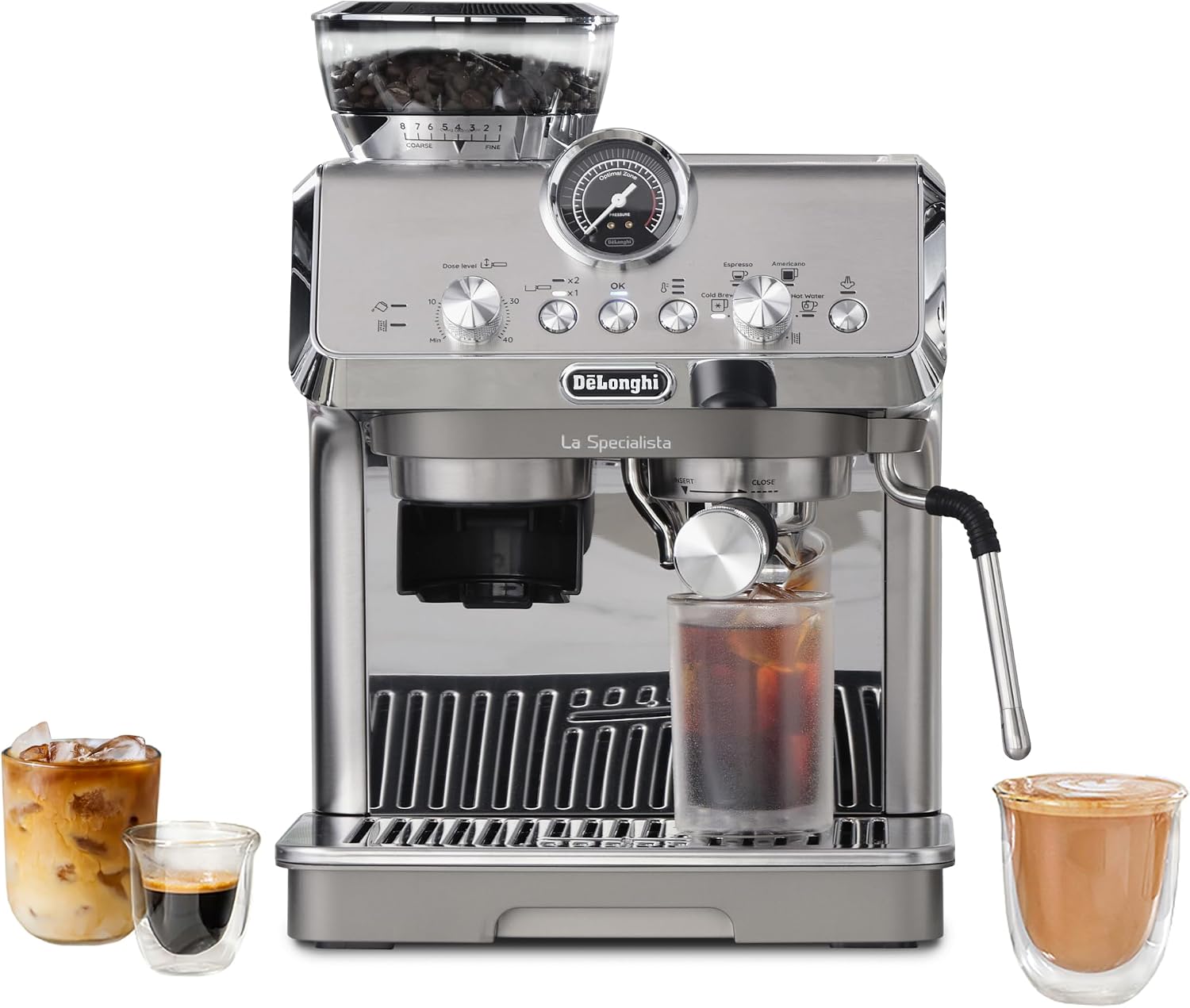
De'Longhi La Specialista Arte Evo EC9255M
| Wattage | 1550 watts |
|---|---|
| Voltage | 120 volts |
| Output Pressure | 9 bar |
| Coffee Input Type | Whole Bean |
| Filter Type | Reusable |
The La Specialista Arte Evo is a semi-automatic espresso machine aimed at hands-on home baristas who want precise control with helpful automation. It grinds whole beans with an integrated conical burr grinder (8 settings) and meters single or double doses so you can pull shots without a separate grinder, then steams milk with a commercial-style wand for microfoam and latte art. Notable features include Active Temperature Control for stable infusion temperature, a 15-bar Italian pump with a 9-bar extraction target, four beverage presets (espresso, Americano, cold brew, hot water), and De'Longhi's Cold Extraction Technology that produces a cold brew-style drink in under five minutes. The machine ships with a barista kit (tamper, dosing funnel, frothing jug) and several removable parts to simplify cleanup. Expect a learning curve if you want to dial in advanced shots, and the unit is fairly heavy and takes counter space, but for those seeking performance without buying multiple appliances it combines consistent grinding, temperature control, and a powerful steam wand in one package.
Best for: Home users who prioritize brew performance and control and want an integrated grinder plus a steam wand to make cafe-quality espresso and milk drinks without separate equipment.
Less Ideal for: Buyers seeking a simple, compact plug-and-play single-button machine or those with very limited counter space should consider smaller automated or capsule machines instead.
- Built-in conical burr grinder with 8 grind settings for consistent dosing
- Commercial-style steam wand that produces smooth microfoam for latte art
- Active Temperature Control and 15-bar pump for stable, repeatable extraction
- Cold Extraction Technology enables a cold brew-style drink in under five minutes
- Includes barista kit and removable dishwasher-safe parts for easier prep and cleanup
- Relatively large and heavy for some kitchen counters
- Learning curve to master manual dialing and temperature/grind adjustments
Verdict: If you want one countertop machine that delivers factory-quality grinding, stable temperature control, and a powerful steam wand for serious home espresso and milk drinks, this model is a top choice.
AMZCHEF Espresso Machine CM1626

| Operation Mode | Semi-Automatic |
|---|---|
| Wattage | 1500 watts |
| Coffee Input Type | whole bean |
| Capacity | 3.9 pounds |
The AMZCHEF CM1626 combines a 44-setting built-in grinder, precision temperature control, and a powerful steam wand into a compact semi-automatic machine aimed at home users. It grinds whole beans on demand and offers a wide range of grind settings so you can tune extraction for espresso or coarser styles, while the temperature control (190°F–201°F) helps dial in flavor. The 1350W heating system and 20-bar pump deliver fast heat-up and consistent brewing, and the stainless steel steam wand produces microfoam suitable for lattes and cappuccinos. One-touch brewing and a touch display simplify daily use, and a removable 60 oz water tank plus descaling support make maintenance straightforward. Downsides are its learning curve for dialling in grind and dose, and the semi-automatic workflow means some manual steps compared with fully automatic machines. For a homeowner who wants control over grind and milk texture without needing separate devices, this machine packs strong value and capability in a compact footprint.
Best for: Buyers who want a single compact machine that gives hands-on control of grind, temperature, and milk texture to improve home espresso without buying separate devices.
Less Ideal for: Those seeking a fully automatic push-button experience or mission-critical commercial throughput should consider fully automatic or commercial models instead.
- Built-in grinder with 44 grind settings for precise control over extraction
- Adjustable brewing temperature between 190°F and 201°F to suit different beans
- Powerful steam wand and 1350W heating for quick microfoam production
- One-touch brewing and touch screen simplify operation for daily use
- Semi-automatic operation requires manual dosing and tamping which has a learning curve
- Grinder and brew adjustments may need frequent tweaking to get consistent shots
Verdict: This AMZCHEF unit is a compact all-in-one choice for home users who want integrated grinding, temperature control, and a capable steam wand for quality espresso and milk drinks.
Breville Barista Pro BES878BSS

| Wattage | 1680 watts |
|---|---|
| Voltage | 120 |
| Coffee Input Type | whole bean, ground |
| Capacity | 2 liters |
| Filter Type | Reusable |
The Breville Barista Pro is a semi-automatic home espresso machine that combines a built-in conical burr grinder, fast ThermoJet heating with PID temperature control, and a manual steam wand for textured milk. Typical use is grind-and-brew single or double shots from whole beans using the 30 grind settings and dose control, then texture milk by hand for lattes or cappuccinos. The 54mm portafilter, dual- and single-wall filter baskets, and low-pressure pre-infusion followed by 9-bar extraction aim to produce rich, consistent espresso. The LCD interface provides straightforward grind and extraction feedback that helps with repeatable shots. Practical benefits include rapid heat-up times, an all-in-one workflow for grinding and brewing, and a powerful steam wand that produces good microfoam for latte art. Limitations are that it is a manually operated machine requiring some technique for best results and regular cleaning, and its size and weight mean it suits a dedicated counter space rather than small kitchens.
Best for: Home coffee lovers who prioritize a reliable, fast all-in-one machine that grinds, brews, and textures milk and who are willing to learn basic barista technique to get consistent results.
Less Ideal for: People who want a fully automatic, hands-off experience or those with very limited counter space should consider simpler or more compact options.
- Integrated conical burr grinder with 30 grind settings for on-demand fresh grounds
- ThermoJet heating with PID delivers quick heat-up and stable extraction temperature
- 54mm portafilter and dose-control features support café-style extraction
- Powerful steam wand creates smooth microfoam suitable for latte art
- Intuitive LCD displays grind and extraction progress for easier learning
- Manual operation requires practice to dial in shots and texture milk well
- Relatively large and heavy so needs permanent counter space
Verdict: Buy this if you want a dependable, fast all-in-one grinder-plus-espresso machine that produces café-quality shots and textured milk with consistent temperature control.
Breville Barista Express BES870XL

| Wattage | 1600 watts |
|---|---|
| Voltage | 120 |
| Coffee Input Type | whole_beans |
| Filter Type | Reusable |
The Breville Barista Express BES870XL combines a built-in conical burr grinder, 54mm portafilter, and a steam wand to take you from whole beans to espresso and textured milk in one countertop unit. It grinds on demand with 16 grind settings and dose control, uses low-pressure pre-infusion and PID temperature control to help extract balanced shots, and the steam wand produces microfoam suitable for latte art when you practice milk technique. Typical use involves filling the hopper, adjusting grind size and dose, tamping, and brewing single or double shots before steaming milk with manual control. Practical benefits include fresher tasting espresso from direct grinding, consistent temperature control for repeatable shots, and a durable stainless steel construction with reusable filters and included tools for setup and cleaning. Important limitations are that it is a manual workflow that requires learning tamping and steaming technique, it takes countertop space and regular maintenance like cleaning the grinder and group area, and the 1-cup capacity design means it is best for single-cup or small household use rather than high-volume brewing.
Best for: Buyers who want a near-cafe experience at home and value social proof and reliability, willing to learn basic barista techniques to get fresh-ground shots and textured milk.
Less Ideal for: People who need fully automatic, one-touch drink programs for high-volume serving or those who prefer a maintenance-free capsule or super-automatic espresso machine.
- Integrated conical burr grinder with 16 precision grind settings for on-demand fresh grounds
- PID temperature control and low-pressure pre-infusion for more consistent, balanced extractions
- 54mm stainless steel portafilter and dual/single-wall filter baskets support 1 or 2-shot dialing
- Powerful steam wand capable of producing microfoam suitable for latte art
- Stainless steel build with reusable filters and included dosing/tamping tools
- Manual operation requires practice to consistently dial in grind, dose, and milk texturing
- Requires regular cleaning and maintenance of grinder, portafilter, and water tank
- Designed for single-cup or small household use rather than continuous high-volume output
Verdict: If you want freshly ground, cafe-quality espresso and are ready to learn manual tamping and steaming, the Barista Express delivers a reliable all-in-one solution with precise temperature and grinding control.
Ninja Luxe Café Premier ES601

| Operation Mode | Fully Automatic |
|---|---|
| Wattage | 1650 watts |
| Coffee Input Type | Ground, Whole Bean |
| Filter Type | Reusable |
| Capacity | 4.4 pounds |
The Ninja Luxe Café Premier ES601 combines a built-in conical burr grinder, assisted tamping, and an automated dual-froth system to deliver café-style espresso, drip coffee, and rapid cold brew from one unit. It guides users with Barista Assist technology for weight-based dosing and step-by-step prompts, and the 25 grind settings plus a removable water reservoir make daily use convenient. The dual froth system (magnetic whisk plus steam) produces consistent microfoam without manual technique, and the self-cleaning steam wand reduces maintenance. Practical extras include reusable filter, included portafilter accessories, and onboard storage for tools. Expect a substantial footprint and appliance weight, and the 1650 watt power draw means it needs a dedicated counter spot and standard outlet. While it automates most steps, precisely replicating a professional barista workflow still requires some learning, and very small kitchens may find it large. For someone who wants reliable, mostly automated espresso and versatile coffee styles without sourcing separate machines, this is a strong all-in-one option.
Best for: Buyers who want a dependable, low-stress way to get café-quality espresso and a variety of coffee styles at home with guided, mostly automated operation.
Less Ideal for: Minimalist kitchens with very limited counter space or buyers who want a compact single-purpose espresso unit should look elsewhere.
- Built-in conical burr grinder with 25 settings for tailored grind and dosing.
- Barista Assist weight-based dosing and assisted tamper simplify consistent shots.
- Dual hands-free frothing system produces repeatable microfoam and has self-clean cycle.
- Three-in-one functionality covers espresso, drip coffee, and rapid cold brew without extra devices.
- Comes with a wide set of accessories and reusable filter for out-of-box use.
- Relatively large and heavy for small kitchens or limited counter space.
- High power draw requires standard dedicated outlet and may restrict placement.
- Automated guidance reduces manual control for advanced baristas seeking full customization.
Verdict: If you want a reliable, guided all-in-one machine that grinds, tamps, and froths for consistent café-style drinks at home, the Ninja Luxe Café Premier ES601 delivers.
Choosing the Right Espresso Machine with Built in Grinder and Milk Frother: Key Factors to Consider
Grinder Type and Adjustment Range
The integrated grinder is the heart of an all-in-one machine because grind size directly affects extraction and crema. Look for burr grinders rather than blade grinders and a wide range of adjustment steps so you can dial in fine espresso settings as well as coarser brews for longer drinks. A stepless or multi-step adjustment lets you adapt to different beans and roast profiles. Also consider where the grind chute discharges; a short, direct path to the portafilter or brew chamber reduces retention and makes dose accuracy easier to maintain.
A grinder with poor retention or limited settings forces frequent guesswork and can make extraction inconsistent. Attention to hopper capacity and whether the hopper is sealed will influence freshness and how often you need to reload beans.
Brew Temperature Stability
Consistent water temperature during extraction is essential for reproducible espresso. Machines that stabilize temperature—via PID control, thermoblocks tuned for espresso, or insulated boilers—produce more consistent flavors across shots. Small temperature swings can make a balanced shot taste sour or bitter, so prioritize models that document temperature control or allow small adjustments.
If you plan to pull consecutive shots or use the machine for back-to-back drinks, also consider heat retention and recovery time. Faster recovery reduces wait time between extractions and keeps performance steady when making multiple drinks in a row.
Steam System Performance
The steam system determines how easily you can texturize milk for cappuccinos, lattes, and flat whites. Powerful steam pressure and a well-shaped steam wand allow you to create microfoam and stretch milk efficiently. Look for machines with good wand articulation and tip design that make it easier to introduce air, create whirlpooling motion, and polish the milk.
Some integrated machines use automatic frothers for one-touch convenience while others offer manual steam wands for more control. Decide whether you prioritize convenience for quick drinks or manual control for latte art and finer milk texture, as these are different skill and performance tradeoffs.
Ease Of Use And Controls
An all-in-one espresso machine should simplify the workflow, not complicate it. Clear controls or programmable shot volumes reduce the learning curve and speed daily use. Indicators for maintenance tasks, simple grind and dose adjustments, and accessible control layouts help you get consistent results without intensive calibration.
Consider the user interface and how much hands-on tuning you want. Some buyers prefer machines with preset, one-touch drink profiles; others want tactile knobs and a pressure gauge for manual dialing. The right balance depends on how involved you want the brewing process to be.
Maintenance Accessibility
Integrated grinders and milk systems add convenience but also require regular cleaning. Check how easily you can access and remove the grinder hopper for cleaning, whether the grinder has a brushable path, and if the milk frother or steam wand has removable tips or cleaning cycles. Machines that make routine tasks straightforward will save time and preserve flavor quality over the long term.
Also consider water filtration compatibility, access to internal components for descaling or service, and whether the drip tray and waste containers are simple to empty. Poor maintenance design increases downtime and can lead to hygiene issues with milk components if neglected.
Footprint And Counter Fit
An integrated machine packs many components into a single unit, so footprint and height matter for kitchen placement. Measure the clearance above the machine for the hopper and consider counter depth to ensure the steam wand has room for pitchers. A bulky machine may offer better performance but could crowd smaller kitchens.
Think about hopper capacity and whether you will keep beans in the hopper long term. Larger hoppers reduce refills but expose more beans to ambient conditions. If space is limited, prioritize compact designs with accessible components.
Single-Unit Workflow Benefits
Combining grinder, brewer, and frother into one machine reduces steps and keeps your counter setup tidy. With the key components integrated, you can grind straight into the portafilter or brew chamber and transition quickly to steaming without juggling multiple devices.
This workflow also helps consistency because the grinder settings and brew routine live in the same ecosystem. For users who make espresso daily, the time savings and reduced equipment complexity are the primary advantages.
- Fewer devices to maintain and fewer cords on the counter
- Smoother, repeatable workflow from bean to cup
- Smaller equipment footprint than separate high-end components
Automatic Frothers Versus Manual Steam Wands
Automatic milk frothers simplify the process with preset frothing cycles that are fast and repeatable. They are ideal for anyone who wants consistently textured milk with minimal technique. These systems are often closed circuits that return milk to the cup or a separate container, limiting the need for manual texturing.
Manual steam wands demand some technique but offer superior control for shaping microfoam and producing latte art. If you enjoy dialing in milk texture or want the ability to make a variety of milk-based drinks, a manual wand is more flexible. Consider how much time you want to invest in milk technique when choosing between the two approaches.
- Automatic frothers: convenience, speed, less technique required
- Manual steam wands: greater control, better for latte art, require skill and cleaning
Tuning Grind Settings For Your Beans
Different beans and roast levels require different grind settings for proper extraction. Lighter roasts often need a slightly finer grind to extract sweetness, while darker roasts can require a coarser setting to avoid over-extraction. Machines with fine-grained adjustment let you iterate quickly and find the sweet spot for a particular coffee.
When testing a new bag of beans, change only one variable at a time. Start with the factory grind setting, pull a short shot, and adjust grind size in small steps based on taste and shot timing. Consistent dosing and tamping are also important when tuning the grind.
- Make incremental grind adjustments when testing a new roast
- Track shot time and taste to guide tuning decisions
- Keep dosing consistent to isolate grind as the variable
Routine Care For Long-Term Performance
Keeping the grinder and milk system clean preserves flavor and prevents mechanical issues. Empty and brush the grinder chute regularly, clean the hopper and burrs per the manufacturer guidance, and purge the steam wand after every use. Periodic backflushing of the brew group and scheduled descaling will keep extraction and steam performance steady.
Neglecting maintenance can cause clogs, stale-bean flavor transfer, and reduced steam pressure. Build a simple weekly and monthly maintenance checklist to extend the life and reliability of the machine.
- Wipe and purge steam wand after each use
- Brush grinder path and clean hopper weekly
- Backflush and descale according to usage and water hardness
Matching Capacity To Household Needs
Consider how many drinks you and your household will make each day. Machines with larger hoppers and faster heat recovery are better for multiple daily drinks, while low-volume users can prioritize compact units with smaller hoppers. If you regularly make drinks for guests, check recovery time and steam capacity so you can pull successive shots and froth milk without long waits.
Also think about bean storage habits. If you prefer swapping beans frequently, a smaller hopper that is easy to remove may be preferable to a large hopper that exposes beans to the environment for extended periods.
- Higher volume households need better heat recovery and larger hoppers
- Frequent bean switching favors removable, smaller hoppers
- Consider water tank size for convenience between refills
How We Chose the Best Espresso Machine with Built in Grinder and Milk Frother
We started by focusing on machines that integrate both a grinder and a milk-frothing system in the same chassis, ensuring a true single-unit workflow. Our selection filtered for units with user-adjustable grind settings and measurable brew controls so you can tune extraction, plus steam systems capable of producing microfoam for espresso-based milk drinks. Key evaluation criteria included grind consistency across settings, brew temperature stability, steam pressure and frothing control, build quality and serviceability, and ease of cleaning for the integrated components. We prioritized machines that offer clear dosing or programmable shot volumes and a range of grind adjustment steps. Units lacking an accessible grinder chute, inadequate steam performance, or very limited maintenance options were excluded. We also considered footprint and usability for daily routines, giving weight to machines with intuitive interfaces and straightforward maintenance. The final list represents balanced choices that perform well on the concrete criteria important to at-home espresso makers.
Our full evaluation process is outlined in our review methodology.
FAQ
Do integrated grinders affect espresso flavor compared with separate grinders?
Integrated grinders can produce excellent results if they use quality burrs and offer fine adjustment. The main tradeoff is that built-in grinders are often optimized for compactness, so check for consistent grind steps and low retention. Proper maintenance and fresh beans are as important as grinder location for flavor.
How often should I descale and backflush an all-in-one espresso machine?
Frequency depends on water hardness and use, but many users backflush weekly if using pressurized baskets or every few weeks with softer water. Descale every 3 to 6 months for typical household use, or more often in hard-water areas. Follow the manufacturer's maintenance guidance where available.
Can automatic frothers make good microfoam for latte art?
Automatic frothers are consistent and fast but usually produce less control than a skilled manual steam wand. They can deliver acceptable microfoam for basic lattes and cappuccinos, but manual wands remain the better choice for detailed latte art and precise milk texture.
What grind setting should I start with for espresso?
Start with a moderately fine setting recommended by the machine, then adjust finer if shots pull too fast or taste sour, or coarser if shots pull too slowly or taste bitter. Make small changes and use consistent dose and tamping while observing shot time and crema.
Is hopper size important if I only make one or two drinks a day?
Hopper size matters less for low-volume users. A smaller, removable hopper may be better because it keeps beans fresher when you change varieties frequently and takes up less counter space. Larger hoppers are useful if you prefer not to refill often.
Final Verdict
When choosing an espresso machine with built in grinder and milk frother, prioritize the features that match how you make coffee. Focus first on grinder quality and adjustment range, then on stable brew temperature and steam performance for your preferred milk drinks. Consider ease of use, maintenance access, and physical footprint to ensure the machine fits your routine and kitchen. All-in-one machines trade off ultimate component independence for convenience and a streamlined workflow. If you value consistent café-style drinks with less setup and fewer devices, choose a model that scores well on grind consistency, temperature control, and steam power to get the best daily results.