
Note: This article contains affiliate links. If you click on these links and make a purchase, we may earn a small commission at no extra cost to you. This helps support our research and content. Read our full affiliate disclosure here.
If you want richer, higher-yield juice that keeps more enzymes and flavor, choosing the right slow juicer matters. A slow juicer uses low-speed extraction to squeeze juice from fruits and vegetables with less heat and oxidation, which often means better taste and longer fridge life. In this guide we shortlist the top-performing slow juicers across typical home kitchens, focusing on extraction efficiency, ease of cleaning, and everyday reliability. Each pick is chosen to suit different priorities like dense leafy greens, citrus, or frequent use. Read on to see which options match the way you juice and which tradeoffs to expect.
Top Picks at a Glance
| Best Overall The best all-around choice for most situations | Kuvings Whole Slow Juicer B6000S |  |
| Best Quality Built to a higher standard if you want something more solid | Hurom H400 Slow Juicer |  |
| Best Value The sweet spot between price and what you get | TUUMIIST Cold Press Juicer TM-580SJ |  |
| Best Budget The cheapest option that still gets the job done reliably | Elite Gourmet EJX600 Juicer |  |
| Top Rated A top-rated pick with lots of positive feedback | NAMA J2 Cold Press Juicer |  |
| Most Popular A crowd favorite that many people choose with confidence | Jocuu Slow Masticating Juicer |  |
| Best Seller A high-volume bestseller chosen again and again | EanOruus 3‑in‑1 Cold Press Juicer |  |
Kuvings Whole Slow Juicer B6000S

| Maximum Power | 240 watts |
|---|---|
| Power Source | Corded Electric |
| Voltage | 110 volts, 120 volts |
| Number of Speeds | 1 |
| Capacity | 400 ml |
The Kuvings B6000S is a slow masticating juicer built to squeeze more juice and preserve nutrients by operating at roughly 50 to 60 RPM with a 240W motor. It accepts larger produce through a 3-inch wide feed chute so you spend less time pre-cutting, and the longer Ultem screw and specially designed strainer press ingredients rather than shredding them to reduce oxidation and increase yield. The unit includes a smart cap for drip-free pouring and quick mixing, plus a patented rotary cleaning brush to make rinsing the strainer and screw easier. Because key parts are made from Eastman Tritan and stainless steel, the juicer handles daily use without feeling flimsy. Practical limits are the single speed control and a relatively small 400 ml juice capacity, which means the machine works best for steady home juicing rather than large-batch commercial runs. Noise and vibration are reported to be low for the motor class, and included accessories cover most basic tasks for smoothies, nut milk, and baby food.
Best for: Buyers who want a reliable home juicer that prioritizes nutrient-rich, higher-yield cold-pressed juice with minimal prep and easy cleaning.
Less Ideal for: People who need high-volume commercial juicing or who want variable-speed control for specialized recipes should consider other options.
- Wide 3-inch feed chute reduces prep by allowing larger fruits and vegetables
- Low-speed masticating action (50–60 RPM) minimizes oxidation and preserves nutrients
- 240W motor provides steady power with relatively low noise and vibration
- Tritan and stainless steel construction for durable, food-safe contact parts
- Patented rotary cleaning brush and smart cap make cleanup and drip-free pouring easier
- Single speed limits flexibility for delicate or very hard ingredients
- 400 ml capacity is modest for batch juicing sessions
Verdict: Choose the Kuvings B6000S if you want a home slow juicer that delivers higher nutrient retention and easy cleanup with minimal prep time.
Hurom H400 Slow Juicer

| Capacity | 2 liters |
|---|---|
| Wattage | 240 watts |
| Power Source | Corded Electric |
| Voltage | 120 |
| Number of Speeds | 1 |
The Hurom H400 is a performance-focused masticating juicer that squeezes juice slowly to maximize yield and minimize pulp and oxidation. It uses a two-part auger and Hurom's Slow Squeeze technology to extract more liquid from fruits and vegetables while keeping noise low thanks to its slow rotation. The wide, self-feeding hopper reduces prep time by fitting larger pieces, and the strainer-free chamber is designed to cut down on scrubbing compared with traditional strainers. At 240 watts and a single speed controlled by a button, it is straightforward to operate for daily family use and can produce juice that stays fresh in the refrigerator up to 72 hours. Practical limitations include hand-wash-only parts and a relatively heavy unit, so moving it around or cleaning after large sessions requires some effort. The H400 is best when you prioritize juice quality, higher yield, and quiet operation over ultrafast extraction or dishwasher convenience.
Best for: Buyers who want the best possible juice quality and yield and value quiet, low-oxidation extraction for regular at-home juicing.
Less Ideal for: If you need a lightweight, fully dishwasher-safe machine or variable-speed control for specific recipes, consider other models that prioritize those features.
- High juice yield using Slow Squeeze technology and a two-part auger
- Low pulp, smooth juice suitable for leafy greens and soft fruits
- Self-feeding wide hopper reduces chopping and speeds prep
- Quieter operation than high-speed juicers, suitable for morning use
- Strainer-free chamber simplifies cleaning compared with traditional strainers
- Parts must be hand washed rather than dishwasher-safe
- Single speed limits control for delicate or varied ingredients
- Heavier unit which makes it less portable
Verdict: Choose the H400 if you want a quiet, high-yield slow juicer that prioritizes juice quality and minimal pulp.
TUUMIIST Cold Press Juicer TM-580SJ
| Wattage | 300 watts |
|---|---|
| Number of Speeds | 55 RPM |
| Power Source | AC |
| Special Features | No Mesh Filter, Whole Fruit Processing |
| Included Components | Cleaning Brush, Fruit Residue Cup, Juice Cup |
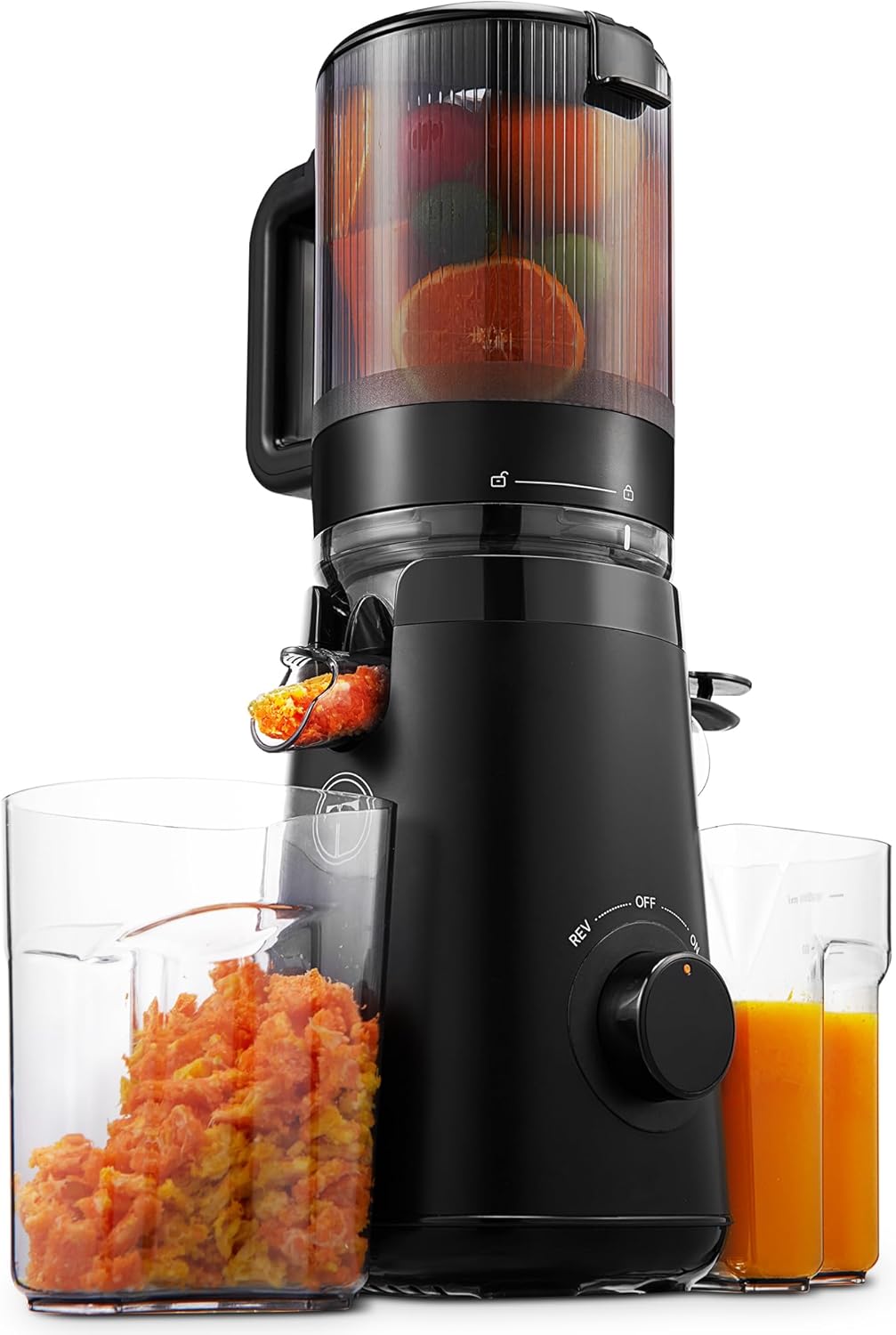
The TUUMIIST TM-580SJ is a masticating cold press juicer built to handle whole fruits and vegetables with minimal prep. It uses a single auger running at 55 RPM to slowly press produce and separate juice into the cup while ejecting dry pulp into a residue cup, which helps maximize juice yield and preserve nutrients. The 5.8-inch feed chute accepts larger pieces and reduces slicing time, and the one-piece assembly plus included cleaning brush aims to make teardown and washing straightforward. At 300 watts it provides steady extraction for leafy greens and harder produce, and its no-mesh-filter design simplifies cleaning compared with filter-based units. Trade-offs are typical for slow juicers: it is larger and slower than centrifugal models so it takes more time for each batch, and ABS plastic construction is less premium-feeling than metal-bodied competitors. For everyday juicing where yield and nutrient preservation matter more than speed, this model offers strong practical value.
Best for: Buyers who prioritize high juice yield and nutrient retention and want a low-prep cold press that is easy to clean and maintain for regular at-home juicing.
Less Ideal for: If you need very fast single-serve juices or prefer a heavy-duty metal appliance for long-term commercial use, this consumer-grade masticating juicer is not the best fit.
- Large 5.8" feed chute reduces prep by fitting bigger fruit and vegetable pieces
- Slow 55 RPM masticating action preserves nutrients and increases juice yield
- No-mesh-filter design and simple one-piece assembly make cleaning faster
- Includes cleaning brush and juice/residue cups for convenient use out of the box
- ABS plastic construction feels less durable compared with metal-bodied juicers
- Slower throughput than centrifugal juicers, so batch jobs take more time
Verdict: A practical slow juicer that maximizes yield and nutrient retention while cutting prep time with a large feed chute, ideal for daily home juicing.
Elite Gourmet EJX600 Juicer

| Capacity | 16 ounces |
|---|---|
| Wattage | 100 watts |
| Power Source | Corded Electric |
| Number of Speeds | 1 |
| Special Features | Manual |
The Elite Gourmet EJX600 is a mini masticating slow juicer built for single-serve use and small kitchens. It runs at a low 70 RPM to reduce foam and oxidation, and the single auger extracts juice from fruits and vegetables into the included 16 oz Tritan cup. The 100-watt motor and 3/4-inch feed chute mean you should pre-cut harder produce into small pieces, but the slow extraction produces smoother juice and preserves more nutrients than centrifugal models. Cleanup is straightforward: only three removable parts and a supplied brush, with most parts top-rack dishwasher safe except the motor base. Built-in overload and overheat protection helps protect the unit during use. Limitations include the small capacity and narrow chute, which make it unsuitable for batch juicing or users who want to process whole items without prep, and the single speed offers no control over extraction. For buyers who need a compact, low-speed cold-press option on a limited budget, it delivers solid performance in everyday single-serve juicing.
Best for: Buyers on a tight budget who want a low-speed, single-serve cold-press juicer for occasional fresh juice and who prioritize compact size and easy cleanup.
Less Ideal for: Those who need high-volume or commercial-style juicing, want to process whole fruits and large vegetables without chopping, or need variable speed control.
- Low-speed 70 RPM masticating action reduces foam and oxidation for smoother, nutrient-rich juice
- Compact, single-serve design fits small counters and includes a 16 oz Tritan juice cup
- Only three removable parts and a cleaning brush make daily cleanup quick
- Built-in overload and overheat protection helps prevent motor damage
- Small 3/4-inch feed chute requires more chopping and slows prep for hard produce
- 16 oz capacity and compact design are not suited for large-batch juicing
- Single speed offers no extraction control for different produce types
Verdict: A budget-friendly, space-saving slow juicer that delivers smoother, nutrient-preserving single-serve juice for everyday home use.
NAMA J2 Cold Press Juicer

| Wattage | 200 watts |
|---|---|
| Power Source | Corded Electric |
| Voltage | 120 |
| Number of Speeds | 1 |
| Capacity | 30 fluid ounces |
The NAMA J2 is a compact masticating cold-press juicer built around a 200 W motor and a self-feeding wide-mouth hopper so you can load a full recipe and let it run hands-free. It processes leafy greens and firm produce at a slow 50 RPM to minimize heat and preserve nutrients while squeezing out higher juice yield with less pulp. The unit includes an auger, coarse strainer, juice and pulp containers, a spinning brush and a pusher, and its parts are designed for quick-release cleaning and light scrubbing. Practical benefits include quiet operation suitable for morning routines, a Tritan and stainless construction that feels sturdy, and a 30 fl oz capacity that fits small to moderate batch juicing. The trade-offs are that it has a single speed and modest 200 W power, so very large batches or heavy-duty commercial use will be slower than high-power models, and some parts require hand washing rather than dishwasher-safe cleaning. For home users prioritizing nutrient retention and reliable daily use, the J2 is an efficient, low-noise choice with straightforward maintenance.
Best for: Buyers who want a reliable, daily-use slow juicer that emphasizes nutrient-preserving cold-press extraction and quiet, hands-free operation for routine at-home juicing.
Less Ideal for: Users who need heavy commercial throughput, variable speed control, or a fully dishwasher-safe machine should consider higher-power or more feature-rich models.
- Self-feeding wide-mouth hopper enables hands-free loading of whole recipes
- Slow 50 RPM masticating action preserves nutrients and increases juice yield
- Quiet, low-vibration operation suitable for morning use
- Includes all necessary accessories and quick-release parts for faster cleaning and assembly
- Single speed limits control for very soft or very hard ingredients
- Key components require hand washing rather than dishwasher cleaning
Verdict: Choose the NAMA J2 if you want a dependable, quiet cold-press juicer built for consistent daily home use and higher juice yield with minimal fuss.
Jocuu Slow Masticating Juicer

| Wattage | 150 watts |
|---|---|
| Number of Speeds | 2 |
| Power Source | Corded Electric |
| Material | Plastic |
The Jocuu slow masticating juicer is a single-auger cold press machine built for extracting higher-yield, lower-oxidation juice from fruits and vegetables. It offers two speed settings for soft and hard produce, a quiet low-speed motor, and an auto-reverse feature to help clear jams. The unit separates pulp from juice and includes an intelligent motor protection that shuts the motor off after 20 minutes to prevent overheating. Assembly is tool-free and most detachable parts are dishwasher-safe, and the package includes a cleaning brush and BPA-free components. In practice this model is compact enough for regular countertop use, handles leafy greens and root vegetables reasonably well, and is simple to disassemble for cleaning; the smaller feed chute means cutting is required for larger items. Expect modest throughput compared with high-end commercial masticators and occasional clogging if you push very dense batches, but the reverse and two-speed options make those interruptions easier to manage. A two-year motor coverage gives added peace of mind for buyers watching reliability and long-term performance.
Best for: Buyers who prioritize reliable, quieter cold-press juicing with clear user feedback and some manufacturer support, and who value a compact unit for daily home use.
Less Ideal for: Users who need very high juice throughput for large batches or who want a wide feed chute for whole fruits without prep should consider larger-capacity commercial models.
- Two speed settings for soft and hard produce to improve extraction.
- Auto-reverse function reduces and clears clogs during juicing.
- Dishwasher-safe detachable parts and included brush simplify cleaning.
- Low-speed quiet motor minimizes noise during operation.
- Automatic motor protection shuts off after 20 minutes to prevent overheating.
- Smaller feeding chute requires more prep and cutting of larger produce.
- Throughput is lower than higher-end or commercial masticating juicers.
Verdict: A compact, quiet 2-speed cold-press juicer with auto-reverse and motor protection that makes reliable home juicing and low-maintenance cleanup easy.
EanOruus 3‑in‑1 Cold Press Juicer

| Capacity | 100 fluid ounces |
|---|---|
| Maximum Power | 250 watts |
| Power Source | ac |
| Voltage | 110 volts |
| Special Features | Auto-Reversing, Overheat Protection |
The EanOruus 3-in-1 Cold Press Juicer is a single-auger masticating machine designed for regular home use and batch prep. It accepts whole fruit and large pieces through a 6.5-inch chute into a 100 oz hopper so you can load multiple servings without constant refilling. The 250 W AC motor is described as high-torque and brushless, which helps it handle fibrous produce quietly and reduces heat that can degrade nutrients. Included juice and sorbet strainers plus a nut-milk option make it easy to switch between juice, frozen-fruit sorbet, and homemade nut milk. Practical touches include an auto-reverse to clear jams, detachable pulp outlet for simpler cleaning, and overheat protection for safer repeated use. Expect hand-wash maintenance for removable parts and a mostly plastic construction. The unit is bulkier and heavier than compact juicers, so it works best on a dedicated counter or for meal-prep sessions rather than quick single glasses, and plastic components may not feel as premium as metal alternatives.
Best for: Home buyers who prioritize reliable, low-heat cold pressing and want to prepare larger batches of juice or nut milk with minimal chopping and occasional frozen-fruit desserts.
Less Ideal for: People who need an ultra-compact, lightweight juicer for occasional single-serve use or those wanting an all-metal, commercial-grade machine.
- Extra-large 100 oz hopper reduces refilling for batch juicing.
- Wide 6.5-inch chute accepts large fruit for minimal prep.
- Versatile 3-in-1 design for juice, nut milk, and sorbet.
- Auto-reverse and overheat protection improve reliability and safety.
- Mostly plastic construction and hand-wash parts may feel less durable than metal-bodied models.
- Size and weight make it less convenient to store or move frequently.
Verdict: Choose this juicer if you want a batch-friendly, versatile cold-press machine that emphasizes gentle, high-yield extraction and hassle-reducing features.
Choosing the Right Slow Juicer: Key Factors to Consider
Extraction Efficiency and Yield
How much juice a slow juicer extracts from a given amount of produce directly affects ongoing cost and convenience. A higher-yield unit reduces the amount of produce you must buy and process to get the same glass of juice, which is especially important for leafy greens and fibrous roots. Evaluate manufacturers' claimed yield and look at descriptions of pulp dryness; drier pulp typically indicates better extraction. Keep in mind that real-world yield will vary by produce type, ripeness, and how the machine is fed.
Ease of Cleaning and Maintenance
Cleaning is the chore that most influences how often you will actually use a juicer. Models with fewer parts, easily removable screens, and wide feed chutes are quicker to rinse and reassemble. Dishwasher-safe components can save time, but check whether plastic parts discolor or retain odors. Also consider how easy it is to reach tight mesh or auger crevices where pulp can accumulate, and whether replacement parts are readily available to keep the unit functional long-term.
Motor Power, Torque, and Stall Resistance
Slow juicers rely on torque rather than raw RPM to process dense or fibrous ingredients. A motor with adequate torque reduces the chance of stalling when you feed hard root vegetables or large quantities of leafy greens. Look for features that protect the motor from overload, such as automatic reverse, thermal cutouts, or secure auger engagement. Stronger torque often correlates with quieter, more consistent extraction but may add weight and cost.
Versatility Across Produce Types
Some slow juicers handle a broad range of items — from soft berries to tough beets and stringy wheatgrass — while others perform best with a narrower set of ingredients. Consider the feed-chute size and whether the unit is designed specifically for citrus, greens, or whole fruits. If you plan to make nut milks, sorbets, or frozen fruit preparations, check for accessories or compatible modes. Versatility reduces the need for multiple appliances and expands the range of recipes you can tackle.
Build Quality and Food-Safe Materials
Materials that contact juice should be BPA-free and resistant to staining and odors. Stainless-steel screens and robust augers typically outlast thin plastic parts. Heavier units often mean sturdier construction, but they also require more counter space and can be harder to store. Inspect how well seals and gaskets fit; leaks or dripping during extraction are a common annoyance and indicate lower-quality assembly.
Noise Level and Kitchen Comfort
Low-speed juicers are generally quieter than high-speed centrifugal machines, but noise and vibration still vary. If you juice early in the morning or in small living spaces, choose a model with documented low decibel operation and stable footing. Reduced noise and vibration improve the user experience and make it easier to multi-task while juicing. Consider rubber feet, internal motor isolation, and reported user experiences with humming or rattling.
Preparing Produce for Best Results
How you prepare fruits and vegetables affects extraction efficiency and final flavor. Firm produce like apples and beets should be cut into sizes that match the feed chute to avoid jamming. Leafy greens and herbs are easiest to juice when loosely packed and alternated with denser items to help the auger move material through the machine.
Remove large pits, seeds, and any inedible cores before juicing. For particularly fibrous or stringy items, a quick chop makes processing smoother and reduces the chance the motor will stall. Cold produce often yields more juice, while overly soft or fermented items can clog screens and reduce shelf life.
- Cut hard produce to fit the feed chute
- Alternate greens with firmer items to improve throughput
- Remove pits and large seeds to prevent damage
- Use chilled produce for better yield and flavor
Daily Upkeep: Quick Rinse Vs Deep Clean
A fast rinse immediately after juicing prevents pulp from drying into hard-to-clean residue. Many owners develop a two-step routine: a quick disassemble and rinse after each use, and a weekly deep clean where screens and fine mesh are soaked and scrubbed.
For a deep clean, soak removable parts in warm, soapy water and use a soft brush to clear mesh holes. Inspect seals and the auger channel for trapped fibers. Regular maintenance extends part life and prevents off-flavors from lingering pulp.
- Rinse right after use to avoid hardened pulp
- Soak screens weekly to remove build-up
- Check seals and gaskets for wear
- Air-dry parts fully before reassembly
Common Troubleshooting Tips
If the machine stalls, reverse the auger if that function is available and remove any lodged material. Avoid forcing large chunks into a narrow feed chute. Persistent stalling may indicate you are pushing too much at once or are processing items beyond the unit's intended scope.
If juice tastes bitter or smells off, check for moldy pulp, clogged screens, or residual oils in plastic parts. Leaks and drips usually point to misaligned seals or worn gaskets; replacing those parts often restores proper operation.
- Use reverse or manual removal for jams
- Reduce feed size for smoother operation
- Inspect and replace worn gaskets to stop leaks
- Clean thoroughly to prevent off-flavors
Storage and Counter Considerations
Slow juicers vary widely in footprint and weight. If you plan to store the unit between uses, choose a model with fewer loose parts or that fits the storage space available. Heavier machines can be left on the counter for convenience, but consider access to outlets and ventilation for motor cooling.
Think about where you will prep produce. A nearby sink simplifies cleanup, while limited counter space may favor a compact design. Some users keep measuring cups and brushes in a nearby drawer to streamline the juicing routine.
- Measure countertop space before buying
- Prefer compact designs if storage is limited
- Keep cleaning tools and cups within reach
- Ensure a stable, level surface during operation
Recipes and Ways to Use Pulp
Pulp from slow juicers is often drier and less watery than centrifugal pulp, which makes it easier to repurpose. Use leftover pulp in muffins, vegetable burgers, crackers, or compost. Experimenting with pulp recipes reduces waste and stretches the value of each batch of produce.
Some users blend small amounts of pulp back into smoothies or mix it into soups and stews for added fiber. Drying pulp in a low oven or dehydrator produces a shelf-stable ingredient for baking or snack bars.
- Add pulp to baked goods for fiber
- Use pulp in savory patties or fritters
- Compost or dehydrate for storage
- Reintroduce small amounts into smoothies
How We Chose the Best Slow Juicer
We prioritized features and specs that directly affect everyday juicing performance and ownership experience. Key evaluation criteria included extraction efficiency, measured by how much juice is recovered from common produce; ease of cleaning, including how many parts must be disassembled and whether components are dishwasher-safe; motor durability and stall resistance for handling hard or fibrous ingredients; versatility across fruits, vegetables, and leafy greens; and noise and vibration levels for pleasant kitchen use. We also assessed build quality and materials that contact food to judge long-term durability and safety. We excluded centrifugal-style machines and compact squeezer gadgets that do not use low-speed auger extraction. Units with unclear materials or poor parts availability were removed. The remaining models were compared using specification sheets, owner feedback on common failure modes, and the practical implications of features like feed-chute size and pulp dryness. These filters ensured the shortlist favors machines that deliver solid yields, simple upkeep, and reliable daily use.
Our full evaluation process is outlined in our review methodology.
FAQ
How often should I clean the juicer after each use?
Rinse removable parts immediately after each use to prevent pulp from hardening. Perform a deeper clean with soaking and brushing at least weekly, depending on frequency of use.
Can a slow juicer handle leafy greens and wheatgrass?
Many slow juicers are designed to process leafy greens effectively, especially when paired with alternating firmer items to push material through. Ultra-tough wheatgrass may require a specialized screen or extra-pass processing.
Why is my juicer producing wet pulp?
Wet pulp usually means the unit is not extracting efficiently. Causes include feeding too quickly, using overly soft or unchilled produce, clogged screens, or a machine not suited for that produce type.
Is it normal for slow juicers to be heavy and take up space?
Yes. Heavier construction often indicates sturdier components and better motor isolation, but it also increases counter footprint. Choose based on whether you will leave the unit out or store it after use.
How long does juice from a slow juicer keep?
Juice from a low-speed extractor tends to store longer than high-speed juice because of reduced oxidation, often keeping for 24 to 72 hours when refrigerated. Storage life depends on produce type and cleanliness during extraction.
Final Verdict
Choose a slow juicer that balances extraction efficiency, cleanup effort, and the kinds of produce you plan to process most often. If you juice a lot of leafy greens, prioritize models with strong torque and designs that prevent clogging. If convenience is paramount, favor units with fewer parts and easy-clean screens. Accept tradeoffs between footprint, weight, and durability. A slightly heavier, better-built machine will often deliver drier pulp and longer service life, while lighter units can be easier to store. Focus on the evaluation criteria discussed here to pick the right slow juicer for daily use and long-term satisfaction.