
Note: This article contains affiliate links. If you click on these links and make a purchase, we may earn a small commission at no extra cost to you. This helps support our research and content. Read our full affiliate disclosure here.
If you want fresher ground meat, better control over texture, and safer handling than prepackaged options, a compact electric meat grinder can make a big difference in a home kitchen. Small electric models fit on limited counter space while still delivering the motor power and feed capacity needed for routine batches of burgers, sausages, and meatloaf. This guide covers six top small electric meat grinders shortlisted for reliable grinding, straightforward cleanup, and sensible safety features. We evaluate motor strength, throughput, accessory versatility, and how easy each unit is to maintain so you can pick the right compact grinder for your cooking habits. Read on to compare the features that matter most for everyday use.
Top Picks at a Glance
| Best Overall The best all-around choice for most situations | Cuisinart Electric Meat Grinder MG-100 |  |
| Best Quality Built to a higher standard if you want something more solid | STX Turboforce II 4000 |  |
| Best Value The sweet spot between price and what you get | CHEFFANO Meat Grinder AZ-MG091DG |  |
| Top Rated A top-rated pick with lots of positive feedback | DUCHIFAD Electric Meat Grinder MG262 |  |
| Most Popular A crowd favorite that many people choose with confidence | Ganiza Food Processor GC10 |  |
| Best Seller A high-volume bestseller chosen again and again | STX Turboforce 3000 Meat Grinder |  |
Cuisinart Electric Meat Grinder MG-100

| Wattage | 300 watts |
|---|---|
| Capacity | 3 pounds |
| Voltage | 120 volts |
| Included Components | Pusher, grinder unit, medium plate, coarse plate |
The Cuisinart MG-100 is a compact countertop meat grinder designed for home cooks who want control over grind size and sausage making. Its 300-watt motor powers metal cutting plates for medium and coarse grinds and can process up to roughly 3 pounds per minute, making it useful for small batch batches of burgers, meatloaf, or sausage. Setup is straightforward: the grinder unit, pusher, and included plates and two sausage attachments assemble quickly and the single on/off switch plus reverse function help clear jams. The stainless steel construction feels sturdy for regular home use and the included accessory storage keeps small parts organized. Limitations are its single speed and modest capacity, so it is best for weekly prep or occasional larger projects rather than continuous heavy-duty use, and very fine grinding options are not provided out of the box. For home cooks who want a reliable, easy-to-clean grinder for fresh ground meat and homemade sausages, this covers the essentials well.
Best for: Home cooks who want a reliable, easy-to-use grinder for regular small-batch tasks like burgers, meatloaf, and homemade sausages and who value straightforward setup and solid construction.
Less Ideal for: People who need a commercial-grade or high-capacity grinder for continuous large-volume processing or who require very fine grind control for specialty preparations.
- 300-watt motor capable of roughly 3 pounds per minute for quick small-batch grinding
- Includes two metal cutting plates for medium and coarse grinds plus two sausage attachments
- Stainless steel construction and simple assembly for easy cleaning and durability
- Reverse function helps clear clogs and improves reliability during use
- Single-speed motor and no fine grinding plate limit precision and versatility
- Modest capacity means it is not ideal for continuous heavy-duty or commercial use
Verdict: A compact, well-built home meat grinder that delivers quick small-batch grinding and sausage-making convenience.
STX Turboforce II 4000
| Wattage | 2000 watts |
|---|---|
| Capacity | 3 pounds |
| Voltage | 120 volts |
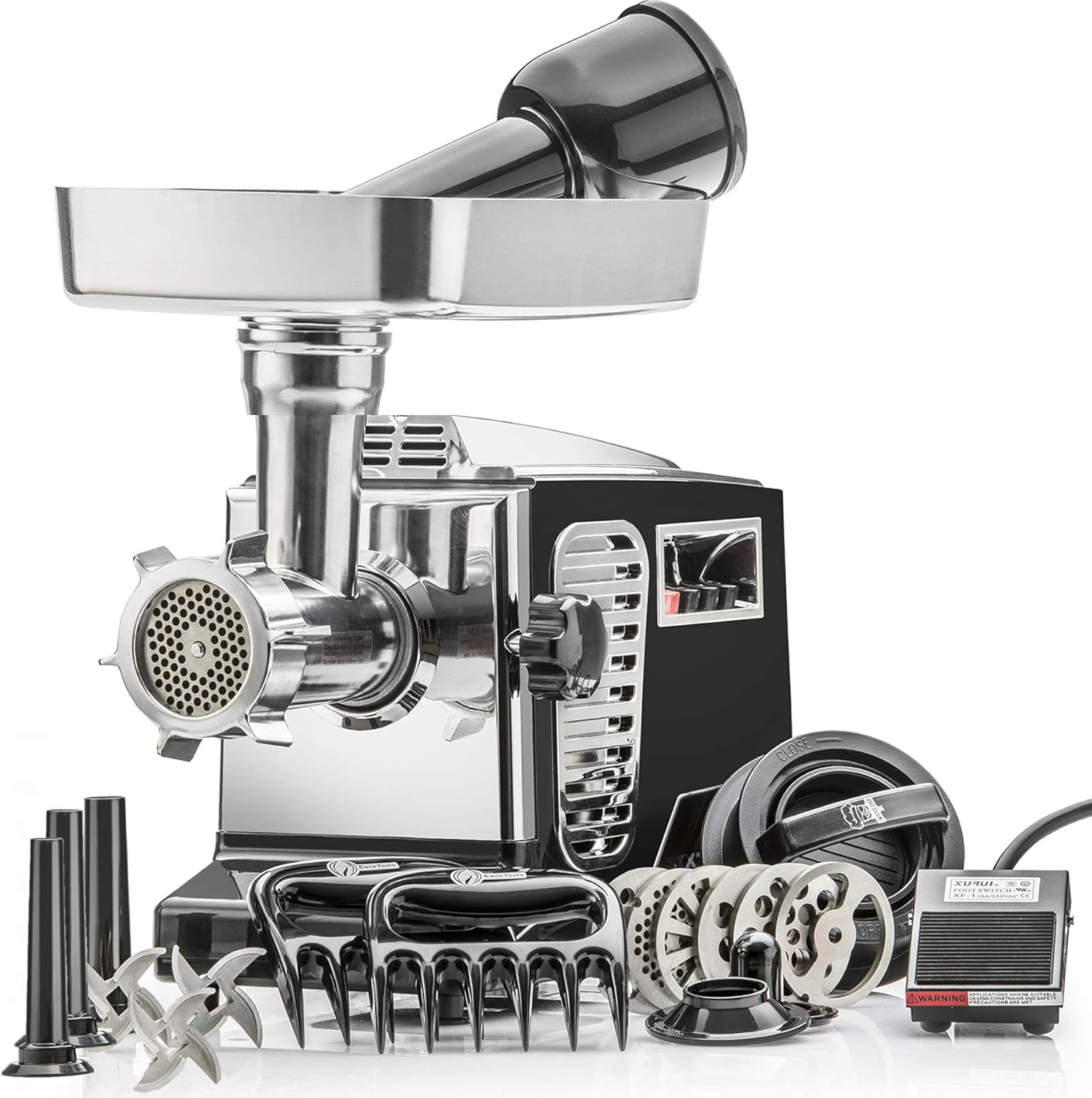
| Included Components | Grinding head, 6 grinding plates, 3 cutting blades, sausage tubes, kubbe attachment, foot pedal |
The STX Turboforce II 4000 is a performance-focused home meat grinder built around a 2000-watt motor and a size No.12 grinding head that handles high-volume batches and soft bones. It is typically used for grinding large quantities of meat, making sausages, kubbe, and burgers thanks to the included grinding plates, sausage tubes, kubbe attachment, meat pusher, meat claws, and patty press. The grinder's air-cooled design and circuit breaker aim to keep the motor running cooler under load, and the high-capacity tray plus AVI auger technology support continuous feeding for faster throughput. Notable practical benefits are the variety of plate sizes and accessories included, the foot pedal for easier control, and stainless steel cutting blades for more durable cutting action. Important limitations are its 3-pound recommended tray capacity for single loads and the unit's substantial weight and footprint compared with compact tabletop grinders, which may matter in small kitchens. If you prioritize raw power and the ability to process big batches or soft bones at home, this model delivers.
Best for: Buyers who prioritize high throughput and raw grinding power for frequent or large-batch home meat processing, including sausage making and handling soft bones.
Less Ideal for: Casual users with very limited kitchen space or those who only grind occasional small batches should consider a smaller, lighter tabletop grinder instead.
- Powerful 2000-watt motor for high throughput and handling soft bones
- Size No.12 grinding head supports large-diameter output and faster processing
- Includes multiple grinding plates, sausage tubes, kubbe attachment, and accessories for versatile use
- Patented air-cooled system and circuit breaker help prevent overheating during long runs
- Foot pedal control allows hands-free operation and safer workflow
- Large and heavier than compact home grinders, requiring more counter or storage space
- 3-pound tray capacity limits how much you can load at once despite high hourly throughput
Verdict: Choose the Turboforce II 4000 when you need a powerful, accessory-rich grinder that can handle large batches and soft bones in a home workshop.
CHEFFANO Meat Grinder AZ-MG091DG

| Capacity | 180 pounds |
|---|---|
| Material Type | Stainless Steel |
| Power Source | Corded Electric |
| Included Components | Sausage maker, food pusher, kubbe attachments, 2 blades, 3 cutting plates |
The CHEFFANO Meat Grinder is a compact home electric grinder that handles basic to heavy-duty kitchen tasks like grinding, making kibbe, and stuffing sausages. It ships with three stainless steel cutting plates, two blades, kubbe and sausage attachments, and a food pusher so you can switch textures and functions quickly. The motor uses a copper-wound design with a 350W rated power and a quoted peak of up to 2800W, which the listing says yields about 3 lb of meat per minute for steady throughput. Controls include a forward and a reverse function to clear jams, and most removable parts are hand-washable for routine cleaning. Practical buyers will appreciate the stainless steel construction and included accessories that let you do multiple tasks without buying add-ons. Limitations include no dishwasher-safe parts and a manufacturer's capacity note rather than measured throughput in real kitchens, so expect some effort when cleaning and when processing very large volumes repeatedly.
Best for: Buyers who want a versatile, no-frills countertop grinder to make fresh ground meat, sausages, and kibbe at home and who prioritize included accessories and durable metal parts over fuss-free dishwasher cleaning.
Less Ideal for: People who need a fully commercial-capacity grinder for continuous large-volume output or who prefer all parts to be dishwasher-safe for fast cleanup.
- Includes multiple stainless steel cutting plates and blades for varied grind textures
- Sausage stuffer and kubbe attachments expand functionality beyond simple grinding
- Copper motor design and reverse function help with steady grinding and jam clearing
- Stainless steel construction for durability and food-safe contact
- Attachments are not dishwasher safe so cleaning is manual
- Manufacturer lists a high peak wattage that may not reflect continuous real-world power
Verdict: A practical, accessory-rich stainless steel grinder that lets home cooks grind meat and stuff sausages reliably without buying extra attachments.
DUCHIFAD Electric Meat Grinder MG262
| Capacity | 3 pounds |
|---|---|
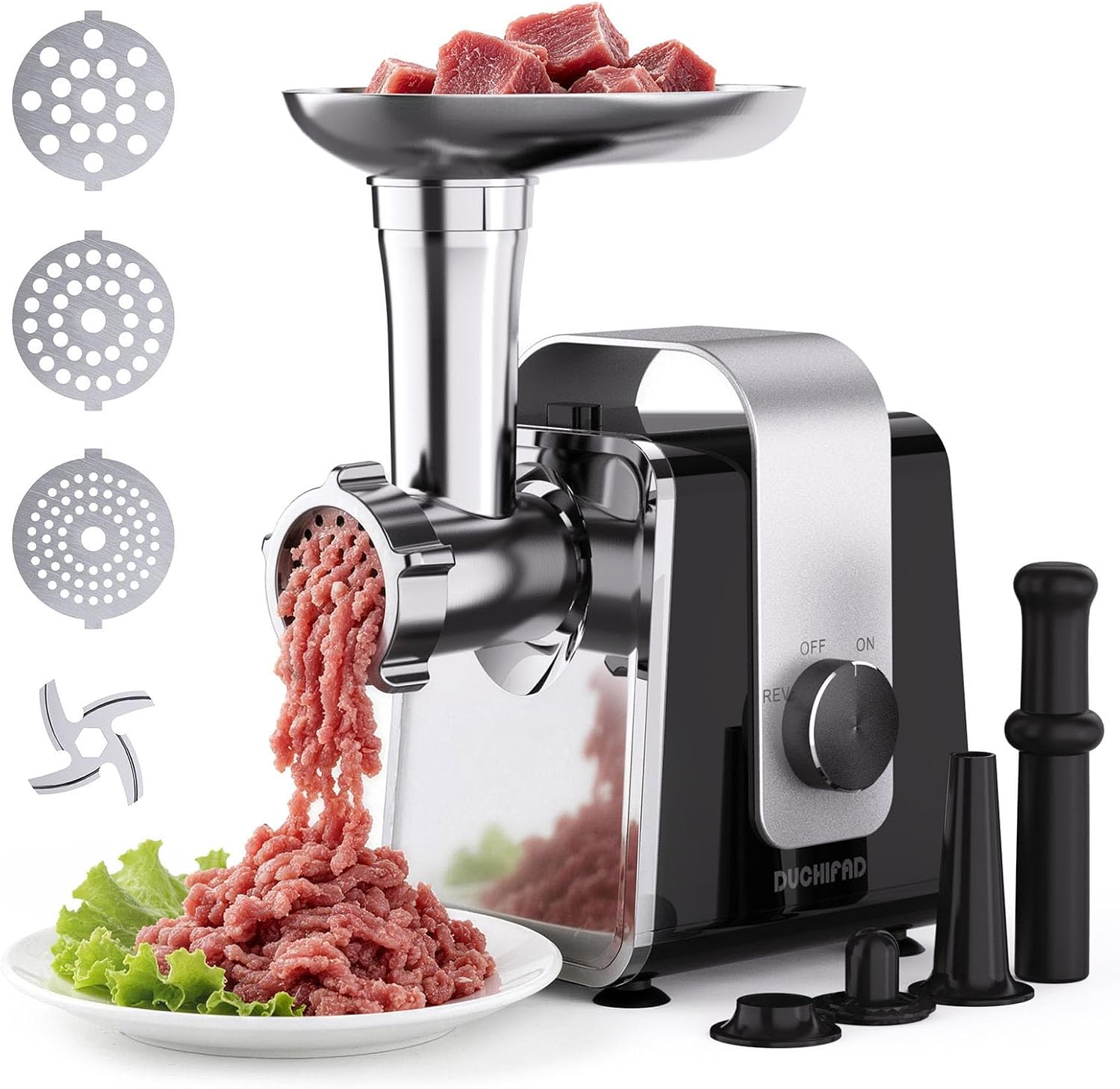
| Included Components | Stainless steel blade, 3 grinding plates, sausage stuffer tubes, kibbe kit, food pusher |
| Material Type | Plastic, Stainless Steel |
| Recommended Uses For Product | GrindingMeat |
This DUCHIFAD MG262 is a small, practical electric meat grinder that handles everything from fine purees to coarse burger mixes and homemade sausages. It uses stainless steel blades and three plates (fine, medium, coarse) so you can switch textures, and the included sausage stuffer tubes and kubbe attachment let you make links and kibbeh without extra purchases. The motor is rated at 350W with a claimed peak up to 2800W and a reverse function to clear jams, and built-in overheat protection helps protect the unit during longer runs. The snap-on design breaks down into a few large parts for quick, tool-free cleaning, and suction feet keep the machine steady while grinding. For regular home use it grinds up to about 3 pounds in a minute and is well suited to fresh or semi-frozen meat. Be aware this is a countertop kitchen appliance with plastic body components, so heavy commercial use or continuous multi-hour operation is beyond its intended scope.
Best for: Home cooks who want a reliable, easy-to-clean grinder to make fresh burgers, sausages, baby food, or pet meals and prioritize longevity of the cutting parts and straightforward maintenance.
Less Ideal for: Users who need a commercial-grade grinder for continuous heavy-duty processing or who prefer an all-metal, professional appliance should look at higher-capacity units.
- Stainless steel blades and grinding plates for durability and food-safe contact
- Three plate sizes plus kibbe and sausage attachments for versatile textures and recipes
- Snap-on, tool-free disassembly for fast cleaning
- Built-in reverse function and overheat protection to reduce jams and protect the motor
- Suction-cup base improves stability during use
- Plastic housing means the exterior is less durable than full-metal models
- Rated for short runs rather than continuous heavy commercial workloads
Verdict: Choose the DUCHIFAD MG262 if you want a dependable, easy-to-clean home meat grinder with stainless steel cutting parts and versatile attachments for everyday sausage and mince tasks.
Ganiza Food Processor GC10

| Wattage | 450 watts |
|---|---|
| Capacity | 0.95 gallons |
| Voltage | 120 volts |
| Material Type | Stainless Steel, Glass |
The Ganiza GC10 is a compact 450W food processor designed for everyday sauce making, chopping, and light grinding. It comes with two 8-cup bowls—one glass and one stainless steel—so you can keep ingredients separate for savory sauces or meat-based blends, and it includes two sets of S-shaped stainless blades for different textures. The two-speed motor handles softer ingredients and tougher items like cooked meats or nuts, and built-in overheating protection helps prevent motor damage during repeated use. Setup and cleaning are straightforward thanks to removable blades and simple controls, and the glass bowl gives good visibility when puréeing sauces. Limitations to note are the modest 450W power and thermal cutoff, which mean it is best for small to medium batches rather than heavy-duty continuous grinding, and the unit's compact capacity may require multiple batches for larger sauce volumes. For cooks who want a safe, easy-to-use processor for everyday sauce prep and occasional meat grinding, the Ganiza GC10 is a practical choice.
Best for: Home cooks who prioritize reliable, safe operation and want a versatile small processor for daily sauce making and light grinding without professional-level power.
Less Ideal for: Users who need to process very large batches, run long continuous grinding sessions, or require industrial-strength motor performance.
- Two bowls (8-cup glass and 8-cup stainless steel) let you separate ingredients for different sauces and uses
- 450W full-copper motor with two speeds handles a range of textures from soft purées to light grinding
- Overheating protection and spring-loaded blade safety reduce risk during frequent kitchen use
- Removable blades and simple controls make cleanup and everyday operation easy
- Modest power and thermal cutoff limit continuous heavy-duty grinding
- Capacity may require multiple batches for large sauce volumes
Verdict: A safe, easy-to-use two-bowl processor that reliably handles everyday sauce prep and light grinding for risk-averse home cooks.
STX Turboforce 3000 Meat Grinder

| Wattage | 1800 watts |
|---|---|
| Capacity | 3 pounds |
| Voltage | 110 volts |
The STX Turboforce 3000 is a high-capacity home meat grinder built to handle regular batch grinding for families and avid home cooks. It uses a size #12 aluminum grinding head driven by a motor rated up to 3000W peak (operating typically 800–1200W under load) and an extra-large hopper that holds roughly 3 pounds of prepped meat, which helps reduce refilling during projects. The kit includes three stainless cutting blades, five grinding plates, sausage stuffing tubes, a kubbe attachment, claws for handling, and a burger/slider press, so you can make ground beef, sausages, kibbe, and formed patties without sourcing extra parts. Practical benefits are the variable intake auger design for larger cuts and the claimed 180–240 pounds per hour throughput when meat is properly prepared. Important limitations: the unit is intended for home use only, will not grind bones or non-meat items, and is relatively large and heavy for a small-appliance kitchen, so it needs a dedicated counter or storage space. The included attachments make it versatile, but users should follow prep guidance to avoid motor strain.
Best for: Buyers who want a dependable, heavy-duty home grinder for regular batch processing and value a full set of attachments for making sausage, patties, and kubbe.
Less Ideal for: People who need a compact travel-friendly unit, want to grind bones or hard materials, or need a commercial-grade grinder for high-volume professional use.
- High-capacity hopper holds about 3 pounds to reduce frequent refills
- Includes multiple grinding plates, sausage tubes, kubbe attachment, and burger press for versatile prepping
- Size #12 head and AVI auger intake let you process larger portion sizes
- Stainless steel cutting blades and aluminum grinding head built for heavy home use
- Not designed to grind bones or non-meat items
- Bulky and relatively heavy for kitchens with limited counter or storage space
Verdict: A versatile, high-capacity home meat grinder that comes with a complete set of attachments and is built for frequent household use.
Choosing the Right Small Electric Meat Grinder: Key Factors to Consider
Motor Power and Torque
Motor power determines how well a small electric meat grinder handles different cuts. Higher wattage and good torque help move denser, partially frozen, or fattier pieces without bogging down. For home use, you want enough continuous power to run small batches without overheating.
Torque matters more than peak wattage for preventing stalls. A grinder with modest wattage but strong gearing can outperform a higher-watt unit that lacks torque. Consider whether the motor has overload protection and a reverse function to clear jams safely.
Throughput and Hopper Capacity
Throughput describes how much meat the grinder can process in a given time. Hopper capacity affects how often you need to refill and how efficiently you can run a session. Small electric grinders trade large capacity for a compact footprint, so look for a balance that fits your typical batch size.
If you plan to grind meat for a family or prep several meals at once, a slightly larger hopper and higher throughput rating reduce running time and stress on the motor. For occasional use or single-meal prep, a smaller hopper is easier to store and rinse.
Build Quality and Food-Safe Materials
Durable construction extends a grinder's useful life. Key parts such as the feed tube, screw, blade, and plates should be made from stainless steel or other food-safe metals to resist corrosion. Plastic housings can be fine if they are thick and well-fitted, but look for metal contact points where stress and wear occur.
Seals and fasteners should be secure but serviceable so components can be removed for cleaning. Poor tolerances lead to wobble and uneven grind, so inspect how parts join and whether replacement components are available.
Ease of Cleaning and Maintenance
Cleaning is a major practical concern with meat grinders. Units with simple disassembly, smooth surfaces, and dishwasher-safe parts reduce the time and effort required after use. Small grinders that trap meat in crevices or have awkward-to-remove plates will discourage regular cleaning and can become hygiene risks.
Maintenance also includes periodic sharpening or replacement of cutting blades and plates. Consider how accessible these parts are and whether the design minimizes hard-to-reach spots where residue can accumulate.
Safety Features and Noise
Compact grinders should include safety details that protect users and the motor. A reverse function helps clear blockages without disassembly, while thermal overload protection prevents motor damage during heavy runs. A stable base and non-slip feet reduce the risk of the unit moving while in use.
Noise level is another user comfort factor. Small electric grinders are not silent, but models with better motor damping and solid housings run noticeably quieter. If you live in a small space or have noise-sensitive household members, look for units with lower reported noise or rubber isolation feet.
Accessory Versatility and Cutting Options
A broader accessory set increases a grinder's usefulness. Multiple plate sizes let you control grind coarseness for burgers, chilies, and sausages. Sausage stuffing funnels and kibbe attachments add recipe flexibility without buying separate tools.
Consider whether accessories are built to the same material standards as the main grinding components and how easy they are to swap. Accessories that are flimsy or hard to clean reduce their practical value.
Preparing Meat for Best Results
Proper preparation improves grind quality and extends motor life. Trim overly tough sinew and cut meat into uniform chunks that will feed smoothly through the hopper. Chilling the meat and blades for 15 to 30 minutes firms up fat and reduces smearing, which yields a cleaner cut and more consistent texture.
If you plan to add seasonings, mix them after grinding so they distribute evenly without changing the grinding dynamics. Use the reverse function to clear small jams and avoid forcing oversized pieces into the feed tube, which can strain the motor.
- Cut meat into 1-inch cubes for consistent feeding
- Partially freeze for firmer texture and less smear
- Use pusher tools; never force with hands
- Clean immediately after use to prevent residue buildup
Cleaning Routine That Works
Adopt a repeatable cleaning routine to keep the grinder sanitary. Start by unplugging and disassembling only the parts that contact meat. Scrape large bits away, rinse with warm water, then wash with a mild detergent. Dry parts thoroughly to prevent rust, and lightly oil metal blades if recommended by the manufacturer.
Avoid soaking electrical housings. For small nooks, a brush or pipe cleaner helps remove trapped residue. Store dry components in a clean, dry place to discourage corrosion and odors.
- Disassemble and rinse immediately after use
- Use a brush for plates and feed tube crevices
- Dry metal parts fully; apply food-safe oil if advised
Sausage Stuffing Tips for Small Grinders
Small electric grinders can handle home sausage projects when matched with the right accessories and technique. Use the included stuffing funnel that fits your casing size and pack the tube evenly without air pockets. Work in short runs to avoid overworking the motor and allow the grinder to rest if it becomes warm.
Keep casings soaked and ready, and twist links by hand after stuffing. For longer sausage-making sessions, consider pre-mixing meat and seasonings in a bowl and loading smaller quantities into the hopper to maintain steady throughput.
- Soak casings before stuffing
- Pack funnels evenly and avoid overfilling
- Run in short bursts to prevent motor overheating
When to Expect Replacement Parts
Cutting blades and plates wear with use and can be sharpened or replaced. Signs you need parts include uneven grind, increased noise, or slipping between the screw and plates. Because small grinders work harder than large ones for the same volume, plan periodic inspection after heavy use seasons.
Seals and pushers may also wear. Keep a checklist of common wear items and where to source replacements. Choosing units with readily available standard-size plates simplifies maintenance over the life of the grinder.
- Inspect blades for dulling after multiple uses
- Replace plates that show pitting or warping
- Keep spare seals and pushers if you grind frequently
Storage and Space-Saving Considerations
Small electric grinders are chosen for compactness, so think about storage before buying. Units with separable parts and a small footprint are easier to stow in cabinets. Some models include a plastic tray or case to keep plates and funnels together, which reduces the time spent searching for accessories.
If counter space is limited, choose a unit with a modest base and rubber feet for stability during use. Consider where you will clean and dry parts, since assembly and disassembly require a flat surface and space to lay out components.
- Look for integrated accessory storage or a small case
- Measure clearance for disassembly on your countertop
- Choose a stable base for safe, compact operation
How We Chose the Best Small Electric Meat Grinder
We focused on small electric meat grinders designed for home use and applied practical filters that reflect real kitchen needs. Primary evaluation criteria included motor power and torque to ensure consistent grinding of lean and fattier cuts, grind throughput and hopper capacity to measure how much meat the unit can process per session, and build materials plus blade and plate quality for durability and food safety. We also assessed ease of cleaning and disassembly because compact grinders are only convenient if they can be cleaned quickly, and safety features such as reverse function, overload protection, and secure feed systems were required for inclusion. We excluded heavy commercial machines, hand-crank models, and units intended solely for occasional light use. Only grinders with usable accessory sets and clear cleaning instructions were considered. The final shortlist emphasizes units that balance compact footprint with enough power and serviceability for routine home grinding.
Our full evaluation process is outlined in our review methodology.
FAQ
Can a small electric meat grinder handle bones?
Small electric grinders are not designed for bones. Even small soft bones can damage plates and blades or stall the motor. Remove bones before grinding and reserve bone processing for machines rated for that purpose.
How often should I sharpen or replace the blade?
Frequency depends on use. For occasional home use, blades may remain sharp for many months. If you notice tearing, inconsistent grind, or longer processing times, sharpen or replace the blade. Keep a spare on hand if you grind frequently.
Is it safe to clean plates and blades in the dishwasher?
Some plates and blades are dishwasher-safe, but others can dull or rust more quickly when exposed to dishwasher detergents and high heat. Check the manufacturer's care recommendations; hand washing and thorough drying is the safest approach for longevity.
What grind plate sizes are useful for home cooking?
Common plate sizes for home use include coarse, medium, and fine. Coarse is good for stews and chili, medium for burgers, and fine for smooth sausages and pâtés. Multiple plate options give the most versatility for different recipes.
How can I prevent my grinder from overheating?
Avoid long continuous runs and process in batches, especially with dense or cold meat. Let the motor rest between batches, and use the reverse function to clear obstructions instead of forcing the feed. Ensure vents remain unobstructed during use.
Final Verdict
Prioritize motor torque, ease of cleaning, and the quality of cutting components when choosing a small electric meat grinder. Decide how much throughput and accessory versatility you need based on typical batch sizes and whether you plan to make sausages or mostly grind for burgers and tacos. Balance compact footprint against hopper capacity and maintenance demands. Choosing a grinder that fits your routine and that you will clean and service regularly delivers the best long-term results.