
Note: This article contains affiliate links. If you click on these links and make a purchase, we may earn a small commission at no extra cost to you. This helps support our research and content. Read our full affiliate disclosure here.
If counter space is tight but you still want café-style espresso at home, a compact machine with an integrated grinder can simplify daily brewing. You get fresher grounds, a shorter workflow, and fewer appliances on the counter when grinder and brewer are combined. This guide shortlists the top small espresso machines with a grinder and explains the real-world tradeoffs buyers face. We focused on extraction performance, grind consistency, and upkeep demands. Read on to see the picks and the criteria we used to evaluate them.
Top Picks at a Glance
| Best Overall The best all-around choice for most situations | Gevi Espresso Machine with Grinder |  |
| Best Quality Built to a higher standard if you want something more solid | Breville Barista Touch BES880BSS |  |
| Best Value The sweet spot between price and what you get | AIRMSEN Espresso Machine BCM2316 |  |
| Best Budget The cheapest option that still gets the job done reliably | Garvee CM5020B Espresso Machine |  |
| Top Rated A top-rated pick with lots of positive feedback | Breville Barista Express BES870XL |  |
| Most Popular A crowd favorite that many people choose with confidence | Philips 3300 Series EP3341/50 |  |
| Best Seller A high-volume bestseller chosen again and again | Ninja Luxe Café Premier ES601 |  |
Gevi Espresso Machine with Grinder

| Output Pressure | 20 bar |
|---|---|
| Wattage | 1450 watts |
| Capacity | 2.3 liters |
| Filter Type | Reusable |
| Operation Mode | Semi-Automatic |
The Gevi espresso machine combines a 20-bar pump, integrated conical burr grinder with 0–30-step adjustment, and a steam wand to let home users grind, brew, and froth without extra equipment. It is set up as a single-panel, semi-automatic unit for making single or double shots and steaming milk for lattes or cappuccinos; the NTC and PID temperature controls help keep extraction and frothing temperatures stable. Practical touches include a removable 2.3 L water tank, cup warmer, and 58 mm portafilter with both single- and dual-wall filters for easier tamping and crema. At 1,450 watts it reaches brew and steam pressure quickly, and the reusable filter reduces waste compared with pods. Expect some learning curve dialing in grind and shot volume to match your taste, and the integrated grinder can be noisier than a separate dedicated grinder. For the size, it offers a lot of pro-style features, but advanced users seeking full commercial control over pressure profiling or a quieter standalone grinder may look elsewhere.
Best for: Buyers who want an all-in-one compact espresso setup that grinds, doses, brews, and steams for daily home specialty drinks without buying separate equipment.
Less Ideal for: People who need a whisper-quiet dedicated grinder, full commercial dual-boiler temperature stability, or who prioritize café-level customization and workflow over convenience.
- Built-in conical burr grinder with adjustable settings for fresher espresso
- 20 bar pump and PID/NTC temperature control for consistent extraction
- Steam wand for microfoam and hot water for Americanos
- Removable 2.3 L water tank and cup warmer improve daily convenience
- Includes 58 mm portafilter and multiple single/dual-wall filters for flexibility
- Integrated grinder can be relatively loud during operation
- Not a true commercial dual-boiler system so back-to-back steaming may require short waits
Verdict: A compact all-in-one machine that delivers grinder-to-cup convenience and consistent home espresso with pro-style controls.
Breville Barista Touch BES880BSS

| Wattage | 1680 watts |
|---|---|
| Voltage | 120 |
| Human Interface Input | Touchscreen |
| Coffee Input Type | whole_beans |
| Filter Type | Reusable |
The Breville Barista Touch combines a conical burr grinder, touchscreen interface, and a hands-free steam wand to streamline making espresso, lattes, and cappuccinos at home. It automatically grinds and doses whole beans with 30 grind settings and then guides you through shot extraction and milk texturing via an intuitive touchscreen; the ThermoJet heating system reaches brew temperature quickly so the machine is ready fast. The steam wand produces microfoam suitable for latte art when used with the included 16 oz stainless steel jug, and the reusable filter and Razor dosing tool help deliver consistent puck prep. For a small kitchen setup this unit packs serious performance, giving repeatable 9-bar extraction and programmable beverage presets. Expect a learning curve to dial in grind and dose for different beans, and the machine is heavier and takes more counter space than basic compact models, so it suits buyers who want near-professional results rather than minimal footprint or ultra-simple operation.
Best for: Serious home espresso makers who prioritize extraction control and café-level steamed milk and want an integrated grinder and guided interface to produce consistent specialty drinks.
Less Ideal for: Buyers who need a very compact, lightweight unit or a no-training, one-button single-serve machine should consider simpler alternatives.
- Integrated conical burr grinder with 30 grind settings for precise dosing
- Touchscreen with programmable presets simplifies drink setup and repeatability
- ThermoJet heating system speeds heat-up so the machine is ready quickly
- Hands-free steam wand and included stainless steel jug produce fine microfoam for latte art
- Comes with useful accessories including Razor dosing tool and water filter
- Larger and heavier than minimalist small machines so it needs ample counter space
- Requires time to learn grind/dose/milk settings to get optimal results
Verdict: If you want near-professional espresso and milk-texturing with an integrated grinder and guided touchscreen in a small kitchen-friendly package, this machine delivers.
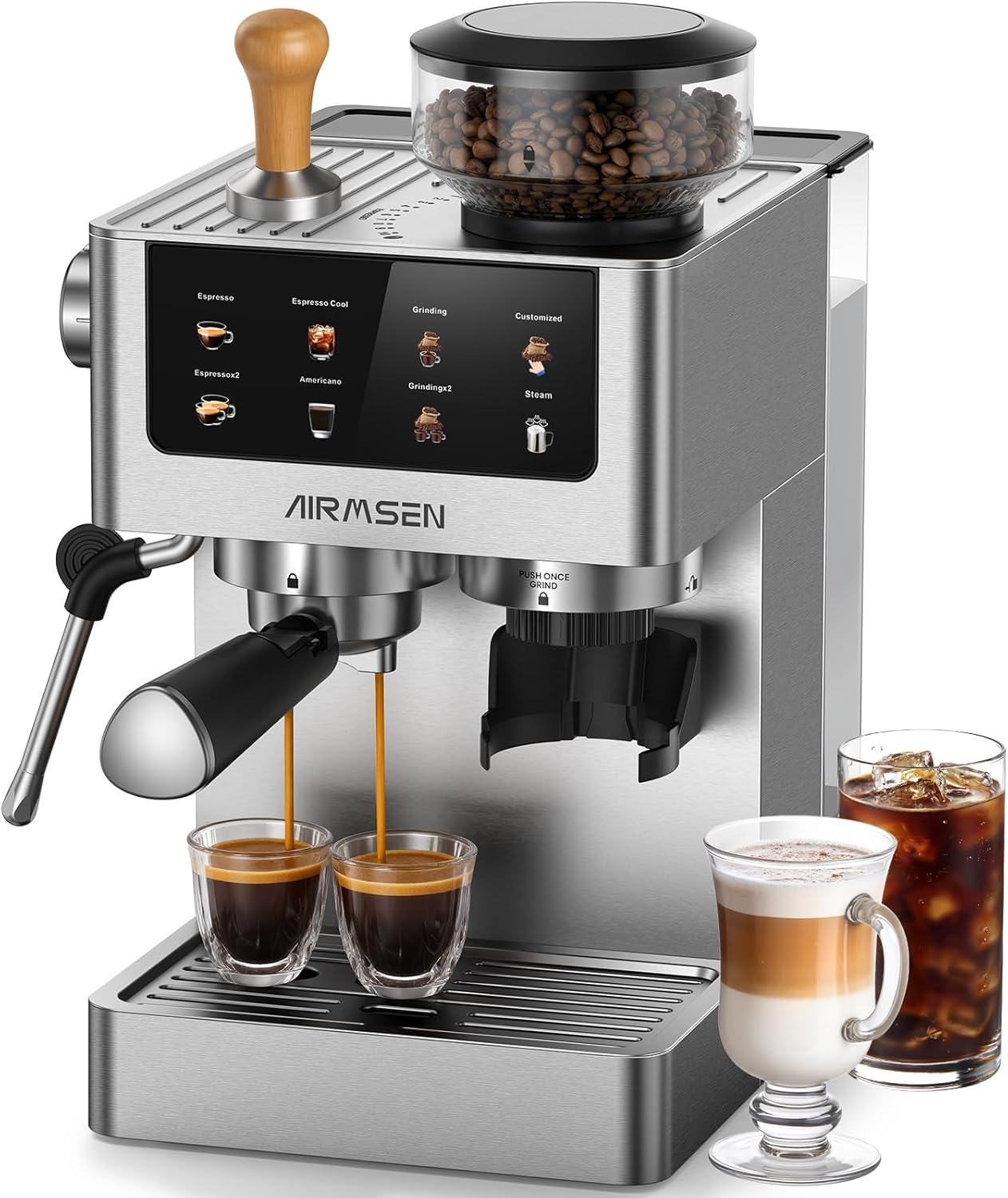
AIRMSEN Espresso Machine BCM2316
| Output Pressure | 20 bar |
|---|---|
| Wattage | 1350 watts |
| Operation Mode | Semi-Automatic |
| Coffee Input Type | Coffee Ground |
| Capacity | 1.8 liters |
The AIRMSEN BCM2316 combines a 10-setting conical burr grinder, a 20‑bar pump, and a manual steam wand into a compact countertop unit aimed at home baristas. Use it to grind fresh beans and pull single or double shots, steam milk for lattes and cappuccinos, or brew Americano and iced coffee; the removable 60 oz water tank and drip tray simplify refills and cleaning. The touchscreen and pre-infusion feature make shot setup straightforward while the straight-through grinder design with anti-static tech reduces mess. Practical touches include a stainless steel cup warmer and reusable filter baskets for single or double servings. Expect factory‑style extraction power and flexible grind control, but note this is a semi-automatic machine so it requires manual tamping and some technique to get consistent results, and its multi-function layout adds learning for new users. It is a solid choice for someone who wants an integrated grinder and milk steaming without taking much counter space, though advanced pros may prefer dedicated commercial components.
Best for: Buyers who want a compact all‑in‑one machine that grinds beans and steams milk at home and who prioritize convenience and space savings over a fully automatic or commercial setup.
Less Ideal for: If you want a plug‑and‑play super-automatic with one-touch milk drinks or a commercial-grade machine with serviceable professional parts, look elsewhere.
- Built-in conical burr grinder with 10 grind settings for fresh, consistent grounds
- 20‑bar pump with pre-infusion for richer extraction and fuller flavor
- Manual steam wand capable of microfoam for lattes and cappuccinos
- Removable 60 oz water tank and drip tray for easier refilling and cleaning
- Full touchscreen control and cup warmer simplify daily use
- Semi-automatic workflow requires manual tamping and practice for consistent shots
- Multi-function design increases complexity compared with single-purpose machines
Verdict: A compact all-in-one small espresso machine with grinder and steam wand that delivers barista-capable extraction and fresh grinds for space-conscious home brewers.
Garvee CM5020B Espresso Machine

| Pressure | 20 BAR |
|---|---|
| Motor Power | 1450W/120V |
| Water Tank Capacity | 2.8 liters |
| Grinder Settings | 0~30 coarseness levels |
The Garvee CM5020B brings an integrated grinder and 20-bar pump to a compact home/office package, so you can grind beans and pull espresso shots without separate equipment. Its 30-step cone grinder lets you adjust coarseness for espresso-focused extraction or coarser settings for other brew styles, while adjustable shot volume and grind time give basic control over strength and yield. The stainless-steel pump and 1450W motor provide consistent pressure for crema and the steam wand froths milk for lattes and cappuccinos. Practical touches like a removable 2.8L water tank and detachable drip tray make refilling and cleaning straightforward. Expect a learning curve dialing in grind and dose to avoid channeling, and the machine is heavier than some small single-purpose units, which reduces portability. Though it includes a grinder and milk frother, build and long-term reliability may not match higher-end prosumer machines, so it is best for users who want an all-in-one entry-level setup rather than a dedicated commercial-grade brewer.
Best for: Buyers seeking a budget-friendly all-in-one espresso solution that grinds beans and steams milk in a single machine and who prioritize convenience over pro-level durability.
Less Ideal for: People who want a lightweight travel unit or experienced home baristas seeking a long-term commercial-grade machine and precise single-dial controls.
- Integrated 30-setting cone grinder for on-demand fresh grounds
- 20-bar Italian pump and 1450W motor for consistent extraction
- Steam wand froths milk for lattes and cappuccinos
- Removable 2.8L water tank and drip tray for easy refills and cleaning
- Heavier and less portable than compact single-purpose machines
- May require dialing in grind and dose to avoid inconsistent shots
Verdict: A budget-conscious, space-saving all-in-one espresso machine that grinds, brews, and steams for home users who want convenience without separate equipment.
Breville Barista Express BES870XL

| Wattage | 1600 watts |
|---|---|
| Voltage | 120 |
| Coffee Input Type | whole_beans |
| Filter Type | Reusable |
| Capacity | 1 cups |
The Breville Barista Express is a compact semi‑automatic espresso machine that grinds, doses and brews single or double shots without needing a separate grinder. It uses an integrated conical burr grinder with 16 grind settings to deliver freshly ground beans directly into a 54mm portafilter, and a thermocoil heating system with digital temperature control to keep extraction consistent. The machine includes single and dual wall filter baskets, a steam wand capable of producing microfoam for lattes and cappuccinos, and a removable water tank for refilling. In practice it speeds the workflow for a home barista: grind, tamp with the integrated tamper, and pull a shot in under a minute while still allowing hands‑on control of dose and texture. Expect a learning curve to dial grind setting and tamping pressure for your preferred shot, and routine cleaning of the grinder and steam wand to maintain performance. Its stainless steel build feels durable but the size and manual controls mean it is best for someone who wants control rather than fully automatic convenience.
Best for: Home users who prioritize reliable, factory-quality espresso workflow with an integrated grinder and want hands‑on control over grind and milk steaming.
Less Ideal for: Buyers who want a push-button, fully automatic machine or who prefer a maintenance-free pod system should consider other options.
- Integrated conical burr grinder with adjustable grind settings for fresh dosing
- 54mm portafilter and dual/single wall baskets for proper shot extraction
- Thermocoil PID temperature control for more consistent brewing temperature
- Powerful steam wand for manual microfoam and latte art
- Compact, stainless steel build with included tools (tamper, razor dose tool)
- Manual operation requires practice to consistently dial in shots
- Regular cleaning and maintenance of grinder and steam wand are needed to retain performance
Verdict: Choose the Barista Express if you want a reliable, all‑in‑one small espresso machine with a built-in grinder that delivers café‑quality shots while keeping hands‑on control.
Philips 3300 Series EP3341/50

| Operation Mode | Fully Automatic |
|---|---|
| Output Pressure | 15 bar |
| Coffee Input Type | whole bean |
| Capacity | 1.8 liters |
| Wattage | 1500 watts |
The Philips 3300 Series EP3341/50 is a compact fully automatic espresso machine that grinds whole beans, tamps, brews and prepares milk drinks with minimal intervention. You select one of six presets on the color touchscreen for espresso, regular coffee, iced coffee, cappuccino, latte macchiato or hot water, then fine tune strength, volume and temperature to taste. The removable LatteGo milk unit produces smooth milk-based drinks and is simple to rinse or wash in the dishwasher, while the AquaClean filter reduces the frequency of descaling. A ceramic grinder and 15-bar pump deliver consistent extraction and Philips' SilentBrew tech reduces operating noise versus prior models. The machine is geared toward daily, one-touch café-style drinks at home, but its water tank and bean hopper mean it needs regular refilling for multi-cup use and the plastic-heavy construction keeps weight down but is less premium-feeling than metal-bodied machines.
Best for: Buyers who want a simple, low-effort path to café-style hot and iced drinks at home and who prioritize easy cleaning and reliable one-touch presets backed by a well-known brand.
Less Ideal for: Those seeking a heavy-duty, all-metal commercial-style machine or users who need very large daily throughput without frequent refilling or more advanced barista controls.
- True bean-to-cup workflow with built-in ceramic grinder for fresh grounds
- LatteGo milk system that rinses clean in seconds and is dishwasher safe
- Touchscreen controls and six presets make one-touch hot or iced drinks easy
- AquaClean filter extends time between descaling cycles
- Mostly plastic construction that feels less premium than metal alternatives
- Water tank and bean hopper require frequent refills if brewing multiple cups daily
Verdict: If you want an easy-to-use bean-to-cup machine that makes consistent one-touch espresso and milk drinks with minimal cleanup, the Philips 3300 Series is a strong small-home choice.
Ninja Luxe Café Premier ES601

| Operation Mode | Fully Automatic |
|---|---|
| Wattage | 1650 watts |
| Coffee Input Type | Ground, Whole Bean |
| Filter Type | Reusable |
| Included Components | Portafilter, Milk Jug, Assisted Tamper, Cleaning tools |
The Ninja Luxe Café Premier ES601 combines an integrated conical burr grinder, assisted tamping, and guided Barista Assist workflows to simplify making espresso, drip coffee, and cold-pressed espresso or rapid cold brew at home. Typical use ranges from single-shot espressos and milk-based drinks to full-pitcher drip coffee and cold brew; the machine handles grinding, weight-based dosing, tamping, brewing, and hands-free frothing with a dual froth system. Notable features include a 25-setting grinder, spring-loaded assisted tamper, self-clearing steam wand, a 70 oz removable water reservoir, and multiple preset drink styles and sizes. These automations make it friendly for less experienced users while still offering control over grind and drink type. Trade-offs are its substantial countertop footprint and weight for a “small” machine and the system's reliance on factory-guided steps rather than fully manual barista controls, which may limit customization for advanced users. Regular cleaning and descaling are required to keep the grinder and steam system performing as intended.
Best for: Buyers who want a low-risk way to get cafe-style espresso and milk drinks at home with clear guided steps and minimal barista skill required.
Less Ideal for: If you prioritize a very compact, lightweight machine or full manual control over every shot, a smaller single-purpose or manual espresso setup would suit you better.
- Built-in conical burr grinder with 25 grind settings for consistent dosing
- Assisted tamper and weight-based dosing reduce setup guesswork
- Hands-free dual froth system produces consistent microfoam without manual technique
- 3-in-1 functionality covers espresso, drip coffee, and rapid cold brew in one unit
- Removable 70 oz water reservoir and onboard accessory storage improve day-to-day convenience
- Larger and heavier than many compact grinder-equipped machines, so needs ample counter space
- More automated workflow limits manual control for experienced home baristas
Verdict: For a risk-averse buyer who wants reliable, guided espresso plus drip and cold-brew capabilities with a built-in grinder, this machine delivers cafe-style results with minimal learning curve.
Choosing the Right Small Espresso Machine with a Grinder: Key Factors to Consider
Grind Performance and Adjustability
The grinder determines shot quality more than most other single features. Consistent particle size and a stepped or continuous adjustment mechanism let you dial in dose for different beans and roast levels. Coarse or uneven grounds lead to channeling and underextracted espresso, so a reliable burr grinder is essential. Adjustment range matters for people who drink both ristretto-style and longer espressos, or who switch between light and dark roasts. Also consider whether the grinder allows easy access for burr cleaning and whether the hopper capacity fits your typical use without requiring constant refills.
Extraction Control and Temperature Stability
Even with a good grinder, extraction depends on stable pressure and water temperature. Look for machines that offer consistent pressure profiling around the 9-bar range and stable brewing temperature to prevent sour or bitter shots. Machines with a clear pre-infusion or programmable shot settings make it easier to extract evenly. Temperature stability is especially important in small machines that heat small water volumes quickly. Check whether the design separates boiler and brew circuits or includes temperature management features that reduce shot-to-shot variance.
Steam System and Milk Texture
If you drink cappuccinos or lattes, the steam wand determines how easy it is to produce microfoam. A powerful steam boiler or a well-designed thermoblock with a professional-style wand lets you texture milk quickly and consistently. For compact machines, consider whether the steam system can reach sufficient pressure without long recovery times between drinks. Also evaluate wand control and reach. Some compact units use automatic frothing attachments that are convenient but offer less manual control over texture. Decide whether you need manual steaming for latte art or prefer a hands-off automatic option.
Maintenance, Cleaning, and Parts Access
Integrated grinders add a maintenance layer compared with separate systems. Look for machines with user-friendly access to the grind chamber for brushing out residual coffee and tools for adjusting or replacing burrs. Removable brew groups, easy-to-empty drip trays, and clear descaling procedures reduce the time you spend on upkeep. Maintenance frequency affects total ownership satisfaction. Machines with intuitive LED alerts or simple service routines will keep performance consistent and avoid surprises, which is especially valuable in a compact kitchen where servicing may be done by the owner.
Footprint and Kitchen Fit
Small machines promise space savings, but real-world fit depends on height, depth, and clearances for the steam wand and hopper. Measure under-cabinet clearance and countertop depth before choosing. A slim profile with a rear or top-facing hopper helps if you store cups above or behind the machine. Consider how the water reservoir is accessed and removed. A front- or side-access reservoir is easier to refill on a crowded counter than a rear-fill design that forces you to move the unit for every top-up.
User Controls and Daily Workflow
Controls affect how quickly you can pull a shot in your morning routine. Simple push-button presets speed up repeatable brewing, while manual or semi-automatic controls offer more flexibility for experimentation. Check whether dose and grind adjustments are intuitive and whether the machine supports single- and double-shot workflows without complicated reconfiguration. A compact machine that streamlines daily tasks will be used more often. Look for models with clear indicators, minimal menu layers, and ergonomically placed portafilters and milk wands to reduce friction in your routine.
Why an Integrated Grinder Matters
An integrated grinder shortens the path from beans to puck, which preserves aroma and reduces handling. It also guarantees that the grinder and brew system were designed to work together, which can simplify dialing in a shot.
Integrated units reduce counter clutter and make the workflow faster, but they can limit upgrade options. For many home users seeking consistent daily espresso without separate components, the tradeoff is worth it.
- Less countertop clutter and fewer accessories
- Fresher grounds with minimal transfer loss
- Grinder settings often tuned to the machine's extraction profile
Space-Saving Layouts and Installation Tips
Think beyond width. Depth and height influence how the machine fits under cabinets and near backsplashes. Position the machine where you can fully open the hopper and remove the water reservoir without moving the unit.
If the machine will live near a sink, verify splash and steam paths to avoid moisture damage to cabinets. Use a rubber mat to protect delicate countertops and to reduce vibration noise during grinding.
- Measure under-cabinet clearance before buying
- Leave room for steam wand clearance and cup placement
- Place near a water source for easy refills
Bean Selection and Roast Level Considerations
Beans and roast level change how you need to grind. Lighter roasts often need finer settings and slightly higher extraction times to bring out acidity and complexity. Darker roasts compress more and may require coarser grinds to avoid overextraction.
Choose a machine whose grinder offers a wide adjustment range if you like trying different beans. Regularly clean the grinder of oily dark-roasted residue to maintain consistent dosing.
- Light roast: finer grind and stable temperature
- Dark roast: coarser grind to prevent bitter shots
- Freshness: use beans within a few weeks of roast date for best results
Common Small-Machine Tradeoffs
Compact machines often sacrifice large reservoirs, professional-grade steam power, or easily accessible service parts. Expect shorter steam recovery times and smaller water capacity compared with full-size machines.
That said, modern compact designs optimize for home use by balancing grind quality, brewing control, and convenient maintenance. Decide which tradeoffs you can accept based on whether you prioritize milk drinks, multiple daily shots, or minimal counter impact.
- Smaller reservoir means more frequent refills
- Lower steam capacity can limit back-to-back milk drinks
- Integrated grinders may be harder to upgrade
Routine Care to Keep Performance Consistent
Daily brushing of the grinder chute and periodic deep cleaning of the burrs prevents dose drift and buildup that affect shot taste. Wipe the steam wand after every use and purge with steam to keep milk residue from clogging the tip.
Follow the manufacturer guidance on descaling and replaceable seals. Preventive upkeep preserves extraction stability and avoids sudden drops in performance.
- Brush grinder chute daily
- Purge and wipe steam wand after each use
- Descale and replace seals on a schedule
How We Chose the Best Small Espresso Machine with a Grinder
We prioritized machines that pair a compact footprint with an integrated grinder and a proven ability to extract balanced espresso. Key evaluation criteria included grind consistency across dose settings, pressure and temperature control during extraction, and the steam system's usability for milk-based drinks. We also assessed ease of cleaning and everyday maintenance, plus build quality for long-term reliability in a home environment. Products were excluded if they required external grinder hardware or only offered blade-style grinding. We also excluded devices that are significantly oversized for small kitchens or that lacked basic dose adjustment and tamping support. Our short list favors units that combine practical grind adjustment, stable extraction parameters, and straightforward maintenance so buyers can get consistent shots without complex setup.
Our full evaluation process is outlined in our review methodology.
FAQ
Is an integrated grinder as good as a standalone grinder?
Integrated grinders can be excellent for daily convenience and matched performance, but high-end standalone grinders may offer larger burrs and finer control. For most home users who value compactness, an integrated unit provides a strong balance of quality and convenience.
How often should I clean the grinder and burrs?
Light brushing of the grind chute and dosing area should be done daily or after each use. A deeper cleaning of the burrs and hopper is usually needed every few weeks, depending on roast oiliness and frequency of use.
Can a small machine handle milk-based drinks reliably?
Many compact machines can texture milk well enough for lattes and cappuccinos, but steam power and recovery vary. If you make multiple milk drinks back-to-back, choose a unit with a stronger steam system and quick recovery to maintain consistent microfoam.
What grind settings should I use for espresso vs lungo?
Espresso generally requires a finer grind and shorter extraction time, while a lungo uses a slightly coarser grind and longer water volume. Small changes in grind and dose influence extraction, so make one adjustment at a time and taste between changes.
Will a built-in grinder add a lot of maintenance?
A built-in grinder adds routine tasks like hopper cleaning and burr maintenance, but the additional time is usually modest. Machines with user-accessible grind chambers and tool-free burr removal make upkeep quick and straightforward.
Final Verdict
A small espresso machine with a grinder streamlines the path from bean to cup and can deliver café-quality shots without a large footprint. Prioritize grind consistency, extraction stability, and a steam system that matches how you drink milk-based drinks. Accept the typical compact tradeoffs such as smaller water reservoirs and potentially lower steam capacity, and focus on models that make maintenance straightforward. With the right balance of grind control and extraction reliability, you can confidently pick a compact integrated machine that fits your counter and brewing habits.