
Note: This article contains affiliate links. If you click on these links and make a purchase, we may earn a small commission at no extra cost to you. This helps support our research and content. Read our full affiliate disclosure here.
When kitchen knives feel blunt, a compact sharpener can save time and make food prep safer. A Small Knife Sharpener is a practical counter or drawer-sized tool that you can reach for between full-service sharpening sessions. The right choice restores a clean edge without removing too much metal, minimizes risk during use, and fits the way you work in the kitchen. This guide shortlists seven top options across common sharpening styles and materials. We evaluated ease of use, the quality of the edge produced, and durability to help you pick a compact sharpener that suits your routine. Read on for quick buyer criteria and the editorial approach we used to select these compact sharpeners.
Top Picks at a Glance
| Best Overall The best all-around choice for most situations | Rada Quick Edge Knife Sharpener R119 |  |
| Best Quality Built to a higher standard if you want something more solid | KEENBEST 400/1000 Whetstone |  |
| Best Value The sweet spot between price and what you get | AccuSharp Knife Sharpener ACCU-001C |  |
| Best Budget The cheapest option that still gets the job done reliably | Smith's 2-Step Knife Sharpener CCKS |  |
| Top Rated A top-rated pick with lots of positive feedback | Work Sharp Guided Field Sharpener |  |
| Most Popular A crowd favorite that many people choose with confidence | KitchenIQ Edge Grip 2-Stage Sharpener |  |
| Best Seller A high-volume bestseller chosen again and again | KITCHELLENCE 3‑Stage Knife Sharpener |  |
Rada Quick Edge Knife Sharpener R119

| Material Type | Stainless Steel |
|---|---|
| Grit Type | Fine |
| Model Number | R119 |
| Manufacturer | Rada Cutlery |
The Rada Quick Edge (R119) is a small, handheld sharpener designed to quickly put a fine edge back on straight-bladed knives. It has two hardened high-carbon stainless steel wheels set in a nylon base; you draw the blade through the V-shaped slot a few times to realign and thin the edge. Because the wheels are fine grit, it is best used for routine maintenance and light re-sharpening rather than repairing heavily rolled or chipped bevels. Its compact size and simple pull-through action make it convenient to keep in a drawer or pack for field use, and the stainless wheels are corrosion resistant so they hold up to regular use. Limitations include the fixed angle and lack of coarse grit, so it cannot replace a full sharpening system when a blade needs significant material removal or re-profiling.
Best for: Buyers who want an easy-to-use tool for regular at-home maintenance and quick touch-ups on straight-edge knives without learning honing techniques.
Less Ideal for: People who need to repair chipped or very dull blades, sharpen serrated knives, or who prefer full sharpening control with multiple grit stages should look elsewhere.
- Simple, fast pull-through operation for quick edge touch-ups
- Hardened high-carbon stainless steel wheels resist corrosion and wear
- Compact, lightweight design fits easily in a drawer or kit
- Made in the USA, manufactured from raw materials through construction
- Fixed angle and fine grit wheels limit use to light maintenance sharpening
- Not suitable for serrated blades or heavy damage repair
Verdict: A compact, reliable pull-through sharpener that makes fast, routine edge touch-ups on straight blades simple and convenient.
KEENBEST 400/1000 Whetstone

| Material Type | Stone |
|---|---|
| Grit Type | Medium |
| Number of Items | 1 |
This two-sided whetstone pairs a coarse 400 grit for repairing and re-profiling dull edges with a 1000 grit face for smoothing and polishing. Made from silicon carbide (white corundum), it soaks in water for 10–15 minutes and stays lubricated during use, which reduces friction and helps remove metal quickly on the 400 side while the 1000 side refines the edge. The stone ships with a basic non-slip rubber base and a short step-by-step guide, making it straightforward for users who want consistent, hands-on control over edge geometry. It works across kitchen, pocket, hunting, and many other blades and can also be used on small axes, chisels, and gardening tools. Expect visible metal removal from the coarse side, so you will need to flatten the stone periodically if you use it heavily, and it lacks a more robust accessory kit such as angle guides or a premium base for bench mounting. For someone focused on performance and edge restoration, this set gives a fast-cutting coarse surface plus a polishing grit at an entry-level price point.
Best for: Buyers who prioritize fast, performance-focused edge repair and want a simple, hands-on whetstone setup to restore and refine blades without specialist tools.
Less Ideal for: If you want a fully guided or tool-free sharpening system with angle presets or a premium mounted base, look for purpose-built guided sharpeners instead.
- Two-sided 400/1000 grits cover re-profiling and polishing steps
- Silicon carbide (white corundum) cuts quickly for fast edge restoration
- Water-use design eliminates need for oil and simplifies prep
- Includes non-slip rubber base and a beginner guide for safer, more consistent sharpening
- No angle guide or premium mounting hardware included
- Heavy use will require periodic flattening to maintain a flat surface
Verdict: A fast-cutting two-sided silicon carbide whetstone that delivers quick edge restoration plus a polishing grit for performance-focused sharpening.
AccuSharp Knife Sharpener ACCU-001C

| Material Type | Acrylonitrile Butadiene Styrene |
|---|---|
| Grit Type | Coarse |
| Included Components | Sharpener |
| Model Number | ACCU-001C |
The AccuSharp ACCU-001C is a small, easy-to-use pull-through sharpener designed to quickly restore a cutting edge on kitchen and outdoor knives. You draw the blade through the reversible diamond-honed tungsten carbide slot and the ergonomic full-length handle and finger guard make the motion stable and safe for both right- and left-handed users. It works on a wide range of blades including chef, paring, cleaver and many serrated edges, and AccuSharp claims a sharp edge in about ten seconds, which matches typical quick-touch ups during food prep. The unit is durable plastic with replaceable carbide blades that can be reversed for extended life, and it is simple to clean by hand or in the dishwasher. The trade-off is this is a coarse, fixed-angle pull-through tool rather than a multi-stage system, so it is best for dulling correction and quick maintenance rather than precision sharpening or re profiling a badly damaged edge.
Best for: Buyers who want a fast, no-fuss way to refresh household and outdoor knives between more thorough sharpenings and value simplicity and speed over precision.
Less Ideal for: People seeking a high-precision sharpening system, progressive multi-grit stones, or a tool for restoring severely chipped or rolled blades should consider a stone or guided sharpening system instead.
- Very quick to use for routine sharpening touch-ups
- Ergonomic full-length handle and finger guard for secure, ambidextrous operation
- Diamond-honed tungsten carbide blades provide effective, durable cutting-edge restoration
- Replaceable and reversible blades extend service life
- Dishwasher-safe plastic body simplifies cleaning
- Fixed coarse grit and angle limit precision honing and fine polishing
- Not intended for re-profiling or professional-grade edge work
Verdict: A fast, durable, and user-friendly pull-through sharpener ideal for quick maintenance of everyday knives.
Smith's 2-Step Knife Sharpener CCKS

| Included Components | 1 sharpener |
|---|---|
| Material Type | Synthetic |
| Grit Type | Coarse,Fine |
Smith's 2-Step Knife Sharpener is a tiny, portable pull-through tool that restores and hones blades in the field or at home. Use the carbide coarse slot for a very dull edge—three to four pulls usually do the job—and finish with the crossed ceramic rods for a smoother, razor-like edge. The sharpener is designed for outdoor use with a lanyard hole, non-slip rubber feet, and a buoyant plastic body that floats if dropped in water. It works on most knife types and is especially handy for fillet and pocket knives when you need a quick edge while fishing, hunting, or camping. Because the angles are preset, it is simple to use for beginners, but that also means you cannot adjust angle or perform more advanced sharpening techniques. Its lightweight synthetic construction is convenient for carry but will not replace a full sharpening system for reshaping badly damaged blades.
Best for: Buyers wanting a low-cost, portable sharpener for quick touch-ups while camping, fishing, or keeping pocket and fillet knives serviceable between full sharpening sessions.
Less Ideal for: Users who need precise angle control, professional reprofiling, or the performance of a full sharpening system should choose a more advanced stone or guided sharpener.
- Two-step design with carbide coarse slot and ceramic rods for both restoring and finishing edges
- Very compact and lightweight with lanyard hole for easy carry
- Non-slip rubber feet and floating body increase safety and outdoor usefulness
- Preset angles cannot be adjusted for custom edge geometry
- Not suitable as a replacement for full sharpening stones for heavily damaged or chipped blades
Verdict: A rugged, budget-friendly two-stage pull-through sharpener that quickly restores and hones knives for outdoor use.
Work Sharp Guided Field Sharpener

| Material Type | Diamond and Ceramic Sharpener |
|---|---|
| Grit Type | Coarse, Fine |
| Included Components | WSGFS221 |
The Work Sharp Guided Field Sharpener is a compact, all-in-one sharpening kit designed for outdoorsmen and home users who need reliable edge maintenance on the go. It uses removable diamond plates for faster material removal, a rotating ceramic rod with coarse and fine sides plus a grooved surface for hooks and serrations, and a leather strop for polishing. A guided angle system holds blades at roughly 20 or 25 degrees to produce repeatable edges without complex setup, and all components store inside the housing so the unit stays tidy in a pack. The kit is durable and straightforward: no assembly or power source is required, and the included broadhead wrench and fish hook groove add practical field functionality. Limitations include a modest abrasive area compared with benchtop systems and less control for very specialized angles, so it is best for routine sharpening rather than precision reprofiling or heavy regrinds. Its compact, tool-free design makes it a dependable choice when portability and consistent results matter most.
Best for: Buyers who prioritize a durable, travel-ready sharpener that delivers consistent edges with minimal fuss for outdoor use and everyday knives.
Less Ideal for: Users seeking a benchtop or motorized system for rapid material removal, wide angle choices, or professional reprofiling should consider larger specialty sharpeners instead.
- All-in-one kit with diamond plates, ceramic honing rod, and leather strop for sharpening and polishing
- Guided angle system (20° and 25°) yields consistent, repeatable edges without skill-intensive setup
- Compact, self-contained design stores abrasives and tools inside the unit for easy transport
- Includes specialty features for field use such as a broadhead wrench and fish hook sharpening groove
- Smaller abrasive surface and limited angle range make heavy reprofiling slower compared with benchtop systems
- Not intended for highly specialized angles or professional resharpening workflows
Verdict: Choose this guided field sharpener when you want a reliable, compact kit that produces consistent, travel-ready edges without tools.
KitchenIQ Edge Grip 2-Stage Sharpener

| Material Type | Plastic |
|---|---|
| Grit Type | Fine |
| Included Components | Complete |
| Model Number | 50009 |
The KitchenIQ Edge Grip is a simple, portable pull-through sharpener built for quick edge restoration and touch-ups. It uses a carbide slot for setting an edge on dull or nicked blades and a ceramic rod slot to hone and polish the edge. The patented V-grip base and non-slip rubber feet let you stabilize the unit on a countertop edge or flat surface, and the soft rubber handle makes one-handed pulls comfortable. Because it is a preset-angle manual sharpener, sharpening is fast and beginner-friendly—pull the blade through one direction a few times and it becomes noticeably sharper. It works on most straight-edge kitchen knives and can handle light serrations, but it is not a precision adjustable system and will remove material faster than stones if overused. Its small footprint fits easily in a drawer for occasional at-home maintenance rather than heavy professional re-profiling.
Best for: Buyers who want a low-effort, reliable tool to restore and maintain kitchen knives at home with minimal learning curve and space needs.
Less Ideal for: Users who need precise angle control, frequent professional-level sharpening, or tools for extensive blade re-profiling should look at adjustable or electric systems instead.
- Two-stage system with carbide (coarse) and ceramic (fine) for edge setting and honing
- Patented V-grip and non-slip feet provide stable sharpening on countertop edges
- Compact, lightweight design stores easily in a drawer
- Pre-set angles make sharpening quick and easy for beginners
- Fixed sharpening angle limits control for users who want precise bevel angles
- Not intended for heavy professional re-profiling or very hard specialty steels
Verdict: A compact, user-friendly two-stage pull-through sharpener that quickly restores usable edges for home cooks who want easy maintenance.
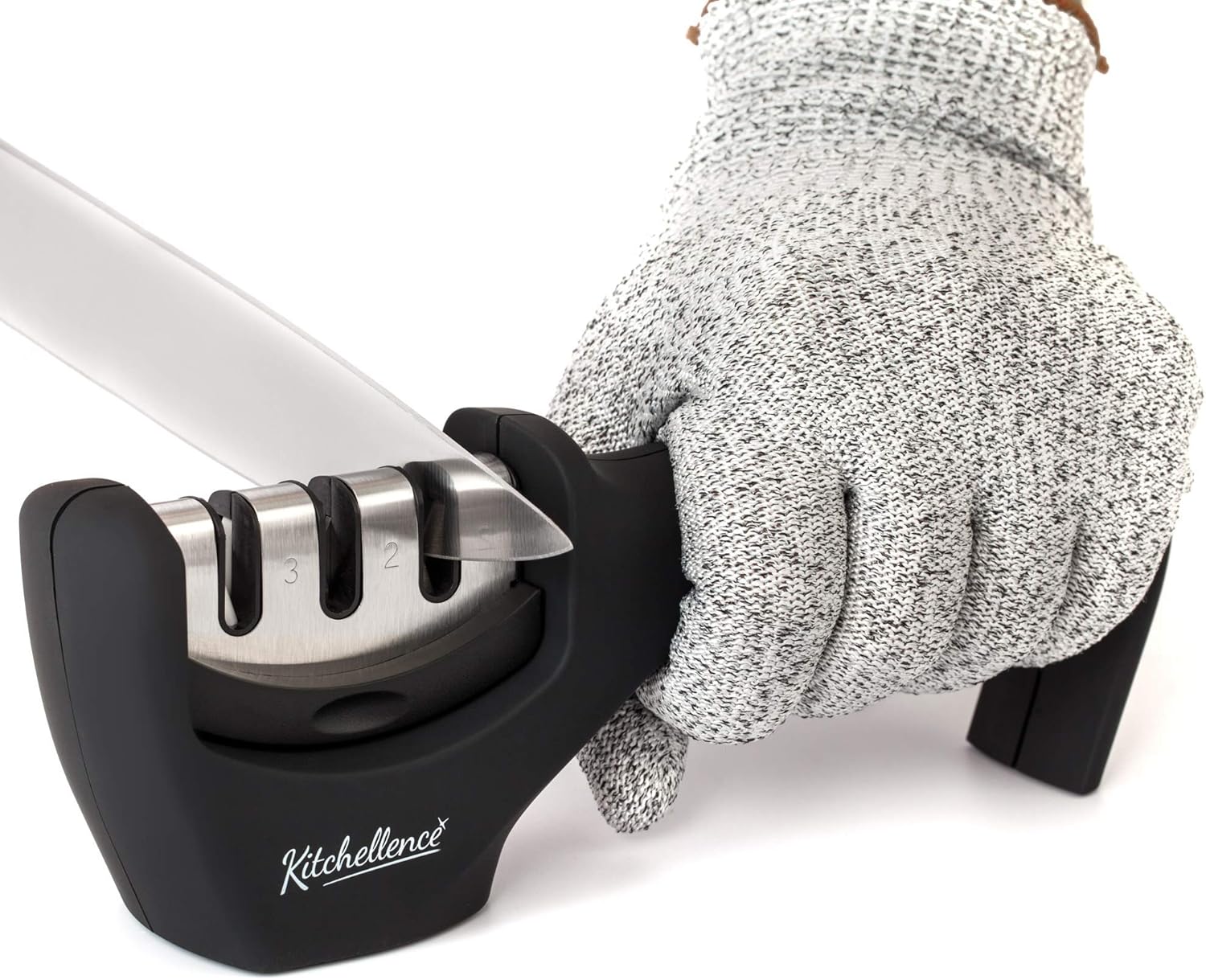
KITCHELLENCE 3‑Stage Knife Sharpener
| Material Type | Plastic |
|---|---|
| Included Components | Yes |
| Number of Items | 1 |
| Model Number | KS37 P |
This handheld 3-stage sharpener is designed to repair damaged edges, re-establish a V-bevel, and finish with a fine polish using a diamond rod, a coarse sharpening slot, and a fine honing slot. It is used by placing the blade in each slot and pulling it through a few times, which makes it quick and approachable for everyday kitchen maintenance. The unit has an ergonomic handle and a nonslip base for control, and the included cut-resistant glove adds a safety layer during use. Constructed from ABS plastic, the sharpener is lightweight and easy to store on a counter or in a drawer. While it handles routine sharpening and edge restoration well for most home knives, it is not meant for precision restoration on high-end specialty blades and lacks adjustable angle settings found on more advanced systems. For routine household upkeep this kit is a simple, safe choice that keeps knives serviceable between professional sharpenings.
Best for: Buyers who want a safe, no-fuss way to maintain everyday kitchen knives and prefer a straightforward tool that minimizes risk during use.
Less Ideal for: Users seeking professional-level edge restoration, precise angle control, or tools specifically for specialty and ceramic blades should look at dedicated sharpening systems instead.
- Three dedicated stages (diamond rod, coarse, fine) for repair, sharpening, and polishing
- Ergonomic handle and nonslip base for controlled, one-handed use
- Includes cut-resistant glove to reduce accidental cuts during sharpening
- Compact, lightweight ABS construction that is easy to store
- No adjustable angle or clamping system for precise edge control
- Not intended for high-end specialty knives or ceramic blades
Verdict: A simple, safety-minded 3-stage sharpener that keeps ordinary kitchen knives serviceable with minimal skill or risk.
Choosing the Right Small Knife Sharpener: Key Factors to Consider
Sharpening Method and Abrasive Type
Different small sharpeners use carbide, ceramic, diamond, or abrasive-coated wheels and rods. Carbide slots are fast for re-profiling very dull edges but remove more material. Ceramic and fine diamond elements are better for polishing and refining an edge without heavy stock removal.
Choosing the abrasive affects how often you need to touch up a knife and how much metal you remove each session. For regular home use, a combination of a coarse stage for repair and a fine stage for polishing is often the most versatile approach.
Angle Guidance and Consistency
Small sharpeners differ in how they control bevel angle. Some provide fixed guides that lock a blade at a preset angle, while others rely on user skill and reference edges. Fixed-angle guides are faster and reduce errors, especially for casual users, but may not match the original factory angle of every knife.
If you own knives with different edge angles, choose a tool that either closely matches the most common angle you use or one that offers multiple preset angles. Consistent angle control is crucial to producing a clean, aligned edge rather than a haphazard bevel.
Safety Features and Ergonomics
Because small sharpeners are often hand-held or used on countertops, ergonomics and safety matter. Look for slip-resistant bases, comfortable grips, and designs that keep fingers away from the abrasive elements. Some compact units include finger guards or suction feet to secure the sharpener during use.
Good ergonomics reduce the chance of accidental slips and make it easier to apply consistent pressure. A more stable tool also helps when working with very dull or damaged blades that need more force to re-profile.
Ease of Maintenance
Abrasive elements wear and can collect metal burs and residue. Some compact sharpeners allow removable or replaceable cartridges, while others are fixed and decline in performance over time. Consider how easy it is to clean the grooves, remove debris, or replace worn parts.
Low-maintenance sharpeners save time and maintain consistent results. If a tool requires frequent replacement of consumables, factor that into long-term usability even for a small, inexpensive device.
Compatibility With Your Knives
Not all small sharpeners work equally well with every blade type. Thin, delicate blades and specialty shapes may be better served by fine abrasives or stropping, while thicker or very dull blades might need a more aggressive coarse stage. Serrated knives generally require specialized tools and are often not serviced well by compact general-purpose sharpeners.
Assess the mix of knives you own and choose a compact sharpener that addresses the majority of your blades. If you have higher-end or very thin Japanese-style blades, prioritize a tool that can provide a fine, low-angle finish without excessive stock removal.
When a Small Sharpener Is Right
Small knife sharpeners are ideal for quick touch-ups and routine edge maintenance between full sharpening sessions. If you prepare food daily and prefer minimal downtime, a compact tool can restore slicing performance in seconds without removing the commitment or space required by a waterstone setup.
These tools are also useful in small kitchens, for travel, or as an entry-level solution for someone new to maintaining knives. They work best when the blade only needs a small amount of re-profiling rather than major repair.
- Best for light to moderate dulling
- Good for occasional home cooks and busy kitchens
- Not a substitute for professional regrinds on severely damaged blades
How to Use a Compact Sharpener Safely
Set the sharpener on a stable surface or engage any non-slip features before starting. Hold the blade by the spine, not by the cutting edge, and draw the blade through the guide in one smooth motion when possible. Avoid excessive pressure, which can overheat the edge or remove too much metal.
Work in stages: start with a coarse slot if the edge is chipped or very dull, then move to a finer slot or a ceramic rod for honing and polishing. Check progress often by testing on soft produce or by feel, rather than relying solely on visual inspection.
- Stabilize the base before sharpening
- Use steady, controlled strokes
- Progress from coarse to fine abrasives
Maintaining Your Sharpener
Inspect abrasive elements periodically for glazing or buildup of metal particles. Wipe the unit clean after use and follow manufacturer guidance for cartridge replacement if applicable. For fixed abrasives, light brushing can remove debris and restore cutting performance.
Store the sharpener in a dry place to prevent corrosion of any metal components and to keep abrasive surfaces free from contaminants. Regular maintenance preserves abrasive life and consistent sharpening angles.
- Brush or wipe metal filings after each use
- Replace cartridges or elements when performance drops
- Keep stored away from humidity and contaminants
Alternatives and Complementary Tools
Small sharpeners are convenient, but they are not the only tool for edge care. A honing rod helps realign a burr and maintain an edge between sharpening sessions, while a fine whetstone or guided system can re-profile an edge more precisely when needed.
Consider combining a compact sharpener for quick touch-ups with a periodic session on a stone or with a professional service for complete re-profiling. This approach balances convenience with long-term edge health.
- Honing rods for regular alignment
- Whetstones for full edge re-profiling
- Strops for final polishing and mirror edges
Common Mistakes to Avoid
Avoid pressing too hard; aggressive pressure leads to uneven bevels and excessive metal removal. Do not rush with multiple fast passes if the tool recommends slow, controlled draws. Using the wrong angle or repeating the wrong motion can worsen the edge rather than improve it.
Also, do not assume all compact sharpeners will fit every blade shape. For serrated edges, look for a tool designed for serrations or use professional servicing. Regularly check the sharpener for worn abrasives and replace or retire units that no longer produce consistent results.
- Do not over-press or rush strokes
- Avoid using a compact sharpener on serrated knives
- Replace or service the sharpener when abrasives wear
How We Chose the Best Small Knife Sharpener
We prioritized compact sharpeners that deliver repeatable, safe edge restoration for common kitchen knives. Our selection criteria focused on physical and user-centered attributes that matter when choosing a small, frequently used sharpener. First, sharpening effectiveness was measured by the sharpener's ability to restore a clean, usable edge on stainless and high-carbon blades without excessive metal removal. Second, user safety and ergonomics were considered, including stability under pressure, handle or base grip design, and guides that minimize angle mistakes. Third, durability of abrasive components and overall build quality determined whether a small tool will last through regular home use. Fourth, ease of use covered learning curve, single-handed operability, and cleaning or maintenance needs. We also looked at compatibility with common blade geometries and how well the tool handles both fine finishing and initial edge repair. We excluded oversized bench systems and professional-only whetstone setups because they do not meet the compact-use goal. We also excluded tools intended solely for serrated knives or for heavy-duty outdoor blades. The list focuses on compact, general-purpose sharpeners suitable for everyday kitchen blades and small specialty knives.
Our full evaluation process is outlined in our review methodology.
FAQ
How often should I use a small knife sharpener?
It depends on use, but many home cooks benefit from a quick touch-up every few weeks if they use knives daily. For lighter use, sharpening every few months may be sufficient. Monitor cutting performance and sharpen when slicing becomes less efficient.
Will a compact sharpener damage high-end knives?
If misused, compact sharpeners can remove more metal than necessary, which over time changes blade geometry. To avoid damage, use the fine stage for finish work, avoid excessive force, and choose a tool that matches the typical edge angle of your knives.
Can I sharpen serrated knives with a small sharpener?
Most general-purpose compact sharpeners are not designed for serrations. Serrated edges usually require specialized tools or individual stropping of each scallop. Look for a sharpener that explicitly lists serrated compatibility if you need that function.
How do I tell when the abrasive parts need replacing?
Signs include reduced cutting speed, uneven edges after passes, glazing of abrasive surfaces, or visible wear on cartridges. If cleaning does not restore performance, consult the product guidance for replacing cartridges or consider a replacement unit.
Is a honing rod a replacement for a small sharpener?
No. A honing rod realigns a folded edge but does not remove metal to restore a dull blade. Use a honing rod between sharpening sessions and a compact sharpener when the blade has dulled and needs material removal to re-establish the bevel.
Final Verdict
For routine home use, prioritize a small sharpener that balances effective cutting performance with safe, repeatable operation. Emphasize consistent angle guidance, an appropriate abrasive progression, and a stable, ergonomic design to minimize user error. Remember that compact sharpeners are best for touch-ups; plan periodic deeper maintenance with finer tools or professional services when edges are heavily worn. Choose a compact option that matches the majority of your knives and maintain it properly to extend both the sharpener and knife life. With the right tradeoffs, a small knife sharpener delivers fast, reliable edge upkeep for everyday cooking.