
Note: This article contains affiliate links. If you click on these links and make a purchase, we may earn a small commission at no extra cost to you. This helps support our research and content. Read our full affiliate disclosure here.
If you bake bread at home but have limited counter space or only bake small batches, a compact stand mixer can make dough prep faster and less messy. A small stand mixer for bread dough should deliver strong, steady torque and a roomy, well-shaped bowl so you get even gluten development without overheating the motor. This guide covers seven shortlisted small stand mixers built for dough work. We focus on real-world factors that matter for home bakers, including mixing power, bowl capacity, attachment design, and maintenance. Read on for a clear explanation of what to watch for and how each shortlisted option fits common baking routines.
Top Picks at a Glance
| Best Overall The best all-around choice for most situations | Martha Stewart Tilt-Head Stand Mixer |  |
| Best Quality Built to a higher standard if you want something more solid | Cuisinart Stand Mixer SM-50BC |  |
| Best Value The sweet spot between price and what you get | CUSIMAX Stand Mixer 5-Quart |  |
| Best Budget The cheapest option that still gets the job done reliably | Vikaluz 3.2QT Stand Mixer |  |
| Top Rated A top-rated pick with lots of positive feedback | KitchenAid Classic Series K45SS |  |
| Most Popular A crowd favorite that many people choose with confidence | Aucma 6.5QT Stand Mixer |  |
| Best Seller A high-volume bestseller chosen again and again | Kitchen in the box 3.2QT Stand Mixer | 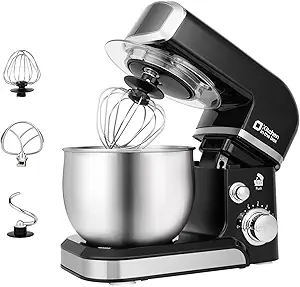 |
Martha Stewart Tilt-Head Stand Mixer

| Capacity | 5.3 quarts |
|---|---|
| Wattage | 660 watts |
| Number of Speeds | 12 |
| Voltage | 120 volts |
The Martha Stewart 5.3QT tilt-head stand mixer is a compact, full-featured machine for home bakers who want reliable performance without a large footprint. It includes a stainless steel whisk, dough hook, and flat beater with a silicone edge, and the 12-speed knob gives fine control from slow folding to high-speed whipping. The 660W motor and heavy-duty base help it handle typical bread doughs and larger batter batches, while the removable splash shield and ergonomic bowl handle make adding ingredients and cleanup easier. The tilt-head design simplifies swapping attachments and scraping the bowl, and the stainless steel mixing bowl holds enough for most home bread recipes. Expect solid day-to-day performance for loaves, pizza dough, and cookie batches, though extremely heavy or very high-volume commercial doughs may push its limits. Overall it balances versatility, space-saving design, and useful attachments for frequent home baking.
Best for: Home bakers who want a compact, capable stand mixer that handles everyday bread, pizza dough, and batch baking with precise speed control and easy cleanup.
Less Ideal for: Those who routinely mix very large or commercial-scale doughs or who prefer the extra stability and lift mechanism of larger bowl-lift mixers.
- 5.3-quart stainless steel bowl fits typical home bread recipes and multi-dozen cookie batches
- Includes dough hook, whisk, and flat beater with silicone edge for versatile mixing tasks
- 12-speed control knob provides fine adjustments from gentle folding to high-speed whipping
- Tilt-head design and removable splash shield make attachment changes and ingredient additions easy
- Heavy-duty base and 660-watt motor deliver stable mixing for most dough and batter jobs
- Not intended for commercial or very high-volume dough mixing
- Tilt-head format can limit bowl clearance compared with bowl-lift designs
Verdict: A compact, well-equipped stand mixer that gives home bakers the control and attachments needed for reliable bread and everyday baking results.
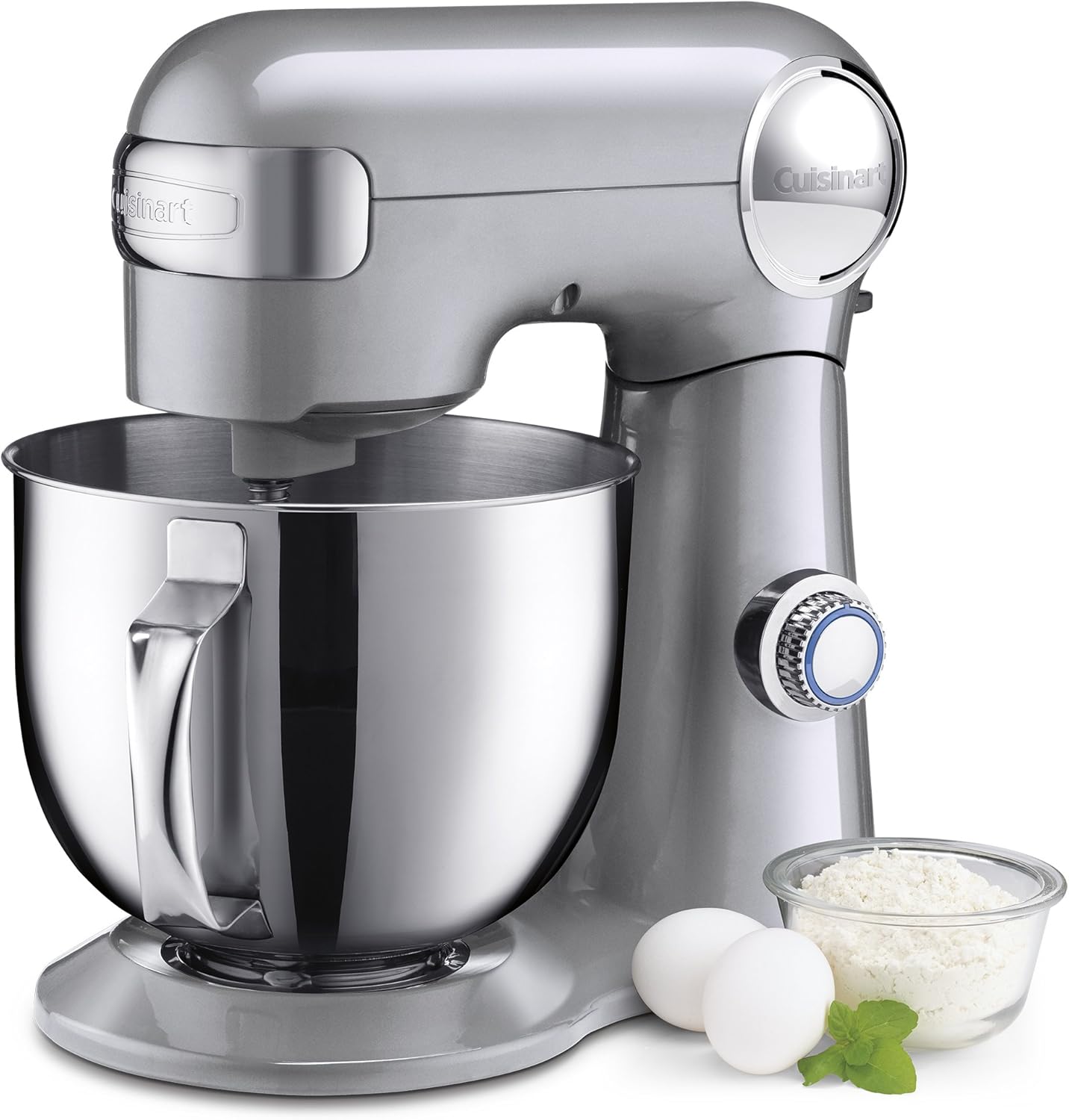
Cuisinart Stand Mixer SM-50BC
| Capacity | 5.5 quarts |
|---|---|
| Wattage | 500 watts |
| Number of Speeds | 12 |
| Controls Type | Knob |
| Voltage | 110 volts |
This Cuisinart stand mixer is built for everyday baking and small-batch bread work with a 500-watt motor and a 5.5-quart stainless steel bowl that handles medium doughs comfortably. The tilt-back head gives easy access to the bowl and the included dough hook, flat paddle, and whisk cover most mixing needs from kneading to whipping, while the splash guard with pour spout keeps counters cleaner when adding ingredients. Twelve speed settings and a simple knob control let you ramp up slowly for dough development or whisk at high speed for meringues, and the die-cast metal construction feels stable under load. Accessories and the bowl are dishwasher safe, and a variety of optional attachments expand functionality beyond mixing. For heavy or very large batches of bread dough the mixer can be pushed, but for home bakers working with typical 1–2 loaf recipes it delivers reliable performance and good value compared with higher-capacity machines.
Best for: Home bakers who prioritize steady mixing power and reliable dough handling for 1–2 loaves of bread and value a durable, easy-to-use machine.
Less Ideal for: People who routinely make very large or high-hydration doughs or need commercial-capacity mixers should consider larger, higher-capacity models.
- 500-watt motor provides strong, consistent power for mixing and kneading
- 5.5-quart stainless steel bowl suits typical home bread and batter recipes
- Includes whisk, flat paddle, dough hook, and splash guard with pour spout
- Die-cast metal construction and tilt-back head for stability and easy access
- Accessories and bowl are dishwasher safe for easier cleanup
- Capacity and motor are modest for very large or heavy commercial-style bread batches
- Controls are basic knob-style without electronic timers or presets
Verdict: A solid mid-size stand mixer that gives reliable power and practical features for home bread bakers working with typical 1–2 loaf recipes.
CUSIMAX Stand Mixer 5-Quart

| Wattage | 650 watts |
|---|---|
| Number of Speeds | 8 |
| Capacity | 5 liters |
| Controls Type | Touch |
| Voltage | 120 volts of alternating current |
The CUSIMAX Stand Mixer is a compact, budget-friendly machine aimed at hands-free mixing for home baking tasks from whipped egg whites to doughs. It uses a 650W metal motor with a metal gear system and eight speeds controlled by a digital touch panel and a 15-minute timer, and the tilt-head design with a grip handle makes installing the 5-quart stainless steel bowl and attachments straightforward. Included dough hook, flat beater and wire whip cover most mixing needs, while the splash guard with an access port helps add ingredients without a mess. Non-slip feet and a sturdy ABS housing keep the unit stable during higher-torque jobs. For heavier or very large loaves you may need to work in smaller batches, since the 5-quart capacity and timer limit very long kneading cycles, and the plastic exterior will not be as durable as thicker metal-bodied mixers. Overall it delivers strong mixing performance for most home bread recipes and is a sensible space-saving option for bakers who want reliable results without a pro-level price tag.
Best for: Home bakers who prioritize practical, reliable performance in a compact machine and want a mixer that handles everyday bread and baking tasks without taking much counter space.
Less Ideal for: Those who bake large batches of bread frequently, need extended continuous kneading cycles, or want a heavy-duty metal-bodied commercial machine.
- Powerful 650W motor with metal gears for effective kneading and mixing
- Digital touch controls with eight speed settings and a 15-minute timer for repeatable results
- Includes three common attachments (dough hook, flat beater, wire whip) for versatile baking tasks
- 5-quart stainless steel bowl suits most home bread and baking batches
- Splash guard with ingredient port reduces mess during mixing
- 5-quart bowl can limit very large or multiple loaves without batching
- Plastic exterior is less rugged than full-metal professional mixers
Verdict: A compact, capable 5-quart stand mixer that delivers strong kneading and versatile home-baking performance for practical bakers.
Vikaluz 3.2QT Stand Mixer

| Capacity | 3.2 quarts |
|---|---|
| Wattage | 250 watts |
| Number of Speeds | 5 |
| Material | 304 Stainless Steel |
This Vikaluz mixer is a compact, budget-friendly machine that combines a hands-free stand mixer and a detachable hand mixer in one unit. It uses an auto-rotating 304 stainless steel bowl and a side-to-side rotating beater head to reach the sides and bottom of the bowl, which helps reduce unmixed pockets when making doughs and batters. The tilt-head design makes installing the 3.2QT bowl and attachments straightforward, and included accessories (dough hook, flat beater, wire whisk) cover most home baking tasks. The 250W motor with five speeds and a Turbo boost handles batters, whipped cream, and small-to-medium doughs, though very heavy or large batches may strain the motor. Its compact footprint fits small kitchens and the removable parts are dishwasher-safe for easy cleanup. For the price you get practical features aimed at everyday baking, but expect limitations when tackling very dense bread doughs or commercial-scale batches.
Best for: Home bakers on a tight budget who want a space-saving mixer that can handle everyday bread and cookie recipes and also convert to a hand mixer for quick tasks.
Less Ideal for: People who routinely mix very large or dense bread doughs or who need a heavy-duty, long-run commercial mixer should look for higher-capacity, higher-power machines.
- 2-in-1 stand and detachable hand mixer saves counter space and adds versatility
- Auto-rotating 304 stainless steel bowl plus side-to-side beater improves mixing thoroughness
- Includes dough hook, flat beater, and wire whisk so it is ready for common baking tasks
- Compact 3.2QT bowl fits small kitchens while still handling multiple loaves or batches
- Dishwasher-safe attachments and tilt-head design make setup and cleanup easy
- 250W motor may struggle with very heavy or large bread doughs
- Smaller 3.2QT capacity limits batch size for serious bread bakers
Verdict: A budget-friendly, space-saving 2-in-1 mixer that delivers thorough mixing for everyday small-batch bread and baking tasks.
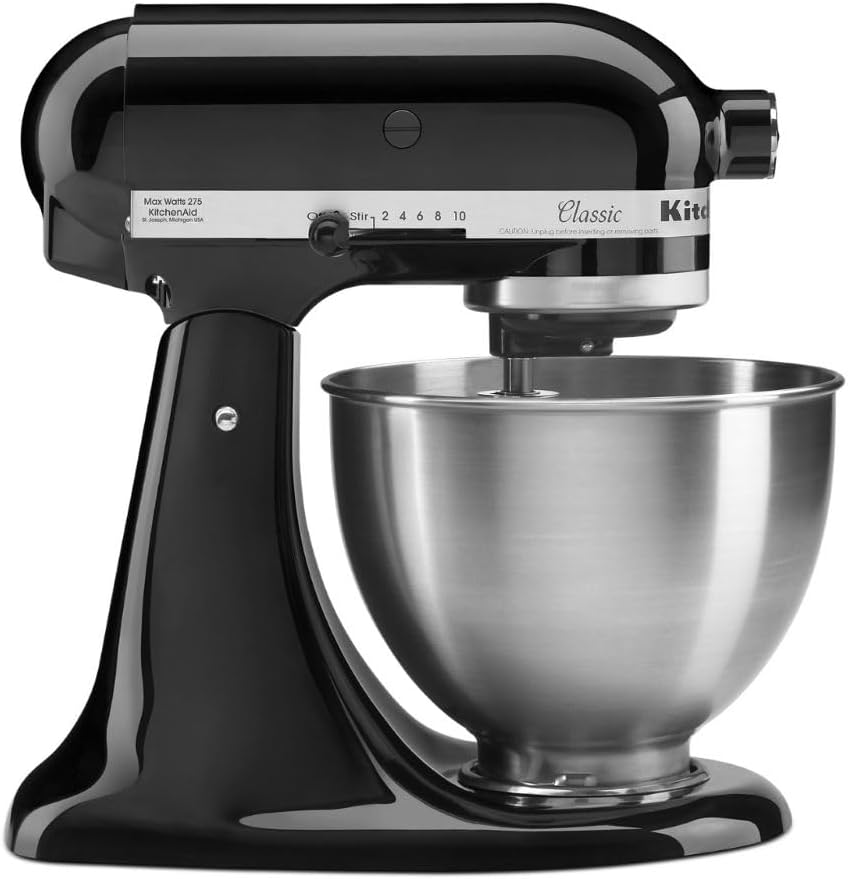
KitchenAid Classic Series K45SS
| Capacity | 4.5 quarts |
|---|---|
| Number of Speeds | 10 |
| Wattage | 275 watts |
| Voltage | 120 volts |
The KitchenAid Classic Series K45SS is a compact tilt-head stand mixer built for regular home baking and light-to-moderate dough work. Its 4.5-quart stainless steel bowl and included flat beater, dough hook, and 6-wire whip let you mix cookie batters, whip cream, and knead small to medium bread doughs without needing add-ons. The metal housing and 59 touchpoints around the bowl promote consistent mixing and long-term durability, while the 10-speed control gives workable range from slow stirring to faster whipping. The front power hub accepts optional attachments for grinders, pasta makers, and more if you want to expand beyond basic mixing. Practical limits are its 4.5-quart capacity and 275-watt motor, which handle typical home batches but will slow or struggle with very large or heavy artisan doughs; users making frequent large loaves may prefer a larger, higher-capacity model. For everyday bakers who value a sturdy, no-frills machine that performs reliably for standard recipes, this mixer is a sensible choice.
Best for: Home bakers who prioritize a reliable, built-to-last mixer for regular small to medium batches and straightforward bread or pastry recipes.
Less Ideal for: Bakers who routinely make large, heavy artisan loaves or commercial quantities should choose a higher-capacity, more powerful machine.
- Durable all-metal construction for long-term use.
- Includes flat beater, dough hook, and wire whip for common baking tasks.
- Tilt-head design provides easy access to the bowl and attachments.
- Ten speeds offer fine control from stirring to whipping.
- Removable stainless steel bowl is dishwasher safe and practical for cleanup.
- 4.5-quart capacity and 275-watt motor are limited for very large or heavy dough batches.
- Tilt-head style can limit bowl size compared with bowl-lift commercial designs.
Verdict: Choose the KitchenAid Classic K45SS if you want a durable, reliable stand mixer that handles everyday bread doughs and baking tasks in a compact package.
Aucma 6.5QT Stand Mixer

| Wattage | 660 watts |
|---|---|
| Capacity | 6.5 quarts |
| Number of Speeds | 6 |
| Voltage | 120 volts |
| Noise Level | 76 db |
The Aucma stand mixer is a heavy-duty home mixer aimed at handling a range of baking tasks from whipped egg whites to dense bread dough. Its 660W pure copper motor and 6.5 quart stainless steel bowl give it the muscle and capacity to mix medium-to-large batches, and the tilt-head design makes attaching the whisk, beater, and dough hook straightforward. Practical touches include a splash guard with an ingredient hatch, non-slip feet for stability, a pulse function and six speed settings for gradually building dough structure, and dishwasher-safe attachments for cleanup. Noise is rated around 76 dB, so it is noticeable but not unusually loud for this class. For kneading very large or frequent commercial batches, the mixer can reach its limits compared with commercial machines, and the housing is ABS plastic rather than metal which may feel less heavy-duty over many years of heavy use. Still, for home bakers making loaves, rolls, and enriched doughs, it provides strong mixing performance and useful capacity at a consumer-friendly spec level.
Best for: Home bakers who want a roomy, capable mixer that can handle regular bread and roll doughs and who value real-user performance and included accessories.
Less Ideal for: People who need a commercial-grade, metal-bodied machine for constant high-volume baking or professional bakery use should look at higher-capacity commercial models.
- 660W pure copper motor provides solid power for mixing and kneading typical bread doughs
- Large 6.5 quart stainless steel bowl accommodates medium to large batch sizes
- Includes whisk, beater, and dough hook plus splash guard with ingredient hatch
- Tilt-head design and non-slip feet make bowl access and stable mixing easy
- Dishwasher-safe attachments simplify cleanup
- ABS plastic housing is less durable-feeling than metal-bodied mixers
- May struggle with very large or commercial-scale dough batches
Verdict: Aucma's 6.5QT mixer delivers the power and bowl capacity most home bakers need to mix and knead bread dough reliably without stepping up to a commercial machine.
Kitchen in the box 3.2QT Stand Mixer

| Capacity | 3 liters |
|---|---|
| Wattage | 300 watts |
| Number of Speeds | 6 |
| Voltage | 120 |
This Kitchen in the box stand mixer is built as a space-saving, entry-level machine for everyday small-batch baking. The 3.2QT stainless-steel bowl and tilt-head design make loading and removing ingredients straightforward, while the included whisk, flat beater, and aluminium dough hook cover common tasks from whipping cream to light dough. Six speed settings give usable range for mixing, beating, and kneading, and four suction feet help keep the mixer steady during operation. At 300 watts it handles typical dough for 1-2 people but the manufacturer warns the bowl is very small and not suited for large batches or pro use. Accessories are dishwasher-safe and the anti-splash lid and gasket reduce mess. Expect a compact, affordable unit that manages cookie batter, small loaves, and whipped mixtures reliably, but do not expect the power or capacity of larger, heavier-duty mixers when working with heavy, high-hydration bread dough or multiple loaves.
Best for: Home bakers who make small batches or single loaves and prioritize a compact, easy-to-store mixer that handles everyday mixing and light dough work.
Less Ideal for: People who regularly make large batches, commercial quantities, or heavy high-hydration bread dough should choose a larger, more powerful mixer instead.
- Compact 3.2QT stainless-steel bowl suited for small kitchens and limited counter space
- Six speed settings and planetary mixing action cover common mixing, whipping, and light kneading tasks
- Includes three durable attachments: aluminium dough hook, flat beater, and stainless-steel whisk
- Dishwasher-safe accessories and an anti-splash lid make cleanup easier
- Small bowl and 300W motor limit capacity and heavy-duty dough performance
- Manufacturer notes higher initial torque at start gear, which may require caution for some users
Verdict: Buy this if you want a compact, budget-friendly stand mixer that reliably handles small-batch baking and light dough tasks.
Choosing the Right Small Stand Mixer for Bread Dough: Key Factors to Consider
Motor Torque and Low-Speed Performance
Kneading bread dough is a low-speed, high-resistance task. What matters more than peak wattage is how much steady torque the motor and gearbox deliver at slow speeds. Insufficient torque leads to laborious kneading cycles, stalled agitators, or overheating and shortened motor life.
When choosing a small stand mixer for bread dough, check for models with explicit torque-friendly gearing, multiple low-speed settings, and user reports of sustained kneading performance. A small mixer with strong low-end torque will handle denser doughs and longer kneading times without strain.
Bowl Capacity and Shape
Bowl capacity determines how much dough you can mix in one batch and how well ingredients circulate during kneading. For most home bread recipes, look for bowls that comfortably hold at least 1 to 2 kilograms of dough if you bake family-size loaves.
The bowl shape also matters: deeper, narrower bowls can help contain flour and water, while wider bowls allow better planetary reach for larger batches. Consider how much counter space you have, since compact mixers often trade bowl size for a smaller footprint.
Dough Hook Design and Attachment Fit
Dough hooks are the primary tool for bread dough. The shape, material, and how securely the hook mates with the drive mechanism affect kneading efficiency and ease of releasing sticky dough. Spiral or C-shaped metal hooks tend to be more effective than plastic hooks at building gluten.
A well-designed attachment minimizes dough wrapping and leaves less residue. Also check how easy it is to attach and remove the hook; a secure connection prevents wobble under load and reduces wear on the drive fitting.
Durability and Gearbox Construction
Durability is crucial because kneading is mechanically demanding. Full metal gearboxes or metal-to-metal gearing typically last longer than plastic gears under repeated heavy use. A solid transmission also keeps the motor operating in its optimal range and reduces heat buildup.
Assess build quality by looking for sturdy housing, a secure head-locking mechanism, and evidence of robust internal construction. Longevity reduces the chance of mid-bake failures and extends the useful life of the appliance.
Ease of Cleaning and Maintenance
Bread dough is sticky and can gum up parts quickly. Removable, dishwasher-safe bowls and hooks simplify cleanup, but access to crevices and the ease of detaching attachments matter just as much. Smooth finishes and fewer small seams reduce places where dough can hide.
Regular maintenance includes checking seals, wiping the mixer after use, and occasionally greasing or servicing the gearbox if the manufacturer recommends it. Choose a design that minimizes time spent on upkeep so you can bake more often.
Noise, Heat Management, and User Comfort
Compact mixers can concentrate noise and heat into a smaller chassis. For frequent bakers, quieter operation reduces kitchen disruption and better heat dissipation preserves motor life. Look for models with ventilation designed to keep the motor cool under long kneading cycles.
Comfort factors include how easy it is to add ingredients while kneading, the control knob ergonomics, and how much counter space the machine occupies. These practical details influence how often you will use the mixer for bread baking.
Why Size Matters For Bread Baking
A smaller stand mixer saves counter space but still needs to deliver the torque required for bread dough. If you bake occasional small loaves or dinner rolls, a compact mixer can be ideal. For larger, denser doughs, understand the mixer's effective batch size so you do not overload the motor.
Consider when you typically bake. If you make several loaves at once, you may prefer a slightly larger bowl even in a compact machine. If your priority is making single loaves or frequent small batches, prioritize a tighter footprint with strong low-speed grunt.
- Compact footprint helps in small kitchens and when storing between uses
- Smaller bowls limit batch size but can speed up single-loaf mixing
- Match bowl capacity to typical recipe sizes to avoid overloading
Attachment Options That Improve Dough Quality
Beyond the standard dough hook, some mixers offer optional attachments that can aid mixing or finishing dough. Look for metal hooks with full-length shafts that reach the bowl bottom and maintain pressure on the dough. Removable splash guards and flexible spatulas can help when incorporating ingredients without stopping the mixer.
Attachment mounting style affects stability. Bayonet or threaded mounts that lock tightly reduce wobble, which improves kneading consistency and reduces wear. Also check whether spare or aftermarket attachments are available if you bake often.
- Metal spiral or C-hooks usually knead more effectively than plastic hooks
- Secure attachment mounts reduce wobble and gear stress
- Helpful extras include splash guards and folding scrapers
Maintenance Tips to Keep a Small Mixer Running
After each use, remove and clean the hook and bowl promptly to prevent dough buildup. Wiping the head and any exposed gears prevents flour dust accumulation which can abrade moving parts over time. If the manufacturer recommends periodic gearbox servicing, follow that schedule to maintain torque performance.
Store the mixer in a dry place away from high humidity. If you notice unusual noises or reduced kneading efficiency, stop using the machine until the cause is diagnosed. Early attention to unusual vibration or heat can prevent more serious failures.
- Clean attachments right away to avoid hardened dough
- Wipe vents and exterior surfaces to reduce dust ingress
- Follow any gearbox maintenance guidance to preserve torque
How to Judge Batch Size and Recipe Scaling
Estimate dough weight before mixing to ensure your small mixer can handle it. Use ingredient weights rather than volumes for reliability. If a recipe yields more dough than your bowl comfortably holds, split the batch into two mixes rather than risking an overloaded motor.
When scaling recipes down to fit a smaller bowl, maintain hydration ratios for consistent crumb. Shorter kneading times may be needed for smaller batches because the dough develops more quickly in a tighter bowl. Track results and adjust kneading duration in a few-minute increments.
- Weigh ingredients to match mixer capacity
- Split large batches to avoid stalling the motor
- Adjust kneading time when working with smaller batches
Practical Safety Considerations
Always secure the mixer head and ensure attachments are fully engaged before starting. Sticky dough can pull attachments loose if they are not properly seated. Keep hands and tools clear while the machine is running and switch off power before removing stuck dough.
Be mindful of ventilation slots and avoid covering them during long kneading cycles. Overheating is a risk with heavy loads in compact designs, so use pause cycles when mixing very dense doughs and allow brief cooling intervals as needed.
- Lock the head and test attachment seating before starting
- Avoid covering ventilation during long kneading runs
- Power off before clearing stuck dough or changing tools
How We Chose the Best Small Stand Mixer for Bread Dough
We focused on machines that are compact yet capable of handling typical home bread doughs, from sandwich loaves to denser artisan-style recipes. Our selection filters prioritized motor torque and durable gearing over raw wattage numbers, because steady, low-speed torque is the most important attribute for kneading without overheating. Bowl size and shape were next, with emphasis on capacities that fit 1 to 2.5 kg of dough while keeping the overall footprint small. Durability and ingredient-friendly attachments were required: we favored mixers with metal dough hooks and robust planetary action to ensure even kneading. Ease of cleaning and tool removal also guided picks, since sticky dough can make upkeep tedious. Noise and heat under load were considered where data or user reports were available, plus warranty and parts availability for peace of mind. We excluded full-size professional mixers, paddle-only machines intended for light batters, and units without documented low-speed torque performance. Final choices balance compact size with real kneading capability, reliable attachments, and straightforward maintenance.
Our full evaluation process is outlined in our review methodology.
FAQ
Can a small stand mixer handle whole wheat or high-hydration doughs?
Often, but it depends on the motor torque and bowl capacity. Whole wheat and high-hydration doughs demand more sustained effort. Choose a compact mixer specified for steady low-speed torque and avoid overfilling the bowl to prevent strain.
How much dough can a small mixer typically knead in one batch?
Typical small stand mixers are best-suited for 1 to 2 kilogram dough batches. Exact capacity varies by bowl shape and motor strength, so estimate dough weight and leave headroom to avoid overloading the motor.
Will frequent kneading shorten the life of a small mixer?
Frequent heavy kneading can increase wear, especially on gearboxes and brushes in compact designs. Regular maintenance, avoiding repeated overloads, and following duty-cycle guidance will extend lifespan.
Are metal dough hooks worth it for bread baking?
Yes. Metal hooks transmit torque more reliably and resist deformation under load. They also tend to release dough more cleanly than plastic hooks and are easier to clean and sanitize.
How can I tell if I am overloading my mixer while kneading?
Signs include stalling or sluggish rotation at low speeds, unusual noises or vibration, and excessive heat build-up. If any of these occur, stop, reduce the batch size, and allow the motor to cool before resuming.
Final Verdict
For home bakers constrained by space, a small stand mixer for bread dough can be a reliable tool when you prioritize low-speed torque, sensible bowl capacity, and durable dough hooks. Accepting the tradeoff between footprint and batch size helps you pick a machine that fits your baking habits. Focus on models that offer strong torque at slow speeds, secure attachment systems, and easy maintenance. That approach will give you consistent kneading performance and longer-term reliability for everyday bread baking.