
Note: This article contains affiliate links. If you click on these links and make a purchase, we may earn a small commission at no extra cost to you. This helps support our research and content. Read our full affiliate disclosure here.
If you bake frequently or run a small bakery, a powerful spiral mixer can save hours of labor and produce more consistent dough than hand mixing. The right spiral mixer handles high-hydration doughs, large batch sizes, and long kneading cycles without overheating or stretching the gluten incorrectly. This guide shortlists the top picks for powerful spiral mixers, emphasizing motor strength, build quality, and consistent dough handling for heavy use. Below you will find concise evaluations based on durability, mixing performance, and usability to help you choose the mixer that fits your production needs.
Top Picks at a Glance
| Best Overall The best all-around choice for most situations | JDCEREN Spiral Dough Mixer |  |
| Best Quality Built to a higher standard if you want something more solid | Eurodib Spiral Mixer LM50T |  |
| Best Value The sweet spot between price and what you get | USAJZM 10.7 Qt Spiral Dough Mixer |  |
| Best Budget The cheapest option that still gets the job done reliably | CUBELLIN 10L Spiral Mixer |  |
| Top Rated A top-rated pick with lots of positive feedback | Ooni Halo Pro Spiral Mixer |  |
| Most Popular A crowd favorite that many people choose with confidence | ZACME 8.4QT Commercial Stand Mixer |  |
| Best Seller A high-volume bestseller chosen again and again | Garvee Commercial Dough Mixer 10.5QT |  |
JDCEREN Spiral Dough Mixer

| Wattage | 750 watts |
|---|---|
| Voltage | 110 volts |
| Capacity | 2.6 gallons |
| Controls Type | Push Button |
This JDCEREN spiral dough mixer is built for frequent dough work, using a 750W copper‑core motor and a spiral stirring rod to simulate hand kneading and develop gluten evenly. It runs at two selectable speeds (about 100 and 200 rpm) while a chain drive rotates the bowl and rod together, which helps mix large batches uniformly. The 2.6 gallon bowl can handle roughly 2.2 to 11 pounds of dough, so it suits small commercial kitchens or serious home bakers making multiple loaves or pizzas. Safety features include a protective shield that cuts power if not closed, and push‑button controls keep operation simple. The machine is mostly stainless steel for durability and easy cleaning, but it is a fairly heavy, stationary unit sized for a prep area rather than countertop portability. Expect straightforward, powerful kneading performance but limited speed range and fewer electronic controls compared with higher‑end commercial mixers.
Best for: Buyers who want a robust, no‑frills spiral mixer to knead medium commercial batches or heavy home doughs and value reliable mixing performance over advanced controls.
Less Ideal for: If you need many speed options, a lightweight portable unit, or a mixer focused on whipping and delicate batters, look at alternative mixer types instead.
- Powerful 750W copper‑core motor for consistent kneading torque
- Spiral hook plus bowl rotation produces even gluten development
- 2.6 gallon stainless steel bowl accommodates small commercial batches
- Safety shield with automatic power cut for safer operation
- Simple push‑button controls that are easy to use in busy kitchens
- Limited to two fixed speed settings so less flexible for delicate tasks
- Heavier, stationary footprint not suited to frequent moving or small counters
Verdict: Choose this spiral mixer when you need a durable, high‑torque machine that reliably kneads medium commercial or heavy home dough batches.
Eurodib Spiral Mixer LM50T
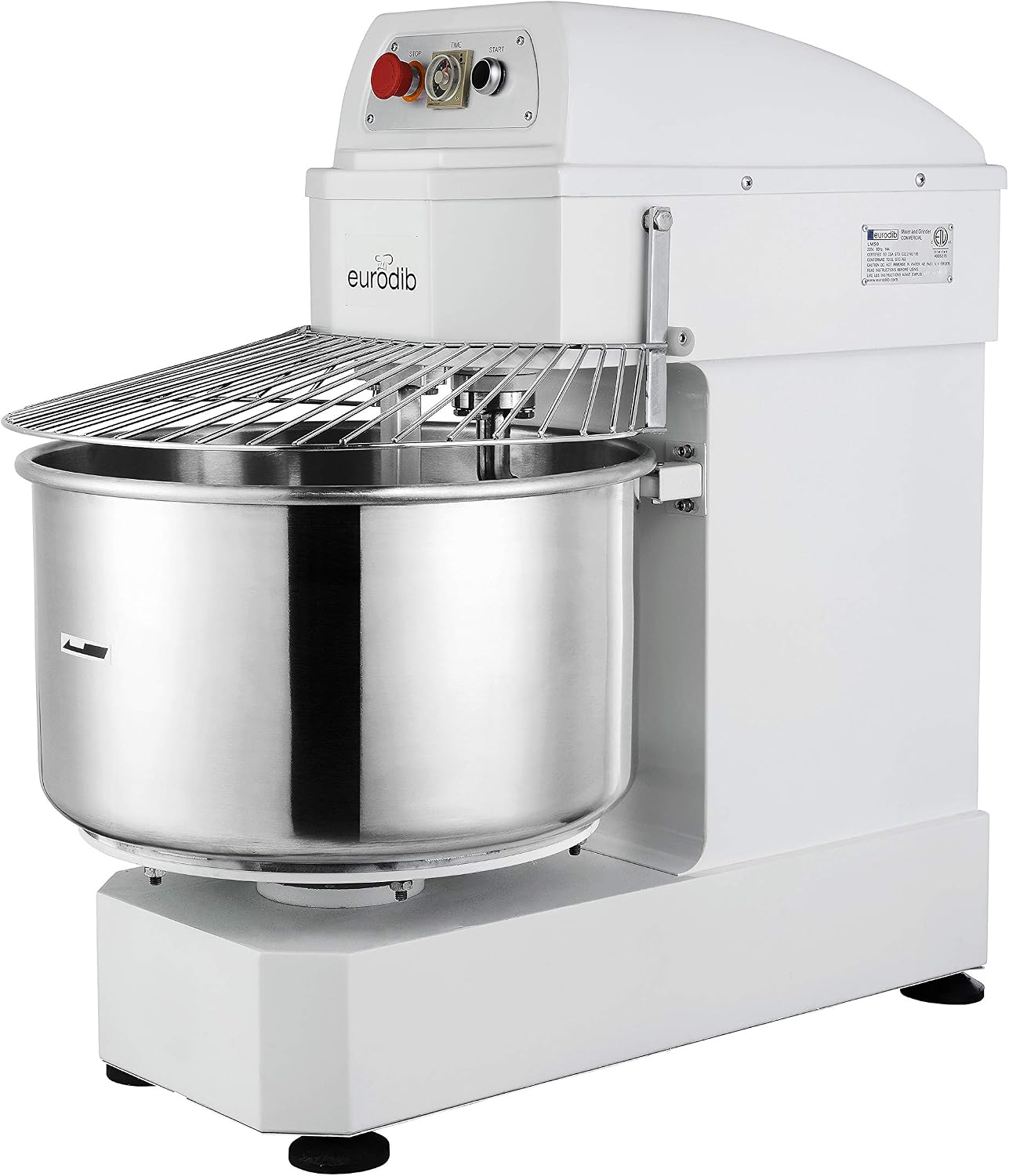
| Capacity | 50 quarts |
|---|---|
| Wattage | 3080 watts |
| Voltage | 220 volts |
| Noise Level | 70 db |
| Mixing speed | 185 RPM (mix), 15 RPM (bowl) |
The Eurodib LM50T is a heavy-duty spiral mixer built for bakeries, pizzerias and other high‑output kitchens that need consistent dough development. Its spiral hook and 50‑quart bowl are intended to knead large batches (up to a 42 lb dough capacity) while the powerful 3,080 watt motor and 185 RPM mixing speed deliver strong, steady torque without overheating. The machine includes a timer, knob controls, bowl guard for operator safety and commercial‑grade stainless‑steel construction for easy cleaning and long service life. At about 70 dB it is reasonably quiet for its class but still noticeably loud in small prep areas. The LM50T runs on 220V and requires a compatible circuit and plug, so installation planning is necessary for many kitchens. For teams prioritizing uniform gluten development and reliable daily output, this mixer offers the capacity and build to handle heavy workloads, though it is sized and wired for commercial electrical setups rather than residential use.
Best for: Aiming for performance and repeatable dough quality in a professional setting, this mixer fits bakeries and pizzerias that need high-capacity, reliable kneading every day.
Less Ideal for: Home bakers, small hobby kitchens, or operations lacking a 220V commercial circuit should consider smaller or 120V models instead.
- Robust 3,080 watt motor and spiral hook deliver consistent kneading power for heavy doughs.
- Large 50‑quart bowl and 42 lb maximum kneading capacity suit high-volume production.
- Commercial stainless steel construction for durability and straightforward cleaning.
- Built-in timer and simple knob controls make operation fast and predictable.
- Requires 220V commercial electrical connection which may need dedicated wiring.
- Bulky footprint and industrial weight limit placement to commercial kitchens or large prep areas.
Verdict: Choose the Eurodib LM50T when you need industrial mixing power and large batch consistency for a busy commercial bakery or pizzeria.
USAJZM 10.7 Qt Spiral Dough Mixer

| Capacity | 10.7 quarts |
|---|---|
| Wattage | 1200 watts |
| Voltage | 120 volts |
| Controls Type | Touch |
| Noise Level | 70 db |
This USAJZM 10.7 Qt spiral dough mixer is built for regular, high-volume dough work and translates commercial features into a user-friendly countertop unit. The pure copper motor and spiral hook focus on rapid, even gluten development, while the removable 304 stainless steel bowl and tilt-head make loading, unloading and cleaning straightforward. You can control the machine via a touch panel or mechanical knob and choose from nine speeds plus a timer and temperature readout for repeatable results across bread, pizza and pastry doughs. The heavy metal drive, cast iron pulley and non-slip feet give the mixer a stable feel during long kneading cycles, and the listed 70 dB noise rating keeps sound at a reasonable level for a commercial motor. The unit is substantial in weight and footprint, so plan for a dedicated spot and expect it to serve bakeries or hobbyists who want commercial durability rather than casual occasional use.
Best for: Bakers who need a rugged, commercial-grade spiral mixer for frequent or larger-batch dough production and who prioritize consistent kneading performance and durable build quality.
Less Ideal for: Casual home cooks who make small batches infrequently or buyers seeking a lightweight, easily storable mixer; it is better suited to workshops, bakeries, or dedicated home baker countertops.
- Pure copper motor and reinforced metal drive for durable, consistent kneading
- Removable 304 stainless steel bowl with tilt-head for easier loading and cleaning
- Nine-speed control plus timer and temperature display for repeatable dough results
- Touch controls combined with a mechanical knob give flexible, simple operation
- Stable heavy construction and non-slip feet reduce vibration during heavy batches
- Heavy and large footprint requires a permanent countertop space
- Relatively high noise level at 70 dB compared with small domestic mixers
Verdict: Choose this mixer when you want commercial-grade, repeatable kneading power and a durable build for frequent large-batch dough work.
CUBELLIN 10L Spiral Mixer

| Capacity | 10 liters |
|---|---|
| Wattage | 750 watts |
| Voltage | 110 volts |
| Controls Type | Push Button |
The CUBELLIN 10L Spiral Mixer is a countertop commercial-style dough mixer designed to handle small-batch pizza and bread dough reliably. It uses a spiral rod and bowl rotation at 100/200 rpm to develop gluten and produce a consistent dough texture, and the 750W copper core motor with chain drive provides steady power for mixes from light batters to heavy doughs. The stainless steel 10L bowl and spiral are durable and easy to clean, while the built-in safety shield and automatic cut-off when the shield is open help prevent accidents during operation. This mixer is compact enough for home kitchens but heavy-duty in feel, able to manage roughly 2.2 to 11 pounds of dough per batch. Limitations include its substantial weight and footprint, which require a sturdy surface, and the two fixed speeds may not suit recipes needing finer speed control, but for buyers prioritizing mixing power and a simple durable design this is a practical choice.
Best for: Buyers seeking a budget-friendly, power-focused spiral mixer for frequent pizza or bread batches who value durability and mixing performance over compactness or variable speed finesse.
Less Ideal for: People who need a lightweight, highly portable mixer or who require precise multi-speed control for a wide range of non-dough tasks should look elsewhere.
- Powerful 750W copper core motor with chain drive for steady mixing of heavy dough
- 10L stainless steel bowl handles roughly 2.2–11 lb dough batches suitable for small commercial or home use
- Spiral mixing system with bowl rotation produces even gluten development and consistent texture
- Safety shield with automatic shutoff reduces risk during operation
- Heavy and relatively large, requiring a strong, stable countertop or dedicated space
- Only two fixed speeds (100/200 rpm) limit fine speed control for delicate tasks
Verdict: A practical, budget-conscious spiral mixer that delivers strong, reliable dough mixing power for small commercial or serious home baking.
Ooni Halo Pro Spiral Mixer

| Capacity | 7.3 quarts |
|---|---|
| Wattage | 650 watts |
| Number of Speeds | 58 |
| Noise Level | 65 db |
| Voltage | 110 volts |
The Ooni Halo Pro Spiral Mixer brings professional spiral-mixer mechanics into a home kitchen to prioritize consistent, high-gluten dough for bread and pizza. It pairs a rotating bowl with a spiral dough hook and a removable breaker bar to knead more effectively than typical planetary mixers, and it includes a geared whisk and flexible beater so you can also whisk and beat for cakes, meringues, and batters. Controls are touch-based with 58 speed settings that span roughly 60 RPM to over 1,000 RPM, letting you dial in slow, steady kneading or faster whisking. The 7.3 quart stainless bowl and 650 W motor are sized for family to small-bakery batches, while the detachable spindle and included splash guard make setup and cleanup easier. Expect a noise level around 65 dB during operation and a substantial machine weight reflecting die-cast aluminum and steel construction. If you want reliable, repeatable dough development and a mixer built like a light commercial unit, the Halo Pro delivers, though its size and heft mean it is best suited to a dedicated countertop space rather than frequent storage away.
Best for: Home bakers and small-batch pros who prioritize consistent, bakery-grade dough and want a machine built to perform reliably session after session.
Less Ideal for: Those who need a compact, lightweight mixer for occasional use or users who require industrial-scale mixing capacity for large commercial volumes.
- Spiral mixing system produces stronger gluten development for bakery-quality dough
- Wide 58-speed range for precise control from slow kneading to high-speed whisking
- Includes four versatile attachments for kneading, beating and whisking
- Removable bowl and detachable spindle simplify cleaning and attachment changes
- Relatively heavy and large, so not ideal for small kitchens or frequent storage
- 650 W motor is strong but may be undersized for very large commercial batches
Verdict: Choose the Halo Pro if you want a reliable, professional-style spiral mixer that consistently produces bakery-quality dough at home.
ZACME 8.4QT Commercial Stand Mixer
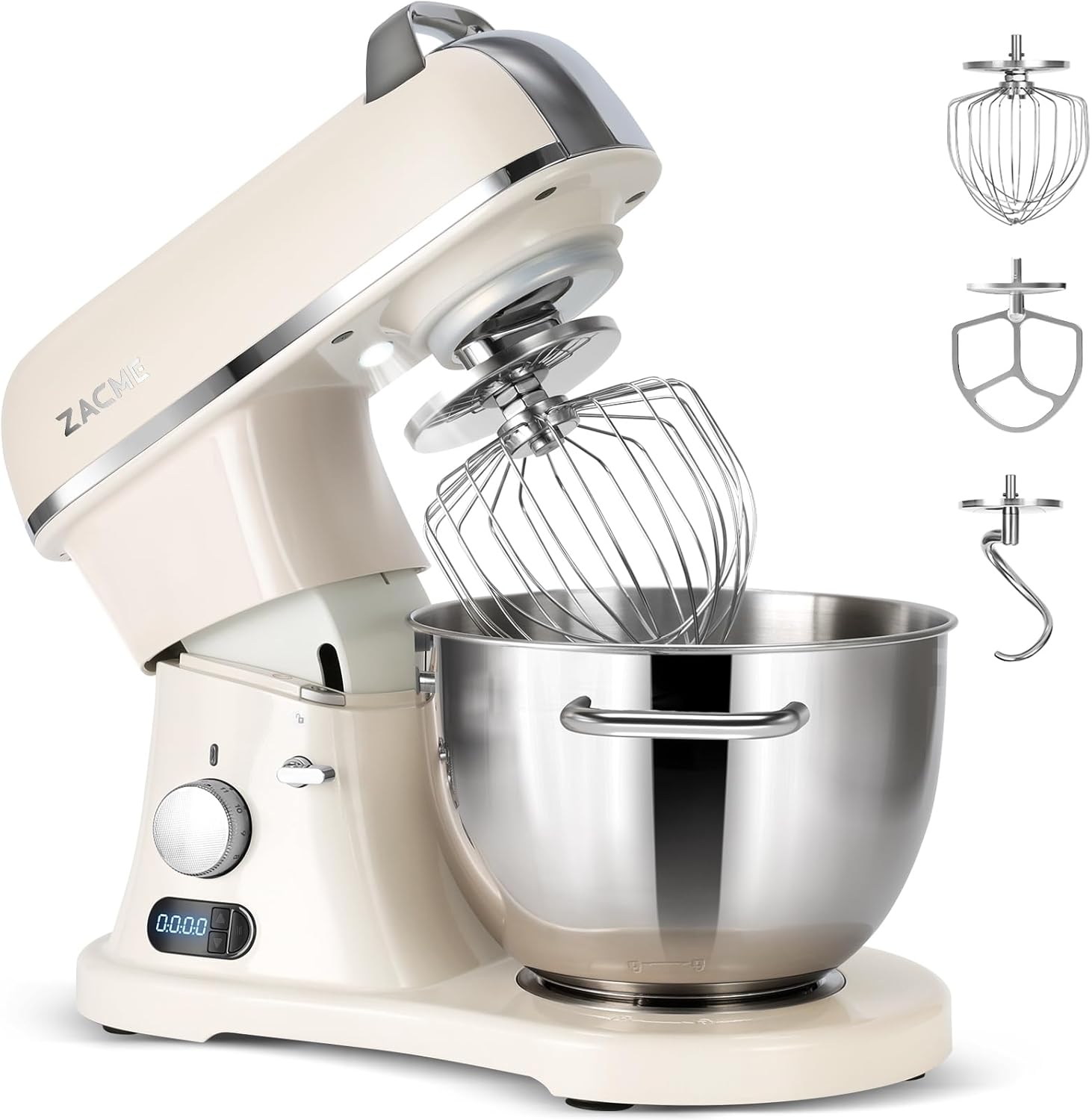
| Capacity | 8.4 quarts |
|---|---|
| Wattage | 800 watts |
| Number of Speeds | 11 |
| Controls Type | Knob + LCD Panel |
| Noise Level | 48 db |
This ZACME 8.4QT commercial stand mixer is built for heavy use: an 800W DC motor, metal gears and an aluminum die‑cast body give it the feel of a commercial machine while the planetary mixing action handles dough, batter and whipping without frequent scraping. It is typically used for large batches—bread, pizza dough, cakes and whipped creams—where the 8.4‑quart bowl and included dough hook, flat beater and wire whip save time compared with multiple small batches. The digital LCD with timer and 11 speed settings makes it easy to dial in slow kneading or fast whipping, and tilt‑head access plus suction feet simplify loading and stabilize operation. Noise is relatively low on slow speeds and the dual cooling fans help during extended runs. Important tradeoffs are its substantial weight and footprint, which suit a permanent kitchen station rather than occasional countertop storage, and the size may be overkill for users who only make small batches occasionally.
Best for: Buyers who prioritize reliable, commercial‑style performance and want a mixer that handles large batches consistently with documented user satisfaction.
Less Ideal for: If you bake only occasionally or need a compact, lightweight mixer that tucks away easily, look for smaller domestic models instead.
- Commercial‑grade aluminum die‑cast body and metal gears for durability
- Large 8.4‑quart stainless steel bowl handles big batches and reduces repeated mixing
- 800W DC motor with 11 speeds and planetary mixing for thorough kneading and whipping
- Digital LCD timer and knob controls for precise, hands‑off operation
- Dual cooling fans and suction feet reduce overheating and vibration during long runs
- Heavy and bulky so not ideal for frequent storage or small kitchens
- May be more machine than needed for single‑person households or very small batches
Verdict: Choose this mixer when you need a robust, commercial‑grade machine that reliably handles large batches and marathon mixing sessions.
Garvee Commercial Dough Mixer 10.5QT

| Capacity | 10.5 quarts |
|---|---|
| Wattage | 650 |
| Voltage | 110 |
| Number of Speeds | 2 |
This Garvee 10.5 QT commercial dough mixer is a spiral-style machine designed to handle heavy doughs in small commercial kitchens or serious home bakers who want restaurant-style performance. The 650W motor drives a dual-rotation system where the hook and bowl turn at different speeds for fast, even kneading; the listing says it can mix up to about 11 pounds of dough in 10–15 minutes. Controls are simple knobs and push buttons with a 60-minute timer and a reset button for straightforward operation. Safety features include a removable clear shield that cuts power if not closed and nonslip feet plus a sturdy chain-drive transmission for stable mixing. Because major parts that touch food are stainless steel, cleanup and durability are practical for frequent use. The unit is hefty and clearly built for commercial workloads, but that size and weight mean it needs a dedicated counter or stand and will be less convenient for casual, occasional bakers.
Best for: Buyers seeking a reliable, restaurant-capable spiral mixer for frequent dough production who prioritize straightforward controls, safety features, and durable construction.
Less Ideal for: Casual home bakers who need a compact, lightweight mixer for occasional use or users who require many speed options and precise low-speed control.
- Dual-rotation spiral design provides even, efficient kneading for heavy doughs
- 650W motor with chain-drive transmission built for continuous commercial use
- Food-grade stainless steel bowl and hook that are easy to clean and durable
- Safety shield with automatic shutdown plus nonslip feet for stable operation
- Large, heavy unit requires a dedicated workspace and is not portable
- Only two speed settings may limit fine control for delicate mixing tasks
Verdict: A sturdy, safety-minded spiral mixer built to handle frequent commercial dough work for buyers who want dependable, restaurant-style kneading performance.
Choosing the Right Powerful Spiral Mixer: Key Factors to Consider
Motor Power and Continuous Torque
A mixer's motor rating and how it delivers torque under load directly affect its ability to handle dense doughs and large batches. Higher continuous torque prevents the motor from stalling during long kneads and reduces strain on transmission components.
When evaluating power, consider both peak horsepower and rated continuous output, and whether the machine has features that maintain torque at low speeds. For heavy baking schedules you will want a motor that can run repeated cycles without significant heat buildup or performance loss.
Gearbox and Drive System Robustness
The gearbox transfers power from the motor to the spiral and is often the first major wear point in heavy-use mixers. Durable, well-lubricated gears and a solid drive design extend service life and reduce downtime.
Look for sealed or serviceable gearboxes, spare-part availability, and straightforward access for repairs. A strong drive system also helps maintain consistent mixing speed under strain, which is important for predictable dough development.
Bowl Size, Shape, and Spiral Geometry
Bowl capacity determines batch size, while bowl depth and curvature influence how the dough folds and moves during kneading. Spiral geometry and placement affect how evenly ingredients are incorporated and how quickly gluten forms.
Choose a bowl and spiral combination suited to your typical batch sizes and dough hydration. For sticky or high-hydration doughs, a deeper, well-contoured bowl with a spiral that promotes gentle folding will yield better texture and less overheating.
Cooling, Thermal Protection, and Duty Cycle
Powerful mixers generate heat, especially during long cycles or frequent use. Effective cooling and thermal protection features prevent motor shutdowns and prolong component life.
Check the rated duty cycle and whether the mixer includes thermal cutouts or automatic rest intervals. For commercial or semi-commercial use, machines with active cooling or serviceable ventilation will tolerate heavier schedules with fewer interruptions.
Ease of Cleaning and Maintenance
A robust mixer also needs to be easy to maintain. Accessible parts, removable bowls, and simple lubrication points reduce downtime and make routine care manageable.
Consider how the mixer handles daily cleaning tasks and whether common wear parts are easy to source. Machines with fewer crevices and dishwasher-safe bowls or detachable components speed up turnover between batches.
Safety Features and Operator Controls
Safety interlocks, emergency stop controls, and clear speed selection reduce the risk of accidents during heavy-duty mixing. Intuitive controls also minimize operator error and improve workflow.
Assess whether the mixer has protective guards, reliable interlocks that stop the unit when opened, and labeled controls for speed and timers. For busy environments, durable switches and a visible control panel contribute to long-term reliability.
How Spiral Mixers Differ From Planetary Mixers
Spiral mixers are specialized for dough development because the bowl rotates while a fixed spiral arm kneads, producing efficient gluten formation with less heat buildup. This contrasts with planetary mixers where the beater moves around a stationary bowl, which can be less efficient for large, heavy doughs.
For bakers handling high-hydration or dense doughs, the spiral action reduces mixing time and preserves dough structure. Understanding this mechanical difference explains why spiral mixers are preferred for bread production and bulk dough work.
- Bowl rotation combined with spiral kneading promotes even gluten development
- Typically faster and gentler for high-hydration doughs
- Designed for larger batch sizes and repeated heavy cycles
Estimating Batch Size and Production Needs
Match the mixer's bowl capacity to your regular batch sizes rather than occasional maximums. Running a mixer at near-capacity constantly increases wear and raises the risk of overheating.
If you plan to scale production, choose a unit with a slightly larger capacity than current needs to allow flexibility. Also factor in downtime for cooling between long cycles if your schedule requires consecutive large batches.
- Select bowl capacity based on average, not peak, batch size
- Allow a buffer for growth to avoid chronic near-capacity operation
- Consider duty cycle when planning consecutive runs
Installation, Footprint, and Workspace Considerations
Powerful spiral mixers are heavier and require a stable, level surface and adequate floor space. Verify electrical requirements and ensure the mixer can be placed where ventilation and access for cleaning are feasible.
Plan for clearance around the machine for bowl removal and operator access. Some models have tilt or lift mechanisms that need extra headroom or adjacent space for bowl handling.
- Confirm floor strength and level surface for heavy units
- Check electrical supply and cord routing requirements
- Leave space for bowl removal and maintenance access
Routine Maintenance and Troubleshooting Basics
Establish a regular maintenance schedule including gear lubrication, inspection of seals, and checking fasteners. Address unusual noises or reduced torque immediately to prevent larger failures.
Keep replacement parts like belts or seals on hand if you rely on the mixer for daily production. Simple troubleshooting steps, such as verifying proper load distribution in the bowl, can often resolve performance hiccups without service calls.
- Lubricate gearbox and moving parts per manufacturer guidance
- Inspect seals and gaskets for wear to prevent contamination
- Document cycle lengths and loads to spot trends before breakdowns
Choosing Between Manual and Automatic Controls
Some mixers offer simple manual speed knobs and handles, while others include programmable timers and multi-speed presets. Automatic controls can improve repeatability, especially when multiple operators are involved.
However, more advanced control systems add complexity and may require additional training or maintenance. Balance the benefits of automation against the reliability and serviceability you need for daily operations.
- Manual controls are simple and often more robust
- Automatic timers support consistent cycle times across batches
- Consider operator skill and maintenance capacity when choosing controls
How We Chose the Best Powerful Spiral Mixer
We focused on criteria that matter specifically for buyers who need heavy-duty dough mixing. First, motor power and torque were prioritized because these determine the mixer's ability to knead dense or high-hydration doughs without bogging down. Second, gearbox and drive durability were evaluated since robust gearing prevents premature failure under repeated load. Third, bowl and spiral design were considered for even gluten development and efficient dough movement. Fourth, cooling and thermal protection were included to ensure the mixer can sustain longer cycles without overheating. Fifth, ease of maintenance and serviceability was assessed so that routine cleaning and parts replacement are practical for frequent use. We excluded lightweight or countertop hobby mixers and any units designed only for small, occasional batches. The result is a list of mixers that balance continuous-use capabilities, maintenance practicality, and consistent dough results.
Our full evaluation process is outlined in our review methodology.
FAQ
What motor size do I need for bakery-grade dough?
It depends on batch sizes and dough hydration. For regular home baking smaller motors can suffice, but for frequent large batches or dense doughs choose higher continuous torque ratings. Look for motors rated for sustained duty rather than short peaks.
How long can a powerful spiral mixer run continuously?
Run time depends on duty cycle and cooling design. Many heavy-duty mixers can handle repeated cycles with short rests, but continuous multi-hour operation may require active cooling or scheduled downtime to avoid thermal shutdowns.
Is bowl material important for dough quality?
Yes. Stainless steel bowls are common because they are durable, hygienic, and easy to clean. Bowl shape and finish also influence how dough moves, so choose a configuration that promotes even folding without trapping sticky dough in seams.
Can I use commercial spiral mixers in a home kitchen?
Often yes, but consider weight, footprint, and electrical needs. Commercial-capacity machines may require a dedicated circuit and more robust floor support. Evaluate space and serviceability before installing a heavy unit at home.
How do I know when gearbox service is needed?
Unusual grinding noises, increased vibration, or reduced torque under normal loads are signs to inspect the gearbox. Regular inspection intervals and following lubrication schedules help catch wear early and avoid major repairs.
Final Verdict
Prioritize motor torque, gearbox durability, and bowl-spiral geometry when choosing a powerful spiral mixer. Balance batch capacity against duty cycle and cooling to ensure consistent performance without excessive downtime. Finally, favor units that are easy to service and clean so that heavy use stays manageable. With these priorities in mind, you can select a mixer that meets your production needs and keeps dough quality consistent.