
Note: This article contains affiliate links. If you click on these links and make a purchase, we may earn a small commission at no extra cost to you. This helps support our research and content. Read our full affiliate disclosure here.
When space is limited, the right Small Water Heater keeps hot water available without taking over a utility closet or cabinet. You want dependable capacity for showers or a single fixture, quick recovery when demand spikes, and an installation profile that fits your home. This guide covers seven shortlisted compact water heaters that excel in small-space applications. We evaluated recovery speed, installation footprint, energy efficiency, and durability so you can pick the small heater that fits your plumbing layout and daily hot-water needs. Read on to see which features matter most and how to match a compact unit to your household.
Top Picks at a Glance
| Best Overall The best all-around choice for most situations | EcoSmart ECO MINI 2.5 |  |
| Best Quality Built to a higher standard if you want something more solid | EcoSmart ECO 11 Tankless Water Heater |  |
| Best Value The sweet spot between price and what you get | Fisoceny 2.5 Gallon Mini Tank Water Heater |  |
| Best Budget The cheapest option that still gets the job done reliably | xwdzswgs 3000W Tankless Water Heater |  |
| Top Rated A top-rated pick with lots of positive feedback | Ganggend 2.5 Gallon Mini Water Heater G25 |  |
| Most Popular A crowd favorite that many people choose with confidence | BISELONG Mini-Tank Water Heater BI-2.5 | 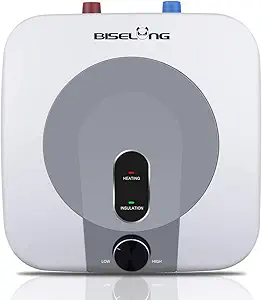 |
| Best Seller A high-volume bestseller chosen again and again | Bosch Tronic 3000 T ES2.5 Mini-Tank |  |
EcoSmart ECO MINI 2.5

| Capacity | 2.5 gallons |
|---|---|
| Wattage | 1440 watts |
| Voltage | 120 volts |
| Mount Type | Wall |
The EcoSmart ECO MINI 2.5 is a compact, wall-mounted electric mini tank designed to deliver near-instant hot water at a single sink or point of use. It stores about 2.5 gallons and runs on 120 volts with a 1440 watt heating element, so installation is simple and it can plug into a standard outlet without special wiring. The unit is lightweight and intended for under-sink or nearby wall mounting to cut down on water waste and the wait for hot water; it can also be used as a boost in-line with a larger heater. A small digital temperature display and straightforward plumbing connections make everyday use simple, and the plastic-bodied design keeps weight and cost down. Limitations are its limited stored volume and modest wattage, so it is best for a single faucet or low-flow fixture rather than multiple simultaneous uses or showers. The product includes basic components for installation and carries a multi-year limited leak warranty.
Best for: Buyers who want a simple, space-saving solution to eliminate hot-water wait at a single sink or to supplement a larger system for low-flow fixtures.
Less Ideal for: Homes needing hot water for multiple fixtures at once or anyone who expects to run showers or high-flow appliances from this unit alone.
- Point-of-use design cuts wait time and water waste for a single sink
- Plugs into a standard 120V outlet so no special circuit needed in many installations
- Lightweight, compact wall-mount form fits under sinks or tight spaces
- Digital temperature display for easy monitoring
- Small 2.5 gallon capacity unsuitable for showers or simultaneous fixtures
Verdict: A compact, easy-to-install point-of-use mini tank that reliably eliminates hot-water wait at a single sink.
EcoSmart ECO 11 Tankless Water Heater

| Wattage | 13000 watts |
|---|---|
| Voltage | 220 volts |
| Flow Rate | 3.1 gpm |
| Maximum Temperature | 140 °F |
| Heat Output | 11 KW |
The EcoSmart ECO 11 is a wall-mounted, 13 kW electric tankless heater made for point-of-use or small low-flow needs like a single bathroom or sink. It heats water on demand using self-modulating electronics and a digital temperature controller that lets you set output in 1 degree increments, producing about 1.3 to 3.1 gpm depending on inlet temperature. Its compact footprint frees up space compared with a conventional tank and the LED display and digital control make it straightforward to operate. Because it only draws power when heating, it is more energy efficient than a storage tank and can trim standby losses. Installation requires proper electrical capacity (single 60A double-pole breaker typical) and appropriate wiring, and performance drops in colder climates or with higher simultaneous flow demands—this unit is optimized for one shower or sink rather than whole-house service. For buyers who need predictable, efficient hot water at a single location, the ECO 11 is a practical, space-saving choice; for larger homes or multiple simultaneous showers you will need a higher-capacity model or multiple units.
Best for: Buyers who want efficient, predictable on-demand hot water for a single bathroom, sink, or small point-of-use location and value compact, wall-mounted equipment.
Less Ideal for: Homes that need multiple simultaneous high-flow fixtures or whole-house hot water should choose a higher-capacity tankless unit or multiple units instead.
- Compact wall-mounted design saves floor space and fits point-of-use locations
- Self-modulating technology adjusts energy use to demand for greater efficiency
- Digital temperature control with LED display for precise setpoint and easy operation
- Provides continuous on-demand hot water for low-flow applications without a storage tank
- Limited flow rate suitable for one shower or a sink, not for whole-house use
- Requires high-amperage electrical circuit and proper wiring for installation
Verdict: A compact, energy-efficient tankless heater that delivers precise on-demand hot water for single-point applications where space and performance matter.
Fisoceny 2.5 Gallon Mini Tank Water Heater

| Capacity | 2.5 gallons |
|---|---|
| Wattage | 1500 watts |
| Voltage | 110/120 V AC |
| Flow Rate | 0.46 gpm |
| Maximum Temperature | 149 °F |
This compact 2.5 gallon mini tank heater is designed to sit under a sink or be wall- or floor-mounted to deliver near-instant hot water for small tasks. It uses a 1500W L-shaped heating element and internal insulation to warm the tank in roughly 5 to 8 minutes, and a mechanical knob lets you set temperatures between about 86 and 149 °F. The unit includes a pressure relief valve, two 1/2" female pipe adapters, mounting bracket, and basic safety features such as overheat and high-pressure protection plus UL-listed cording. In practice it is best for kitchen sinks, RVs, or short hot-water runs where a full-size water heater is impractical; it is not intended to serve a shower or continuous high-flow applications because flow rate and tank capacity are limited. Installation is straightforward for someone comfortable with basic plumbing, though careful tightening of outlet fittings and correct placement of the pressure relief valve are important to prevent leaks. For buyers needing a compact, energy-efficient source of occasional hot water, this model is a practical choice.
Best for: Buyers who want a compact, energy-efficient way to get hot water at a single sink, in an RV, or for short hot-water tasks and who prioritize space savings and quick recovery over high flow.
Less Ideal for: People needing continuous high-flow hot water, whole-house servicing, or shower-capable output should choose a larger or dedicated tankless solution.
- Compact 2.5 gallon tank fits under sinks or in RVs for space-constrained installations
- 1500W heating element reaches usable temperatures in about 5–8 minutes
- Includes installation hardware and 1/2" female pipe adapters for easier hookup
- Built-in safety features including overheat protection, pressure relief valve, and UL-certified cord
- Limited flow rate (0.46 gpm) and small capacity make it unsuitable for showers or prolonged use
- Requires careful installation and tightening of fittings to avoid leaks
Verdict: A compact, easy-to-install mini tank that delivers quick hot water at a single sink or in an RV when space and energy efficiency are top priorities.
xwdzswgs 3000W Tankless Water Heater

| Power | 3000W |
|---|---|
| Power Source | AC |
| Maximum Temperature | 122 °F |
| Mount Type | Wall |
| Material Type | Acrylonitrile Butadiene Styrene |
This small electric tankless heater delivers on-demand hot water at the sink without a storage tank, using 3000W to raise outlet temperature quickly at low flow rates. It is built for vertical wall mounting under a counter and includes an LED display with selectable Fahrenheit or Celsius, basic safety protections such as dry-boil and leakage protection, and an IPX4 rating. Installation is straightforward for someone comfortable with basic plumbing and electrical work: it uses a 1/2 inch NPT connection and ships with screws and a manual, but the manufacturer recommends a dedicated circuit and specific wire size and breaker rating. Practical benefits are fast warm-up, compact footprint that fits tight spaces, and energy efficiency since it heats only when needed. Important limitations are flow-rate dependent output—not suitable for showers—and the strict vertical-only mounting and electrical requirements, which may require pro help for safe installation in some homes.
Best for: Buyers who need an inexpensive, space-saving solution to supply hot water to a single sink or small appliance and are willing to follow the installation and electrical recommendations.
Less Ideal for: Homes needing whole-house hot water, showers, or buyers who cannot modify wiring or do not want to meet the specified installation requirements.
- Instant, on-demand hot water for point-of-use fixtures
- Very compact, space-saving under-sink design
- Digital temperature display with ℃/℉ selection
- Multiple built-in safety features including dry-boil and leakage protection
- Includes mounting screws and basic installation hardware
- Not suitable for shower use due to limited flow capacity
- Requires vertical installation and specific electrical wiring and breaker size
Verdict: A compact, budget-friendly point-of-use tankless heater that delivers immediate hot water for a single sink when installed per the stated electrical and mounting requirements.
Ganggend 2.5 Gallon Mini Water Heater G25

| Capacity | 2.5 gallons |
|---|---|
| Wattage | 1500 watts |
| Voltage | 110 volts |
| Maximum Temperature | 149 °F |
| Maximum Pressure | 108 psi |
The Ganggend 2.5 Gallon Mini Water Heater (G25) is a compact under-sink electric tank that delivers near-instant hot water for small fixtures. It uses a 1500W L-shaped heating element and a well-insulated 2.5 gallon tank to heat water quickly—manufacturer claims warm water in about six minutes—and a digital display plus manual knob lets you set temperatures between 86 and 149°F. Mounting is flexible; you can wall-mount it or set it under a counter, and it uses standard 1/2" NPT fittings so it ties into typical household plumbing. Built-in safety features include overheat protection and an automatic pressure relief valve, and the inner tank uses enamel/low-carbon stainless materials with thicker steel for improved durability. Practical limits are its small capacity and 110/120V power, so it is best for a single sink, RV, or point-of-use applications rather than whole-house supply. Installation requires a nearby electrical outlet and basic plumbing connections but the compact footprint makes it easy to tuck into tight spaces.
Best for: Buyers who want a reliable, compact point-of-use heater to supply a single sink, small bathroom, RV hookup, or food truck tap with quick access to hot water and simple, durable construction.
Less Ideal for: Homes seeking whole-house hot water or multiple simultaneous fixtures should choose a larger or higher-capacity system instead.
- Compact footprint fits under sinks or in cabinets for point-of-use heating
- 1500W L-shaped element and insulation for relatively fast heat-up and reduced standby loss
- Digital temperature display with manual control for precise temperature adjustment
- Standard 1/2" NPT connection and included mounting bracket simplify plumbing and installation
- Built-in safety features including overheat protection and pressure relief valve
- 2.5 gallon capacity limits supply to single fixtures and short uses
- 110/120V power limits recovery rate compared with higher-voltage commercial units
Verdict: A reliable, space-saving point-of-use mini tank that delivers quick, controllable hot water for a single sink or small application.
BISELONG Mini-Tank Water Heater BI-2.5

| Capacity | 2.5 gallons |
|---|---|
| Wattage | 1500 watts |
| Voltage | 120 volts |
| Maximum Temperature | 149 °F |
| Maximum Pressure | 108 psi |
The BISELONG BI-2.5 is a small under-sink storage water heater meant to supply a single sink or nearby appliance with on-demand warm water from its 2.5-gallon tank. It uses a 1500W heating element and a thicker stainless steel inner tank to speed recovery and resist corrosion, and the unit is mountable on a wall, shelf, or floor for flexible installation. The built-in thermostat and insulation maintain set temperature up to the 149°F maximum while limiting standby loss, and included fittings and brackets simplify installation for an experienced DIYer or plumber. Practical benefits include compact footprint for tight cabinets, multiple safety protections like overtemperature and dry-heat safeguards, and compatibility with 120V household circuits. Important limits are its small capacity, which can run out quickly under heavy use or multiple simultaneous draws, and the need for correct electrical and pressure hookups to meet the recommended 15A/20A circuit guidance and 108 PSI max pressure. For buyers prioritizing a reliable point-of-use heater, it balances recovery speed and compact size well.
Best for: Buyers who want a compact, proven point-of-use heater to supply instant hot water at a single sink or appliance and who value visible safety features and solid construction.
Less Ideal for: Households needing hot water for multiple fixtures, whole-home systems, or large continuous draws should choose a larger storage or on-demand solution.
- Compact 2.5-gallon tank fits under sinks and in tight spaces
- 1500W heating element with faster recovery for short waits between uses
- Thicker stainless steel inner tank and laser welding to reduce corrosion risk
- Multiple built-in safety protections including overtemperature and dry-heat prevention
- Includes installation brackets and pipe fittings for easier setup
- Small tank capacity can run out during extended or simultaneous hot-water use
- Requires proper electrical circuit and installation knowledge to meet safety recommendations
- Not suitable for whole-home use or high-demand appliances
Verdict: Choose this compact 2.5-gallon mini-tank if you want a space-saving, safety-focused point-of-use heater that delivers quick recovery for a single sink or appliance.
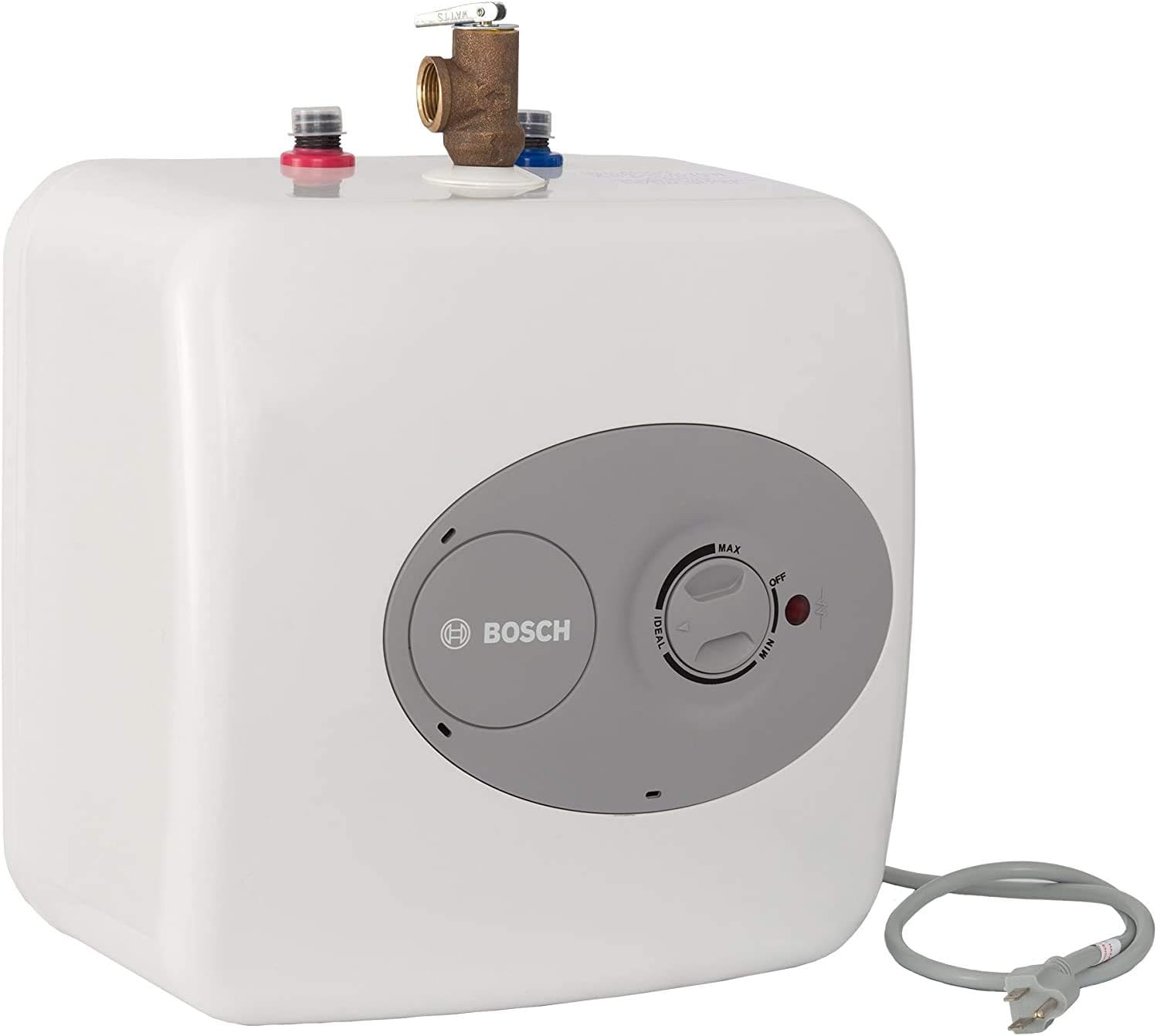
Bosch Tronic 3000 T ES2.5 Mini-Tank
| Capacity | 2.5 gallons |
|---|---|
| Wattage | 1440 watts |
| Voltage | 120 volts |
| Maximum Temperature | 140 °F |
| Efficiency | 98% |
The Bosch Tronic 3000 T ES2.5 is a compact 2.5-gallon electric mini-tank made for point-of-use hot water needs. It mounts on a shelf, wall, or floor and can plug into a standard 120V outlet for independent installation, or be plumbed inline with a larger system to reduce wait time at sinks. The glass-lined tank and 1440 W heating element provide quick recovery and good thermal efficiency, and the external temperature dial plus a temperature-and-pressure relief valve give straightforward control and safety. Its small footprint and included mounting bracket make it easy to tuck under a vanity or install in a utility area, and the unit can supply hot water to one or two nearby sinks. Limitations are predictable for its class: the 2.5-gallon capacity means it is for short bursts of use rather than long continuous draws, and it requires a nearby 120V outlet or hardwired installation location.
Best for: Buyers who want a reliable, easy-to-install mini-tank to eliminate wait time for hot water at a single sink or small fixture and who prioritize proven, low-risk equipment.
Less Ideal for: Homes needing whole-house hot water, large households with high simultaneous demand, or users who expect long continuous hot-water draws.
- Point-of-use design delivers hot water quickly at a nearby sink
- Plugs into a standard 120V outlet for simple independent installation
- Glass-lined tank for durability and corrosion resistance
- External temperature dial and T&P relief valve enhance control and safety
- Flexible mounting: shelf, wall, or floor with included bracket
- Small 2.5-gallon capacity limits usage to short tasks and nearby fixtures
- Not suitable as a whole-house solution or for long continuous hot-water demands
Verdict: A compact, proven mini-tank that reliably delivers near-instant hot water at a single sink with straightforward, low-risk installation.
Choosing the Right Small Water Heater: Key Factors to Consider
Capacity and Intended Use
Choose a capacity that matches the number of fixtures and typical simultaneous demand. Small water heaters are best for single bathrooms, point-of-use sinks, or small studios where demand is limited. If you frequently run a shower and a dishwasher at the same time, a slightly larger small-capacity tank or a point-of-use tankless option may be necessary.
Underestimating capacity leads to cold-water interruptions and user frustration. Overestimating capacity wastes space and can add unnecessary standby losses. Think in terms of peak-minute requirements rather than average daily volume to size the unit effectively.
Recovery Rate and Peak Performance
Recovery rate describes how quickly the unit can supply more hot water after the initial volume is used. For small heaters with storage tanks, faster recovery typically requires more powerful heating elements or higher BTU input on gas models. For tankless or near-instant units, flow rate at a specific temperature rise is the key spec.
A unit with a slow recovery may be fine for occasional use, but it will struggle if you routinely need back-to-back hot-water events. Match recovery characteristics to your usage pattern to avoid mid-shower cold snaps.
Installation Footprint and Mounting
Compact units are chosen for limited space, so mounting style and clearances are crucial. Measure the intended location and account for access space for service, piping, and electrical or gas connections. Some small heaters are designed for wall mounting, others sit on a floor pedestal, and some can be installed horizontally under counters.
Also consider how the unit interfaces with existing plumbing and whether your installation requires additional parts such as expansion tanks, isolation valves, or flexible connectors. Ease of access impacts future maintenance and possible replacement.
Energy Efficiency and Standby Loss
Energy efficiency determines how much energy is required to keep water hot and to heat new water. For storage-style small heaters, low standby loss and good insulation reduce ongoing energy waste. Tankless small heaters avoid standby loss but their efficiency depends on matching flow rate to demand and the electrical or gas input efficiency.
Consider operating patterns: frequent short draws favor tankless or well-insulated small tanks, while occasional longer draws can be handled by higher-capacity compact tanks. Check efficiency metrics and insulation values when comparing options.
Safety Features and Controls
Reliable temperature controls and safety devices are essential. Look for adjustable thermostats with clear temperature range markings and built-in temperature and pressure relief valves for storage units. For electric small heaters, overheat protection and suitable electrical ratings prevent wiring issues. Some units include digital controls or thermostatic mixing valves to reduce scald risk.
Good controls not only protect occupants but also allow you to optimize performance and energy use. Consider how easy the controls are to access once the unit is installed.
Serviceability and Warranty
Ease of maintenance affects long-term ownership. Accessible heating elements, replaceable anodes, and straightforward access to control panels simplify routine servicing. Consider whether the unit allows isolated servicing without draining the entire system, and whether replacement parts are commonly available.
Warranty terms indicate expected durability and manufacturer confidence. Look for clear coverage on tanks, heating elements, and parts. Longer, component-specific warranties are generally better for small appliances expected to be in continuous use.
Sizing a Small Water Heater for Your Home
To size a compact water heater, start by listing the fixtures you expect to serve simultaneously and estimate their hot-water flow rates. Typical shower flows, sink flows, and appliance draws give you a peak-minute demand target. Choose a storage capacity or tankless flow rating that meets that peak demand with a small safety margin.
If you are replacing an existing unit, note the existing unit's recovery rate and any comfort issues first. For new installs, prioritize a slightly higher recovery rate over a marginally larger tank when space is constrained.
- Measure available installation space and clearance for maintenance
- Calculate combined fixture flow for expected simultaneous use
- Match recovery or flow-rate specs to your peak demand
Installation Considerations and Permits
Installation of a small water heater often requires local code compliance for venting, seismic straps, electrical circuit sizing, and pressure-relief discharge routing. Verify permit requirements before purchasing and factor any necessary upgrades into the installation plan.
Consider the proximity to the point of use to reduce lag time and heat loss in piping. Shorter runs improve perceived performance and can justify a smaller capacity unit.
- Check local codes for venting and relief valve discharge
- Plan for adequate clearances and service access
- Locate the unit near frequent hot-water draws when possible
Energy Use Patterns: Tank Vs Point-of-Use Tankless
Storage-style small heaters provide a buffer of ready hot water but incur standby losses. Point-of-use tankless units eliminate standby loss but must be sized correctly for flow and temperature rise. Your daily usage profile determines which approach best balances convenience and operating cost.
For infrequent, short demands such as a single sink, a small storage tank can be simpler and more forgiving. For repeated short draws throughout the day, a tankless unit can reduce wasted energy if the electrical or gas supply supports rapid heating.
- Short, frequent draws favor tankless or well-insulated small tanks
- Longer consecutive draws may need modest stored capacity
- Consider electricity or gas availability and circuit sizing for tankless options
Maintaining Performance Over Time
Regular maintenance preserves efficiency and extends service life. For storage units, periodic flushing to remove sediment and checking or replacing sacrificial anodes reduces corrosion risk. Electrical units may need element inspections, while gas units require burner and vent checks.
Plan for straightforward maintenance access when siting the unit. A well-maintained small water heater will retain recovery speed and temperature stability far longer than one that is difficult to service.
- Flush sediment from storage tanks annually in moderate-hardness water
- Inspect anodes and replace as needed per manufacturer guidance
- Verify safety valve operation and check electrical or gas connections
Noise, Venting, and Location Options
Noise levels and venting needs vary by type. Electric small heaters are nearly silent and require no combustion venting. Gas small heaters may produce combustion noise and need proper venting and clearance. Consider placing noisy units away from living areas or choose silent electric models for closets near bedrooms.
Location choices include under-sink installations, utility closets, or dedicated small mechanical rooms. Make sure the chosen location allows required venting, drainage for relief valves, and access for routine checks.
- Electric units are quieter and simpler in confined spaces
- Plan venting and combustion air for gas models
- Allow drainage paths for pressure-relief or leak events
How We Chose the Best Small Water Heater
We prioritized technical and practical criteria that matter for compact hot-water systems. First, we screened units by usable capacity and recovery rate to ensure each small water heater can meet peak demand for a single bathroom or point-of-use application. Next, installation footprint and mounting options were evaluated, including vertical and horizontal clearances, tankless wall units versus small storage tanks, and ease of accessing connections for plumbing and electrical. Energy performance was assessed using standby loss and rated efficiency figures so readers can compare ongoing operating cost potential. Durability and warranty terms were considered, focusing on corrosion protection, anode design, and typical warranty coverage for small-capacity appliances. Finally, we looked at controls and safety features such as thermostats, pressure-relief provisions, and freeze protection when applicable. We excluded oversized models and whole-home commercial units that exceed the typical compact installation envelope. Also omitted were specialty units intended solely for outdoor or recreational-vehicle use. The resulting selections balance compact size with realistic service life and maintainability, emphasizing units suited to tight spaces and single-fixture or light multi-fixture households.
Our full evaluation process is outlined in our review methodology.
FAQ
How do I know if a small water heater has enough hot water for my shower?
Estimate your shower flow and duration, then compare that to the unit's rated capacity and recovery. A small storage unit should supply the expected volume plus a margin, while a tankless unit should list a flow rate at the temperature rise you need.
Can a small water heater be installed under a sink?
Many small units are designed for under-sink or cabinet mounting, but you must confirm clearances, access for maintenance, and drainage for the pressure-relief valve. Electrical and plumbing connections should also meet local code for that location.
What maintenance does a small storage heater need?
Typical maintenance includes periodic flushing to remove sediment, checking and replacing the sacrificial anode when required, and testing the pressure-relief valve. These tasks help prevent corrosion and maintain thermal performance.
Are tankless small water heaters more efficient than small tanks?
Tankless units avoid standby heat loss and can be more efficient for intermittent draws, but their real-world efficiency depends on matching the unit's flow capability to your demand and ensuring adequate electrical or gas supply.
Do small water heaters require special permits?
Permit requirements vary by location and the installation specifics, such as changes to gas lines, venting, or electrical circuits. Check local regulations before installation and plan for any inspections or licensed work.
Final Verdict
Choosing the right Small Water Heater comes down to matching capacity, recovery, and installation constraints to how and where you use hot water. Prioritize recovery rate and installation footprint when space and simultaneous demand are limiting factors. Balance energy considerations against convenience by choosing between small storage tanks and point-of-use tankless units. Focus on serviceability and safety features to ensure reliable performance over time. With careful measurement of demand and installation space, you can confidently pick a compact hot-water solution that delivers steady service without unnecessary complexity.