
Note: This article contains affiliate links. If you click on these links and make a purchase, we may earn a small commission at no extra cost to you. This helps support our research and content. Read our full affiliate disclosure here.
If you need instant hot water without a bulky storage tank, a portable tankless water heater can be a game changer. These compact units provide on-demand heating for outdoor showers, RV use, backup household supply, and small point-of-use needs. Picking the right unit affects how quickly you get hot water, how stable the temperature remains under changing flow, and how easy the unit is to install and maintain. This guide presents six shortlisted portable tankless water heaters that cover common use cases and installation constraints. We evaluated each option across practical criteria so you can match a unit to your expected flow needs, fuel type, and installation environment. Read on for a clear sense of which features matter most and how to prioritize them for your situation.
Top Picks at a Glance
| Best Overall The best all-around choice for most situations | Camplux BD158N Portable Tankless Water Heater |  |
| Best Value The sweet spot between price and what you get | Amzgachfktch 6L Propane Tankless Heater |  |
| Best Budget The cheapest option that still gets the job done reliably | SANAUGAS Tankless Propane Water Heater SND10-264 |  |
| Top Rated A top-rated pick with lots of positive feedback | GASLAND BS158 6L Tankless Heater |  |
| Most Popular A crowd favorite that many people choose with confidence | CAMPLUX AY132 Portable Tankless Heater |  |
| Best Seller A high-volume bestseller chosen again and again | GASLAND BE158R Propane Tankless Heater |  |
Camplux BD158N Portable Tankless Water Heater

| Power Source | Liquid Propane |
|---|---|
| Flow Rate | 1.58 gpm |
| Maximum Temperature | 167 °F |
| Heat Output | 41,000 BTU/hour |
| Water Pressure Range | 3.0-110.0 PSI |
The Camplux BD158N is a small, battery-ignited propane tankless heater made for outdoor showers, RVs, cabins, and other off-grid hot-water needs. It produces up to 41,000 BTU and a flow of about 1.58 gallons per minute, so it provides steady hot water for a single shower or washing tasks without a storage tank. Setup is straightforward: connect a water inlet hose, attach the included 5 ft gas regulator to a 20 lb propane cylinder, insert two D batteries for the piezo ignition, and mount or carry it using the foldable handle. Temperature is controlled by adjusting water and gas flow, and the unit handles a wide pressure range down to 3 psi, which makes it compatible with tap supply or a pumped tank. Important limitations are modest flow rate and lower efficiency at high elevations, so it is best for one-person showers rather than filling tubs or running multiple taps. The unit is lightweight and portable but does require a separate pump if drawing from a non-pressurized tank and periodic battery replacement for ignition.
Best for: Buyers who want a portable, high-heat propane tankless heater for single-person outdoor showers, RV trips, or cabin use and prioritize easy setup and off-grid operation.
Less Ideal for: Anyone needing high flow for multiple simultaneous fixtures, full-tub filling, or a mains-electric solution for indoor whole-home use should consider larger or different systems.
- Portable, compact design with a foldable handle for easy transport and wall or temporary mounting.
- High heat output (41,000 BTU) that produces consistent hot water on demand within the unit's flow range.
- Includes useful accessories: pre-installed 5 ft gas regulator and 5 ft on/off shower kit for faster setup.
- Battery-powered ignition that works without mains electricity, suitable for remote or off-grid use.
- Wide operating water pressure range (3–110 psi) allowing flexibility with tap supply or pump-fed sources.
- Low maximum flow (about 1.58 GPM) limits use to single-person showers or light washing tasks.
- Requires separate water inlet hose, 20 lb propane tank, and batteries which are not fully included for standalone operation.
Verdict: Choose the Camplux BD158N when you need a lightweight, high-heat portable propane tankless heater that delivers reliable single-shower hot water off-grid.
Amzgachfktch 6L Propane Tankless Heater

| Power Source | gas_powered |
|---|---|
| Flow Rate | 1.58 gpm |
| Heat Output | 42000 british thermal units |
| Capacity | 1.58 gallons |
| Special Features | Anti-Freezing Protection, Dry Combustion Protection, Flame Failure Protection, High Water Pressure Protection, Low Water Flow Protection, Overheat Protection |
This portable propane tankless heater is designed for outdoor and off-grid use where a compact, instant-hot-water source is needed. It runs on a standard 20 lb LP cylinder and uses two D cell batteries for electronic ignition, producing up to 40,000 BTU and about 1.58 gallons per minute of hot water so you get immediate warm water for showers, washing animals, or campsite cleanup. The unit includes a CSA-approved regulator, a foldable carry handle, a 5 ft shower head, garden-hose adapter, and mounting hardware, and it starts at low water pressure down to 2.5 PSI. Safety features are extensive and practical, with anti-freeze, dry-combustion, flame-failure, overheat and high/low water flow protections. Limitations to note are the modest flow rate that suits single-point use only and the minimum pressure requirement that may need a booster pump on weak systems, plus it is intended for outdoor use and should be kept dry to avoid damage. If you need a compact, safe way to get hot water without power, this model covers the essentials well.
Best for: Buyers who prioritize a compact, safe, and portable hot-water solution for camping, RVs, cabins, or outdoor tasks and want a reliable, no-grid option that is easy to move and set up.
Less Ideal for: Households that need multi-fixture hot water, high-flow indoor systems, or a fully weatherproof permanent indoor installation should look elsewhere.
- Compact, lightweight design with foldable handle for easy transport and storage
- Runs on standard 20 lb propane with electronic battery ignition for off-grid use
- Built-in CSA-approved regulator and six safety protections including overheat and flame-failure devices
- Starts at low water pressure (2.5 PSI) so it will operate on many portable water sources
- Maximum flow of 1.58 GPM limits use to a single fixture at a time
- Requires minimum water pressure and may need a booster pump in low-pressure setups
Verdict: A lightweight, safety-focused propane tankless heater that gives instant hot water for single outdoor fixtures and off-grid use.
SANAUGAS Tankless Propane Water Heater SND10-264

| Power Source | Liquid Propane |
|---|---|
| Flow Rate | 2.64 gpm |
| Maximum Temperature | 140 °F |
| Heat Output | 68000 british thermal units |
| Capacity | 10 liters |
This compact tankless propane heater supplies instant hot water at up to 2.64 gallons per minute and is designed for outdoor use like camping, cabins, RVs, and off-grid properties. It mounts to a wall or can be set up temporarily using the included installation kit and garden adapters, and the LED display and temperature controller make it straightforward to operate. The unit is rated at 68,000 BTU for strong heat output and includes six safety protections such as flame failure, overheat, dry combustion, low-flow cutoff, and anti-freeze measures. Practical benefits include a full parts kit out of the box and compatibility with low water pressure down to about 3.6 PSI, which helps keep heating working in remote locations. Expect some limitations: it runs on liquid propane and requires batteries for ignition, so you need fuel and occasional battery replacements, and flow or temperature can be affected if water pressure drops below the protection threshold. Fit and stable installation are important for safe indoor use in ventilated areas.
Best for: Buyers needing an affordable, portable hot-water solution for camping, cabins, or off-grid use who prioritize straightforward installation and safety features over integrated electric options.
Less Ideal for: People who need an electric or permanently plumbed indoor water heater or who cannot reliably supply propane and batteries should consider other options.
- Delivers up to 2.64 GPM for quick hot water on demand
- High heat output (68,000 BTU) suitable for cold or low-flow conditions
- Comprehensive safety features including overheat and low-flow protection
- Includes installation kit and fittings for portable or semi-permanent setup
- LED display and temperature controller for simple operation
- Requires liquid propane supply and D-cell batteries for ignition
- Water heating can cut out if inlet pressure falls below the low-flow protection threshold
Verdict: A budget-friendly portable propane tankless heater that gives reliable on-demand hot water with strong BTU output and built-in safety for outdoor and remote use.
GASLAND BS158 6L Tankless Heater
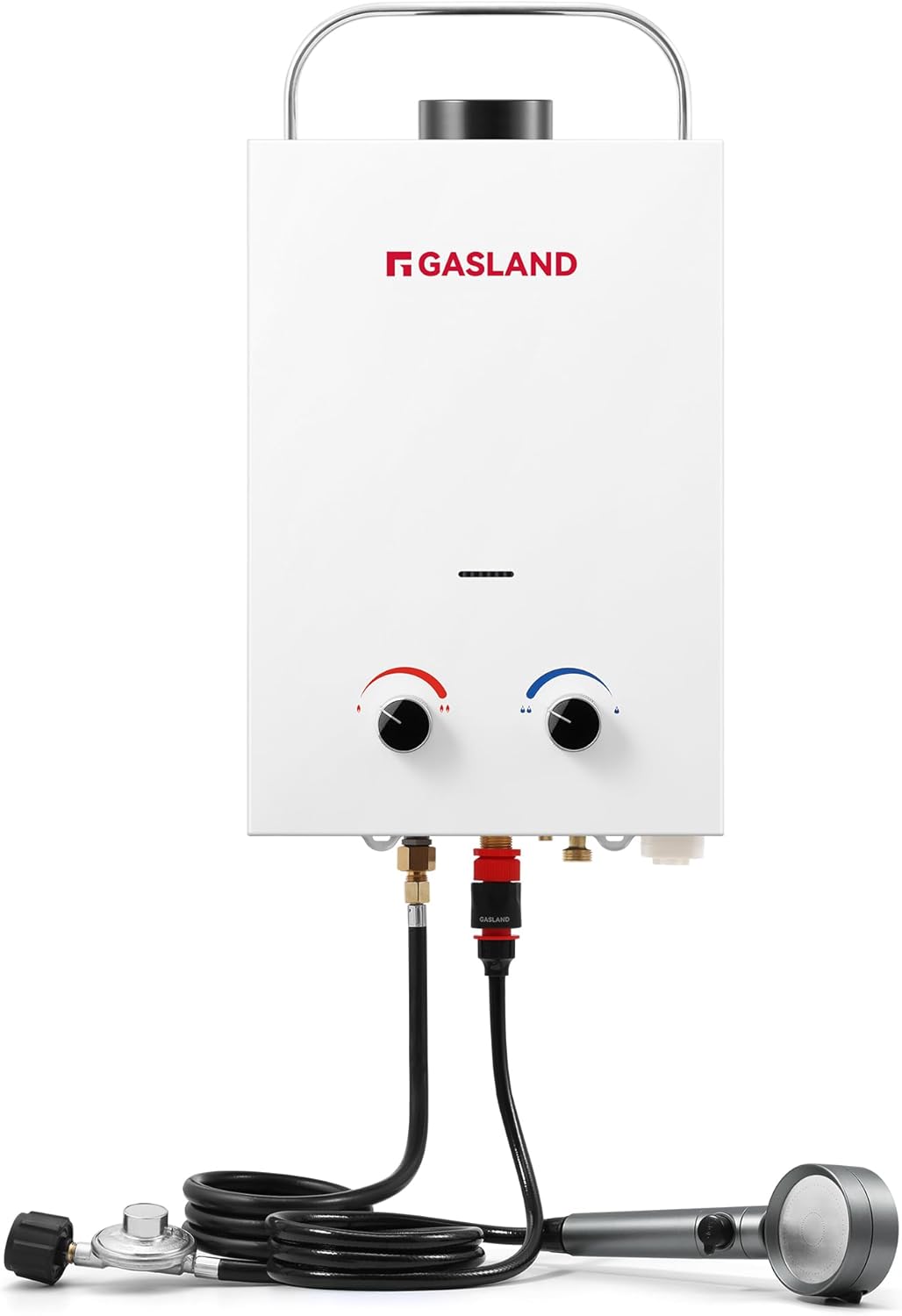
| Power Source | Liquid Propane |
|---|---|
| Flow Rate | 1.58 gpm |
| Heat Output | 41,000 BTU/hr |
| Maximum Temperature | 109.4 °F |
The GASLAND BS158 is a compact outdoor tankless water heater designed to deliver instant hot water from a standard LPG tank without mains electricity. It is typically used for camping, RV showers, outdoor hoses, tiny homes, or cabins where a simple, portable source of hot water is needed. The unit runs on a 20 lb propane cylinder and uses two D-cell batteries for electronic ignition and the LED monitor, so it works off-grid and will run for months between battery changes depending on use. Notable features include a 1.58 GPM flow rate, CSA certification, multiple safety protections such as overheat, low-flow, dry-combustion, flame-failure and anti-freezing safeguards, and a supplied regulator, hose and shower head. Practical benefits are straightforward installation, splash resistance for outdoor conditions, and a modest 41,000 BTU output that produces warm water quickly at moderate flow. Limitations are the relatively low maximum temperature and flow compared with larger models, lack of horizontal installation, and unsuitability above about 3,300 feet or in strong winds, so it is best for single-point outdoor use rather than whole-house demands.
Best for: Buyers who prioritize dependable, self-contained hot water for outdoor or off-grid situations and want a unit with built-in safety features and simple setup.
Less Ideal for: People who need high-flow or whole-house hot water, need operation in high-altitude or very windy locations, or require horizontal installation should look at larger or specialized models instead.
- Runs on common propane tanks and needs only two D-cell batteries for ignition so it works off-grid
- CSA certified with multiple protective systems including overheat and flame-failure devices
- Includes regulator, hose and a 5 ft on/off shower head for out-of-the-box outdoor use
- Compact and splash-proof design makes it easy to mount and store for seasonal use
- Maximum flow and temperature are modest compared with larger portable units so it may not support simultaneous high-demand uses
- Not rated for high-altitude use above ~3,300 feet and can be sensitive to strong wind conditions
Verdict: A reliable, off-grid propane tankless heater with strong safety features and simple setup for single-point outdoor hot water needs.
CAMPLUX AY132 Portable Tankless Heater

| Flow Rate | 1.32 gpm |
|---|---|
| Heat Output | 34,000 BTU/HR |
| Power Source | Propane with 2 D batteries ignition |
| Maximum Temperature | 114 °F |
| Water Pressure Range | 3-130 PSI |
The CAMPLUX AY132 is a portable propane tankless water heater designed for outdoor use like camping, RVing, remote cabins, and pet washing. It runs from a 20 lb propane tank and uses two D batteries for ignition so no AC power is required, and it delivers up to 1.32 gallons per minute of hot water with a rated 34,000 BTU output. The unit includes a folding handle, wall-mount option, a CSA-certified gas regulator, shower head and hose, and a simple on/off shower head so setup is straightforward for most users. Built-in protections such as anti-freeze, overheat, flame-failure, low-flow, and dry-combustion safeguards make it safer for family use outdoors, and it can start with very low inlet pressure so it pairs well with small 12V pumps or gravity water bags. Trade-offs are the modest flow rate and maximum temperature compared with larger models, and like all propane tankless heaters it requires proper ventilation and a stable propane supply in cold conditions.
Best for: Buyers who prioritize a proven, safety-minded portable solution for hot water on camping trips, RVs, or remote cabins and want a unit that is easy to set up and runs without mains electricity.
Less Ideal for: People who need high flow or indoor whole-house hot water, or those who prefer electric or tank systems that do not use propane.
- Runs off propane and D batteries so it works off-grid without electrical hookup
- CSA certified and includes multiple safety protections for outdoor family use
- Folding handle and included regulator, shower head, and hoses simplify setup and transport
- Starts at very low water pressure so it works with small pumps or gravity-fed sources
- Maximum flow rate (1.32 GPM) is low for multiple concurrent uses
- Not intended for indoor installation so ventilation and safe placement are required
Verdict: A compact, CSA-certified propane tankless heater that reliably delivers instant hot water off-grid with built-in safety features and easy setup.
GASLAND BE158R Propane Tankless Heater

| Power Source | Liquid Propane |
|---|---|
| Flow Rate | 1.58 gpm |
| Heat Output | 41,000 BTU/hr |
| Maximum Temperature | 175 °F |
| Capacity | 6 liters |
The GASLAND BE158R is a portable propane tankless water heater built for outdoor showers, RVs, and other off-grid hot water needs. It runs on a standard 20 lb propane tank and uses electronic ignition powered by two D-cell batteries, producing up to 41,000 BTU and about 1.58 gallons per minute of hot water. The unit includes a bright LED digital display for temperature, multiple safety protections (overheat, flame failure, dry combustion, low flow, anti-freeze), and CSA certification for North American safety standards. In practice it delivers quick hot water for single-point uses like a shower or washing gear, and it starts with very low inlet pressure so it works with gravity-fed or low-pressure sources. Expect modest flow compared with household heaters, so it is best for one fixture at a time; also it is splash resistant but not meant for prolonged exposure to rain and needs winter draining and dry storage. The package includes a regulator, hose, shower head and adapters, so you can set it up fairly quickly for outdoor use.
Best for: Buyers who want a safety-focused, ready-to-use portable hot water solution for camping, RVing, outdoor showers, or off-grid cabins and prioritize reliable protection and straightforward setup.
Less Ideal for: People needing high-flow or multi-fixture hot water or a permanently installed indoor water heater should look at larger, higher-capacity models.
- Runs on standard 20 lb propane so it works off-grid without electricity
- CSA certified and includes multiple safety protections for peace of mind
- Digital LED temperature readout makes it easy to monitor and adjust water temperature
- Low water pressure start (around 3.6 PSI) lets it run from gravity or weak supply
- Comes with regulator, hose, shower head and mounting hardware for quick setup
- Flow rate (1.58 GPM) is modest and suited to a single shower or cleaning task rather than whole-house use
- Not fully weatherproof — prolonged rain exposure can damage internal components
Verdict: Choose the GASLAND BE158R if you want a CSA-certified, easy-to-install portable propane heater that delivers safe, on-demand hot water for single outdoor or off-grid uses.
Choosing the Right Portable Tankless Water Heater: Key Factors to Consider
Flow Rate And GPM Requirements
Flow rate, measured in gallons per minute, directly determines how many fixtures a portable tankless water heater can support simultaneously. If you plan to run a shower and a sink at the same time, check the unit's guaranteed GPM at the expected temperature rise.
Cold inlet temperatures reduce effective output, so consider typical water temperature where you live. Buyers in colder climates need units with higher GPM ratings or larger heating capacity to maintain comfortable shower temperatures. Under-sizing leads to weak flow or lukewarm water during peak use.
Temperature Rise And Stability
Temperature rise is the difference between incoming water temperature and the desired output temperature. Manufacturers often quote maximum BTU or kW, but real-world performance depends on how well the unit maintains set temperature when flow changes.
Look for models with responsive modulation or electronic controls that adjust fuel or power to hold temperature. Units that allow precise setpoint adjustments are easier to tune for mixed tasks such as dishwashing and bathing. Rapid swings under variable flow are inconvenient and can make a unit feel underpowered even if its peak rating is adequate.
Fuel Type And Energy Efficiency
Portable tankless units commonly run on propane, natural gas, or electric power, and each option affects efficiency, runtime, and where you can use the heater. Propane provides high heat output for mobile and off-grid use but requires fuel storage and periodic refilling. Electric units are simpler to install but need sufficient electrical service for high-power models.
Consider the unit's thermal efficiency and any standby losses. Higher efficiency reduces fuel consumption and operating cost, particularly for intermittent or long-duration use. If you expect extended outdoor use, factor in fuel availability and consumption rate to estimate how long a single propane cylinder will last.
Installation Needs And Mounting
Portable tankless heaters vary in how they connect to water, fuel, and power. Some are designed for wall mounting; others include brackets for temporary setups. Check the required water pressure and recommended inlet filter to protect internal components.
Examine connection types for gas and water fittings and whether adapters are needed for your setup. Also confirm electrical needs if the unit uses electronics for ignition or control. Simpler connections reduce installation time and the chance of leaks or improper venting during temporary or semi-permanent installations.
Safety Features And Certifications
Safety matters more with high-temperature, high-pressure water systems and when the heater will be used in mobile or outdoor scenarios. Look for overheat protection, flame failure shutoff, proper venting guidance for combustion units, and freeze protection if you will operate in low temperatures.
Certifications from recognized testing bodies indicate that basic safety and performance standards were met. Units lacking clear certification or adequate safety documentation are higher risk for installation problems or premature failure. Portable use increases exposure to the elements, so robust safety systems help prevent accidents.
Maintenance And Serviceability
Ease of maintenance influences long-term reliability and operating cost. Routine tasks include cleaning inlet filters, checking burners or heating elements, and flushing scale if you have hard water. Units with accessible panels and clear maintenance instructions reduce hassle.
Consider availability of replacement parts and how simple it is to swap consumables such as igniters or filters. For users who will store or transport the heater frequently, corrosion-resistant fittings and removable components make upkeep easier and extend equipment life.
Common Installation Scenarios
Portable tankless water heaters are used in diverse settings including RVs, cabins, outdoor showers, jobsite wash stations, and as temporary backup for point-of-use taps. Each scenario imposes different constraints on mounting, fuel supply, and environmental exposure.
For mobile installation inside an RV or enclosed trailer, verify required clearances and static ventilation guidance for combustion units. For outdoor or temporary setups, focus on weather protection and simple, secure hookups that minimize leak and trip hazards.
- RV use: compact footprint and secure mounting points matter most
- Outdoor shower or campsite: choose weather-resistant enclosures and easy fuel attachment
- Backup point-of-use: prioritize rapid connection options and minimal setup time
Managing Cold Inlet Water
Cold incoming water greatly reduces a unit's effective output because the heater must produce a larger temperature rise. In regions with very low groundwater temperatures, you may need a unit with higher capacity or reduce the target outlet temperature to maintain flow.
Practical mitigation steps include insulating inlet plumbing, preheating water where feasible, or staging flow by limiting simultaneous fixtures. Adjusting the target temperature and testing at typical cold-season conditions will reveal whether a given heater meets your needs.
- Insulate inlet lines to reduce heat loss
- Test performance at expected cold-season inlet temps
- Limit concurrent fixtures when necessary
Fuel Management And Runtime Planning
If the unit uses propane, plan fuel consumption by checking BTU output and estimating run times against cylinder capacity. For longer outdoor or off-grid use, have spare fuel on hand and follow safe storage practices.
Electric units require verifying circuit capacity and breaker sizing. For temporary installs, portable generators can provide power but confirm the generator can handle the heater's startup and continuous draw without tripping.
- Estimate propane runtime based on BTU rating and cylinder size
- Confirm electrical service and breaker requirements for electric models
- Avoid mixing temporary fuel sources without checking compatibility
Protecting Units From Weather And Corrosion
Portable units face exposure to humidity, rain, and temperature swings. Choose options with corrosion-resistant materials and follow manufacturer guidance for sheltered placement. A simple weatherproof housing or cover can extend life when the unit is used outdoors frequently.
Drain and dry the unit before winter storage if temperatures will drop below freezing. Regularly inspect fittings and seals for corrosion or degradation, especially after salt-air or high-humidity exposure.
- Use weatherproof covers for outdoor installations
- Drain internal water before freezing temperatures
- Inspect and replace seals as part of regular maintenance
Noise, Venting, And Neighbor Considerations
Combustion-based portable tankless units can produce operational noise and require safe venting to avoid exhaust buildup. Consider where you will mount the heater relative to living spaces and neighbors to avoid noise or fume concerns.
Electric models are generally quieter and require no flue, but may generate fan or pump noise. For shared sites or campgrounds, aim to position the unit so exhaust and sound are directed away from occupied areas.
- Check ventilation requirements for combustion units
- Position exhaust away from occupied areas
- Prefer electric units where quiet operation is a priority
How We Chose the Best Portable Tankless Water Heater
Our shortlist focused on real-world performance, installation versatility, safety features, energy use, and durability for portable tankless water heaters. We prioritized flow rate stability under variable inlet temperatures because sustained usable hot water depends on how much water a unit can heat at a given temperature rise. Energy efficiency and fuel type were key since they determine operating cost and where you can run the unit reliably. We also evaluated ignition and control systems for reliability and ease of use, plus safety protections such as overheat shutoff and freeze protection for outdoor or seasonal installations. Durability and weather resistance matter for portable applications, so we favored units with corrosion-resistant materials and clear IP or outdoor-use guidance. Installation flexibility—mounting options, water and gas fittings, and electrical requirements—was another filter because many buyers will install in tight or mobile spaces. We excluded products that lacked basic safety certifications or had insufficient documentation for installation and maintenance. The result is a set of options that balance dependable hot-water output, efficient operation, and practical installation features.
Our full evaluation process is outlined in our review methodology.
FAQ
How many gallons per minute do I need for a shower?
Most showers run between 1.5 and 2.5 GPM. Choose a unit that can supply your desired outlet temperature at that flow rate given your local inlet temperature. If you plan to run other fixtures at the same time, add their flow rates to determine total GPM needed.
Can I use a portable tankless heater in freezing weather?
Some units include freeze protection or are rated for outdoor use, but many require draining and sheltering in freezing conditions. If you expect use in subfreezing temperatures, select a model with explicit freeze protection and follow winterization procedures.
What maintenance does a portable tankless water heater need?
Routine maintenance includes cleaning inlet filters, flushing scale if you have hard water, and checking seals and fittings. Frequency depends on water hardness and usage. Accessible panels and clear instructions simplify these tasks.
Are electric portable tankless heaters better than gas for mobility?
Electric models are simpler to install and do not need fuel storage, but they require adequate electrical capacity. Gas models offer higher heat output for the same size and are often preferable for remote or off-grid use where propane is available.
How loud are portable tankless water heaters during operation?
Noise varies by design. Combustion units produce burner and fan noise that can be noticeable, while electric units tend to be quieter. If noise matters, check user guidance on operational sound and position the unit away from living areas.
Final Verdict
Choosing the right portable tankless water heater requires balancing flow needs, fuel availability, and installation constraints. Prioritize a unit that delivers the necessary GPM at your expected inlet temperature and that matches your preferred fuel type and electrical capacity. Also weigh temperature stability, safety features, and weather resistance for the environments where you will use the heater. With those tradeoffs in mind, you can select a compact on-demand heater that provides reliable hot water and fits your mounting and maintenance expectations.