
Note: This article contains affiliate links. If you click on these links and make a purchase, we may earn a small commission at no extra cost to you. This helps support our research and content. Read our full affiliate disclosure here.
If you use video calls for family chats, telehealth, or remote work, the right smart display can make conversations feel natural and reliable. Picking a device optimized for video calling matters because camera framing, low-light performance, and microphone pickup shape how others see and hear you. This guide covers the top shortlisted smart displays designed specifically for video calling, highlighting the traits that matter most in everyday use. Below we summarize how each pick performs on camera quality, audio capture, and ease of use so you can match a device to your typical calling environment.
Top Picks at a Glance
| Best Overall The best all-around choice for most situations | ViewClix Smart Frame 15.6" |  |
| Best Quality Built to a higher standard if you want something more solid | Google Nest Hub Max |  |
| Best Value The sweet spot between price and what you get | eufy Smart Display E10 |  |
| Best Budget The cheapest option that still gets the job done reliably | Facebook Portal Mini |  |
| Top Rated A top-rated pick with lots of positive feedback | Amazon Echo Show 5 |  |
| Most Popular A crowd favorite that many people choose with confidence | Amazon Echo Show 15 |  |
| Best Seller A high-volume bestseller chosen again and again | Meta Portal 10" Touch |  |
ViewClix Smart Frame 15.6"

| Resolution | 1080p |
|---|---|
| Compatible Devices | iPhone, iPad, Android, Laptop, Desktop |
| Connectivity Technology | Ethernet, Wi-Fi |
| Power Source | AC |
| Aspect Ratio | 16:9 |
The ViewClix Smart Frame is a 15.6-inch 1080p digital frame built around simple remote management and video calling for seniors and family use. You send photos and short videos from the ViewClix mobile app or member portal, create albums and playlists, and the frame displays captions, weather, reminders, and a day clock. Video calls can be initiated from family members and set to auto-answer for hands-free conversations, and the frame connects via Wi‑Fi or Ethernet. Setup and ongoing management are handled remotely by invited users, which keeps the experience low-friction for the person using the frame. The unit uses button controls and a remote rather than a touchscreen, and includes a one-month Premier Membership that enables the manufacturer warranty benefits and additional services. Limitations include the subscription-based Premier features beyond the trial and a product design focused on simplified interaction rather than full-feature smart-display app ecosystems.
Best for: Buyers who want a simple, family-managed smart display focused on effortless photo sharing and reliable video calls with older relatives or less tech-savvy users.
Less Ideal for: Users seeking a fully featured smart display with broad third-party apps, voice assistants, or a touchscreen-first interface should consider other smart displays.
- 1080p 15.6-inch display suitable for clear photos and video calls
- Remote management lets family update content and settings without hands-on help
- Auto-answer video calling for hands-free connections with seniors
- Supports photo and video sharing from iPhone, Android, and computers
- Both Wi‑Fi and Ethernet connectivity for flexible networking
- Key premium features and extended warranty require a paid Premier Membership after the trial
- Controls are buttons and a remote rather than a touchscreen, which limits direct interaction
Verdict: Choose the ViewClix Smart Frame if you want a 15.6-inch, remotely managed display that makes video calling and photo sharing with seniors as simple and hands-off as possible.
Google Nest Hub Max

| Screen Size | 10 inches |
|---|---|
| Native Resolution | 1280 x 800 pixels |
| Video Capture Resolution | 1080p |
| RAM Size | 4 GB |
| Speaker Description | Stereo speaker system with a 30W subwoofer, total power output of 50W |
The Nest Hub Max is a 10-inch smart display built around video calling, media playback, and smart-home control. It uses a 6.5 MP front camera capable of 1080p video capture and a 10-inch 1280 x 800 LCD to show callers and content, while the built-in stereo speaker system with a 30W subwoofer (50W total) delivers noticeably fuller audio than smaller displays. You interact via the touchscreen and Google Assistant for hands-free calls, controlling compatible smart devices, and streaming music or video. The device also includes facial recognition for personalized responses and a wide-angle camera that keeps people framed during calls. Practical limitations include the LCD resolution that is good but not 4K and local storage/memory details that are oriented to on-device functions rather than heavy multitasking. For users prioritizing clear video calls and strong built-in audio in a countertop smart display, the Nest Hub Max is a capable all-in-one choice.
Best for: Buyers who want a smart display optimized for high-quality video calls and strong on-device audio while also using voice and touch to manage a Google-based smart home.
Less Ideal for: Those who need a higher-resolution display for ultra-fine video or who prefer a platform outside the Google ecosystem should consider other options.
- 6.5 MP front camera with 1080p video capture for clear video calls
- 10-inch touchscreen provides a large, usable display for video and controls
- Stereo speaker system with 30W subwoofer and 50W total power for strong audio
- Facial recognition and wide-angle camera help personalize and keep subjects framed
- Display is 1280 x 800 LCD, not higher-resolution like 4K
- Memory/storage specs focus on system functions and may limit advanced local media handling
Verdict: Choose the Nest Hub Max if you want a single smart display that delivers clear 1080p video calls and much stronger built-in audio than typical small displays.
eufy Smart Display E10

| Display | 8" HD touchscreen |
|---|---|
| Storage | Built-in 64 GB (expandable up to 512 GB) |
| Wi‑Fi | 2.4GHz/5GHz Wi‑Fi 6 compatibility |
| Power | Rechargeable with charging dock included |
The eufy Smart Display E10 is an 8-inch touchscreen hub designed to display live feeds and manage eufy security cameras, doorbells, and smart locks from one panel. It shows up to four camera views at once, wakes automatically for door alerts or motion, and stores event clips locally on its built-in 64 GB with support for expansion up to 512 GB for near-instant playback. The display is rechargeable and includes a wall mount and charging dock so it can be placed around the house or moved between rooms, and it supports one-touch arming, a dedicated emergency alert button, and Wi‑Fi 6 for more stable connections. It does not currently integrate third-party devices or full eufy app control, so it works best inside an all-eufy ecosystem rather than as a general-purpose smart display for video calls with non-eufy hardware. For households prioritizing quick local video review and simple on-device control of eufy cameras, the E10 provides responsive playback and clear day/night monitoring, but buyers should expect platform lock-in until broader app or third-party support is added.
Best for: Buyers who want a practical, local-control hub to centralize monitoring of a full eufy security setup and value instant playback and simple on-device controls.
Less Ideal for: People who need a general-purpose smart display for cross-brand video calling or who want direct app-based management of the display right now.
- Shows four live camera feeds on one screen for broad situational awareness.
- Built-in 64 GB storage with local backup and support up to 512 GB for instant playback of events.
- Rechargeable design with included charging dock and wall mount for flexible placement.
- Wi‑Fi 6 compatibility for improved network stability and faster streams.
- One-touch arm/disarm and a dedicated emergency alert button for quick control.
- Only supports eufy Security devices and lacks third-party device integration.
- Cannot currently be managed through the eufy app, limiting remote configuration options.
Verdict: If you run an all-eufy security system and want fast local playback plus a simple, portable control panel, the Smart Display E10 is an efficient hub to centralize monitoring.
Facebook Portal Mini

| Standing screen display size | 8 |
|---|---|
| Operating System | Portal |
| Flash Memory Size | 16 |
| Batteries | 1 Lithium Ion batteries required. |
| Rear Webcam Resolution | 5 pixels |
The Portal Mini is a compact smart display built around video calling with Messenger and WhatsApp and includes Alexa for basic smart assistant tasks. Its 8-inch touchscreen and Smart Camera automatically pan and zoom to keep people in frame, and Smart Sound helps emphasize voices while reducing background noise, which makes group calls and family chats more natural. Portal also supports Messenger Rooms for larger gatherings, integration with apps like Zoom, and simple photo and media sharing from Facebook and Instagram. Privacy controls are straightforward with a camera/microphone disable switch and a physical cover for the lens, and calls are encrypted. The Mini runs Portal OS and needs Wi-Fi and AC power, and it stores modest internal memory for apps and media. Trade-offs for budget-minded buyers are the device size and the platform focus: the Mini is smaller than full-size smart displays and its ecosystem centers on Facebook services, so users who want a larger screen or broader third-party app support may look elsewhere.
Best for: Buyers who want an affordable, compact device primarily for reliable video calls with family and friends and who already use Messenger or WhatsApp.
Less Ideal for: Users seeking a larger display for group media viewing or those who prefer wide third-party app availability and a more neutral platform.
- Smart Camera that automatically pans and zooms to keep people in frame during calls
- Smart Sound enhances the active speaker and reduces background noise
- Built-in Alexa and app integrations for music, photos, and basic smart home control
- Simple privacy controls including a camera/microphone disable switch and lens cover
- Platform is focused on Facebook services which limits some third-party app variety
- Smaller 8-inch screen may feel cramped for group video or shared media viewing
Verdict: A compact, budget-friendly smart display built for easy, high-quality video calls with simple privacy controls and Alexa support.
Amazon Echo Show 5

| Display | 5.5-inch |
|---|---|
| Camera | 2 MP |
| Audio | Improved bass and clearer vocals |
The Echo Show 5 is a small smart display intended primarily for hands-free video calls, quick information at a glance, and basic smart-home control. It pairs a 5.5-inch touchscreen with a 2 MP camera and Alexa voice control so you can place video calls to other Echo users or the Alexa app, view compatible cameras, and use Drop In to check on family or pets. Audio is improved over earlier generations with deeper bass and clearer vocals, making short videos and voice calls sound fuller than on similar compact displays. Privacy features include a physical camera shutter and a mic/camera off button, which are useful if you want simple, easy-to-use protections. The device is compact enough for bedside or countertop use, and it supports common streaming services and photo slideshows when idle. Limitations are its small screen for detailed video calls and a modest 2 MP camera that is fine for casual chats but not for high-detail video conferencing.
Best for: Buyers who prioritize a dependable, privacy-minded device for casual video calls and quick smart-home control in small spaces.
Less Ideal for: People who need a large-screen device for multi-person video conferencing or who require high-resolution camera quality for professional calls.
- Compact 5.5-inch display fits on nightstands and small countertops
- 2 MP camera and Alexa-enabled calling for easy video chats and Drop In
- Improved audio with deeper bass and clearer vocals for better call sound
- Physical camera shutter and mic off button for simple privacy control
- Integrates with compatible smart-home devices and shows camera feeds
- Small screen and 2 MP camera limit video detail for group calls or presentations
- Not intended as a primary media center due to its compact size
Verdict: A compact, privacy-focused smart display that reliably handles casual video calling and basic smart-home control.
Amazon Echo Show 15
| Display | 15.6" Full HD (1080p) |
|---|---|
| Camera | Auto‑framing, wide field of view, 3.3x zoom |
| Entertainment | Built‑in Fire TV; remote included |
| Privacy controls | Camera shutter and mic/camera off button |
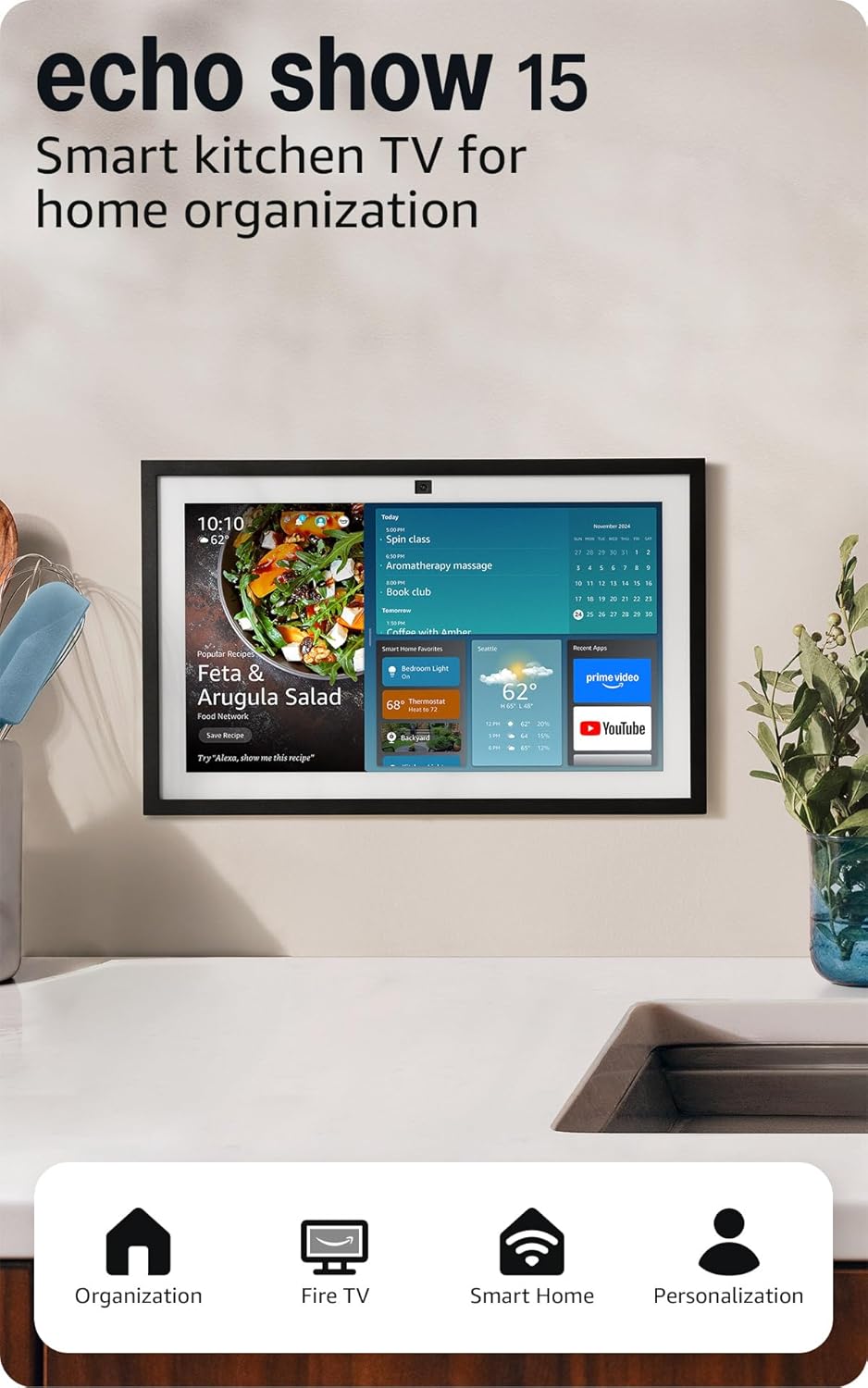
The Echo Show 15 is a large 15.6-inch Full HD smart display built to sit on a wall or counter and act as a family organization and entertainment hub. It runs Alexa with customizable widgets for calendars, to-do lists, weather and smart‑home controls, and it includes built‑in Fire TV so you can stream apps like Prime Video and Netflix or use the included remote. Video calling benefits from a wide field of view, auto-framing, 3.3x zoom and noise reduction for clearer conversations, and the display can double as a photo slideshow or media screen. The unit emphasizes privacy with a camera shutter and mic/camera off button. Practical limits are its size, which is great for kitchens but less suited to small desks, and its integration is tightly tied to the Amazon/Fire TV and Alexa ecosystems, so users expecting broader platform neutrality may find some limits.
Best for: Buyers who prioritize clear group video calls and a shared household hub experience and who prefer an Alexa/Fire TV centered smart home setup.
Less Ideal for: People who need a compact desktop display, or who want a platform‑agnostic smart display that favors non‑Amazon ecosystems.
- Large 15.6" Full HD display good for group video calls and shared household info
- Built‑in Fire TV for streaming apps and included remote for TV‑style navigation
- Auto‑framing camera with wide field of view and 3.3x zoom improves video call composition
- Smart home dashboard and customizable widgets centralize family calendars and routines
- Privacy controls include a physical camera shutter and mic/camera off button
- Tightly integrated with Amazon/Fire TV/Alexa ecosystem which limits platform flexibility
- Physical footprint is large and may not fit smaller rooms or desks
Verdict: Choose the Echo Show 15 if you want a large, Alexa‑centric smart display optimized for family video calling and shared household organization.
Meta Portal 10" Touch

| Standing screen display size | 10 inches |
|---|---|
| Screen Resolution | 1280 X 800 Pixel |
| Wireless Type | 802.11ac |
| Rear Webcam Resolution | 13 mp |
| Power Source | corded electric |
The Meta Portal 10" Touch is a home-focused smart display built primarily for video calls and shared media. It runs Portal OS on a 10-inch 1280×800 touchscreen and connects over 802.11ac Wi-Fi to place calls via Messenger, WhatsApp and supported conferencing apps; the device also supports Alexa voice control and music apps with additional account setup. Portal's Smart Camera automatically pans and zooms to keep people in frame and Smart Sound reduces background noise to make voices clearer during calls, which is useful for hands-free conversations and small-group calls. The frame-style design doubles as a photo display when not on calls, and privacy controls include a camera cover and simple mic/camera disable options. Limitations to consider are reliance on a Facebook or WhatsApp account for full functionality, the need for an always-on AC connection and varying third-party app support depending on employer or region. For buyers wanting a stable, easy-to-use dedicated calling screen, Portal delivers a focused, privacy-minded experience for home video calling and light media use.
Best for: Buyers who want a simple, dedicated in-home video calling screen that prioritizes easy setup, clear audio/video, and straightforward privacy controls.
Less Ideal for: Users who need a battery-powered portable device, who want full independence from social accounts, or who require broad enterprise app support blocked by employer policies.
- Smart Camera that automatically pans and zooms to keep subjects in frame
- Smart Sound processing to reduce background noise and enhance voice clarity
- 10-inch 1280×800 touchscreen for touch control and photo display
- Built-in privacy controls including a physical camera cover and mic/camera disable options
- Requires Facebook/WhatsApp account for full calling features and app integrations
- Must remain plugged into AC power and needs a stable Wi-Fi connection
Verdict: A straightforward, privacy-minded 10-inch smart display that makes home video calling easier and more reliable for mainstream users.
Choosing the Right Smart Display for Video Calling: Key Factors to Consider
Camera Quality and Field of View
A sharp sensor and good lens are critical because they determine how clearly remote participants see you and how much of your surroundings are visible. Look for higher resolution and optics that keep faces in focus at typical room distances. Field of view matters for framing: a wider angle helps in group calls but can introduce distortion; a narrower view keeps attention on one or two people.
Low-light sensitivity affects evening or dim-room calls. Cameras with better low-light performance or built-in exposure controls produce less grain and more natural skin tones. Auto-exposure and white-balance behavior are also important for consistent image quality across changing lighting conditions.
Microphone Array and Noise Rejection
Microphones determine whether you are heard clearly across different rooms and noise levels. Devices with multiple-microphone arrays can beamform to your voice, reduce background noise, and pick up people farther from the display. Assess how the system handles competing sounds like pets, appliances, or HVAC.
Good voice isolation and echo cancellation reduce the need to raise your voice or repeat yourself. Built-in gain control and automatic level adjustment help maintain steady volume for listeners even when you move around while speaking.
Screen Size, Resolution, and Viewing Distance
The display affects how well you see the other person and shared content. Larger screens and higher resolutions make facial expressions and onscreen details easier to read, which matters for meetings or collaborative sessions. Consider typical seating distance: small displays work for close-up kitchen counters, while living-room setups benefit from bigger panels.
Also think about the device's aspect ratio and brightness. Higher brightness helps in well-lit rooms and against window backlight, while matte versus glossy finishes influence glare and reflection handling.
Platform Compatibility and Call Services
Ensure the smart display supports the video calling platforms you and your contacts use. Native app support or built-in integration can simplify starting calls and syncing contacts. Some devices use a specific calling service as the default while offering other options via third-party apps or browser interfaces.
Consider account and contact management, whether you can initiate calls from voice commands, and how easily you can accept incoming calls. Single-sign-on and family account features may matter if multiple household members will use the device.
Privacy Controls and Physical Covers
Privacy is a practical concern when a camera and microphone are always connected. Physical shutters or detachable privacy covers give immediate visual assurance that the camera is off. Equally important are clear software controls to disable microphones or cameras and visible indicators that show when the device is actively transmitting audio or video.
Look for straightforward privacy settings and accessible hardware toggles so every household member can manage sensing features without digging through menus.
Mounting, Tilt, and Placement Flexibility
Where and how you place the display affects framing, angle, and microphone pickup. Devices with adjustable mounts, tilt, or wall-mount options let you position the camera at eye level and reduce distracting angles. Stability and the footprint of the base matter for counters and shelves, while wall-mount options free up surface space.
Also consider cable routing and whether the device needs line-of-sight for voice assistants or infrared remotes. Ease of repositioning helps if you plan to move the device between rooms or set it on a portable stand.
How Camera Features Improve Real Calls
Camera specs on paper only tell part of the story. Practical features like auto-framing, pan-and-zoom, and face-tracking change how natural a call feels because they keep participants centered without manual adjustment. Auto-framing is useful in kitchens or family rooms where people move around during a call.
Beyond hardware, software image processing affects skin tones, exposure balance, and motion handling. Look for devices that handle backlighting gracefully and avoid aggressive sharpening that creates an artificial appearance.
- Auto-framing keeps moving participants centered.
- Low-light processing reduces grain in evening calls.
- Optical quality affects how natural faces look versus digital sharpening.
Audio Considerations for Different Room Types
Microphone performance varies by room size and background noise. Small quiet rooms need less aggressive noise suppression, while open-plan spaces benefit from stronger beamforming and echo cancellation. If you share a device, check whether the microphone array reliably picks up more than one speaker.
Built-in speakers should balance volume and clarity so you do not need external speakers for typical calls. Voice clarity and midrange reproduction are more important than deep bass for conversation.
- Beamforming helps in larger or noisier spaces.
- Echo cancellation reduces feedback in single-room setups.
- Check speaker clarity for spoken word instead of music fidelity.
Using Smart Displays for Remote Work
If you intend to use a smart display for meetings, consider multitasking features like screen sharing, calendar integration, and support for virtual backgrounds. A device that can show meeting notes or shared documents while maintaining a clear video feed improves remote collaboration.
Also plan for network reliability and whether the display supports wired connections or prioritized Wi-Fi modes. Stable video calling in a work context is often more about consistent networking than marginal camera improvements.
- Look for built-in calendar and meeting join options.
- Prefer devices with strong Wi-Fi or ethernet options for stability.
- Consider the ability to pair with headsets if confidentiality or noise is a concern.
Setup, Updates, and Long-Term Maintenance
Easy initial setup speeds time to first call. Devices that guide account sign-in, privacy settings, and contact sync simplify adoption for nontechnical household members. Regular firmware updates matter because they patch security and can improve call performance over time.
Also evaluate how easy it is to clean and maintain the device, including dusting the camera lens and ensuring vents remain clear for cooling during extended calls.
- Step-by-step on-screen setup lowers friction for family use.
- Regular updates support security and feature improvements.
- Accessible lens and grille areas make cleaning straightforward.
Accessories That Extend Usefulness
Accessories can change where and how a smart display performs. Stands, wall mounts, and tilt adapters let you position the device for the best camera angle and microphone pickup. Privacy covers and dedicated mounts for eye-level alignment are common additions.
External microphones or speakers are options if you need very high-fidelity audio for group calls or presentations. However, most home use cases are served well by built-in arrays and speakers when combined with correct placement.
- Mounts enable eye-level positioning for better framing.
- Privacy covers add a physical barrier to the camera.
- External audio gear is optional for large-group or presentation scenarios.
How We Chose the Best Smart Display for Video Calling
We focused on properties that directly affect the video calling experience and excluded devices that prioritize other features over communication. Key evaluation dimensions included camera quality and field of view, microphone array performance and noise rejection, screen size and resolution for clear remote video, platform and call-service compatibility, and everyday usability features such as auto-framing, privacy controls, and mounting or tilt options. We also considered power and network requirements that affect call stability in typical home networks. We excluded units whose cameras or microphones were clearly auxiliary to another primary function, as well as devices that lacked basic privacy or call controls. Our shortlists are built from products that combine reliable audio capture, robust camera behavior in varied lighting, and intuitive call controls. These criteria align with what matters most in real-world calling: being seen, being heard, and keeping calls simple to start and manage.
Our full evaluation process is outlined in our review methodology.
FAQ
Will a smart display work with my existing video services?
It depends on the device and the service. Many smart displays offer native integration with common video platforms, while others support calls through linked accounts or companion apps. Check whether the display provides direct app support or requires bridging through a phone or computer.
Do smart displays need a lot of bandwidth for smooth video calls?
Video calls can use anywhere from modest to substantial bandwidth depending on resolution and frame rate. For stable HD calls, a reliable broadband connection and a strong Wi-Fi signal are beneficial. If your network is shared, prioritize the device or use wired ethernet where available.
How do privacy controls typically work on smart displays?
Most devices offer a combination of software toggles to mute audio and disable the camera, plus physical shutters or covers on some models. Visual indicators usually show when the camera or microphone is active. Review the device's privacy settings to ensure they match your comfort level.
Can multiple people use the same smart display account?
Yes, many displays support multiple user profiles or guest modes so the device can recognize different household members and their contacts. Account management varies by platform, so look for clear profile-switching or family account features if you plan shared use.
Is a wall mount better than a tabletop position for calls?
Wall mounting can place the camera at a more natural eye level and free up counter space, which often improves framing and reduces glare. Tabletop placement is more flexible for moving the device between rooms. Choose based on where most calls occur and whether permanent placement is acceptable.
Final Verdict
Prioritize camera and microphone performance when choosing a smart display for video calling, because those two factors most directly affect communication clarity. Balance screen size and placement options with the device's privacy controls and platform compatibility to match how you make calls and who you call most often. Focus on devices that offer reliable low-light imaging, strong microphone arrays, and simple call controls. That approach helps ensure your next smart display delivers consistently clear video calls without unnecessary complexity.