
Note: This article contains affiliate links. If you click on these links and make a purchase, we may earn a small commission at no extra cost to you. This helps support our research and content. Read our full affiliate disclosure here.
Installing a smart light bulb for ceiling fans changes how you light living spaces and bedrooms. The right bulb gives you smoother dimming, consistent color temperature, and fewer compatibility headaches with fan fixtures and wall switches. In this guide we shortlist the top options built for fan-mounted fixtures and evaluate them on practical home-use criteria like dimming behavior, color accuracy, connectivity, and heat management. Below are our top picks for ceiling-fan-compatible smart bulbs plus a detailed look at the technical and usability factors buyers should consider before choosing one.
Top Picks at a Glance
| Best Overall The best all-around choice for most situations | Lightinginside B11 E12 Smart Bulb (4-Pack) |  |
| Best Quality Built to a higher standard if you want something more solid | DAYBETTER Smart A19 Bulb QA5W63 |  |
| Best Value The sweet spot between price and what you get | ILC RGB LED Color Changing Bulb | 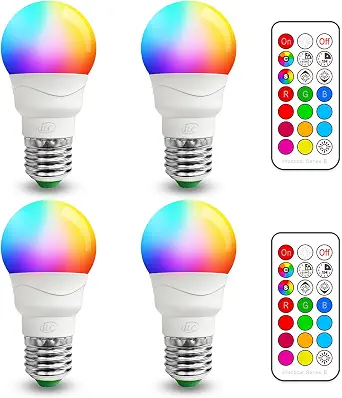 |
| Best Budget The cheapest option that still gets the job done reliably | GIOVAR C37 LED Candelabra Bulb (4-Pack) |  |
| Top Rated A top-rated pick with lots of positive feedback | Philips Hue White & Color Ambiance E12 Candle Bulb |  |
| Most Popular A crowd favorite that many people choose with confidence | Amazon Basics Smart A19 LED Bulb | 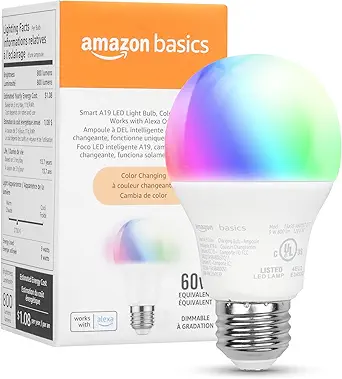 |
| Best Seller A high-volume bestseller chosen again and again | Kasa Smart Bulb KL125P2 |  |
Lightinginside B11 E12 Smart Bulb (4-Pack)

| Wattage | 6 watts |
|---|---|
| Bulb Base | E12 |
| Light Output Maximum | 500 lumens |
| Color Temperature | 2700–6500K (tunable white) |
| Connectivity Protocol | Bluetooth, Wi‑Fi |
These Lightinginside B11 E12 smart bulbs are small candelabra LEDs designed for chandeliers, ceiling fans, and decorative fixtures where an E12 base is required. They pair to the free SmartLife app over 2.4 GHz Wi‑Fi and use BLE as a local backup for faster, more reliable setup and control, and they work with Alexa and Google Assistant for voice commands. Each bulb produces about 500 lumens while drawing 6 watts, supports dimming, tunable white from 2700–6500K, and offers RGB color with music-sync and custom scenes for parties or ambiance. Practical perks include group control, scheduling, timers, and a claimed 25,000‑hour life backed by a two‑year warranty. Trade-offs are typical for E12 smart bulbs: the 500lm output is modest compared with larger A19 bulbs, so they suit fixtures where multiple bulbs provide total light; and remote features require initial Wi‑Fi pairing. For ceiling fans with candelabra sockets these bulbs add flexible color and automation without needing a hub.
Best for: Buyers who want flexible color and scheduling in ceiling fans or chandeliers with E12 sockets and prefer easy, hub-free smart control that balances convenience and features.
Less Ideal for: People seeking very bright single-bulb lighting for task areas or those who need A19/E26 form factors instead of candelabra E12 sockets.
- No hub required and supports both 2.4 GHz Wi‑Fi and Bluetooth for local control and faster setup
- Tunable white plus full RGB color with music sync, scenes, and group control for versatile ambiance
- Voice control via Alexa and Google Assistant after app pairing
- Energy efficient 6W (60W equivalent) output with smooth dimming and a claimed 25,000‑hour life
- 500 lumens per bulb is relatively low for a single-room primary light source
- Requires 2.4 GHz Wi‑Fi for cloud features and initial Wi‑Fi setup
Verdict: A compact, hub-free E12 smart bulb pack that brings tunable white, RGB color, and reliable BLE+Wi‑Fi control to ceiling fans and chandeliers.
DAYBETTER Smart A19 Bulb QA5W63

| Wattage | 9 watts |
|---|---|
| Bulb Shape Size | A19 |
| Bulb Base | E26 |
| Light Output Maximum | 800 lumens |
| Connectivity Technology | Bluetooth, Wi-Fi |
These DAYBETTER A19 bulbs function as full-featured smart LEDs for everyday and decorative ceiling fan use. Installation is the same as a standard E26 bulb and they pair through the DAYBETTER app using 2.4GHz Wi‑Fi or Bluetooth, after which you can control brightness, color temperature (2700K–6500K) and 16 million RGB shades, set schedules, create groups, and sync color changes to music. At 9 watts and 800 lumens they deliver roughly 60W-equivalent white light suitable for most fan fixtures while offering dimming through the app or voice assistants. Practical benefits for ceiling fans include grouping multiple bulbs for uniform scenes, scheduling for automated on/off, and voice control for hands-free operation. Limitations to note are the need for the vendor app to enable Alexa/Google integration, no 5GHz Wi‑Fi support, and incompatibility with physical wall dimmers which can cause flicker, so dimming must be done digitally. Occasional connectivity troubleshooting may be needed if bulbs are far from the router or subject to weak 2.4GHz signal strength.
Best for: Buyers who want bright, color-capable smart bulbs that integrate with Alexa or Google and provide easy group control and scheduling for ceiling fans.
Less Ideal for: Users who rely on 5GHz Wi‑Fi-only networks, need integration with Tuya/Home Assistant, or prefer hardware dimmers over app-based dimming.
- Full color plus tunable white (2700K–6500K) and 16 million RGB shades for flexible mood and task lighting
- Voice and app control with grouping and scheduling for easy automation on ceiling fans
- 800 lumens at 9W provides bright 60W-equivalent output suitable for common fan fixtures
- Supports both 2.4GHz Wi‑Fi and Bluetooth for direct and networked control
- Music sync and preset scenes add decorative options for parties or ambiance
- Requires the DAYBETTER app for initial setup and smart assistant linking
- Does not support 5GHz Wi‑Fi and may drop connection if far from the router
- Not compatible with physical wall dimmers and must be dimmed via app or voice
Verdict: A practical six-pack of bright, voice-enabled A19 bulbs that give ceiling fans flexible color and scheduling control for mood and task lighting.
ILC RGB LED Color Changing Bulb
| Wattage | 5 watts |
|---|---|
| Bulb Base | E26 |
| White Brightness | 450 lumens |
| Color Temperature | 2700 Kelvin |
| Light Source Operating Life | 25000 hours |
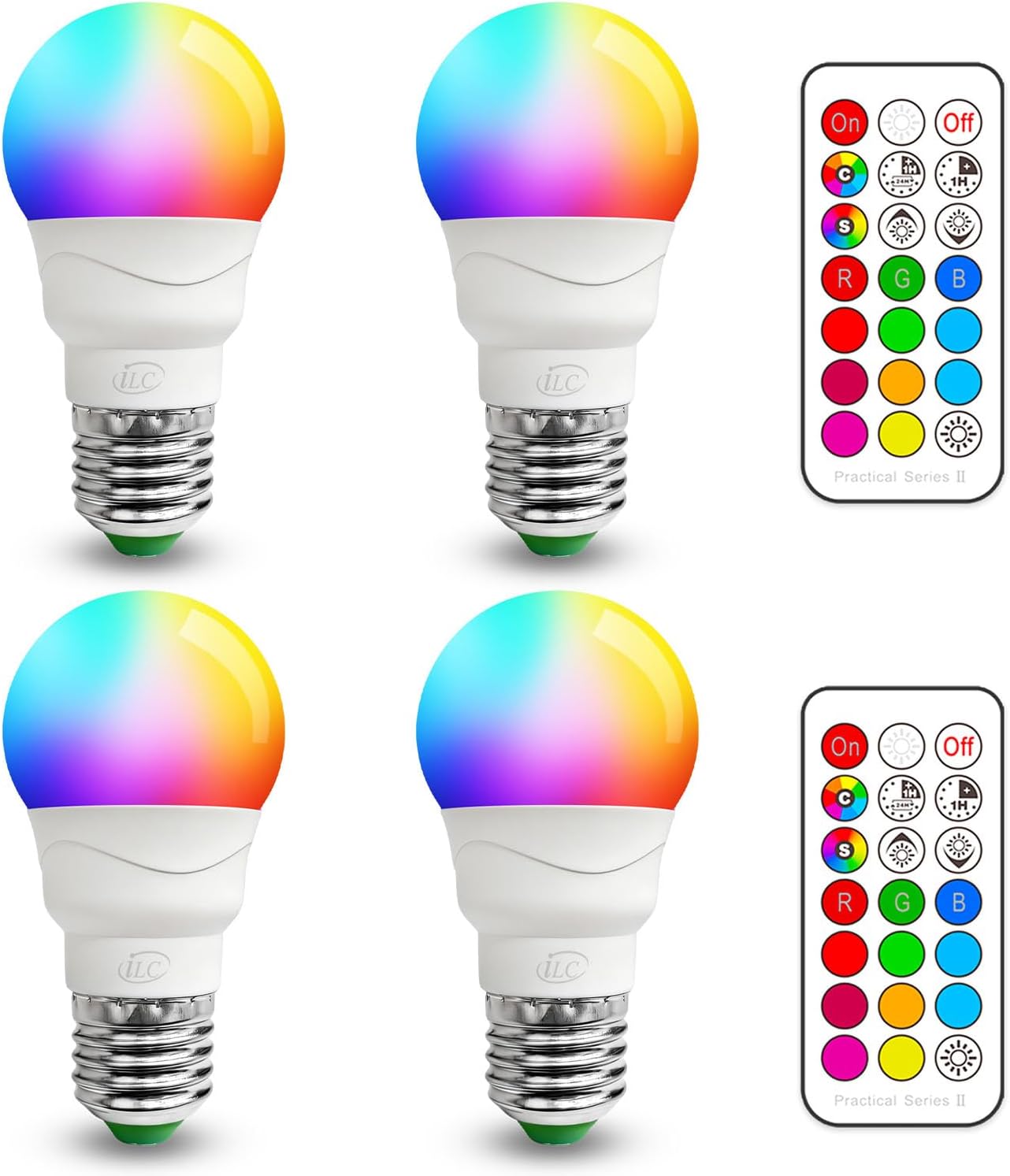
The ILC RGB LED Color Changing Bulb is a small A15 LED that replaces a 40W incandescent using just 5W while offering 12 colors plus a 2700K warm white option. It screws into standard E26 sockets such as ceiling fan fixtures and is controlled with the included infrared remote so you can change color, select flash or smooth color modes, dim across three brightness levels, and set one-time or 24-hour repeat timers without any smartphone or Wi‑Fi setup. The bulb is designed for multi-bulb synchronization so colors and effects stay consistent in chandeliers or fan light clusters, and it remembers the last color or mode used. Practical limits to note: it uses an IR remote so line-of-sight is required and it is not compatible with dimmer wall switches. With a 450-lumen white output and 85 CRI it works well as accent or bedroom lighting but is not intended as a primary high-output room light.
Best for: Buyers who want an economical, easy-to-install color-changing bulb for ceiling fans or multi-bulb fixtures and prefer simple remote control over app setups.
Less Ideal for: People who need smartphone app control, voice assistant integration, or bulbs that work with existing wall dimmers should look elsewhere.
- Energy-efficient 5W LED that replaces a 40W incandescent for lower power use
- Includes infrared remote for color selection, dimming, timers, and modes without Wi‑Fi
- 450 lumens and 85 CRI give usable warm-white light for bedrooms and fan fixtures
- Sync and memory functions keep multiple bulbs in a fixture coordinated
- Infrared remote requires direct line-of-sight and may be less convenient than RF or app control
- Not compatible with wall dimmer circuits so cannot be used with in-wall dimmers
Verdict: A low-power, remote-controlled RGBW bulb that makes ceiling-fan and chandelier fixtures colorful and easy to control without Wi‑Fi.
GIOVAR C37 LED Candelabra Bulb (4-Pack)

| Wattage | 6 watts |
|---|---|
| Bulb Base | E12 |
| Color Temperature | 5000 Kelvin |
| Light Output Maximum | 600 lumens |
| Incandescent Equivalent Wattage | 60 watts |
These GIOVAR C37 bulbs are E12-base LED candelabra lamps sold in a four-pack and intended as direct replacements for 60W incandescent bulbs. They deliver a daylight 5000K color and about 600 lumens of bright, task-oriented light while using roughly 6 watts, so they work well in ceiling fan light housings, chandeliers, and vanity fixtures that accept E12 bases. The bulbs are non-dimmable and rated for a long operating life, and the listing highlights flicker-free operation and a CRI above 85 for reasonably accurate color rendering. Practical benefits include lower energy use and less frequent replacement compared with incandescent bulbs, and the compact candelabra shape fits many fan and chandelier shades. Important limitations are the non-dimmable design and the fixed 5000K color, which may be too cool for living areas that favor warmer light; also the product notes to check height clearance for some enclosed fixtures. For buyers looking for a bright, budget-friendly E12 LED for ceiling fans, these are a straightforward, efficient option.
Best for: Buyers wanting an inexpensive, energy-saving E12 bulb that delivers bright, daylight illumination for ceiling fans, task areas, and chandeliers and who prioritize cost and lumen output over tunable color or dimming.
Less Ideal for: Anyone who needs dimmable bulbs or prefers warm, adjustable color temperatures for ambient living spaces should look for alternatives with dimming and color options.
- Replaces 60W incandescent with 600 lumens while consuming about 6W each
- Daylight 5000K output suitable for task lighting in kitchens or work areas
- Flicker-free design with CRI over 85 for better color rendering
- Compact E12 candelabra shape fits most ceiling fan and chandelier sockets
- Non-dimmable so cannot be used with compatible dimmer circuits or mood lighting setups
- Fixed 5000K color may be too cool for bedrooms or living rooms seeking warmer tones
Verdict: A budget-friendly E12 LED that delivers bright 5000K light and big energy savings for ceiling fan fixtures when you just need reliable, non-dimmable illumination.
Philips Hue White & Color Ambiance E12 Candle Bulb

| Light Output | 450 lumens |
|---|---|
| Power Consumption | 5.8 watts |
| Light Source Operating Life | 25000 hours |
| Connectivity Protocol | Bluetooth, Zigbee |
| Control Method | App, Voice |
This Philips Hue White and Color Ambiance E12 smart candle bulb is designed for decorative fixtures like chandeliers and candelabra sockets and provides up to 450 lumens from a 5.8-watt LED. It pairs via Bluetooth for simple one-room control and also supports Zigbee so you can add a Hue Bridge to unlock remote control, automations, and larger-system reliability. Use the Hue app or voice assistants to change color, set scenes, or schedule routines; the bulb supports warm-to-cool whites plus millions of colors and offers about 25,000 hours of rated life. In practice the bulb delivers consistent color and dimming performance suitable for mood lighting in bedrooms, dining rooms, or ceiling-fan fixtures with an E12 socket, and the Zigbee option reduces dependence on Wi-Fi when paired with a Bridge. The main limitations are its decorative C9/candle shape and E12 base, which restricts use to candelabra fittings, and unlocking full multi-room control requires purchasing a Bridge separately.
Best for: Buyers who prioritize dependable smart lighting that integrates into a mature Hue system and want consistent color and dimming performance for decorative ceiling fan or chandelier fixtures.
Less Ideal for: People who need a standard medium-base bulb or want full cloud control without adding a Hue Bridge should consider other smart bulbs.
- Dimmable color and white light with millions of hues for flexible mood lighting
- Bluetooth and Zigbee connectivity for quick setup and optional bridge-based reliability
- 450 lumens output while consuming only 5.8 watts for efficient brightness
- Works with voice assistants for hands-free control
- Rated 25,000 hours operating life for long-term use
- E12 candelabra base and candle shape limit compatibility to decorative fixtures
- Full remote control and multi-room features require a separate Hue Bridge
Verdict: Choose this Philips Hue E12 candle bulb when you want reliable, color-capable smart lighting that integrates into a Hue system for stable, bridge-backed control.
Amazon Basics Smart A19 LED Bulb

| Wattage | 9 watts |
|---|---|
| Bulb Shape Size | A19 |
| Bulb Base | E26 |
| Light Output Maximum | 800 lumens |
| Light Color | Color Changing |
The Amazon Basics Smart A19 is a straightforward Alexa-only smart bulb that replaces a standard A19/E26 lamp with 16 preset colors and dimming via the Alexa app or voice commands. It installs like a normal bulb and connects directly to a 2.4 GHz Wi-Fi network so no hub is required, making it easy to add to a ceiling fan light kit that accepts A19 bulbs. The bulb produces up to 800 lumens (about a 60W incandescent equivalent) and offers a warm white option at 2700 K for everyday lighting alongside RGB moods for parties or movie nights. Setup and grouping happen inside the Alexa app and you can create routines or control the bulbs remotely. Important limitations: it only works with Alexa, it does not support physical dimmer switches, and it only connects to 2.4 GHz Wi-Fi, so households using other voice platforms or 5 GHz-only networks will need alternatives.
Best for: Buyers who want an easy, Alexa-centered smart upgrade for ceiling fan lights and prefer simple app/voice control and grouping over cross-platform compatibility.
Less Ideal for: People who use Google Assistant, Apple HomeKit, or who require bulb compatibility with physical dimmer switches or 5 GHz-only networks should look elsewhere.
- No hub required — connects directly to 2.4 GHz Wi-Fi for simple setup
- Voice and app control via Alexa with grouping and routines
- Color changing plus dimming from 5% to 100% for ambience and task lighting
- 800 lumens output matches common ceiling fan fixtures for general room illumination
- Only compatible with Alexa and not with Google Assistant or Apple HomeKit
- Incompatible with physical dimmer switches
- Requires a 2.4 GHz Wi-Fi network and will not join 5 GHz networks
Verdict: If you want an inexpensive, no-hub Alexa smart bulb that fits standard ceiling fan fixtures and delivers solid brightness plus color options, this is an easy pick.
Kasa Smart Bulb KL125P2
| Light Output Maximum | 800 lumens |
|---|---|
| Light Source Wattage | 9 watts |
| Bulb Shape Size | A19 |
| Bulb Base | E26 |
| Color Temperature | 2500K-6500K |
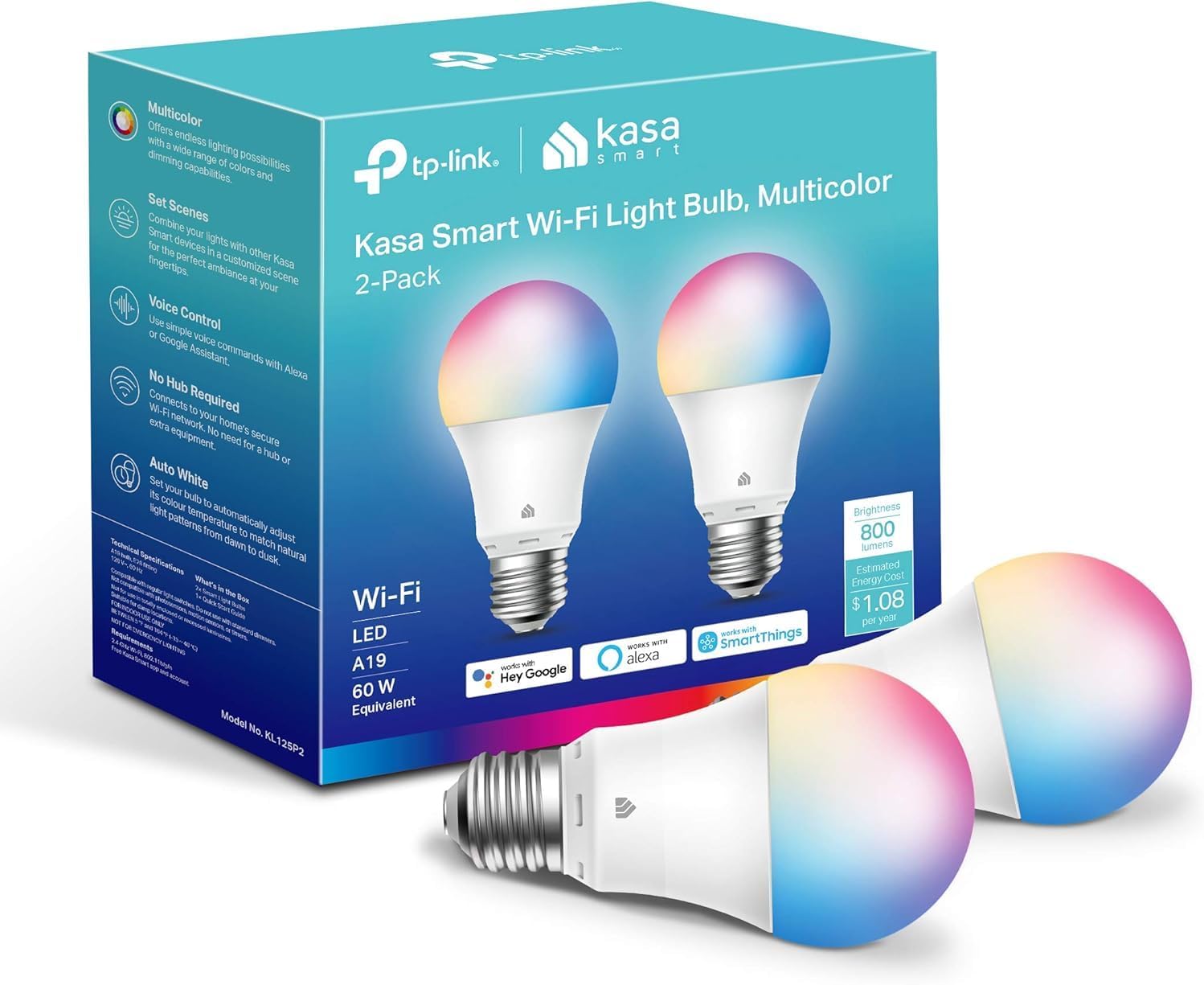
The Kasa KL125P2 is a full-color A19 smart bulb that replaces a 60W incandescent while drawing about 9W and delivering roughly 800 lumens. It connects directly to 2.4 GHz Wi‑Fi so no hub is required, and you control it with the Kasa app or voice assistants like Alexa and Google Assistant. Notable features include 16 million colors, tunable white from warm to cool (2500K–6500K), dimming, scheduling, and built-in basic energy monitoring. In practice the bulb is useful for ceiling fans because its standard E26/A19 shape fits most fixtures and the dimming plus color temperature scheduling lets you set comfortable wake and sleep lighting scenes. Setup is straightforward for mainstream users and the app offers grouping and timers for room-level control. The main limitations are the 2.4 GHz Wi‑Fi requirement and that the 800-lumen output is best for general ambient lighting rather than tasks that need very bright illumination; also some advanced integrations require the Kasa ecosystem. For buyers who want reliable, easy-to-use smart lighting on fan fixtures, this is a practical, well-rounded choice.
Best for: Buyers who want reliable, easy-to-setup smart lighting for ceiling fans and common rooms and who prioritize hands-free voice control and simple scheduling over maximum brightness.
Less Ideal for: People needing very high-brightness task lighting or who only have 5 GHz Wi‑Fi and cannot provide a 2.4 GHz connection.
- Full color plus tunable white for flexible scenes and routines.
- Works with Alexa and Google Assistant for hands-free voice control.
- No separate hub required — connects directly to 2.4 GHz Wi‑Fi.
- Includes scheduling, grouping, and basic energy monitoring in the app.
- Maximum output about 800 lumens may be dim for task lighting in large rooms.
- Requires a 2.4 GHz Wi‑Fi network and will not work on 5 GHz-only networks.
Verdict: A straightforward, hub-free multicolor smart bulb that fits ceiling fans and delivers simple voice control and scheduling for risk-averse buyers seeking dependable smart lighting.
Choosing the Right Smart Light Bulb for Ceiling Fans: Key Factors to Consider
Dimming Behavior With Fan Dimmers and Pull Switches
Many ceiling fans use legacy triac wall dimmers or a simple pull-chain switch that interrupts power. Bulbs respond differently to partial voltage and rapid on-off cycles. Smooth dimming matters because it affects both comfort and the risk of visible flicker.
Look for bulbs that list compatibility with leading dimmer types or that specifically state flicker-free dimming. If you plan to use a pull chain or a fan speed controller, choose bulbs tested to tolerate frequent power interruptions without losing settings or producing startup flicker.
Color Temperature and True-Color Rendering
Color temperature options—warm white through daylight—and accurate color rendering determine how natural skin tones, decor, and task lighting appear. Tunable white bulbs let you switch from warm evening tones to cool daylight for tasks.
For colored smart bulbs, consider the color gamut and how saturated hues look at lower brightness. Accurate color rendering indices and manufacturer-provided calibration specs help predict real-world appearance, especially in rooms where lighting quality matters for tasks or aesthetics.
Connectivity and Smart-Home Integration
A bulb's wireless protocol affects range, latency, and interoperability. Wi-Fi bulbs connect directly to your router but may add load to the network. Zigbee and Z-Wave bulbs require a hub but usually offer lower latency and more stable device meshes, especially with many devices.
Consider what ecosystem you already use. Check whether the bulb supports voice assistants and popular automation platforms, and whether it offers local control rather than cloud-only operation to ensure responsiveness and privacy.
Heat Management in Fan Fixtures
Ceiling-fan light housings can trap heat, and bulbs mounted directly under a fan motor can run hotter than when in open lamps. Excessive operating temperature shortens LED life and can change color performance over time.
Choose bulbs with good thermal design or explicit use ratings for enclosed fixtures. Look for specifications about maximum operating temperature and tested lifespan in typical fan housings to avoid premature dimming degradation or early failure.
Physical Fit and Weight
Ceiling fans often have shallow or decorative light bowls with limited clearance. Bulb size and weight affect fit, balance, and the ability of the fixture to close correctly.
Check the bulb's dimensions and weight against your fan's light housing. Low-profile bulbs reduce wobble and improve airflow. Avoid oversized bulbs that press against diffusers or that add torque to the fixture assembly.
Startup Behavior and Memory Settings
How a bulb behaves after a power interruption is important with fan switches or household routines that cycle power. Some smart bulbs return to the last state, others default to on or to a preset scene, which can be inconvenient if your fan's pull chain momentarily cuts power.
Look for bulbs that offer configurable power-on behavior or that advertise power-loss memory. This feature prevents unexpected bright-on states and preserves user preferences without relying on cloud services.
Installation Tips for Ceiling-Fan Fixtures
Install smart bulbs while the fan and wall switch are turned off to avoid accidental motor activation. Confirm the bulb base matches your fixture and that the shade or diffuser has enough clearance. For fixtures with multiple bulbs, install identical bulbs to keep color and brightness consistent across the beam.
- Turn off fan power at the circuit breaker for safer access when needed.
- If the fan has separate fan and light switches, test each control after installation to ensure expected behavior.
- When replacing multiple bulbs, consider labeling them to keep room scenes consistent.
Managing Flicker and Uneven Dimming
Flicker often shows up when bulbs are used with incompatible dimmers or when the fan's internal wiring imposes voltage variation. To minimize flicker, use bulbs rated for triac or trailing-edge dimmers and enable any internal anti-flicker settings the bulb or app provides. If flicker persists, try a different dimming mode in the smart app or use an inline dimmer rated for LEDs.
- Enable any firmware updates or anti-flicker modes during setup.
- Test bulbs at low brightness levels to check for color shift or strobing before final installation.
- Avoid mixing bulb types on the same circuit to reduce visible inconsistencies.
Optimizing Scenes and Automation for Fan Lights
Ceiling-fan lights are commonly used for general room lighting and for routines tied to occupancy, bedtime, or wake-up scenes. Use tunable white bulbs to create warm evening scenes and brighter, cooler scenes for morning tasks. Automations that dim lights gradually at night can be more pleasant than abrupt off commands and can work around the fan's power cycling behavior.
- Create separate scenes for reading versus ambient lighting to exploit tunable white ranges.
- Use schedules tied to sunrise and sunset for automatic color temperature adjustments.
- If using motion sensors, add a short-on delay to avoid rapid cycling when humidity or pets trigger the sensor.
Choosing Between Color and Tunable White Bulbs
Tunable white bulbs give flexible white light from warm to cool and suit most living areas where accurate whites matter. Color bulbs add decorative options and are useful for parties or accent lighting but may not render whites as naturally as tuned white LEDs. If you primarily use ceiling fans for general lighting, prioritize high-quality tunable white bulbs with good color rendering index. Reserve full-color bulbs for fan fixtures that serve dual roles as accent features.
- For task-oriented rooms, favor high CRI tunable white bulbs.
- For occasional color use, ensure the bulb maintains good white balance at lower brightness levels.
- Check app controls for quick toggles between white presets and colored scenes.
Maintaining Bulbs in High-Use Ceiling Fans
Ceiling fans often run for long hours, which increases cumulative operating time for bulbs. Regularly inspect bulbs for discoloration, reduced output, or unusual heat. Keep fixtures and diffusers clean to maintain light output and thermal dissipation. If the fixture uses a dimmer or frequent switching, choose bulbs with longer rated lifespans and robust start-up electronics designed for high-cycle environments.
- Wipe diffusers clean quarterly to prevent dimming from dust buildup.
- Monitor bulb firmware updates for reliability improvements.
- If you notice shortened bulb life, consider bulbs with higher thermal ratings or lower operating temperatures.
How We Chose the Best Smart Light Bulb for Ceiling Fans
We focused on bulbs that work well in ceiling-fan fixtures and deliver reliable day-to-day performance. Our evaluation prioritized measurable, user-relevant criteria: electrical compatibility with fan dimmers and pull switches, dimming smoothness across the full range, color temperature accuracy and gamut for tunable-color bulbs, wireless connectivity stability with common smart-home hubs, and thermal performance when enclosed or mounted close to fan motors. We excluded bulbs that require nonstandard or proprietary power modules and any products with known widespread reports of flicker when dimmed or when used with fan switches. We also filtered out bulbs that lack clear color temperature calibration data or that use unlisted wireless protocols. The remaining selections were scored on compatibility, dimming behavior, color accuracy, connectivity, and heat management to reflect the factors that most affect real-world use in ceiling-fan fixtures.
Our full evaluation process is outlined in our review methodology.
FAQ
Will smart bulbs work with my fan’s pull chain switch?
Often they will, but behavior depends on how the switch interrupts power. Some smart bulbs remember their previous state after power is cut and restored, while others default to on. Choose bulbs that support configurable power-on behavior for reliable performance with pull chains.
Can I dim a smart bulb using my existing wall dimmer?
Possibly, but only if the dimmer and bulb are compatible. Many LED-compatible dimmers support smooth dimming, but legacy dimmers can cause flicker. Look for bulbs rated for triac or trailing-edge dimmers and test at low brightness to confirm smooth operation.
Do smart bulbs overheat inside enclosed fan light shades?
Enclosed or shallow shades can raise operating temperature. Bulbs with better thermal design or explicit ratings for enclosed fixtures handle heat better and maintain lifespan. Check the bulb's maximum operating temperature and packaged guidance for enclosed use.
Will color-changing bulbs render whites accurately?
Color bulbs can produce whites, but tunable white LEDs generally render neutral whites more accurately. If accurate white light for tasks is a priority, favor tunable white bulbs with high color rendering metrics rather than full-color-only bulbs.
Do smart bulbs require a hub to work with voice assistants?
It depends on the wireless protocol. Wi-Fi bulbs typically connect directly to your network and may work without a hub. Zigbee or Z-Wave bulbs usually need a hub but can offer more stable mesh performance. Check the product's connectivity options to match your existing setup.
Final Verdict
Prioritize compatibility with your fan's switching and dimming hardware, and look for bulbs that offer smooth dimming, accurate whites, and reliable heat management in confined fixtures. Tradeoffs include choosing between full-color options for decorative flexibility and tunable white bulbs for the most natural-looking whites and task lighting. Focus on the few criteria that affect daily use most: dimming behavior with your control method, thermal performance in enclosed fan housings, and connectivity that fits your smart-home setup. With those priorities in mind you can pick a smart bulb that reduces flicker, holds color fidelity, and lasts through frequent fan use.