
Note: This article contains affiliate links. If you click on these links and make a purchase, we may earn a small commission at no extra cost to you. This helps support our research and content. Read our full affiliate disclosure here.
A smart lock can turn an ordinary door into a more secure, convenient entry point for your home. Choosing the right smart lock matters because it affects everyday routines, guest access, and the overall safety of your property. The models we shortlisted represent reliable approaches to electronic access, balancing security features, installation complexity, and daily usability. This guide explains the factors that mattered in our selection and walks through practical considerations so you can pick the smart lock that fits your door and lifestyle. Below are the top picks and the evaluation criteria we used to narrow the field.
Top Picks at a Glance
| Best Overall The best all-around choice for most situations | Google Nest x Yale Lock |  |
| Best Quality Built to a higher standard if you want something more solid | Level Lock Pro D2 |  |
| Best Value The sweet spot between price and what you get | ULTRALOQ Bolt SE Smart Deadbolt | 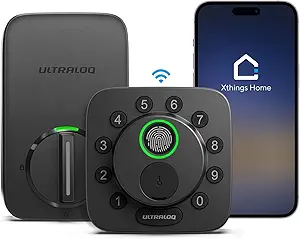 |
| Top Rated A top-rated pick with lots of positive feedback | ARPHA WiFi Video Smart Lock D289W |  |
| Most Popular A crowd favorite that many people choose with confidence | Schlage Encode WiFi Deadbolt |  |
Google Nest x Yale Lock

| Lock Type | Deadbolt |
|---|---|
| Connectivity Protocol | Wi-Fi |
| Control Method | Voice |
| Additional Features | Alarm, Keyless |
The Nest x Yale Lock replaces a standard deadbolt with a tamper-resistant, key-free smart lock controlled from the Nest app or its exterior keypad. It is typically installed on a front door in place of an existing deadbolt and connects to your Wi-Fi through the included Nest Connect so you can lock and unlock remotely, get alerts, and see access history. The keypad supports unique passcodes and a Privacy Mode to temporarily disable code entry, while one-touch locking and optional auto-lock simplify daily use. The lock also issues tamper and low-battery alerts and integrates with voice assistants for hands-free control. Important limitations are that remote features require the Nest app, working internet, and the Nest Connect, and proper fitment requires measuring your door backset and cross bore; professional installation may be helpful if your door or hardware is nonstandard.
Best for: Buyers who want a secure, easy-to-manage smart deadbolt with keypad access and remote control and who value auditability and guest passcodes.
Less Ideal for: People who need a purely offline mechanical lock or who prefer a smart lock that does not rely on a bridge or persistent internet connection.
- Keyless entry with keypad and unique passcodes for family and guests
- Remote locking, unlocking, and alerts via the Nest app when connected with Nest Connect
- Tamper and low-battery alerts for improved security awareness
- One-touch locking and auto-lock options for convenient everyday use
- Remote features require Nest Connect and working Wi-Fi which adds dependency on network hardware
Verdict: Choose the Nest x Yale Lock if you want a tamper-resistant, app-controlled deadbolt with keypad codes and remote access for managing home entry.
Level Lock Pro D2

| Lock Type | Deadbolt |
|---|---|
| Connectivity Protocol | Matter, Bluetooth |
| Control Method | App, Remote, Voice |
| Additional Features | Apple home keys, Fob Unlock, One-Touch Lock |
The Level Lock Pro D2 is a low-profile smart deadbolt that keeps the interior and exterior of your door looking like a traditional lock while packing modern access options. It installs with just a screwdriver and fits standard U.S. doors, using an internal motor and sensors to offer touch-to-unlock, NFC key fobs, Apple Home Key, physical keys, and voice or app control via Bluetooth or Matter when paired with a compatible hub or the Level Connect bridge. Its BHMA AAA/ANSI Grade 1 certification, bump-and pick-resistant cylinder, and end-to-end encryption make it suitable for buyers who prioritize security and reliability. Door status detection and an activity feed add daily convenience, while the minimal visible hardware preserves aesthetics. Remote control requires a separate Matter-compatible hub or bridge, and some users will need to buy the keypad or long strike plate separately for specific installations. Battery-powered operation is convenient but means you must monitor battery level to avoid lockouts.
Best for: Buyers who prioritize high security and seamless smart-home integration and want a discreet, performance-oriented deadbolt that blends with traditional door aesthetics.
Less Ideal for: Users who need built-in Wi-Fi remote access or an included keypad out of the box, or those unwilling to manage battery replacement and an external hub.
- Discreet design with internalized motor keeps door faceplate looking like a traditional deadbolt
- Supports Matter and Bluetooth for local and smart-home integrations including Apple Home Key
- BHMA AAA/ANSI Grade 1 security with bump- and pick-resistant cylinder and encryption
- Multiple access methods: touch-to-unlock, NFC fobs, Apple Home Key, physical keys, voice and app control
- Easy DIY installation with included strike plate, keys, fobs, and CR2 battery
- Remote access requires a separate Matter hub or Level Connect bridge sold separately
- Keypad and extended strike plate are sold separately if you need keypad entry or nonstandard strike cutouts
Verdict: Choose the Level Lock Pro D2 if you want a compact, Grade 1-certified smart deadbolt that delivers strong security and Matter-based smart-home performance while staying virtually invisible on your door.
ULTRALOQ Bolt SE Smart Deadbolt
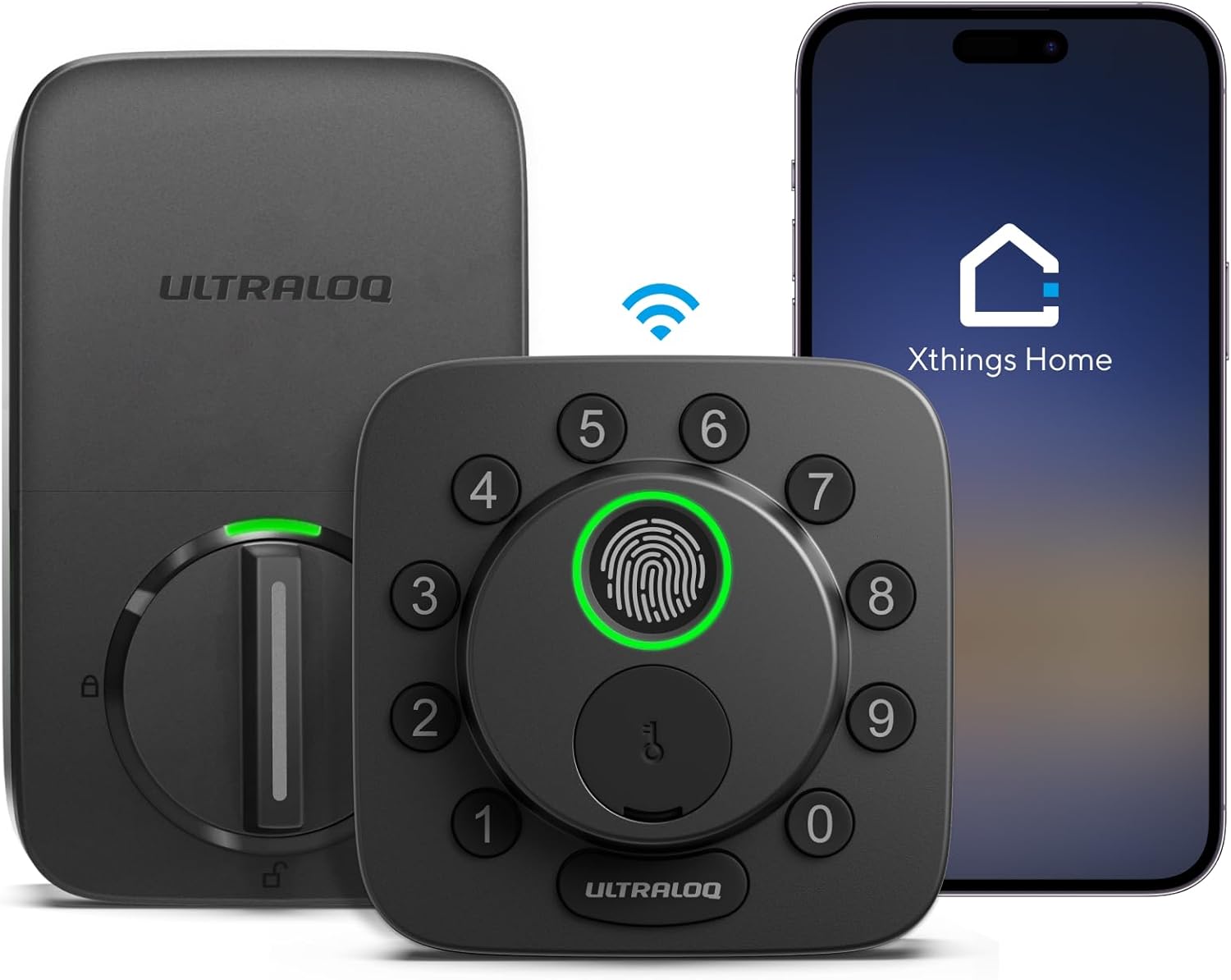
| Connectivity Protocol | Bluetooth, Matter, Wi‑Fi |
|---|---|
| Lock Type | Biometric, Deadbolt, Keypad |
| Additional Features | Auto Lock, Fingerprint ID, App Remote Control |
| Waterproof Rating | IP65 |
| Battery | 4 AA (not included) |
The ULTRALOQ Bolt SE is a feature-rich smart deadbolt aimed at replacing a standard exterior deadbolt with keyless convenience and remote control. It offers seven access methods including an AI-driven fingerprint reader, up to 50 passcodes, smartphone app control via built-in Wi‑Fi, Matter-over-Thread remote access through a compatible border router, and two mechanical backup keys. Typical use cases are front doors for homeowners or short-term rentals where sharing temporary eKeys, viewing event history, and enabling auto-lock are helpful. Notable practical benefits include fast fingerprint unlock (advertised ~0.3s), IP65 weather resistance for exterior mounting, bank-level encryption with local storage for user data, and a long battery life claim using 4 AA cells thanks to Thread efficiency. Limitations to plan for: Matter features require a Thread border router and a Matter-compatible app, the lock uses 2.4 GHz Wi‑Fi only for direct app control, and the door sensor is not included so some automations depend on third-party sensors. Installation is DIY-friendly and ULTRALOQ backs mechanical components for life and electronics for 18 months.
Best for: Buyers who want a durable, full-featured smart deadbolt that centralizes access methods and remote control for everyday home security and guest management.
Less Ideal for: People who lack or do not want to add a Matter/Thread border router or who need built-in door sensor functionality without adding separate devices.
- Multiple entry methods including fingerprint, keypad, app, voice, and mechanical keys for flexible access management
- Built-in Wi‑Fi plus Matter-over-Thread support enables remote control and ecosystem integration when a Thread hub is present
- IP65 weather resistance and ANSI/BHMA certification make it suitable for exterior doors
- Long battery life design (up to 18 months) and low-power Thread connectivity reduce maintenance frequency
- Matter features require a compatible Thread border router and extra setup to enable remote Matter control
- Supports only 2.4 GHz Wi‑Fi for direct app access, which may need router placement adjustments
Verdict: A versatile, weather‑resistant smart deadbolt that combines fast biometric unlocking with built‑in Wi‑Fi and Matter support for buyers who prioritize flexible access and smart home integration.
ARPHA WiFi Video Smart Lock D289W

| Connectivity Protocol | Bluetooth, Wi-Fi |
|---|---|
| Additional Features | App Unlock, Auto-Lock, Camera, Fingerprint, Wifi |
| Lock Type | Biometric, Wifi |
| Included Components | Mounting screws, front and rear mechanism, installation guide, lithium batteries |
| Rechargeable Battery | 7800mAh (listed in description) |
The ARPHA D289W combines a WiFi smart deadbolt, 150° camera, fingerprint sensor, keypad, and traditional key override into a single unit designed for front doors and rental properties. Installation is tool-light and does not require wiring, and the lock connects to home networks over 2.4 GHz WiFi and Bluetooth so you can view live video and unlock remotely from the TUYA app. In daily use the fingerprint reader and anti-peep PIN make frequent entry quick while the adjustable auto-lock timer and 24/7 live view help with package monitoring and guest access. Two-way audio simplifies doorstep conversations and the lock is weather-rated to IP54 with an operating temperature range suitable for most climates. The 7800 mAh rechargeable battery avoids repeated AA changes but will need periodic charging depending on camera and activity use. App dependence and the requirement for 2.4 GHz WiFi mean full functionality relies on a compatible network and the TUYA ecosystem.
Best for: Buyers who prioritize a dependable, all-in-one smart deadbolt with on-demand video and multiple access options for front doors, rentals, or managed properties.
Less Ideal for: People who lack a 2.4 GHz WiFi network or who prefer a purely local lock with no app dependency should consider a simpler hardwired or Bluetooth-only option.
- Combines camera, fingerprint, keypad, app control, and keyed backup in one unit
- Live 24/7 video and two-way audio for remote monitoring and doorstep communication
- Adjustable auto-lock timer and anti-peep PIN improve day-to-day security and convenience
- Weather-resistant (IP54) design and wide operating temperature range for exterior use
- Large rechargeable 7800mAh battery reduces frequent battery swaps
- Requires 2.4 GHz WiFi and TUYA app for full remote features
- Camera and app use can increase power draw and shorten time between charges
Verdict: Choose this smart deadbolt if you want a single, reliability-focused exterior lock with built-in camera and multiple secure entry methods managed from a mobile app.
Schlage Encode WiFi Deadbolt
| Connectivity Protocol | Bluetooth, Wi-Fi |
|---|---|
| Control Method | Voice |
| Lock Type | Keypad |
| Included Components | Installation Hardware, Installation Instructions |
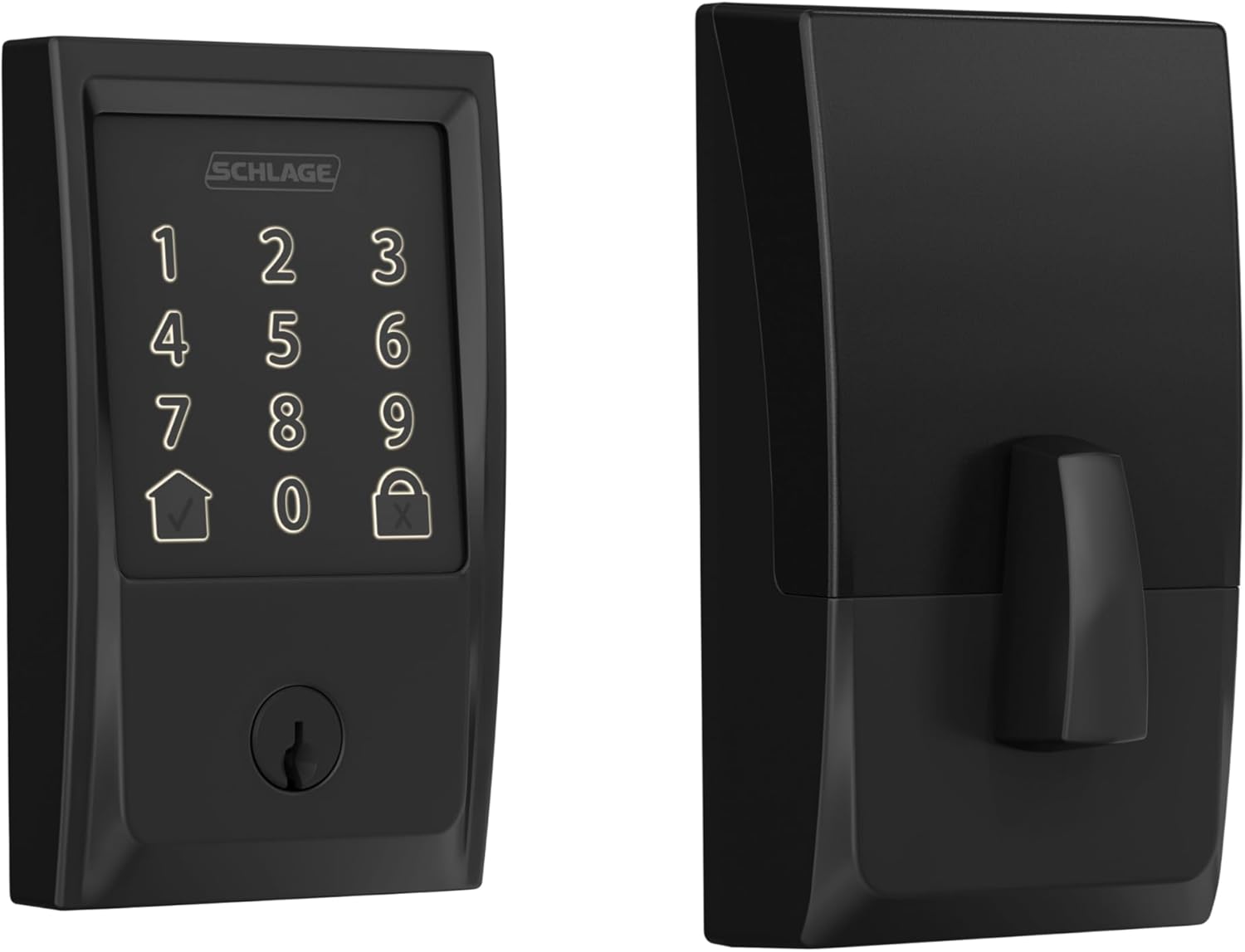
The Schlage Encode is a battery-powered touchscreen deadbolt designed for everyday front-door security with smart control. It installs with just a screwdriver and fits standard residential doors, so it is typically used as a direct replacement for a conventional deadbolt to add remote access, temporary codes, and activity history. Notable features include built-in Wi‑Fi for remote lock/unlock without a separate hub, voice compatibility with Alexa and Google Assistant, a fingerprint-resistant touchscreen, a customizable built-in alarm that detects forced entry, and the ability to store and manage many unique access codes. In practice the Encode streamlines keyless entry for households and hosts who need short-term access for guests, and the Schlage Home app provides notifications and a usage log for oversight. Limitations to consider are that it runs on four AA batteries so you must monitor battery level, and some advanced integrations require pairing through the Schlage app or supported voice platforms rather than direct third-party apps. The lock's BHMA-certified security and simple DIY installation make it a practical choice when you want proven hardware with modern remote control features.
Best for: Buyers who prioritize proven security and want a straightforward smart upgrade that provides remote access, code-based guest entry, and activity logs without professional installation.
Less Ideal for: Users seeking a fully wired, maintenance-free power option or those who need direct integrations with niche third-party home automation systems without using the vendor app should consider other options.
- Built-in Wi‑Fi for remote control without an external hub
- BHMA-certified security, durability, and finish ratings
- Easy DIY installation with only a screwdriver and included hardware
- Customizable access codes and activity history for monitoring and guest access
- Built-in alarm to detect forced entry attempts
- Runs on AA batteries so it requires periodic replacement and monitoring
- Some smart-home integrations rely on the Schlage Home app for setup and management
Verdict: Choose the Schlage Encode when you want a BHMA-certified, easy-to-install smart deadbolt with built-in Wi‑Fi for reliable remote access and guest code management.
Choosing the Right Smart Lock: Key Factors to Consider
Security and Encryption
Robust on-device security and modern encryption protocols matter because the lock protects physical access to your home. Look for products that implement end-to-end encryption for remote access and that offer multi-factor options like app approval plus PIN or biometric gateways.
Also consider how the lock handles local security when the network is unavailable. Locks that maintain strong offline PIN or mechanical-key fallback modes reduce the risk of being locked out if connectivity fails.
Installation Compatibility
Not all smart locks fit every door or deadbolt. Compatibility with your existing single-cylinder deadbolt, backset depth, and door thickness determines whether you can do a simple retrofit or need significant modifications.
Consider whether the smart lock mounts to the existing interior thumbturn or replaces the full deadbolt. Retrofit designs that use existing hardware typically simplify installation and preserve your exterior appearance.
Access Management and Sharing
The ease of adding and removing users, scheduling temporary codes, and auditing entry events are core practical features. If you frequently host guests, tradespeople, or short-term renters, the ability to create time-limited PINs or app-based guest access is essential.
Also check whether user management is cloud-based or local. Cloud systems usually make remote code provisioning easier, while local-only systems can reduce exposure to cloud-service outages and privacy risks.
Power and Battery Considerations
Battery life, low-battery warnings, and the availability of emergency power options affect reliability. Locks powered by replaceable AA or AAA batteries are simple to maintain; rechargeable internal batteries remove frequent battery swaps but may require more involved servicing.
Think about how the lock communicates low power: clear in-app alerts and a visible indicator on the device help avoid unexpected lockouts. Also note whether the lock supports an external emergency power source, like a micro-USB terminal, in case the battery dies.
Smart-Home Integration and App Stability
Integration with the rest of your home automation setup determines how seamlessly the lock becomes part of your routines. Native support for common ecosystems, local triggers, and voice assistants can automate locking and unlock events.
Stable apps and a reliable update process are important for long-term security and features. Look for locks with clear firmware update paths and a track record of timely security patches.
Types of Smart Lock Mechanisms
Smart locks fall into a few common mechanical approaches: retrofit units that attach to your interior thumbturn, full-deadbolt replacements, and exterior-mounted keypad locks. Retrofit units are popular because they preserve the exterior hardware and usually avoid drilling. Full replacements can provide a cleaner integrated look and sometimes stronger mechanical performance. Keypad-first designs focus on code entry and may or may not include remote access features.
- Retrofit: mounts to interior thumbturn; minimal exterior change
- Full-deadbolt replacement: replaces entire lock for integrated operation
- Keypad and deadbolt combos: ideal for frequent code-based access
Wiring, Power, and Emergency Options
Most smart locks run on batteries, but installation details vary. Some use common AA batteries behind an interior cover, while others use sealed rechargeable packs. Consider how easy it is to swap batteries and whether the lock provides low-battery notifications. A few models include a terminal for a temporary external power boost if batteries die during use.
- Replaceable battery packs are simple to maintain
- Rechargeable internal batteries reduce replacement frequency but complicate servicing
- External emergency power ports can prevent lockouts from dead batteries
Connectivity: Bluetooth, Wi-Fi, and Bridges
Connectivity affects whether you can lock or unlock remotely and how the lock integrates with automation. Bluetooth-only locks are reliable for on-site control and use less power, but they require your phone to be nearby. Wi-Fi–enabled locks support remote control without extra hardware but can draw more power. Some systems use a local bridge or hub to translate between the lock and cloud services, offering a balance of remote access and lower battery drain.
- Bluetooth: low power, good for local control
- Wi-Fi: direct remote access, higher power use
- Bridge or hub: offloads heavy networking while enabling remote features
User Management Workflows
Different locks offer varying interfaces for adding users and assigning codes. Look for systems that let you assign different permission levels, set expiration times for temporary codes, and review access logs. Ease of provisioning matters if you will frequently add contractors, cleaners, or guests. Also check whether administrators can manage codes from a mobile app, a web portal, or only at the lock itself.
- Time-limited codes simplify temporary access
- Role-based permissions help control who can change settings
- Audit logs provide a history of entries and attempted entries
Maintenance and Longevity
Maintenance needs include battery replacement intervals, mechanical wear on the bolt, and software updates. Regularly check firmware status and install security patches when available. Mechanically, ensure the strike plate and alignment are sound to reduce stress on the bolt and electronics. A well-installed lock with routine battery checks and occasional firmware updates will last longer and behave more reliably.
- Check alignment and strike plate condition annually
- Replace batteries before they reach critical low levels
- Install firmware updates promptly to maintain security
How We Chose the Best Smart Lock
We started by focusing on features that actually affect day-to-day security and convenience. Evaluation prioritized strong authentication options, verified encryption and tamper resistance, and flexible user access controls. We also weighed physical compatibility with common deadbolts, the clarity of installation instructions, and whether installation required professional tools or electrical work. Battery life and low-battery alerts were included because they determine reliability over time. Finally, we looked at software maturity: app stability, firmware update mechanisms, and support for common smart-home integrations. Products were excluded if they lacked proven encryption, required invasive door modifications, or had consistently poor user feedback on reliability or setup. The final list emphasizes locks that balance robust security, straightforward installation, dependable power management, and usable mobile or keypad access features.
Our full evaluation process is outlined in our review methodology.
FAQ
Will a smart lock fit my existing deadbolt?
Many smart locks are designed to retrofit to common single-cylinder deadbolts and attach to the interior thumbturn. Confirm the lock's compatibility with your deadbolt type, backset, and door thickness before purchasing. Some designs replace the entire deadbolt and require removing existing hardware.
What happens if the battery dies?
Most locks provide low-battery alerts via their app and have visible indicators on the device. Many models allow you to swap in fresh batteries quickly, and some include an emergency external power terminal so you can temporarily power the lock to regain access. A mechanical key override may also be available depending on the design.
Are smart locks secure against hacking?
Security depends on the lock's encryption, authentication options, and firmware update practices. Locks that use up-to-date encryption, two-factor options, and timely firmware patches reduce exposure. Always keep the companion app and firmware updated and use strong, unique account credentials.
Can I share temporary access with guests?
Yes. Most smart locks let you create time-limited PINs or app-based guest passes that expire automatically. Check whether the system requires cloud access to create codes remotely or if you must be local to provision temporary access.
Do smart locks work with home automation systems?
Many locks integrate with popular home automation platforms through native support or a bridge. Integration can enable routines, voice control, and status monitoring. Verify which ecosystems the lock supports and whether those features meet your automation needs.
Final Verdict
Balance security, installation complexity, and daily convenience when choosing a smart lock. Prioritize strong encryption and reliable user-management options if remote access and guest control are important. If you prefer a simple retrofit, choose a design that fits your existing deadbolt and minimizes door modification. Finally, consider battery behavior and app stability as ongoing operational factors. With those tradeoffs in mind, pick the lock that matches how you use your entryway and the level of automation you want.