
Note: This article contains affiliate links. If you click on these links and make a purchase, we may earn a small commission at no extra cost to you. This helps support our research and content. Read our full affiliate disclosure here.
If you live in an apartment, a smart thermostat can make your space more comfortable while trimming energy use and headaches. You need a unit that fits limited wiring options, cooperates with building rules, and delivers reliable scheduling and remote control. This guide shortlists the top smart thermostats for apartment living and explains the installation, compatibility, and convenience tradeoffs that matter most. Below are the best picks for apartments along with the evaluation criteria we used to select them and practical advice for choosing the right model for your situation.
Top Picks at a Glance
| Best Overall The best all-around choice for most situations | ecobee Smart Thermostat Essential |  |
| Best Quality Built to a higher standard if you want something more solid | ecobee Smart Thermostat Premium |  |
| Best Value The sweet spot between price and what you get | Sensi ST55 Smart Thermostat |  |
| Best Budget The cheapest option that still gets the job done reliably | Honeywell Home X2P Programmable Thermostat |  |
| Top Rated A top-rated pick with lots of positive feedback | Sensi Touch ST75 |  |
| Most Popular A crowd favorite that many people choose with confidence | Amazon Smart Thermostat |  |
| Best Seller A high-volume bestseller chosen again and again | Google Nest Thermostat |  |
ecobee Smart Thermostat Essential

| Connectivity Technology | Wi-Fi |
|---|---|
| Power Source | Battery Powered |
| Display Type | LCD |
| Control Type | Touchpad Control |
| Specification Met | Energy Star |
The ecobee Smart Thermostat Essential is a compact Wi‑Fi thermostat that gives apartment dwellers remote control and schedule-based energy savings without a lot of setup complexity. It pairs with Apple HomeKit, Google Assistant, and Siri/Alexa ecosystems so you can change temperature manually at the 3.74‑inch touch LCD or from the ecobee mobile app. The unit uses auto-scheduling and eco+ features to adjust heating and cooling for energy savings and can work with the optional Power Extender Kit if your wall wiring lacks a C wire. For renters or small-space owners it supports most 24 VAC HVAC equipment including conventional systems, heat pumps, and boilers, and can accept an optional SmartSensor to monitor other rooms. Limitations include the basic feature set compared with higher-end ecobee models (no built-in occupancy sensor or air quality monitor) and the need to check system compatibility before purchase; the thermostat is not compatible with line-voltage, millivolt, or 0‑10VDC systems. Its straightforward controls and app integration make it a practical, lower-cost smart option for apartments that use standard low-voltage HVAC.
Best for: Apartment residents who want a straightforward, app-controlled smart thermostat that reduces energy use and integrates with major smart home platforms without the complexity of premium models.
Less Ideal for: People who need advanced HVAC diagnostics, built-in air quality monitoring, or support for non‑low‑voltage heating systems should look at more feature-rich or specialized alternatives.
- Works with HomeKit, Google Assistant, and Alexa for voice and app control
- Auto-scheduling and eco+ features help reduce heating and cooling usage
- Easy DIY installation with PEK option for homes without a C wire
- Compact touch LCD for simple local control
- Compatible with most 24 VAC HVAC systems used in apartments
- Lacks built-in room occupancy sensor and air quality monitoring found on higher-end models
- Not compatible with line-voltage, millivolt, or 0-10VDC systems
Verdict: A budget-friendly smart thermostat that brings reliable app and voice control plus energy-saving automation to apartments using standard low-voltage HVAC.
ecobee Smart Thermostat Premium

| Connectivity Protocol | Wi-Fi |
|---|---|
| Connectivity Technology | Bluetooth |
| Power Source | Battery Powered |
| Voltage | 24 volts |
| Display Type | LCD |
The ecobee Smart Thermostat Premium is a high-end wall-mounted thermostat that combines a large LCD interface with built-in Siri and Alexa voice assistants, an included SmartSensor for room-level temperature control, and an integrated air quality monitor. It is typically installed in place of a conventional 24VAC thermostat and can be used to manage heating and cooling schedules from the touchscreen or the ecobee app, with support for HomeKit, Google Assistant, SmartThings, and IFTTT. Notable features include radar-based occupancy sensing for improved presence detection, doorbell Live View integration for compatible ecobee doorbells, and a Power Extender Kit for installations without a C-wire. In practice the SmartSensor helps reduce hot and cold spots in apartments by prioritizing the rooms you select, while the air quality alerts and filter reminders add useful home-health feedback. The speaker and voice assistant make hands-free control and media playback convenient, but apartment dwellers should confirm HVAC compatibility first since the unit targets 24VAC systems and does not support high-voltage or millivolt setups.
Best for: Performance-minded apartment residents who want precise comfort control, built-in voice assistants, and room-level sensing to optimize comfort and energy use in specific rooms.
Less Ideal for: People with non-24VAC HVAC systems such as electric baseboard, millivolt, or 110/220V line-voltage heating should choose a thermostat designed for those systems.
- Built-in Siri and Alexa for voice control and a speaker for media playback
- Included SmartSensor reduces hot and cold spots by sensing occupancy and room temperature
- Integrated air quality monitor with alerts and filter change reminders
- Power Extender Kit and trim kit included to simplify DIY installs on most 24VAC systems
- Supports major smart home platforms including HomeKit, Google Assistant, and SmartThings
- Not compatible with line-voltage, millivolt, or 0-10V systems
- Requires verification for HVAC compatibility since it targets 24VAC systems
Verdict: A feature-rich, performance-focused smart thermostat for apartment HVAC systems that want room-level sensing, built-in voice assistants, and air quality monitoring.
Sensi ST55 Smart Thermostat

| Connectivity Technology | Wi-Fi (2.4 GHz) |
|---|---|
| Controller Type | Alexa, Apple HomeKit, Google Assistant, SmartThings, Vera |
| Temperature Control Type | Programmable, Smart/Remote |
| Power Source | 24 volts alternating current |
| Number of Batteries | 2 AA (included) |
The Sensi ST55 is a straightforward smart thermostat that brings remote control, scheduling, and basic energy reports to apartment HVAC systems without a complicated setup. It connects over 2.4 GHz Wi‑Fi and pairs with Alexa, Google Assistant, Apple HomeKit, SmartThings, and Vera so you can change temperature from the app or by voice. The unit is designed for DIY wall mounting and includes mounting hardware, wire stickers, and step‑by‑step app guidance so installation is approachable for renters who have access to the thermostat wiring. Practical features include programmable schedules, filter reminders, usage reports, smart alerts, and Energy Star certification to help manage energy costs. The ST55 uses button controls with an LED display and requires two AA batteries for backup while typically running from 24 VAC HVAC power. It is not a touchscreen flagship and sticks to essential controls rather than advanced zoning or learning algorithms, but that simplicity makes it reliable and easy to use in smaller living spaces like apartments.
Best for: Apartment dwellers who want a simple, dependable smart thermostat that saves energy and offers remote control without a complex installation process.
Less Ideal for: Those seeking a touchscreen interface, adaptive learning thermostat, or advanced multi‑zone control should consider other models.
- Works with major voice assistants and smart home platforms for remote voice control
- Energy Star certification plus usage reports and scheduling to help reduce HVAC energy use
- Designed for easy DIY installation with included hardware and app guidance
- Includes filter reminders and smart alerts for basic maintenance tracking
- No color touchscreen or advanced learning features found in higher-end thermostats
- Requires standard HVAC wiring access; not suitable if you cannot reach existing thermostat wiring
Verdict: A practical, Energy Star smart thermostat that gives apartment residents reliable remote control and energy reports with easy DIY installation.
Honeywell Home X2P Programmable Thermostat

| Controller Type | Push Button |
|---|---|
| Temperature Control Type | Programmable |
| Display Type | LCD |
| Power Source | 2 AA batteries |
| Mounting Type | Wall Mount |
The Honeywell Home X2P is a straightforward programmable thermostat aimed at simple 1 heat/1 cool systems. It provides 5-2 day scheduling or a non-programmable mode, a large backlit LCD for easy daily adjustments, and optional reminders such as change-filter alerts and humidity monitoring. Installation is typical for line-voltage thermostats and uses 2 AA batteries for power, and it pairs with a UWP wall plate to simplify mounting and future swaps. Practical benefits include clear on-device controls and a scheduling system that helps cut runtime during away hours, which suits small homes or apartments with basic HVAC setups. Limitations are that it is not a full-featured smart thermostat platform; it lacks advanced remote app control, learning routines, or broad multi-stage HVAC compatibility, and it will not work with electric baseboard heating systems that use 120-240V. For someone who needs a low-friction, programmable wall unit to lower utility use without a complex installation or subscription, this model fits neatly.
Best for: Apartment dwellers on a budget who want a reliable, easy-to-use programmable thermostat to reduce heating and cooling runtime without needing smartphone control.
Less Ideal for: Shoppers who want remote app control, voice assistant integration, or support for multi-stage or high-voltage baseboard heating should look at smart or specialized models instead.
- 5-2 day scheduling plus non-programmable option for flexible routines
- Large backlit LCD and clear font for easy on-device adjustments
- Change filter reminders and basic humidity monitoring features
- Simple battery-powered installation with UWP wall plate compatibility
- No Wi-Fi app control or advanced smart features
- Not compatible with electric baseboard (120-240V) systems
Verdict: A no-frills programmable thermostat that gives apartments reliable scheduling and easy on-device control without the complexity or cost of smart thermostats.
Sensi Touch ST75

| Connectivity Technology | Wi-Fi (2.4 GHz) |
|---|---|
| Screen Size | 4.3 inches |
| Control Method | App, Touch, Voice |
| Specific Uses For Product | Air Conditioner, Boiler, Furnace, Heat Pump |
| Specification Met | Energy Star |
The Sensi Touch ST75 is a wall‑mounted smart thermostat that replaces standard thermostats to give remote control and scheduling for apartment HVAC systems. It pairs to 2.4 GHz Wi‑Fi and works with major smart home platforms so you can adjust temperature from the Sensi mobile app or by touch and voice through assistants. The bright 4.3‑inch color touchscreen and intuitive menus make daily adjustments easy, while programmable schedules, geofencing and usage reports help reduce runtime and energy use. Installation is designed for DIY with illuminated easy‑click terminals and a built‑in level, but a common wire (C‑wire) is required for stable power. Notable extras include filter reminders and maintenance alerts to protect system longevity and Energy Star certification for proven efficiency. The unit emphasizes data privacy and is backed by Emerson/White‑Rodgers HVAC pedigree, which supports long‑term reliability, though renters should confirm C‑wire availability or plan for a power adapter before buying.
Best for: Buyers who prioritize a dependable, brand‑backed smart thermostat for an apartment and want straightforward app control, clear on‑device controls, and energy reporting to reduce HVAC runtime.
Less Ideal for: Renters without access to a C‑wire or users who only have 5 GHz Wi‑Fi and cannot add a 2.4 GHz network should look for alternatives or a power adapter solution.
- Large color touchscreen with intuitive menus for easy local control
- Remote access and scheduling via Sensi mobile app with usage reports
- Works with Alexa, Google Assistant, Apple HomeKit and other smart platforms
- Energy Star certified and includes smart alerts and filter reminders
- Designed for DIY installation with illuminated easy‑click terminals and built‑in level
- Requires a C‑wire for reliable power which may need professional wiring or an adapter
- Only supports 2.4 GHz Wi‑Fi, so 5 GHz networks are not compatible
Verdict: Choose the Sensi Touch ST75 when you want a reliable, Energy Star certified smart thermostat with clear touchscreen controls and robust app features backed by HVAC expertise.
Amazon Smart Thermostat
| C‑wire required | Yes |
|---|---|
| Works with | Alexa and Ring |
| Remote control | Alexa app |
| Energy feature | Alexa+ scheduling and energy rebate info |
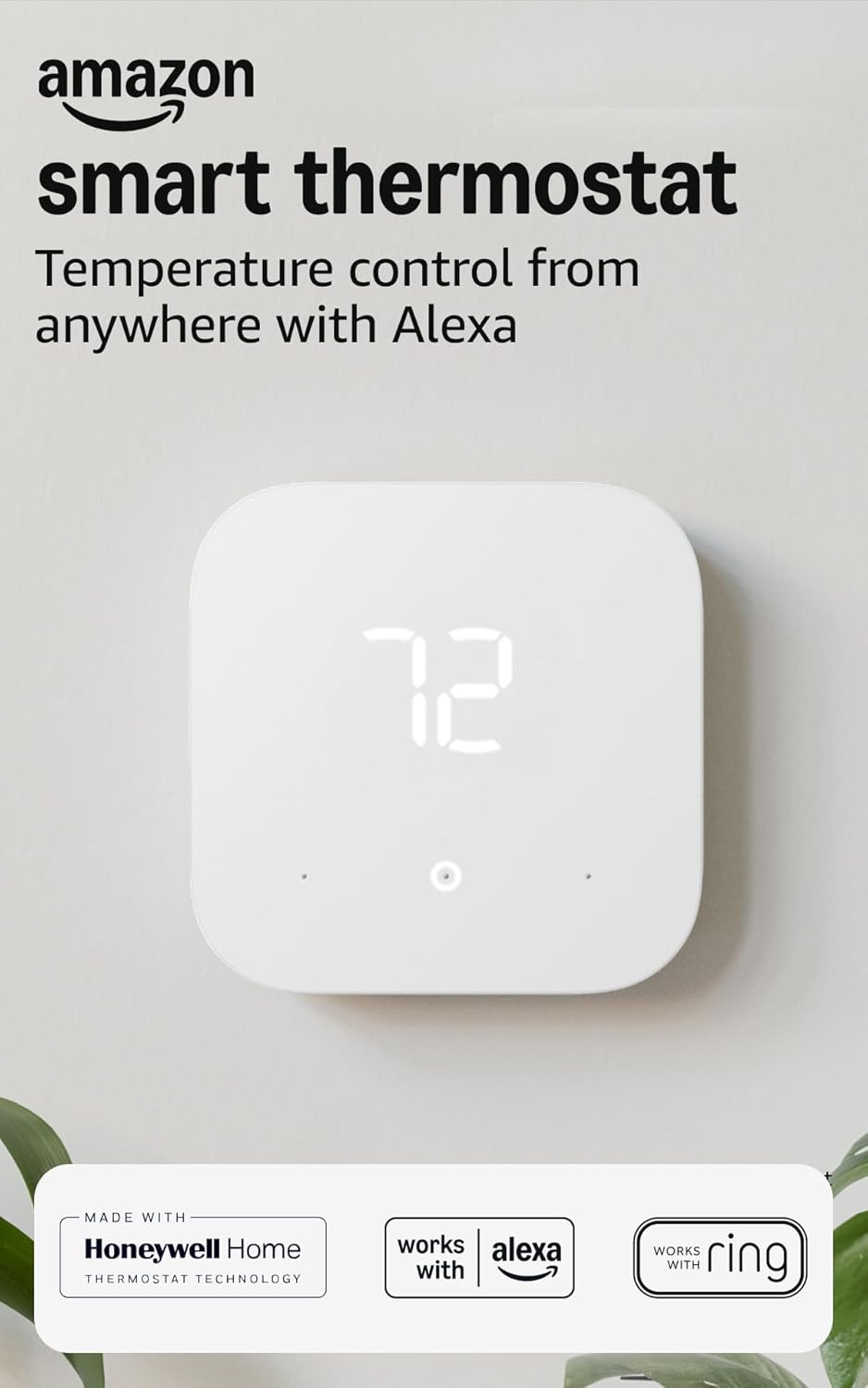
The Amazon Smart Thermostat is a straightforward Wi‑Fi thermostat that brings Alexa integration and basic scheduling to an apartment HVAC setup. It installs like a conventional thermostat (C‑wire required) and pairs with the Alexa app to create home, away, and sleep schedules or let Alexa adjust temperature based on presence and linked Echo devices. The unit supports remote control from the app, routines via Alexa+, and can share temperature data with compatible Ring and Alexa devices to create simple comfort zones. Backed by Honeywell thermostat technology, it focuses on energy savings and easy DIY setup rather than advanced HVAC diagnostics or professional-grade features. It is a good fit if you want hands‑off voice control, app scheduling, and potential utility rebate information, but it lacks the deep HVAC customization and multi‑stage system detection of higher‑end models. Expect easy voice and app controls in daily use and modest energy savings if you adopt programmable schedules.
Best for: Apartment dwellers who want simple voice control and app scheduling with a focus on easy setup and proven, mainstream thermostat technology.
Less Ideal for: People who need advanced HVAC diagnostics, multi‑stage system support, or installer‑level customization should look at higher‑end smart thermostats.
- Works with Alexa and Ring for voice control and presence‑based adjustments
- App-based scheduling and remote temperature control via the Alexa app
- Easy DIY installation with guided setup in the Alexa app
- Energy‑focused features and guidance on potential utility rebates
- Built on Honeywell thermostat technology for reliable baseline performance
- Requires a C‑wire for power which may need adapter or professional wiring
- Does not provide advanced multi‑stage HVAC diagnostics or professional installer features
Verdict: Choose this thermostat if you want an affordable, Alexa‑centric smart thermostat that makes voice control and simple scheduling easy in an apartment.
Google Nest Thermostat
| Connectivity Technology | Bluetooth, Wi-Fi |
|---|---|
| Power Source | Battery Powered |
| Display Type | LCD |
| Control Type | Remote Control, Voice Control |
| Number of Batteries | 2 A batteries required (included) |
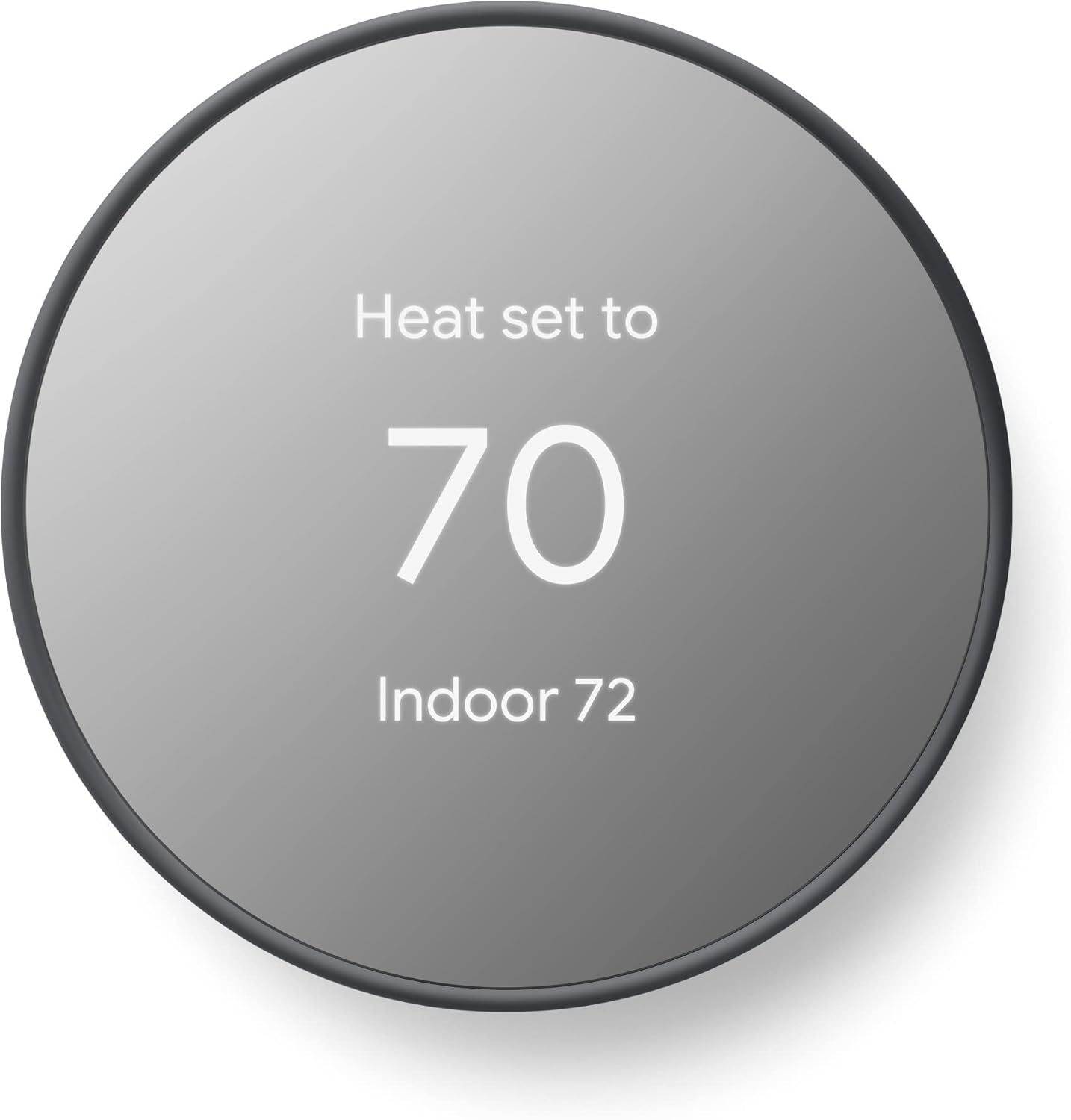
The Google Nest Thermostat is a compact smart thermostat designed for easy self-installation and everyday temperature control in apartments. It connects to 2.4 GHz and 5 GHz Wi-Fi and to other devices via Bluetooth, letting you adjust settings from the Google Home app or with voice assistants. The unit can learn simple patterns and use features like Savings Finder and Eco Temperatures to reduce energy use when you leave, and it will send alerts if it detects potential HVAC issues. Installation is straightforward for most systems and it is designed to work without a C wire in many homes, though some setups may still require one or a power accessory. The two-inch LCD and side touch bar make local control intuitive, and included batteries and mounting hardware simplify setup. Limitations include basic feature depth compared with higher-end learning thermostats and reliance on the Google Home ecosystem for the smoothest experience, which may not suit users who want the most advanced scheduling or detailed energy reports.
Best for: Apartment dwellers who want a simple, reliable smart thermostat that saves energy and can be controlled from a phone or voice assistant without complex setup.
Less Ideal for: People who need advanced, detailed HVAC analytics or the most feature-rich learning thermostat should consider higher-end models instead.
- Easy self-install with included mounting hardware and batteries
- Remote control and scheduling through the Google Home app
- Works on common HVAC systems and can operate without a C wire in many homes
- Energy-saving features like Savings Finder and automatic Eco Temperatures
- Compact, user-friendly interface with voice assistant support
- Less sophisticated learning and reporting than higher-end Nest models
- May require a C wire or power accessory on some HVAC setups
Verdict: A straightforward, apartment-friendly smart thermostat that delivers easy remote control and practical energy-saving features without a complicated install.
Choosing the Right Smart Thermostat for Apartment: Key Factors to Consider
Wiring and Power Options
Many apartments lack a dedicated C wire, so confirm how a thermostat is powered before buying. Some smart thermostats work without a C wire by using power-stealing methods or a battery pack; others require a common wire for reliable operation.
If your apartment uses electric baseboard heat or other nonstandard wiring, check whether the thermostat explicitly supports that system. Considering wiring early avoids installation roadblocks and helps you choose a model you can install without landlord permission for significant electrical changes.
Mounting and Removability
Renters need mounting solutions that are secure but reversible. Look for thermostats that offer low-impact mounting options such as adhesive plates, minimal drilling requirements, or bracket systems that leave the original wiring and wall patches intact.
Also verify whether the unit can be removed cleanly when you move. Products that require permanent wall cuts or heavy-duty anchors may not be suitable for leased spaces and can create disputes with property managers.
Heating System Compatibility
Apartments use a range of systems: electric baseboard, hydronic radiators, forced-air, or heat pump setups. Each system has different control signals and safety requirements, so make sure a thermostat explicitly lists support for your system type.
Mis-matched thermostats can lead to poor temperature control or system damage. If the building uses a centralized HVAC with building-level controls, verify whether a tenant-level thermostat is allowed or whether you can only control a local unit within your apartment.
Mobile App and Remote Control
Smart thermostats are only as useful as their control software. Evaluate the mobile app for reliability, scheduling flexibility, and remote temperature control. Intuitive scheduling, geofencing, and simple manual overrides make day-to-day use painless.
Also consider account and access controls if multiple household members will manage the unit. A clear onboarding flow and responsive app reduce time spent troubleshooting and increase the likelihood you will actually use energy-saving features.
Energy Reporting and Automation
Look for clear energy reports and automated features that reduce waste without constant tinkering. Weekly usage summaries, suggested setpoint changes, and adaptive scheduling can provide measurable savings and help you fine-tune comfort.
Automation that learns poorly or cannot be easily overridden may become frustrating. Prefer systems with transparent suggestions and easy manual control so you can balance efficiency and comfort.
Privacy, Connectivity, and Integrations
Smart thermostats connect to your home network and may transmit usage data. Check the product's privacy disclosures and account requirements to understand what data is collected and how it is used.
Also assess connectivity needs: some units require a stable Wi-Fi connection, others integrate with smart-home platforms or voice assistants. Choose a thermostat whose integration level matches your desired level of automation and privacy comfort.
Apartment-Friendly Installation Tips
Before removing an old thermostat, photograph the wiring and label each conductor. That record makes reinstallation or landlord discussions straightforward.
If you lack a C wire, try simple workarounds first: check for an unused conductor in the wall, use a battery-backed model, or consider a professional-installed C-wire adapter that is minimally invasive.
When mounting, use nonpermanent fasteners where possible and preserve any baseplates or wall anchors so the original fixture can be restored when you move.
- Turn off power at the breaker before touching wiring.
- Keep original wall plates and screws for reinstallation.
- Test the new thermostat on battery power before securing it to the wall.
Understanding Compatibility With Building HVAC
Some apartments are served by building-wide HVAC and do not permit tenant-level changes. Confirm whether you control a local thermostat or are reporting issues to building maintenance.
For electric baseboard systems, make sure the thermostat supports line-voltage control. Many smart thermostats are low-voltage only and will not work with those systems.
- Ask building management about HVAC control policies before purchasing.
- Identify whether your system is low-voltage or line-voltage to avoid buying an incompatible unit.
Maximizing Comfort While Saving Energy
Set realistic setback and schedule ranges that reflect your daily patterns rather than extreme temperature swings. Small, consistent setbacks often yield savings without sacrificing comfort.
Use geofencing and simple occupancy schedules to avoid heating or cooling an empty apartment. Combine manual overrides with automated schedules so you maintain control when plans change.
- Aim for modest setpoint changes of 2 to 4 degrees to save energy without discomfort.
- Use adaptive scheduling features sparingly at first to verify they match your living patterns.
Managing Connectivity and App Access
Place the thermostat on a stable Wi-Fi network or choose a model that supports local control where possible. Unreliable connectivity undermines the convenience of remote access and scheduling.
If multiple roommates need access, set up shared accounts or permissions in the app rather than sharing login credentials. That approach keeps control centralized and auditable.
- Check router placement and signal strength near the thermostat location.
- Enable two-factor authentication on accounts that support it for added security.
What to Do When You Move Out
Plan removal well before your move-out date. Reinstall the original thermostat and restore wiring to the prior state to avoid deductions from security deposits.
Document the condition of the wall and wiring after removal. Leave any instructions or warranty materials with the landlord if required.
- Keep the original thermostat and hardware in case management asks for it.
- Perform a quick operational test after reinstalling the original unit to confirm the system works as before.
How We Chose the Best Smart Thermostat for Apartment
We shortlisted smart thermostats that address the common constraints of apartment living: limited or nonstandard wiring, building or landlord restrictions, and the need for easy setup and reliable remote control. Our selection emphasized compatibility with common apartment heating systems, the ability to operate without a dedicated C wire when possible, and straightforward mounting that does not require invasive installation. We also prioritized thermostats with clear scheduling and mobile app controls for remote temperature management and energy-saving features like adaptive scheduling or simple setback modes. Concrete evaluation criteria included wiring flexibility, system compatibility (electric baseboard, forced air, heat pump support), ease of installation and removal for renters, mobile app usability and remote access, and energy-saving features and reporting. We excluded thermostats that require significant electrical work, permanent wiring modifications, or professional-only installation. Units that lacked clear information about compatibility or renter-friendly mounting options were not considered. Our approach weighs the practical realities of apartment life and focuses on options that balance convenience, compatibility, and energy efficiency.
Our full evaluation process is outlined in our review methodology.
FAQ
Can I install a smart thermostat in an apartment without a C wire?
Often yes. Several smart thermostats offer battery operation or power-stealing modes that work without a C wire. However, performance may vary and some features can be limited. If constant power is required, a C-wire adapter or professional wiring may be necessary.
Will installing a smart thermostat void my lease or damage the HVAC?
It depends on your lease and the building's rules. Installing a compatible thermostat typically does not harm the HVAC if done correctly, but you should get permission for any changes that alter wiring or require drilling. Use renter-friendly mounting methods to avoid disputes.
Are smart thermostats compatible with electric baseboard heating in apartments?
Many smart thermostats are designed for low-voltage systems and will not work with line-voltage baseboard heaters. Look specifically for thermostats that list line-voltage or electric baseboard compatibility before purchasing.
How much Wi-Fi reliability do smart thermostats need?
Smart thermostats require a stable connection for remote control, firmware updates, and cloud features. Basic scheduling and manual control may work without Wi-Fi, but remote access and energy reporting usually need reliable internet.
Can roommates share control of a smart thermostat?
Yes. Most thermostat apps allow multiple users or shared access so roommates can adjust schedules and temperature. Use app-specific permissions or separate accounts where available to keep control organized.
Final Verdict
When choosing a smart thermostat for an apartment, prioritize wiring compatibility, mounting that respects rental rules, and a reliable control app. Tradeoffs are inevitable: models that avoid C-wire requirements may restrict advanced features, while fully featured units often need stable power and more invasive installation. Focus on the criteria most relevant to your situation—wiring type, system compatibility, and ease of removal—and choose a thermostat that balances convenience with the energy-saving capabilities you actually intend to use.