
Note: This article contains affiliate links. If you click on these links and make a purchase, we may earn a small commission at no extra cost to you. This helps support our research and content. Read our full affiliate disclosure here.
Picking the right table fan for bedrooms matters because airflow, noise, and size directly affect sleep quality and comfort. A fan that moves enough air without sounding like a jet can make the difference between a restful night and repeated wakeups. You also need to consider placement, ease of control, and safety for nighttime use. This guide covers the top shortlisted table fans for bedrooms, highlighting the models that best balance low noise, effective airflow, and bedroom-friendly features. Below you will find practical notes on performance, convenience, and fit so you can pick the right fan for your sleeping space.
Top Picks at a Glance
| Best Overall The best all-around choice for most situations | DREO TurboPoly Table Fan DR-HAF002 |  |
| Best Quality Built to a higher standard if you want something more solid | Vornado 630 Air Circulator |  |
| Best Value The sweet spot between price and what you get | Amazon Basics Air Circulator Fan FT19-16AB |  |
| Best Budget The cheapest option that still gets the job done reliably | Gaiatop USB Desk Fan TF55B |  |
| Top Rated A top-rated pick with lots of positive feedback | IRIS USA WOOZOO Desk Fan PCF-SDS15T |  |
| Most Popular A crowd favorite that many people choose with confidence | Honeywell TurboForce HT-900 |  |
| Best Seller A high-volume bestseller chosen again and again | Honeywell TurboForce HT-904 |  |
DREO TurboPoly Table Fan DR-HAF002

| Power Source | ac |
|---|---|
| Number of Speeds | 3 |
| Noise Level | 25 db |
| Wattage | 12 watts |
| Air Flow Capacity | 800 cfm |
The DREO TurboPoly Table Fan is a small air circulator built to push air farther than a typical desk fan while staying quiet enough for bedroom use. It uses deep-pitched blades and aerodynamic design to produce up to 800 CFM airflow at three speed settings, and the head tilts to aim airflow around a room or directly at a bed or desk. The fan runs on AC power, has a plastic body that is easy to wipe clean, and includes wall-mount hardware if you prefer a mounted installation. Noise is rated at about 25 dB on low, so it can run during sleep without being intrusive, and the 12-watt motor keeps energy use low. On the downside it is a basic control set with no timer or remote and the plastic construction is utilitarian rather than premium, so it is best for someone prioritizing airflow and quiet operation over extra features or styling.
Best for: Buyers who want a quiet, energy-efficient bedroom fan that focuses on moving air effectively across a room rather than extra smart features.
Less Ideal for: Users looking for a premium metal design, app control, scheduled timers, or advanced oscillation should consider other options.
- High reported airflow (800 CFM) for a small table fan
- Quiet operation around 25 dB suitable for bedrooms
- Three simple speed settings for easy adjustment
- Adjustable tilt and optional wall-mounting for flexible placement
- Low power draw at 12 watts for efficient continuous use
- Controls are basic with no timer, remote, or smart features
- Plastic construction limits premium feel and durability
Verdict: If you need a quiet, low-power table fan that moves a lot of air for bedroom circulation, this DREO model is a practical, no-frills choice.
Vornado 630 Air Circulator

| Number of Speeds | 3 |
|---|---|
| Air Flow Capacity | 1120 cfm |
| Wattage | 50 watts |
| Noise Level | 52 db |
| Voltage | 120 volts |
The Vornado 630 is a compact whole-room air circulator that uses Vornado's vortex design to deliver continuous, directional airflow ideal for bedroom use. It offers three-speed manual controls via a dial and an adjustable tilt head so you can aim high-velocity air where you need it most. Deep-pitched plastic blades, an inlet guide cone, and a spiral grille combine to produce strong airflow capacity rated at 1120 cfm while drawing about 50 watts, which makes the unit efficient for sustained use overnight. At typical bedroom distances the fan is quiet compared with high-velocity alternatives, though the listed noise level is 52 dB on the higher setting. The plastic construction keeps the unit light and easy to move, and the removable grille makes basic cleaning straightforward. There is no remote or smart control and the fan only has three fixed speeds, so it is best for buyers who prioritize robust, focused airflow over fine-grained speed adjustments or connectivity features.
Best for: Buyers who want a performance-focused bedroom fan that moves a lot of air with simple, reliable controls and directional aiming rather than smart features.
Less Ideal for: If you need whisper-quiet operation at very low speeds, programmable timers, or app/remote control, consider other models with DC motors and finer speed steps.
- Vortex airflow design delivers strong whole-room circulation
- Three simple speed settings with an easy-to-use control dial
- Adjustable tilt head directs airflow to specific areas
- High airflow capacity (1120 cfm) while consuming about 50 watts
- Removable grille simplifies cleaning
- Only three fixed speeds and no remote or smart controls
- Plastic construction may feel less premium than metal designs
- Noise can be noticeable on the highest setting
Verdict: Choose the Vornado 630 when you want a compact, performance-first bedroom fan that delivers powerful, directional whole-room airflow with simple controls.
Amazon Basics Air Circulator Fan FT19-16AB

| Power Source | Corded Electric |
|---|---|
| Number of Speeds | 3 |
| Wattage | 35 watts |
| Noise Level | 60 db |
| Indoor Outdoor Usage | Indoor |
This Amazon Basics air circulator is a small, no-frills table fan designed to boost airflow in bedrooms and home offices. It uses three 7-inch plastic blades driven by a 35-watt motor and offers three speed settings controlled by a rear rotary knob, so you can switch between gentle breeze and stronger circulation. The head tilts up to 90 degrees for directed airflow and the fan is light and portable, making it easy to move between surfaces. Its simple plastic construction keeps the unit affordable and easy to clean, and the modest power draw helps limit energy use during long nightly runs. Noise is listed around 60 dB on higher settings, so it is noticeable at max speed and may distract light sleepers. There are no advanced features like timers, oscillation, or remote control, and build materials are basic rather than premium. For buyers who want straightforward, efficient airflow in a small footprint, this fan performs the essentials reliably without extras.
Best for: Buyers who prioritize straightforward, space-saving cooling for bedrooms or desks and want an inexpensive, energy-conscious fan that is easy to move and operate.
Less Ideal for: People seeking silent operation, whole-room oscillation, smart controls, or premium metal construction should consider other models with those features.
- Compact footprint fits on bedside tables or small desks
- Adjustable 90-degree tilt lets you aim airflow precisely
- Three speed settings cover low to high circulation needs
- Lightweight and portable for easy repositioning
- Energy efficient 35-watt motor for lower power use
- No oscillation or timer features for whole-room coverage or scheduled use
- Plastic construction feels basic compared with higher-end metal fans
- Higher speed produces noticeable noise around 60 dB
Verdict: A compact, energy-efficient bedside table fan that delivers reliable directed airflow for practical bedroom cooling.
Gaiatop USB Desk Fan TF55B

| Power Source | USB Powered |
|---|---|
| Number of Speeds | 3 |
| Noise Level | 40 db |
| Wattage | 5 watts |
| Motor Type | Brushless |
The Gaiatop USB Desk Fan is a small, portable table fan designed to deliver directed airflow at a low cost. It runs from any USB power source and offers three speeds that top out at about 4.8 m/s, making it useful for cooling a bedside table, desk, or dorm room. The fan uses a brushless motor for quieter operation and sits on a stable base with rubber feet to reduce vibration; the cover detaches so blades are easy to wipe clean. With a 5-foot cable and push-button controls, it is simple to set up and move between a laptop, power bank, or wall adapter. Limitations are its compact coverage area—this is meant for personal spot cooling rather than circulating air across a whole bedroom—and the plastic construction and small blade size mean it cannot match larger fans for raw airflow or long-range circulation.
Best for: Buyers who want an inexpensive, easy-to-use personal fan for a bedside or desk where portability and low noise matter more than room-wide circulation.
Less Ideal for: People looking to cool a whole bedroom or larger shared space should choose a larger, higher-volume fan or air circulator instead.
- USB powered for use with laptops, power banks, or adapters
- Three distinct speed settings for adjustable personal cooling
- Brushless motor designed for quieter operation
- Detachable cover and compact design make cleaning and transport easy
- Small footprint provides only localized spot cooling
- Plastic construction and small blades limit long-range airflow
Verdict: A compact, budget-friendly USB desk fan that delivers quiet, adjustable spot cooling for bedside and desktop use.
IRIS USA WOOZOO Desk Fan PCF-SDS15T

| Number of Speeds | 8 |
|---|---|
| Noise Level | 17 db |
| Air Flow Capacity | 835 cfm |
| Motor Type | brushless DC motor |
| Wattage | 96 watts |
The IRIS USA WOOZOO Desk Fan PCF-SDS15T is a small but powerful table fan designed to move air across a bedroom or office with minimal noise. It uses a brushless DC motor and offers eight speed settings plus wide horizontal and vertical oscillation to direct airflow across a room or toward a single spot. The included remote and timer (2/4/8 hours) make it convenient to adjust settings from bedside, and the low noise rating lets you run the fan while sleeping or studying. Practical benefits include a long cord for flexible placement, energy-efficient operation on lower speeds, and a compact footprint that fits on nightstands or desks. Limitations are typical of compact table fans: the plastic construction is lightweight rather than premium, and while it reaches far for its size, it is not a replacement for a whole-home air mover or an outdoor fan in very large rooms.
Best for: Buyers who prioritize a quiet, reliable bedside or desk fan that can run overnight with simple remote and timer controls and consistent performance over time.
Less Ideal for: People who need a heavy-duty air mover for large open-plan rooms or outdoor use should consider larger fans with higher airflow and more robust construction.
- Brushless DC motor for quieter, more energy-efficient operation
- Eight speeds with multi-directional oscillation for targeted or whole-room airflow
- Includes remote control and timer for convenient bedside operation
- Long power cord for flexible placement on nightstands or desks
- Plastic build is lightweight and less durable-feeling than metal alternatives
- Not intended to replace larger room or whole-house fans for very large bedrooms
Verdict: A quiet, energy-efficient table fan with strong directional airflow and convenient remote and timer controls ideal for bedroom use.
Honeywell TurboForce HT-900
| Number of Speeds | 3 |
|---|---|
| Air Flow Capacity | 185 cfm |
| Wattage | 35 watts |
| Motor Type | brushless |
| Installation Type | Tabletop or Wall Mount |
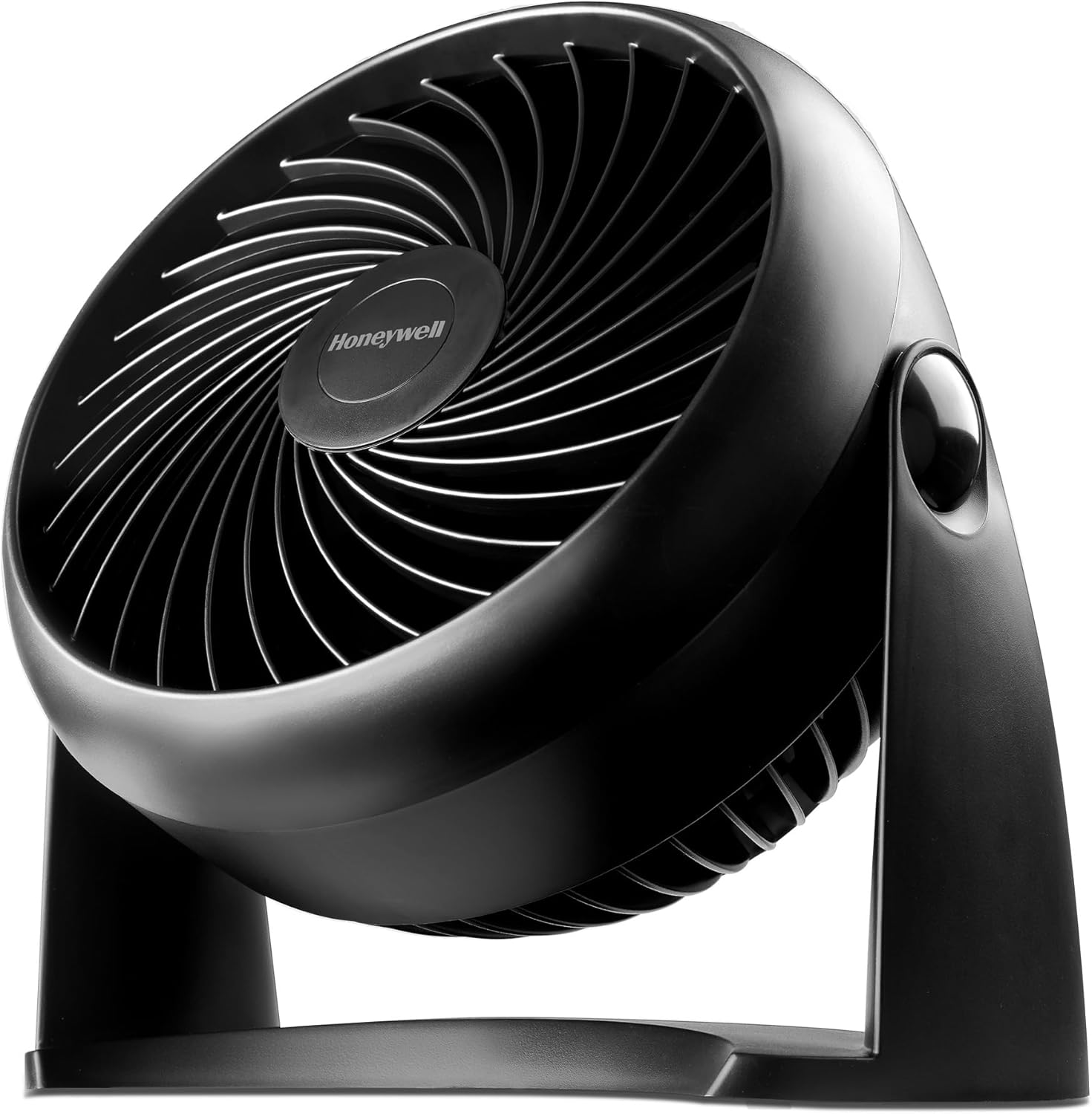
The Honeywell TurboForce HT-900 is a small, corded tabletop fan built to move a surprising amount of air for its size. It has an aerodynamic turbo housing and three push-button speeds that deliver up to 185 cfm, so it works well as a desk fan or for boosting circulation in a bedroom alongside an air conditioner. The adjustable head pivots 90 degrees to target airflow where you need it, and the plastic housing keeps the unit lightweight and easy to reposition or wall-mount. Noise is low on the lower speeds, making it suitable for night use, and the brushless-type motor promises reliable everyday operation. Expect simple manual controls with no timer or remote and basic plastic construction that is durable but not premium feeling. For routine cooling and air circulation in small spaces this fan is effective and fuss-free, but it does not offer smart features or advanced noise isolation found on higher-end models.
Best for: Buyers who prioritize proven performance and social proof—people seeking a reliable, no-frills bedroom fan that consistently delivers strong airflow and low noise.
Less Ideal for: Anyone wanting a premium-feeling fan, integrated smart features, or scheduled/remote control should consider more feature-rich models.
- Compact turbo housing produces strong airflow up to 185 cfm for a small fan
- Three simple push-button speeds with a 90-degree pivoting head for directed cooling
- Lightweight and suitable for table, desk, or wall-mounted placement
- Relatively quiet operation on low settings, appropriate for bedrooms
- Basic plastic construction lacks premium materials and extra durability cues
- No timer, remote, or smart controls for scheduled or remote operation
Verdict: A compact, reliable table fan that delivers strong, quiet airflow for bedroom cooling without frills.
Honeywell TurboForce HT-904
| Power Source | Corded Electric |
|---|---|
| Number of Speeds | 3 |
| Air Flow Capacity | 185 cfm |
| Noise Level | 25 db |
| Motor Type | Brushless |
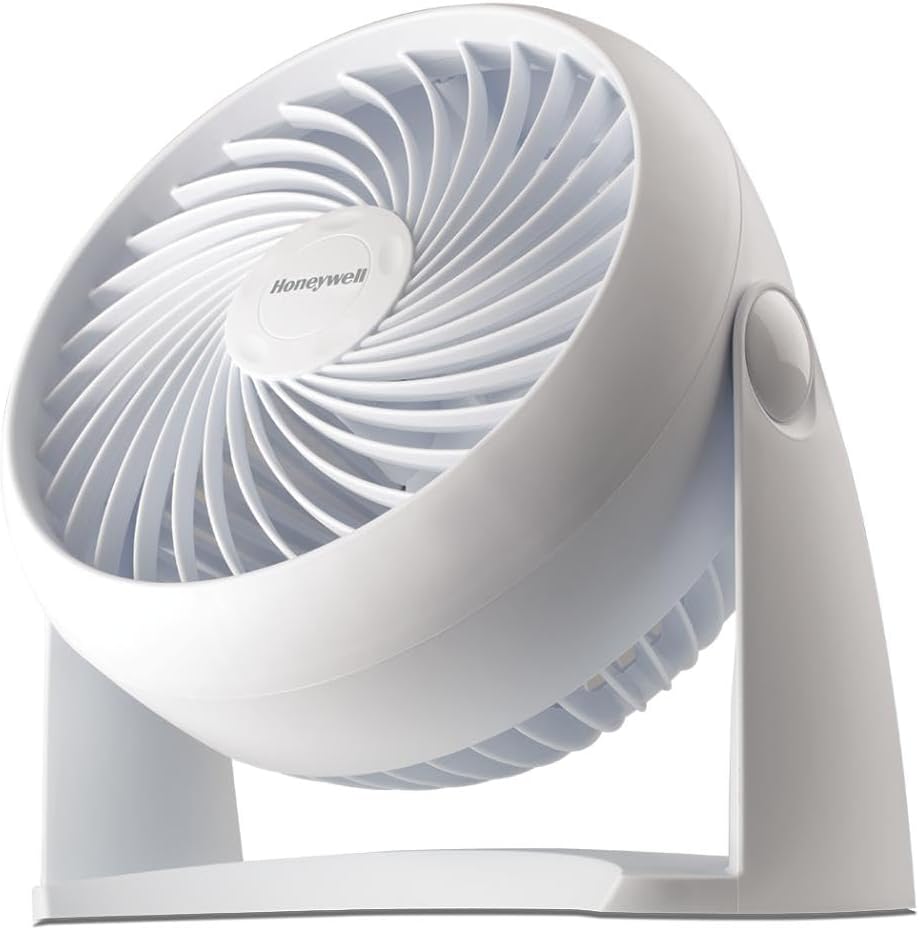
The Honeywell TurboForce HT-904 is a small tabletop fan built to move a lot of air for its size while staying quiet enough for bedroom or home-office use. It uses an aerodynamic turbo design and a brushless motor to produce up to 185 cfm of airflow from a compact housing, and the 90-degree pivoting head plus three straightforward speed settings make it easy to aim cooling where you need it. Practical touches include a corded power source and a simple push-button control layout that are reliable for daily use. In practice the fan delivers noticeable circulation across small to medium rooms and can supplement or reduce air-conditioner runtime. The main compromises are its basic manual controls and plastic blade construction, so it lacks advanced features like a timer, remote, or variable speed dial, and it is best for direct airflow rather than whole-house ventilation. For buyers who prioritize dependable cooling, low noise, and simple operation, this model is a robust, no-frills choice.
Best for: Buyers who want a reliable, easy-to-use bedroom or desk fan that prioritizes quiet, effective airflow over smart features or fancy controls.
Less Ideal for: People seeking app control, timers, or premium materials and finishes should consider models that offer advanced features and higher-end construction.
- Powerful aerodynamic design delivers strong airflow (185 cfm) for its compact size
- Quiet operation suitable for bedrooms with a low noise rating
- Three-speed control and 90-degree pivoting head for easy directional cooling
- Brushless motor for reliable, energy-efficient performance
- Basic manual controls with no timer, remote, or advanced features
- Plastic blades and simple construction may feel less premium
Verdict: A dependable, quiet tabletop fan that delivers strong directed airflow for bedroom and desk use without complicated controls.
Choosing the Right Table Fan for Bedrooms: Key Factors to Consider
Noise Level
Bedroom fans are used for long periods while you sleep, so noise level is a top priority. Look for measured noise ratings or manufacturer claims for low-speed operation and compare how loud the fan is at typical bedside distances. A fan with a smooth, steady sound is less likely to wake sensitive sleepers than one that produces rattles or tonal whines.
Consider whether the unit offers multiple speed steps or a low-power night mode that reduces noise. Noise becomes especially important if you use the fan for white-noise masking; in that case, a consistent, broadband hum is preferable to intermittent mechanical sounds.
Airflow And Coverage
Airflow determines how effectively a fan cools a bedroom and whether you need multiple units. For bedside use, look for fans that produce a focused breeze with adjustable tilt so air can be directed at the pillow or across the bed. Manufacturer airflow ratings (CFM) can help compare units, but also evaluate airflow distribution—some fans push a narrow jet while others create a wider, gentler circulation.
Smaller bedrooms need less overall flow than large master bedrooms. If you sleep with multiple people or want to circulate air throughout the room, pick a fan with higher airflow or a wider oscillation range.
Size, Footprint, And Placement
Table fans must fit on nightstands, dressers, and other small surfaces. Measure available tabletop space and choose a fan with a compact base and stable stance to avoid accidental tipping. Low-profile designs or models with smaller diameters are easier to place without crowding lamps, books, or alarm clocks.
Also consider the fan height and tilt range. Taller stands can throw air farther across the bed, while a low-profile fan may be better for side tables. If you have limited space, prioritize stable, narrow-footprint designs that still allow effective airflow.
Controls And Convenience Features
Bedside fans should be simple to operate in low-light conditions. Look for tactile buttons, clearly labeled dials, or a remote control for adjusting speed without leaving bed. Programmable timers and auto-off functions let you set the fan to run only while you fall asleep, saving energy and preventing overnight noise.
Other convenience features include built-in nightlight options, quiet oscillation modes, and memory functions that restore your last setting after power interruptions. Ease of cleaning and access to the grille also matter for long-term maintenance.
Energy Use And Runtime
Fans are typically much more energy-efficient than air conditioners, but power draw still affects long-term operating cost. Check wattage at typical low and medium settings to estimate nightly consumption. Lower-power motors and efficient blade designs can provide adequate airflow with minimal electricity use.
If you plan to run a fan all night every night, choose models with lower continuous power draw and consider features like sleep timers or eco modes to reduce energy use when full airflow is not needed.
Safety And Build Quality
Safety is important in a bedroom environment. Look for grills that prevent small fingers from reaching the blades, stable bases that resist tipping, and materials that stay cool to the touch. Certifications or basic compliance with safety standards add confidence for long-term use.
Durable construction and a solid motor reduce the chances of rattles and mechanical noise developing over time. Also consider whether the fan has easy-to-clean surfaces and replaceable parts to extend service life.
Where To Place A Table Fan In The Bedroom
Placement affects both comfort and noise perception. Position a fan so airflow reaches your head and torso without blasting directly into your face if you prefer gentler cooling. For single sleepers, placing the fan on a low nightstand angled toward the pillow often provides the best balance of airflow and quiet. For couples, a central dresser or bedside table that directs a wider sweep of air can improve circulation without excessive noise for either partner.
- Angle the fan slightly upward to circulate air across the bed rather than directly at your head.
- Avoid placing fans too close to walls where reflected noise can increase perceived volume.
- Use a timer to run the fan while falling asleep and reduce speed later to minimize overnight noise.
Using Fans To Help With Sleep And White Noise
Many people use table fans both for cooling and for consistent background sound. A fan that produces a steady, broadband hum can mask household noises and make it easier to fall asleep. If white noise is the goal, test a fan at low speeds to ensure it provides a continuous sound without mechanical clicks or pitchy vibrations that may become irritating over time.
- Low, steady-speed settings are usually best for white-noise masking.
- Check for audible oscillation mechanisms, which can cause intermittent sounds at some speeds.
- If you rely on white noise, prefer fans with variable-speed control to fine-tune the sound level.
Maintenance And Cleaning Tips
Regular cleaning keeps a fan running quietly and efficiently. Dust buildup on blades and in the grille reduces airflow and can create imbalance that increases vibration and noise. Most table fans allow the grille to be removed for blade wiping; follow the manufacturer instructions for safe disassembly and reassembly. Besides dusting, inspect the base and tilt mechanisms periodically for looseness. Tighten any fasteners that have worked free and lubricate moving parts only if the design and documentation recommend it.
- Unplug the fan before cleaning and use a soft cloth for blades.
- Clean grille openings with a brush to avoid accumulation that restricts airflow.
- Check for wobble and correct loose fittings to prevent new noise sources.
Managing Nighttime Safety And Convenience
Nighttime use raises safety and convenience considerations. Choose models with stable bases and protective grilles to reduce the risk of contact with blades. For homes with children or pets, stricter grille spacing and tip-over protection are especially valuable. Convenience features such as a remote control, easy-to-read indicators, or a memory function reduce the need to handle the unit in the dark. If you use a fan with a timer, program it to turn off after you are likely to have fallen asleep to save energy and limit noise exposure.
- Prefer models with anti-tip designs or low centers of gravity.
- Remote controls or illuminated dials help make adjustments without turning on room lights.
- Look for models with one-touch night modes or sleep timers for automatic overnight behavior.
How We Chose the Best Table Fan for Bedrooms
We prioritized features and performance that matter for nightstand and bedside use. Our selection filters focused on noise output at typical sleeping distances, measured airflow or manufacturer airflow ratings for small rooms, and available speed or mode options that allow fine control. We also considered physical footprint and mounting or tilt options so the fan fits on common bedside furniture, plus safety features such as grille design and tip-over stability for use near beds. Practical usability was another core filter. We included products with straightforward controls, programmable timers, or remote control for nighttime convenience. Energy efficiency and typical power draw were reviewed to favor options that can run for hours on low cost. We excluded large floor or industrial fans, specialty outdoor units, and devices lacking clear noise or airflow specs. In short, we selected fans that balance quiet operation, controllable airflow, compact size, energy use, and simple bedside-friendly features.
Our full evaluation process is outlined in our review methodology.
FAQ
How loud is a typical bedroom table fan at night?
Typical bedroom table fans on low settings range from very quiet to moderately audible depending on motor design and build quality. Many modern bedside fans are engineered for low decibel output and produce a soft, steady hum rather than disruptive mechanical sounds.
Can a small table fan cool a whole bedroom?
A small table fan can improve comfort locally and help circulate air, but its ability to cool an entire bedroom depends on room size and fan airflow. For full-room circulation, choose a model with higher airflow ratings or wider oscillation rather than a purely narrow, focused breeze.
Is it safe to run a table fan all night?
Running a table fan overnight is generally safe when the unit is used according to its instructions, placed on a stable surface, and kept clear of obstructions. Ensure the fan has a stable base and intact grille, and avoid leaving it where it can be knocked over by pets or children.
How often should I clean my bedroom fan?
Clean your bedroom fan every few weeks if you use it regularly; homes with more dust or pets may require more frequent cleaning. Regular blade and grille cleaning prevents airflow loss and reduces noise from imbalanced blades.
Do oscillation and tilt matter for bedside use?
Yes. Oscillation helps distribute air across a wider area, which is useful for cooling multiple sleepers or circulating room air. Adjustable tilt lets you direct airflow precisely at the pillow or across the bed, improving personal comfort without increasing overall noise.
Final Verdict
When choosing a table fan for bedrooms, prioritize low noise, suitable airflow for your room size, and bedside-friendly controls. Balance the need for a focused breeze at the pillow with a compact, stable footprint that fits your furniture and minimizes risk of tipping. Decide whether you value white-noise masking or stronger cooling, then select a fan with the appropriate speed range, timer or memory features, and safety grille. Focusing on these tradeoffs will help you pick a bedside fan that provides comfortable, quiet cooling through the night.