
Note: This article contains affiliate links. If you click on these links and make a purchase, we may earn a small commission at no extra cost to you. This helps support our research and content. Read our full affiliate disclosure here.
Picking the right table fan makes summer more comfortable without turning your room into a noisy wind tunnel. A well-chosen Table Fan delivers targeted airflow where you need it, fits small surfaces, and uses minimal energy compared with larger room systems. This guide shortlists the top models across common use cases and highlights the features that matter for daily comfort. Below we cover five leading Table Fans and explain how we evaluated airflow, noise, and controls so you can pick the fan that suits your space and schedule.
Top Picks at a Glance
| Best Quality Built to a higher standard if you want something more solid | Rowenta Turbo Silence Desk Fan VU2730 |  |
| Best Value The sweet spot between price and what you get | Amazon Basics Air Circulator Fan FT19-16AB |  |
| Best Budget The cheapest option that still gets the job done reliably | Gaiatop USB Desk Fan TF55B |  |
| Top Rated A top-rated pick with lots of positive feedback | IRIS USA WOOZOO Desk Fan PCF-HE18 |  |
| Most Popular A crowd favorite that many people choose with confidence | Honeywell TurboForce HT-900 |  |
Rowenta Turbo Silence Desk Fan VU2730

| Power Source | Corded Electric |
|---|---|
| Number of Speeds | 4 |
| Noise Level | 38 db |
| Air Flow Capacity | 1589 cfm |
| Wattage | 45 watts |
The Rowenta Turbo Silence Desk Fan is a compact tabletop fan built to move a lot of air quietly. It offers a high airflow rating (up to 1,589 ft3/min) and four speeds, including a Silent Night setting for near-silent operation and a Turbo Boost for maximum refreshment. The fan oscillates about 120 degrees and its adjustable head helps spread airflow across a room, making it useful on a bedroom nightstand, home office desk, or small living area. Controls are simple with push-button speed selection and a remote for convenience, and the metal/plastic construction feels stable while the safety grid adds peace of mind around children. The main trade-offs are its corded design and weight for a desk fan, which reduce portability compared with battery-powered models, and the high airflow at top speed can still be loud compared with the minimum 38 dB rating. For buyers who prioritize quiet but powerful cooling in a compact package, this fan balances performance and everyday usability well.
Best for: Buyers who want the strongest possible cooling from a compact table fan while keeping noise low during normal use, especially for bedrooms or home workspaces.
Less Ideal for: People who need a lightweight, battery-powered portable fan for travel or outdoor use should consider a dedicated portable model instead.
- Very high maximum airflow for strong cooling reach
- Low-noise minimum setting (38 dB) suitable for sleeping or studying
- Four speed settings including a Turbo mode and a Silent Night mode for flexible use
- 120° oscillation and adjustable head provide wide room coverage
- Corded design and relatively heavy for a desk fan, limiting battery-free portability
- Maximum speed produces noticeably more noise despite strong airflow
Verdict: Choose this fan when you need compact but powerful airflow with very quiet low-speed operation for bedrooms and home offices.
Amazon Basics Air Circulator Fan FT19-16AB

| Power Source | Corded Electric |
|---|---|
| Number of Speeds | 3 |
| Wattage | 35 watts |
| Noise Level | 60 db |
| Indoor Outdoor Usage | Indoor |
This Amazon Basics table air circulator is a straightforward, no-frills fan designed to move air in small to medium rooms. It has three 7-inch plastic blades driven by a 35-watt motor and a back-mounted rotary knob that selects low, medium, and high speeds. The head tilts up to 90 degrees so you can direct airflow to a bed, desk, or seating area, and the fan is light and portable for easy repositioning. Setup is essentially plug-and-play and the corded design means consistent power without recharging or batteries. Because it is made of plastic and uses a basic rotary control, it lacks advanced features like timers, remote control, or oscillation, but those omissions keep the unit compact and simple to operate. Noise at higher speeds is noticeable but typical for a budget table fan. For buyers who want reliable air circulation without extras, this fan delivers usable airflow, low power draw, and easy placement around the home.
Best for: Buyers who prioritize straightforward, low-power air circulation and want a compact, easy-to-move fan for bedrooms, home offices, or small living spaces.
Less Ideal for: People who need powerful whole-room circulation, quiet operation at high speeds, or smart features like timers and remote control should consider larger or feature-rich models instead.
- Simple three-speed rotary control that is easy to use.
- Adjustable 90-degree tilt lets you aim airflow where needed.
- Compact and lightweight design makes it easy to move and fit on desks or bedside tables.
- Energy efficient 35-watt motor for low power consumption.
- No oscillation, timer, or remote so direction and scheduling must be adjusted manually.
- Plastic construction limits durability and feels basic compared with metal models.
Verdict: A compact, energy-efficient table air circulator that delivers reliable directed airflow for buyers who want simple, portable cooling.
Gaiatop USB Desk Fan TF55B

| Power Source | USB Powered |
|---|---|
| Number of Speeds | 3 |
| Noise Level | 40 db |
| Wattage | 5 watts |
| Motor Type | Brushless |
The Gaiatop USB Desk Fan is a compact table fan designed for personal cooling at a desk, bedside, or in a small travel setup. It runs from any USB power source and offers three speed settings for adjustable airflow, with the highest setting reaching about 4.8 m/s. The fan uses a brushless motor and five plastic blades for efficient, relatively quiet operation and includes a stable base with rubber pads to limit vibration. A detachable front cover makes blade cleaning simple, and the head tilts 90 degrees to direct air where you need it. Practical benefits include low power draw, a long 5 ft cable for flexible placement, and a lightweight portable design that fits in bags. Limitations are its small sweep and limited room coverage, so it is best for individual cooling rather than circulating air across a larger room, and the plastic construction means it is not as durable as heavier, higher-end table fans.
Best for: Buyers who want an inexpensive, portable personal fan for a desk, bedside, or travel use and prioritize low power draw and easy cleaning.
Less Ideal for: People who need whole-room circulation, high durability, or a heavy-duty fan for large spaces should consider larger models instead.
- USB powered for use with laptops, power banks, and USB adapters
- Three speed settings let you pick gentle to strong airflow
- Compact, lightweight and easy to carry for travel or dorm use
- Detachable cover and simple construction make cleaning straightforward
- Stable base with rubber pads reduces vibration and slipping
- Small 5.5-inch blades provide limited coverage suitable only for personal cooling
- All-plastic construction is less rugged than metal-bodied fans
Verdict: A budget-friendly, portable USB desk fan that delivers adjustable personal airflow and easy maintenance for small-space cooling.
IRIS USA WOOZOO Desk Fan PCF-HE18

| Number of Speeds | 3 |
|---|---|
| Noise Level | 29 db |
| Wattage | 96 watts |
| Power Source | Corded Electric |
| Motor Type | Brushless |
The IRIS USA WOOZOO Desk Fan is a compact tabletop air circulator designed to move air efficiently across small to medium rooms. It uses deep-pitch blades and an aerodynamic spiral grille to push air up to about 36 feet and cover roughly 244 square feet while remaining quiet at lower settings. The fan offers three speed settings accessed via push-button controls, a brushless motor for more consistent performance and longer life, and adjustable oscillation and vertical tilt so you can direct airflow where needed. Its lightweight plastic housing and built-in handle make it easy to move between a desk, nightstand, or countertop. Practical benefits include reliable everyday cooling, low-noise operation suitable for work or sleep, and simple controls with a small footprint. Limitations are the basic three-speed manual control with no timer or remote and a plastic build that is functional but not premium-feeling compared with higher-end metal fans.
Best for: Buyers who prioritize a dependable, low-noise desk fan for everyday cooling in bedrooms, home offices, or dorms and want simple, durable operation without extra smart features.
Less Ideal for: If you need remote control, programmable timers, or a heavy-duty premium-metal fan for aesthetics, this model is not the best choice.
- Brushless motor for consistent operation and longer expected lifespan
- Quiet performance down to about 29 dB, suitable for bedrooms and offices
- Three straightforward speed settings with adjustable oscillation and tilt
- Compact, lightweight design with a built-in handle for easy relocation
- Controls are basic push-button only with no remote or timer
- Plastic construction lacks premium build feel compared with metal options
Verdict: A reliable, quiet desktop air circulator that delivers straightforward, durable cooling for everyday use.
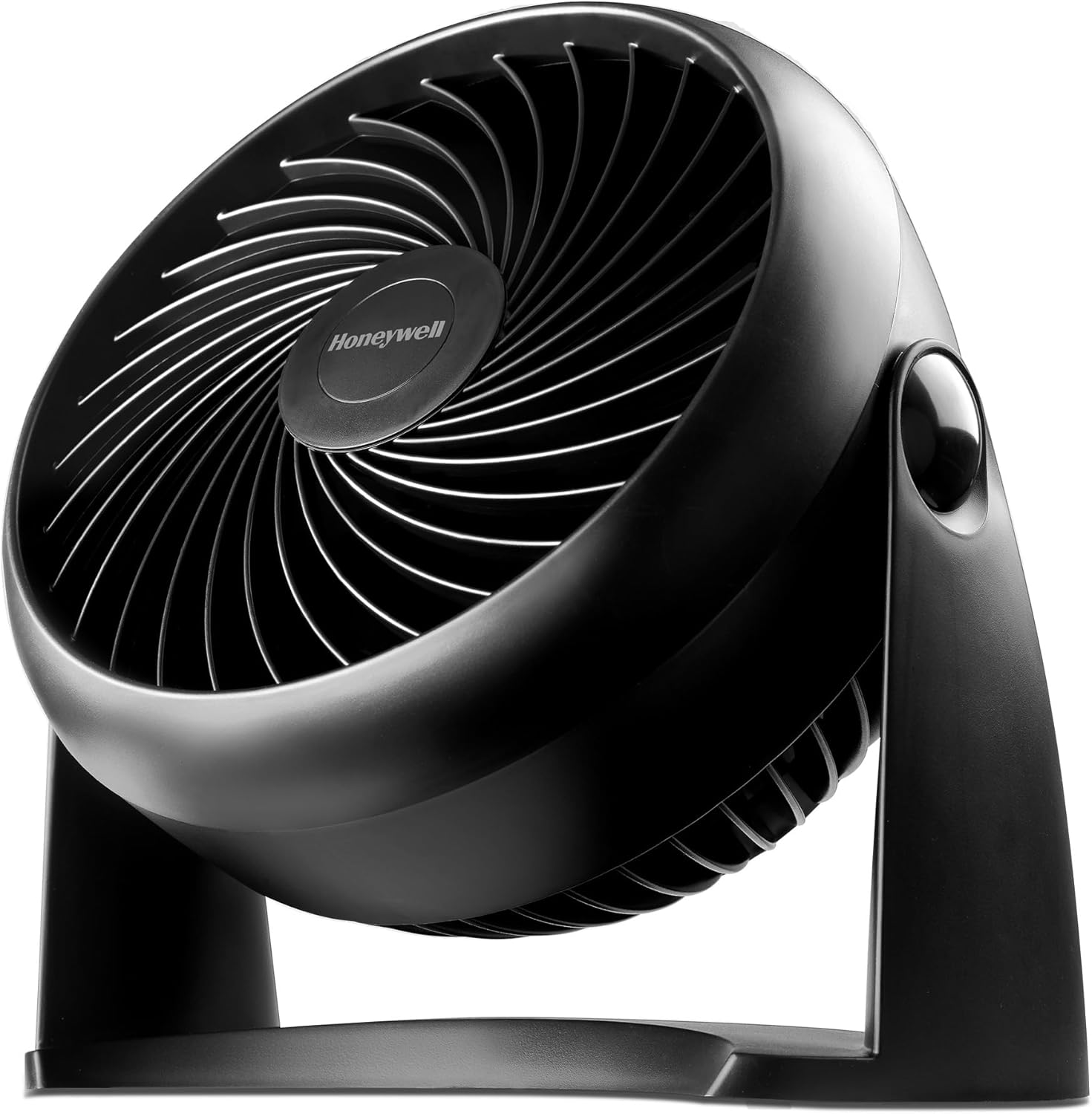
Honeywell TurboForce HT-900
| Power Source | Corded Electric |
|---|---|
| Number of Speeds | 3 |
| Wattage | 35 watts |
| Air Flow Capacity | 185 cfm |
| Motor Type | brushless |
The Honeywell TurboForce HT-900 is a small, corded tabletop air circulator designed to move a surprising amount of air for its size. It has an aerodynamic three-blade design driven by a brushless motor and three push-button speed settings, letting you choose quiet low airflow for sleep or higher output for spot cooling; the manufacturer claims usable airflow up to about 25 feet. The head pivots 90 degrees so you can direct the breeze where you need it and the unit can also be wall-mounted for added flexibility. At 35 watts it is energy efficient and the compact plastic build makes it easy to move between a desk, nightstand, or shelf. Limitations include basic manual controls with no timer or remote and a plastic exterior that is functional but plain compared with higher-end metal or designer fans. Noise is marketed as very low, but output at top speed can still be noticeable in very quiet rooms. For straightforward, reliable spot cooling the HT-900 performs exactly as intended.
Best for: Buyers who want a proven, no-frills tabletop fan that reliably delivers targeted cooling and value, and who prioritize user reviews and established performance when choosing small room fans.
Less Ideal for: Those seeking a feature-rich or designer fan with remote control, programmable settings, or premium metal construction should consider more advanced models.
- Compact, portable design that works on a desk or mounts to a wall
- Three speeds and 90-degree pivoting head for targeted airflow
- Brushless motor and 35W power draw offer efficient, reliable operation
- Aerodynamic TurboForce design provides strong airflow for a small fan
- Controls are manual push buttons with no remote or timer
- Basic plastic construction lacks premium materials or styling
Verdict: A compact, dependable tabletop circulator that delivers strong, targeted airflow and reliable performance for buyers who value proven results.
Choosing the Right Table Fan: Key Factors to Consider
Airflow and Coverage
Airflow determines how effectively a Table Fan moves air across a desk, bedside table, or small living area. Look for fans with multiple speed settings and a clear description of airflow patterns so you can match output to the size of the space. Oscillation and adjustable tilt extend coverage, letting a single fan serve multiple people or direct a concentrated breeze when you need it.
Higher airflow is useful for larger tables or open areas, while a focused, lower-speed setting is better for near-field cooling like reading or sleeping. Consider how the fan distributes air at different speeds rather than judging solely by the highest setting.
Noise Performance
Noise matters if the fan will run in a bedroom, office, or other quiet environment. Fans with smoother motors, aerodynamic blade designs, and vibration-dampening mounts usually deliver quieter operation. Check for models that provide noise data, quiet mode settings, or proven low-decibel performance for overnight use.
Balance the need for airflow with acceptable sound. A very powerful fan that is loud at medium speeds may not be appropriate for a bedside table, whereas a quieter fan with steady low-to-medium airflow can be more comfortable during long use.
Controls and Convenience
How you interact with the Table Fan affects daily usability. Physical dials or push-buttons provide simple, reliable control, while remote control or an integrated timer adds convenience for hands-off operation. Variable speed steps, mode presets, and easy-to-read indicators help you dial in comfort quickly.
Consider whether you need a night mode, a programmable timer for automatic shutoff, or a remote for hard-to-reach placements. Simple, intuitive controls reduce frustration and make frequent adjustments less cumbersome.
Size, Weight, and Stability
Table Fans must fit on small surfaces and stay stable during operation. Compact dimensions and modest weight make placement flexible, but the design must ensure a low center of gravity and anti-slip feet to prevent tipping. Evaluate the fan's footprint relative to the surface you plan to use and whether it blocks other items.
For shared spaces, a slightly heavier base is preferable. Lightweight fans are easier to move between rooms but may need careful placement to avoid accidental knocks.
Energy Use and Motor Type
Energy efficiency affects running costs and suitability for continuous or overnight use. Fans with efficient motors or DC designs typically draw less power at comparable airflow than older AC motors. Check for energy-saving modes or low-power settings that maintain comfort while reducing consumption.
Motor type also influences longevity and noise. Brushless motors or well-built AC motors generally last longer and run quieter, making them a better long-term investment for frequent use.
Safety and Maintenance
A secure grille, stable base, and reliable wiring are essential for safe tabletop placement, especially around children and pets. Removable grills or tool-free disassembly simplify cleaning, which preserves airflow and prevents dust buildup that can reduce efficiency.
Consider whether replacement parts or service options are available and whether the fan design allows straightforward cleaning of blades and motor housings without requiring specialized tools.
Where Table Fans Work Best
Table Fans excel at targeted, short-range cooling for desks, nightstands, and small seating areas. They are best when you want direct airflow without cooling an entire room. Because they are compact, they fit into workspaces and bedside setups where a floor or ceiling unit would be overkill.
Use a table fan to supplement ventilation, speed up drying after small spills, or circulate air near windows to even out temperature differences. Their portability makes them useful in multi-room homes where temporary, spot cooling is needed.
- Direct personal cooling at a desk or bedside
- Supplementing HVAC circulation in localized areas
- Portable use for quick, temporary airflow
Matching Fan Features to Your Space
Smaller rooms benefit from fans with smooth oscillation and lower minimum speeds to avoid drafts. For a home office, prioritize a model with reliable low-noise performance and a focused airflow mode that keeps you cool without interrupting video calls.
If the fan will be placed on a shelf or high surface, ensure the tilt range and oscillation span reach the intended area. For shared tables, choose models with wider oscillation or multiple fan heads to distribute air more evenly.
- Bedrooms: quiet modes and timers
- Desks: focused airflow and compact footprint
- Shared spaces: wider oscillation and adjustable tilt
Installation, Placement, and Safety Tips
Place the fan on a stable, flat surface away from edges to reduce the risk of tipping. Keep the cord out of walkways and avoid placing the fan where it can blow directly onto liquid-filled containers. For night use, set timers or low-speed modes to save energy and reduce noise.
Regularly clean the grill and blades to maintain airflow and prevent dust from entering the motor housing. If you move the fan between rooms, disconnect and inspect the cord for wear before reuse.
- Use anti-slip pads or a heavier base on narrow surfaces
- Avoid placing fans where pets or children can reach moving parts
- Unplug before cleaning or moving the fan
When a Table Fan Is Not the Right Choice
Table Fans are not ideal for cooling large open-plan spaces or whole rooms where air distribution needs to be broad and consistent. In those cases, you will get more even results from larger fans or whole-room systems designed for higher CFM output.
If you require humidity control, air filtration, or temperature reduction beyond direct airflow, a standalone fan will not meet those needs. Consider whether a fan is the right tool for the problem you are trying to solve before committing to a tabletop option.
- Not suited for whole-room cooling
- Does not dehumidify or filter air
- Limited effectiveness in very large or high-ceiling spaces
How We Chose the Best Table Fan
We selected models that balance effective airflow, quiet operation, thoughtful controls, and build durability for everyday home use. Our filters prioritized measurable performance and real-world convenience: variable speed range and airflow distribution, noise output at typical settings, oscillation and tilt flexibility, control options including timers and remote or onboard switches, and overall construction and warranty support. We excluded specialty industrial blowers and very niche novelty fans that do not offer variable control or consistent airflow. We also set aside models lacking clear user-facing controls or with poor stability for tabletop placement. The result is a shortlist focused on fans that are compact, easy to position, and designed for regular indoor use. Evaluation emphasized concrete, buyer-relevant specs and features rather than brand perception. We looked for clear documentation of airflow or speed steps, measured or reported noise characteristics, reliable oscillation or directional control, and durable materials or safety features that matter for home environments.
Our full evaluation process is outlined in our review methodology.
FAQ
How loud are table fans on average?
Noise varies widely depending on motor type and blade design. Many models have quiet modes that run around typical indoor noise levels, while higher speeds produce noticeably more sound. Look for reported decibel data or user descriptions if low noise is important.
Can a table fan cool a whole small room?
A table fan can improve circulation and create a cooling effect near occupants, but it usually cannot lower the overall room temperature significantly. For whole-room cooling, a larger dedicated unit or improved ventilation is more effective.
Are remote controls and timers worth it?
Remote controls and timers add convenience, especially for bedside or hard-to-reach placements. They are useful for overnight use and make it easy to adjust settings without getting up. Whether they are worth it depends on how often you plan to change settings remotely.
How often should I clean a table fan?
Clean accessible grills and blades every few weeks if used frequently, and more often in dusty environments. Regular cleaning maintains airflow efficiency and reduces strain on the motor, extending the fan's useful life.
Do DC motor fans use less energy than AC?
Generally, fans with DC or brushless motors run more efficiently and can deliver similar airflow at lower power draw compared with some AC designs. Efficiency gains depend on motor quality and design rather than motor type alone.
Final Verdict
When choosing a Table Fan, prioritize the combination of airflow and noise performance that matches how and where you will use the unit. For bedside and office use, quiet operation and precise speed control matter most. For shared or larger tabletop areas, wider oscillation and stronger airflow take priority. Weigh tradeoffs between portability and stability, and consider energy-efficient motor options for continuous use. Use the factors above to narrow choices and pick a fan that delivers comfortable, controllable airflow for your daily needs.