
Note: This article contains affiliate links. If you click on these links and make a purchase, we may earn a small commission at no extra cost to you. This helps support our research and content. Read our full affiliate disclosure here.
If your home runs on well water, selecting the right tank water heater matters more than it does on municipal systems. Well water often contains minerals, sediment, and varying pH that can accelerate corrosion, impair burners or elements, and shorten service life. You need a tank water heater for well water that balances corrosion resistance, an adequate recovery rate, and serviceability. This guide shortlists the top tank water heaters for well water across common capacities and fuel types. We evaluated units for durability, maintenance friendliness, and the practical performance factors that affect day-to-day hot-water reliability. Read on to see the criteria we used and the features to prioritize when choosing a model for a well-supplied home.
Top Picks at a Glance
| Best Overall The best all-around choice for most situations | GE 18 Gallon Lowboy Water Heater |  |
| Best Quality Built to a higher standard if you want something more solid | Bosch Tronic 3000 T ES2.5 Mini-Tank |  |
| Best Value The sweet spot between price and what you get | VEVOR 6-Gallon Electric Tank Water Heater |  |
| Best Budget The cheapest option that still gets the job done reliably | Ganggend 2.5-Gallon Mini Tank Water Heater |  |
| Top Rated A top-rated pick with lots of positive feedback | ThermoMate ES800 8-Gallon Water Heater |  |
| Most Popular A crowd favorite that many people choose with confidence | BISELONG BI-2.5 2.5-Gallon Water Heater | 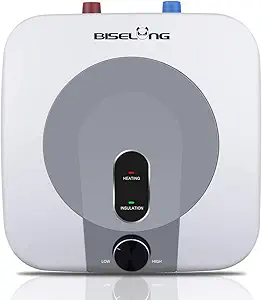 |
| Best Seller A high-volume bestseller chosen again and again | GE 10 Gallon Point-of-Use Water Heater |  |
GE 18 Gallon Lowboy Water Heater

| Power Source | Electric |
|---|---|
| Wattage | 3800 watts |
| Voltage | 240 volts |
| Capacity | 18 gallons |
| Efficiency | 0.93 (Uniform Energy Factor) |
This GE 18-gallon lowboy electric water heater is built for tight spaces and small households, delivering hot water for one to two people without a tall tank footprint. It uses a 240V electric supply and a 3800 watt heat output for relatively fast recovery, and the inlet tube design draws cold water from the bottom of the tank to maximize available hot water. Practical features include an adjustable thermostat, a rust-proof drain valve for easier maintenance, and an anode rod to help resist corrosion. With a reported 0.93 uniform energy factor the unit is reasonably efficient for electric storage tanks. Limitations to consider are the modest 18-gallon capacity, which can run short during back-to-back showers or high simultaneous demand, and the requirement for a dedicated 208/240V 30A circuit, which may need electrical work in some homes. For well water applications, the corrosion protection and durable drain valve are helpful, but buyers should confirm water quality and consider a sediment filter to protect the tank and inlet tube.
Best for: Buyers needing a compact, factory-quality electric storage heater for a small household or point-of-use location who value space-saving installation and reliable corrosion protection.
Less Ideal for: Large households, homes with high simultaneous hot water demand, or anyone seeking a taller-capacity or gas-fired water heater.
- Lowboy design fits under counters and in tight spaces where height is limited
- Quick recovery from a 3800 watt heat output for faster replenishing of hot water
- Inlet tube maximizes hot water delivery by drawing cold water from the tank bottom
- Anode rod and rust-proof drain valve improve durability and maintenance
- High uniform energy factor (0.93) for decent electric efficiency
- Small 18-gallon capacity may not meet needs for multiple simultaneous uses
- Requires a dedicated 208/240V 30A electrical circuit which may need professional installation
Verdict: Choose this compact GE lowboy electric heater when you need a space-saving, efficient tank with solid corrosion protection for a small household or point-of-use on well water.
Bosch Tronic 3000 T ES2.5 Mini-Tank
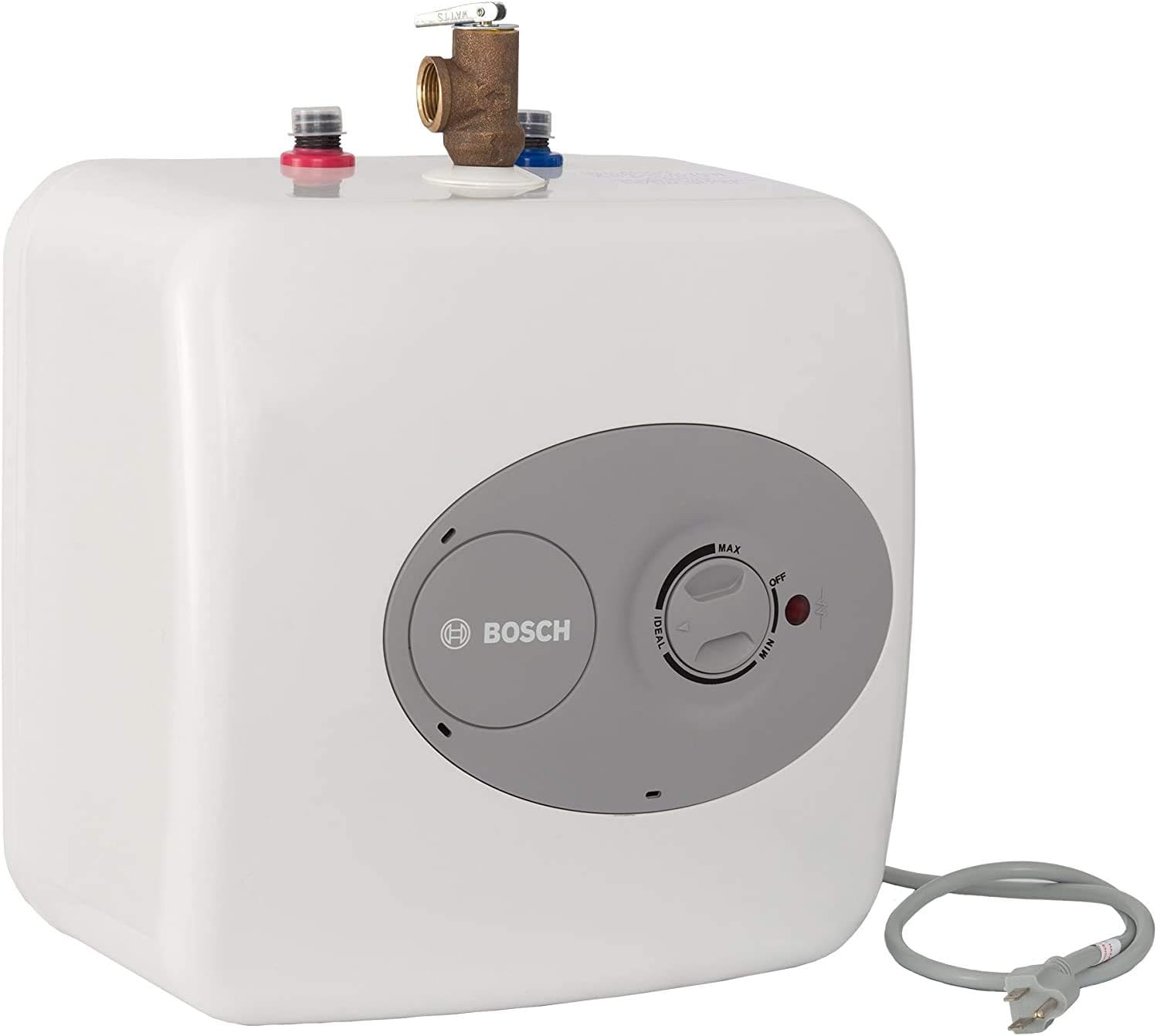
| Capacity | 2.5 gallons |
|---|---|
| Wattage | 1440 watts |
| Voltage | 120 volts |
| Maximum Temperature | 140 °F |
| Efficiency | 98% |
The Bosch Tronic 3000 T ES2.5 is a compact point-of-use electric mini-tank that delivers near-instant hot water where you need it, such as under a sink or for a single fixture. It heats with a 1440-watt element on standard 120V power and offers a glass-lined 2.5-gallon tank for durability and thermal efficiency. Installation is flexible: the unit can be shelf-, wall- or floor-mounted and either plugged into a 120V outlet with the supplied cord or piped inline with a larger water source. An external temperature dial and a temperature-and-pressure relief valve give basic control and safety. The heater's fast recovery and high thermal efficiency make it suitable for short, frequent hot-water draws and it can serve up to two sinks in light-use scenarios. Limitations include the small capacity, which means it is not suitable as a household primary heater, and the modest 1440W element that restricts recovery speed compared with higher-wattage point-of-use units.
Best for: Buyers who prioritize fast, local hot water delivery and straightforward installation for a single sink or light-use fixtures and want a durable, efficient mini-tank solution.
Less Ideal for: Homes needing a primary or high-demand hot water source, large households, or applications requiring continuous long-duration hot water should look at larger or higher-capacity heaters.
- Point-of-use design supplies hot water quickly at a nearby sink
- Glass-lined tank for corrosion resistance and longer service life
- Flexible mounting (shelf, wall, or floor) and plug-in 120V installation
- External temperature dial and safety relief valve for simple control and protection
- Small 2.5-gallon capacity limits continuous hot-water draws
- 1440W element provides slower recovery than higher-wattage units
Verdict: Choose the Bosch ES2.5 when you want a durable, energy-efficient mini-tank that delivers fast local hot water for sinks and light-demand fixtures.
VEVOR 6-Gallon Electric Tank Water Heater

| Capacity | 6 gallons |
|---|---|
| Wattage | 1600 watts |
| Voltage | 120 volts |
| Maximum Temperature | 167 °F |
| Mount Type | under sinks |
This compact VEVOR 6-gallon tank heater is built for point-of-use hot water needs in tight spaces like studios, RVs, or a guest sink. It uses a 1600W immersion heating element and 20 mm foam insulation to heat water quickly and minimize standby loss, while a simple rotary knob and LED indicator make temperature control straightforward. Safety features include dry-heat protection, overtemperature and overpressure safeguards, a T&P relief valve, and an IPX4 splash rating, which helps in damp locations. The steel tank with enamel lining aims to resist corrosion for longer service life, and the top outlet and under-sink mount type keep installation compact. Limitations are the small 6-gallon capacity, which limits continuous hot-water flow for high-demand well systems, and the 120V/1600W power restricts how fast large volumes recover compared with higher-power or tankless units. Installation and plumbing accessibility matter for well setups, and users may need a small booster or larger tank if multiple fixtures run simultaneously.
Best for: Buyers who need a compact, reliable point-of-use heater to supply a single faucet or occasional light hot-water tasks and who prioritize compact footprint and straightforward controls.
Less Ideal for: Homes with high simultaneous hot-water demand or well systems feeding multiple fixtures without a booster should choose a larger tank or higher-power solution instead.
- Compact 6-gallon tank fits under sinks or in small utility spaces
- 1600W element and thick foam insulation deliver relatively fast heating with reduced standby loss
- Built-in safety: dry-heat, overtemperature, overpressure protections and T&P relief valve
- Simple rotary temperature control with LED heating-status indicator
- Enamel-lined steel tank improves corrosion resistance for longer life
- Small capacity limits continuous hot-water availability for multiple fixtures
- 120V/1600W power gives slower recovery than higher-power or tankless systems
Verdict: A space-saving, safety-focused point-of-use tank heater that works well for single fixtures where compact size and simple operation matter most.
Ganggend 2.5-Gallon Mini Tank Water Heater

| Capacity | 2.5 gallons |
|---|---|
| Wattage | 1500 watts |
| Voltage | 110 volts |
| Maximum Temperature | 149 °F |
| Maximum Pressure | 108 psi |
This compact 2.5-gallon electric mini tank is built for tight spaces such as under sinks, in RVs, or inside cabinets and supplies near-instant hot water for single-point use. The 1500W L-shaped heating element and insulated tank deliver faster heat-up times—manufacturer claims hot water in as little as six minutes—and the digital display with a manual knob makes it simple to set temperatures between 86°F and 149°F. Safety and durability are addressed with an automatic pressure relief valve, overheat protection, enamel lining, and reinforced inner tank material. Mounting is flexible; you can wall-mount it or sit it on the floor, and it uses a standard 1/2" NPT connection to fit typical plumbing. Limits to expect: the 2.5-gallon capacity supports only short, localized demands rather than whole-house needs, and the 110V/1500W power level means it is best for point-of-use installations rather than heavy continuous loads. For buyers on a budget needing reliable, compact hot water for one fixture, it balances fast recovery and safety features in a small footprint.
Best for: Buyers who need an affordable, space-saving point-of-use heater to deliver quick hot water to a single sink, RV, or small laundry setup and prefer simple digital controls and basic safety features.
Less Ideal for: Homes that require whole-house hot water, multiple simultaneous fixtures, or higher continuous flow rates should choose a larger-capacity or higher-power system.
- Compact footprint fits under sinks and in cabinets for point-of-use installation
- 1500W L-shaped heating element for rapid heat-up and efficient heat exchange
- Digital temperature display and manual control for precise temperature setting
- Built-in safety features including pressure relief valve and overheat protection
- Standard 1/2" NPT connection for compatibility with typical household plumbing
- 2.5-gallon capacity is limited to single-fixture use and short hot-water draws
- 110V/1500W power is not suitable for sustained or whole-house hot water demand
Verdict: A budget-friendly, compact mini tank that delivers fast, safe hot water for a single fixture or RV where space and cost are the top priorities.
ThermoMate ES800 8-Gallon Water Heater
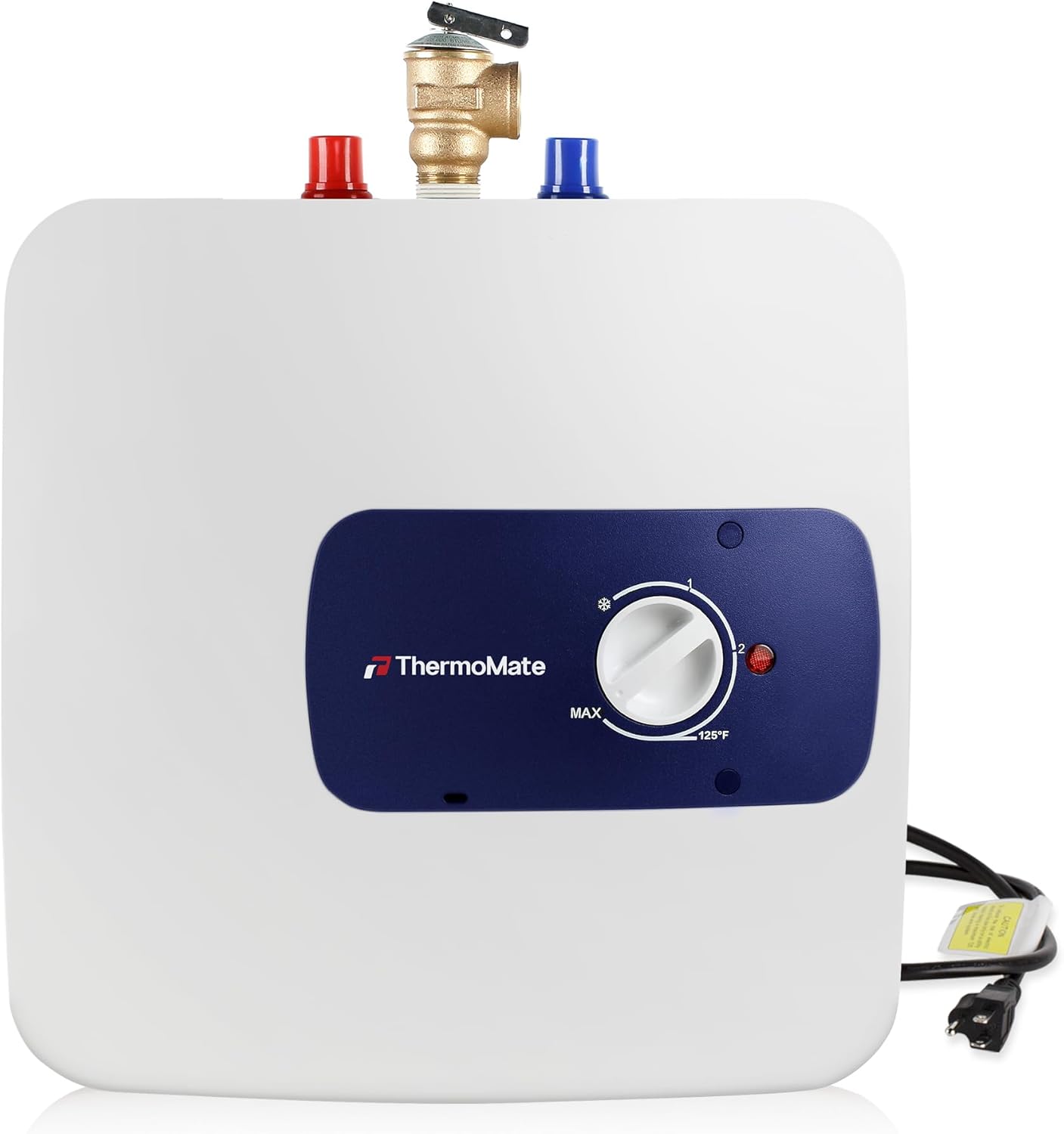
| Capacity | 8 gallons |
|---|---|
| Wattage | 1440 watts |
| Voltage | 120 volts |
| Maximum Temperature | 140 °F |
| Maximum Pressure | 150 psi |
The ThermoMate ES800 is an 8-gallon point-of-use electric tank water heater designed to supply near-instant hot water to a single faucet or to act as a booster on a short run. It plugs into a standard 120V outlet and uses a 1440W Incoloy 800 heating element to heat water up to about 140°F, with an adjustable thermostat and a 50-149°F range listed for the ES series. The unit installs on the wall or floor and includes a T&P valve and mounting kit, so it is suited for under-sink or compact utility locations. Notable durability features include a glass-lined three-layer tank, a thick anode rod to resist corrosion and scale, and UL-listed safety components. Practical benefits are reduced wait time for hot water, lower standby losses compared with routing long hot-water lines, and easy 120V plug-in installation where a dedicated 240V circuit is not available. Limitations are inherent to mini-tank design: it serves small flows only and is not intended for showers or multiple fixtures at once, and recovery is limited by the 8-gallon capacity and 1440W power. For hard-water areas, the glass lining and sacrificial anode help, but periodic maintenance is still needed to manage scale buildup.
Best for: Buyers who want a simple, compact hot-water booster for a single sink or short run and prioritize easy plug-in installation and durable internal protection for hard-water environments.
Less Ideal for: Homes needing whole-house hot water, shower supply, or multiple simultaneous fixtures should choose a larger tank or a proper tankless unit instead.
- Compact point-of-use design fits under sinks or in small spaces
- Plug-in 120V connection with included mounting hardware simplifies installation
- Incoloy 800 heating element offers improved corrosion resistance and heating efficiency
- Glass-lined tank and thick anode rod provide extra protection against corrosion in hard-water conditions
- UL-listed safety components and included T&P valve for pressure and temperature protection
- Not sized for showers or simultaneous multi-fixture use
- 8-gallon capacity means limited hot-water run time before recovery is required
- Recovery and flow capacity limited by 1440W power at 120V
Verdict: A compact, plug-in 8-gallon mini-tank with corrosion-resistant internals that is ideal as a durable under-sink booster in hard-water locations.
BISELONG BI-2.5 2.5-Gallon Water Heater

| Capacity | 2.5 gallons |
|---|---|
| Wattage | 1500 watts |
| Voltage | 120 volts |
| Maximum Temperature | 149 °F |
| Maximum Pressure | 108 psi |
The BISELONG BI-2.5 is a small, under-sink electric storage heater that holds 2.5 gallons and uses a 1500W heating element to deliver near-instant hot water for one or two nearby fixtures. It is typically mounted under a sink, in an RV, or on a shelf to reduce wait time and conserve energy compared with running water from a distant tank. Notable features include a thicker 304 stainless steel inner tank, upgraded heating tube materials, built-in thermostat control that maintains set temperature, and multiple safety protections such as over-temperature and dry-heat prevention. The compact square design and included mounting brackets and fittings make installation straightforward for those comfortable with basic plumbing and electrical work. Important limitations are the small storage capacity, so it only services close-by sinks or appliances and is not suitable as a whole-house heater, and it requires a dedicated 120V/15–20A circuit and correct installation of the pressure relief valve to avoid issues. For buyers focused on short runs of reliable hot water, the BI-2.5 offers a space-saving, energy-conscious solution.
Best for: Buyers who want a compact, under-sink source of reliable hot water for a single sink, RV, or small appliance and who prioritize proven safety features and build quality.
Less Ideal for: Homes needing hot water for multiple bathrooms or whole-house demand, or buyers who want a plug-and-play unit without any electrical or plumbing installation.
- Compact 2.5-gallon tank fits under sinks, in cabinets, or in RVs to save space
- 1500W heating element with faster recovery for near-instant hot water at a nearby fixture
- Thicker 304 stainless steel inner tank and upgraded heating tube for improved durability
- Built-in thermostat and smart inverter-style control to keep water at set temperature and reduce standby loss
- Includes mounting brackets and basic fittings for straightforward installation
- Small capacity only supports one or two close fixtures and is not suitable for whole-house use
- Requires proper electrical hookup and correct installation of the pressure relief valve to avoid failures
Verdict: Choose this compact unit when you need a durable, under-sink heater that delivers quick hot water to a nearby sink or RV connection with built-in safety controls.
GE 10 Gallon Point-of-Use Water Heater

| Power Source | Electric |
|---|---|
| Voltage | 120 volts |
| Capacity | 10 gallons |
| Maximum Temperature | 140 °F |
| Maximum Pressure | 150 psi |
The GE 10-gallon point-of-use electric water heater delivers on the basic need for on-location hot water in tight spaces like kitchens, bathrooms, laundry rooms, garages, or cabins. It installs on a standard 120-volt circuit and uses familiar 1/2-in NPT water connections for straightforward hookup, and it can operate alone or inline to boost hot water for longer pipe runs or appliances. The unit includes an adjustable thermostat for simple temperature changes and stainless steel heating elements plus an anode rod to resist rust and corrosion. Its compact floor-mount design makes it convenient where space is limited and reduces the need to run long hot-water lines. Expect typical trade-offs for a small tank: limited hot-water capacity before recovery is needed and a modest heat output capped at 140°F, so it is best for point-of-use needs rather than whole-house supply. The product carries a multi-year limited warranty on the tank and parts for added reassurance.
Best for: Buyers who want a reliable, simple hot-water solution for a single fixture or short run and prefer a straightforward, low-risk installation with factory-quality components and warranty coverage.
Less Ideal for: Homes needing whole-house hot water, high simultaneous demand, or fast recovery for multiple fixtures should consider larger or higher-voltage models.
- Compact point-of-use design fits tight spaces and reduces long plumbing runs
- Standard 120V power and 1/2-in NPT water connections simplify installation
- Stainless steel heating element and anode rod improve corrosion resistance
- Adjustable thermostat for easy temperature control
- Can be used standalone or inline to boost other water heaters
- 10-gallon capacity limits supply and requires frequent recovery under heavy use
- 120V power limits recovery rate compared with higher-voltage commercial units
Verdict: A compact, low-risk point-of-use electric heater that provides dependable on-location hot water with easy installation and corrosion-resistant components.
Choosing the Right Tank Water Heater for Well Water: Key Factors to Consider
Corrosion Resistance and Anode Systems
Well water often contains dissolved minerals and sometimes low pH that accelerate corrosion. A robust tank lining and a replaceable sacrificial anode rod are the first lines of defense. Glass-lined tanks resist corrosion initially, but the anode rod extends life by sacrificing itself to protect steel walls.
When evaluating options, look for tanks with thicker linings, heavier-gauge steel, and easily accessible anode rods so you can inspect and replace them during regular maintenance. Models that offer multiple anode configurations or magnesium/zinc options give flexibility depending on your well water chemistry.
Sediment Management and Drainage
Sediment is a common issue with well water and collects at the bottom of tanks, insulating heating elements and promoting localized corrosion. Good drain valve access and a tank design that allows periodic flushing will prolong element and tank life.
Choose a unit with a full-size brass drain valve and a removable bottom cleanout where possible. Regularly flushing the tank reduces sediment buildup and helps maintain both recovery performance and heating efficiency, lowering the risk of premature failures.
Recovery Rate Versus Tank Capacity
Recovery rate is how quickly a heater can raise the tank temperature after hot water is used. For homes with well water, a faster recovery rate can offset a smaller tank because it shortens the window when sediment can overheat elements. Conversely, larger households often need greater storage capacity to avoid running out of hot water during peak use.
Match capacity and recovery to household demand. If your well produces limited flow or you already use point-of-use conservation, a larger tank with moderate recovery may be better. If you expect high simultaneous demand, prioritize higher recovery numbers or larger tanks to maintain comfort.
Serviceability and Replaceable Parts
When a component fails, the ability to access and swap parts quickly reduces downtime and repair cost. Well water can increase the frequency of element or burner replacement, so units designed for straightforward servicing are advantageous.
Look for clearly labeled access panels, standard-sized heating elements, and commonly available thermostats and anode rods. Documentation and replacement-part availability affect long-term ownership, so favor designs that do not require specialized proprietary parts for routine repairs.
Fuel Type, Venting, and Installation Constraints
Fuel type affects recovery characteristics and installation needs. Gas-fired tanks typically offer faster recovery than electric equivalents but require proper venting and combustion air. Electric tanks are simpler to install but depend on element condition and electrical capacity.
Consider the existing utility setup and the cost and feasibility of vent runs or electrical upgrades. Also account for space, clearance, and local code requirements related to combustion air and flue termination when planning installation.
Energy Efficiency and Insulation
Standby heat loss impacts operating cost and how often the heater cycles, which in turn affects wear. Higher insulation R-values and low-heat-loss designs reduce cycle frequency and energy use, which is beneficial in well-water systems where repeated heating can expose components to more sediment stress.
Assess insulation thickness and factory standby-loss ratings. Better-insulated tanks reduce energy bills and lessen the cumulative effect of repeated heating on tank internals and heating elements.
Preparing Well Water Before the Tank
Treating well water ahead of the heater can dramatically extend a tank's service life. Simple mechanical filtration to remove sand and large particulates and a sediment filter placed before the water heater reduce abrasive wear and sediment accumulation inside the tank.
If your water has high hardness or iron, consider a softening or iron-removal step. While whole-house softeners add maintenance and can affect anode behavior, they often reduce scale buildup on elements and heat exchangers, improving long-term recovery performance.
- Install a sediment pre-filter with an easy-to-replace cartridge.
- Use a first-stage filter to capture sand and grit before the heater.
- Test water composition to decide if softening or iron removal is warranted.
Routine Maintenance Schedule for Well Sites
A modest maintenance schedule prevents many common failures. Drain and flush the tank at least once a year to remove sediment. Check and replace the anode rod every 2 to 5 years depending on corrosion rates and water chemistry.
Inspect heating elements, burners, and venting annually. Clean or replace inlet filters and inspect pressure relief valves for proper operation. Keeping a simple log of maintenance dates helps you spot accelerating wear before it causes a major failure.
- Flush tank annually; more often if sediment is heavy.
- Check anode rod condition every 12 months.
- Inspect venting and combustion components for gas models yearly.
Sizing Guidance for Typical Households on Well Water
Estimate peak hour demand and match it to tank capacity and recovery. A larger family typically needs a larger tank or higher recovery rate to avoid shortfalls. For smaller households or vacation homes, a medium-capacity tank with good insulation may be the most efficient choice.
Also consider well pump capacity. If the pump cannot sustain high simultaneous draws, prioritize storage capacity over raw recovery because the water draw rate can limit real-world replenishment speed.
- Calculate peak hour demand from showers and appliances.
- Confirm well pump flow rate to avoid oversizing recovery expectations.
- Balance storage and recovery to fit household patterns.
Common Failure Modes with Well Water
Sediment buildup at the tank bottom is one of the most frequent issues. It leads to element burnout, lower efficiency, and localized corrosion. Regular flushing and good pre-filtration reduce this risk.
Corrosion from low pH or high dissolved solids can eat through linings over time. Anode degradation and poor tank protection accelerate failure. Monitoring anode condition and choosing tanks with robust linings helps mitigate these risks.
- Element burnout caused by sediment insulation.
- Accelerated corrosion when anode protection is exhausted.
- Blockages in inlet screens and valves due to grit.
Installation Tips to Extend Service Life
Install the heater on a stable, level surface with a drip pan and accessible clearance for service. Use union fittings or dielectric unions on plumbing connections to simplify future repairs and reduce corrosion at dissimilar metal joints.
Add an accessible shutoff valve and a sediment filter upstream. Position the tank so the drain valve and anode are reachable without dismantling piping. For gas units, ensure correct vent slope and combustion-air pathways per code.
- Use a drip pan with a visible drain.
- Install unions on supply lines for easy removal.
- Ensure clear access to drain valve and anode rod.
How We Chose the Best Tank Water Heater for Well Water
We focused on attributes that directly affect long-term performance in homes supplied by well water. Primary evaluation criteria were tank corrosion resistance, recovery rate and capacity, and ease of maintenance because well water can introduce sediment and minerals that shorten component life and reduce efficiency. We also assessed access to replaceable parts and simplicity of service to minimize downtime when repairs are needed. Safety features and code-compliant venting or thermal controls were considered to ensure reliable operation in typical residential installations. Energy efficiency and insulation quality were included to reflect operating cost and standby heat loss, which matter when replacing an older tank. We excluded units that are narrowly specialized for commercial installations or that require proprietary servicing that limits homeowner maintenance. We prioritized products with clear serviceability, robust corrosion protections, and sensible capacity-to-recovery balances for single-family use. The final picks represent models that score well across these measurable dimensions rather than marketing claims.
Our full evaluation process is outlined in our review methodology.
FAQ
How often should I flush a tank that uses well water?
Often once per year is a general baseline, but frequency depends on sediment level. If you notice sand or grit in taps or faster anode consumption, flush twice a year or more.
Will a water softener protect my tank from corrosion?
A softener reduces scale from hardness but does not eliminate corrosion from low pH or dissolved oxygen. Softening can lower scale on elements but you should still monitor anode condition and tank lining health.
Can I install a tank water heater myself on a well system?
Basic plumbing-savvy homeowners can handle simple replacements, but gas venting, combustion air, or electrical upgrades may require a licensed professional. Local code often mandates professional installation for gas appliances.
How do I know if my well water is harming my heater?
Signs include rapid anode depletion, frequent element or burner failures, visible sediment in the drain water, and reduced recovery. Periodic water testing and visual tank checks help identify problems early.
Is an electric tank better than a gas tank for well water?
It depends. Electric tanks avoid combustion air and venting issues and can be simpler to service, while gas tanks typically offer faster recovery. Consider recovery needs, installation constraints, and how well water affects elements versus burners when deciding.
Final Verdict
When choosing a tank water heater for well water, prioritize corrosion protection, accessible maintenance features, and a capacity-recovery balance that matches household demand and well pump output. Pre-filtration and a regular flushing schedule reduce common well-water failure modes and extend service life. Focus on tanks that make routine tasks like anode replacement and sediment flushing straightforward, and weigh fuel and venting implications relative to your installation constraints. With those priorities in place, you can select a tank that delivers reliable hot water and lowers long-term repair risk.