
Note: This article contains affiliate links. If you click on these links and make a purchase, we may earn a small commission at no extra cost to you. This helps support our research and content. Read our full affiliate disclosure here.
Picking the right tankless water heater for home use changes how your household accesses hot water. The wrong capacity or fuel type can leave multiple fixtures struggling during peak times, while the right unit delivers consistent flow, lower standby losses, and a smaller footprint. This guide presents seven shortlisted tankless water heaters that perform well in typical home installations, with attention to flow capacity, energy type, and installation demands. We evaluate each option for real-world factors like family size, plumbing layout, and local fuel availability to help you match a unit to your home. Read on for clear criteria and practical notes to help you choose the best tankless water heater for your home setup.
Top Picks at a Glance
| Best Overall The best all-around choice for most situations | EcoSmart ECO 18 Tankless Water Heater |  |
| Best Quality Built to a higher standard if you want something more solid | Rinnai RU160iN Tankless Water Heater |  |
| Best Value The sweet spot between price and what you get | WINTEMP WN27 27kW Tankless Water Heater |  |
| Best Budget The cheapest option that still gets the job done reliably | xwdzswgs 3000W Tankless Water Heater |  |
| Top Rated A top-rated pick with lots of positive feedback | Rheem RTG-84XLN-3 Tankless Gas Heater |  |
| Most Popular A crowd favorite that many people choose with confidence | EcoSmart ECO 11 Tankless Water Heater |  |
| Best Seller A high-volume bestseller chosen again and again | Rheem RTEX-18 Tankless Electric Heater |  |
EcoSmart ECO 18 Tankless Water Heater

| Wattage | 18000 watts |
|---|---|
| Voltage | 240 volts |
| Flow Rate | 3.51 gpm |
| Efficiency | 99.8 % |
| Mount Type | Wall |
The EcoSmart ECO 18 is a wall-mounted 18 kW electric tankless water heater intended for homes in warmer climates where incoming water is around 62 degrees F or higher. It delivers about 2.5 to 3.5 gallons per minute, which is suitable for a single shower plus a sink and can support two showers simultaneously in particularly warm regions. The unit uses self-modulating smart technology and offers a digital temperature control with 1 degree increments for precise output. Installation requires a 240V supply with two 40A double-pole breakers and 8 gauge wiring, so homeowners should plan for appropriate electrical capacity. Its compact metal body saves space compared with tank models and the manufacturer backs key components with a lifetime parts warranty. Limitations include its reduced flow in colder incoming water and the need to confirm the model is sized correctly for household hot water demands and electrical setup before purchase.
Best for: Buyers looking for a compact, efficient electric tankless heater for single-family hot water needs in warmer regions who want precise digital temperature control and factory-quality parts coverage.
Less Ideal for: Homes in cold climates or households needing multiple simultaneous high-flow hot water uses should consider higher-capacity electric or gas models or a whole-home solution.
- On-demand heating with self-modulating smart technology for efficient energy use
- Digital temperature control adjustable in 1 degree increments
- Compact wall-mounted design saves space compared with tank heaters
- Lifetime warranty on key components covers electronics, exchanger, and element
- Rated performance assumes warmer inlet water; flow and capacity drop in cold climates
- Requires significant electrical capacity including two 40A breakers and 8 gauge wiring
Verdict: A space-saving, energy-efficient electric tankless heater best suited to warmer climates or smaller households that need on-demand hot water with precise temperature control.
Rinnai RU160iN Tankless Water Heater

| Power Source | Gas Powered |
|---|---|
| Flow Rate | 9 gpm |
| Maximum Temperature | 140 °F |
| Mount Type | Wall |
| Special Features | ENERGY STAR Qualified, Built-in Recirculation Pump with Smart-Circ Technology |
The Rinnai RU160iN is a compact, high-efficiency condensing tankless water heater designed to deliver continuous hot water for whole-home use. It heats on demand rather than storing water, which reduces standby energy loss and frees up space compared with a tank unit. The unit is aimed at performance: a 9 GPM flow rate supports multiple fixtures or appliances running simultaneously, and the unit's high Uniform Energy Factor (0.97) means good fuel efficiency. Built-in Circ-Logic recirculation compatibility lets you pair an external pump for faster hot water delivery and scheduled recirculation, and Wi-Fi monitoring is available with an optional module for remote checks. Installation is wall-mounted and requires professional plumbing and gas hookup. The practical upside is consistent strong water pressure and near-unlimited hot water for larger households, while the main considerations are the need for professional installation, a compatible external pump for true recirculation benefits, and that it is designed for indoor natural gas use only.
Best for: Homeowners who prioritize strong continuous performance and energy efficiency and need a unit that can supply multiple bathrooms or appliances without running out of hot water.
Less Ideal for: People looking for a plug-and-play or electric solution, or those who need an outdoor-rated heater or want to avoid hiring professional gas/plumbing installation.
- High 9 GPM flow rate supports multiple fixtures and appliances simultaneously
- Condensing design with a 0.97 UEF yields strong fuel efficiency
- Circ-Logic recirculation compatibility reduces wait time when paired with an external pump
- Compact wall-mounted footprint saves space compared with tank heaters
- Optional Wi-Fi monitoring via Controlr module enables remote status checks
- Requires professional gas and plumbing installation
- Recirculation requires an external pump which is sold separately
- Indoor natural gas model only, not suitable for outdoor or electric installations
Verdict: Buy this if you need a high-performance, energy-efficient natural gas tankless heater that reliably delivers hot water for several fixtures at once.
WINTEMP WN27 27kW Tankless Water Heater

| Wattage | 27000 watts |
|---|---|
| Voltage | 240 volts |
| Flow Rate | 6.5 gpm |
| Maximum Temperature | 140 °F |
| Mount Type | Wall |
The WINTEMP WN27 is a wall-mounted 27 kW electric tankless heater built to supply continuous hot water for residential use, especially in homes with moderate hot-water demand. It uses self-modulating controls to adjust power based on incoming water temperature and flow, which helps maintain stable output temperatures and improves efficiency. The unit supports up to 6.5 gallons per minute, making it suitable for showers and combined low-to-moderate fixture use, and includes safety features like overheat, leakage, and dry-fire protection along with ETL certification. Practical conveniences include an LED display, temperature lock, and WiFi remote control for adjusting setpoints without accessing the unit. Important considerations are electrical requirements: the unit draws up to 113 A and needs three 40 A double-pole breakers with heavy-gauge wiring and a robust household service, so professional electrical work is typically required for installation. Compact wall mounting saves space versus tanks, but installation complexity and high circuit capacity needs are trade-offs buyers should plan for.
Best for: Buyers wanting a space-saving, energy-efficient whole-house tankless that delivers stable on-demand hot water for typical household shower and sink use and who prioritize operational efficiency and remote control convenience.
Less Ideal for: Homes without adequate electrical service or buyers who need very high simultaneous flow for many fixtures where a larger-capacity or multiple-unit solution would be more appropriate.
- High 27 kW output supports up to 6.5 GPM for continuous hot water
- Self-modulating control maintains stable water temperature and improves efficiency
- Built-in safety features with ETL certification including overheat and dry-fire protection
- Compact wall-mounted design frees up floor space
- WiFi remote control and LED display for convenient temperature adjustments
- Requires substantial electrical capacity and multiple 40 A breakers, often needing a professional upgrade
- May not supply simultaneous high-flow demands in larger homes without multiple units
Verdict: Choose the WINTEMP WN27 if you want a compact, energy-saving electric tankless that reliably delivers continuous hot water for typical household shower and sink needs with WiFi temperature control.
xwdzswgs 3000W Tankless Water Heater

| Wattage | 3000 watts |
|---|---|
| Voltage | 110 volts |
| Flow Rate | 0.5 gpm |
| Maximum Temperature | 131 °F |
| Mount Type | Wall |
This compact 3000W tankless unit is designed as a point-of-use under-sink heater to provide near-instant hot water for sinks and small fixtures. It mounts vertically and connects to a standard 1/2-inch plumbing interface, heating water quickly at low flow rates and letting you set temperature via the LED display. Built-in protections include dry-burn prevention, leakage protection, over-temperature shutdown, and IPX4 splash resistance, which make it suitable for kitchen and bathroom tasks like dishwashing and hand washing. The small footprint and lightweight ABS housing make it easy to fit into tight spaces and install with the included screws, though the manual recommends a dedicated high-capacity circuit and 2.5 mm2 wiring for safe operation. Practical limits are the low flow rate (0.5 gpm) and 110V input, so it will not support showers or multiple outlets simultaneously; expect best performance for single-sink use. For buyers prioritizing a low-cost, compact solution to get hot water at a single point of use, this model covers the basics with clear temperature readout and key safety features.
Best for: Buyers needing an inexpensive, space-saving point-of-use heater for a single sink or small utility area who prioritize upfront cost and compact installation over whole-house capacity.
Less Ideal for: Homes that need hot water for showers, multiple fixtures, or higher flow applications should choose a higher-capacity or whole-house unit instead.
- Compact wall-mounted design that fits under sinks and in small spaces
- Digital LED display for setting and monitoring water temperature
- Several built-in safety protections including dry-burning and over-temperature shutoff
- Easy to install with standard 1/2-inch interface and included mounting hardware
- Low maximum flow rate (0.5 gpm) limits use to single sinks and light tasks
- Requires a dedicated high-capacity circuit and recommended wiring for safe operation
Verdict: A budget-friendly, compact point-of-use tankless heater that delivers quick hot water at a single sink with basic safety features.
Rheem RTG-84XLN-3 Tankless Gas Heater

| Power Source | Natural Gas |
|---|---|
| Flow Rate | 8.4 gpm |
| Heat Output | 180000 BTU/hr |
| Maximum Temperature | 140 °F |
| Wattage | 132 watts |
The Rheem RTG-84XLN-3 is an outdoor non-condensing natural gas tankless water heater designed to provide continuous hot water for a multi-bath home. It produces 180,000 BTU/hr with an 8.4 gpm maximum flow and a maximum outlet temperature of 140°F, so it can run several showers simultaneously without the typical tank recovery time. The unit includes Hot Start Programming to reduce cold-water bursts between back-to-back uses and built-in overheat protection for the heat exchanger. As an outdoor model it removes the need for indoor venting and its compact, wall-mount design saves floor and closet space. Energy efficiency is improved over traditional 50-gallon tanks, and a water-saver setting reduces wasted water while waiting for set temperature. Important limitations are that it is non-condensing (so it is less efficient than condensing models in some climates) and it requires qualified professional installation and natural gas service outdoors, which adds install complexity. The long heat-exchanger warranty offers reassurance for buyers prioritizing dependable, long-lived performance.
Best for: Buyers who prioritize dependable, continuous hot water for medium to large households and want a rugged outdoor tankless unit with long-term reliability.
Less Ideal for: Homes without an available outdoor natural gas hookup or buyers seeking the highest possible seasonal efficiency from a condensing unit should consider other options.
- High heat output (180,000 BTU/hr) supports multiple simultaneous showers
- Hot Start Programming reduces cold-water bursts between uses
- Outdoor installation avoids indoor venting and saves interior space
- Water-saving feature reduces wasted cold water while waiting for hot water
- 15-year heat exchanger warranty provides long-term reliability assurance
- Non-condensing design is less fuel-efficient than condensing units in some regions
- Requires professional gas installation and outdoor gas hookup
Verdict: Choose this Rheem outdoor tankless if you need a robust, reliable on-demand gas heater that delivers continuous hot water for multi-bath homes.
EcoSmart ECO 11 Tankless Water Heater

| Wattage | 13000 watts |
|---|---|
| Voltage | 220 volts |
| Flow Rate | 3.1 gpm |
| Maximum Temperature | 140 °F |
| Heat Output | 11 KW |
The EcoSmart ECO 11 is a 13 kW, wall-mounted electric tankless heater built for point-of-use tasks like a single shower, bathroom sink, or small office breakroom. It uses self-modulating electronics to heat water on demand, with a digital temperature control and LED display that let you set the output in 1 degree increments. Installation saves floor space compared with a tank unit and reduces standby energy because the unit only draws power when water is flowing. Performance depends on inlet temperature: expected flow ranges from about 1.3 to 3.1 gpm, so it reliably handles one shower or a sink but is not sized for whole-house needs. The unit requires a 240V circuit and significant amperage, so plan for proper electrical service and a professional install. Its small footprint and straightforward controls make it a convenient point-of-use solution, but buyers should verify sizing for their climate and peak hot-water demands before buying.
Best for: Buyers who want a compact, energy-efficient point-of-use heater that provides reliable on-demand hot water for a single bathroom, sink, or small breakroom and who prioritize proven performance and clear product feedback.
Less Ideal for: Homes needing whole-house hot water or simultaneous multi-shower use and buyers without the necessary electrical service or unwilling to arrange professional electrical upgrades.
- Compact wall-mounted design saves floor space
- Self-modulating system only uses energy needed to heat flowing water
- Digital temperature control with 1-degree increments for precise output
- Suitable flow rate for a single shower or sink in warmer climates
- LED display and straightforward controls simplify use
- Limited flow capacity not suitable for whole-house use
- Requires a dedicated 240V circuit and high amperage installation
Verdict: Choose the ECO 11 when you need a compact, energy-efficient point-of-use electric tankless heater that reliably delivers hot water for a single shower or sink.
Rheem RTEX-18 Tankless Electric Heater
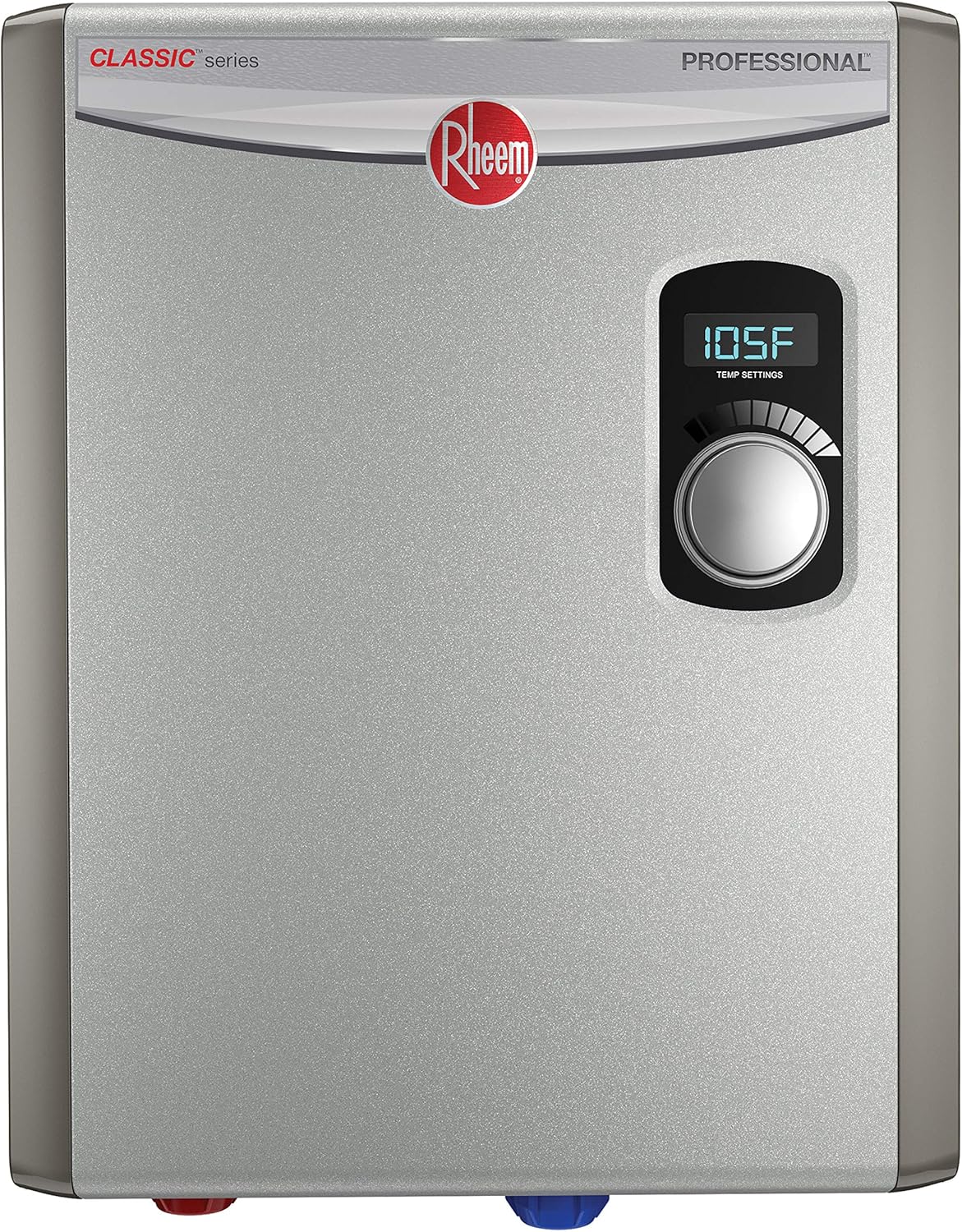
| Wattage | 18000 watts |
|---|---|
| Voltage | 240 volts |
| Flow Rate | 4.4 gpm |
| Maximum Temperature | 140 °F |
| Efficiency | 99.8% |
The Rheem RTEX-18 is a compact, wall-mounted tankless electric heater intended for whole-home or single-shower use in moderate climates. It uses self-modulating heating elements to match power to demand, which improves efficiency and reduces wasted energy compared with tank models. The unit provides up to about 4.4 gallons per minute and includes an external digital thermostatic control with an LED display for precise temperature adjustment. Installation is straightforward for electricians familiar with high-amperage electric appliances, with 240V wiring and threaded 3/4 inch NPT water connections. Practical benefits include a small footprint that frees storage space, on-demand hot water that avoids standby losses, and field-serviceable copper elements. Limitations to note are the electrical requirement (18 kW needs substantial breaker capacity) and flow capacity that may be marginal for simultaneous multiple high-demand fixtures in cold incoming water conditions. It also does not require venting, but professional electrical and plumbing setup is recommended to realize safe, reliable operation.
Best for: Buyers who prioritize reliable on-demand hot water, lower operating energy use, and a compact wall-mounted unit that fits a typical household with moderate hot-water demand and a preference for a straightforward, serviceable design.
Less Ideal for: Homes without adequate 240V electrical service or households that regularly run multiple high-flow fixtures at once should consider higher-capacity or gas alternatives.
- Self-modulating 18 kW elements that adjust power to match hot water demand
- Digital thermostatic LED control for accurate temperature setting
- Compact wall-mounted design saves space compared with tanks
- Field-serviceable copper heating elements for easier maintenance
- Does not require venting, allowing flexible indoor placement
- Requires substantial 240V electrical capacity and appropriate breakers
- Flow rate (up to 4.4 GPM) may be limited for multiple simultaneous high-demand fixtures
Verdict: Choose the RTEX-18 if you want a compact, efficient electric tankless heater that delivers dependable on-demand hot water for a typical mid-size home while saving space and energy.
Choosing the Right Tankless Water Heater for Home: Key Factors to Consider
Flow Rate and Simultaneous Fixture Demand
Flow rate is the core capacity metric for tankless units because it determines how many fixtures you can run at once without a temperature drop. Calculate total expected flow by adding typical fixture demands during peak periods, such as multiple showers, dishwasher cycles, and laundry. Match that combined flow to a unit's rated gallons-per-minute output at the temperature rise you need.
Temperature rise matters because incoming ground or city water is often far below desired output. A model may hit a high GPM at small temperature rises but perform differently when raising cold winter water up to 120°F. Choosing a unit with appropriate flow at the expected temperature rise ensures consistent hot water across seasons.
Fuel Type and Electrical Requirements
Tankless water heaters run on gas (natural or propane) or electricity, and each has implications for performance and installation. Gas-fired units tend to provide higher continuous flow for large households but require proper venting and gas line capacity. Electric units are simpler to site and vent but may need heavy-duty electrical service and multiple dedicated circuits for high-output models.
Before deciding, check your home's existing utility capacity and plan for any electrical panel upgrades or gas-line sizing. Fuel choice also affects long-term operating characteristics, so factor in availability and local energy costs when assessing which type fits your home.
Venting, Clearances, and Location
Venting and clearances dictate where a tankless unit can be mounted and how easy installation will be. Indoor gas units usually need direct venting to the exterior with specific piping runs and termination clearances. Outdoor-rated units avoid indoor venting but require protection from freezing temperatures in cold climates.
Consider proximity to the main water line and common hot-water fixtures to minimize run lengths and heat loss. Accessibility for maintenance is also important; leave enough service clearance so filters, valves, and heat-exchanger access panels can be reached without removing the unit from the wall.
Maintenance Needs and Water Quality
Regular maintenance preserves performance and extends service life. Tankless heat exchangers and flow paths can accumulate scale where hard water is present, which reduces efficiency and flow. Scheduled descaling or installation of a water-softening or filtration solution can prevent buildup.
Look for units with easy-to-access service ports, removable filters, and clear maintenance instructions. In areas with aggressive water chemistry, plan for more frequent service intervals and inspect warranty terms that reference corrosion or scale-related exclusions.
Control Options and User Interface
Control options affect comfort and how easily you can tune performance. Basic models offer a simple thermostat dial, while more advanced units provide digital thermostats, remote control, and adaptive algorithms to maintain steady output. Some units include recirculation compatibility or integrated recirculation controls that reduce wait time at fixtures.
Choose the control level that fits your household. Families that need precise temperature by multiple fixtures will benefit from better control and recirculation support, whereas simple single-bath homes can opt for straightforward controls.
Warranty Coverage and Service Access
Warranty length and coverage scope are practical considerations because repairs can be disruptive. Check what components are covered and the conditions for warranty validity. Some warranties require professional installation or regular documented maintenance.
Also consider local service availability and whether replacement parts are commonly stocked. Easier access to qualified technicians and straightforward warranty terms reduce downtime and long-term ownership hassles.
Sizing a Tankless Unit for Typical Households
Sizing a tankless water heater starts by estimating peak simultaneous demand. Add the flow rates for all fixtures you expect to run at once during peak periods and then select a unit whose rated GPM at the required temperature rise meets or exceeds that total. For example, two showers and a dishwasher together often require more than a single low-capacity unit can sustain.
Also account for seasonal changes in inlet water temperature. In colder months, the same unit will deliver fewer gallons per minute at your target output temperature, so allow a margin when picking capacity. If you are unsure about precise demands, lean toward modest oversizing to avoid shortfalls during busy times.
- Estimate peak simultaneous flow in gallons per minute
- Check manufacturer GPM at specific temperature rises
- Allow extra capacity for cold-weather inlet temperatures
Retrofitting an Existing Home
Retrofitting often requires evaluating existing utilities. Gas units need properly sized gas lines and venting runs. Electric units may necessitate panel upgrades and multiple high-amp circuits. Consider routing and concealment for any new piping or electrical wiring.
In older homes, insulation of hot-water lines and space for service work are important. Plan the installation site so it minimizes plumbing alterations and keeps run lengths reasonable. Discussing local code requirements with a licensed installer early in the process can prevent expensive last-minute changes.
- Verify gas-line capacity or electrical panel availability
- Plan venting routes that meet code and clearances
- Keep hot-water piping runs as short as practical
Cold Climate Considerations
In cold climates, incoming water temperatures are much lower, increasing the required temperature rise and reducing a unit's effective flow. Look for models rated to handle the local winter inlet temperatures without dropping below desired delivery temperatures when multiple fixtures run.
Protect outdoor-mounted units from freezing and confirm freeze-protection features if you plan outdoor installation. For indoor units, ensure condensate lines and vent terminations are winterized and that the installation location remains above freezing.
- Check rated performance at low inlet temperatures
- Prefer units with built-in freeze protection for outdoor installs
- Insulate condensate and drain lines in cold regions
Recirculation and Instant Hot Water Options
Recirculation systems reduce wait time at fixtures and improve comfort but add complexity. Some tankless units support integrated recirculation pumps or are compatible with external pump systems. Integrated control reduces installation steps but may affect energy use if not managed with timers or demand controls.
If long pipe runs cause slow hot-water delivery, consider point-of-use solutions for remote bathrooms or kitchen sinks. Those reduce the need to oversize the main unit and can be more energy-efficient when used strategically.
- Integrated recirculation reduces wait times but may increase energy use
- Point-of-use units are an alternative for distant fixtures
- Use demand or timer controls to limit unnecessary recirculation
Permits, Codes, and Professional Installation
Many jurisdictions require permits and inspections for replacing or installing water heating equipment, especially for gas units and significant electrical work. A licensed installer familiar with local codes ensures proper venting, combustion air provisions, and safe electrical connections.
Budget time for inspection and permit processing. Professional installation also preserves warranty validity for many manufacturers, and it reduces the risk of poor combustion venting or inadequate gas-line sizing that could cause performance or safety issues.
- Check local permit requirements before scheduling work
- Use licensed contractors for gas and high-voltage electrical installations
- Retain installation records for warranty and future service needs
How We Chose the Best Tankless Water Heater for Home
We focused on technical fit, real-world capacity, and installation practicality when assembling this list of tankless water heaters for home use. Key evaluation criteria included flow rate and temperature rise because these determine whether a unit can meet simultaneous household demands. We assessed fuel and electrical requirements to ensure units suit typical residential utility infrastructure. Installation complexity and venting needs were reviewed since retrofit jobs vary widely in time and cost. Reliability indicators such as build quality and simple serviceability were considered to lower the risk of disruptive failures. Finally, operating efficiency and expected energy performance were examined to estimate ongoing energy use. We excluded specialty commercial units and whole-house systems intended only for very large properties, focusing instead on residential-capacity models suitable for single-family homes or similarly sized dwellings. Units that required custom utility upgrades beyond normal residential service were also filtered out. The result is a curated set of tankless water heaters chosen for realistic home installations, balanced performance, and practical maintenance requirements.
Our full evaluation process is outlined in our review methodology.
FAQ
How do I know what flow rate I need for my home?
Estimate the gallons per minute for fixtures you expect to run simultaneously, such as showers, sink faucets, and appliances. Add those flow rates together and choose a unit rated to deliver that GPM at the expected temperature rise.
Can I replace a tank heater with a tankless unit without major upgrades?
It depends on your existing utilities. Electric tankless units often need upgraded electrical service, and gas tankless models may require larger gas lines and new venting. A site assessment will reveal whether significant upgrades are necessary.
Are tankless water heaters energy efficient for a typical family?
Tankless units eliminate standby heat loss and tend to be more efficient for households that use hot water intermittently. Actual savings depend on usage patterns, fuel type, and the efficiency of the chosen model.
How often do tankless units need maintenance?
Maintenance frequency depends on water quality and usage. In hard-water areas, descaling annually or per the manufacturer schedule is common. Regular checks of filters, vents, and condensate drains help maintain efficiency and prevent failures.
Is a recirculation pump compatible with all tankless heaters?
Not all models support integrated recirculation. Some require an external pump with specific control logic. Verify recirculation compatibility and control options before planning a system that relies on instant hot-water delivery.
Final Verdict
When choosing a tankless water heater for a home, prioritize flow capacity at the expected temperature rise and match fuel type to your house's utilities. Factor in installation complexity, venting needs, and maintenance requirements so the unit fits both your daily hot-water habits and long-term serviceability. Balance modest oversizing for peak periods against installation constraints to avoid shortfalls during busy times. Focus on units that meet your simultaneous demand, are installable within your home's utility limits, and offer accessible maintenance. That approach will help you pick a reliable tankless water heater that delivers consistent hot water and manageable operating needs over time.