
Note: This article contains affiliate links. If you click on these links and make a purchase, we may earn a small commission at no extra cost to you. This helps support our research and content. Read our full affiliate disclosure here.
If you live in a mobile home, choosing the right tankless water heater changes daily comfort and usable space. Mobile homes demand compact, efficient units that supply enough hot water for showers, washing machines, and sinks while fitting tight mechanical areas and meeting venting and power limits. This guide shortlists the seven best tankless water heaters tailored for mobile home use, focusing on real-world factors like flow capacity, fuel and electrical requirements, venting options, and ease of installation. Below you will find top picks chosen for common mobile-home constraints and usage patterns, plus clear buying criteria to help you pick the unit that matches your household size and hookup type.
Top Picks at a Glance
| Best Overall The best all-around choice for most situations | Stiebel Eltron Tempra 24 Trend |  |
| Best Quality Built to a higher standard if you want something more solid | Rinnai RX199iN Tankless Water Heater |  |
| Best Value The sweet spot between price and what you get | ThermoMate ET270 27kW Tankless Heater |  |
| Best Budget The cheapest option that still gets the job done reliably | ThermoMate Tankless Water Heater ET045CAN4 |  |
| Top Rated A top-rated pick with lots of positive feedback | Orbek RV Tankless Water Heater |  |
| Most Popular A crowd favorite that many people choose with confidence | EcoSmart ECO 11 Tankless Water Heater |  |
| Best Seller A high-volume bestseller chosen again and again | Rheem RTEX-18 Tankless Electric Heater |  |
Stiebel Eltron Tempra 24 Trend

| Wattage | 24 KW |
|---|---|
| Voltage | 240 volts |
| Maximum Temperature | 140 °F |
| Maximum Pressure | 150 psi |
| Power Source | Hard Wiring Required |
The Tempra 24 Trend is a compact, wall-mounted electric tankless heater designed to provide continuous on-demand hot water for small whole-house or point-of-use needs. It uses self-modulating electronics to match heat output to flow, which improves efficiency and reduces standby waste while the digital LED display makes setting and monitoring temperature straightforward. In practice this model is capable of supplying one to two showers in warm climates (less in cold climates), and its copper heating system and silent operation make it unobtrusive in tight install locations. Installation requires hardwiring to a 240V supply and sufficient service capacity, and the unit's performance depends strongly on incoming water temperature and municipal water flow. The Tempra 24 Trend is a good fit where space is limited and steady hot water is needed without venting, but buyers should confirm electrical service requirements and sizing for their climate before choosing this model.
Best for: Buyers who want a compact, energy-efficient tankless unit for a small home or mobile home where space is limited and continuous on-demand hot water is the priority.
Less Ideal for: Homes without adequate 240V electrical capacity or large households that need multiple high-flow fixtures running at once should consider higher-capacity systems or models with different power requirements.
- Self-modulating electronics for more efficient, demand-matched heating
- Digital LED temperature display for easy, precise control
- Compact wall-mount design that requires no venting
- Silent operation with a copper heating system for durability
- Requires substantial 240V electrical service and breaker capacity
- May only support one to two simultaneous showers depending on inlet temperature and climate
Verdict: A space-saving, energy-conscious tankless heater that delivers reliable on-demand hot water for small homes and mobile home installs when electrical service matches the unit's requirements.
Rinnai RX199iN Tankless Water Heater

| Power Source | Gas Powered |
|---|---|
| Flow Rate | 11 gpm |
| Maximum Temperature | 140 °F |
| Heat Output | 199000 british thermal units |
| Efficiency | UEF .98 |
The Rinnai RX199iN is a compact condensing tankless water heater built for continuous high-demand hot water delivery. It produces up to 11.1 gallons per minute, enough to run multiple fixtures at once, and its Smart Sense gas control lets the unit operate on either natural gas or propane. The Versa Vent design permits indoor or outdoor installation with a simple adaptation, and the unit is Energy Star qualified with an industry-leading UEF of 0.98 for strong efficiency and lower fuel usage. Practical touches include an easy-to-use interface, a Quick Flush routine that simplifies maintenance, and optional Wi-Fi control via an add-on module for remote diagnostics. Because it is a powerful, condensing model rated at 199k BTU, installation should follow professional guidance and consider venting and space constraints; the unit is compact but requires appropriate clearances and fuel hookups. For buyers needing reliable, on-demand hot water in a space-conscious installation, the RX199iN balances high flow rates and energy efficiency well.
Best for: Buyers who prioritize strong continuous hot water performance and energy efficiency and need a compact, high-capacity tankless heater for homes where multiple fixtures run concurrently.
Less Ideal for: Those who want a simple DIY swap for older small-capacity heaters or who cannot support professional gas venting and installation requirements.
- Delivers up to 11.1 GPM, supporting multiple fixtures simultaneously
- Very high efficiency (UEF 0.98) reduces fuel consumption compared with standard units
- Convertible to natural gas or propane with Smart Sense control for fuel flexibility
- Versa Vent allows indoor or outdoor installation with a simple adaptation
- Quick Flush feature and compact footprint make maintenance and placement easier
- High heat output (199k BTU) requires professional installation and appropriate venting
- Wi-Fi control requires a separately sold module
- Not a plug-and-play replacement for older low-capacity mobile-home units without checking fuel and vent compatibility
Verdict: Choose the RX199iN when you need a compact, high-capacity, and very efficient tankless heater that reliably supplies hot water for multiple fixtures at once.
ThermoMate ET270 27kW Tankless Heater

| Power Source | 208~240V Hardwire |
|---|---|
| Wattage | 27 KW |
| Flow Rate | 5.27 gpm |
| Maximum Temperature | 140 °F |
| Mount Type | Wall |
The ThermoMate ET270 is a high-capacity electric tankless unit intended to deliver instant hot water for demanding residential use. It heats on demand with a 27 kW output and claims a 5.27 gpm flow rate at a 35°F rise, making it suitable for multiple fixtures running simultaneously in many homes. The unit uses self-modulating technology to adjust power based on incoming water temperature and flow, which improves efficiency and helps maintain a steady output temperature between 80°F and 140°F via a digital display with 1° increments. Installation requires hardwiring to 208–240V with substantial electrical capacity — the model can draw up to 114 A and needs three double-pole 40 A breakers and 3 x 8 AWG wiring. The compact wall-mount design saves floor space and the heating element is separated from the water path to reduce scale and corrosion. Important constraints are the high electrical service requirements and the need to confirm the unit size matches your mobile home electrical panel and available breaker space.
Best for: Buyers who prioritize efficient, continuous hot water and can provide the required modern electrical service for a high-power tankless unit, especially where space is limited.
Less Ideal for: People with limited electrical service, small mobile-home panels, or those who cannot install the necessary breakers and wiring should consider lower-power or gas alternatives.
- High 27 kW output supports multiple fixtures and steady water flow
- Self-modulating control improves efficiency and maintains stable temperature
- Digital temperature display with 1° adjustment for precise control
- Compact wall-mounted design conserves space and includes mount kit
- Heating element separated from water path to reduce scale and corrosion
- Requires substantial electrical capacity including up to 114 A draw and three 40 A double-pole breakers
- Not a plug-and-play or low-power option for small or older electrical systems
Verdict: If your mobile home has the electrical capacity, the ET270 delivers powerful, space-saving on-demand hot water with precise digital control and efficient self-modulating operation.
ThermoMate Tankless Water Heater ET045CAN4

| Wattage | 4500 watts |
|---|---|
| Power Source | ac |
| Maximum Temperature | 131 °F |
| Special Features | Self-modulating Power; Touch Control Panel; Waterproof |
This compact ThermoMate unit is a 4500W, 120V point-of-use tankless heater designed for instant hot water at a single sink. It is typically installed under or over a sink in tight spaces in mobile homes, small bathrooms, salons, or hotel reception areas and is hardwired to a dedicated double-pole 40A breaker. The heater uses self-modulating power to adjust energy use to the incoming water temperature, and its cast aluminum heating element separated from the stainless steel water tube helps reduce scale and corrosion for longer life. The touch control panel and digital temperature display let you set water temp in 1°F increments between 85°F and 131°F, and the unit claims flow from 0.26 to 1.0 GPM with 0.85 GPM at a 35°F rise—enough for a single faucet. Important limitations are the modest flow rate that is only suitable for one fixture at a time and the requirement for a substantial dedicated 40A double-pole circuit and 8 AWG wiring, which may increase installation cost in older mobile homes. The slim, waterproof housing and included mounting kit make it straightforward to tuck into tight spaces where a full-size heater would not fit.
Best for: Buyers in need of an affordable, space-saving heater for a single sink in a mobile home or small living space who prioritize quick hot water and energy efficiency at the point of use.
Less Ideal for: Homes needing hot water for multiple fixtures, showers, or simultaneous use, or owners who cannot accommodate the required electrical circuit upgrades.
- Instant on-demand hot water for a single sink with precise 1°F temperature control
- Self-modulating power improves energy efficiency by matching heating to inlet water temperature
- Compact, slim housing fits tight under-sink locations and includes a mounting kit
- Cast aluminum heating element separated from the water path and stainless steel tube to resist scale and corrosion
- Low maximum flow rate suitable only for one faucet or low-flow applications
- Requires a dedicated 40A double-pole breaker and 8 AWG wiring, which may need electrical upgrades
Verdict: A budget-friendly, compact point-of-use tankless heater that delivers precise, energy-efficient hot water for a single sink in tight mobile home installations.
Orbek RV Tankless Water Heater

| Power Source | Liquid Propane |
|---|---|
| Voltage | 12 volts DC |
| Flow Rate | 3.5 gpm |
| Maximum Temperature | 123 °F |
| Heat Output | 60000 BTU |
The Orbek RV Tankless Water Heater is a 12V DC propane-fired, on-demand unit designed for RV and camper use. It supplies continuous hot water for showers, dishwashing, and other freshwater needs without storing heated water, which reduces standby propane use compared with tank systems. Notable features include a 60,000 BTU burner, an oxygen-free copper heat exchanger, brushless DC fan, and a smart remote that sets temperature between 95°F and 123°F and displays error codes. The unit includes safety protections such as flame-failure shutoff, dry-combustion protection, frost protection, and a built-in 150 PSI pressure-reducing valve. Practical benefits for mobile-home owners are straightforward: reliable hot water at high altitudes, simplified standard RV connections for DIY installation, and quieter, efficient forced-draft combustion. Limitations to plan for are the 12V power requirement (so an AC-to-DC converter is needed if you only have 110V shore power) and the need to confirm door cutout compatibility and professional plumbing/gas hookup if you are not comfortable with RV gas systems.
Best for: Mobile-home and RV owners who prioritize dependable, continuous hot water and want a heater that handles altitude changes and built-in safety features for regular travel use.
Less Ideal for: Users who prefer simple plug-and-play electric units or those unwilling to manage propane and 12V electrical integration should consider other solutions.
- Continuous on-demand hot water with a 60,000 BTU propane burner
- Designed for high-altitude operation using oxygen-free copper heat exchanger and brushless DC fan
- Multiple safety protections including flame failure, dry combustion, and frost protection
- Smart remote control for temperature adjustment and error-code display
- Built-in 150 PSI pressure-reducing valve simplifies installation
- Requires a 12V DC power supply so an AC-to-DC converter may be needed in many hookups
- Door panel cutout sizes must match or be adapted so replacement may require additional parts
Verdict: Choose this unit if you need a travel-ready, propane tankless heater that reliably delivers continuous hot water with altitude-capable performance and built-in safety features.
EcoSmart ECO 11 Tankless Water Heater

| Wattage | 13000 watts |
|---|---|
| Voltage | 220 volts |
| Flow Rate | 3.1 gpm |
| Maximum Temperature | 140 °F |
| Mount Type | Wall |
The EcoSmart ECO 11 is a 13 kW, 240 V electric tankless heater built for point-of-use hot water like a bathroom sink, small shower, or office breakroom. It uses self-modulating technology to heat water only when needed and includes a digital temperature control and LED display for 1 degree increments. Installation is wall-mounted and space-saving compared with tank heaters, and the unit is intended for climates with inlet temperatures around 67°F or higher where it can deliver roughly 1.3 to 3.1 gpm depending on inlet temperature. Practical benefits include near-instant hot water at the fixture, reduced standby energy waste, and a small footprint that suits tight mobile-home utility areas. Important limitations are the modest flow rate and electrical requirements — it draws substantial amperage and is sized for single-fixture or low-flow setups rather than whole-house use, so confirm your electrical service and hot-water needs before choosing this model.
Best for: Buyers who want a compact, energy-efficient point-of-use heater for a mobile home or small bathroom and prioritize reliable customer feedback and proven performance.
Less Ideal for: People needing whole-house hot water or higher flow for multiple simultaneous showers should choose a higher-capacity or different fuel model.
- Compact wall-mounted design saves floor space and fits tight utility areas
- Self-modulating technology heats only what is needed for better energy efficiency
- Digital temperature control and LED display allow precise temperature setting
- Capable of providing point-of-use hot water for a sink or single shower depending on inlet temperature
- Limited flow rate makes it unsuitable as a whole-house solution in most climates
- Requires high electrical amperage and appropriate circuit breakers for installation
Verdict: Choose the ECO 11 when you need a compact, energy-efficient electric point-of-use heater that reliably delivers on-demand hot water for a single sink or low-flow bathroom in a mobile home.
Rheem RTEX-18 Tankless Electric Heater
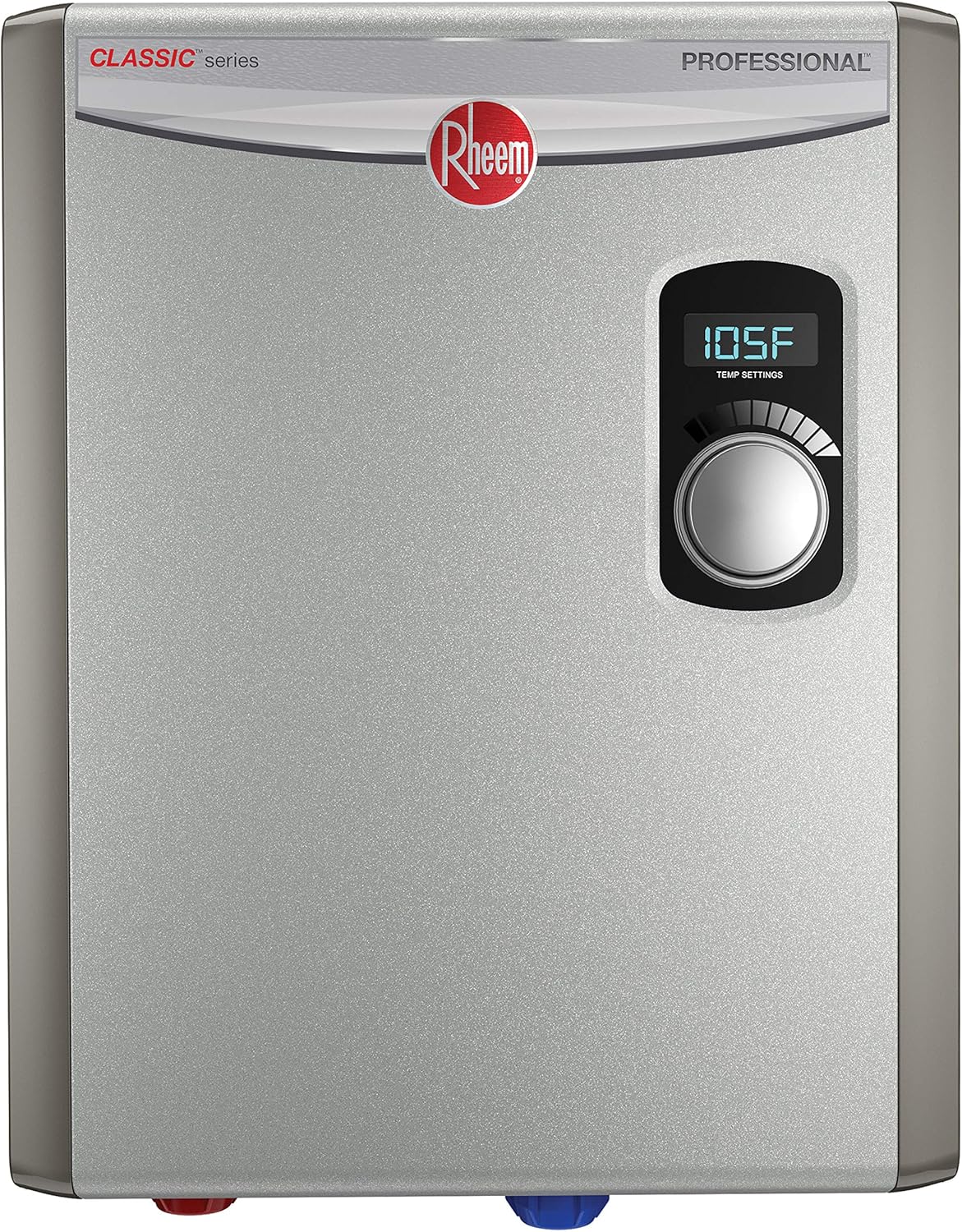
| Wattage | 18000 watts |
|---|---|
| Voltage | 240 volts |
| Flow Rate | 4.4 gpm |
| Maximum Temperature | 140 °F |
The Rheem RTEX-18 is a wall-mounted tankless electric unit aimed at whole-home and single-shower applications in moderate climates. It uses self-modulating electronics and two copper immersion heating elements to deliver up to 4.4 gallons per minute while adjusting power to match demand, which helps reduce energy use compared with a storage tank. Installation is straightforward for a tradesperson with bottom 3/4 inch NPT water connections and no venting requirement, and the external LED temperature control gives +/-1 degree tuning for consistent outlet temperature. The compact stainless steel housing saves space and can be sited near fixtures or in a central location. Important limitations are its 18 kW power rating, which may not support multiple simultaneous high-flow fixtures in cold inlet conditions, and it requires appropriate 240V electrical capacity and breakers. The unit is serviceable with field-replaceable elements but will need professional electrical and plumbing hookup for safe, code-compliant installation.
Best for: Buyers seeking a compact, factory-quality electric tankless heater for a mobile or modest whole-home setup who prioritize steady, energy-smart hot water and a risk-averse, reliable installation path.
Less Ideal for: Homes that need high simultaneous hot-water demand in very cold climates or those without accessible 240V electrical capacity should consider higher-kW or gas alternatives.
- Provides continuous on-demand hot water with up to 4.4 GPM flow rate
- Self-modulating controls that scale power to demand for improved efficiency
- External LED temperature control with fine +/-1 degree adjustment
- Compact wall-mounted design that saves space and requires no venting
- Durable copper immersion heating elements that are field serviceable
- 18 kW output may be insufficient for multiple simultaneous high-flow fixtures in cold climates
- Requires 240V electrical service and correct breaker sizing for safe operation
Verdict: Choose the RTEX-18 when you want a compact, energy-modulating electric tankless heater that delivers reliable on-demand hot water for modest whole-home or mobile-home use.
Choosing the Right Tankless Water Heater for Mobile Home: Key Factors to Consider
Flow Rate and Real-World Demand
Flow rate determines how much hot water a unit can deliver simultaneously and is the core performance metric for tankless heaters. For mobile homes, common simultaneous demands include a shower plus a washing machine or two sinks. Calculate expected flow by adding typical fixture rates and matching that to the unit's rated gallons per minute at the temperature rise you need. Remember that advertised peak flow often assumes a small temperature rise; mobile homes in colder climates need units rated for larger rises, which reduces available GPM.
Choosing a unit with a modest margin above your calculated demand avoids lukewarm showers when two appliances run together. This factor directly affects daily comfort and whether you have to stagger water use.
Fuel Type and Electrical Requirements
Tankless units run on electricity or on-demand gas. Mobile homes often have limited electrical service and more constrained gas hookups, so check service capacity before selecting a unit. Electric tankless models can require high-amp dedicated circuits or three-phase service, which many mobile-home electrical panels cannot supply without upgrades. Gas-fired models need proper supply pressure and safe venting; some units require a minimum gas line diameter or regulator settings.
Matching the unit to existing utility capacity avoids expensive electrical panel upgrades or gas line rework. Consider energy source reliability in your area and whether seasonal temperature swings affect fuel performance or availability.
Venting, Clearance, and Mounting Constraints
Mobile homes limit interior mechanical space and may restrict traditional chimney-style venting. Many tankless units offer direct-vent or concentric vent options that exhaust horizontally through an exterior wall, which is often preferable in mobile housing. Check manufacturer clearance requirements for combustible surfaces and whether the unit can be mounted vertically or horizontally in your available space.
Poor venting planning can create safety hazards or require building modifications. Choosing a unit with flexible venting options and compact mounting dimensions reduces installation hurdles and preserves living space.
Size, Weight, and Service Access
Physical dimensions matter when mounting inside narrow closets or small utility bays typical of mobile homes. A lightweight, slim profile simplifies installation and transport. Also verify that serviceable components are accessible once mounted: common maintenance tasks include cleaning filters, replacing anode rods, or accessing burn chambers and electrical terminals.
If routine maintenance requires removing the unit from a tight cavity, downtime and labor costs can rise. Pick units with front-accessible service panels or designs that allow clearance for routine upkeep.
Temperature Rise and Climate Considerations
Temperature rise is the difference between incoming groundwater temperature and your desired output. In colder regions, incoming water can be much colder, reducing the unit's effective flow at a target output temperature. Mobile-home owners should estimate local groundwater temperature for winter peaks and choose a unit rated to maintain needed flow at that higher rise.
Ignoring climate-driven temperature rise leads to undersized systems and poor hot-water performance during cold months, so factor seasonality into capacity planning.
Durability, Warranty, and Maintenance Needs
Durable construction and a clear warranty give long-term confidence, especially in housing where replacing equipment can be disruptive. Look for units with corrosion-resistant heat exchangers and straightforward warranty terms. Consider the frequency and ease of maintenance tasks such as descaling or filter changes, because hard water or sporadic use patterns in mobile homes can shorten component life.
A longer warranty and easy service access reduce lifetime cost and the hassle of repairs.
Sizing a Tankless Heater for Typical Mobile-Home Households
Start by listing the fixtures you expect to run at once and assign typical flow rates. For example, showers often draw 1.5 to 2.5 GPM, washing machines 1.0 to 2.0 GPM, and faucets 0.5 to 1.5 GPM. Add those flows to estimate peak simultaneous demand.
Next, use local cold-water temperatures to calculate the temperature rise required to reach your desired hot-water temperature. With demand and required rise, choose a unit with a rated GPM at that rise that exceeds your estimate by a healthy margin to avoid performance shortfalls.
- Measure incoming water temperature or check regional averages for winter lows
- Add fixture flow rates for simultaneous-use scenarios
- Account for lower flow rates when higher temperature rises are required
Electrical Panel and Gas Supply Checklist
Before choosing a unit, inspect the mobile home's electrical panel and gas service. Note breaker capacity, available amps for dedicated circuits, and whether the current setup supports the high-demand draws of some electric tankless units.
For gas-fired units, confirm gas line diameter, pressure, and whether venting paths allow for direct or concentric venting. These checks prevent surprises during installation and help scope needed trades work.
- Record existing breaker ratings and available free slots
- Verify gas line size and pressure with a qualified technician
- Plan vent routes early to avoid structural modifications
Venting Options and Installation Locations
Choose a location that supports the required venting method with minimal penetrations through exterior walls. Horizontal direct venting is often most practical in mobile homes, but clearances and nearby openings must meet code.
Consider installing the unit near points of use to reduce lag time and pipe heat loss. If space is tight, an exterior-mounted or closet-friendly model with flexible venting adapters can be a better fit.
- Map the shortest, code-compliant vent path before purchasing
- Avoid locating the heater near air intakes or combustible materials
- Ensure service access without removing large cabinetry or panels
Maintenance Tips to Extend Unit Life
Regular flushing or descaling extends the life of heat exchangers, especially in areas with hard water. Follow frequency recommendations based on local water hardness and usage patterns.
Keep inlet filters clean and check for leaks at fittings and seals. Periodic visual inspections can catch early signs of corrosion, scaling, or vent blockages before they become major problems.
- Establish a descaling schedule tailored to water hardness
- Check valves, seals, and vents annually
- Keep a simple service log to track maintenance and warranty milestones
Common Installation Pitfalls to Avoid
Underestimating required temperature rise, attempting to run too many fixtures at once, and ignoring venting clearances are frequent causes of poor performance. Also avoid choosing an electric unit without verifying electrical capacity.
DIY installations that skip required permits or inspections can lead to unsafe conditions or failed inspections. Always follow local codes and consult qualified installers for fuel connections and venting work.
- Do not rely solely on peak GPM numbers without checking rise ratings
- Plan for inspection and permit timelines
- Hire qualified pros for gas and electrical hook-ups
How We Chose the Best Tankless Water Heater for Mobile Home
We evaluated units based on criteria that matter most for mobile-home installations and everyday performance. Primary filters included compact footprint and venting flexibility so units fit limited mechanical spaces and comply with common mobile-home venting options. We prioritized measured flow rate at realistic temperature rises to ensure the heater can handle showers and appliances simultaneously. Installation complexity was a key consideration, including required fuel type, electrical service, and whether the unit supports common mobile-home gas or electrical hookups. Energy efficiency and standby loss were included to reflect operating cost differences over time. Durability and build quality were considered through warranty length and documented component materials. We excluded products that lack explicit mobile-home compatibility, require atypical structural modifications, or have impractical power or venting demands for most manufactured-housing setups. The resulting list focuses on units that balance compact size, dependable hot-water delivery, manageable installation, and long-term reliability.
Our full evaluation process is outlined in our review methodology.
FAQ
Can a tankless water heater fit inside a mobile home closet?
Often yes. Many tankless units have compact footprints designed for small mechanical spaces, but you must check manufacturer clearance requirements and ensure front access for service. Venting and combustion-air provisions may also dictate mounting location.
Do electric tankless heaters need a panel upgrade in mobile homes?
They can. Some electric models require high-current dedicated circuits that exceed typical mobile-home panel capacity. Verify the unit's amperage requirements and compare them to your panel before buying to avoid costly upgrades.
How does cold incoming water affect performance?
Colder inlet water increases the temperature rise required, which reduces the unit's available flow at your target output. In regions with low groundwater temperatures, select a unit rated for higher rises or expect lower simultaneous-flow capability.
Are there venting options that work better for mobile homes?
Direct or concentric horizontal venting is often the most practical because it avoids roof penetrations. Choose a model that supports the venting configuration permitted by local code and that fits the available exterior wall locations.
How often should a mobile-home tankless unit be descaled?
Frequency depends on water hardness and usage. In hard-water areas, descaling every 6 to 12 months is common. If water is soft or you use a softening pre-treatment, annual or biennial descaling may be sufficient.
Final Verdict
For mobile homes, prioritize compact units with appropriate flow ratings at realistic temperature rises and flexible venting options. Match the unit to existing fuel and electrical capacity to avoid costly upgrades and choose models with accessible service panels to simplify maintenance. Balance flow needs against space and installation complexity to pick a solution that reliably supplies hot water without requiring structural changes.