
Note: This article contains affiliate links. If you click on these links and make a purchase, we may earn a small commission at no extra cost to you. This helps support our research and content. Read our full affiliate disclosure here.
Older houses often have heating systems and wiring that differ from modern homes, so choosing the right thermostat matters for comfort, reliability, and avoiding costly rework. You need a control that matches your heating system, fits existing wiring, and gives the temperature control features you actually use. This guide shortlists the top thermostats for older homes, focusing on units that balance compatibility, ease of installation, and accurate temperature control. Below you will find the picks that made our list and the practical criteria we used to evaluate them, followed by guidance to help you pick the best fit for your home.
Top Picks at a Glance
| Best Overall The best all-around choice for most situations | ecobee Smart Thermostat Essential |  |
| Best Quality Built to a higher standard if you want something more solid | ecobee Smart Thermostat Enhanced |  |
| Best Value The sweet spot between price and what you get | Honeywell Home X2P RTH20B |  |
| Best Budget The cheapest option that still gets the job done reliably | Honeywell Home CT30A Manual Thermostat |  |
| Top Rated A top-rated pick with lots of positive feedback | Nurfosttek Non-Programmable Thermostat |  |
| Most Popular A crowd favorite that many people choose with confidence | Sensi Smart Thermostat ST55 |  |
| Best Seller A high-volume bestseller chosen again and again | Google Nest Thermostat |  |
ecobee Smart Thermostat Essential

| Connectivity Technology | Wi-Fi |
|---|---|
| Controller Type | Amazon Alexa, Android, Apple HomeKit, Google Assistant, iOS |
| Power Source | Battery Powered |
| Display Type | LCD |
| Mounting Type | Wall Mount |
The ecobee Smart Thermostat Essential is a pared-down smart thermostat that gives you remote control, scheduling, and basic energy-saving automation without extra frills. It installs to a wall plate and connects over Wi‑Fi so you can control temperature from the ecobee app or a 3.74-inch touch LCD, and it integrates with Alexa, Siri/HomeKit, and Google Assistant for voice control. Built-in eco+ features and auto-away help reduce runtime when rooms are empty, and the thermostat reports energy usage to help tune schedules. For older homes the ability to check compatibility and add ecobee's Power Extender Kit if you lack a C wire makes installation feasible in many systems, and the included backplate and wire labels simplify a DIY swap. Limitations: it is battery powered rather than line-powered, lacks built-in remote sensors in the base package, and advanced features found on higher-end ecobee models are not included, so buyers wanting room-by-room balancing or integrated air quality monitoring will need add-ons or a different model.
Best for: Buyers who want a straightforward, energy‑minded smart thermostat that is easy to control from an app or touchscreen and that can be adapted to older HVAC setups with common DIY installation.
Less Ideal for: Homes that need integrated room sensors, built-in air quality monitoring, or the fullest advanced controls—those buyers should consider a higher-end model or additional accessories.
- Wi‑Fi connectivity with app control and 3.74-inch touch LCD for easy remote or local adjustments
- Works with Alexa, Google Assistant, and Apple HomeKit for voice control
- eco+ features and auto-away scheduling help reduce heating and cooling runtime
- Compatibility checker and optional Power Extender Kit make it suitable for many older systems without a C wire
- Includes backplate, screws, and wire labels to simplify DIY installation
- Does not include SmartSensor remote sensors in the base package
- Battery powered design instead of requiring common wire may limit long-term power stability
- Fewer advanced features than higher-end ecobee models, such as built-in air quality monitoring
Verdict: A practical, app‑controllable smart thermostat that balances energy-saving features and easy DIY installation for older homes.
ecobee Smart Thermostat Enhanced

| Connectivity Technology | Wi-Fi |
|---|---|
| Power Source | Corded Electric |
| Voltage | 24 volts |
| Display Type | LCD |
| Screen Size | 4 inches |
The ecobee Smart Thermostat Enhanced is a wall-mounted, hardwired smart thermostat designed to reduce heating and cooling waste while keeping rooms comfortable. It connects over dual-band Wi‑Fi and pairs with voice assistants and Apple HomeKit for remote and voice control, while the ecobee app offers schedule suggestions and temperature control from a phone or Apple Watch. Built-in radar occupancy sensing and support for ecobee SmartSensors let the thermostat detect which rooms are in use and prioritize comfort where it matters, and the included Power Extender Kit helps with installations that lack a C wire. Practical benefits include automatic away and sleep adjustments that can cut energy use, a clear 4-inch LCD for local control, and compatibility with most 24 VAC HVAC systems. Limitations to note: it requires a compatible 24 VAC system (line-voltage and millivolt systems are not supported) and it is a hardwired device so installation may be more involved than a battery-powered model. For older homes, checking compatibility before buying is important to avoid wiring surprises.
Best for: Buyers who want a performance-focused smart thermostat that reduces energy use and prioritizes occupied rooms in older houses while retaining advanced app and voice control.
Less Ideal for: Homes with non-24 VAC heating systems such as line-voltage or millivolt setups, or buyers who need a simple battery-powered thermostat with minimal installation work.
- Radar occupancy sensing improves room-level comfort detection.
- App and voice assistant integrations enable remote and voice control.
- Includes Power Extender Kit and trim accessories for easier DIY installs.
- Supports most 24 VAC HVAC systems and is Energy Star certified.
- Hardwired design provides continuous power and stable operation.
- Not compatible with line-voltage or millivolt HVAC systems.
- Hardwired installation can require more time or professional help in some older homes.
Verdict: A performance-oriented, hardwired smart thermostat that uses radar sensing and app integrations to improve comfort and cut energy use in older 24 VAC homes.
Honeywell Home X2P RTH20B

| Power Source | 2 AA batteries |
|---|---|
| Temperature Control Type | Programmable |
| Scheduling | 5-2 day (or non-programmable) |
| Display Type | Backlit LCD |
| Compatibility | Single-Stage 1 Heat/1 Cool |
The Honeywell Home X2P RTH20B is a straightforward programmable thermostat aimed at single-stage 1 heat/1 cool systems commonly found in older houses. It provides 5-2 day scheduling (with non-programmable option), a large backlit LCD for easy reading, and configurable reminders such as change air filter alerts. Installation is simple for conventional systems and the included UWP wall plate helps cover older wiring patterns and wall openings. Power is from two AA batteries so you can avoid worrying about a C-wire in many installs, and compatibility covers common heating types like forced air and hot water heat while excluding electric baseboard systems. The interface is basic push-button and touchpad control rather than a touchscreen or smart-home ecosystem, so you get reliable local control but not advanced remote app features. For homeowners who want dependable programmable control and clear on-device info without bells and whistles, the RTH20B is a practical, easy-to-install option; those seeking Wi-Fi connectivity or multi-stage heat pump control should look elsewhere.
Best for: Homeowners in older houses who want a reliable, easy-to-install programmable thermostat for basic heating and cooling control without needing smart features.
Less Ideal for: Users who want Wi-Fi connectivity, smart-home integration, or support for multi-stage HVAC systems should consider a different model.
- 5-2 day scheduling with a non-programmable option for flexible routines
- Large backlit LCD and clear font for easy daily use
- Works with common single-stage heating systems including forced air and hot water
- Battery-powered operation avoids immediate need for a C-wire
- UWP wall plate simplifies installation in older homes
- No Wi-Fi or remote app control for off-site adjustments
- Limited to single-stage 1H/1C systems and not compatible with electric baseboard heat
Verdict: A no-frills programmable thermostat that makes upgrading temperature control in older homes simple and dependable without requiring a C-wire.
Honeywell Home CT30A Manual Thermostat

| Controller Type | Hand Control |
|---|---|
| Additional Features | Heat Only |
| Power Source | Low Voltage Control |
| Display Type | Manual |
| Control Type | Dial Control |
The Honeywell Home CT30A is a straightforward, heat-only mechanical thermostat that uses a bimetal temperature sensor and snap-action switch to control a low-voltage furnace. Installation is DIY-friendly: it includes a decorative backplate and mounting hardware and does not require leveling, so swapping an older manual thermostat is quick. Its dial control and manual display make it easy to set and adjust without menus or power requirements. The lack of programming, digital display, or compatibility with heat pump and multi-stage systems keeps the design very simple, which suits homes that only need reliable on/off heating control. Practical benefits include mercury-free construction and a compact contemporary look that blends with most interiors. The main limitations are its single-function heat-only design and absence of advanced features like scheduling, remote control, or cooling support, so it is not a fit for households wanting energy-saving automation or multi-system integration.
Best for: Homeowners in older houses seeking an inexpensive, no-frills replacement thermostat for a single-stage heating system who prioritize simplicity and reliability over smart features.
Less Ideal for: Homes that need cooling control, heat pump or multi-stage system support, or users who want programmable schedules and remote access.
- Very simple, easy-to-use dial control with no programming required
- Includes mounting hardware and decorative backplate for quick DIY installation
- Mercury-free bimetal sensor and snap-action switch provide reliable basic heating control
- Compact contemporary design that fits most walls
- Only supports heat-only low-voltage furnace systems and is not compatible with heat pumps or multi-stage systems
- No programmable schedules, digital display, or remote/Wi-Fi control
Verdict: A budget-friendly, reliable manual thermostat ideal for older single-stage heating systems where simple temperature control is the priority.
Nurfosttek Non-Programmable Thermostat

| Controller Type | Push Button |
|---|---|
| Temperature Control Type | Manual |
| Power Source | Battery Powered |
| Display Type | LCD |
This Nurfosttek non-programmable thermostat is a straightforward replacement thermostat designed for 1 heat/1 cool single-stage systems commonly found in older homes. It uses 2 AAA batteries, an easy-to-read LCD with blue backlight, and large up/down push buttons for manual temperature changes, plus fan and system mode switching. The unit offers an adjustable temperature swing so you can favor tighter temperature control or fewer equipment cycles to reduce wear, which helps with longevity in older HVAC systems. Installation is DIY-friendly and includes mounting screws, anchors, wiring labels, and a step-by-step manual. Practical touches like a low-battery indicator and simple battery compartment speed routine maintenance. Because it is non-programmable and manual, it lacks scheduling, remote control, or smart features, so it is best for homeowners who want a reliable, no-frills control that minimizes complexity rather than energy-optimizing automation.
Best for: Homeowners updating thermostats in older houses who prioritize simple, reliable manual control and easy DIY installation over smart scheduling features.
Less Ideal for: People who want remote access, automatic scheduling, or integration with smart home systems should look at programmable or Wi-Fi thermostats instead.
- Works with standard single-stage heating and cooling systems for broad compatibility in older homes
- Clear LCD and large buttons make temperature changes simple to read and operate
- Adjustable temperature swing lets you trade off tighter control versus fewer cycles to protect older equipment
- Includes wiring labels, screws, anchors, and manual for straightforward DIY installation
- Battery-powered with low-battery indicator avoids wiring to a C-wire and reduces installation complexity
- No programmable schedule, Wi-Fi, or remote control capabilities
- Battery operation means periodic battery replacement is required
Verdict: A dependable, no-frills manual thermostat that gives older homes simple, easy-to-maintain temperature control without added complexity.
Sensi Smart Thermostat ST55

| Connectivity Technology | Wi-Fi |
|---|---|
| Control Method | App, Touch, Voice |
| Power Source | Corded Electric |
| Screen Size | 5 inches |
| Number of Batteries | 2 AA batteries required. (included) |
The Sensi ST55 is a straightforward smart thermostat designed to replace a standard wall unit while adding Wi‑Fi control, scheduling, usage reports, and smart alerts. Installation is pitched at DIYers: the unit mounts in a standard thermostat footprint, includes mounting hardware, wire stickers and step‑by‑step app guidance, and usually does not require a common wire in many homes. Once set up, the Sensi app provides remote access, programmable schedules, energy usage reports and filter reminders, and the thermostat integrates with Alexa, Google Assistant, Apple HomeKit and SmartThings for voice control. The LED display and physical buttons keep basic operation simple for households used to manual thermostats. Energy Star certification and usage reporting can help owners of older homes monitor and cut HVAC costs. Limitations to consider are the modest 5‑inch screen and button control instead of a full color touchscreen, and the unit relies on 2 AA batteries for backup which means occasional battery changes.
Best for: Homeowners updating an older single‑family or period home who want a reliable, energy‑focused smart thermostat that is easy to install themselves and integrates with common voice assistants.
Less Ideal for: Buyers seeking a premium touchscreen interface or a thermostat with advanced HVAC diagnostics beyond usage reports should consider higher‑end models.
- Easy DIY installation with mounting hardware and app guidance.
- Works with major smart platforms including Alexa, Google Assistant and HomeKit.
- Energy Star certified with usage reports and smart alerts to track HVAC performance.
- Simple LED display and physical buttons make basic operation familiar and accessible.
- No full color touchscreen; control relies on buttons and a smaller display.
- Uses 2 AA batteries for backup which require occasional replacement.
Verdict: A user‑friendly, Energy Star smart thermostat that brings app and voice control to older homes with an easy DIY install and practical energy reporting.
Google Nest Thermostat
| Connectivity Technology | Bluetooth, Wi-Fi |
|---|---|
| Power Source | Battery Powered |
| Display Type | LCD |
| Screen Size | 2 inches |
| Control Type | Remote Control, Voice Control |
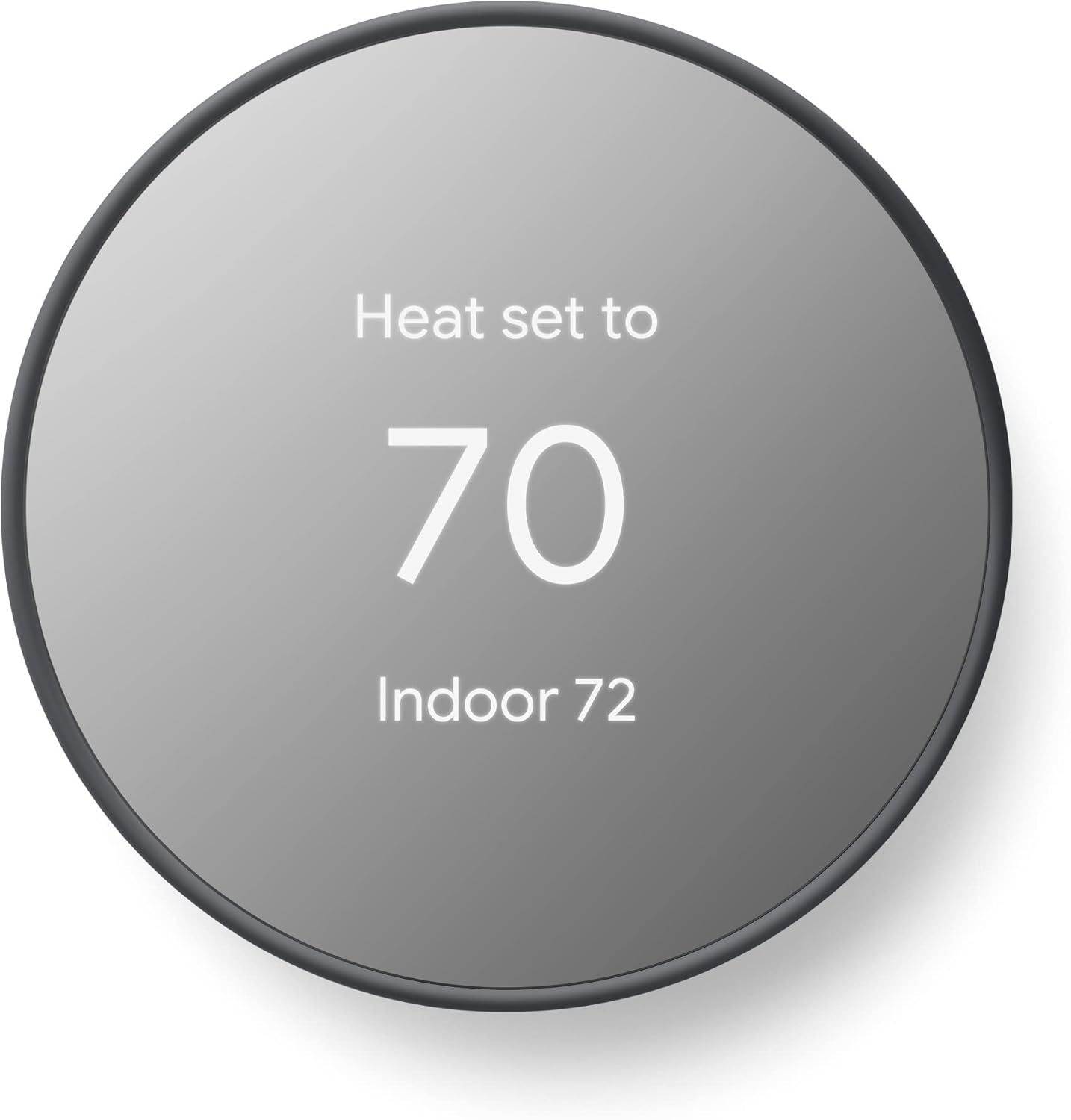
The Google Nest Thermostat is a compact smart thermostat intended to replace a basic wall thermostat and give you remote control and simple scheduling through the Google Home app. It connects via Wi‑Fi and Bluetooth and supports voice control with Google Assistant and other Matter-certified assistants, while operating on two included A batteries so many homes can install it without a C wire. Typical uses are remote temperature changes, creating an energy-saving schedule, and receiving HVAC monitoring alerts when the system behaves abnormally. Notable features include Savings Finder suggestions, Eco Temperatures when the home is empty, and easy self-installation that most users can complete in about 30 minutes. Trade-offs to consider are limited advanced learning compared with higher-end Nest models, and some heating or cooling setups may still require a C wire or power accessory for reliable operation. The small LCD display and touch-side control bar keep interactions simple but offer less detailed on-device controls than larger thermostats.
Best for: Buyers who want a straightforward, reliable smart thermostat that adds remote control and basic energy-saving automation to an older home without a complex installation process.
Less Ideal for: Homeowners who need advanced learning features, extensive on-device controls, or systems that require constant powered thermostats should consider more fully featured or professional solutions.
- Wi‑Fi and Bluetooth connectivity for remote app control and voice commands
- Designed for easy self-installation in most homes without a C wire
- Energy-saving features including Eco Temperatures and Savings Finder suggestions
- Simple touch-bar and compact LCD for straightforward on-device control
- Includes mounting hardware and batteries for quick setup
- May require a C wire or power accessory for some HVAC configurations
- Less advanced learning and on-device controls than premium Nest models
Verdict: A simple, install-friendly smart thermostat that brings app and voice control plus basic energy-saving features to older homes with minimal fuss.
Choosing the Right Thermostat for Older Homes: Key Factors to Consider
Heating System Compatibility
Identify the type of heating system you have and confirm the thermostat supports it. Older homes commonly use single-stage furnaces, boilers, or heat-only systems without air conditioning, and some systems use millivolt or line-voltage controls. Each of these control types has different terminal and voltage requirements, and choosing a thermostat that matches the system prevents malfunctions and protects equipment.
Checking compatibility matters because installing a thermostat that expects a modern 24V control signal into a noncompatible system can lead to nonresponsive heating, blown fuses, or the need for a separate interface relay. Before buying, inspect the current thermostat wiring and label the terminals, then consult the thermostat's compatibility guidance or wiring schematic to verify it supports your system type.
Wiring and the C-wire Issue
Many older homes lack a dedicated common 24V wire, known as a C-wire, which modern smart thermostats often require for continuous power. Determine whether a C-wire is present and whether adding one is practical. Thermostats that include alternative power options, such as power-sharing technology or an included power module, reduce the need for running new wiring.
How wiring affects the install is practical: running a new C-wire can involve attic or basement access and may require an electrician. Choosing a thermostat that works without a C-wire or that ships with a simple adapter keeps installation simpler and less disruptive in older houses.
Mounting and Backplate Fit
Older homes often have nonstandard wall boxes or uneven plaster and wallpaper, which makes mounting and hiding old wall scars important. Look for thermostats with an oversized backplate, easy-to-adjust mounting options, or paintable trim to conceal previous holes and wiring runs.
A well-designed backplate reduces the need to patch walls or perform cosmetic repairs after installation. Consider the thermostat's depth and whether the base will sit flush against older drywall or plaster; some units include spacers or shims to help with uneven surfaces.
User Interface and Programming
The interface determines how easily you and other household members can set schedules, adjust temperatures, and troubleshoot issues. In older homes, you may want simple, large controls and clear on-screen status rather than complex menus. If you prefer smart features, ensure the interface balances connectivity with straightforward local control.
Programming complexity can affect long-term satisfaction. A thermostat that is easy to program or that offers reliable auto-schedule learning will reduce the time you spend managing comfort. Also consider whether multiple household members will interact with it and if the display is readable from a distance or at night.
Power and Battery Options
Thermostats either draw power from the HVAC control circuit or rely on batteries. Battery-powered models are easy to fit into homes without a C-wire but require periodic battery changes. Units that accept batteries as backup provide resilience during power interruptions.
Consider the maintenance trade-offs: battery-only operation simplifies installation but adds ongoing upkeep, whereas a hardwired power option reduces battery changes but may need wiring work. Some thermostats support both, offering hardwiring with battery backup to get the best of both approaches.
Sensor Placement and Remote Sensing
Temperature at the thermostat location may not represent the whole house, especially in older homes with uneven heat distribution. Look for thermostats that support remote sensors or multiple-zone sensing, which allow you to balance comfort in frequently used rooms or basements.
Remote sensors help avoid overheating or underheating areas far from the thermostat and can improve comfort without changing the entire heating system. Consider whether the thermostat supports wired or wireless sensors and how those sensors are powered and mounted.
Common Older-Home Wiring Types Explained
Older homes can use several wiring and control standards that differ from modern 24V digital controls. Typical setups include low-voltage 24V systems with fewer terminals, millivolt systems used with standing pilot boilers, and line-voltage controls in electric baseboard heating. Identifying which category your system belongs to simplifies the thermostat selection process.
If your current thermostat has only a couple of wires and no labeled terminals, start by removing the cover and photographing the wiring. Note color and terminal labels, and check whether there is a wire connected to a C or common terminal. This step helps rule out many modern thermostats that cannot operate without a specific control voltage or interface.
- 24V low-voltage: common in boilers, furnaces, and central HVAC systems.
- Millivolt: often used on vintage boilers and gravity-fed systems.
- Line-voltage: used for electric baseboard or radiant heaters and requires a compatible line-voltage thermostat or relay.
Installation Tips for Older Walls and Wiring
Prepare the wall before installing by turning off power at the heating system and labeling wires. Use a backing plate or adapter to cover old paint or wallpaper damage and to provide a flat mounting surface. If the wall is plaster, consider using wall anchors or toggles to secure the thermostat base safely.
When fishing new wires is impractical, look for compatible thermostats that work with the existing cable. If a C-wire is needed and you cannot run a new conductor, a power adaptor or add-on module can sometimes provide the required common without extensive rewiring. Always verify the module supports your specific control type before installing.
- Turn off power to the heating system before touching wiring.
- Label wires and photograph the original setup for reference.
- Use an adapter plate to hide wall imperfections.
Balancing Simplicity and Smart Features
Smart thermostats offer benefits like remote control, scheduling, and energy reports, but they can also add complexity in older homes. If you need only basic schedule control and dependable operation, a straightforward programmable thermostat may be the best fit. For those who want connectivity, choose models that degrade gracefully to manual control if the network is unavailable.
Consider whether remote sensors or app-based schedules will actually improve comfort in your house. In some older homes, uneven heating patterns mean sensor placement or zoning changes are more effective than advanced algorithms. Focus on features that solve real comfort problems in your home rather than novelty functions.
- Prefer simple programming if multiple household members will adjust settings.
- Choose smart features only when they address a clear comfort or convenience need.
- Ensure the thermostat has local controls that work without Wi-Fi.
When to Consider a Professional Installer
Some older systems may have ambiguous wiring, unsafe line-voltage connections, or require a relay interface for modern thermostats. If you encounter line-voltage wiring, exposed junctions, or if your heating system uses unusual voltages, it is wise to consult a qualified HVAC technician or electrician to avoid damage and maintain safety.
A professional can also advise on whether installing a new C-wire, adding relays, or upgrading the zone controls is a cost-effective long-term decision. For straightforward low-voltage swaps, many homeowners can handle the installation themselves, but do not hesitate to seek help when wiring uncertainty exists.
- Hire a pro for line-voltage or unclear wiring.
- Ask a technician about adding a C-wire or relay modules.
- Get a safety check if your system has exposed or corroded wiring.
Maintaining Thermostat Performance Over Time
Keep the thermostat free of dust and check batteries annually if used as a power option. Periodically verify temperature calibration by comparing the device reading to a reliable thermometer placed nearby. If the thermostat uses remote sensors, check their batteries and signal strength to maintain accurate control.
Watch for signs of wiring wear or loose terminal connections, especially in older installations where oxidation can occur. Addressing small maintenance items early helps avoid intermittent control issues that can be misdiagnosed as equipment failures.
- Replace batteries annually if used.
- Calibrate by cross-checking with a room thermometer.
- Inspect wiring terminals for corrosion or looseness.
How We Chose the Best Thermostat for Older Homes
We focused on compatibility, installation simplicity, temperature control accuracy, and long-term usability when selecting thermostats suitable for older homes. Compatibility was a primary filter: only thermostats that can support common legacy heating systems such as conventional boilers, furnaces with single-stage or two-stage control, and systems that lack a common 24V C-wire were considered. Installation simplicity weighed heavily; we prioritized products that can be wired to existing terminals, include clear wiring diagrams, or work with common add-on power modules for homes without a C-wire. Temperature control accuracy and sensor options were used to assess real-world comfort and energy savings potential. Usability and interface clarity were assessed to favor models that offer straightforward programming or reliable smart features without excessive complexity. Durability and build quality were considered to ensure the units will perform reliably in older houses where replacements may be more difficult. We excluded units that require full HVAC rewiring, specialized proprietary control systems, or uncommon voltages found only in commercial installations. The resulting list favors thermostats that practical homeowners and installers can fit into older electrical and heating setups with minimal modification.
Our full evaluation process is outlined in our review methodology.
FAQ
Can I install a modern thermostat without a C-wire in an older home?
Often you can, because some thermostats use power-stealing technology or include a power module to work without a dedicated C-wire. However, results vary by system; for reliable operation you may prefer a unit specifically rated for C-wire-less installation or add a simple power adapter.
How do I tell if my heating system uses millivolt or 24V control?
Inspect the thermostat wiring and the heating appliance control board. Millivolt systems typically have very few wires and are found on older boilers with pilot lights. A multimeter reading at the thermostat terminals can confirm voltage, but if you are unsure, consult an installer to avoid miswiring.
Are line-voltage thermostats different from regular ones?
Yes. Line-voltage thermostats are designed to switch mains power directly for electric baseboard or radiant systems and are not interchangeable with low-voltage 24V thermostats. If your system uses line voltage, choose a thermostat or relay rated for that voltage and installation type.
Will a smart thermostat help reduce energy use in an older house?
Smart thermostats can help by enabling schedules, setback strategies, and more precise control, but savings depend on the building envelope and heating system efficiency. In some older homes, reducing drafts and improving insulation or zoning may deliver bigger gains than thermostat features alone.
What should I do if the thermostat display goes blank after installation?
A blank display usually indicates a power issue. Check that the furnace or boiler power switch is on, verify wiring connections at the thermostat base, and confirm any circuit breakers are not tripped. If the unit requires a C-wire and one is not present, installing a compatible power module or adding a C-wire can resolve the problem.
Final Verdict
Choosing the right thermostat for an older home comes down to matching the device to your heating system and wiring while prioritizing installation simplicity and reliable temperature control. Focus first on compatibility and whether a C-wire is available, then weigh interface clarity and sensor options to address actual comfort problems. If wiring or voltage is unclear, seek professional help to avoid damage. With the right balance of compatibility and features, you can improve comfort and convenience in an older house without extensive rewiring.