
Note: This article contains affiliate links. If you click on these links and make a purchase, we may earn a small commission at no extra cost to you. This helps support our research and content. Read our full affiliate disclosure here.
When you head into the backcountry or set up at a remote campsite, having a dependable water treatment system matters for safety and convenience. An under-sink reverse osmosis water filter for camping gives you laboratory-grade contaminant reduction in a compact, under-counter package that can be adapted to temporary or semi-permanent setups. You want a unit that removes the right contaminants, keeps a reasonable flow for daily use, and is simple enough to install where water access is limited. This guide covers seven shortlisted under-sink reverse osmosis water filters for camping and explains the evaluation criteria we used. Read on to understand the tradeoffs between filtration performance, flow rate, installation needs, and maintenance so you can pick the best fit for your campsite setup.
Top Picks at a Glance
| Best Overall The best all-around choice for most situations | Waterdrop G2 Tankless RO System |  |
| Best Quality Built to a higher standard if you want something more solid | Waterdrop G5P500A Tankless RO |  |
| Best Value The sweet spot between price and what you get | APEC Water ROES-50 RO System |  |
| Best Budget The cheapest option that still gets the job done reliably | AQUALTRA USF-4RF-100 RO System | 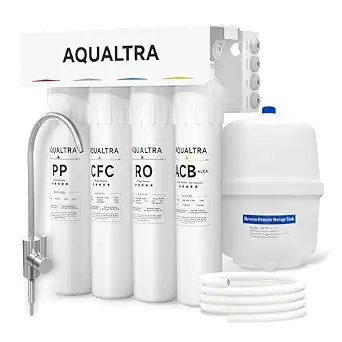 |
| Top Rated A top-rated pick with lots of positive feedback | iSpring RCC7-BN RO System |  |
| Most Popular A crowd favorite that many people choose with confidence | iSpring RCC7AK-BN Reverse Osmosis |  |
| Best Seller A high-volume bestseller chosen again and again | Express Water ROALK5D 50 GPD |  |
Waterdrop G2 Tankless RO System

| Purification Method | Reverse Osmosis |
|---|---|
| Flow Rate | 400 GPD |
| Filtration Stages | 7 Stage |
| Pure to Drain Rate | 1:1 |
| Installation Type | Under Sink |
The Waterdrop G2 is a compact, tankless under-sink reverse osmosis system designed to deliver fast, high-quality drinking water without the bulk of a storage tank. Installed beneath the sink, it uses a seven-stage filtration stack including RO membrane and carbon/PP prefilters to reduce TDS and common contaminants while keeping lead-free certified components. The tankless design and 400 GPD flow rate mean filtered water is available quickly — about a cup in 12 seconds — and the system advertises a low 1:1 pure-to-drain ratio to reduce waste. It requires an under-sink electrical outlet and some drilling during installation, but Waterdrop's integrated housing, twist-and-pull filter cartridges, and reportedly easy sub-30-minute installation make filter changes and setup straightforward. Practical benefits include smaller footprint, quieter sealed housing, and the ability to connect to an ice maker or refrigerator with an optional tank. Limitations are the need for power under the sink and that true field use for camping requires a stable water source, electricity, and likely a temporary mounting surface rather than a portable setup.
Best for: Buyers who want a high-capacity, space-saving under-sink RO that delivers fast, low-waste filtered water and who prioritize easy maintenance and compact installation under a fixed sink.
Less Ideal for: People needing a portable or off-grid water filter for remote camping trips without reliable electricity or a fixed under-sink mounting location should look for dedicated portable or nonpowered filtration options.
- Tankless compact design saves under-sink space compared with tanked RO systems
- High flow capacity up to 400 gallons per day for fast dispensing
- Seven-stage filtration including RO membrane and carbon/PP elements for broad contaminant reduction
- Low 1:1 pure-to-drain ratio that reduces wastewater compared with many RO units
- Twist-and-pull replacement filters and integrated housing simplify filter changes and installation
- Requires an under-sink electrical outlet and drilling for installation
- Not a truly portable unit — needs a stable water supply and power, limiting direct use at campsites
Verdict: Choose the Waterdrop G2 when you need a high-flow, low-waste, space-saving under-sink RO system with easy filter swaps for reliable filtered water at a fixed campsite or cabin with power.
Waterdrop G5P500A Tankless RO

| Filtration stages | 8-stage |
|---|---|
| Purification method | Reverse Osmosis |
| Flow rate | 500 GPD |
| Pure to drain ratio | 2:1 |
| Power source | Corded Electric |
The Waterdrop G5P500A is a compact, tankless under-sink reverse osmosis system built for high throughput and steady purified water delivery. It uses an 8-stage filtration train including a 0.0001 μm RO membrane plus an alkaline mineral stage to reduce contaminants like lead, chlorine, fluoride, PFOA/PFOS and add back minerals. The tankless design saves under-sink space and produces a fast flow — Waterdrop rates it at 500 GPD and says a 6-ounce cup fills in about 8 seconds — which makes it useful wherever you need near-immediate filtered water. The unit requires power and a drilled faucet installation, and it supports connections to appliances such as ice makers and refrigerators. Practical benefits include low footprint, clear filter life and TDS display, and a 2:1 purified-to-drain ratio that cuts water waste versus many conventional RO systems. Limitations for portable or remote use are that it needs mains power and permanent under-sink plumbing, so it is better suited to a basecamp or cabin setup than on-the-move camping.
Best for: Buyers who prioritize high-performance, fast-output purified water at a permanent campsite, cabin, or basecamp and want tankless space savings with mineralized output.
Less Ideal for: People needing a truly portable or off-grid filter for backpacking or transient car camping should choose a battery-free or countertop/portable purifier instead.
- High flow capacity rated at 500 gallons per day for fast dispensing
- 8-stage filtration including 0.0001 μm RO membrane and alkaline mineral stage
- Tankless, compact design that saves under-sink space
- 2:1 pure-to-drain ratio to reduce wastewater compared with many RO systems
- Display for filter lifespan and TDS monitoring
- Requires corded electric power and permanent under-sink installation
- Faucet installation needs drilling into the countertop
Verdict: If you need a high-capacity, tankless under-sink RO that delivers fast, mineralized drinking water for a basecamp or cabin, this unit is a performance-focused choice.
APEC Water ROES-50 RO System

| Purification Method | Reverse Osmosis |
|---|---|
| Filtration Stages | 5-Stage |
| Daily Output | 50 GPD |
| Operating Pressure Range | 40-85 psi |
| Supported Water TDS Level Maximum (PPM) | 2000 |
The APEC ROES-50 is a 5-stage under-sink reverse osmosis system designed to deliver very high-purity water from a standard kitchen connection. It uses a sequence of prefilters, an RO membrane, and post-filtration to remove chlorine, lead, fluoride, PFAs, microplastics and other common impurities, and includes a storage tank and dedicated faucet for steady flow. Installation is DIY-friendly with color-coded tubing and quick-connect fittings so you can set it up without specialty tools, and the included Filter-Max cartridge set simplifies routine maintenance. Practical benefits include strong contaminant removal comparable to bottled water and a steady reserve of treated water for drinking and cooking. The system is not portable and needs AC-compatible plumbing and space under a sink or in an RV cabinet, and its 50 GPD output and tank mean it is best for point-of-use supply rather than large-volume refilling. Expect regular filter changes on a 6–24 month cadence depending on feed water quality and moderate water waste typical of RO systems.
Best for: A practical buyer who wants a reliable, high-capacity point-of-use drinking water solution for a campsite base with under-sink or cabinet space, prioritizing contaminant removal and low-maintenance operation.
Less Ideal for: People needing a lightweight, truly portable purifier for backcountry hikes or short-term car camping without a fixed hookup should choose a compact or gravity-fed filter instead.
- Five-stage filtration removes a broad range of contaminants including heavy metals, fluoride, and microplastics.
- Produces up to 50 gallons per day with a storage tank for steady flow to a dedicated faucet.
- Includes Filter-Max replacement set, brushed nickel faucet, tank and installation kit for a complete out-of-box setup.
- DIY-friendly quick-connect fittings and color-coded tubing make installation and servicing straightforward.
- Not designed for portability so it is unsuitable as a mobile or lightweight camping-only unit.
- Requires under-sink space and compatible plumbing and power for installation.
- Typical RO wastewater ratio means some water is discarded during filtration.
Verdict: Choose the ROES-50 when you want a durable, high-performance under-sink RO that reliably delivers very pure drinking water at a campsite base with plumbing access.
AQUALTRA USF-4RF-100 RO System
| Purification Method | Reverse Osmosis |
|---|---|
| Filter Life Cycle | 36 months |
| Capacity | 3.2 gallons |
| Pure to Drain Rate | 3:1 |
| Flow Rate | 100 GPD |
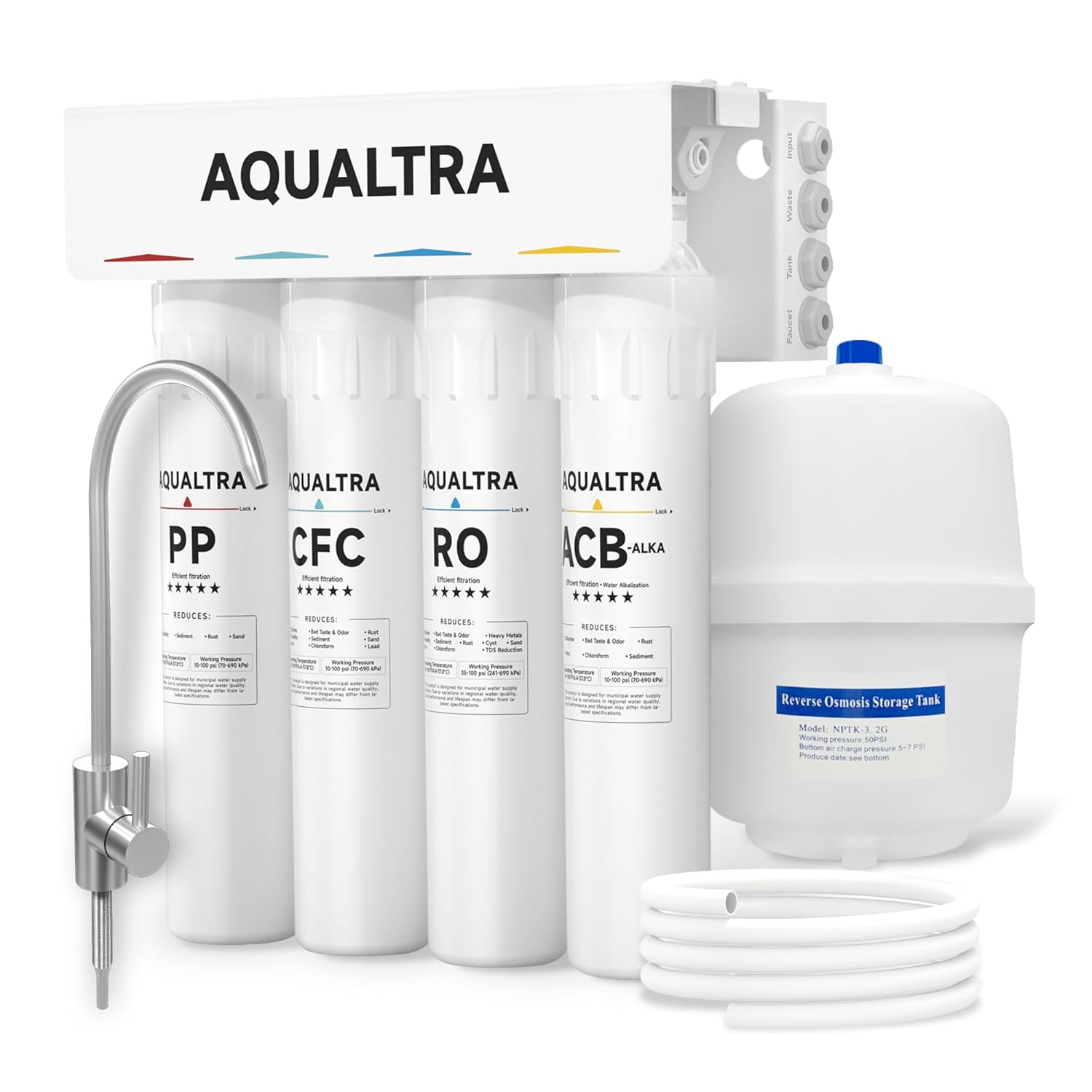
The AQUALTRA USF-4RF-100 is a four-stage under-sink reverse osmosis system that reduces a wide range of contaminants and adds alkaline minerals back into the water. It installs under a sink using water pressure and includes a 3.2 gallon storage tank and a dedicated faucet for on-demand drinking water. Key features include a 100 GPD RO membrane, multi-stage filtration (PP, carbon, RO, alkaline carbon), tested contaminant removal rates, and a claimed 3:1 pure-to-drain ratio to limit waste. Filters are rated with staggered lifespans so you only replace certain elements periodically, and push-to-connect fittings plus a quick-twist design are intended to simplify installation and filter changes. Important limitations for the camping context are that the system is built for municipal cold water only, requires under-sink mounting and a pressurized supply, and is not suitable for untreated well water or portable field use without pre-filtration and plumbing. For a budget-minded buyer wanting reliable under-sink RO performance where a fixed hookup is available, this system offers strong contaminant reduction and mineralized taste without high-end extras.
Best for: Campers on a budget who have access to a fixed, pressurized cold-water hookup and want a low-cost under-sink RO that removes contaminants and improves taste.
Less Ideal for: People needing a portable or off-grid filtration solution or those relying on untreated well water without pre-treatment should look elsewhere.
- High claimed contaminant removal with a 0.0001 μm RO membrane for thorough filtration
- Alkaline remineralization to improve taste and add minerals back to purified water
- 100 GPD rated flow with a 3.2 gallon storage tank for fast on-demand water
- Push-to-connect and quick-twist fittings designed for easier installation and filter changes
- Requires a cold, pressurized municipal water hookup and under-sink mounting so it is not portable
- Not suitable for well water without pre-filtration
Verdict: If you need a budget-friendly under-sink RO that delivers thorough contaminant removal and alkaline remineralization for a fixed campsite hookup, this system is a practical choice.
iSpring RCC7-BN RO System

| Purification Method | Reverse Osmosis, Activated Carbon, Carbon block |
|---|---|
| Power Source | No Power Needed |
| Maximum Flow Rate | 3.4 liters per minute |
| Supported Water TDS Level Maximum (PPM) | 750 |
| Capacity | 75 gallons |
The iSpring RCC7-BN is a 5-stage under-sink reverse osmosis system designed to deliver bottled-quality drinking water at home without using electricity. It uses three prefilters (sediment, GAC, carbon block), a high-rejection RO membrane and a post-carbon polish to remove a wide range of contaminants and reduce TDS by roughly 80 to 90 percent. Installation is intended for under-sink mounting and includes push-to-connect fittings, a storage tank and a top-mounted brushed nickel faucet for dispensing. The clear first-stage housing makes visual checks easy and the system includes factory-quality components intended for long service life, which reduces maintenance surprises. Important limitations for the camping context are its size, tanked storage and requirement for municipal tap water only, so it is not a lightweight or off-grid filter for backpacking; it is better suited to a reliable camp kitchen with under-sink space and a pressurized water supply. Replacement filters are available as designated part numbers and the unit requires periodic filter and membrane changes to keep performance high.
Best for: Buyers who prioritize dependable, factory-quality water purification and want consistently low-TDS drinking water in a camp kitchen or RV setup with available under-sink space and a pressurized water feed.
Less Ideal for: People needing a lightweight, portable, or off-grid filtration solution for backpacking or remote campsites without pressurized municipal water should look to specialized portable filters instead.
- 5-stage filtration removes a broad range of contaminants down to 0.0001 microns
- NSF/ANSI 58 certification backs tested RO performance
- Transparent first-stage housing for quick visual inspections
- Push-to-connect fittings and included components simplify installation
- Designed for municipal tap water and not suitable for untreated well or raw surface water
- Bulky, tanked design makes it impractical for backpacking or truly off-grid camping
Verdict: Choose the RCC7-BN when you need a reliable, certified under-sink RO that consistently produces high-quality drinking water for a camp kitchen or pressurized RV hookup.
iSpring RCC7AK-BN Reverse Osmosis

| Purification Method | Reverse Osmosis, Alkaline, Activated Carbon, Carbon block |
|---|---|
| Power Source | No Power Needed |
| Maximum Flow Rate | 284 liters_per_day |
| Operating Pressure Range | 70 psi |
| Filter Life Cycle | 6 months |
The iSpring RCC7AK-BN is a six-stage under-sink reverse osmosis system that removes a wide range of contaminants and then adds minerals back to raise pH for better-tasting water. It is typically installed beneath a sink and supplies a dedicated brushed-nickel faucet and storage tank for on-demand filtered water. Notable features include NSF/ANSI 58 whole-system certification, a transparent sediment housing for easy inspection, push-to-connect fittings for simpler DIY hookups, and a patent-pending top-mounted fastener that makes faucet installation from above the counter easier. The system runs without electricity and is rated to produce up to about 75 gallons per day, which covers moderate daily needs. Maintenance involves periodic filter and membrane replacements on the manufacturer schedule and swapping in recommended replacement filter sets. Important limitations are its size and the need for an under-sink mount and storage tank, which make it less convenient for very short-term or ultra-portable camping setups, and professional-style installation may still be preferable for first-time installers despite the guided materials and videos.
Best for: Buyers who prioritize verified contaminant removal and documented performance and plan to use a durable under-sink RO setup at a basecamp or RV site where size and a storage tank are acceptable.
Less Ideal for: Those needing an ultralight, truly portable filter for backpacking or short-term tent camping should choose compact gravity or pump filters instead.
- Full-system NSF/ANSI 58 certification for verified contaminant reduction
- Includes alkaline remineralization stage for improved taste and balanced pH
- Transparent first-stage housing for visual filter monitoring
- Push-to-connect fittings and online installation videos ease DIY installation
- Operates without electricity, producing filtered water by pressure-driven RO
- Requires under-sink space and a storage tank, limiting portability for short camping trips
- Regular filter and membrane replacements are required to maintain performance
Verdict: If you want a proven, NSF-certified under-sink RO that adds minerals back for better-tasting water at a semi-permanent campsite or RV hookup, this system delivers reliable, electricity-free performance.
Express Water ROALK5D 50 GPD

| Purification Method | Alkaline, Reverse Osmosis |
|---|---|
| Capacity | 50 gallons_per_day |
| Maximum Flow Rate | 0.8 gpm |
| Operating Pressure Range | 40-80 psi |
| Other Special Features of the Product | NSF certified |
The Express Water ROALK5D is a 10-stage under-sink reverse osmosis system that converts municipal or treated well water into alkaline mineral water and stores it in a small pressurized tank for on-demand use. It installs under a cabinet and connects to standard 3/8" or 1/2" fittings, and includes quick-connect tubing, a brass faucet, and a 4 gallon (3.2 gallon usable) storage tank. The system claims NSF testing to standard 58 and reduces a wide range of contaminants while an alkaline stage adds minerals back into the water. Practical benefits include a compact footprint that fits most under-sink spaces, 50 gallons-per-day capacity, and an included filter set for initial setup so you can start using filtered water right away. Important limitations to consider are the system's 40-80 psi operating range and typical RO waste ratio of roughly 1:1 to 1:3, which can require a booster pump or extra plumbing in low-pressure or water-conservative setups, and the need to change filters on schedule every few months to maintain performance.
Best for: Buyers who prioritize tested contaminant reduction and want a compact under-sink RO that delivers bottled-quality alkaline water without complex setup.
Less Ideal for: People who need a camping-ready, portable system that runs off low pressure or limited water without a pump should look at dedicated portable or low-pressure filtration options.
- Multi-stage RO plus alkaline remineralization for cleaner, better-tasting water
- Includes brass faucet and 4 gallon storage tank for on-demand dispensing
- 50 gallons-per-day rated capacity suitable for typical household needs
- Quick-connect tubing and included filter set simplify initial installation
- Requires 40-80 psi to operate reliably and may need a booster pump in low-pressure locations
- Produces wastewater at a rate of roughly one to three gallons per gallon produced
Verdict: Choose this compact 10-stage RO if you want a factory-quality under-sink system that produces alkaline, lab-tested drinking water and includes a ready-to-use tank and faucet.
Choosing the Right Under-Sink Reverse Osmosis Water Filter for Camping: Key Factors to Consider
Contaminant Reduction
How effectively the system removes bacteria, viruses, sediment, chlorine, heavy metals, and dissolved solids is the most important factor for camping. Reverse osmosis membranes paired with pre- and post-filters provide multi-stage protection. For campsite use you want clear specification of membrane rejection rates and the types of contaminants the prefilters address because source water quality varies widely.
If you will be sourcing water from lakes, streams, or unfamiliar taps, prioritize systems with rated microbial and dissolved-solids reduction. Systems that only filter sediment or taste without a reliable RO membrane are not adequate for uncertain water sources.
Flow Rate and Recovery
Flow rate is how quickly treated water becomes available at the tap. Recovery rate estimates how much of the input water becomes purified output versus waste. For camping, high instantaneous flow is helpful for filling bottles and cooking, while reasonable recovery reduces the amount of raw water you must collect. A system with very low flow or poor recovery will force frequent waits or require a separate storage container, which adds complexity.
Consider the number of people in your group and typical daily water tasks when assessing required flow. Portable under-sink RO units often trade faster recovery for a small footprint, so choose according to whether you prioritize speed or minimal space and weight.
Installation Requirements
Ease of installation determines how practical the system is for camping. Look for units that use common fittings, require minimal permanent modifications, and offer clear mounting options for temporary setups. Tools and plumbing knowledge in the field are limited, so systems with quick-connect fittings or simple saddle valves are preferable.
Check whether the system needs an electrical connection for pumps or UV stages and whether that aligns with your power availability. Also confirm that tubing lengths and adapter compatibility match your campsite water sources to avoid improvisation.
Maintenance and Consumables
Regular filter and membrane changes are part of owning an RO system. For camping use you want easy-to-replace cartridges, clear service intervals, and accessible spare parts. Systems that require specialty tools to change membranes or that have nonstandard filter sizes complicate field servicing.
Evaluate how often prefilters, carbon stages, and the RO membrane require replacement based on your expected water quality. Also consider how simple it is to flush or sanitize the system between trips to prevent biological buildup during storage.
Portability and Physical Footprint
Space and weight constraints matter when a unit must be added to a campsite rig. Under-sink systems vary from compact assemblies designed for small cabinets to larger units with storage tanks. Choose a design that fits your available mounting area and that can be secured for transport.
Think about whether you need to remove the unit between trips or leave it semi-permanently installed. Portable-friendly models pack down or detach easily and use standard tubing for quick reconnects.
Setting Up an Under-Sink RO System at a Campsite
Plan the plumbing route before you arrive so you can minimize onsite modifications. Identify a stable flat surface near the water source and a place to secure tubing from the intake to the RO unit and from the unit to your faucet or dispensing container. If the system includes a storage tank, position it lower than the faucet to allow gravity-assisted flow where pumps are not available.
Use quick-connect fittings or standard hose adapters to make temporary hookups straightforward. Bring spare clamps, tape, and a few common adapters to handle slight variances in campsite faucets or water spigots.
- Measure available cabinet or under-counter space for the unit and tank
- Confirm power requirements if the system uses a booster pump or UV stage
- Bring extra tubing and a toolkit for minor adjustments
Managing Waste Water and Environmental Considerations
RO systems produce concentrated waste water that contains the contaminants removed from the feed water. When camping, avoid dumping this brine directly into sensitive streams or water bodies. Collect waste water in a dedicated container and dispose of it responsibly according to local rules or at an appropriate wastewater facility.
If you are in a location without disposal options, consider systems with higher recovery rates or plan to use waste water for nonconsumptive tasks such as cleaning gear where safe and allowed.
- Use a waste container to capture reject water
- Follow Leave No Trace principles when disposing of wastewater
- Prefer higher-recovery units if disposal options are limited
Power Options and Booster Pumps
Low incoming pressure at campsite sources can limit RO performance. Many camping-oriented under-sink RO systems either accept lower pressures or offer optional booster pumps. Battery-powered or 12V booster pumps can increase feed pressure without mains power, improving flow and membrane recovery. Evaluate whether bringing a pump is worth the extra equipment weight.
If you have a generator or shore power at your campsite, electric booster pumps broaden your system choices. Otherwise, select systems rated for lower-pressure operation and combine them with prefiltration to protect the membrane.
- Check system minimum feed pressure specifications
- Consider 12V or battery-powered pumps for remote setups
- Weigh the tradeoff between pump convenience and additional gear
Sanitizing and Winter Storage
Between trips, properly flush and sanitize the RO system to prevent bacterial growth. Use a manufacturer-recommended sanitizing solution or mild bleach rinse where appropriate, then rinse thoroughly with clean water. Drain the system and remove filters if you plan to store it in freezing conditions, as trapped water can damage membranes and housings.
For multi-season use, maintain a sanitation schedule and store spare prefilters and O-rings in a dry place. Regular upkeep reduces the chance of fouling when you next deploy the system at a campsite.
- Sanitize and fully flush before long-term storage
- Remove and dry filters if exposure to freezing temperatures is possible
- Keep spare O-rings and filter housings on hand for repairs
Adapting an RO System to Different Water Sources
Source water at campsites can range from municipally treated taps to surface water from lakes or streams. Pre-filtration is essential when using particulate-laden sources. Install or carry a robust sediment prefilter to protect the RO membrane and extend service life. Carbon prefilters help remove chlorine and organic taste compounds that can foul membranes and reduce output.
When drawing from surface water, consider an upstream disinfection step for biological hazards. UV stages or chemical pretreatments can reduce microbial loads before the RO membrane. Always confirm that any added treatment aligns with your planned power and weight constraints.
- Use sediment prefilters for turbid water
- Add carbon stages to remove chlorine and organics
- Consider upstream disinfection when biological risk is high
How We Chose the Best Under-Sink Reverse Osmosis Water Filter for Camping
We focused on selection criteria that matter for camping use and under-sink RO systems. First, contaminant reduction was prioritized: we looked for systems with multi-stage filtration and a reverse osmosis membrane rated to remove common biological, chemical, and heavy-metal contaminants. Second, flow and recovery rate were key, since campers need usable output without excessive wait times or large storage tanks. Third, portability and installation footprint were considered, favoring compact assemblies and systems that can be installed with basic tools or temporarily plumbed into campsite water access. Fourth, maintenance and filter-change simplicity were evaluated, because field-friendly servicing reduces downtime and the need for specialized tools. We excluded whole-house and point-of-entry systems as well as gravity-only filters; the list is limited to under-sink reverse osmosis solutions appropriate for portable or semi-permanent campsite rigs. Other filters were removed if they required complex plumbing modifications, nonstandard fittings, or had unclear membrane specifications. Final selections balanced measurable filtration performance, realistic flow for small-group camping, straightforward serviceability, and a manageable physical footprint.
Our full evaluation process is outlined in our review methodology.
FAQ
Can an under-sink RO system be safely installed in a tent or temporary campsite kitchen?
Often yes, but it depends on available space and access to a stable water source. You will need a flat mounting surface, a way to secure tubing, and a plan for reject-water disposal. Portable-friendly units with quick-connect fittings are easiest to use in temporary setups.
How often should I change filters and the RO membrane when using the system for camping?
Filter life depends on feed-water quality and frequency of use. Prefilters may need replacement after a few hundred gallons or a camping season of heavy use, while RO membranes typically last 1 to 3 years with proper pretreatment. Inspect and replace parts more frequently if source water is turbid or heavily contaminated.
Do I need a pump to run an under-sink RO system at remote sites?
It depends on inlet pressure. Some RO systems are designed to operate at low pressures and will work without a pump, but performance and flow improve with a booster pump. If your campsite has low source pressure, a 12V or battery-powered pump can be a practical solution.
How should I handle waste water from an RO system while camping?
Collect reject water in a dedicated container and dispose of it per local regulations. Avoid dumping concentrated waste into natural water bodies. If disposal options are limited, favor systems with higher recovery rates or plan to use reject water for tasks where it will not harm the environment.
Is it necessary to sanitize the system between camping trips?
Yes. Flushing and sanitizing the system between uses reduces biological buildup and prolongs filter life. Use a recommended sanitizing solution, rinse thoroughly, and dry components as needed before storage.
Final Verdict
For camping use, prioritize an under-sink reverse osmosis water filter that matches the realities of your setup: a reliable contaminant-reduction profile, usable flow and recovery, and simple installation and maintenance. If you will frequently encounter low-pressure or untreated sources, factor in a booster pump and robust prefiltration. For weekend or seasonal campers, ease of serviceability and a compact footprint often matter more than maximum daily capacity. Balance the tradeoffs between speed, weight, and service needs to pick a system that keeps treated water available without adding undue complexity to your campsite routine.