
Note: This article contains affiliate links. If you click on these links and make a purchase, we may earn a small commission at no extra cost to you. This helps support our research and content. Read our full affiliate disclosure here.
If you want consistently clean, great-tasting drinking water without countertop units or pitchers, an under-sink reverse osmosis system can be an effective long-term solution. These systems install beneath your sink and use multiple filtration stages to remove dissolved solids, chlorine, lead, and other common contaminants that affect taste and safety. This guide covers seven shortlisted under-sink reverse osmosis water filters for drinking water chosen for household use. We evaluated each option for contaminant removal, installation practicality, and daily performance so you can pick a system that fits your faucet setup and water quality goals. Read on for the criteria we used and the key tradeoffs to expect when choosing a system.
Top Picks at a Glance
| Best Overall The best all-around choice for most situations | Waterdrop G2P600 Under-Sink RO |  |
| Best Quality Built to a higher standard if you want something more solid | Home Master Artesian Full Contact TMAFC-ERP |  |
| Best Value The sweet spot between price and what you get | APEC Water ROES-50 |  |
| Best Budget The cheapest option that still gets the job done reliably | FS-TFC 5-Stage RO System FS-RO-100G-A |  |
| Top Rated A top-rated pick with lots of positive feedback | iSpring RCC7-BN 5-Stage RO |  |
| Most Popular A crowd favorite that many people choose with confidence | iSpring RCC7AK-BN 75 GPD RO System |  |
| Best Seller A high-volume bestseller chosen again and again | Waterdrop G3P600 Reverse Osmosis |  |
Waterdrop G2P600 Under-Sink RO
| Purification Method | Reverse Osmosis |
|---|---|
| Flow Rate | 600 gallons per day |
| Filtration Stages | 7-stage |
| Pure to Drain Ratio | 2:1 |
| Power Source | Corded Electric |
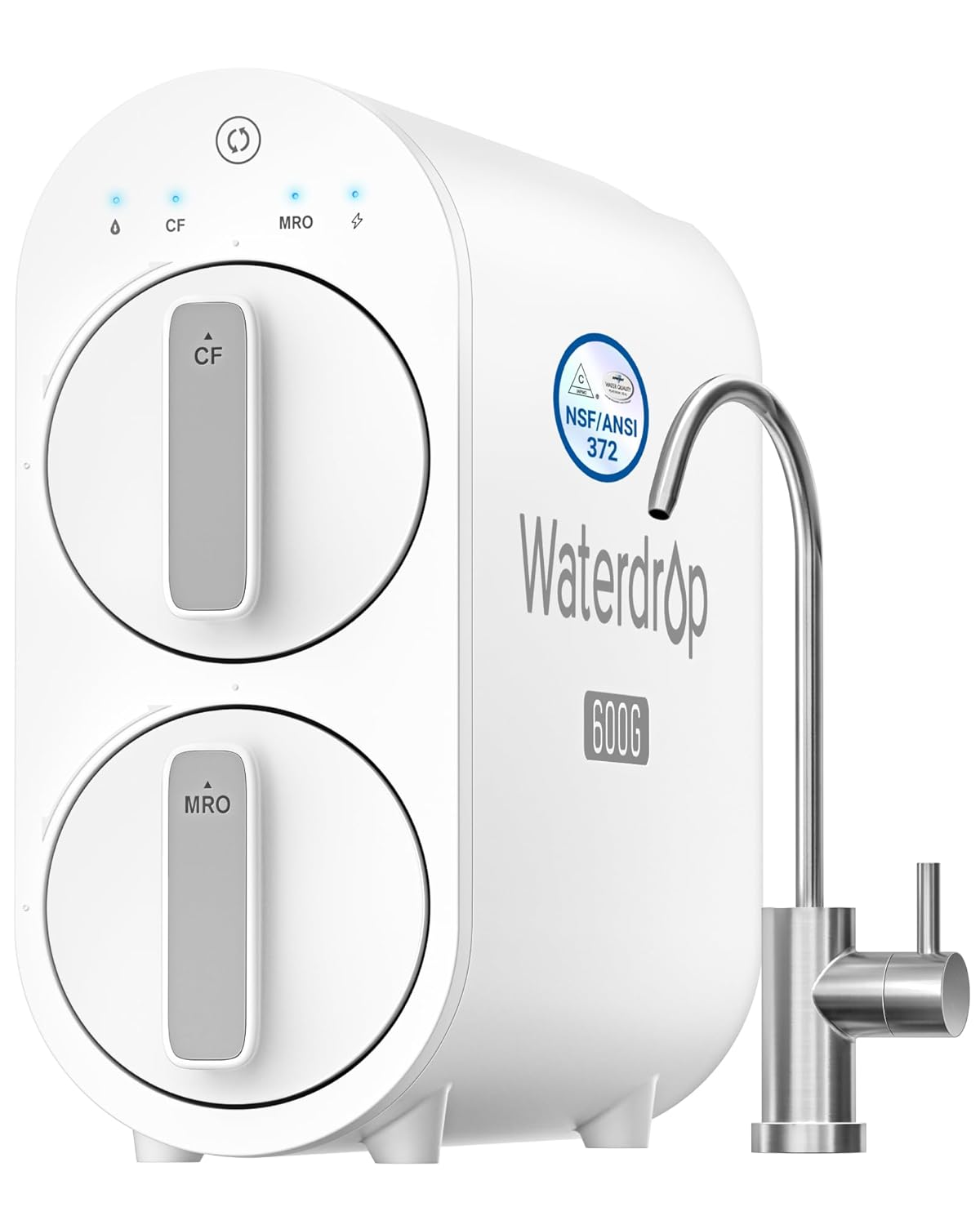
The Waterdrop G2P600 is a compact, tankless under-sink RO system designed to supply high volumes of drinking water without a storage tank. It uses a seven-stage filtration train and delivers up to 600 gallons per day, offering fast flow that can fill a small cup in seconds, which makes it handy for busy kitchens and larger households. The system plugs into power and includes quick twist-and-pull filters and a smart filter-life indicator to make maintenance straightforward. Its 2:1 pure-to-drain ratio reduces wastewater compared with many traditional RO units, and the tankless layout saves under-sink space and keeps water fresher on demand. Installation is intended to be user-friendly and the unit ships with a faucet and replacement filters. Limitations to note are the need for an electrical outlet under the sink and the upfront complexity of RO plumbing for first-time DIYers, and like all RO systems it produces some waste water and requires periodic filter and membrane replacements.
Best for: Home buyers who want an all-round, high-capacity under-sink RO that delivers fast, ready drinking water while minimizing footprint and ongoing hassle.
Less Ideal for: People who lack under-sink electrical access or who prefer a passive, non-pressurized filter without any drain waste should consider alternative filtration options.
- Tankless design saves under-sink space and supplies fresh water on demand
- High output up to 600 GPD suitable for large households or frequent use
- 2:1 pure-to-drain ratio reduces wastewater compared with many RO systems
- Seven-stage filtration with NSF/ANSI 372 lead-free certification for thorough contaminant removal
- Quick twist-and-pull filters and filter-life indicators simplify maintenance
- Requires a nearby electrical outlet since the unit is corded
- RO plumbing and initial installation can be more complex for first-time DIY installers
Verdict: Choose the Waterdrop G2P600 if you want a compact, tankless under-sink RO that delivers fast, high-volume drinking water with lower wastewater and easy filter changes.
Home Master Artesian Full Contact TMAFC-ERP

| Purification Method | Alkaline, Reverse Osmosis |
|---|---|
| Stages | 7-stages |
| Waste Ratio | 1:1 |
| Maximum Flow Rate | 1 gpm |
| Supported Water TDS Level Maximum (PPM) | 500 |
The Home Master Artesian Full Contact TMAFC-ERP is a seven-stage under-sink RO system designed to deliver very pure, better-tasting drinking water with faster flow and improved efficiency. It combines standard RO filtration with a patented two-pass remineralization stage that adds calcium and magnesium back into the water for a more neutral pH and fuller taste. A built-in non-electric permeate pump boosts production while cutting wastewater, and the Fast Flo kit with larger fittings gives a noticeably quicker tap fill rate. The modular filter housings and assembled filter cluster make annual filter changes straightforward without wrenches, and catalytic carbon media targets chloramines and chlorine better than ordinary carbon. Important limitations are its under-sink footprint and the need to replace filters roughly once a year or every 2000 gallons, and it requires 40-95 psi feed pressure to meet performance claims. For buyers focused on high-quality drinking water with mineral restoration and improved efficiency, this system delivers practical, measurable benefits.
Best for: Buyers who prioritize water purity, fast delivery at the tap, and restored mineral taste in drinking water and who are willing to perform annual maintenance to keep peak performance.
Less Ideal for: Those who need a very compact or portable solution or who want a maintenance-free filter for years without cartridge changes.
- Adds beneficial minerals twice for improved taste and more neutral pH
- Non-electric permeate pump increases production and reduces wastewater
- Fast Flo fittings and larger tubing provide quicker faucet fill rates
- Modular, easy-to-change filters and fully assembled unit simplify maintenance
- Catalytic carbon stage improves removal of chloramines and chlorine
- Requires annual filter replacement or after ~2000 gallons
- Takes significant under-sink space compared with simpler filters
- Performance depends on adequate feed pressure (40-95 psi)
Verdict: Choose this system if you want high-purity RO water with faster flow and factory-quality remineralization for better-tasting tap water.
APEC Water ROES-50

| Filtration Stages | 5-Stage |
|---|---|
| Daily Output (GPD) | 50 GPD |
| Operating Pressure Range | 40-85 psi |
| Supported Water TDS Level Maximum (PPM) | 2000 |
| Filter Life Cycle | 6 months |
The APEC Water ROES-50 is a 5-stage under-sink reverse osmosis system designed to deliver ultra-pure drinking water at about 50 gallons per day. It is installed under the sink and connects to a dedicated faucet, using prefilters, an RO membrane, and a post-filter to remove chlorine, heavy metals, fluoride, PFAs, microplastics, and other impurities. The kit ships with the storage tank, a brushed-nickel faucet, quick-connect fittings, and color-coded tubing to make DIY installation straightforward for someone comfortable with basic plumbing. Filters are high-capacity and the prefilters protect the membrane so routine replacements range from 6 to 24 months depending on feed-water quality. Practical benefits include certified contaminant reduction, steady filtered water from the tank for drinking and cooking, and widely available replacement filter sets. Expect typical RO trade-offs such as a dedicated tank that takes under-sink space and normal water waste during production, and the system requires periodic filter changes and occasional maintenance to preserve output and taste.
Best for: Buyers who want a durable, proven under-sink RO system that reliably produces very low-TDS drinking water and who prefer a DIY-ready kit with long-lived filters.
Less Ideal for: People who cannot dedicate under-sink space, need a zero-waste system, or who want a countertop unit requiring no plumbing changes.
- Five-stage filtration with RO membrane removes a broad set of contaminants including heavy metals, fluoride, PFAs, and microplastics
- Certified performance and WQA-level construction for reliable contaminant reduction
- Includes tank, faucet, and installation kit with quick-connect fittings for DIY setup
- High-capacity filters and staged design extend membrane life and reduce maintenance frequency
- Requires under-sink space for the tank and filter housings
- Produces wastewater as part of the RO process
Verdict: A reliable, certified 5-stage under-sink RO system that delivers very low-TDS drinking water and comes as a DIY-friendly complete kit.
FS-TFC 5-Stage RO System FS-RO-100G-A

| Purification Method | Reverse Osmosis |
|---|---|
| Capacity | 100 gallons |
| Maximum Flow Rate | 18 liters per hour |
| Operating Pressure Range | 30-85 psi |
| Supported Water TDS Level Maximum (PPM) | 500 |
This FS-TFC 5-stage reverse osmosis system is an under-sink purifier designed to deliver high-purity drinking water without electricity. It uses a five-stage filtration train and a pressurized storage tank to remove a broad range of contaminants and is rated to reduce up to 99.999% of impurities according to the manufacturer. The unit is compact and claims an 18 L/hour (about 100 gallons per day) flow at typical household pressure, making it suitable for daily drinking and cooking needs. The kit includes a faucet, tank, feedwater adapter and extra tools, plus four replacement filters to cover roughly a year of use, which lowers first-year operating costs. Installation is marketed as tool-free and DIY-friendly for most standard sinks. Expect practical benefits like clearer tasting water, lower long-term consumable costs, and no electrical draw, while noting the stated 1:1 drain ratio still produces some wastewater and replacement filters are required annually to maintain performance.
Best for: Buyers looking for an affordable under-sink RO that delivers hospital-grade contaminant reduction on a tight operating budget and prefers a straightforward DIY install.
Less Ideal for: Homes with very low water pressure, very high-TDS source water above the stated limit, or buyers who want zero-waste water systems or UV disinfection integrated out of the box.
- High contaminant reduction claimed for broad removal of VOCs, heavy metals and common tap tastes and odors
- Compact under-sink design fits standard sinks and saves counter space
- Includes faucet, tank and four extra replacement filters to reduce first-year maintenance cost
- No electricity required and a relatively high flow rate suitable for drinking and cooking
- Manufacturer-stated removal rates and performance may vary with incoming water quality and require timely filter changes
- The system produces wastewater despite a relatively low 1:1 drain ratio
- Some installations may still need basic plumbing fittings despite the tool-free claim
Verdict: A budget-friendly, compact under-sink RO that minimizes first-year filter costs and delivers high contaminant reduction without needing electricity.
iSpring RCC7-BN 5-Stage RO

| Purification Method | Reverse Osmosis, Activated Carbon, Carbon block |
|---|---|
| Capacity | 75 gallons |
| Maximum Flow Rate | 3.4 liters per minute |
| Supported Water TDS Level Maximum (PPM) | 750 |
The iSpring RCC7-BN is an under-sink reverse osmosis drinking water system that uses three pre-filters, a high-precision RO membrane, and a post-polishing carbon stage to remove sediments, chlorine, PFAS, heavy metals and other contaminants. It installs under a kitchen sink and includes a brushed-nickel designer faucet and all tubing and fittings, with push-to-connect fittings and a transparent first-stage housing for quick visual checks. The unit produces up to 75 gallons per day and stores treated water in a pressurized tank so purified water is available on demand without a pump. Notable benefits are its NSF/ANSI 58 certification, factory-quality components, and clear housings that make maintenance straightforward for people who prefer DIY filter changes. Limitations to note are that it is intended for municipal tap water rather than untreated well water and it requires periodic filter and membrane replacement to maintain performance and TDS reduction levels.
Best for: Buyers who prioritize a reliable, tested under-sink system that consistently produces bottled-quality drinking water and who prefer systems with clear maintenance cues and DIY-friendly installation.
Less Ideal for: Homes drawing from untreated well sources without prior whole-house treatment and buyers who want a zero-maintenance, filter-free solution.
- Five-stage filtration including RO membrane and post-carbon polishing for broad contaminant reduction
- NSF/ANSI 58 certification provides third-party validation of performance
- Transparent first-stage housing and push-to-connect fittings simplify inspection and DIY maintenance
- Includes all housings, filters, tubing and a lead-free faucet for a complete under-sink installation
- Not rated or configured for untreated well water without additional pre-treatment
- Requires routine replacement of filters and the RO membrane to sustain contaminant reduction
Verdict: Choose the RCC7-BN if you want a proven, NSF-certified under-sink RO system that reliably delivers drinking-quality water with straightforward DIY maintenance.
iSpring RCC7AK-BN 75 GPD RO System

| Purification Method | Reverse Osmosis, Alkaline, Activated Carbon, Carbon block |
|---|---|
| Power Source | No Power Needed |
| Maximum Flow Rate | 284 liters_per_day |
| Operating Pressure Range | 70 psi |
| Filter Life Cycle | 6 months |
The iSpring RCC7AK-BN is a six-stage under-sink reverse osmosis system that delivers factory-certified RO purification and adds minerals back for a higher pH drinking water. It filters water through sediment, carbon and an RO membrane, then an alkaline mineral stage to restore taste and trace minerals, and stores treated water in the included tank for on-demand use. Notable features include NSF/ANSI 58 whole-system certification, a transparent first-stage housing for quick visual checks, push-to-connect fittings and color-coded tubing that simplify a do-it-yourself install, and a patented top-mounted faucet nut that makes countertop access easier. The system requires no electricity and is compatible with standard fridge connections if you add an ice maker kit. Practical benefits are thorough contaminant reduction, visible filter wear for timely maintenance, and a brushed nickel faucet included in the kit. Limitations are the routine filter replacements every six to twelve months depending on usage and the need for under-sink space to accommodate the tank and filter housings, which may challenge very small cabinets.
Best for: Buyers who prioritize verified lab-tested performance and want a proven whole-system RO with visible maintenance cues and DIY-friendly installation.
Less Ideal for: People with very small or shallow cabinets who cannot fit an under-sink storage tank or those seeking a maintenance-free, filterless drinking solution.
- NSF/ANSI 58 certified for the full RO system
- Six-stage filtration with alkaline remineralization for improved taste
- Transparent first-stage housing for easy visual inspection
- Push-to-connect fittings and top-mounted faucet design simplify DIY installation
- Includes storage tank and brushed nickel faucet
- Requires periodic filter changes (typical 6–12 month cycles)
- Needs significant under-sink space for the tank and housings
Verdict: Choose the RCC7AK-BN if you want a lab-certified, six-stage RO that restores minerals and makes DIY installation and maintenance straightforward.
Waterdrop G3P600 Reverse Osmosis
| Filtration stages | 8-stage |
|---|---|
| Flow rate | 0.42 gpm |
| Pure to drain ratio | 2:1 |
| Supported TDS max | 1500 ppm |
| Power source | Corded Electric |
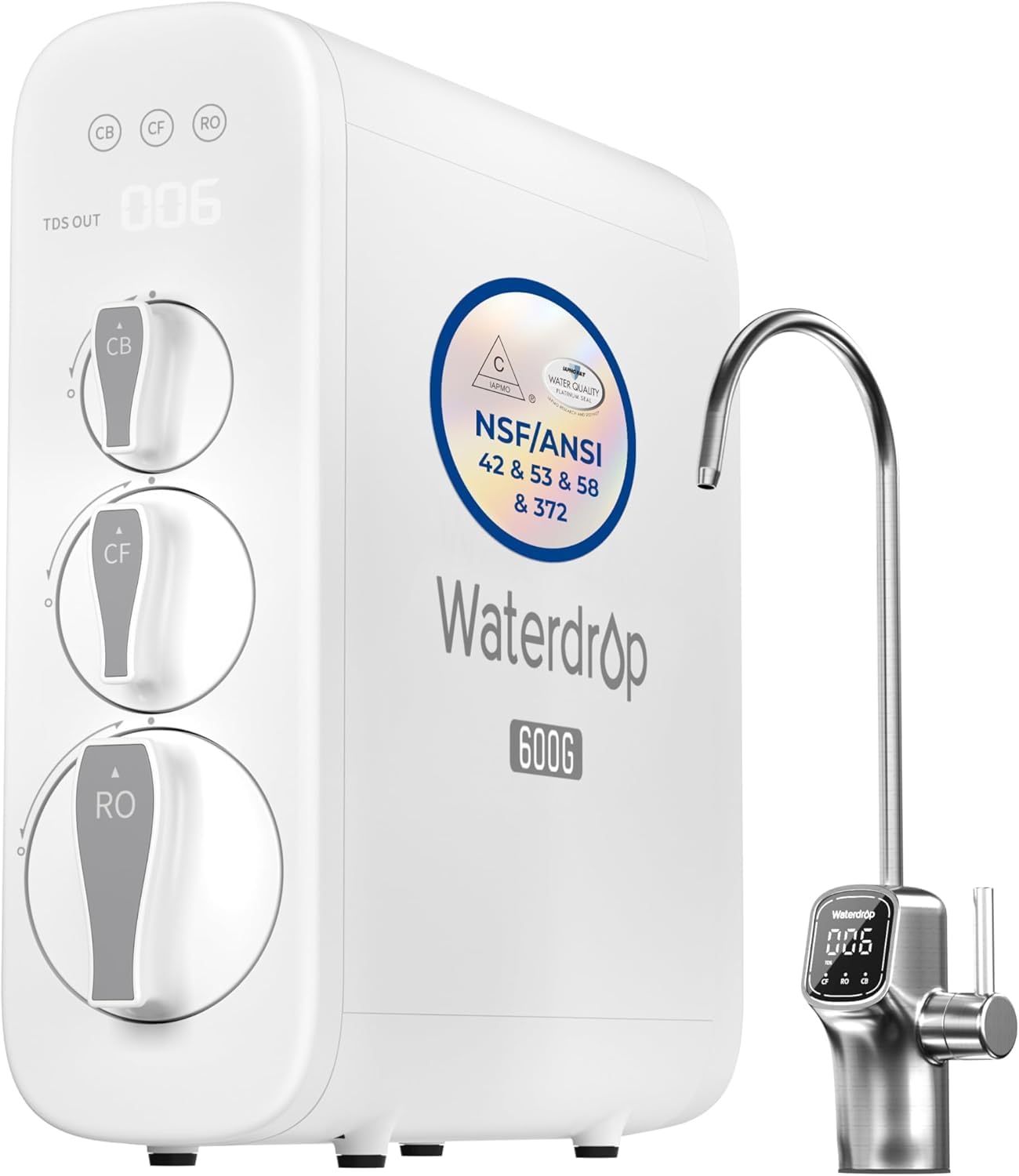
The Waterdrop G3P600 is a tankless under-sink reverse osmosis system designed for steady household drinking water. It uses an 8-stage filtration train including an RO membrane and carbon block stages to reduce TDS, heavy metals, PFAS, chlorine and other common contaminants, and it produces up to 600 gallons per day with a fast faucet flow that fills an 8 oz cup in about 8 seconds. The included smart faucet shows TDS and filter life, and the system has an automatic flushing function to help maintain membrane performance. The tankless design frees up under-sink space and allows tool-free twist-and-replace filter changes. Limitations to note are the need for a nearby electrical outlet since the unit is corded, and the system requires drilling two sink holes for faucet and drain connections during installation; also the product lists a small amount of waste water despite a low 2:1 pure-to-drain ratio. For buyers who prioritize certified contaminant reduction and a compact installation footprint, this model delivers strong daily capacity and clear maintenance feedback.
Best for: Buyers who want a compact, certified RO system that gives visible water-quality feedback and high daily output without a storage tank.
Less Ideal for: People who cannot provide an under-sink power connection, cannot drill additional sink holes, or who prefer non-RO filtration methods that do not produce any wastewater.
- High production capacity up to 600 gallons per day for fast, steady drinking water
- 8-stage filtration including RO membrane and carbon block to reduce TDS, heavy metals, PFAS and chlorine
- Smart LED faucet with TDS readout and filter life tracker for visible water quality and maintenance reminders
- Tankless design saves under-sink space and uses quick twist-and-replace filters without tools
- Low 2:1 pure-to-drain ratio to reduce wastewater compared with conventional RO systems
- Requires a nearby electrical outlet because the unit is corded
- Installation needs two drilled holes (faucet and drain) which may complicate retrofits
- Still produces wastewater despite an improved drain ratio
Verdict: Choose the Waterdrop G3P600 if you want a high-capacity, tankless under-sink RO with certified multi-stage filtration and an easy-to-read smart faucet for reliable drinking water.
Choosing the Right Under-Sink Reverse Osmosis Water Filter for Drinking Water: Key Factors to Consider
Filtration Performance and Contaminant Profile
Different reverse osmosis systems target different contaminant sets and removal levels. You should check which contaminants the system has been tested to reduce, especially if your water has specific concerns such as lead, nitrates, total dissolved solids, or chlorinated taste and odor. A system with an RO membrane plus pre- and post-carbon stages will typically address dissolved solids and organic taste compounds more effectively.
Matching the filter's certified removal list to your water report matters because some systems are optimized for TDS reduction while others emphasize chlorine and VOC removal. If your municipality posts an annual water quality report, compare that to the filter's tested claims to ensure the system addresses your priority contaminants.
Production Rate and Usable Flow
Reverse osmosis removes contaminants by pushing water through a semi-permeable membrane, which produces purified water at a slower rate than unfiltered tap flow. Daily production rate and tank capacity determine how much treated water is available at the faucet without long waits. Consider whether you need a higher gallons-per-day rating or a larger storage tank to avoid frequent delays during peak use.
Flow rate at the faucet also depends on tank pressure and the presence of a booster pump. Homes with low incoming water pressure may see reduced production without a pump. If you frequently fill pitchers or drink from the tap, prioritize higher rated systems or those that include a permeate pump to balance convenience with filtration.
Installation Compatibility and Space Requirements
Under-sink RO systems vary in size and connection style. Measure the cabinet space under your sink, including clearance for filter housing, tubing routing, and the storage tank. Check whether the system requires drilling the countertop for a dedicated faucet or if it can connect to an existing faucet hole. Standard 1/4-inch quick-connect fittings simplify installation, but some setups may need adapter fittings for older plumbing.
If you are not comfortable with basic plumbing, factor in whether the system includes clear instructions and user-friendly parts. Systems that require minimal tools and have labeled tubing reduce the risk of installation mistakes and leaks.
Maintenance Frequency and Ongoing Parts
RO systems require periodic replacement of prefilters, carbon filters, and the membrane. Prefilters often need changing every 6 to 12 months, while membranes typically last 2 to 4 years depending on feed-water quality. Consider how easy it is to access and swap filters; quick-release housings and color-coded tubing make routine maintenance faster and less prone to error.
Also check availability of replacement cartridges and whether filters are sold as common sizes or proprietary packs. Systems with widely available cartridges generally lower the long-term upkeep effort and cost compared with those that use obscure or single-supplier parts.
Materials, Fittings, and Leak Resistance
Durable housings, reinforced tubing, and reliable fittings matter for long-term leak resistance. Look for systems with solid polyprop housings, brass or corrosion-resistant valve components, and well-rated quick-connect fittings. Poorly designed fittings or low-quality tubing increase the chance of pinhole leaks and premature replacement.
Consider whether the system includes an automatic shutoff valve that stops water flow to the membrane when the storage tank is full. That feature reduces continuous drain flow and can extend membrane life.
Common Installation Configurations
Under-sink reverse osmosis systems are typically installed with the filtration stack and storage tank inside the cabinet and a separate dedicated faucet mounted on the sink or countertop. Some systems offer models that work with a spare faucet hole or can tie into an existing cold-water line with an adapter.
Pay attention to tank placement since a full tank needs clearance and room to access the shutoff valve and tubing. Systems that include compact, horizontally oriented tanks can be easier to fit under smaller cabinets.
- Dedicated faucet: requires a drilled hole or unused hole in the sink
- Adapter feed connection: ties into the cold-water line under the sink
- Inline or compact designs: save space but may limit filter size
Boosting Performance in Low-Pressure Homes
If household water pressure is below the manufacturer's recommended range, production rate and membrane efficiency will drop. Options to address this include adding a booster pump or selecting a system rated for lower input pressures.
A permeate pump is a non-electrical option that improves effective delivery from the storage tank by reducing backpressure on the membrane. When installed correctly, it raises faucet flow without increasing water waste.
- Check minimum inlet pressure requirements
- Consider a permeate pump for modest pressure boosts
- Booster pumps increase production but need space and electrical access
Waste Water and Efficiency Considerations
Reverse osmosis systems produce a concentrate stream that carries rejected contaminants to the drain. The typical ratio of purified water to wastewater varies widely between systems. If wastewater generation is a priority, look for systems with higher recovery rates or those that use a permeate pump to improve efficiency.
You can also capture reject water for non-potable uses such as plant watering or cleaning to reduce net waste, provided local codes and water quality considerations permit it.
- Typical reject ratios range from 1:1 to 4:1 depending on system and pressure
- Permeate pumps can lower waste by improving recovery
- Reuse reject water for chores when appropriate and safe
Taste, Mineral Balance, and Optional Post-Filters
RO systems remove minerals that affect taste. Some users prefer a remineralization or alkaline post-filter to restore a balanced mouthfeel and slightly raise pH for taste. Remineralizers do not affect contaminant removal but change the drinkability profile of the output water.
If you are sensitive to flat-tasting water, consider systems with optional carbon polishing filters or remineralization stages to improve flavor while retaining contaminant reduction.
- Carbon post-filters improve taste and remove residual VOCs
- Remineralization adds calcium or magnesium for mouthfeel
- Choose post-filters that are easy to replace during routine maintenance
Monitoring Water Quality Over Time
After installing an under-sink RO system, periodically testing treated water helps confirm that filters and membranes are functioning as expected. Simple TDS meters show changes in dissolved solids and can indicate when the membrane needs attention, but they do not report specific contaminants like lead or VOCs.
Schedule filter changes per manufacturer guidance and check connections for leaks at each servicing interval. Keeping replacement parts on hand reduces downtime and ensures continuous access to treated drinking water.
- Use a TDS meter to track overall dissolved solids
- Perform visual checks of fittings at each filter change
- Retain water test results to spot long-term trends
How We Chose the Best Under-Sink Reverse Osmosis Water Filter for Drinking Water
We prioritized products that demonstrate reliable contaminant removal, practical everyday flow, and straightforward installation suited to typical kitchen sink setups. Our primary filters were independent third-party or lab-rated removal claims for common drinking-water contaminants, and we favored systems with multi-stage filtration that include a sediment prefilter and a carbon stage ahead of the reverse osmosis membrane. We also evaluated system flow and storage considerations because reverse osmosis systems trade filtration thoroughness against production rate. Ease of installation and maintenance mattered: we included systems with accessible filter changes and clear documentation. Build quality and durable fittings were assessed so routine plumbing connections and pressure tolerances do not create premature leaks or failures. Exclusions: we excluded units without verifiable removal performance or those intended only for non-drinking uses. We did not consider countertop, pitcher, or whole-house systems because the scope is under-sink reverse osmosis for drinking water. Across selections we focused on five concrete dimensions: filtration efficiency for specific contaminants, production rate and usable flow, installation and compatibility with standard sink plumbing, ongoing maintenance effort and parts availability, and materials/build reliability. Those criteria guided which systems made the shortlist.
Our full evaluation process is outlined in our review methodology.
FAQ
How often should I change the prefilters and membrane?
Prefilters typically need replacement every 6 to 12 months depending on water quality and usage, while RO membranes commonly last 2 to 4 years. Heavy sediment or high chlorine levels can shorten filter and membrane life, so inspect parts and follow the manufacturer's recommended schedule.
Will an under-sink RO system remove lead and nitrates?
Reverse osmosis membranes are effective at reducing dissolved ions such as lead and nitrates when the system is properly configured with carbon prefilters and a certified membrane. Always verify the system's tested removal claims against contaminants of concern on your water report.
Can I install an under-sink RO system myself?
Many systems are designed for DIY installation using quick-connect fittings and clear instructions. Basic plumbing skills are helpful. If your sink setup is nonstandard or you are uncomfortable with tools and water connections, hiring a professional is a safe option.
How much storage tank capacity do I need?
Tank size depends on household drinking habits. A common household finds a 2 to 4 gallon tank sufficient for daily drinking and cooking needs. Larger households or frequent high-volume use may prefer a bigger tank or a system with higher production rate to avoid delays.
Do RO systems waste a lot of water?
RO systems do produce reject water, and the waste ratio varies by model and inlet pressure. Systems with permeate pumps or higher recovery designs will reduce waste. You can also repurpose rejected water for non-potable tasks to lower net consumption.
Final Verdict
Choosing the right under-sink reverse osmosis water filter for drinking water involves balancing contaminant removal, production rate, and maintenance practicality. Prioritize verified removal performance for contaminants you care about, and match the system's production and tank size to your household's daily usage. Accept that higher removal rates usually mean slower production and potential waste. If you need faster delivery, look for systems with higher rated production or pumps. With the right fit for your cabinet space, water pressure, and maintenance willingness, you can have reliable, great-tasting drinking water from an under-sink RO system.