
Note: This article contains affiliate links. If you click on these links and make a purchase, we may earn a small commission at no extra cost to you. This helps support our research and content. Read our full affiliate disclosure here.
If you are worried about lead in your tap water, choosing the right under-sink reverse osmosis system matters. These systems sit out of sight while removing dissolved metals and particulate contaminants that whole-house filters often miss. You want a unit that reliably reduces lead to safe levels without making the kitchen faucet unusably slow or difficult to maintain. This guide lists six shortlisted under-sink reverse osmosis water filters picked for their proven lead reduction potential, practical flow performance, and serviceability. We lay out how we evaluated each option and what to prioritize so you can select a system that fits your household's water use and maintenance preferences.
Top Picks at a Glance
| Best Overall The best all-around choice for most situations | APEC Water RO-90 | 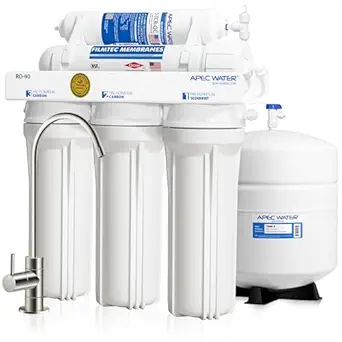 |
| Best Quality Built to a higher standard if you want something more solid | Home Master Artesian Full Contact TMAFC-ERP |  |
| Best Budget The cheapest option that still gets the job done reliably | FS-TFC 5-Stage RO System |  |
| Top Rated A top-rated pick with lots of positive feedback | iSpring RCC7AK-BLK Reverse Osmosis System |  |
| Most Popular A crowd favorite that many people choose with confidence | APEC Water ROES-50 |  |
| Best Seller A high-volume bestseller chosen again and again | Express Water RO5DX 5-Stage RO |  |
APEC Water RO-90

| Purification Method | Activated Carbon, Reverse Osmosis |
|---|---|
| Installation Type | Under Sink |
| Power Source | Manual (Water Pressure) |
| Capacity | 90 gallons_per_day |
| Operating Pressure Range | 40-85 psi |
The APEC Water RO-90 is a five-stage under-sink reverse osmosis system designed to deliver high-capacity, near-complete contaminant removal for drinking and cooking water. It uses sediment and multi-stage carbon prefilters, a FILMTEC high-rejection RO membrane, and a final coconut-shell refining carbon post-filter to reduce taste, chlorine, heavy metals and up to nearly all total dissolved solids. Typical use is standard under-sink installation with the included tank and lead-free faucet; the system runs on household water pressure and provides up to 90 gallons per day, making it suitable for families who drink and cook with filtered water. Notable practical benefits are its high daily output, long-life high-capacity filters that reduce replacement frequency, and robust fittings and components intended to limit leaks. Limitations include required under-sink space for the tank and unit, the need to replace filters periodically, and dependence on sufficient feed pressure for optimal production rates. Installation is DIY-friendly for someone comfortable with basic plumbing, but may require a pro if you prefer not to handle fittings or space constraints.
Best for: Buyers who want a reliable, high-capacity under-sink RO that prioritizes thorough contaminant and lead removal for everyday drinking and cooking water and are willing to install and maintain a multi-stage system.
Less Ideal for: People with very limited under-sink space, those who cannot provide adequate feed water pressure, or buyers who prefer no-tank countertop or pitcher-style filtration solutions.
- Five-stage filtration including a high-rejection FILMTEC RO membrane for strong contaminant and lead reduction
- 90 gallons per day capacity suitable for households and daily kitchen use
- High-capacity prefilters and post-filter reduce frequency of replacements
- Comes with tank, designer lead-free faucet and necessary tubing and fittings for full under-sink setup
- Requires dedicated under-sink space for the tank and system components
- Performance depends on household feed water pressure and may need a booster in low-pressure situations
Verdict: Choose the RO-90 if you want a high-output, five-stage under-sink RO built to remove lead and a broad range of impurities for reliable daily drinking water.
Home Master Artesian Full Contact TMAFC-ERP

| Purification Method | Alkaline, Reverse Osmosis |
|---|---|
| Maximum Flow Rate | 1 gpm |
| Operating Pressure Range | 40-95 psi |
| Supported Water TDS Level Maximum (PPM) | 500 |
| Capacity | 2000 gallons |
The Home Master Artesian Full Contact TMAFC-ERP is an under-sink reverse osmosis system designed for high-performance water purification with remineralization. It uses a 7-stage process including catalytic carbon and a DOW RO membrane, plus a patented two-pass alkaline remineralization that adds calcium and magnesium back into the water for better taste. A built-in non-electric permeate pump boosts production and cuts wastewater, while the Fast Flo fittings and larger tubing deliver a rapid 4.5 second fill rate for an 8 oz. glass. The modular, canister-style filter cluster is user-friendly for annual service and filter changes without wrenches, and the included storage tank and faucet make installation complete. Performance strengths include strong contaminant removal typical of RO systems and improved water efficiency versus traditional designs, but buyers should expect the usual RO considerations: it requires under-sink space, periodic filter and membrane replacement, and water disposal from the reject stream (albeit reduced). For households prioritizing fast delivery, mineral-balanced taste, and lower wasted water, this model is engineered to perform.
Best for: Buyers who want a performance-focused under-sink RO that maximizes purity, faster delivery, and mineralized taste while reducing wastewater for everyday drinking water.
Less Ideal for: People with very limited under-sink space, those unwilling to perform annual filter maintenance, or households that cannot accommodate any reject water should consider other options.
- 7-stage filtration with catalytic carbon and RO membrane for thorough contaminant reduction
- Patented two-pass remineralization adds calcium and magnesium for improved taste
- Non-electric permeate pump increases water production and reduces waste
- Fast Flo fittings and larger tubing deliver quick faucet fill rates
- Modular canister design makes annual filter changes simple without wrenches
- Requires under-sink space and basic plumbing installation
- Periodic replacement of filters and RO membrane is necessary to maintain performance
Verdict: Choose this system if you want a high-performance under-sink RO that delivers faster, mineralized drinking water with significantly improved water efficiency.
FS-TFC 5-Stage RO System

| Purification Method | Reverse Osmosis |
|---|---|
| Maximum Flow Rate | 18 liters per hour |
| Supported Water TDS Level Maximum (PPM) | 500 |
| Capacity | 100 gallons |
| Installation Type | Under Sink |
The FS-TFC 5-stage RO system installs under a standard sink to deliver treated drinking water by filtering through five stages and a reverse osmosis membrane that targets chlorine, heavy metals, fluoride, lead, nitrates and other common contaminants. It is typically used for kitchen drinking and cooking water and connects to a dedicated faucet and storage tank for on-demand access. Notable features include a claimed 99.999% contaminant reduction, an 18 L/hour (about 100 GPD) flow capacity, tool-free DIY installation with supplied fittings, and four extra replacement filters included for the first year. Practical benefits are compact sizing that fits most cabinets, a low 1:1 drain ratio that reduces wastewater compared with many RO units, and no electricity required for operation. Important limitations are the modest stated filter life of about one year for routine replacements and the need to monitor feed pressure and TDS limits to maintain performance; under very low inlet pressure or very high TDS the output may decline. The unit is well suited for households wanting strong contaminant removal without complicated setup, but expect routine filter changes and occasional maintenance to keep lead removal performance optimal.
Best for: Buyers who prioritize high contaminant reduction on a tight budget and want an easy DIY under-sink installation for drinking and cooking water.
Less Ideal for: Those who need zero-maintenance or whole-home filtration or who cannot provide consistent inlet pressure or who exceed the stated TDS limit should consider other solutions.
- Five-stage RO membrane targets a wide range of contaminants including lead and heavy metals
- Compact under-sink design fits most standard cabinets and includes faucet and storage tank
- Tool-free, DIY installation with supplied fittings and illustrated instructions
- Includes four extra replacement filters to cover nearly a year of use
- Low 1:1 drain ratio reduces wastewater compared with many RO systems
- Filter lifecycle requires yearly replacement which adds ongoing cost
- Performance depends on adequate inlet pressure and TDS level limits
Verdict: A budget-friendly under-sink RO that delivers strong lead and contaminant reduction with easy DIY installation and low wastewater loss.
iSpring RCC7AK-BLK Reverse Osmosis System

| Purification Method | Reverse Osmosis |
|---|---|
| Number of Filtration Stages | 6-stage |
| Power Source | Ac |
| Supported Water TDS Level Maximum (PPM) | 97 |
| Capacity | 75 gallons |
The iSpring RCC7AK-BLK is an under-sink reverse osmosis system built for steady, long-term water purification and improved taste. It uses six stages of filtration including three pre-filters, an RO membrane that removes contaminants down to 0.0001 microns, a fine GAC polishing stage, and an alkaline remineralization cartridge to restore pH and minerals. The clear first-stage housing makes visual checks simple and push-fit connectors plus color-coded tubing simplify a DIY install without needing electricity. NSF/ANSI 58 certification and stated removal rates for lead, fluoride, PFAS, and many other contaminants mean the unit targets the heavy hitters buyers worry about. Practical benefits include low daily operating cost estimates, compatibility options for fridges, and a modern black faucet that hides under-sink hardware. Limitations are typical for non-pressurized RO systems: it requires under-sink space, produces wastewater during purification, and periodic filter and membrane replacements are necessary to keep certified removal levels intact.
Best for: Buyers who prioritize dependable contaminant removal and certified performance and want a long-term under-sink RO solution that restores minerals for better tasting drinking water.
Less Ideal for: Those with very limited under-sink space or who need an instant, no-waste water system should consider alternative filtration types or countertop models.
- Six-stage filtration including remineralization for better taste and balanced pH
- NSF/ANSI 58 certified with verified high removal rates for lead and other contaminants
- Transparent first-stage housing for quick visual checks
- Push-fit connectors and color-coded tubing simplify DIY installation
- Includes a stylish black RO faucet and parts for fridge compatibility
- Requires adequate under-sink space and careful pre-installation measurement
- Generates wastewater as part of the RO process and needs periodic filter/membrane replacement
Verdict: Choose the RCC7AK-BLK when you want a certified, reliable under-sink RO system that removes lead and restores minerals for steady, great-tasting drinking water.
APEC Water ROES-50

| Filtration Stages | 5-Stage |
|---|---|
| Daily Output | 50 GPD |
| Purification Method | Reverse Osmosis |
| Operating Pressure Range | 40-85 psi |
| Supported Water TDS Level Maximum (PPM) | 2000 |
The APEC Water ROES-50 is a five-stage under-sink reverse osmosis system designed to deliver very low-TDS drinking water at about 50 gallons per day for typical households. It installs under a kitchen sink and connects to a dedicated faucet, using prefilters to protect an RO membrane and a post-filter to polish taste; the kit ships with a tank, faucet, fittings, and a replacement Filter-Max set to get started. The unit is WQA/NSF-aligned in materials and is built for DIY installation with quick-connect fittings and color-coded tubing, which makes routine filter changes straightforward. Practical benefits include strong contaminant reduction (lead, arsenic, chlorine, PFAs, microplastics) and steady stored flow from the included tank for dispensing drinking and cooking water. Limitations are the modest production rate typical of tanked RO systems and the need to plan periodic filter and membrane replacements based on incoming water quality, and it requires under-sink space for the system and tank.
Best for: Buyers who prioritize proven contaminant removal and want a tested, widely used under-sink RO system with clear user feedback and straightforward DIY installation.
Less Ideal for: Households that need very high continuous output without a storage tank or those without available under-sink space or willingness to perform periodic filter maintenance.
- Five-stage filtration that targets lead, arsenic, chlorine, PFAs, and many other contaminants
- Includes tank, faucet, installation kit, and a Filter-Max set for initial setup
- DIY-friendly quick-connect fittings and color-coded tubing simplify installation and service
- WQA/NSF-aligned construction and materials suitable for drinking water systems
- Production rate limited to about 50 GPD which may be slow for continuous high-demand use
- Requires under-sink space for the unit and separate storage tank
- Filters and membrane need periodic replacement based on feed water quality
Verdict: Choose the ROES-50 if you want a widely recommended, five-stage under-sink RO that reliably reduces lead and other contaminants with easy DIY installation.
Express Water RO5DX 5-Stage RO

| Purification Method | Reverse Osmosis |
|---|---|
| Stages | 5-stage (SED, GAC, ACB, ROM, PAC) |
| Gallons Per Day | 50 GPD |
| Maximum Flow Rate | 0.8 gpm |
| Capacity | 4 gallons |
The Express Water RO5DX is an under-sink reverse osmosis system designed to deliver very high impurity reduction for household drinking water. It uses a five-stage filtration train — sediment, granular activated carbon, activated carbon block, RO membrane, and post activated carbon — to cut heavy metals, fluoride, PFAS, pharmaceuticals, and other contaminants while storing treated water in a 4 gallon tank for immediate use. Installation is intended for under‑cabinet mounting and the kit includes feed adapters, quick‑connect fittings, a brass/chrome faucet, a tank stand, and extra filters for the first year. Practical benefits include a compact footprint, a fast 0.8 gpm faucet flow, an advertised 50 GPD production rate, an included leak stop sensor, and NSF/ANSI testing for common RO standards. Important limitations are that the system wastes between one and three gallons of water per gallon produced depending on feed pressure, it requires adequate incoming water pressure (40–80 psi) or a booster pump, and routine annual membrane replacement and semiannual pre/post filter changes are necessary. The RO5DX is most useful where high contaminant reduction is the priority and space under the sink is available.
Best for: Buyers who place safety and verified contaminant removal first and want a turn‑key under‑sink RO that is certified for heavy metal and fluoride reduction and comes with the parts needed to install and operate for the first year.
Less Ideal for: Those who lack sufficient household water pressure, need a zero‑waste solution, or want a portable/countertop filter for renters who cannot modify plumbing.
- Five-stage filtration including RO membrane for high reduction of heavy metals and fluoride
- NSF/ANSI tested and certified performance for multiple contaminant classes
- Includes faucet, 4 gallon storage tank, extra filter set and leak stop sensor out of the box
- Quick‑connect fittings and included adapters simplify under‑sink installation
- Delivers up to 50 gallons per day with 0.8 gpm faucet flow for typical household use
- Produces waste water at a ratio of roughly 1–3 gallons discarded per gallon produced
- Requires sufficient incoming water pressure (40–80 psi) and occasional membrane replacement
- Not designed for remote or refrigerator hookups without additional tubing or a booster pump
Verdict: If you want a certified, high‑performance under‑sink RO focused on removing lead and other heavy contaminants with an included faucet and first‑year filters, the RO5DX is a strong, low‑risk choice.
Choosing the Right Under-Sink Reverse Osmosis Water Filter for Lead Removal: Key Factors to Consider
Lead Reduction Efficiency
How effectively a system removes lead matters because partial removal can leave concentrations above health guidelines. Reverse osmosis membranes paired with carbon stages are the primary defense against dissolved lead and particulate forms. Look for systems with documented reduction percentages or certifications from recognized test labs.
High-percentage removal reduces the frequency of follow-up testing and increases confidence in water safety. If you have confirmed elevated lead levels, prioritize systems with the strongest reported removal rates and consider post-treatment monitoring.
Flow Rate and Daily Recovery
Flow rate determines how quickly you can draw filtered water for drinking, cooking, and filling containers. Under-sink reverse osmosis systems vary widely in output and in the speed at which they replenish storage tanks. A low recovery rate can be inconvenient for households that need frequent access to filtered water.
Account for household size and typical simultaneous water use. Systems with higher daily production or better tankless flow characteristics reduce the need to wait for water to refill. Consider whether a dedicated faucet with steady flow or a slower tank-fed faucet better matches your routine.
Filter Life and Replacement Ease
Replacement frequency affects ongoing maintenance time and cost. Pre-filters often capture sediment and protect the membrane, while carbon post-filters polish taste and remove residual contaminants. Longer filter life reduces how often you interrupt supply for maintenance.
Ease of replacement is important if you plan to do upkeep yourself. Systems with quick-change cartridges and clear labeling minimize installation errors. Check whether replacement parts are widely available and whether filters are sold as kits to simplify routine service.
Installation and Plumbing Compatibility
Under-sink systems must connect to existing cold-water lines and often require a drain connection for reject water. Installation complexity ranges from straightforward quick-connect fittings to systems needing additional valves, adapters, or countertop clearance for storage tanks.
Assess the available under-sink space, your comfort with basic plumbing work, and whether you will hire a professional. Simple, well-documented installations cut time and reduce risk of leaks, while more complex setups may deliver better performance but require pro installation.
Waste Water and Recovery Ratio
Reverse osmosis systems produce reject water as they concentrate contaminants. The recovery ratio—the amount of filtered water produced versus waste water—affects water efficiency and utility costs. Older or simpler units may waste several gallons for each gallon filtered, while higher-efficiency designs reduce that overhead.
If municipal limits or personal preferences make conserving water important, prioritize systems with improved recovery ratios or the option to route reject water for nonpotable uses. Understanding this tradeoff helps balance removal performance with environmental and cost concerns.
Materials, Certifications, and Warranty
Materials in contact with filtered water should be rated for potable use and resist leaching. Look for NSF or equivalent certifications that specifically cover lead reduction or components of the system. A clear warranty that covers defects and membrane failure gives added protection over the long term.
Certification and solid materials reduce the risk of secondary contamination and provide independent verification of claims. Warranties that include labor or parts for a reasonable period can be helpful if issues arise.
How Reverse Osmosis Removes Lead
Reverse osmosis combines a semi-permeable membrane with pre- and post-filtration stages to remove dissolved ions and particulate matter. The membrane's tiny pores selectively block lead ions and larger particles while allowing water molecules to pass, and activated carbon stages capture organic compounds and improve taste.
Pre-filters protect the membrane from sediment and chlorine that can degrade its effectiveness. Post-filters or remineralization stages are added by some systems to improve flavor and adjust pH after the membrane stage. Understanding these stages helps you evaluate claims about lead removal and expected maintenance.
- Membrane pore size is the core mechanism for dissolved lead removal
- Carbon stages help remove particulate-bound lead and improve taste
- Pre-filters extend membrane life by removing sediment and chlorine
Testing and Verification for Lead Reduction
Look for independent lab testing or certifications that verify lead reduction claims. Third-party test results provide a more reliable basis than marketing statements alone. If available, review the conditions under which tests were performed because lab scenarios can differ from home plumbing realities.
After installation, it is advisable to conduct a follow-up water test to confirm lead has been reduced to acceptable levels. Testing kits or professional water tests can give you numeric confirmation and peace of mind, especially in homes with known contamination risks.
- Check for independent lab reports or certification references
- Confirm reduction under comparable flow and pressure conditions
- Plan post-installation testing to validate performance at your tap
Installation Tips and Common Pitfalls
Measure the available under-sink space before shopping because tank size and filter orientation affect fit. Keep clearance for quick cartridge removal and hose routing. Verify the cold-water shutoff and drain access points so you can avoid surprises during installation.
Watch for common pitfalls such as overtightening fittings, failing to flush new filters properly, or neglecting to install the drain saddle at the correct height. Follow manufacturer instructions for mounting and pressure settings, and consider adding a dedicated shutoff for the system where practical.
- Confirm under-sink clearance for tank and filter housings
- Flush new membranes and cartridges per instructions to remove initial carbon fines
- Use proper fittings and avoid cross-threading to prevent leaks
Maintenance Schedule and Best Practices
Establish a maintenance routine based on filter life and reported usage. Typical schedules include replacing sediment and carbon pre-filters annually or more often in high-sediment water, with membranes lasting longer depending on feed water quality and system use. Keep a log of change dates to avoid overdue service.
Sanitize the system during major service intervals and verify O-ring condition when reassembling housings. Store replacement parts on hand if you live in an area with slow delivery times to avoid extended periods without proper filtration.
- Track filter replacement dates and set calendar reminders
- Sanitize housings when changing membrane elements
- Inspect tubing and connectors for signs of wear each service interval
Dealing with Hard Water and Scaling
Hard water can shorten membrane life through scale buildup. If your feed water is hard, consider pre-treatment options such as a water softener or scale inhibitor to protect the membrane and maintain flow. Some under-sink systems are more tolerant of mineral content, but pre-treatment is often the best long-term strategy.
Monitor production and flow reduction as early signs of scaling. Timely maintenance and appropriate pre-treatment preserve both lead-removal performance and overall output.
- Consider softening or scale control when mineral content is high
- Watch for declining flow as an indicator of scaling
- Regular maintenance mitigates performance loss from hard water
How We Chose the Best Under-Sink Reverse Osmosis Water Filter for Lead Removal
We focused on attributes directly tied to effective lead removal and everyday usability. Primary filters had to include a membrane and pre/post-filtration stages proven to reduce dissolved heavy metals and particulate lead. We prioritized documented reduction rates for lead, certified test data when available, and compatibility with standard under-sink plumbing. Flow rate under typical household draw and the presence of a dedicated faucet or integrated feed were used to assess usability. We also evaluated filter longevity and replacement frequency, looking for reasonable service intervals and clear filter-change procedures. Build quality and warranty coverage were examined to gauge long-term reliability. Systems requiring frequent specialized tools or complex installation were deprioritized relative to easily serviceable models. Units that lacked clear lead-reduction claims, required unusual plumbing alterations, or had ambiguous replacement-part availability were excluded. The result is a curated list that balances lab-level removal performance with realistic daily use and upkeep considerations.
Our full evaluation process is outlined in our review methodology.
FAQ
How often should I test water after installing an under-sink RO system?
Test once shortly after installation to confirm lead reduction, then again annually or after any major plumbing work. If you suspect a change in source water quality, test more frequently.
Will an under-sink RO system remove all forms of lead?
RO membranes remove dissolved lead ions and, when combined with pre-filtration, are effective against particulate-bound lead. Effectiveness depends on system configuration and proper maintenance.
Can I install an under-sink RO system myself?
Many under-sink RO units are designed for DIY installation using quick-connect fittings, but comfort with basic plumbing is helpful. Hire a professional if you are unsure or if modifications to existing plumbing are required.
Does RO treatment affect water taste or pH?
RO filtration often produces very neutral-tasting water and can slightly lower pH. Systems with remineralization or post-carbon stages can restore flavor and balance if you prefer a specific taste profile.
How much waste water do RO systems produce?
Waste varies by design and can range from less efficient ratios to more efficient recovery systems. If water conservation is important, select units with improved recovery or plan to redirect reject water for nonpotable uses.
Final Verdict
When selecting an under-sink reverse osmosis water filter for lead removal, prioritize documented lead-reduction performance, adequate flow rate for your household, and straightforward maintenance. Consider water chemistry and space constraints to choose a system that balances efficiency and convenience. The right choice depends on tradeoffs between maximum contaminant removal, water waste, and ease of upkeep. Focus on certified reduction rates, accessible replacement parts, and installation compatibility so you can secure safer drinking water with manageable ongoing care.