
Note: This article contains affiliate links. If you click on these links and make a purchase, we may earn a small commission at no extra cost to you. This helps support our research and content. Read our full affiliate disclosure here.
If you want to cut microplastics and other fine particulates from your tap, installing an under-sink reverse osmosis system is one of the most effective long-term options. These systems sit out of sight, treat water to a very fine micron rating, and integrate with your kitchen faucet to deliver consistently filtered water for drinking and cooking. Choosing the right system matters because not all reverse osmosis units are designed or certified to capture the smallest plastic particles while still providing usable flow and reasonable maintenance intervals. This guide shortlists seven top under-sink reverse osmosis water filters selected for microplastic removal, and it explains the critical factors we used to evaluate them, including filtration efficiency and flow performance. Read on to find the systems that best match your daily use and maintenance preferences.
Top Picks at a Glance
| Best Overall The best all-around choice for most situations | Waterdrop G2P600 Tankless RO |  |
| Best Quality Built to a higher standard if you want something more solid | Home Master Artesian TMAFC-ERP |  |
| Best Value The sweet spot between price and what you get | APEC Water ROES-50 |  |
| Best Budget The cheapest option that still gets the job done reliably | Slevoo SJ-RO75R Reverse Osmosis |  |
| Top Rated A top-rated pick with lots of positive feedback | VIVA21 5-Stage Reverse Osmosis System |  |
| Most Popular A crowd favorite that many people choose with confidence | iSpring RCC7AK-BN Reverse Osmosis |  |
| Best Seller A high-volume bestseller chosen again and again | Waterdrop G3P600 Tankless RO |  |
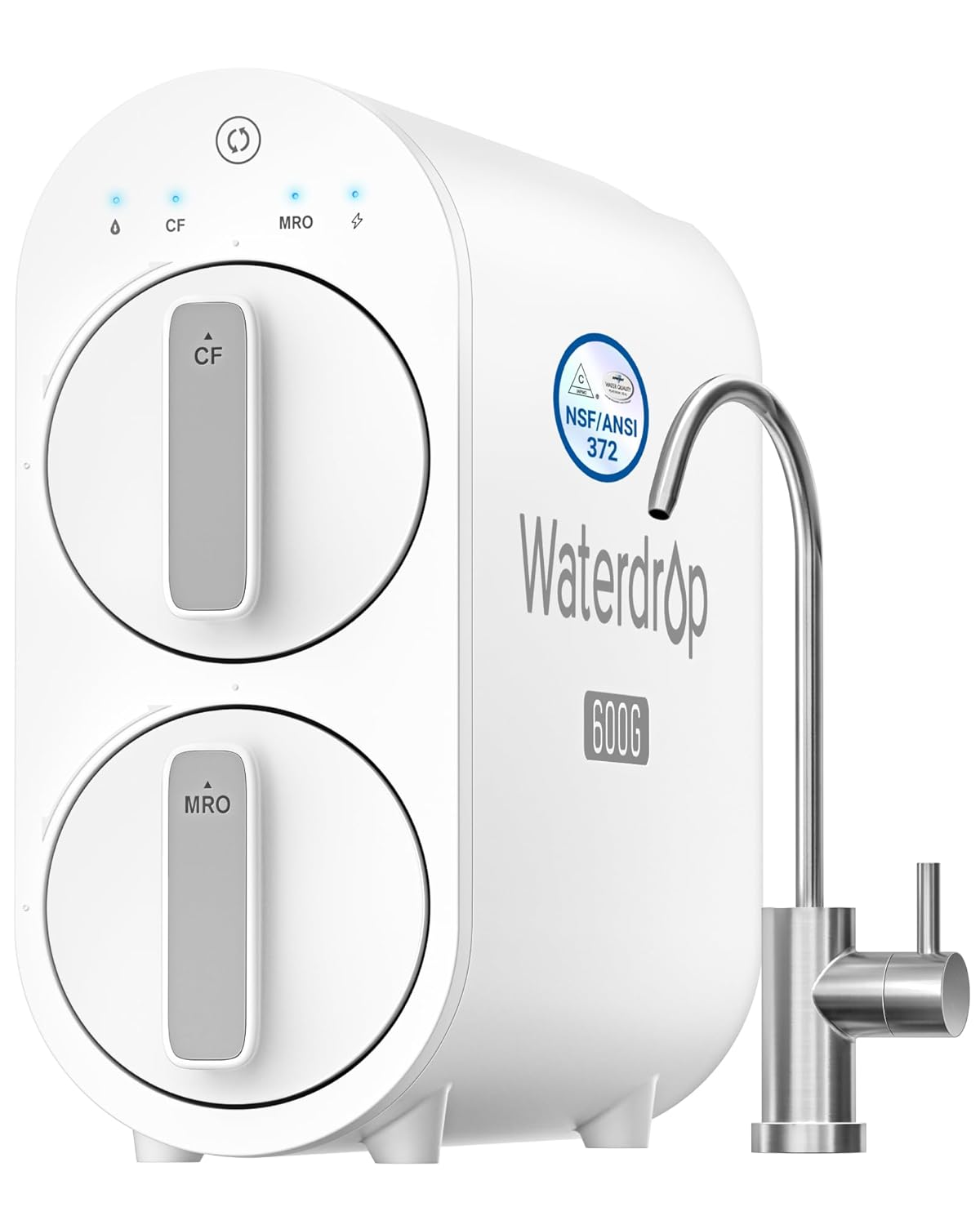
Waterdrop G2P600 Tankless RO
| Purification Method | Reverse Osmosis |
|---|---|
| Power Source | Corded Electric |
| Maximum Flow Rate | 25 milliliters_per_second |
| Supported Water TDS Level Maximum (PPM) | 500 |
| Other Special Features of the Product | Tankless, 2:1 Pure to Drain Ratio, Reduced Waste Water Production |
The Waterdrop G2P600 is a compact tankless under-sink RO system built for steady daily use in a household or small office. It combines seven filtration stages and a fast 600 GPD output to produce drinking water quickly while keeping installation simple with a plug-in power source and a twist-and-pull filter design. The tankless layout reduces under-sink bulk and the claimed 2:1 pure-to-drain ratio cuts wastewater compared with older RO designs, making it easier to repurpose drain water for chores. Filter life indicators and reportedly quick cartridge swaps help maintenance feel straightforward, and NSF/ANSI 372 lead-free certification addresses basic material safety. Important limits are that it requires an electrical outlet and has a stated maximum feed TDS of 500 ppm, so very high-mineral or unusual source water may need pretreatment. Expect typical RO reject water and periodic filter replacements even as it reduces contaminants effectively.
Best for: Buyers who want a space-saving under-sink RO that delivers fast, high-volume filtered water with lower wastewater and reasonably simple maintenance.
Less Ideal for: Homes relying on very high-TDS well water or installations without an accessible outlet should consider systems with pretreatment or nonpowered options instead.
- High flow capacity up to 600 gallons per day for fast dispensing
- Tankless design saves under-sink space and reduces standing water
- 2:1 pure-to-drain ratio lowers wastewater compared with many RO systems
- Seven-stage filtration and NSF/ANSI 372 lead-free materials for robust contaminant reduction
- Twist-and-pull filters with lifespan indicators for quick, tool-free replacements
- Requires a nearby electrical outlet for operation
- Maximum supported feed TDS is 500 ppm, limiting use on very hard or highly mineralized sources
Verdict: Choose the G2P600 if you want a compact, high-output tankless under-sink RO that minimizes wastewater while delivering fast, daily drinking water.
Home Master Artesian TMAFC-ERP

| Purification Method | Alkaline, Reverse Osmosis |
|---|---|
| Maximum Flow Rate | 1 gpm |
| Operating Pressure Range | 40-95 psi |
| Supported Water TDS Level Maximum (PPM) | 500 |
| Capacity | 2000 gallons |
The Home Master Artesian Full Contact TMAFC-ERP is a high-performance under-sink RO system designed to maximize production and reduce waste while adding beneficial minerals back into the water. It uses a seven-stage filtration path including catalytic carbon and a DOW RO membrane, plus a patented two-pass remineralization that adds calcium and magnesium for better taste. A built-in non-electric permeate pump improves efficiency by cutting wastewater and boosting output, and the Fast Flo kit raises dispense flow so the faucet fills quickly. The modular, canister-style filters are straightforward to swap annually or every 2,000 gallons without tools, and catalytic carbon helps target chloramines and other chemical contaminants that standard carbon may miss. For microplastics removal the combination of sediment prefiltration and the thin-film composite RO membrane provides strong physical and adsorptive capture, though true microplastic performance depends on particle size and TDS. Installation is under-sink and the package includes a tank, faucet, and fittings, but the system requires space beneath the sink and occasional filter changes to maintain peak performance.
Best for: Buyers who prioritize high throughput, low wastewater, and strong contaminant removal while still wanting mineralized, great-tasting water on tap.
Less Ideal for: People with very limited under-sink space or those who want a maintenance-free, filterless drinking water option.
- Non-electric permeate pump reduces wastewater and increases water production
- Seven-stage filtration with catalytic carbon and RO membrane for thorough contaminant removal
- Patented two-pass remineralization adds calcium and magnesium for improved taste
- Fast Flo fittings and larger tubing yield noticeably quicker faucet fill rates
- Modular filter design makes annual replacements simple without wrenches
- Requires adequate under-sink space and clearances for installation
- Annual filter and membrane replacements are needed to sustain performance
Verdict: Choose this system if you want a fast, efficient under-sink RO that minimizes waste and returns mineral-rich, great-tasting water suitable for high-performance filtration needs.
APEC Water ROES-50

| Purification Method | Reverse Osmosis |
|---|---|
| Filtration Stages | 5-Stage |
| Capacity | 50 gallons |
| Operating Pressure Range | 40-85 psi |
| Filter Life Cycle | 6 months |
The APEC ROES-50 is a 5-stage under-sink reverse osmosis system designed to deliver very pure drinking water for a household tap. It uses prefilters, an RO membrane, and a post-filter to remove contaminants such as chlorine, heavy metals, fluoride, and microplastics, and it ships with a storage tank and dedicated brushed-nickel faucet for a complete install. Typical use is standard under-sink plumbing with quick-connect fittings and color-coded tubing so most DIYers can complete installation without specialty tools, and filter replacements range from about 6 to 24 months depending on feed water quality. The system is WQA/NSF-level certified components and a 50 GPD membrane gives steady output for daily drinking and cooking needs, though flow at the faucet depends on tank pressure and will be slower than direct-supply taps. Maintenance is straightforward but requires periodic filter swaps and occasional membrane care, and the unit needs 40-85 psi feed pressure and a cold water source to meet specs.
Best for: Buyers who want a practical, high-purity under-sink system that reliably removes microplastics and common contaminants and prefer a DIY install with bundled components.
Less Ideal for: People who need high instantaneous flow for multiple simultaneous taps or who cannot provide the required feed pressure and space under the sink.
- Five-stage filtration including an RO membrane that removes microplastics and a wide range of contaminants
- Rated for 50 gallons per day suitable for typical household drinking and cooking needs
- DIY-friendly installation with quick-connect fittings and color-coded tubing
- Includes tank and dedicated faucet so no separate purchases are required
- Faucet flow relies on the storage tank so dispensing is slower than direct-feed systems
- Requires regular filter and membrane replacements based on incoming water quality
Verdict: APEC ROES-50 is a practical, easy-to-install under-sink RO that reliably reduces microplastics and other contaminants for everyday household drinking water.
Slevoo SJ-RO75R Reverse Osmosis

| Certification | NSF/ANSI 58 |
|---|---|
| Filtration Accuracy | 0.0001 microns |
| Capacity | 700 gallons |
| Pure to Drain Ratio | 3:1 |
| Supported Water TDS Maximum | 2000 PPM |
The Slevoo SJ-RO75R is a space-conscious under-sink reverse osmosis system designed to deliver high-purity drinking water at a modest cost of ownership. It uses a 0.0001 micron RO membrane plus pre- and post-filters (PPC and GAC) to reduce heavy metals, fluoride, chlorine, PFAS and other microscopic contaminants commonly associated with microplastics and dissolved solids. With a stated 700 gallon-per-day capacity and a 3:1 pure-to-drain ratio, it produces filtered water quickly and claims better water efficiency than many older RO units. Installation is intended to be straightforward and the system includes three replacement filters plus a change-filter indicator and a quick pull-and-twist replacement design for fast servicing. The unit is plastic-bodied and compact enough for tight cabinetry, but buyers should expect a gravity/faucet-pressure powered setup and a small amount of wastewater from normal RO operation. For shoppers focused on removing extremely small particles and common dissolved contaminants without paying for a premium brand, this unit delivers solid filtration performance for the price.
Best for: Buyers seeking an affordable under-sink RO that removes microscopic contaminants and common dissolved pollutants while fitting into small cabinets and keeping ongoing maintenance simple.
Less Ideal for: Those who prioritize premium metal construction, zero wastewater operation, or integrated pumps for very low incoming water pressure should consider higher-end or specialty units instead.
- NSF/ANSI 58 certified RO membrane with 0.0001 micron filtration for very small particles
- Includes three replacement filters and a filter change indicator for easier maintenance
- Compact under-sink footprint suitable for small cabinets
- Stated 700 gallon-per-day capacity and a 3:1 pure-to-drain ratio for relatively fast, water-efficient output
- Plastic construction may feel less durable than metal-bodied systems
- Provides wastewater as part of normal RO operation despite a better-than-average ratio
Verdict: A budget-friendly, compact RO system that reliably removes microscopic contaminants including those associated with microplastics while keeping installation and filter changes simple.
VIVA21 5-Stage Reverse Osmosis System

| Purification Method | Activated Carbon, Reverse Osmosis |
|---|---|
| Installation Type | Under Sink |
| Supported Water TDS Level Maximum (PPM) | 1000 |
| Filter Life Cycle | 12 months |
| Capacity | 50 gallons |
The VIVA21 5-stage reverse osmosis system is a complete under-sink kit built to remove dissolved solids and common contaminants using sediment, carbon prefilters, an RO membrane, and a post-carbon stage. It installs under a kitchen sink and comes with a dedicated faucet, storage tank, tubing, an installation kit, and a leak detector so households can start using filtered water for drinking, cooking, coffee, and ice right away. Notable features include WQA Gold Seal certification for NSF/ANSI 58 performance and lead-content compliant wetted components, an automatic shutoff to prevent tank overfill, and leak-resistant fittings for everyday reliability. The multilayer filtration sequence helps capture particles and microplastics at the sediment stage before the membrane, while carbon stages improve taste and remove residual chlorine. Practical trade-offs are the usual RO considerations: it requires under-sink space for the system and tank and periodic filter replacements roughly on a 12-month cycle for some stages, and it will produce wastewater during normal operation.
Best for: Buyers who prioritize a reliable, certified under-sink RO system for daily drinking water and want a complete kit that reduces particulates and improves taste with minimal extra purchases.
Less Ideal for: Anyone short on under-sink space or those who do not want routine filter replacement and wastewater associated with reverse osmosis systems should consider alternative filtration methods.
- Complete under-sink kit with faucet, tank, installation hardware, and leak detector included
- WQA Gold Seal certification to NSF/ANSI 58 and lead-content compliance for verified performance and materials
- Five filtration stages (sediment, carbon, RO membrane, post-carbon) target dissolved solids, chlorine, and particulates
- Automatic shutoff and leak-resistant fittings reduce risk of overfill and everyday leaks
- Requires dedicated under-sink space for the unit and storage tank
- Some filters have an approximate 12-month replacement interval which adds ongoing maintenance
Verdict: A WQA-certified, all-included 5-stage RO kit that reliably reduces dissolved solids and particulates for households seeking certified daily drinking water.
iSpring RCC7AK-BN Reverse Osmosis

| Purification Method | Reverse Osmosis, Alkaline, Activated Carbon, Carbon block |
|---|---|
| Power Source | No Power Needed |
| Maximum Flow Rate | 284 liters_per_day |
| Supported Water TDS Level Maximum (PPM) | 750 |
| Filter Life Cycle | 6 months |
The iSpring RCC7AK-BN is an under-sink reverse osmosis system that combines a 5-stage RO process with a final alkaline mineral stage to restore pH and taste after filtration. It is installed under the sink and supplies purified water via a dedicated brushed nickel faucet and storage tank, and it operates without electricity. Notable features include NSF/ANSI 58 full-system certification, a transparent first-stage housing for visual sediment checks, push-to-connect fittings and color-coded tubing for easier DIY installation, and a convertible feed adapter that fits common fittings. In practice the system removes a wide range of contaminants including high TDS, lead, PFAS, chlorine and particulates, and the mineral stage gives water a balanced pH. Maintenance involves periodic filter and membrane replacements on a 6‑month to multi-year cadence depending on which cartridge is used. Limitations include the need for under-sink space for the tank and unit, and the usual RO drawback of producing wastewater during filtration; installation is DIY-friendly but may still take time for novice installers.
Best for: Buyers who prioritize proven purification and independent social proof want an NSF-certified RO system that also improves taste with minerals and can be installed without electricity.
Less Ideal for: Those who lack sufficient under-sink space or who need a zero-waste filtration solution should consider different filter types.
- NSF/ANSI 58 full-system certification confirming performance and safety
- Alkaline remineralization stage restores healthy pH and improves taste
- Transparent first-stage housing makes sediment buildup easy to monitor
- Operates without electricity so it works during outages and in non-powered kitchens
- Push-fit fittings and color-coded tubing simplify DIY installation
- Requires under-sink space for the tank and filter housings
- Produces rinse wastewater as part of the reverse osmosis process
Verdict: Choose the iSpring RCC7AK-BN when you want an NSF-certified, electricity-free under-sink RO system that also adds minerals back for better-tasting, microplastic-reducing drinking water.
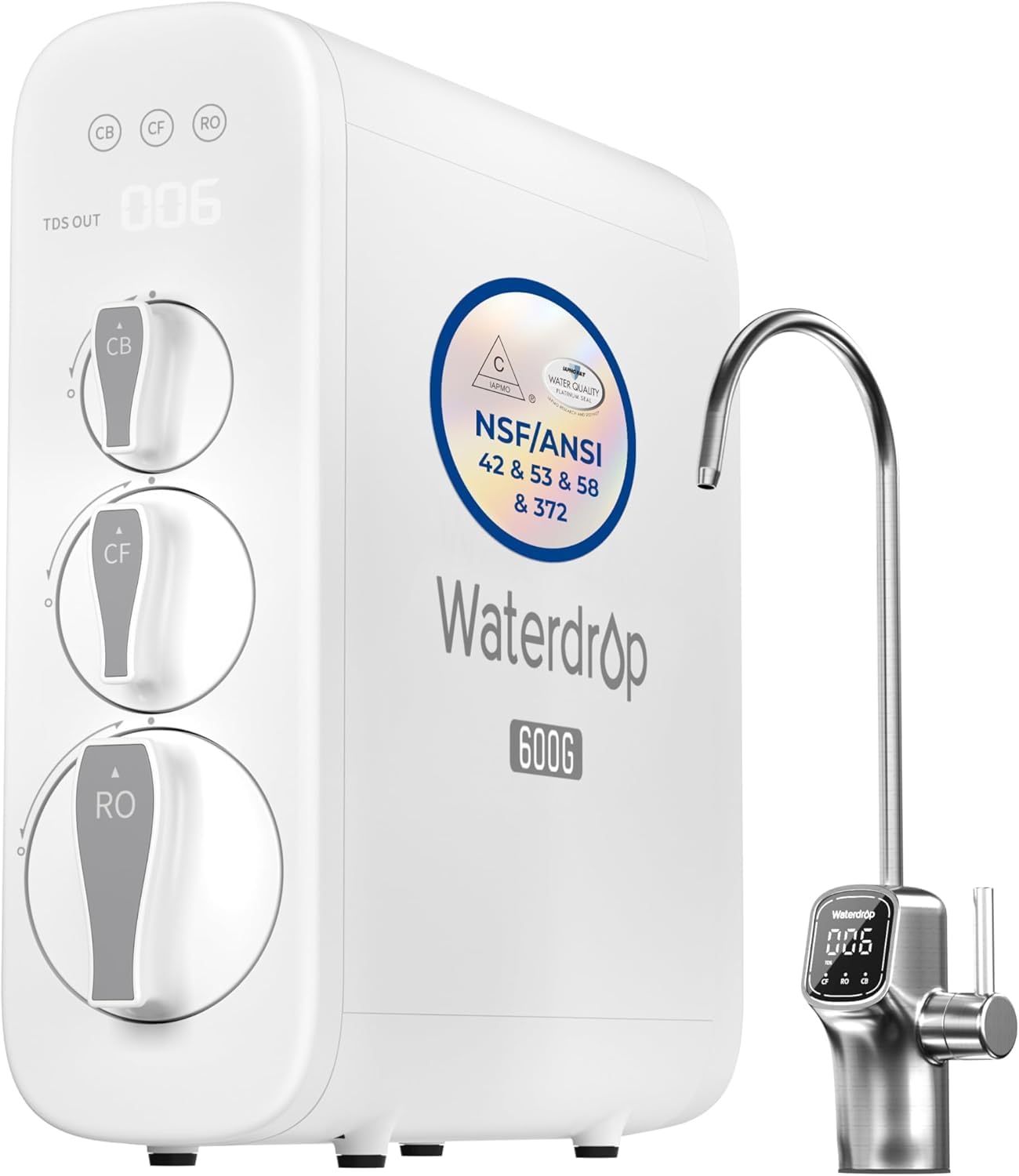
Waterdrop G3P600 Tankless RO
| Filtration stages | 8-stage |
|---|---|
| Flow rate | 600 GPD |
| Purification method | Reverse Osmosis, Carbon Block |
| Pure to drain ratio | 2:1 |
| Maximum flow rate | 0.42 gpm |
The Waterdrop G3P600 is a tankless under-sink reverse osmosis system built for steady, high-volume filtration in kitchens concerned about contaminants. It runs eight filtration stages including a carbon block and RO membrane to reduce chlorine, heavy metals, PFAS, fluoride and particulates, and the system delivers a fast flow that fills an 8 oz cup in roughly eight seconds. The unit is tankless to save under-sink space and the smart faucet includes a TDS readout and filter life indicators so you can monitor water quality without guesswork. Installation requires an under-sink power outlet and two drilled holes for faucet and drain connections, and filters are twist-and-replace for quick servicing. Notable limitations are the need for electricity and the 2:1 pure-to-drain ratio, which still wastes some water compared with zero-waste options. For buyers who prioritize certified contaminant reduction and a compact footprint, this system offers clear, monitorable performance; if you need a completely passive or nonpowered filter, look elsewhere.
Best for: Buyers who want a certified, high-capacity under-sink RO system that minimizes under-sink bulk and provides clear, easy-to-read water quality feedback for everyday drinking and cooking.
Less Ideal for: People who need a passive, nonpowered filtration solution or who cannot accommodate under-sink electrical hookups or drilled faucet/drain holes.
- Eight-stage filtration including RO membrane and carbon block reduces a wide range of contaminants including PFAS and heavy metals.
- High capacity 600 GPD output with fast faucet flow for quick access to drinking water.
- Tankless design saves under-sink space and allows tool-free filter replacement.
- Smart faucet provides TDS monitoring and filter-life indicators for easy maintenance tracking.
- Requires under-sink electricity and a power outlet for operation.
- Produces waste water at a 2:1 pure-to-drain ratio rather than totalmente eliminating drain water.
Verdict: Choose the G3P600 if you want a compact, certified tankless RO that delivers high-capacity contaminant reduction with a smart faucet for easy monitoring.
Choosing the Right Under-Sink Reverse Osmosis Water Filter for Microplastics: Key Factors to Consider
Micron Rating and Media Layers
The micron rating tells you the smallest particle size a filter can capture. For microplastics, look for prefilters and RO membranes that explicitly list sub-micron or sub-1-micron ratings. Multi-stage systems typically combine a sediment prefilter to trap larger debris, activated carbon to remove organics and chlorine, and a reverse osmosis membrane that captures the finest particulates. Effective microplastic control depends on both the membrane pore size and the quality of preceding stages, which prevent premature clogging and extend membrane life.
Understanding media layers helps you predict long-term performance. A robust sediment prefilter protects downstream components and reduces maintenance frequency. Carbon stages improve taste and remove chemical contaminants that can adhere to plastic particles. Confirming the construction and specification of each stage gives you a realistic expectation of how well the system will reduce microplastics over time.
Flow Rate, Recovery Rate, and Daily Use
Reverse osmosis systems vary in how much filtered water they produce and how quickly. Flow rate affects how long it takes to fill a glass or a pot, while recovery rate describes how much of the source water becomes usable filtered water versus how much is discharged as waste. For kitchen use you want a system that balances a reasonably quick dispense rate with an acceptable waste-to-clean-water ratio.
If your household uses several gallons of filtered water per day, consider systems with higher production capacity or an appropriately sized storage tank. Also evaluate whether the system's flow performance meets your peak-use moments, such as filling kettles or multiple jugs, because excessively slow systems create friction for everyday tasks.
Filter Longevity and Replacement Practicalities
Filter life affects both convenience and cost. Prefilters usually have shorter lifespans and require more frequent replacement than the RO membrane. Look at recommended replacement intervals in months and gallons treated to estimate annual maintenance. Consider how easy the replacements are to perform; systems with quick-change cartridges reduce service time and the risk of installation errors.
Also check availability of replacement filters from multiple suppliers and whether the system uses common cartridge sizes. Systems that require proprietary or hard-to-find parts can increase long-term ownership cost and downtime if replacement stock runs low.
Installation Complexity and Plumbing Compatibility
Under-sink reverse osmosis systems connect to cold water supply lines, require a drain connection for reject water, and typically mount a dedicated faucet. Installation complexity varies from straightforward quick-connect fittings to setups that need drilling or specialized valves. Verify the connection types included and whether the system fits standard under-sink cabinet dimensions and plumbing layouts.
If you plan to install the unit yourself, prioritize systems with clear instructions, included mounting hardware, and common connection sizes. If a professional install is likely, consider how the ease of service and clear access to parts will affect labor time and future maintenance.
Materials, Certifications, and Build Durability
Materials in contact with water should be safe and corrosion-resistant. Look for food-grade plastics, lead-free fittings, and membranes manufactured to recognized standards. Certifications from independent testing bodies that reference particulate reduction or specific contaminant removal add credibility to manufacturer claims.
Build durability also impacts reliability under cabinet conditions where moisture and temperature changes occur. Sturdy housings, secure mounting brackets, and well-clamped tubing reduce the chance of leaks. Long-term reliability reduces the risk of sudden failures and the need for emergency repairs.
Waste Water Management and Environmental Considerations
Reverse osmosis produces reject water that carries concentrated contaminants and microplastics. Understanding how much waste a system generates and planning for its drainage is important. Some buyers redirect reject water to a utility sink or use it for non-potable tasks, reducing overall household water waste.
Consider models that advertise improved recovery rates or offer optional booster pumps that increase productive output. Weigh the environmental impact of higher reject ratios against the benefits of finer filtration and improved drinking water quality when making a choice.
How Reverse Osmosis Captures Microplastics
Reverse osmosis uses a semipermeable membrane with very small pores to separate dissolved and particulate matter from water. Microplastics are physical particles, and when the membrane pore size is sufficiently small, these fragments are trapped and carried away with the system's reject stream. Effective capture also depends on upstream stages that remove larger particulates which otherwise accelerate membrane fouling.
In practice, a well-configured multi-stage under-sink system will trap a wide range of particle sizes before the membrane, ensuring the RO membrane primarily filters the finest fragments and dissolved solids. Proper maintenance and timely prefilter changes keep that membrane functioning at designed efficiency.
- Sediment prefilters protect downstream membranes from larger particles
- Carbon stages remove organics and chlorine that can degrade RO membranes
- RO membranes target sub-micron particulates including many microplastic fragments
- Reject line removes concentrated contaminants and trapped particles
Balancing Filtration and Flow for Kitchen Use
High filtration efficiency is critical for microplastics, but buyers should weigh that against flow needs. Very fine filtration can slow dispensing if the system is undersized or lacks an adequate storage tank. Choosing the right tank volume and production capacity helps avoid interruptions during peak usage.
If you frequently fill large containers, look for systems designed for higher daily output or those that support larger or additional storage tanks. For occasional drinking-water use, a standard tank size will typically suffice and keep cabinet footprint smaller.
- Check gallons-per-day ratings to match household consumption
- Larger storage tanks reduce wait times but take more cabinet space
- Some systems accommodate booster pumps to increase output and recovery
Maintenance Tips to Keep Microplastic Removal Optimal
Routine maintenance preserves filtration performance. Replace sediment and carbon prefilters on the manufacturer-recommended schedule, because clogged prefilters reduce throughput and shift more load onto the RO membrane. Monitor the membrane condition and replace it according to the expected life or when water taste and production decline.
Keep tubing and fittings secure and periodically inspect for leaks. Flush new filters per instructions before use, and keep a small toolkit under the sink for basic servicing. Logging replacement dates helps you avoid overdue changes that can compromise microplastic capture.
- Follow recommended prefilter replacement intervals
- Flush new cartridges before first use
- Keep spare filters on hand to avoid missed maintenance
Installation Considerations and Space Planning
Under-sink RO systems require planning for supply and drain connections plus space for a storage tank. Measure cabinet dimensions and note existing plumbing locations before selecting a model. Some systems have horizontal or vertical tank orientations which affect the best fit in your cabinet.
Consider access for future filter changes and whether the faucet mounting hole is available. If your sink lacks an extra hole, you may need to use an existing soap dispenser hole or install a deck-mounted faucet adapter. Planning ahead reduces surprises during installation.
- Verify tank orientation and cabinet clearance
- Confirm supply and drain fitting sizes match your plumbing
- Plan faucet placement or adapter needs before installation
Measuring Performance: What Specs Matter
When comparing systems, pay attention to micron ratings, membrane type, gallons-per-day output, and recovery ratio. Micron ratings and membrane materials indicate theoretical removal capability, while production and recovery specs indicate real-world usability. Also review stated filter lifespans and whether the system offers quick-change cartridges for easier servicing.
If independent test data or certification details are available, these provide stronger evidence of real-world performance than marketing claims alone. Use specifications together with practical considerations like cabinet fit and maintenance requirements to select the best match.
- Micron rating and membrane material for particulate removal
- Gallons per day and recovery ratio for practical output
- Filter lifespan and change procedure for upkeep planning
How We Chose the Best Under-Sink Reverse Osmosis Water Filter for Microplastics
We focused on features and specifications that directly affect microplastic removal and everyday usability. Primary evaluation criteria included filter micron rating and multi-stage media composition, which determine how effectively a system intercepts fine plastic fragments and other particulates. We also assessed system flow and recovery rate to ensure filtered water is available without long waits for typical household use. Build quality and connection type were considered because durable fittings and straightforward installation minimize leaks and downtime. Filter life and replacement cost were reviewed to estimate ongoing maintenance effort and expense. Finally, we examined documentation for certification claims and independent test results where available, prioritizing systems with verifiable filtration performance. We excluded countertop and point-of-use pitchers, inline faucet attachments, and whole-house systems because they either lack the fine filtration or integration required for consistent under-sink microplastic removal. Units with unclear specification of micron rating, ambiguous media descriptions, or lacking basic installation hardware were also filtered out. The remaining products meet a baseline for micron-level particulate control, practical flow rates, reasonable maintenance cycles, and reliable plumbing connections.
Our full evaluation process is outlined in our review methodology.
FAQ
Can an under-sink reverse osmosis system remove microplastics from my tap water?
Often, yes. A properly designed multi-stage under-sink reverse osmosis system with a sub-micron membrane and effective prefilters will capture many microplastic particles. Effectiveness depends on the membrane pore size and the condition of the prefilters.
How often do I need to change filters to maintain microplastic removal?
It usually depends on water quality and system usage. Sediment and carbon prefilters commonly need replacement every 3 to 12 months, while RO membranes may last 2 to 3 years. Following the manufacturer schedule and monitoring output and taste helps maintain performance.
Will installing an under-sink RO system reduce my water pressure or flow at the tap?
You may notice slower dispensing compared with unfiltered tap water unless the system includes an adequately sized storage tank or has a high production rating. Properly matched tank capacity and system output reduce wait times for typical drinking and cooking tasks.
What should I do with the reject water from an RO system?
Most households route reject water to a nearby drain or utility sink. Some people repurpose it for non-potable uses like plant watering where appropriate. Keep in mind that reject water contains concentrated contaminants and should not be used for drinking.
Are replacement filters for under-sink RO systems hard to find?
Replacement availability varies by system. Many common systems use standardized cartridge sizes that are widely available, while others use proprietary parts. Choosing a system with accessible replacement filters reduces the chance of downtime.
Final Verdict
For reliable reduction of microplastics, prioritize systems with clearly stated sub-micron membrane ratings, effective sediment prefiltration, and documented daily output that matches your household needs. Balance filtration efficiency against flow and maintenance demands by considering tank size, recovery rate, and filter replacement intervals. By focusing on installation fit, material quality, and realistic upkeep costs, you can choose an under-sink RO system that delivers consistent, cleaner water with manageable service requirements.