
Note: This article contains affiliate links. If you click on these links and make a purchase, we may earn a small commission at no extra cost to you. This helps support our research and content. Read our full affiliate disclosure here.
If you need near-instant hot water for a single sink, an under-sink water heater can eliminate long waits and reduce water waste. These compact units mount under kitchen or bathroom cabinets and deliver hot water directly at the point of use, which matters when space is limited or when the main water heater is too far away. This guide shortlists the top-performing under-sink water heaters and evaluates them on recovery speed, energy use, capacity, and installation ease. Read on for practical pros and cons to help you pick the right compact heater for your sink and routine.
Top Picks at a Glance
| Best Overall The best all-around choice for most situations | Stiebel Eltron SHC 2.5 Mini-Tank |  |
| Best Quality Built to a higher standard if you want something more solid | Bosch Tronic 3000 T ES4 |  |
| Best Value The sweet spot between price and what you get | Fisoceny 2.5 Gallon Mini Tank Water Heater |  |
| Best Budget The cheapest option that still gets the job done reliably | xwdzswgs 3000W Tankless Water Heater |  |
| Top Rated A top-rated pick with lots of positive feedback | thermomate ES 2.5 Gallon Mini Tank |  |
| Most Popular A crowd favorite that many people choose with confidence | InSinkErator HOT150 Instant Hot Water Dispenser |  |
| Best Seller A high-volume bestseller chosen again and again | Rheem RTEX-04T 3.5 kW Tankless |  |
Stiebel Eltron SHC 2.5 Mini-Tank

| Capacity | 2.5 gallons |
|---|---|
| Wattage | 1300 watts |
| Voltage | 120 volts |
| Flow Rate | 2.5 gpm |
| Maximum Pressure | 150 psi |
The Stiebel Eltron SHC 2.5 is a compact under-sink electric mini-tank designed to deliver immediate hot water for hand washing and kitchen sink tasks. It mounts on the wall or floor near the fixture, plugs into a standard 120 V outlet and draws about 11 amps, so no special wiring is required. The 2.5 gallon glass-lined tank and 1300 W element heat water quickly with an advertised 18 minute recovery time, and the included T and P valve and mounting bracket simplify installation. Because the tank is small and well insulated, standby losses are low and it is practical for close-proximity use where long pipe runs would waste water and energy. Limitations are inherent to the size: it will supply only short bursts of hot water for single fixtures and is not suitable as a whole-house or heavy-duty shower source. Buyers should also plan for routine maintenance typical of tank-style heaters and allow space for the unit and plumbing beneath the sink.
Best for: Buyers who want a reliable, space-saving source of near-instant hot water for a sink or small workstation and who value easy installation and low standby loss.
Less Ideal for: Those needing hot water for full bathrooms, long showers, or multiple fixtures at once should choose a larger or dedicated point-of-use solution instead.
- Compact under-sink form factor frees up space and reduces pipe run time
- Plugs into standard 120 V outlet, no special wiring required
- Glass-lined tank and 1300 W element provide quick recovery for short hot water needs
- Includes mounting bracket and T and P valve for straightforward installation
- Low standby energy loss compared with larger tank heaters
- 2.5 gallon capacity only supports short, single-fixture hot water demands
- Not suitable as a primary water heater for showers or multiple simultaneous uses
Verdict: A compact, easy-to-install mini-tank that delivers fast, local hot water for a single sink without special wiring.
Bosch Tronic 3000 T ES4
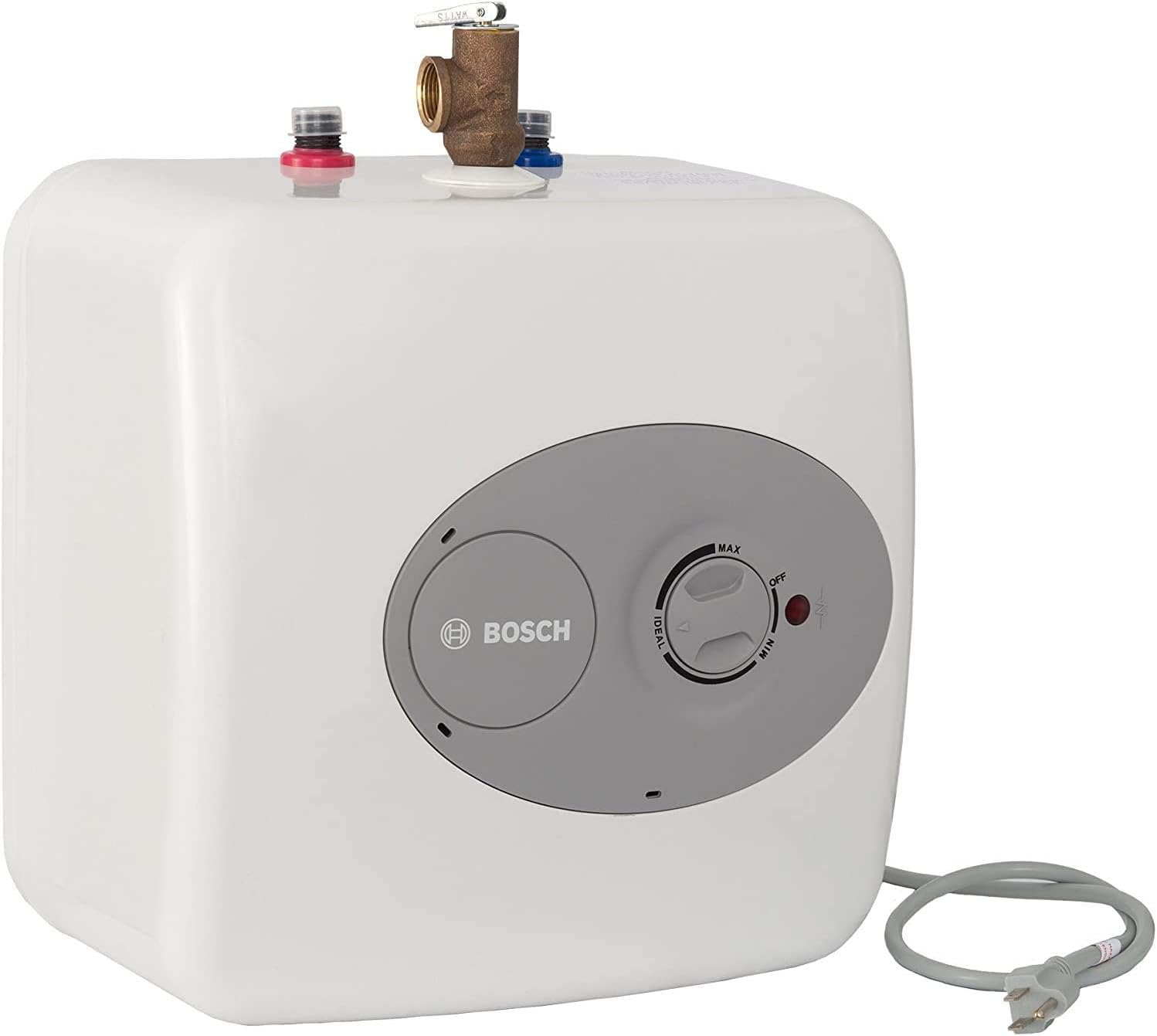
| Capacity | 4 gallons |
|---|---|
| Wattage | 1440 watts |
| Voltage | 120 volts |
| Temperature Range | 65-145°F |
| Water Pressure Range | 150 psi |
The Bosch Tronic 3000 T ES4 is a compact 4-gallon electric mini-tank that provides near-instant hot water at a single sink or as a supplement to a remote main heater. It plugs into a standard 120 V outlet and can be shelf, wall, or floor mounted using the included bracket, making installation flexible in tight under-sink spaces. The glass-lined tank and thick CFC-free foam insulation boost durability and reduce standby heat loss, while the external temperature dial and included temperature-and-pressure relief valve give straightforward control and safety. With a 1440-watt element and a recovery rate suited to point-of-use applications, it can serve one or two nearby fixtures without long waits. Limitations are inherent to the small tank capacity: it is not meant for whole-house use and will run out if demand exceeds the 4-gallon storage and recovery rate. Routine maintenance like anode rod inspection is required to avoid premature tank issues. For buyers who need reliable, fast hot water at a single sink, the ES4 is a practical, space-saving choice.
Best for: Buyers who prioritize fast, reliable hot water at a single sink or workstation and need a compact unit that fits under cabinets or on a wall.
Less Ideal for: Homes or users seeking whole-house hot water or simultaneous use across multiple distant fixtures should choose a larger tank or a dedicated whole-house solution.
- Point-of-use design delivers hot water quickly at a single sink or nearby fixture
- Glass-lined tank and thick foam insulation reduce corrosion and standby heat loss
- Plug-in 120 V connection simplifies installation without hardwiring
- Flexible mounting options: shelf, wall, or floor with included bracket
- Small 4-gallon capacity can be exhausted under sustained use
- Requires annual anode rod inspection and maintenance to prevent tank failure
Verdict: Choose the Bosch ES4 when you need a compact, fast-recovery under-sink heater to deliver reliable hot water right where you use it.
Fisoceny 2.5 Gallon Mini Tank Water Heater

| Capacity | 2.5 gallons |
|---|---|
| Wattage | 1500 watts |
| Voltage | 120 volts |
| Maximum Temperature | 149 °F |
| Maximum Pressure | 108 psi |
This Fisoceny 2.5-gallon mini tank is a compact under-sink water heater meant to deliver hot water quickly for sinks, RVs, and small point-of-use needs. It uses a 1500W L-shaped heating tube to bring the tank up to temperature in roughly 5–8 minutes and offers a mechanical knob to set temperatures between 86 and 149 F. The unit includes two 1/2" FIP stainless supply hoses, a pressure relief valve and mount bracket for straightforward wall or floor mounting, and built-in safety features such as overheat protection, anti-dry burn and high-pressure protection. Because the tank is small, it provides bursts of hot water rather than continuous flow; the listed flow rate and design mean it is suitable for kitchen sinks and RV sinks but not for showers. Insulation and an intelligent control chip reduce standby heat loss, and the stainless tank with seamless welding aims to limit leaks and scaling. Expect simple installation and fast on-demand hot water for low-flow tasks, with the usual capacity limits of a mini tank unit.
Best for: Buyers who need a practical, compact point-of-use heater to supply quick hot water to a single sink, RV, or small workspace and value easy installation and safety features.
Less Ideal for: Homes or users who need sustained high-flow hot water for showers, multiple fixtures, or whole-house supply should choose a larger-capacity heater instead.
- Quick heat-up from 1500W element for fast small-batch hot water.
- Compact under-sink design fits tight spaces and supports wall or floor mounting.
- Includes hoses, pressure relief valve, and mounting kit for easier installation.
- Multiple safety protections including overheat, anti-dry burn, and pressure relief.
- Good insulation and control chip reduce standby heat loss for better efficiency.
- Small 2.5-gallon capacity limits continuous hot-water use and is not suitable for showers.
- Flow rate and output are low compared with whole-house or larger point-of-use heaters.
Verdict: A space-saving, safe, and efficient mini tank that delivers fast hot water at a single sink or RV hookup when you need a practical point-of-use solution.
xwdzswgs 3000W Tankless Water Heater

| Power | 3000W |
|---|---|
| Power Source | AC |
| Maximum Temperature | 122 °F |
| Mount Type | Wall |
| Material Type | Acrylonitrile Butadiene Styrene |
This compact 110V tankless water heater is designed for point-of-use installation under a sink to provide near-instant hot water without a storage tank. It heats water with a 3000W element and an LED screen that shows temperature in Celsius or Fahrenheit, and the unit is intended for vertical wall mounting. Typical uses are at kitchen or utility sinks, in small apartments, RVs, or other tight spaces where a full water heater is impractical. The unit includes multiple safety features such as dry-boil protection, water-electricity isolation, IPX4 splash resistance, leakage protection, and automatic shutdown on overheating. Installation is straightforward for someone comfortable with basic plumbing and electrical hookup, and it uses a 1/2 inch NPT interface with predrilled mounting holes. Important limits: it is a point-of-use device not suited for full showers and performance depends on inlet flow—the higher the flow, the lower the outlet temperature—so expect modest flow rates. The manufacturer also recommends heavier gauge wiring and a 32A trip switch for safe operation. For budget buyers it is a space-saving, energy-efficient option if your hot water need is limited.
Best for: Buyers looking for an inexpensive, space-saving way to get instant hot water at a single sink, especially in small apartments, RVs, or utility spaces where a full-size heater is impractical.
Less Ideal for: Homes or users needing hot water for showers, multiple simultaneous fixtures, or higher flow demands should choose a larger point-of-entry or higher-capacity unit.
- Compact, space-saving design for under-sink or small-space installation
- 3000W heater provides near-instant hot water for point-of-use fixtures
- Digital LED display with selectable Celsius/Fahrenheit for temperature control
- Multiple built-in safety protections including dry-boil and leakage protection
- Easy mounting with 1/2 inch NPT interface and included screws
- Not suitable for showers or applications needing high flow rates
- Requires vertical installation only and specific wiring and breaker capacity
Verdict: A budget-friendly, compact tankless under-sink heater that delivers instant hot water for a single fixture with strong safety features.
thermomate ES 2.5 Gallon Mini Tank

| Capacity | 2.5 gallons |
|---|---|
| Wattage | 1440 W |
| Voltage | 120 volts |
| Maximum Temperature | 149 °F |
| Maximum Pressure | 150 psi |
The ThermoMate ES 2.5‑gallon mini tank is a compact, plug-in point-of-use water heater that delivers near-instant hot water for a single faucet or small appliance. It heats with a 1440 W Incoloy 800 element and stores a small reserve of water at an adjustable temperature up to 149°F, making it useful for kitchen sinks, bathroom vanities, RVs, and small outbuildings. The stainless steel, glass-lined tank and anode rod are built to resist corrosion and extend service life, and the unit includes a UL-listed T&P relief valve for safety. Installation is straightforward: 1/2" NPT water fittings, wall or floor mounting, and a standard 120 V plug-in electrical connection. Because the tank holds only 2.5 gallons and is intended for single fixtures, it will not support showers or high-flow demands, and recovery is limited by the small capacity and 1440 W element. For users who need reliable, compact hot water at a sink without reworking home wiring, this unit offers durable construction and simple installation but is not a full-house solution.
Best for: Buyers who prioritize long-term reliability and low-maintenance performance for a single sink or small-use point-of-use application and want a durable, safety-certified mini tank they can install without rewiring.
Less Ideal for: Large households or locations needing hot water for showers, multiple fixtures, or high-flow appliances should choose a larger tank or tankless solution instead.
- Compact point-of-use design fits under sinks or mounts on a wall
- Incoloy 800 heating element for improved corrosion resistance and long life
- Glass-lined stainless steel tank plus anode rod reduces corrosion and scale buildup
- UL-listed safety components including T&P relief valve
- Plug-in 120V connection avoids hard-wiring and simplifies installation
- Only 2.5‑gallon capacity so it cannot handle showers or multiple simultaneous draws
- Limited heat output (1440 W) means slower recovery after extended use
Verdict: A rugged, UL‑listed mini tank built for dependable, low-maintenance under‑sink hot water when you need a compact, factory‑quality point‑of‑use solution.
InSinkErator HOT150 Instant Hot Water Dispenser

| Wattage | 750 watts |
|---|---|
| Installation Type | Deck Mounted |
| Upper Temperature Rating | 210 °F |
| Power Source | Corded Electric |
| Capacity | 0.67 gallons |
The InSinkErator HOT150 provides near-boiling water on demand via a compact 2/3-gallon stainless steel tank paired with a satin nickel, deck-mounted faucet. It is typically installed beside a kitchen sink as a dedicated hot-water tap for making coffee and tea, speeding cooking tasks, thawing or sanitizing, and loosening jar lids. The unit uses a 750-watt heater with an adjustable thermostat that ranges from 160 to 210 degrees F, and tool-free tank connections plus dry-start protection make DIY installation straightforward if you have a nearby unswitched outlet and the required control valve and fittings. The dispenser claims up to 60 cups per hour at near-boiling temperatures, so it keeps up with moderate household use, and the stainless tank helps with corrosion resistance. Expect a one-year in-home parts and service warranty; the system is not a full replacement for a whole-house heater and requires a counter hole for faucet mounting and a dedicated valve for supply connection.
Best for: Buyers who prioritize fast, reliable near-boiling water at the sink and want a proven, well-reviewed under-sink solution backed by service coverage.
Less Ideal for: Homes that need whole-house hot water or users who lack space or plumbing access for a dedicated under-sink valve and outlet should consider other options.
- Delivers near-boiling water on demand for beverages and quick cooking tasks
- Compact under-sink tank saves counter space compared with kettles or full-size boilers
- Adjustable thermostat (160–210°F) for temperature control
- Tool-free tank connections and dry-start protection simplify installation and offer safety
- Stainless steel tank resists corrosion and supports frequent use
- Requires a nearby unswitched AC outlet and a dedicated control valve for installation
- Limited to point-of-use supply and not suitable as a whole-house heater
Verdict: A compact, service-backed under-sink system that reliably delivers near-boiling water at the tap for kitchens that need fast point-of-use hot water.
Rheem RTEX-04T 3.5 kW Tankless

| Wattage | 3500 watts |
|---|---|
| Voltage | 120 volts |
| Flow Rate | 0.9 gpm |
| Maximum Temperature | 140 °F |
| Capacity | 0.9 gallons |
The Rheem RTEX-04T is a point-of-use tankless electric heater intended for a single sink or other low-flow application where quick hot water is needed without a storage tank. It mounts on the wall and runs on 120V with a 3.5 kW element, producing up to about 0.9 gpm depending on inlet temperature, and offers digital thermostatic control adjustable in 1-degree steps up to 140°F. Installation is simplified because no venting is required, and the compact stainless steel body fits under a sink or in a small closet to free floor space. In practice this model is best where demand is small — a bathroom sink, wet bar, garage sink, or point-of-use laundry — and it reliably heats water on demand while avoiding standby losses of tank units. Limitations are its low flow rate and modest power, so it will not support showers or multiple simultaneous fixtures, and it requires a dedicated 30-amp circuit and appropriate electrical panel capacity for safe operation.
Best for: Buyers who want a reliable, space-saving hot water source for a single sink or low-flow point-of-use location and prioritize predictable, on-demand performance with straightforward installation.
Less Ideal for: Homes needing hot water for showers, multiple fixtures at once, or higher-flow applications should choose a higher-kW or whole-home model instead.
- Compact wall-mounted design fits under sinks and saves floor space
- Thermostatic digital control with 1°F increments up to 140°F
- No venting required, simplifying indoor installation
- Heats water on demand to avoid standby energy losses
- Low maximum flow rate (around 0.9 gpm) unsuitable for showers or multiple fixtures
- Requires a dedicated 30-amp circuit and sufficient household electrical service
Verdict: A compact, easy-to-install point-of-use tankless heater that delivers predictable on-demand hot water for a single low-flow fixture.
Choosing the Right Under-Sink Water Heater: Key Factors to Consider
Capacity and Tank Size
Under-sink water heaters are meant for point-of-use delivery, so capacity determines how long you get usable hot water before the unit must recover. Smaller tanks or tankless point-of-use units supply only a few liters per minute or a short burst of hot water, which is usually fine for handwashing or a quick dish rinse. If you plan to run a higher-flow faucet or a sprayer, choose a higher-capacity model or one with a faster recovery rate.
Also consider how simultaneous use affects performance. If another nearby fixture might call for hot water at the same time, a slightly larger capacity reduces the chance of running out. Matching capacity to typical flow rates and duration of use keeps the heater from short-cycling and extends component life.
Recovery Speed and Flow Rate
Recovery speed is the rate at which the heater reheats water after the tank is depleted or how quickly a tankless point-of-use unit can sustain a set temperature at a given flow. Faster recovery reduces downtime between uses and improves user experience at sinks where hot water is needed frequently. Manufacturers often list flow rates at specific temperature rises; compare those specs against your faucet's flow.
For low-flow faucets, a modest flow-rated unit may be sufficient. For pull-down kitchen faucets or hands-free sensors that deliver higher flow, prioritize models with higher sustained flow or shorter cooldown times so temperature remains consistent during use.
Energy Efficiency and Standby Loss
Because under-sink heaters are often installed close to the point of use, they can cut water waste but may also introduce additional energy use if standby losses are high. Insulation quality and whether the unit is tankless affect ongoing energy consumption. Tankless point-of-use options eliminate standby loss but may draw significant power while heating; small tanks have some standby loss but draw less instantaneous power.
Consider your usage pattern. If the sink is used sporadically, low standby loss or a demand-activated unit can save energy. If the sink sees frequent short uses, a small insulated tank with quick recovery can be more efficient overall.
Electrical and Plumbing Compatibility
Installation requirements differ across under-sink heaters. Some plug into a standard outlet and need only basic plumbing connections, while others require a dedicated high-amp circuit or hardwiring. Verify voltage and amperage needs against your home wiring and whether an electrician is necessary. On the plumbing side, check inlet and outlet connection sizes, whether flexible hoses are supported, and if pressure-relief provisions are included.
Ensuring compatibility ahead of purchase avoids costly on-site upgrades and speeds installation. If cabinet space or access is limited, look for models designed for tight clearances and that come with installation hardware.
Safety Features and Certifications
Because these units operate with hot water and electricity in confined spaces, safety matters. Look for over-temperature protection, automatic shutoff, pressure-relief valves for stored-water models, and leak-detection features where available. Verified safety certifications or third-party testing provide assurance that the unit meets basic electrical and plumbing safety standards.
A clear, accessible pressure-relief installation and straightforward maintenance instructions reduce the risk of damage or hazardous conditions over time.
Maintenance and Serviceability
Point-of-use water heaters benefit from low maintenance, but accessible components make upkeep easier. Consider whether the unit allows for easy flushing to remove mineral buildup, if replaceable sacrificial anodes are supported on tank models, and how simple electrical or thermostat access is for servicing. Local availability of replacement parts and clear warranty terms also affect long-term ownership.
Machines that are hard to access or require specialized tools for routine maintenance often cost more in service over their lifetime, so pick a design that matches your willingness to perform periodic upkeep.
Where Under-Sink Heaters Make Sense
Under-sink heaters are best for single fixtures that need reliable hot water without running the main heater or waiting for the lines to clear. They suit kitchens with long runs from the main water heater and bathrooms where instant hot water improves comfort or hygiene. They are also useful in cabins, guest bathrooms, or utility sinks where space and efficiency are priorities.
Think about use patterns. For occasional handwashing, a small unit is fine. For tasks like rinsing dishes or filling a small pot, you may need a higher flow capability. Consider whether the sink sees continuous use or intermittent bursts and pick a product that matches that rhythm.
- Good for single-sink locations and isolated fixtures
- Reduces water waste by delivering hot water quickly
- Useful in small apartments, guest bathrooms, and utility rooms
Installation Tips for Tight Cabinets
Measure the cabinet depth, width, and available clearance before choosing a unit. Many under-sink heaters can be mounted to the cabinet wall, the back panel, or the floor of the cabinet. Leave space for piping, electrical access, and the mandatory pressure-relief discharge line for tank models.
When routing plumbing and electrical connections, keep flexible hoses and quick-disconnect fittings in mind to simplify future service. If an outlet is not available, evaluate whether a professional electrician is required for a dedicated circuit. Also plan for proper venting or drainage for pressure-relief discharges to avoid water damage inside the cabinet.
- Confirm clearance for hoses and valves
- Provide accessible shutoff and relief lines
- Consider professional help for electrical upgrades
Comparing Tank Vs Tankless Point-of-Use Units
Tank models store a small volume of hot water and are typically simpler to install electrically. They are good for short, repeated uses because the stored hot water is immediately available. Tankless point-of-use models heat water on demand and avoid standby heat loss, but they require sufficient electrical power when operating and may have limits on sustained high flow rates.
Decide based on use pattern and electrical capacity. For frequent short uses, a small insulated tank gives consistent temperature with minimal startup demands. For infrequent or sporadic use, a tankless unit may be more energy-efficient overall despite higher instantaneous power draw during operation.
- Tank: immediate hot water, minor standby loss
- Tankless: no standby loss, higher instantaneous power
- Match choice to flow needs and electrical capacity
Minimizing Heat Loss and Noise
Insulation level affects how much heat the unit loses into the cabinet and how long the stored water stays hot. Well-insulated tanks reduce cycling and can be quieter during operation. Tankless units may produce noticeable operational noise when heating under load, so factor this in for bathrooms where quiet is desired.
Position the unit away from wall surfaces that could be sensitive to heat and use vibration-damping mounts if available. Simple foam pipe insulation on external hot lines further reduces thermal loss and keeps cabinet interiors cooler.
- Choose insulated tanks to reduce standby loss
- Expect some operational noise from tankless heaters
- Use pipe insulation and vibration mounts to limit heat and sound transfer
Common Installation Mistakes to Avoid
Avoid undersizing the heater for faucet flow rates. Check the faucet flow in liters or gallons per minute and compare it to the unit's rated output at your desired temperature rise. Undersized units will struggle to maintain temperature and may cycle excessively.
Do not neglect the pressure-relief discharge path for tank models. That line must terminate safely and be accessible. Also avoid blocking the unit's access points after installation; allow space for future maintenance and for checking electrical and plumbing connections.
- Confirm flow rate compatibility before purchase
- Install a safe, accessible pressure-relief discharge
- Leave service clearance around the unit
How We Chose the Best Under-Sink Water Heater
We selected units that are realistically sized for under-sink installation and that meet the needs of single-sink hot water delivery. Our editorial filters prioritized safety certifications, measured recovery or flow-to-temperature performance, and energy efficiency ratings to reflect ongoing operating cost differences. Installation practicality mattered, so we checked for common mounting options, connection types, and whether standard household electrical or plumbing was sufficient. Durability and warranty coverage were considered to gauge long-term reliability. We excluded full-size or whole-house heaters and any units that require unusual professional modifications or nonstandard fuel types. The final list balances compact footprint, how quickly the unit can supply hot water at typical low-flow fixtures, ease of installation in tight cabinets, energy consumption during typical use, and expected longevity under household conditions.
Our full evaluation process is outlined in our review methodology.
FAQ
Can an under-sink water heater supply a kitchen faucet and dishwasher?
Usually under-sink heaters are designed for a single fixture. They can handle a kitchen faucet but often not both a faucet and dishwasher simultaneously. For dual-use, check the unit's flow or capacity ratings and consider the dishwasher's hot water requirements.
Do under-sink heaters require a dedicated electrical circuit?
It depends on the model. Some plug into a standard outlet while higher-capacity or tankless point-of-use units may need a dedicated circuit. Verify the electrical specifications before installation and consult an electrician if unsure.
How often should an under-sink tank unit be flushed?
Flushing frequency depends on water hardness and usage but is commonly recommended annually to remove mineral buildup. In harder water areas, more frequent flushing helps maintain efficiency and extends component life.
Will a tankless under-sink heater increase my home's electricity peak demand?
Tankless units draw high power briefly while heating on demand, which can increase instantaneous load. If you have limited service capacity or other high-draw appliances, check the unit's amperage requirements to avoid exceeding your panel limits.
Are pressure-relief valves necessary on under-sink tank models?
Yes. Stored-water units require a pressure-relief valve or similar safety mechanism to prevent overpressure conditions. The discharge from that valve should be routed to a safe, visible location to detect leaks or activations.
Final Verdict
When choosing an under-sink water heater, match capacity and recovery to how the sink is actually used and verify electrical and plumbing compatibility before buying. Prioritize safety features, adequate insulation or low standby loss, and installation ease for the tight cabinet environment. Tradeoffs are typically between instant availability and electrical demand, so pick the option that fits your daily flow needs and home wiring. With the right balance of capacity, recovery, and safety, you can get reliable hot water at a fraction of the wait time from a distant main heater.