
Note: This article contains affiliate links. If you click on these links and make a purchase, we may earn a small commission at no extra cost to you. This helps support our research and content. Read our full affiliate disclosure here.
If you live in a small apartment, have limited access to exterior venting, or need a quieter laundry setup, a ventless dryer can be a practical choice. These machines condense or circulate air rather than using an external exhaust, so installation is simpler and you can place them in tighter spaces. This guide covers six shortlisted ventless dryers that suit compact homes and varied laundry routines. We evaluated options across drying performance, energy use, cycle flexibility, and ease of maintenance to help you pick a model that fits your space and fabric care needs. Read on for concise buying guidance and the evaluation criteria used to select our top picks.
Top Picks at a Glance
| Best Overall The best all-around choice for most situations | LG DLHC1455W Heat Pump Dryer |  |
| Best Quality Built to a higher standard if you want something more solid | Samsung 4.0 cu. ft. Heat Pump Dryer |  |
| Best Value The sweet spot between price and what you get | Smad 4.4 Cu.Ft Heat Pump Dryer |  |
| Best Budget The cheapest option that still gets the job done reliably | GE GFQ14ESSNWW Washer Dryer Combo |  |
| Top Rated A top-rated pick with lots of positive feedback | Techomey 2.7 Cu.Ft Washer Dryer Combo |  |
| Most Popular A crowd favorite that many people choose with confidence | Magic Chef 2.7 cu ft Washer Dryer Combo |  |
LG DLHC1455W Heat Pump Dryer

| Capacity | 4.2 cubic feet |
|---|---|
| Form Factor | Smartphone |
| Access Location | Top Load |
| Door Orientation | Reversible |
The LG DLHC1455W is a compact ventless heat pump dryer designed to deliver efficient, fabric-friendly drying in small laundry spaces. It uses Dual Inverter Heat Pump technology to recycle moisture and reduce energy use compared with traditional condenser ventless designs, and Sensor Dry adjusts run time to prevent over-drying. The dryer fits into a 24-inch footprint and supports stacking on a matching compact washer, making it a good choice for closets, condos, or apartments where venting is not possible. You get 14 preset programs and Wi-Fi smart control via the ThinQ app for remote monitoring and cycle start, and a stainless-steel drum aimed at gentler handling of garments. Trade-offs include a higher upfront complexity than a basic condenser dryer and longer cycle times typical of heat pump designs, so it favors energy savings and fabric care over the fastest possible dry cycle. Installation flexibility and smart features make it a practical option for buyers prioritizing efficiency and space savings.
Best for: Buyers who need a ventless dryer that saves energy and fits in tight laundry spaces while offering smart controls and multiple drying programs.
Less Ideal for: People who prioritize the fastest possible dry times or who need the simplest, lowest-cost dryer with minimal technology.
- Dual Inverter Heat Pump technology for more energy-efficient drying than conventional condenser ventless dryers
- Compact 24-inch footprint with 4.2 cu ft capacity fits closets or stacked installations
- Sensor Dry system that automatically adjusts drying time based on moisture levels
- Wi‑Fi smart control via LG ThinQ for remote monitoring and cycle start
- Stainless-steel drum designed to be gentle on fabrics
- Heat pump dryers typically have longer cycle times than vented or condenser dryers
- More complex technology may mean higher upfront cost and potentially more specialized service
Verdict: Choose this compact ventless heat pump dryer if you want energy-efficient, fabric-friendly drying and installation flexibility in small spaces.
Samsung 4.0 cu. ft. Heat Pump Dryer

| Form Factor | Front Load |
|---|---|
| Capacity | 4 cubic feet |
This Samsung heat pump dryer is a ventless unit designed to save energy while protecting fabrics with lower-temperature drying. It uses heat pump technology and Sensor Dry to adjust time and temperature automatically, which reduces overheating and shrinkage on delicate loads. The AI Smart Dial learns your preferred cycles and simplifies the control panel, and built-in Wi‑Fi with the SmartThings app lets you start, stop, schedule cycles, and receive end-of-cycle alerts remotely. Installation is flexible since it does not require external venting, making it suitable for apartments or stacked laundry setups. Trade-offs include a smaller 4.0 cu. ft. drum compared with full-size dryers and likely longer cycle times than conventional vented electric dryers due to the lower-temperature heat pump process. For buyers focused on energy savings and gentle drying, it delivers practical benefits; if you need rapid, large-load drying often, a larger vented unit may be faster.
Best for: Buyers who prioritize energy efficiency and gentle fabric care and want a flexible, ventless dryer that integrates with smart-home controls.
Less Ideal for: Households that regularly need to dry very large or bulky loads quickly should consider a larger-capacity or vented dryer instead.
- Ventless heat pump design for improved energy efficiency and flexible placement
- Sensor Dry optimizes time and temperature to reduce fabric damage
- AI Smart Dial simplifies controls and learns frequently used cycles
- Wi‑Fi connectivity with SmartThings enables remote start, scheduling, and alerts
- Smaller 4.0 cu. ft. capacity limits large or bulky loads
- Heat pump drying typically has longer cycle times than traditional vented dryers
Verdict: Choose this ventless heat pump dryer if you want energy-efficient, gentle drying with smart controls and flexible installation.
Smad 4.4 Cu.Ft Heat Pump Dryer
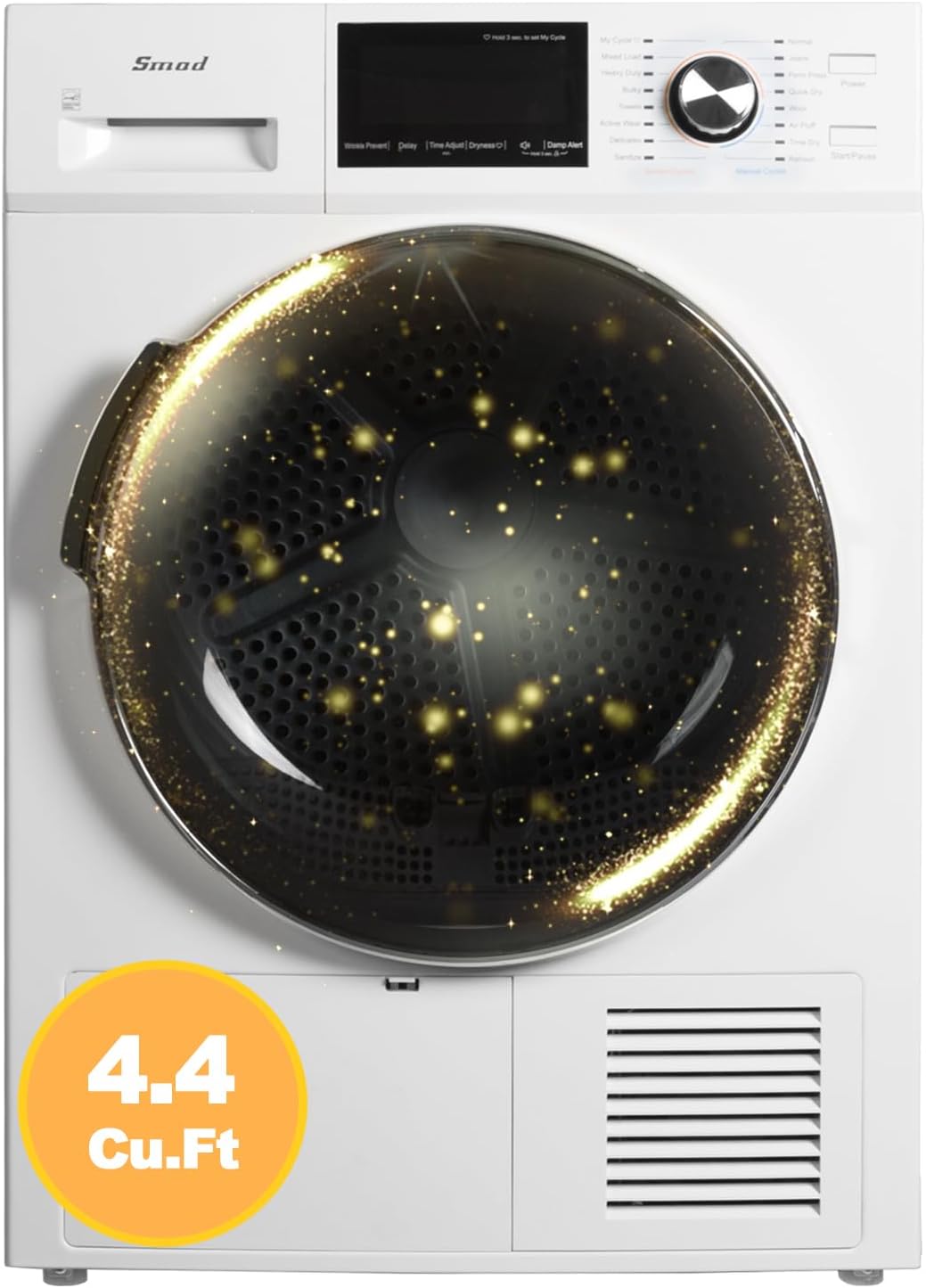
| Form Factor | Front Load |
|---|---|
| Capacity | 4.4 cubic feet |
| Item Type Name | Heat-Pump Dryer |
| Included Components | power cable |
| Specification Met | UL |
The Smad 4.4 cu.ft heat pump dryer is a compact ventless front-load unit designed for energy-efficient drying in small laundry spaces. It uses heat pump technology to lower power consumption compared with conventional electric dryers and offers 16 drying programs to handle different fabrics and load types. The LED control panel and cycle status lights make it easy to monitor progress, while damp-dry and wrinkle-care signals help reduce over-drying and ironing time. Practical additions include a sanitize function and a stackable design that saves floor space. Expect slower drying cycles than high-heat vented machines since heat pump dryers operate at lower temperatures, and the unit is best suited to smaller loads. The dryer ships with a power cable and meets UL specification, but buyer feedback is limited and mixed, so confirm local support and service options if that matters. For someone trading raw speed for lower energy use and flexible installation, this model delivers key ventless advantages in a compact package.
Best for: Buyers who prioritize lower operating costs and flexible installation in tight spaces and who prefer energy-efficient, fabric-friendly drying over maximum speed.
Less Ideal for: Households that need very fast drying for large, frequent loads or that rely on rapid turnaround for heavy bedding and towels.
- Ventless heat pump design reduces energy consumption compared with standard electric dryers
- Compact, stackable front-load form fits small laundry spaces
- LED control panel and cycle status lights for easy monitoring
- 16 drying programs plus sanitize and wrinkle-care options for fabric-specific cycles
- Drying cycles are generally slower than vented high-heat dryers
- Limited visible customer feedback and potential uncertainty around service/support
Verdict: Choose this compact ventless heat-pump dryer if you want energy-efficient, stackable drying for smaller loads and flexible installation where venting is not possible.
GE GFQ14ESSNWW Washer Dryer Combo

| Capacity | 2.4 cubic feet |
|---|---|
| Voltage | 120 volts |
| Number of Washing Cycles | 14 |
| Number of Drying Cycles | 1 |
| Access Location | Front Load |
This GE combination washer-dryer packs a full laundry workflow into a single 24-inch unit that requires no external venting, making it suitable for tight spaces like closets or under counters. You load, wash, and dry in the same drum using 14 wash cycles and an automatic Auto Wash + Dry function that selects an appropriate dry cycle based on the wash selection. Practical features include dispensers for detergent, bleach, and fabric softener, steam wash for better stain removal, five soil and temperature settings for fabric care, and an Add a Garment button to pause and add items mid-cycle. The unit runs on a standard 120V plug and includes fill and drain hoses and an attached power cord, simplifying installation. Because it is a combined machine, drying capacity and cycle times are more limited than a separate dryer and very large loads may need splitting, and the single drying cycle option reduces flexibility for specialty dry needs. Noise and cycle length can be longer than separate machines, but for space-limited budgets this unit delivers a capable, compact ventless laundry solution.
Best for: Buyers who need a space-saving, no-vent laundry solution on a budget and prioritize convenience and compact installation over separate washer and dryer performance.
Less Ideal for: Households that do very large or frequent loads, need fast turnaround, or require advanced drying options should choose separate washer and dryer units instead.
- Ventless condenser design fits in closets or under counters with a standard 120V plug
- 2.4 cu. ft. capacity lets you wash larger items less often than very small combos
- Auto Wash + Dry automatically matches drying to the chosen wash cycle for convenience
- Steam wash and multiple soil/temperature settings improve stain removal and fabric care
- Includes dispensers for detergent, bleach, and fabric softener for hands-off dosing
- Single drying cycle option limits flexibility compared with standalone dryers
- Combined wash-dry machines typically have longer cycle times and smaller effective dry loads than separate units
Verdict: A compact, ventless all-in-one that delivers convenient wash-and-dry performance for budget-minded shoppers who need a closet- or under-counter laundry solution.
Techomey 2.7 Cu.Ft Washer Dryer Combo

| Capacity | 2.7 cubic feet |
|---|---|
| Drying load | 13 lbs |
| Wash load | 26.5 lbs |
| Spin speed | 1400 RPM |
| Controls Type | Touch |
This Techomey washer-dryer combo combines washing and ventless drying in a single 24-inch front-load unit designed for space-constrained homes. It offers a 2.7 cu ft drum for washing (26.5 lb max) and a 13 lb drying capacity, 16 preset programs, touch LED controls, child lock and dispensers for detergent and softener. The stainless steel inner tub supports high-temperature self-cleaning and the 1400 RPM spin speed extracts more water to shorten drying cycles. Its ventless design removes the need for an external exhaust and the unit is engineered for quieter operation under 63 dB. Practical limits are the smaller drying capacity compared with the wash load and potentially longer dryer cycles typical of ventless systems, so heavy bedding or large loads must be split. Installation flexibility and integrated wash-and-dry convenience make this a good choice where space and lack of venting are the constraints, but buyers should plan loads around the separate wash and dry capacities to avoid repeated cycles.
Best for: Buyers who need a reliable, space-saving laundry solution for apartments, RVs, or small homes and prioritize a single, easy-to-use machine that cleans and dries without external venting.
Less Ideal for: Households that regularly wash large items like king-size bedding or very bulky loads and those who need full-capacity simultaneous wash and dry cycles.
- Integrated ventless wash and dry saves floor space and needs no external venting
- Stainless steel inner drum with 90°C self-cleaning for hygienic maintenance
- High 1400 RPM spin helps reduce drying time by removing more moisture
- 16 preset programs and touch LED controls simplify cycle selection
- Child lock and dispensers for detergent and softener add usability and safety
- Drying capacity is notably smaller than the wash capacity, requiring smaller or split loads
- Ventless drying can take longer and may use more energy than vented dryers
Verdict: A compact, ventless combo built for dependable, space-saving wash-and-dry performance where external venting is not available.
Magic Chef 2.7 cu ft Washer Dryer Combo

| Capacity | 2.7 cubic feet |
|---|---|
| Voltage | 120 volts |
| Wattage | 1320 watts |
| Spin Speed | Up to 1300 RPM |
| Number of Cycles | 16 wash, 2 dry |
This Magic Chef unit combines a front-load washer and ventless condensing dryer in a single compact cabinet, making it a space-saving option for apartments and small homes. It offers 16 wash cycles, two drying cycles, five wash and rinse temperatures, and spin speeds up to 1300 RPM, so it handles a range of fabrics from delicates to heavier loads while extracting a lot of water to reduce dry time. Electronic controls with an LED display, a delay-start timer, and a tub clean cycle make routine use straightforward. The ventless design means it requires no external vent but drying is typically slower than vented machines and dry times will vary with load size and fabric type. The stainless steel drum and multiple soil levels are practical for everyday laundry, though buyers should expect longer drying cycles and smaller load capacity compared with full-size separate washer and dryer setups.
Best for: Buyers who need a single, compact washer-dryer solution for apartments, condos, or laundry closets and who value space savings and straightforward controls backed by other users' practical experience.
Less Ideal for: Households that run large frequent loads or need fast, high-capacity drying performance should consider separate full-size washer and vented dryer options instead.
- Space-saving all-in-one design fits small laundry areas without an external vent
- Multiple wash cycles and five temperature settings for fabric-specific care
- Stainless steel drum and 1300 RPM spin help with durability and water extraction
- Electronic controls with LED display, delay start, and tub clean for convenient operation
- Ventless condensing dryer cycles are slower and may not fully dry large or heavy loads
- 2.7 cu ft capacity is smaller than standard separate machines, limiting load size
Verdict: Choose this Magic Chef combo when you need a reliable ventless washer-dryer that saves space and offers enough cycle options for typical apartment laundry needs.
Choosing the Right Ventless Dryer: Key Factors to Consider
Drying Performance for Common Fabrics
How quickly and evenly a ventless dryer removes moisture from cottons, synthetics, and mixed loads determines its practicality for daily use. Faster cycle times help when you need garments ready the same day, but overly aggressive heat can cause shrinking or wear. Look for machines that balance temperature and airflow to handle towels, shirts, and delicates without repeated runs.
Also consider whether the dryer offers moisture-sensing or auto-dry options. Those features stop cycles when items reach the target dryness level, saving time and energy while reducing unnecessary fabric stress.
Cycle Options and Fabric Care Programs
A dryer that offers a range of cycle choices lets you treat different textiles appropriately. Programs for delicates, permanent press, heavy items, and quick-dry loads expand versatility and reduce the risk of damage. Timed cycles are useful for heavier items, while humidity-sensing programs prevent overdrying.
Controls and programmability matter too. Intuitive interfaces and presets reduce user error, while adjustable temperature and dryness levels let you fine-tune results for specific garments.
Energy Use and Operating Cost
Ventless dryers vary widely in how efficiently they convert electricity into usable drying. Heat-pump and condenser technologies typically use less energy than simple resistive systems, which matters if you run the dryer frequently. Lower energy use reduces monthly costs and environmental impact.
Check for models with energy-saving modes, moisture sensors that shorten runtimes, and reasonable cycle lengths. Keep in mind that very low-energy models may trade off cycle speed, so balance efficiency goals with practical drying times.
Footprint and Installation Flexibility
One of the main reasons buyers choose ventless dryers is placement freedom. Compact dimensions and the ability to operate without an external exhaust make these units suitable for closets, bathrooms, or stacked laundry centers. Measure your available floor or stack space and factor in door clearances and service access.
Also review water drainage needs for condenser units, whether a drain hose is required, and if the machine supports stacking with a compatible washer. Easy installation reduces setup time and avoids costly modifications to your home.
Lint Management and Maintenance
Effective lint capture and simple maintenance routines keep performance consistent and reduce fire risk. Inspect how accessible the lint filter is, how often it needs cleaning, and whether there are secondary traps that require occasional service. Some ventless designs also include easily removable condenser units that need periodic rinsing.
Routine upkeep should be straightforward and not require special tools. Clear maintenance guidance from the manufacturer helps prevent common issues and prolongs the dryer's useful life.
How Ventless Dryers Work
Ventless dryers remove moisture without pushing air outside. Condenser models extract humidity from the drum air and collect it in a tank or route it to a drain. Heat-pump designs recycle heated air through a refrigerant loop for greater efficiency. Both approaches avoid the need for an exterior vent, making placement more flexible.
Heat management and airflow patterns are key to performance. Because these systems rely more on internal heat recovery, cycle times can differ from vented units, and understanding the underlying technology helps set realistic expectations for drying speed and energy use.
- Condenser dryers: collect water in a removable reservoir or drain.
- Heat-pump dryers: reuse heat, offering higher energy efficiency.
- No external venting required, ideal for apartments or closets.
Placement and Venting Alternatives
Think through where the dryer will live before buying. Kitchens, bathrooms, and stacked closet setups are common locations, but each has its own constraints for ventilation, humidity control, and service access. Even ventless units benefit from space with reasonable airflow to avoid trapping humidity.
If you do not have a floor drain, many condenser models offer a removable tank you empty periodically. Some also allow a permanent drain hose connection. Consider whether you need a drain-ready setup or prefer a tank you can manage manually.
- Measure depth and height for stacking configurations.
- Plan for door swing and front access for lint removal.
- Verify whether a drain hose option is available if you cannot empty a water tank often.
Noise, Vibration, and Apartment Living
Noise and vibration are important in multi-unit housing. Look for units with balanced drums, vibration-dampening feet, and quiet fan operation. Cycle times matter less if a machine runs quietly, but loud operation can be disruptive even on short cycles.
Place a ventless dryer on a solid, level surface and use anti-vibration pads if your floor amplifies sound. Good installation and regular maintenance also reduce noise by preventing imbalance and motor strain.
- Seek models with explicit noise ratings or quiet-mode options.
- Use leveling and anti-vibration accessories when needed.
- Keep loads balanced to minimize thumping and extended runtimes.
Caring for Delicates and Specialty Loads
Because ventless dryers can run longer than vented units, delicate fabric care is crucial. Choose models with low-heat or air-fluff cycles for items that should not be exposed to sustained heat. Mesh bags and small-load settings help protect lightweight garments.
For bulky items like comforters, check whether the dryer supports larger loads and has tumble patterns that prevent clumping. If you frequently dry mixed loads, prioritize humidity sensing and adjustable tumble settings to reduce re-runs and fabric stress.
- Use dedicated delicates cycles to limit heat exposure.
- Consider smaller, more frequent loads for better drying uniformity.
- Use moisture sensors to prevent overdrying of sensitive fabrics.
How We Chose the Best Ventless Dryer
We focused on machines that deliver reliable drying without an external vent, prioritizing real-world usability for small-home and apartment setups. Our selection filters included cycle effectiveness for mixed fabrics, installation flexibility, and long-term operating costs. We looked for units that handled typical household loads efficiently while offering sensible fabric-care programs and straightforward maintenance. Concrete evaluation dimensions included measured drying effectiveness across cotton and mixed loads, range and usefulness of cycle options, energy consumption and estimated operating cost, physical footprint and installation ease, and durability features such as drum and heater design. We excluded specialty commercial units and hybrid condenser-vent models that require ducting. Units lacking basic lint-management or clear installation guidance were also not considered. The resulting shortlist emphasizes balanced performance, sensible features, and predictable operating expenses for everyday home use.
Our full evaluation process is outlined in our review methodology.
FAQ
Are ventless dryers as effective as vented dryers?
Ventless dryers can be very effective for everyday laundry, but they often run longer than vented models to reach the same dryness level. Heat-pump designs are more energy-efficient, though cycle times may be slower. The right choice depends on whether speed or energy use matters more to you.
Do ventless dryers need a drain or a water tank?
Some condenser ventless dryers collect condensed water in a removable tank, while others support a drain hose for continuous drainage. Heat-pump models typically use internal condensation and may also offer tank or drain options. Choose based on how often you want to empty the reservoir and whether a drain is available where you install the unit.
Can I stack a ventless dryer on top of a washer?
Many ventless dryers are designed for stacking, but compatibility depends on dimensions and available stacking kits for your setup. Verify the dryer's footprint and the washer's top-loading or front-loading configuration before planning a stacked installation.
How often should I clean the lint filter and condenser?
Clean the lint filter after every few loads, or as recommended by the manufacturer, to maintain airflow and safety. Condenser units and secondary traps generally need periodic rinsing or vacuuming—often every few months depending on usage—to preserve efficiency.
Are ventless dryers safe for small homes and apartments?
Yes, ventless dryers are commonly used in apartments and small homes because they do not require exterior ducting. Proper placement, moisture control, and regular maintenance are important to avoid excess indoor humidity and to ensure efficient operation.
Final Verdict
When choosing a ventless dryer, balance drying speed, energy use, and the fabric-care programs you actually need. If you prioritize lower operating costs and gentler drying, look for heat-recovery or well-designed condenser systems with moisture sensors. If quick turnaround is more important, select a model with robust heating and sensible cycle selection while accepting somewhat higher energy use. Ultimately, match the dryer's footprint and installation options to your space, and pay attention to lint management and maintenance requirements. Prioritizing the criteria covered in this guide will help you pick a ventless dryer that fits your home and laundry habits with confidence.