
Note: This article contains affiliate links. If you click on these links and make a purchase, we may earn a small commission at no extra cost to you. This helps support our research and content. Read our full affiliate disclosure here.
If you need reliable hot water but have limited floor space, a wall-mounted water heater can be the right solution. These compact units free floor room, shorten pipe runs, and often cut standby losses compared with bulky tank systems. Choosing the right wall-mounted water heater affects energy bills, installation complexity, and how quickly hot water reaches fixtures. This guide shortlists the top wall-mounted water heaters across common household needs. We evaluate units for energy efficiency, installation and venting requirements, output capacity, and long-term durability. Read on to compare the main tradeoffs and find the style that fits your home and plumbing setup.
Top Picks at a Glance
| Best Overall The best all-around choice for most situations | APUS 27kW Tankless Water Heater |  |
| Best Quality Built to a higher standard if you want something more solid | ThermoMate ET080 8kW Tankless Heater |  |
| Best Value The sweet spot between price and what you get | ThermoMate ES 6.5-Gallon Mini Tank |  |
| Best Budget The cheapest option that still gets the job done reliably | xwdzswgs 3000W Tankless Water Heater |  |
| Top Rated A top-rated pick with lots of positive feedback | Bosch Tronic 3000 T ES2.5 Mini-Tank |  |
| Most Popular A crowd favorite that many people choose with confidence | Stiebel Eltron SHC 2.5 Mini-Tank |  |
| Best Seller A high-volume bestseller chosen again and again | Rheem RTEX-18 Tankless Electric |  |
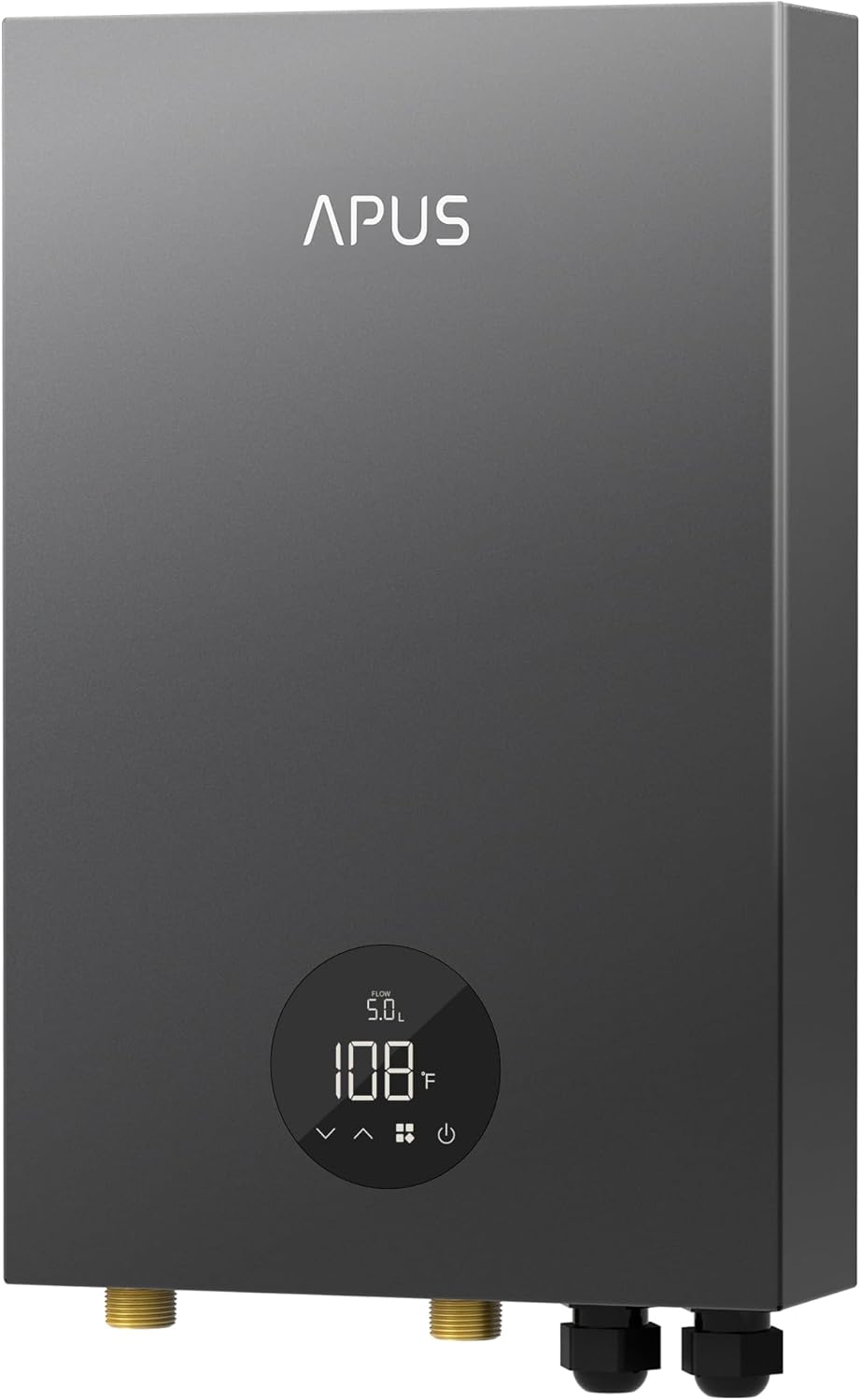
APUS 27kW Tankless Water Heater
| Wattage | 27000 watts |
|---|---|
| Voltage | 240 volts |
| Flow Rate | 6.5 gpm |
| Maximum Temperature | 140 °F |
| Efficiency | 99% |
The APUS 27kW tankless heater is a compact wall-mounted unit designed to deliver continuous hot water for multi-point homes. It heats on demand up to 6.5 gallons per minute, making it suitable for running several fixtures at once, and the self-modulating control adjusts power to match flow and inlet temperature to keep output steady while saving energy. The LED display lets you dial outlet temperature in 1°F increments from 86°F to 140°F and the unit remembers the last setting. Installation requires a 240V hardwired supply with three 40A breakers and 6×8 AWG cable, and standard 3/4-inch NPT plumbing connections simplify hookup for a permanent install. Practical benefits include near-instant hot water without a storage tank, compact footprint for tight utility spaces, and multiple safety monitors with fault display. Limitations are the high electrical service requirement and the need for professional installation, and actual flow and temperature rise will vary with inlet water temperature and household demand.
Best for: Buyers who want a reliable, whole-home tankless solution that delivers strong simultaneous flow and precise temperature control for a family or multi-bath household.
Less Ideal for: Those without adequate 240V electrical capacity or renters who cannot install a permanently wired unit should consider lower-power or point-of-use alternatives.
- High 27 kW output supports up to 6.5 GPM for 3–4 simultaneous uses
- Self-modulating control improves temperature stability and reduces wasted power
- Digital LED control with 1°F adjustment and memory for precise comfort
- Compact wall-mounted design saves floor space and uses standard 3/4-inch NPT connections
- Built-in safety monitoring with fault display for operating protection
- Requires substantial 240V electrical service (3×40A breakers and 6×8 AWG wiring)
- Professional hardwired installation is necessary for safe, compliant setup
Verdict: Choose this APUS 27kW tankless heater if you need compact, high-flow on-demand hot water for a 3–4 point whole-home installation.
ThermoMate ET080 8kW Tankless Heater

| Wattage | 8 KW |
|---|---|
| Voltage | 240 volts |
| Flow Rate | 1.9 gpm |
| Maximum Temperature | 131 °F |
| Mount Type | Wall |
The ThermoMate ET080 is a small, wall-mounted electric tankless heater built for point-of-use hot water. It delivers up to about 1.56 GPM at a 35°F rise and can reach a maximum temperature near 131°F, so it handles single fixtures or two low-flow faucets in warmer climates. The unit uses a cast aluminum heating chamber and a separated heating element to reduce direct water contact, which helps limit scale buildup and potential leaks. Self-modulating electronics adjust power to match incoming water temperature and flow, improving efficiency and reducing wasted electricity. Installation requires a 240V feed, an 8 AWG line, and a 40A double-pole breaker, so expect a qualified electrician for hookup. Practical limits are the modest flow rate and 8kW output—this is not suitable for full-house hot water demands or high flow showers in cold climates. On the plus side it is compact, wall-mounted, and offers safety features like overheat protection and auto shutoff when water is absent.
Best for: Buyers who prioritize compact, efficient point-of-use performance and want a wall-mounted electric heater for one or two low-flow fixtures.
Less Ideal for: Homes needing whole-house hot water or higher flow rates for multiple simultaneous showers should choose a higher-capacity model or a gas tankless unit.
- Compact wall-mounted design saves floor space and fits tight locations.
- Self-modulating control improves energy efficiency by matching power to flow and inlet temperature.
- Cast aluminum heating chamber with separated heating element reduces direct scaling and leak risk.
- Built-in safety features include overheat protection and automatic shutoff when no water is detected.
- Low maximum flow rate (around 1.56 GPM) limits use to single sinks or low-flow faucets.
- Requires a 240V supply, 40A double-pole breaker, and 8 AWG wiring which can add to installation cost.
Verdict: Choose the ThermoMate ET080 if you need a compact, energy-efficient wall-mounted unit to reliably supply hot water to a single sink or other point-of-use fixture.
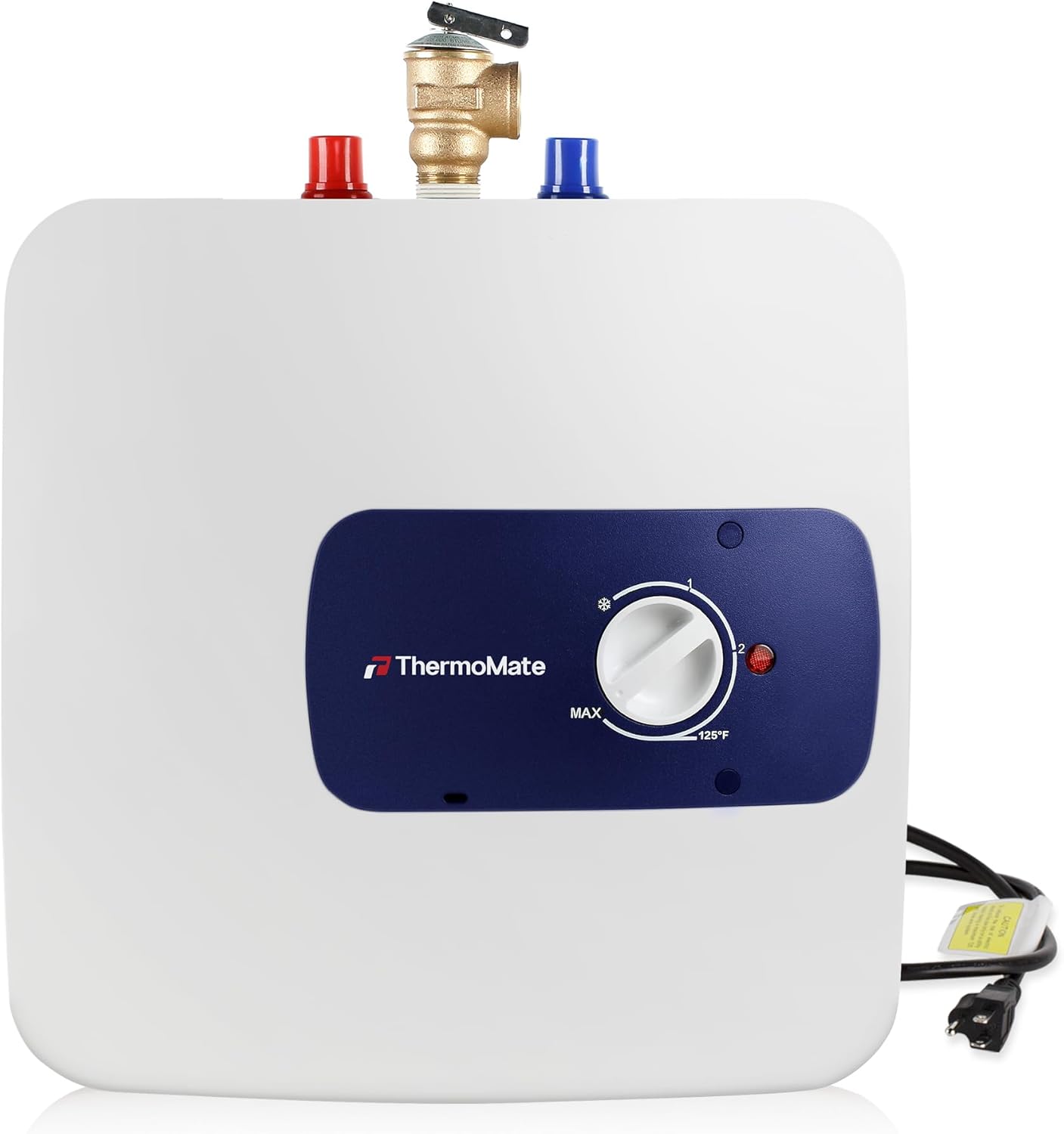
ThermoMate ES 6.5-Gallon Mini Tank
| Capacity | 6.5 gallons |
|---|---|
| Power | 1440 watts |
| Voltage | 120 volts |
| Maximum Temperature | 149 °F |
| Max. Water Pressure | 150 psi |
The ThermoMate ES 6.5-gallon mini tank is a compact electric point-of-use heater intended to provide near-instant hot water for a single fixture. It mounts under a sink or on a wall and plugs into a standard 120V outlet, using a 1440W element and a glass-lined tank to heat and store a small volume of water at adjustable temperatures up to 149°F. Typical uses include boosting hot water at kitchen sinks, small laundry sinks, or remote bathrooms where tying into the main water heater would waste time and water. Notable features include three thermostat settings, a temperature and pressure relief valve, UL listing, and a plug-in design that avoids hardwiring. Practical benefits are faster hot water delivery, reduced wait time and water waste, and easy installation in tight spaces. Limitations include the small storage capacity that makes it unsuitable for showers or high-flow fixtures and a nominal 12A draw that limits use to standard 120V circuits only. Buyers should plan piping and placement so the unit serves a single low-flow fixture for reliable performance.
Best for: Buyers who want a space-saving, easy-to-install way to deliver quicker hot water to a single sink or small workspace and who prioritize efficiency and reduced wait time.
Less Ideal for: Homes that need whole-house hot water or frequent high-flow use such as showers or multiple simultaneous fixtures should choose a larger or tankless solution.
- Compact point-of-use design fits under sinks or mounts on the wall
- Plug-in 120V connection avoids hardwiring and simplifies installation
- Adjustable thermostat with temperature range up to 149°F
- Glass-lined tank and included T&P relief valve for corrosion resistance and safety
- UL listed and designed for single-fixture hot water boosting
- Not intended to service showers or high-flow fixtures due to limited storage capacity
- Stored hot water can be depleted quickly under continuous use
Verdict: A compact, plug-in 6.5-gallon mini tank that delivers faster hot water to a single fixture with simple installation and efficient operation.
xwdzswgs 3000W Tankless Water Heater

| Wattage | 3000 watts |
|---|---|
| Voltage | 110 volts |
| Flow Rate | 0.5 gpm |
| Maximum Temperature | 131 °F |
| Mount Type | Wall |
This compact tankless unit is a point-of-use wall-mounted electric heater that delivers near-instant hot water for a sink or small fixture. It runs on 110 volts and 3000 watts and uses an LED display with touch controls to show temperature in Fahrenheit or Celsius, so you can monitor outlet temperature while adjusting flow. The heater is intended for vertical installation and includes basic safety features such as dry-burn protection, leakage protection, over-temperature shutdown, and IPX4 splash resistance. Practical benefits include a very small footprint that fits under sinks or in tight spaces, a universal G1/2-inch water connection for easy plumbing, and a long power cord plus simple mounting screws for straightforward installation. Important limitations are the low flow rate (0.5 gpm) and modest maximum temperature that make it suitable only for single fixtures and light-duty tasks rather than whole-house use, and the unit requires a recommended dedicated circuit and correctly sized wiring for safe operation. For buyers who need instant hot water at a single sink and want a low-cost wall-mounted option, this model is a usable solution.
Best for: Buyers on a tight budget who need an inexpensive point-of-use wall-mounted heater for a single sink or small fixture and prioritize space savings and instant hot water over high flow.
Less Ideal for: People looking to supply multiple fixtures, take showers, or replace a whole-house heater should choose a higher-capacity model instead.
- Compact wall-mounted design fits easily under sinks and in tight spaces
- Digital LED display with touch controls and selectable ℃/℉
- Multiple safety protections including dry-burn and over-temperature shutdown
- Universal G1/2-inch interface and simple mounting hardware included
- Low flow rate (0.5 gpm) limits use to single fixtures and light tasks
- Requires a properly sized dedicated circuit and wiring for safe installation
Verdict: A budget-friendly, space-saving wall-mounted tankless heater that provides instant hot water for a single sink or small point-of-use application.
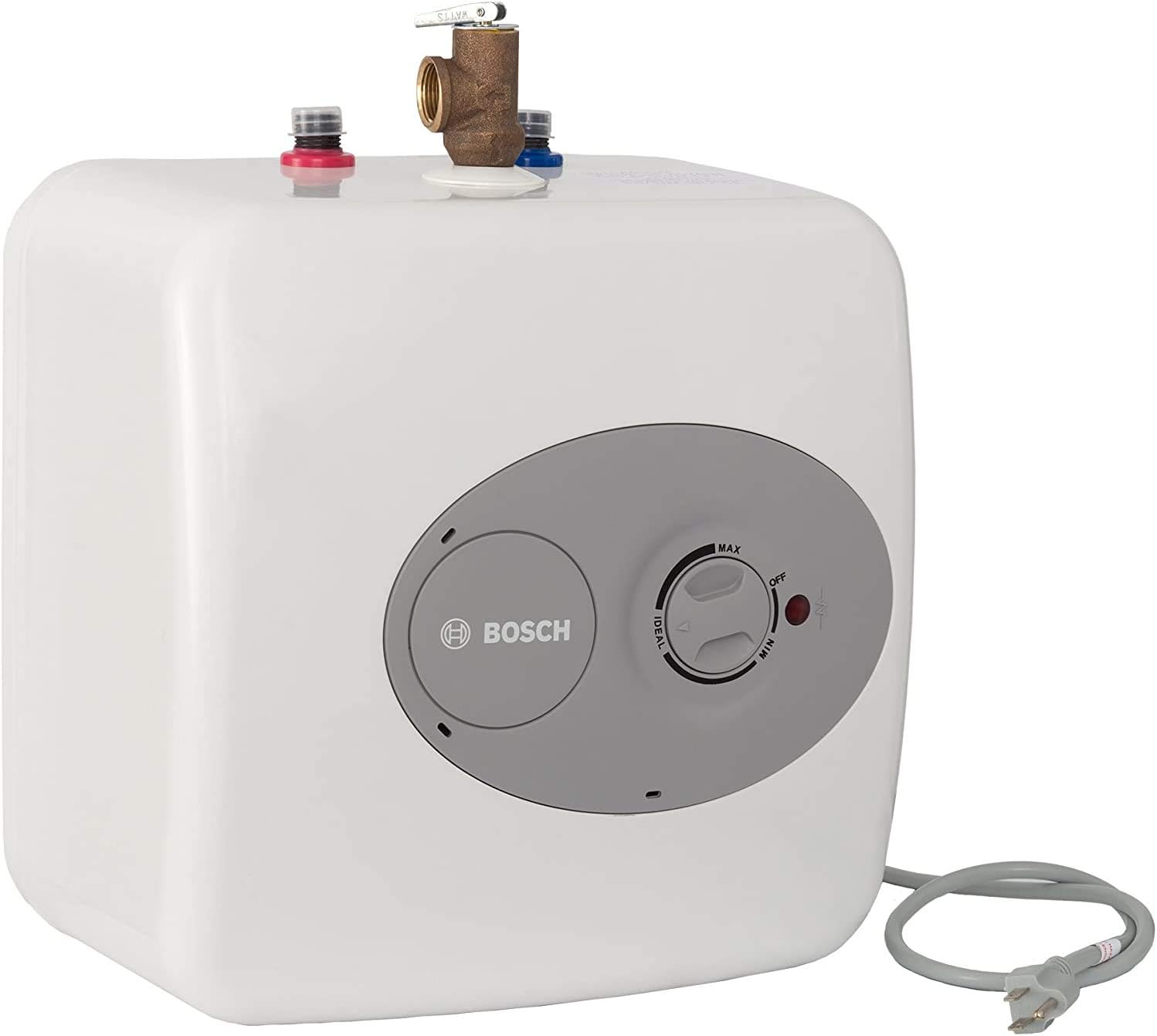
Bosch Tronic 3000 T ES2.5 Mini-Tank
| Capacity | 2.5 gallons |
|---|---|
| Wattage | 1440 watts |
| Voltage | 120 volts |
| Maximum Temperature | 140 °F |
| Efficiency | 98% |
The Bosch Tronic 3000 T ES2.5 is a compact point-of-use electric mini-tank intended to sit under a sink or mount on a wall to supply immediate hot water for one or two sink fixtures. It uses a 1440-watt heating element on 120 volts and a glass-lined 2.5-gallon tank to provide fast recovery and good thermal efficiency, so you spend less time waiting for warm water. Installation is straightforward for homeowners or pros: it can be plugged into a 120V outlet with the supplied cord or piped inline with a larger system, and the package includes a mounting bracket and a temperature-and-pressure relief valve for safety. The external temperature dial makes adjusting output simple, and the unit's small footprint fits in tight spaces. Expect reliable, long-lived service thanks to the glass-lined tank and simple electric design, though capacity is limited to short runs and it is not suited to supplying a full bathroom or shower for extended use.
Best for: Buyers who prioritize dependable, low-maintenance point-of-use hot water for a sink or small kitchenette and want a compact unit that is easy to install and maintain.
Less Ideal for: People needing sustained hot water for showers, tubs, or multiple high-demand fixtures should choose a larger tank or a whole-house solution instead.
- Compact 2.5-gallon tank fits under sinks or mounts on a wall for point-of-use installation
- Glass-lined tank for corrosion resistance and longer service life
- Plugs into standard 120V outlet for easy independent installation or can be piped inline
- Fast recovery with 1440W heating for quick access to hot water at fixtures
- External temperature dial and included T&P relief valve improve control and safety
- Small 2.5-gallon capacity limits continuous hot water delivery for multiple or high-flow fixtures
- Not suitable as the primary water heater for a full bathroom or shower
Verdict: A compact, reliable point-of-use mini-tank that delivers fast, durable hot water for sinks and small fixtures.
Stiebel Eltron SHC 2.5 Mini-Tank

| Capacity | 2.5 gallons |
|---|---|
| Wattage | 1300 watts |
| Voltage | 120 volts |
| Flow Rate | 2.5 gpm |
| Maximum Pressure | 150 psi |
The Stiebel Eltron SHC 2.5 is a plug-in mini-tank water heater meant to deliver immediate hot water for handwashing and small kitchen or bathroom tasks. It mounts to a wall or floor with the included bracket and fills from a cold-water supply, providing a 2.5 gallon buffer that reduces wait times and pipe heat loss compared with distant tanks. The unit runs on standard 120V household power and pulls about 11 amps, so no special wiring is needed. Notable features include a glass-lined steel tank, 1300 watt heating element with relatively fast recovery for its size, T and P valve included, and certification for lead-free compliance. Practical benefits are compact footprint, lower standby losses than larger tanks, and straightforward installation for point-of-use scenarios. Limitations are obvious: capacity is small so it suits only low-flow uses, and it will run out during extended tasks like full showers or heavy dishwashing; recovery and delivery are sized for sinks and short uses. If you need dependable hot water at a single fixture with minimal space impact, this is a solid factory-quality mini-tank option backed by multi-year tank warranty.
Best for: Buyers who prioritize reliable, compact point-of-use hot water for a single sink or small kitchenette and value proven build quality and certifications.
Less Ideal for: Homes that need hot water for full showers, multiple simultaneous fixtures, or whole-house supply should choose a larger capacity heater or a tankless system.
- Compact wall-or-floor mount design saves space under or near a sink
- Plugs into standard 120V outlet so no special wiring required
- Glass-lined steel tank and included T and P valve improve durability and safety
- Relatively fast recovery and low standby losses for a small tank
- Only 2.5 gallons of usable hot water so not suitable for continuous high-flow uses
- Not intended as a whole-house solution; limited to point-of-use applications
Verdict: Choose this mini-tank if you want a compact, factory-quality point-of-use heater that reliably delivers hot water at a single fixture without special wiring.
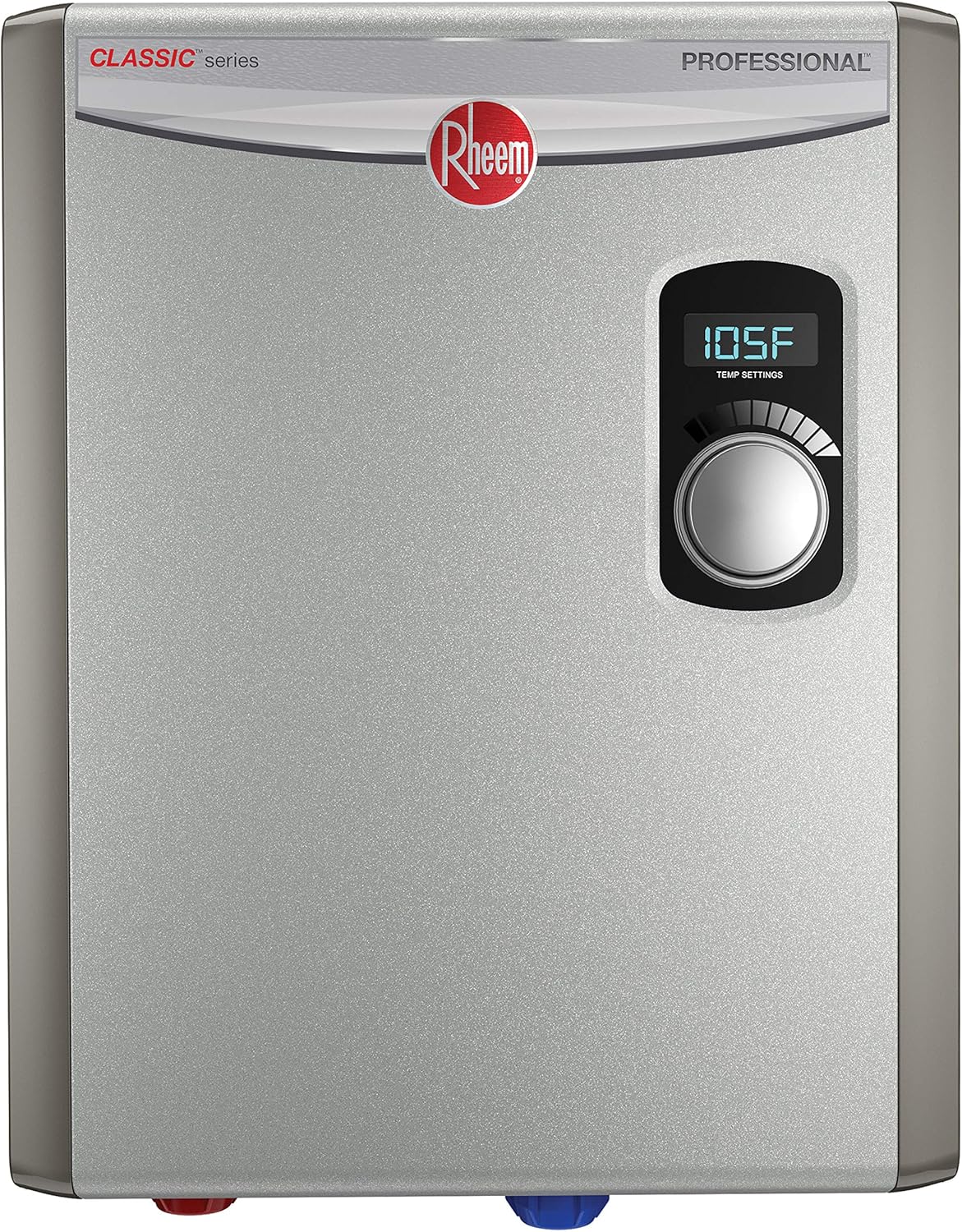
Rheem RTEX-18 Tankless Electric
| Wattage | 18000 watts |
|---|---|
| Voltage | 240 volts |
| Flow Rate | 4.4 gpm |
| Maximum Temperature | 140 °F |
| Mount Type | Wall |
The Rheem RTEX-18 is a wall-mounted tankless electric water heater designed for continuous hot water in mid-size homes and single-shower whole-home applications. It uses self-modulating electric elements to adjust power to demand and provides a maximum flow rate of 4.4 gallons per minute with digital temperature control and an LED display for precise setpoints. Installation is simplified with bottom 3/4 inch NPT water connections and a compact footprint that saves space compared with conventional tanks; no venting is required. The unit's durable copper immersion heating elements are field-serviceable, and Rheem rates the device at 18 kW and 240 volts, which supports steady hot water delivery in moderate inlet temperature conditions. Important limitations are the flow rate ceiling and the electrical service it requires; households with cold groundwater or simultaneous high-flow demands may see reduced output, and installation needs appropriate breakers and wiring. For buyers seeking a compact, energy-smart wall-mounted electric heater, the RTEX-18 is a practical, straightforward choice.
Best for: Homeowners who prefer a low-risk, reliable replacement or upgrade to a wall-mounted electric heater and value steady on-demand hot water without the complexity of venting or gas hookups.
Less Ideal for: Large households with simultaneous high hot-water demand or homes with very cold incoming water that need higher flow rates than the unit can sustain.
- On-demand heating with self-modulating elements for energy efficiency
- Digital LED temperature control with +/-1 degree accuracy for precise output
- Compact wall-mounted design requires no venting and saves floor space
- Durable, field-serviceable copper heating elements
- Maximum flow rate of 4.4 GPM may not support multiple high-flow fixtures simultaneously
- Requires a 240V, high-kW electrical supply and suitable breakers for installation
Verdict: Choose the RTEX-18 when you want a compact, wall-mounted electric tankless heater that delivers precise, energy-efficient on-demand hot water for mid-size homes.
Choosing the Right Wall-Mounted Water Heater: Key Factors to Consider
Capacity and Output
Capacity and hot water output determine whether a wall-mounted heater can serve your household. For small storage wall-mounted units, the gallon capacity dictates how many fixtures you can run consecutively before recovery is needed. For tankless or on-demand wall units, the flow rate rating at realistic temperature rises indicates how many showers or appliances can run simultaneously.
Matching output to your typical peak usage avoids cold-water sandwiches and frequent cycling. Consider your number of bathrooms, typical shower flow rates, and whether you run multiple appliances at once. Oversizing adds cost and may increase standby losses for storage models, while undersizing leads to inadequate supply during peak times.
Energy Efficiency and Operating Cost
Energy efficiency influences long-term operating cost more than initial purchase price. Look for published efficiency metrics such as Uniform Energy Factor for storage models or thermal efficiency and energy factor equivalents for on-demand units. Higher efficiency reduces fuel or electricity consumption and lowers monthly utility bills.
Also consider standby losses for small storage units and modulation range for tankless types. A unit with good part-load performance will use less energy when demand is low, which is common in everyday household patterns.
Installation Requirements and Venting
Wall-mounted water heaters often require specific mounting structures, clearances, and venting arrangements. Gas-fired wall units may need direct venting to the exterior or special combustion air provisions, while electric units usually avoid venting but demand appropriate circuit sizing.
Assess the mounting surface and available wall space, the proximity to plumbing runs, and whether you can provide required vent terminations. Installation complexity affects contractor time and cost and may constrain where you can locate the unit in your home.
Fuel Type and System Compatibility
Choosing between electric, natural gas, or propane wall-mounted heaters affects performance and installation. Fuel type determines venting, electrical requirements, and operating costs depending on local rates. Electric units are simpler to site but may need high-capacity circuits; gas units often deliver higher continuous output but need safe exhaust.
Ensure the chosen fuel type matches existing home utilities or that you are prepared for necessary upgrades. Also consider integration with solar preheat or existing hydronic systems if applicable.
Controls, Safety, and User Interface
Controls and safety features influence daily convenience and long-term reliability. Reliable thermostatic controls, clear temperature settings, and simple diagnostics make routine use easier. Safety features such as overheat protection, pressure relief valves, and freeze protection for exterior installations help avoid damage and hazards.
Good user interfaces reduce the need for technician visits and make it easier to fine-tune performance for comfort and efficiency. Evaluate whether the control layout suits the installation location and whether remote or digital control options are important to you.
Durability and Maintenance Needs
Durability affects life-cycle cost and the frequency of service calls. Materials resistant to corrosion, quality of internal heat exchangers, and the presence of replaceable sacrificial anodes for storage options all contribute to longevity. For tankless designs, scale buildup in hard-water areas can reduce heat exchanger life unless maintenance or water treatment is applied.
Consider access for servicing, availability of replacement parts, and recommended maintenance intervals. Units that are easier to maintain reduce long-term hassle and unexpected downtime.
Wall-Mounted Units Vs Floor-Mounted Systems
Wall-mounted water heaters save floor space and often reduce plumbing run lengths, which can improve hot water delivery times. They are ideal in apartments, small homes, and utility closets where footprint matters.
However, wall-mounted designs sometimes have lower storage capacity than floor-mounted tanks and can require stronger wall supports and specific venting arrangements. Evaluate the tradeoffs of footprint versus capacity for your installation site.
- Better for tight spaces and compact homes
- Can shorten pipe runs and reduce heat loss
- May require reinforced mounting or backing
- Often limits maximum tank size compared with floor units
Choosing Between Tankless and Small Storage Wall Units
Tankless wall-mounted units provide on-demand hot water with minimal standby loss and a compact profile. They perform well for households with staggered hot water usage patterns and can supply continuous hot water within their flow limits.
Small storage wall-mounted heaters offer a buffer for short simultaneous uses and simpler electrical or combustion setups. They can be more forgiving when multiple fixtures run briefly at once. Consider usage patterns and whether continuous high flow or short bursts of simultaneous demand are more common in your home.
- Tankless: low standby loss, continuous output limited by flow rate
- Small storage: short bursts of simultaneous use, possible standby losses
- Water quality and scale concerns affect tankless maintenance needs
Siting Tips and Common Installation Pitfalls
Pick a location that minimizes the distance to main hot water fixtures to reduce lag time. Avoid locations prone to freezing unless the unit includes certified freeze protection or you can ensure heated enclosure protection.
Confirm required clearances and service access before purchase. Check if local codes require seismic straps, secondary drain pans, or specific venting terminations. Failing to plan for vent runs or electrical upgrades is a common source of delays during installation.
- Locate near major demand points to reduce wait time
- Verify wall structure and anchoring method
- Plan vent routing and electrical/capacity upgrades in advance
- Allow space for future servicing and component replacement
Maintenance Best Practices for Longevity
Regular maintenance reduces failures and preserves efficiency. For storage units, inspect and replace sacrificial anodes when recommended and flush the tank to remove sediment. For tankless heat exchangers, perform descaling procedures on the recommended schedule if you have hard water.
Check vent terminations, pressure relief valves, and control diagnostics periodically. Keep clearances and airflow unobstructed for combustion air and venting. A planned maintenance routine can extend service life and maintain energy performance.
- Flush tanks annually or as recommended
- Descale tankless units on a predictable interval
- Inspect pressure relief and venting components regularly
- Document service dates and parts replaced for warranty support
Sizing a Wall-Mounted Water Heater for Typical Households
Estimate peak simultaneous hot water needs by listing likely simultaneous uses, such as a shower plus a dishwasher. For tankless units, convert fixture flow rates into total required flow at a realistic temperature rise. For small storage units, select a capacity that handles typical short bursts without long recovery delays.
Factor in inlet water temperature, which affects required heating power. In colder climates, a higher output or larger capacity is necessary to maintain comfortable shower temperatures when inlet water is colder.
- Calculate combined fixture flow rates for peak scenarios
- Adjust expectations based on inlet water temperature
- Allow margin for occasional simultaneous uses
- Consult a qualified installer for complex multi-bath layouts
How We Chose the Best Wall-Mounted Water Heater
We selected units based on criteria that matter to homeowners installing wall-mounted water heaters. First, energy efficiency was a primary filter because operating cost and heat loss vary widely between tankless and small storage designs. Second, installation and venting complexity were key since many buyers mount these units in tight utility closets or on exterior walls. Third, hot water output and recovery rate were evaluated to ensure the heater can meet typical household demand patterns. Fourth, build quality and corrosion resistance were considered for long-term durability in moist environments. Fifth, control and safety features, such as thermostatic control, overheat protection, and pressure relief, were used to judge practical usability. We excluded bulky floor-mounted models and specialty commercial units that do not fit residential wall-mount use. Models lacking clear efficiency ratings, basic safety features, or reasonable documentation on installation were also removed from consideration. The remaining picks balance compact footprint with measurable performance and realistic installation requirements.
Our full evaluation process is outlined in our review methodology.
FAQ
Are wall-mounted water heaters suitable for small apartments?
Often yes. Their compact footprint preserves floor space and can be installed in closets or on exterior walls. Confirm local code requirements and ensure the wall can support the unit weight and mounting hardware.
How do I know if my home needs a tankless wall unit or a small storage model?
It depends on usage patterns. Tankless units are efficient for continuous or staggered demand and reduce standby losses. Small storage models are better for handling short bursts of simultaneous use. Estimate your peak flow needs to decide.
What maintenance do wall-mounted water heaters require?
Maintenance typically includes flushing storage tanks to remove sediment, replacing anodes if present, and descaling tankless heat exchangers in hard-water areas. Also inspect vents, pressure relief valves, and controls periodically.
Can a wall-mounted water heater be installed outdoors?
Some models are rated for outdoor installation and include freeze protection and weatherproof enclosures. Only install outdoors if the unit specifications explicitly allow it and local codes permit exterior mounting.
Will a wall-mounted water heater save me money on utilities?
It can, depending on fuel type, efficiency rating, and usage patterns. Tankless units reduce standby losses, while efficient storage units with good insulation also cut operating cost. Long-term savings depend on local energy prices and real-world usage.
Final Verdict
When choosing a wall-mounted water heater, prioritize the combination of output and installation practicality that matches your household patterns. Balance energy efficiency against required hot water flow and the complexity of venting or electrical upgrades. Consider maintenance implications and the physical mounting requirements for the chosen location. By focusing on realistic peak demand, fuel compatibility, and serviceability, you can select a compact solution that delivers dependable hot water and minimizes long-term operating hassles.