
Note: This article contains affiliate links. If you click on these links and make a purchase, we may earn a small commission at no extra cost to you. This helps support our research and content. Read our full affiliate disclosure here.
When you have a busy household, running out of hot water becomes a daily frustration. Choosing a water heater sized and configured for large families reduces cold-water shocks, limits schedule conflicts, and lowers the chance of mid-shower interruptions. This guide walks you through the top shortlisted water heaters built to deliver sustained hot-water output and fast recovery during peak usage. We evaluated units across capacity, recovery speed, efficiency, and installation needs to help you pick the option that matches your home plumbing and usage patterns. Read on for a concise overview of what matters and the best choices for different large-household scenarios.
Top Picks at a Glance
| Best Overall The best all-around choice for most situations | MIZUDO 199,000 BTU Tankless Water Heater |  |
| Best Quality Built to a higher standard if you want something more solid | A. O. Smith ATI-540P-N Tankless Water Heater |  |
| Best Value The sweet spot between price and what you get | WINTEMP 27kW Tankless Water Heater |  |
| Best Budget The cheapest option that still gets the job done reliably | Daordaer Tankless Water Heater |  |
| Top Rated A top-rated pick with lots of positive feedback | Rinnai REHP65 65-Gallon Heat Pump |  |
| Most Popular A crowd favorite that many people choose with confidence | Rheem RTEX-18 Tankless Electric |  |
| Best Seller A high-volume bestseller chosen again and again | Orbek RV Tankless Water Heater |  |
MIZUDO 199,000 BTU Tankless Water Heater

| Power Source | Natural Gas |
|---|---|
| Flow Rate | 10.3 gpm |
| Maximum Temperature | 149 °F |
| Heat Output | 199000 btu_per_hour_per_foot_per_fahrenheit |
| Mount Type | Wall |
The MIZUDO 199,000 BTU tankless water heater is a high‑capacity natural gas unit built to supply continuous hot water for large households. It delivers up to 10.3 GPM, supports 5 to 7 fixtures at once, and uses a sealed direct‑combustion system that draws combustion air from outdoors to protect indoor air quality. Typical use cases are whole‑house hot water for simultaneous showers, laundry, and dishwasher use where demand is high. Notable features include smart Wi‑Fi/APP control for remote temperature adjustments and monitoring, a 6‑stage gas modulation system for tight temperature stability (±1°F), and multiple safety protections including freeze protection and flame failure detection. The unit is compact for a 199k BTU model and installs on a wall with standard 3/4" NPT water and gas connections, but venting requires compatible 3"/5" direct venting and the vent kit is sold separately. Practical benefits are abundant hot water on demand, app convenience for schedules and alerts, and robust safety features suited to family use; limitations include the need for proper high‑capacity gas supply, professional venting and installation, and likely higher installation complexity compared with lower‑output models.
Best for: Buyers who need reliable, on‑demand hot water for large families and prioritize steady temperature control and remote monitoring for whole‑house use.
Less Ideal for: Small households with low hot water demand or buyers seeking a plug‑and‑play electric solution should consider lower‑capacity or electric models instead.
- High flow rate (up to 10.3 GPM) supports multiple fixtures simultaneously
- Large 199,000 BTU output suitable for whole‑house hot water in large homes
- Wi‑Fi and app control for remote temperature adjustments, scheduling, and alerts
- Sealed direct combustion and multiple safety protections preserve indoor air quality and provide operational safeguards
- 6‑stage modulation gives tight temperature stability within ±1°F
- Requires appropriate high‑capacity natural gas supply and correct venting configuration
- Direct vent kit and professional installation are necessary and add to total cost
Verdict: Choose this unit if you need high continuous flow and precise temperature control for a large household that uses multiple hot water fixtures at once.
A. O. Smith ATI-540P-N Tankless Water Heater

| Power Source | Natural Gas |
|---|---|
| Flow Rate | 10 gpm |
| Heat Output | 199000 British thermal units |
| Efficiency | 0.93 UEF |
| Mount Type | Wall |
The ATI-540P-N is a high-capacity natural gas tankless unit designed to deliver continuous hot water for larger households. It supplies up to 10 gallons per minute and produces 199,000 BTU, making it suitable for simultaneous showers and appliance use in homes with three or more bathrooms. This condensing design achieves high efficiency (0.93 UEF) and uses commercial-grade materials including alloy steel and a marine-grade 316L stainless steel heat exchanger for durability. A built-in recirculation pump reduces wait time for hot water, and safety features such as overheat protection, exhaust and water temperature control, and an AFR sensor help protect the unit and users. Installation is wall-mounted and requires professional plumbing and gas hookup; recirculation may need a bypass valve that is not supplied. The unit is relatively compact for its capacity but is a powered natural gas appliance that needs proper venting and clearance. For buyers prioritizing strong performance and long-term reliability, this model balances high flow, efficiency, and durable construction.
Best for: Homeowners who need dependable, high-flow hot water across multiple bathrooms and prioritize performance and long-term durability in a natural-gas tankless system.
Less Ideal for: Small households with minimal simultaneous hot-water demand or buyers seeking a simple plug-and-play electric or small tank solution.
- High continuous flow rate of 10 GPM suitable for multiple simultaneous fixtures
- Strong heat output at 199,000 BTU for reliable temperature maintenance
- High efficiency condensing design with 0.93 UEF to reduce energy use
- Integrated recirculation pump for faster hot-water delivery
- Commercial-grade materials and long heat-exchanger warranty for durability
- Requires professional gas hookup, proper venting, and possible additional bypass hardware for recirculation
- Heavier and more complex to install compared with simple tank models
Verdict: Choose the ATI-540P-N when you want a powerful, efficient natural-gas tankless heater that delivers continuous high flow for larger families.
WINTEMP 27kW Tankless Water Heater
| Wattage | 27 KW |
|---|---|
| Voltage | 240 volts |
| Flow Rate | 6.5 gpm |
| Maximum Temperature | 140 °F |
| Mount Type | Wall |
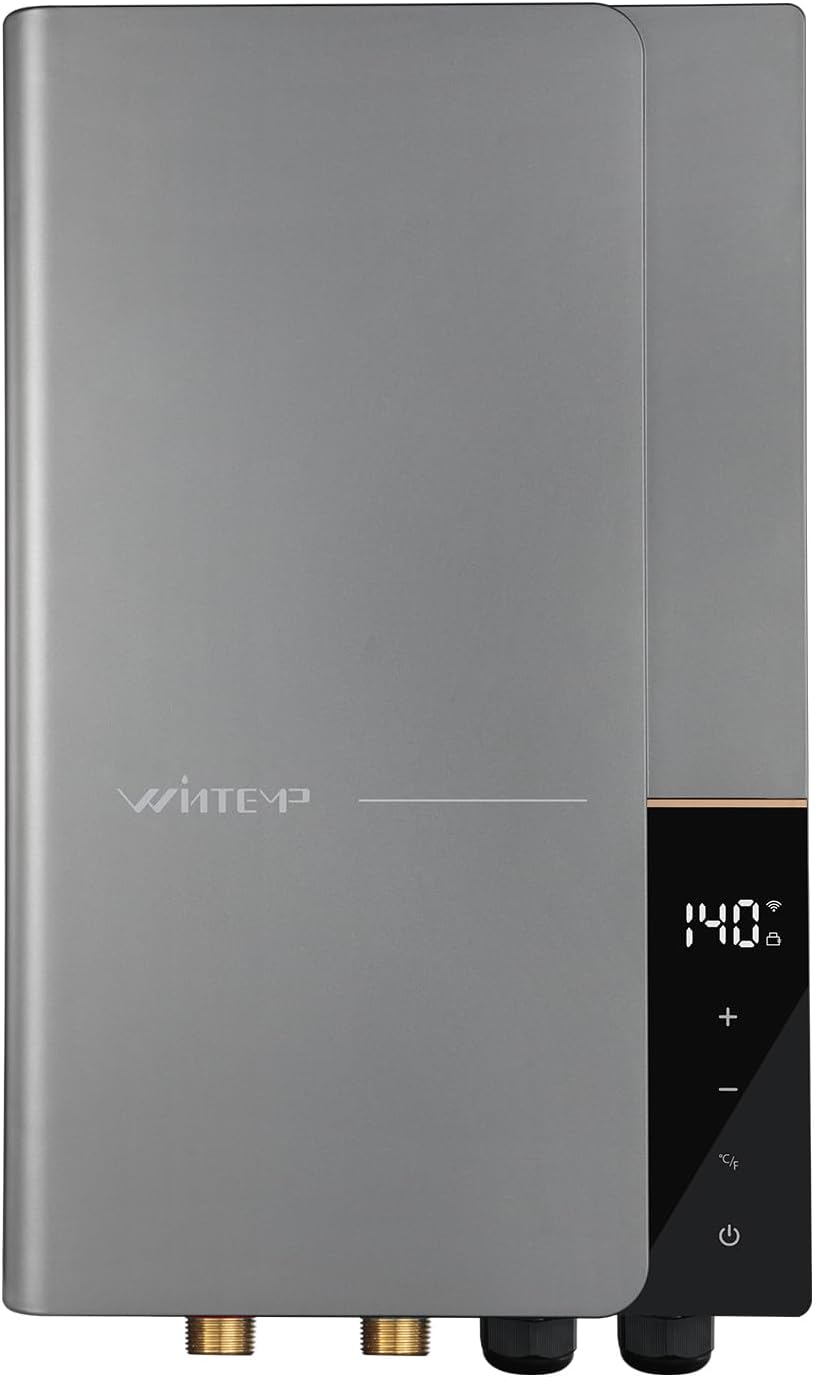
The WINTEMP 27kW tankless water heater is a wall-mounted electric unit designed to supply continuous hot water for multi-point use. It self-modulates power based on flow and temperature demand, includes an LED display and Wi-Fi, and offers multiple safety protections such as overheat, leakage, and dry-fire safeguards with ETL certification. With a listed flow rate around 6.5 gpm and maximum output temperature of 140°F, it can support routine household needs like showers and simultaneous sink use in moderate-demand homes. Installation requires significant electrical capacity (3 x 40A double-pole breakers and heavy-gauge wiring) and a recommended 250A household service, so plan for professional electric work. The compact wall footprint saves space compared with tank heaters and the self-regulating control helps reduce standby energy use. Key practical limits are the high amperage and panel requirements, which may make retrofits costly for older homes, and the unit is intended for whole-house or 2–4 point applications rather than very high-demand households with many simultaneous showers.
Best for: Buyers who prioritize continuous hot water and energy efficiency and are willing to upgrade electrical service if needed; good for households that need reliable hot water at several points but not extreme simultaneous demand.
Less Ideal for: Homes with limited electrical panel capacity or those needing very high flow for many simultaneous showers without an electrical service upgrade.
- High 27 kW heating output for sustained hot water delivery
- Self-modulating control reduces energy use when flow is low
- Compact wall-mounted design saves space compared with tank heaters
- Multiple safety protections and ETL certification
- Requires substantial electrical capacity and professional wiring (3x40A DP breakers)
- Flow rate (~6.5 gpm) may not support many simultaneous high-demand fixtures
Verdict: Choose this unit if you want compact, energy-saving on-demand hot water for a moderate to large household and can provide the required electrical service upgrade.
Daordaer Tankless Water Heater

| Power Source | Electric |
|---|---|
| Wattage | 3000 watts |
| Voltage | 110 volts |
| Flow Rate | 1.6 gpm |
| Maximum Temperature | 131 °F |
This compact electric tankless unit provides near-instant hot water for a single sink or small point-of-use location, heating water to a maximum of 131°F and producing roughly 1.6 gallons per minute at its 3000W/110V rating. It mounts to the wall and uses a slim footprint so it is easy to tuck under a sink or in a small bathroom; controls are available via touchscreen and a remote which is handy when hands are wet. Safety features include dry-heating protection, high-temperature cutoff, and leakage protection, and installation uses a standard 1/2-inch plumbing interface. The small flow rate and 3 kW power mean it will struggle to supply multiple fixtures at once, so expect steady hot water for one faucet or quick successive use but not simultaneous showers. For buyers who need an inexpensive, space-saving on-demand heater for a sink or compact bathroom, it is a practical budget option, but it is not suited to whole-house or multi-person hot-water demands.
Best for: Buyers seeking an affordable, space-saving on-demand heater for a single sink, small bathroom, or point-of-use installation who prioritize upfront cost and compactness over multi-fixture performance.
Less Ideal for: Large families or homes that need simultaneous hot water for showers and multiple fixtures should look for higher-capacity whole-house tankless units or traditional tank systems.
- Compact wall-mount design saves floor space and fits under sinks
- Remote control plus touch display for convenient temperature adjustment
- Built-in safety features including dry-heating protection and leakage protection
- Quick warm-up time with near-instant hot water (about 20 seconds)
- Low flow rate (1.6 gpm) and 3000W/110V power limit simultaneous use of multiple fixtures
Verdict: A very affordable, compact tankless unit that delivers instant hot water for a single sink or small point-of-use installation.
Rinnai REHP65 65-Gallon Heat Pump

| Capacity | 65 gallons |
|---|---|
| Voltage | 240 volts |
| Special Features | Heat Pump Technology, Demand-Response Enabled |
| Power Source | ac_dc |
The Rinnai REHP65 is a large-capacity electric heat pump water heater built to deliver high volumes of hot water while cutting energy use. It uses heat pump technology on a 240V circuit to extract ambient heat and heat the 65-gallon glass-lined steel tank, offering an advertised first-hour delivery of 80 gallons which suits busy households. Energy Star certification and a high Uniform Energy Factor indicate strong operating efficiency, and the CTA-2045 communication port enables demand-response signals from utilities to reduce peak-time costs. The unit ships with common 3/4" MNPT connections and requires 240V/30A power and R134a refrigerant for the heat pump loop. Practical benefits include reduced electricity consumption compared with traditional resistive tanks, a durable glass-lined interior, and a long residential parts and tank warranty for peace of mind. Important limits are that it needs a dedicated 240V circuit and proper ventilation around the unit for heat-pump operation, and installation is more complex than a standard electric tank which may raise upfront installation effort and cost.
Best for: Buyers who prioritize dependable, energy-efficient hot water for large households and want a durable, warranty-backed solution that lowers long-term operating costs.
Less Ideal for: Those who need a simple plug-and-play replacement or have limited space or no 240V circuit available should consider simpler electric or gas options instead.
- High first-hour delivery (80 gallons) suitable for households with large hot water demand
- Heat pump technology and Energy Star certification deliver lower operating costs than conventional electric tanks
- Demand-response enabled CTA-2045 port lets the unit reduce energy use during grid peak events
- Glass-lined steel tank offers corrosion resistance for long service life
- Generous residential warranty coverage on tank and parts for long-term reliability
- Requires a dedicated 240V/30A electrical circuit and professional installation
- Heat pump performance depends on ambient air temperature and adequate installation clearance
Verdict: Choose the REHP65 if you need reliable, high-volume hot water for a large family while cutting energy bills with heat pump efficiency and utility demand-response support.
Rheem RTEX-18 Tankless Electric
| Wattage | 18000 watts |
|---|---|
| Voltage | 240 volts |
| Flow Rate | 4.4 gpm |
| Maximum Temperature | 140 °F |
| Efficiency | 99.8% |
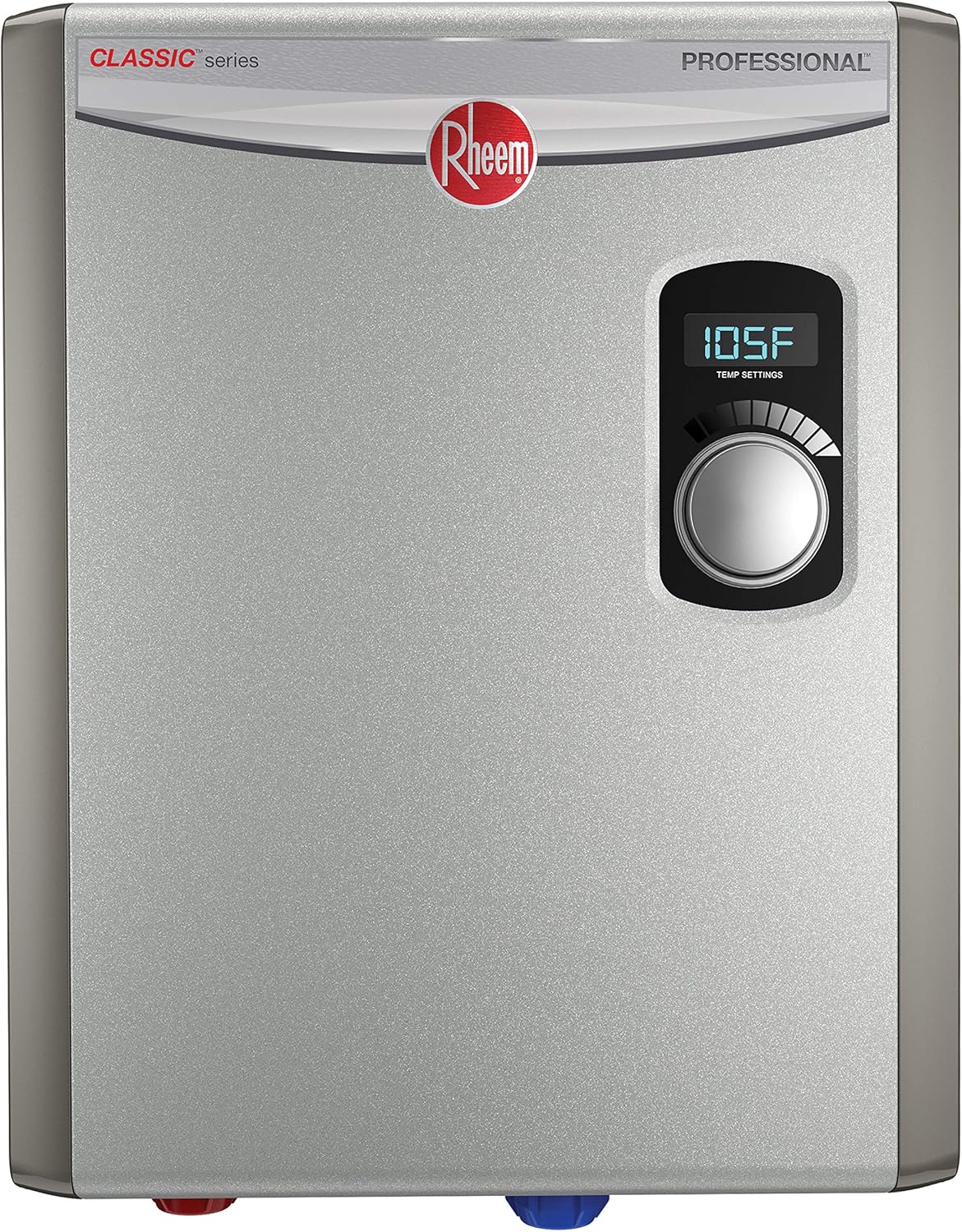
The Rheem RTEX-18 is a self-modulating, 18 kW tankless electric water heater intended to deliver continuous hot water for mid-range whole-home use. It heats water on demand using two field-serviceable copper immersion heating elements and a digital thermostatic control with LED display for +/-1 degree adjustment. Installation is straightforward for a wall-mounted unit with bottom 3/4 inch NPT connections and no venting required. In practice the RTEX-18 can supply up to about 4.4 gallons per minute, which typically supports one to two fixtures running concurrently depending on incoming groundwater temperature. Its self-modulating electronics reduce wasted power by matching output to demand, improving efficiency versus a standing tank. Important limitations are the 4.4 GPM peak flow and the 240V, 18 kW electrical requirement, which may need a multi-breaker circuit and limit performance in cold climates or for large families with simultaneous high-demand use. For households that size needs careful matching of fixture schedules or higher-capacity units for fully concurrent showers.
Best for: Buyers who prioritize energy savings and continuous hot water for a mid-size household and who check electrical capacity and flow needs before buying.
Less Ideal for: Large families that frequently run multiple showers or appliances at once without staggered schedules should consider higher-flow or higher-kW models instead.
- On-demand heating with self-modulating control improves energy efficiency
- Digital LED thermostat with fine temperature adjustment
- Compact, wall-mounted design saves space and requires no venting
- Field-serviceable copper heating elements for easier maintenance
- Maximum flow rate (~4.4 GPM) may not support multiple simultaneous full showers
- Requires 240V, high‑amp electrical supply which can need significant breaker capacity
Verdict: A compact, energy-efficient whole-home tankless that delivers on-demand hot water for mid-size households when electrical capacity and simultaneous flow needs are matched correctly.
Orbek RV Tankless Water Heater

| Power Source | Liquid Propane |
|---|---|
| Voltage | 12 volts DC |
| Flow Rate | 3.5 gpm |
| Maximum Temperature | 123 °F |
| Maximum Pressure | 150 psi |
The Orbek RV Tankless Water Heater is a 60,000 BTU propane, 12V DC tankless unit designed to provide continuous hot water for RVs and campers. It supplies hot water on demand for showers, dishwashing, and general onboard use while the burner runs only when water is called for, which helps reduce propane usage compared with tank models. Notable features include an adjustable temperature range from 95°F to 123°F, a smart remote control, built-in 150 PSI pressure-reducing valve, and safety protections such as frost protection, flame failure shutoff, and dry combustion protection. The unit uses oxygen-free copper heat exchangers and a brushless DC fan for improved high-altitude performance and staged combustion to reduce cold spots. Installation is intended for standard RV door-mount openings and standard NPT water connections and runs on 12V DC power, so many owners can replace an existing RV heater without major modifications. Important limitations are the requirement for a 12V DC supply (an AC-to-DC converter is needed if only 110V AC is available) and that the unit is sized for RV family use rather than large stationary household systems.
Best for: Buyers seeking a reliable, factory-grade tankless heater for family RV travel who prioritize continuous hot water, safety features, and high-altitude performance.
Less Ideal for: Those wanting a stationary whole-house water heater or users without an accessible 12V DC supply who do not want to install a voltage converter.
- High 60,000 BTU output provides strong on-demand hot water for back-to-back uses
- Designed for high-altitude operation with copper heat exchangers and brushless DC fan
- Remote temperature control and adjustable range from 95°F to 123°F
- Multiple built-in safety features including flame failure shutoff, dry combustion protection, and frost protection
- Includes a factory-quality 150 PSI pressure-reducing valve and a remote control in the box
- Requires a 12V DC power source so an AC-to-DC converter is necessary if only 110V AC is available
- Meant for RV installations and not sized or specified for whole-house residential systems
Verdict: A powerful, safety-focused tankless propane heater built to deliver dependable continuous hot water for RV families, especially at altitude.
Choosing the Right Water Heater for Large Families: Key Factors to Consider
Capacity Versus Household Demand
Capacity determines how much hot water is available before the unit needs to recover. For large families, choose a capacity that covers simultaneous uses such as showers, laundry, and dishwashing. Tank units are sized by gallons while tankless units are rated by gallons per minute; translate typical shower and appliance flow rates into a realistic peak demand estimate.
Underestimating demand leads to frequent cold-water dips and scheduling conflicts. Over-sizing increases upfront cost and footprint. Consider typical shower lengths, the number of bathrooms, and whether multiple appliances run at once to find the right balance between capacity and practicality.
Recovery Rate and Peak Flow
Recovery rate is how quickly a tank heater reheats incoming cold water; for tankless systems, look at continuous flow rate at realistic temperature rises. High recovery or high flow prevents interruptions when multiple fixtures are in use. This is critical for large families that frequently need hot water at several points in the house simultaneously.
Also consider the impact of inlet water temperature. In colder climates the effective flow or recovery will fall, so choose a unit rated to deliver sufficient output at your local groundwater temperature.
Energy Efficiency and Operating Cost
Efficiency affects long-term running costs, which matter more for households with heavy hot-water use. Compare energy factor or uniform energy factor ratings for electric and gas tank units, and thermal efficiency or EF-equivalent performance for tankless options. Higher efficiency reduces fuel consumption but may require a higher upfront investment.
Also evaluate standby losses with large tanks versus the on-demand nature of tankless designs. Consider possible incentives for high-efficiency models and how expected daily hot-water demand influences payback time.
Installation Requirements and Space
Installation needs can be a deciding factor. Tank units require floor or garage space and potentially larger venting or exhaust systems for gas models. Tankless units often mount on walls and may need upgraded gas lines, larger electrical service, or dedicated venting. Accessibility for maintenance and placement relative to high-use areas affects efficiency and perceived performance.
Plan for piping runs, venting, and condensate management where applicable, and verify whether your home's utility supply meets the unit's requirements. Complex installations increase upfront labor costs and may limit which models are practical for an older home.
Maintenance, Durability, and Corrosion Resistance
High-use households accelerate component wear. Choose units with corrosion-resistant materials, accessible sacrificial anodes for tanks, and serviceable heat exchanger components for tankless systems. Regular maintenance such as flushing mineral buildup is more important in hard-water areas and for large families to preserve efficiency and capacity.
Longer warranty periods on major components can offset repair risk. Also factor in availability of replacement parts and the expected service life when comparing options.
Controls, Safety Features, and User Convenience
Practical controls help households fine-tune temperature and reduce complaints about scalding or insufficient heat. Look for reliable thermostatic controls, anti-scald features, and easily understood indicators for maintenance. Remote or digital controls can be helpful for large households to manage temperature schedules or limit maximum water temperature for certain fixtures.
Safety features such as pressure-relief systems, automatic shutdowns, and leak detection compatibility improve long-term reliability and reduce the risk of costly damage in busy homes.
Tank Versus Tankless: Practical Tradeoffs
Tank systems store a large volume of ready hot water and can satisfy multiple fixtures in quick succession until the stored supply is depleted. They are straightforward to install in many homes and generally have predictable performance tied to tank size and recovery rate.
Tankless systems provide on-demand hot water and avoid standby heat loss, offering potentially lower operating costs and endless hot water for staggered usage. However, their real-world output depends on incoming water temperature and may require larger gas or electrical service for high simultaneous demand.
- Tanks: simpler installation, predictable stored capacity, faster recovery needs for repeated peaks.
- Tankless: compact footprint, on-demand supply, may need utility upgrades for peak simultaneous flow.
Sizing for Multiple Bathrooms and Appliances
To size properly, add estimated flow rates for each fixture likely to run concurrently. Typical shower heads run 1.5 to 2.5 gallons per minute, dishwashers and washing machines have intermittent draws. Build a realistic peak-demand profile and add a margin to avoid shortages.
For tank heaters, consider first-hour rating as a planning metric. For tankless, use the gallons-per-minute rating adjusted for the expected temperature rise from your local inlet temperature to the desired output.
- Map common simultaneous scenarios, such as two showers plus a dishwasher.
- Adjust for colder inlet temperatures in winter, which lowers effective output for tankless units.
Installation Logistics for Busy Households
Placement affects both performance and convenience. A centrally located unit can reduce wait time and heat loss in long supply runs. For tank units, ensure floor load and clearance are adequate. For tankless units, check venting routes and service access.
Plan for periodic maintenance without major disruption. If the unit is in a high-traffic area, noise and accessible controls become more important. Budget time for regular tasks such as flushing sediment from tanks or descaling tankless heat exchangers in hard-water areas.
- Central placement shortens wait times and reduces heat loss.
- Allow service clearance and easy access to controls and drains.
Energy Use Patterns and Long-Term Costs
Estimate daily hot-water consumption to compare operating costs realistically. High-demand households may recoup efficiency investments faster than smaller homes. Consider local energy prices and the relative cost of electricity versus gas when evaluating long-term expenses.
Also factor in standby losses for large tanks and the potential for variable-rate electrical plans that reward shifting some loads outside peak hours.
- High efficiency helps most in homes with frequent hot-water use.
- Check local energy rates and seasonal variations when calculating operating cost.
Dealing with Hard Water and Water Quality
Hard water shortens the service life of both tank and tankless systems by promoting scale buildup. For tank systems, sediment and mineral deposits reduce effective capacity and recovery. For tankless systems, scale can restrict flow and damage heat exchangers.
Consider water treatment or scheduled descaling programs in areas with hard water. Systems with easier access to cleanable components reduce maintenance time and expense.
- Install water softening or conditioning where mineral content is high.
- Schedule regular maintenance intervals based on local water quality.
How We Chose the Best Water Heater for Large Families
We focused on models and configurations that reliably meet the needs of households with multiple simultaneous hot-water demands. Key evaluation criteria included tank capacity or equivalent flow rate for tankless units, recovery rate or continuous flow capability, energy efficiency and operating cost implications, and installation and venting requirements that affect feasibility in typical homes. We also considered durability features such as corrosion protection, warranty coverage for major components, and ease of maintenance because frequent use accelerates wear. Noise levels and controls were reviewed for households where placement near living spaces matters. Units were excluded if they lacked clear performance specifications for recovery or capacity, had insufficient installation guidance for common home setups, or relied on rare fuel types. The resulting shortlist favors products that balance high usable capacity and fast recovery with reasonable energy use and straightforward installation, making them suitable for real-world large-family use cases.
Our full evaluation process is outlined in our review methodology.
FAQ
How do I estimate the size I need for a large family?
Estimate concurrent hot-water draws by listing fixtures and appliances likely to run at the same time and adding their flow rates. For tanks use first-hour rating and choose a buffer above typical peak demand. For tankless convert the sum of flows into a gallons-per-minute requirement at your expected inlet temperature.
Is a tankless system always better for a large household?
Not always. Tankless units avoid standby losses and provide on-demand hot water, but delivering enough flow for multiple simultaneous uses may require higher-capacity units and utility upgrades. Tank systems with large tanks can better handle short bursts of simultaneous demand without complex installation changes.
How does inlet water temperature affect performance?
Colder inlet water requires more energy to reach desired output temperature, reducing the effective flow rate of tankless systems and lengthening tank recovery cycles. When sizing, use local groundwater temperature estimates to ensure chosen capacity or flow ratings meet real-world needs.
What maintenance should I expect with high household use?
Expect more frequent maintenance such as flushing tanks to remove sediment, replacing sacrificial anodes, and descaling tankless heat exchangers in hard-water areas. Regular inspection of vents, valves, and controls helps prevent downtime and preserves efficiency.
Can I add a recirculation pump to reduce wait time?
Yes. A hot-water recirculation system shortens wait times at fixtures and reduces wasted water. They add installation complexity and modest energy use, so weigh the convenience benefits against installation cost and ongoing power consumption.
Final Verdict
For large families, prioritize usable capacity and recovery or flow rate first, then balance energy efficiency and installation practicality. Sizing based on realistic simultaneous demand and local inlet temperature reduces the risk of shortages and unexpected utility upgrades. Decide whether the compact, on-demand nature of tankless fits your household patterns or whether a large-capacity tank with strong recovery is the simpler path. Focus on durability, maintenance needs, and installation requirements to choose a solution that provides reliable hot water for your busy home.