
Note: This article contains affiliate links. If you click on these links and make a purchase, we may earn a small commission at no extra cost to you. This helps support our research and content. Read our full affiliate disclosure here.
When you manage laundry for four people, a washing machine needs to do more than just run — it has to handle larger loads, remove common stains reliably, and fit into an efficient weekly routine. Choosing the right washing machine for a family of 4 reduces time spent on laundry, lowers energy and water use per load, and helps keep clothes looking better longer. This guide highlights a shortlist of the top machines suited to family use, focusing on capacity, cleaning performance, cycle variety, and durability. We evaluated options that make heavy weekly loads manageable while keeping operating costs reasonable. Read on to see the criteria we used and what matters when matching a machine to a busy household.
Top Picks at a Glance
| Best Overall The best all-around choice for most situations | LG WM4200HWA 5.0 cu ft Washer |  |
| Best Quality Built to a higher standard if you want something more solid | LG WM4200HBA 5.0 Cu. Ft. Washer |  |
| Best Value The sweet spot between price and what you get | COMFEE' 2.7 cu.ft Washer Dryer Combo |  |
| Best Budget The cheapest option that still gets the job done reliably | SUPER DEAL Twin Tub Washer 13L |  |
| Top Rated A top-rated pick with lots of positive feedback | SPEED QUEEN Home Style Washer |  |
| Most Popular A crowd favorite that many people choose with confidence | BLACK+DECKER 4.5 Cu. Ft. Front Load Washer BFLW45M |  |
| Best Seller A high-volume bestseller chosen again and again | Auertech Portable Twin Tub Washer |  |
LG WM4200HWA 5.0 cu ft Washer

| Capacity | 5 cubic feet |
|---|---|
| Controls Type | Touch |
| Maximum Rotational Speed | 1300 rpm |
| Annual Energy Consumption | 105 kilowatt hours per year |
| Washer Dispenser Options | 4 Tray Dispenser with Smart Grid |
The LG WM4200HWA is a high-capacity front-load washer designed to handle bulky family loads with a 5.0 cu ft drum and TurboWash cleaning that shortens cycle time without sacrificing soil removal. Typical use includes weekly family laundry, bedding, and towels where the large capacity reduces the number of cycles needed. Notable features include Steam Wash and an Allergiene cycle for deeper cleaning and allergen reduction, a stainless-steel drum, a 4-tray dispenser with Smart Grid for easy detergent management, and SmartThinQ Wi‑Fi for remote monitoring and start/pause notifications. ENERGY STAR certification and a LoDecibel motor with vibration reduction help keep operating costs and noise down. Important trade-offs are the physical footprint and depth with the door open, which require planning in smaller laundry rooms, and the complexity of smart features that some users may not use. For buyers seeking a reliable, feature-rich washer that balances capacity, cleaning performance, and convenience, the WM4200HWA is a strong choice.
Best for: Families who want a single washer that handles frequent, bulky loads with strong cleaning cycles and convenient remote controls without prioritizing the smallest footprint.
Less Ideal for: People with very limited laundry spaces or those who prefer the simplest mechanical controls and no smart connectivity should consider smaller or simpler models.
- Large 5.0 cu ft drum accommodates king-size bedding and bulky loads
- Steam Wash and Allergiene cycle improve stain removal and reduce allergens
- TurboWash 360° reduces cycle times while maintaining cleaning performance
- ENERGY STAR certified for lower energy and water use
- SmartThinQ Wi‑Fi lets you monitor and control cycles remotely
- Large footprint and door clearance require careful space planning
- Smart features add complexity that some users may not use
Verdict: A roomy, energy-efficient family washer that balances fast, effective cleaning with smart convenience for busy households.
LG WM4200HBA 5.0 Cu. Ft. Washer

| Capacity | 5 cubic feet |
|---|---|
| Controls Type | Touch |
| Annual Energy Consumption | 105 kilowatt hours per year |
| Access Location | Front Load |
| Washer Dispenser Options | 4 Tray Dispenser |
The LG WM4200HBA is a performance-focused front-load washer built to handle large family laundry with its 5.0 cubic foot drum and TurboWash 360 technology that speeds cleaning without sacrificing results. It pairs hybrid electronic controls with an LCD display and ThinQ Wi‑Fi for remote monitoring and cycle control, while AI-driven sensors assess fabric texture and load size to pick optimized settings. The inverter direct drive motor is designed for quieter operation and greater durability, and the stainless steel drum and 4‑tray dispenser support heavy, repeated use. Energy-conscious buyers will note the ENERGY STAR design and estimated annual consumption of about 105 kWh. Practical limitations include the substantial depth requirement with the door open and the physical size and weight that may complicate installation in tighter laundry spaces. For routine family loads, bulky items, and mixed fabric types, this washer delivers strong cleaning performance and time-saving features; buyers should confirm space and installation needs before purchase.
Best for: Buyers who prioritize strong cleaning performance and time-saving features for a busy household and want smart controls to manage loads remotely.
Less Ideal for: Those with very small laundry closets, tight installation spaces, or who need an ultra-compact washer.
- Large 5.0 cu. ft. drum handles bulky family loads and comforters
- TurboWash 360 reduces cycle time while maintaining cleaning performance
- Wi‑Fi ThinQ connectivity and AI sensors allow remote control and automatic cycle selection
- Quiet, durable inverter direct drive motor and stainless steel drum for long-term use
- Requires significant clearance with door open which may be awkward in small laundry rooms
- Heavy and bulky unit can be difficult to move and install
Verdict: A high-capacity, smart-enabled washer designed to speed through large family loads with strong cleaning performance and durable components.
COMFEE' 2.7 cu.ft Washer Dryer Combo

| Capacity | 26 pounds (wash), 13 pounds (dry) |
|---|---|
| Voltage | 120 volts |
| Maximum Rotational Speed | 1400 rpm |
| Annual Energy Consumption | 90 kilowatt hours per year |
| Number of Washing Cycles | 8 |
This COMFEE' combo combines a 2.7 cu.ft washer and integrated ventless dryer so you can wash and dry in one uninterrupted cycle, which is useful for small households or tight spaces. It offers 8 wash cycles plus a dedicated dry cycle, steam care to reduce allergens and wrinkles, a wool setting, quick 36-minute wash, delay start and a child lock for convenience. The inverter brushless motor is marketed for quieter, more energy-efficient operation and the machine supports adding garments mid-cycle. Practical features like overnight wash-and-dry and a timed dry option make it easy to set laundry before bed and have it ready by morning without moving loads. Limitations to consider are the moderate 26 lb wash / 13 lb dry capacity that makes it better suited to smaller or partial loads rather than a full family week of laundry, and the single drying cycle option limits flexibility for delicate or heavy items. Buyers should also note the unit is relatively heavy and requires proper installation and removal of transport bolts before use.
Best for: Practical buyers who need a space-saving, energy-conscious laundry solution that can handle frequent small to medium loads and streamline chores for a busy household.
Less Ideal for: Large families who need to dry large loads at once or users who require separate full-size washer and dryer cycles for heavy bedding or substantial weekly laundry volumes.
- All-in-one wash and ventless dry cycle eliminates moving clothes between machines
- Steam care reduces allergens and helps cut wrinkles and odors
- Brushless inverter motor for quieter, more energy-efficient operation
- Multiple programs including quick wash, wool care, delay start and add-garment function
- Drying capacity is smaller than washing capacity, limiting full-load drying
- Only one drying cycle choice reduces control over drying intensity and fabric-specific care
Verdict: Buy this if you want a compact, energy-conscious all-in-one that washes and dries small to medium loads overnight to simplify laundry for a busy household.
SUPER DEAL Twin Tub Washer 13L
| Capacity | 13 liters |
|---|---|
| Operation Mode | Semi Automatic |
| Max Rotational Speed | 1300 rpm |
| Voltage | 115 volts |
| Number of Standard Cycles | 2 |
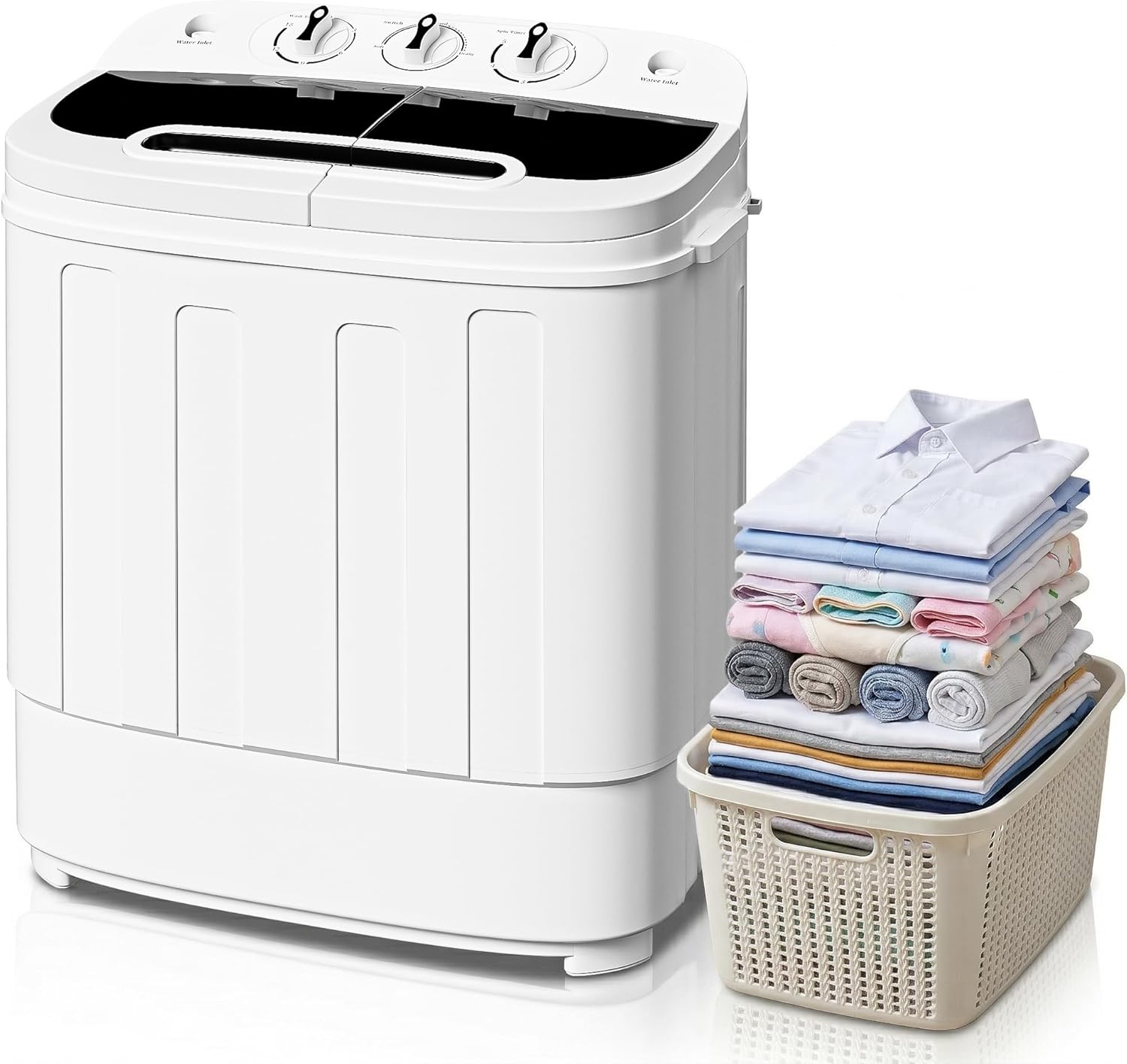
This compact twin-tub washer pairs a small wash drum with a separate spinner so you can wash and spin-dry loads concurrently, which speeds through small batches of laundry. It is semi-automatic with rotary knobs and an LED display, offers a powerful 1300 RPM spin for water extraction, and includes a lint filter and a drain pipe for straightforward draining. Typical use is light household loads, dorm or RV laundry, or as a supplemental machine for quick items — you fill the top, set the wash timer (up to 15 minutes) and either move garments to the spinner or run both at once. The plastic body keeps weight down and prevents rust, and the simple controls make it easy to operate without installation work. Expect limitations for a family of four: capacity is modest and the two-cycle setup requires manual transfer for full cleaning cycles, so it is best as a space-saving backup rather than a full replacement for a standard front- or top-load washer. Energy use is low and the unit is easy to move and store.
Best for: Buyers seeking a low-cost, portable washer for small loads, secondary laundry duty, or use in tight spaces like dorms, RVs, or apartments who prioritize compactness and simplicity.
Less Ideal for: Households that need to wash large weekly loads for multiple people or those who want a fully automatic, hands-off washer for primary family laundry.
- Twin-tub design lets you wash and spin simultaneously to save time on small loads
- 1300 RPM spin provides strong water extraction for faster drying
- Lightweight plastic construction resists rust and is easy to move
- Built-in lint filter and drain pipe simplify maintenance and draining
- 13-liter capacity and separate wash/spin tubs are undersized for large family loads
- Semi-automatic operation requires manual transfer between wash and spin for some cycles
Verdict: Choose this compact twin-tub washer if you want an affordable, portable secondary machine for small, frequent loads and tight spaces.
SPEED QUEEN Home Style Washer

| Capacity | 16 pounds |
|---|---|
| Access Location | Top Load |
| Finish Types | Stainless Steel |
| Cycle Options | Standard, Quick Wash, Spin |
| Display | digital |
The Speed Queen Home Style Digital top-load washer is a straightforward residential machine built around durability and basic, dependable performance. It handles typical family loads with a 16 lb capacity and uses a stainless steel tub, curved 4-vane agitator, and a solid-mount suspension to reduce vibration and wear, while digital push-button controls make cycle selection simple. Typical use is washing everyday clothing, linens, and mixed loads using dispenser options for detergent, fabric softener, and bleach; cycle choices include standard, quick wash, and spin. The practical benefits are its robust construction, minimal electronics, and user-friendly interface that together favor long-term reliability and fewer service needs. Trade-offs are its modest capacity compared with larger family machines and a limited cycle menu for specialty fabrics or heavy-duty cleaning, so it may require more frequent loads or pre-treating for very soiled items.
Best for: Buyers who prioritize a tough, no-nonsense washer that minimizes downtime and maintenance for everyday family laundry.
Less Ideal for: Households that routinely wash very large or bulky items or that need a wide range of specialized cycles for delicate or heavily soiled garments.
- Stainless steel tub and drum material for durability and corrosion resistance
- Solid-mount suspension and 4-vane agitator designed to reduce vibration and mechanical wear
- Simple digital push-button controls that are easy to use and service
- Built-in dispensers for detergent, fabric softener, and bleach
- 16 lb capacity can be small for larger weekly laundry loads
- Limited cycle selection may not suit specialized fabric care needs
Verdict: Choose this Speed Queen washer if you want a compact, well-built top-load machine focused on long-term reliability for everyday family laundry.
BLACK+DECKER 4.5 Cu. Ft. Front Load Washer BFLW45M

| Capacity | 4.5 cubic feet |
|---|---|
| Number of Standard Cycles | 12 |
| Voltage | 120 volts |
| Max Spin Speed | 1300 RPM |
This BLACK+DECKER front-load washer is built for family laundry with a 4.5 cubic foot drum that handles larger loads and a 1300 RPM max spin to reduce drying time. It offers 12 cycles including MyCycle, Bulky/Sheets, Heavy Duty, Delicates, and Baby Care, plus five temperature and spin settings so you can tailor washes to different fabrics. Controls are touch-based with an LED display and a delay-start up to 24 hours, and the MyCycle preset lets you save a frequently used program for one-touch convenience. The washer is ENERGY STAR rated and uses HE detergent, which helps keep operating costs and water use lower than older models. Installation is freestanding on a solid floor and it requires both hot and cold water hookups and a compatible drain. Expect a heavy unit that may need two people to move and standard indoor installation work. For buyers focused on reliability, the machine covers essential cycles and efficiency, though the 1-year limited warranty and lack of integrated smart features may matter to those wanting extended protection or Wi-Fi controls.
Best for: Households that need a reliable, energy-efficient full-size washer that can handle regular family loads and multiple fabric types while prioritizing proven performance over smart features.
Less Ideal for: Buyers who want app control, extended factory protection plans, or who need a compact or stackable washer for tight laundry closets should consider alternatives.
- Spacious 4.5 cu. ft. drum handles full family loads to cut wash frequency
- ENERGY STAR rated for lower energy and water use compared with non-rated models
- 12 specialized cycles including MyCycle for saved custom programs
- 1300 RPM max spin helps shorten drying time
- Touch controls with LED display and 24-hour delay-start for scheduling convenience
- No built-in smart/Wi-Fi features or app integration
- Only a 1-year limited warranty included
Verdict: A roomy, ENERGY STAR front-load washer that reliably handles family-sized loads with useful preset cycles and efficient performance.
Auertech Portable Twin Tub Washer

| Capacity | 40 pounds |
|---|---|
| Operation Mode | Semi Automatic |
| Max Rotational Speed | 1300 rpm |
| Additional Features | drain pump |
This twin-tub portable washer separates washing and spinning so you can wash and spin different loads at once, which saves time for routine family laundry. It is semi-automatic with three knob controls for wash time, spin time and mode, and a 1300 rpm motor that powers the spinner for faster moisture removal. The unit includes inlet and drain hoses plus a drain pump so you can empty water to a higher outlet without manual scooping. Built from polypropylene with transparent lids, the machine is compact enough for apartments, dorms or an RV and requires no permanent installation. Important limitations are its semi-automatic operation and relatively modest stated wash capacity versus a full-size family machine, so you will need to split larger loads and move wet laundry to drying. Expect some vibration and manual hose routing in everyday use, but for households needing a space-saving, water-saving auxiliary washer this model offers straightforward controls and practical features.
Best for: Buyers who prioritize a reliable, space-saving secondary washer for frequent small loads and who prefer simple, familiar controls over full automation.
Less Ideal for: Families that need to wash large weekly loads in a single cycle or who require a fully automatic machine with integrated drying and advanced cycles.
- Separate wash and spin tubs let you wash and spin different loads simultaneously
- Drain pump included for flexible drainage to higher or remote outlets
- Simple knob controls make operation easy for nontechnical users
- 1300 rpm spinner reduces drying time by extracting more water
- Compact, lightweight polypropylene body resists rust and fits small spaces
- Semi-automatic design requires manual intervention to transfer and monitor loads
- Capacity is smaller than full-size family washers so larger loads must be split
Verdict: Choose this compact twin-tub washer if you need a simple, portable solution that separates wash and spin cycles and offers flexible drainage for small-space family laundry.
Choosing the Right Washing Machine for a Family of 4: Key Factors to Consider
Drum Capacity and Load Management
Capacity determines how many garments you can wash in one cycle and directly affects how often you need to run the machine. For a family of four, larger drums reduce the total number of weekly cycles and make it easier to handle bulky items such as bedding or towels. Consider both rated drum volume and recommended load weights; slightly underfilling a larger drum often gives better wash movement and stain removal than stuffing a smaller drum full.
Also evaluate load-sensing features and cycle presets that adjust water and time based on load size. These features help ensure larger drums remain efficient and do not waste water or energy when washing smaller loads.
Cleaning Performance and Cycle Options
Effective soil and stain removal is central for family laundry that includes activewear, food stains, and children's clothing. Look for machines with targeted cycles such as heavy-duty, stain removal, and prewash options. Longer soak or extra-rinse selections can improve results for particularly soiled loads.
Cycle flexibility matters because different garments require different treatments. Gentle or hand-wash equivalents protect delicates, while sanitize or high-temperature options help with bedding and items that need deeper cleaning.
Water and Energy Efficiency
Operating costs add up quickly for a household of four, so efficient water and energy use are critical. Check the machine's cycle-specific water consumption and estimated energy per cycle. High-efficiency designs that use less water per pound of laundry and optimized wash motions typically yield lower utility bills over time.
Also consider features that shorten cycle time without sacrificing cleaning, such as load-sensing, rapid wash presets, and eco modes. These can reduce both energy use and total time spent on laundry.
Durability, Warranty, and Serviceability
A washing machine for a family of four should be built to handle frequent use. Durable components, quality drum materials, and robust suspension systems reduce the chance of premature failure. Look for accessible filter locations, clear error reporting, and straightforward parts access to simplify repairs.
Warranty coverage and the availability of local service technicians affect long-term ownership cost and convenience. Machines that are easier to maintain and repair will spend less time out of service and often cost less to keep running over several years.
Noise, Vibration, and Installation
Household machines often run while family members occupy shared spaces, so low noise and minimal vibration are important for comfort. Anti-vibration designs, balanced drums, and sound-damping enclosures help keep operation quiet, especially during high-speed spins.
Installation factors such as leveling feet, placement clearance, and whether a machine needs a dedicated drain or power circuit can influence where you can install it and how well it performs acoustically.
Cycle Speed and Convenience Features
Convenience features affect how easily a busy household can keep laundry moving. Fast or express cycles let you refresh lightly soiled clothes quickly, while delayed-start and end-of-cycle alerts help you align laundry with your schedule. Features like steam refresh, automatic detergent dispensers, and app connectivity can add convenience but evaluate whether each feature offers meaningful benefit for everyday family use.
Consider how intuitive the controls are and whether common tasks can be performed quickly without navigating deep menus. Simpler, reliable controls may be preferable in a high-use family environment.
Front-Load Vs Top-Load: What Works Best for Families
Both front-load and top-load machines can meet the needs of a family of four, but they differ in practical ways that affect daily use. Front-loaders tend to offer larger effective drum space and better water efficiency, which helps with larger loads and lower utility use. Top-loaders are often easier to load and unload quickly, which can matter when managing kids and frequent small loads.
Think about how you typically sort, move, and fold laundry. If you frequently wash bulky items, a front-loader's drum shape can be advantageous. If quick, frequent loads are the norm and bending is a concern, a top-loader may be more convenient.
- Front-load: usually better water efficiency and spin speed for drier loads
- Top-load: easier access and typically simpler cycle operation
- Consider the footprint and door swing when planning installation
Managing Bulky Loads and Bedding
Families often need to wash towels, duvet covers, and mattress protectors. Look for machines with a bulky or bedding cycle and a drum large enough to allow free movement. Overloading reduces cleaning performance and increases wear on suspension components.
Spin speed influences how much water remains at the end of a cycle; higher spin speeds extract more water and reduce drying time, but check that your chosen machine supports the recommended speeds for bulky items.
- Use bedding cycles or select gentle agitation with longer soak times
- Avoid stuffing bedding into smaller drums; run two loads if needed
Reducing Odors and Mold Risk
Machines used frequently by families can develop odors if detergent residue and damp laundry sit in the drum. Choose models with self-clean or drum-clean cycles and ensure you run a hot-cleaning cycle periodically. Leaving the door slightly ajar after use and wiping accessible seals reduces trapped moisture.
Detergent choice and using the correct amount also help prevent buildup. High-efficiency detergents are important in low-water machines to avoid soap residue that encourages mildew.
- Run a maintenance or drum-clean cycle monthly
- Wipe seals and leave door ajar after cycles when possible
Smart Features That Matter in Real Use
Connectivity and smart controls can add convenience but they vary in usefulness. Useful features include clear cycle status alerts, remote start for scheduling off-peak operation, and diagnostic reporting that can flag common problems before they escalate. App control is helpful when you want to start or monitor cycles from another room.
Avoid prioritizing gimmicky features over core performance. For a busy family, reliability, clear controls, and cycles that match real laundry needs should come before advanced connectivity.
- Remote start and status alerts for convenient scheduling
- Diagnostic reporting for quicker troubleshooting
- Prioritize practical smart features over extras with limited daily benefit
Placement, Venting, and Laundry Workflow
Where you place the machine affects noise perception, access, and how easily laundry moves through your home. A ground-level laundry room with space for sorting and folding reduces trips and speeds the process. If installing in a shared area, consider acoustic isolation pads or positioning that minimizes transmitted vibration.
Plan for detergent and supplies storage close to the machine and ensure clearance for full door swing. For stacked installations, check manufacturer guidelines for combined washer-dryer height and maintenance access.
- Allow clearance for door swing and maintenance access
- Consider an adjacent folding area to streamline routine laundry tasks
How We Chose the Best Washing Machine for a Family of 4
Our selection process centered on features and real-world priorities that matter for a family of four. We prioritized drum capacity and load handling to reduce the number of weekly cycles, along with cycle efficiency measured in wash time, water use, and energy draw. Cleaning effectiveness across common household soils was another core filter, including stain-lift capability and options for sanitizing or heavy-duty cycles. Durability and serviceability were considered by checking build features such as robust drum materials, reinforced suspension, and accessible maintenance points. We also weighed cycle variety and programmability, looking for options that include quick washes, delicates, bulky items, and allergen or sanitizing cycles. Noise and vibration control were included because family laundry often runs during evenings or overnight. We excluded machines that are clearly undersized for a four-person household or that lack key family-friendly cycles. Models with unverified reliability or poor documented serviceability were removed. The final list reflects machines that balance capacity, efficiency, cleaning performance, durability, and user convenience.
Our full evaluation process is outlined in our review methodology.
FAQ
What drum capacity is ideal for a family of four?
A drum capacity that comfortably handles medium-to-large loads is ideal, often in a range that allows washing bedding or multiple towels without overfilling. Aim for a capacity that reduces the number of weekly cycles while still allowing proper agitation and water flow for thorough cleaning.
How often should a family-run machine be serviced?
Regular maintenance includes checking inlet filters and drain filters every few months, running a drum-clean cycle monthly, and inspecting hoses annually. Professional service is usually only needed if you notice leaks, persistent errors, or unusual vibration.
Are high spin speeds important for busy households?
Higher spin speeds can significantly reduce moisture in washed items, cutting drying time and energy use. However, very high speeds may be rougher on delicate fabrics, so choose machines that let you select spin speed by cycle.
Can I run frequent quick cycles without increasing wear?
Occasional quick cycles are convenient for lightly soiled clothes, but constant short cycles can increase mechanical wear compared with fewer full washes. Balance quick cycles with full, properly sized washes for heavier or bulkier loads.
How do I prevent odors in a frequently used machine?
Run periodic hot or drum-clean cycles, use the recommended detergent amounts, and leave the door open after cycles to dry the drum. Wiping seals and removing wet items promptly also reduces the chance of mildew and odors.
Final Verdict
For a family of four, prioritize machines that combine ample drum capacity with robust cleaning cycles and efficient water and energy use. Durable construction and accessible service points reduce downtime and long-term ownership costs, while good noise control and thoughtful convenience features help the machine fit into a busy household routine. Balance capacity against available space and consider how often you want to run laundry when choosing features. Focus on capacity, cleaning performance, and reliability first, then add conveniences like rapid cycles or smart alerts based on your household habits.