
Note: This article contains affiliate links. If you click on these links and make a purchase, we may earn a small commission at no extra cost to you. This helps support our research and content. Read our full affiliate disclosure here.
If you run a laundromat, the washing machines you choose determine throughput, customer satisfaction, and long-term operating cost. Commercial laundry environments demand machines built for heavy, continuous use, with large capacities, robust components, and serviceability that keeps downtime to a minimum. This guide presents seven shortlisted washing machines for laundromats that meet those real-world needs. We screened options for capacity, reliability, ease of service, and energy efficiency so you can pick units suited to your business flow. Read on for the key considerations that separate durable commercial washers from ones that cost more in repairs and lost revenue.
Top Picks at a Glance
| Best Overall The best all-around choice for most situations | WYDDDARY 44lb Commercial Washer Dryer |  |
| Best Quality Built to a higher standard if you want something more solid | Speed Queen Home Style Washer |  |
| Best Value The sweet spot between price and what you get | ROVSUN 30LBS Portable Washing Machine |  |
| Best Budget The cheapest option that still gets the job done reliably | SUPER DEAL Twin Tub Washing Machine |  |
| Top Rated A top-rated pick with lots of positive feedback | COMFEE' Portable Washer CLV24N2AMG |  |
| Most Popular A crowd favorite that many people choose with confidence | Giantex Twin Tub Washing Machine |  |
| Best Seller A high-volume bestseller chosen again and again | Auertech Portable Twin Tub Washer |  |
WYDDDARY 44lb Commercial Washer Dryer

| Capacity | 44 pounds |
|---|---|
| Power | 2.2KW motor |
| Heating power | 6KW |
| Operation Mode | Fully Automatic |
| Controls Type | Touch |
This WYDDDARY industrial unit is a purpose-built 3-in-1 washer that washes, spins, and dries up to 44 pounds of dry clothes per cycle, aimed squarely at commercial laundry use. Its 304 stainless steel drum and shell promise corrosion resistance for heavy daily loads, while a copper-wire variable-frequency motor (2.2 kW) and 6 kW heating element provide strong wash power and faster drying. The full-computer LCD touch panel makes programming straightforward and the belt-drive design keeps operation relatively quiet. The machine also uses a hydraulic and spring suspension system for vibration control and includes safety features such as an emergency stop and a locking tempered-glass door. For laundromat scenarios this model reduces footprint by combining three functions into one cabinet and speeds throughput with large-drum capacity and powerful heating. Trade-offs to consider are its large physical footprint and industrial weight, which require proper floor support and professional installation, and the unit runs on 220V three-phase power so site electrical compatibility must be confirmed.
Best for: Operators who need a single, high-throughput machine for laundromat or commercial laundry rooms and prioritize durability, strong heating, and compact workflow integration.
Less Ideal for: Residential users or small businesses without three-phase power, limited floor load capacity, or those who prefer separate washer and dryer units for flexible scheduling.
- Integrated wash, spin, and dry functions reduce need for separate machines
- 304 stainless steel drum and shell resist rust and chemical corrosion
- Powerful motor and 6 kW heater shorten cycle and drying times
- Advanced suspension and shock absorption for stable floor operation
- Intuitive full-computer LCD touch controls simplify program selection
- Requires 220V three-phase power and substantial floor load capacity
- Large, heavy industrial unit that needs professional installation
Verdict: A robust 3-in-1 commercial washer-dryer built for high-throughput laundromat use where durability, strong heating, and integrated wash-dry cycles matter most.
Speed Queen Home Style Washer

| Capacity | 16 pounds |
|---|---|
| Access Location | Top Load |
| Finish Types | Stainless Steel |
| Cycle Options | Standard, Quick Wash, Spin |
| Display | digital |
The Speed Queen Home Style top-load washer is built around a heavy-duty, no-frills design that focuses on cleaning performance and durability. It uses a curved 4-vane agitator and a stainless steel tub to deliver aggressive mechanical action that removes soil effectively, while a solid mount suspension and automatic controls keep cycles consistent and stable during operation. Typical use is straightforward: load, choose between standard, quick wash, or spin cycles on the push-button digital panel, add detergent, softener, or bleach to the dispenser, and let the machine handle timing. The 16 lb capacity suits frequent, smaller loads common in a laundromat setting that needs quick turnover, and the portable, freestanding installation makes placement flexible. Trade-offs include limited cycle variety compared with high-end models and a top-load agitator design that can be harsher on delicate fabrics. The unit's focus is on reliable cleaning and long-term service rather than advanced laundry features or customization.
Best for: Buyers who prioritize reliable, hard-working washers that deliver consistent cleaning performance and long-term durability for frequent use in a small commercial or high-usage environment.
Less Ideal for: Shoppers seeking gentle, feature-packed machines for large mixed loads or consumers who need many specialty cycles and fabric-care options.
- Stainless steel tub and drum for durability and resistance to wear
- Solid mount suspension reduces vibration for stable operation
- Curved 4-vane agitator delivers strong mechanical cleaning action
- Digital push-button controls make cycle selection simple and repeatable
- Top-load agitator can be rougher on delicate garments
- Limited cycle options compared with feature-rich commercial washers
Verdict: Choose this Speed Queen washer when you need a compact, service-focused top-load machine that consistently delivers strong cleaning and long-term durability.
ROVSUN 30LBS Portable Washing Machine

| Capacity | 30 pounds |
|---|---|
| Voltage | 110 volts |
| Controls Type | Touch |
| Number of Washing Cycles | 8 |
| Wattage | 400 |
The ROVSUN 30LBS portable washing machine is a top-load, full-automatic laundry unit designed to handle large loads in compact spaces. It offers eight wash cycles, eight water levels and a single drying cycle, plus a built-in drain pump for easy water removal; the diamond-pattern stainless steel drum is meant to reduce fabric wear while improving cleaning. Typical use is straightforward: select a program on the touch panel, set water level and delay if needed, then let the machine wash and spin-dry the load—quick cycles can finish in about 26 minutes for light loads. Practical features include a child lock, adjustable feet for stability and a wash memory that resumes after power interruptions. Trade-offs are the single drying cycle and modest 400W power, so very heavy or commercial laundromat throughput expectations will exceed its design; noise is advertised under 60dB for wash and up to 70dB for spin but expect typical portable-machine sound. For apartments, small-scale communal use, or back-up laundry service this washer balances capacity and convenience in a compact footprint.
Best for: Buyers who want a high-capacity portable washer that handles family-sized loads in small spaces and values configurable wash options and easy drain-out setup.
Less Ideal for: Businesses or high-volume laundromats needing industrial throughput or separate, fast commercial-grade drying should choose a commercial washer-dryer instead.
- Large 30 lb (3.0 cu ft) capacity for a portable washer
- Eight wash programs and eight water levels for flexible cleaning
- Stainless steel diamond-pattern drum designed to reduce wear on clothes
- Built-in drain pump simplifies water removal without extra plumbing
- Child lock and adjustable feet improve safety and placement stability
- Only one drying/spin cycle limits drying versatility compared with separate dryers
- 400W power suggests longer cycles or reduced performance on very heavy or bulky loads
Verdict: Choose this if you need a large-capacity portable washer that offers multiple wash programs and an integrated drain pump for convenient, space-saving laundry.
SUPER DEAL Twin Tub Washing Machine
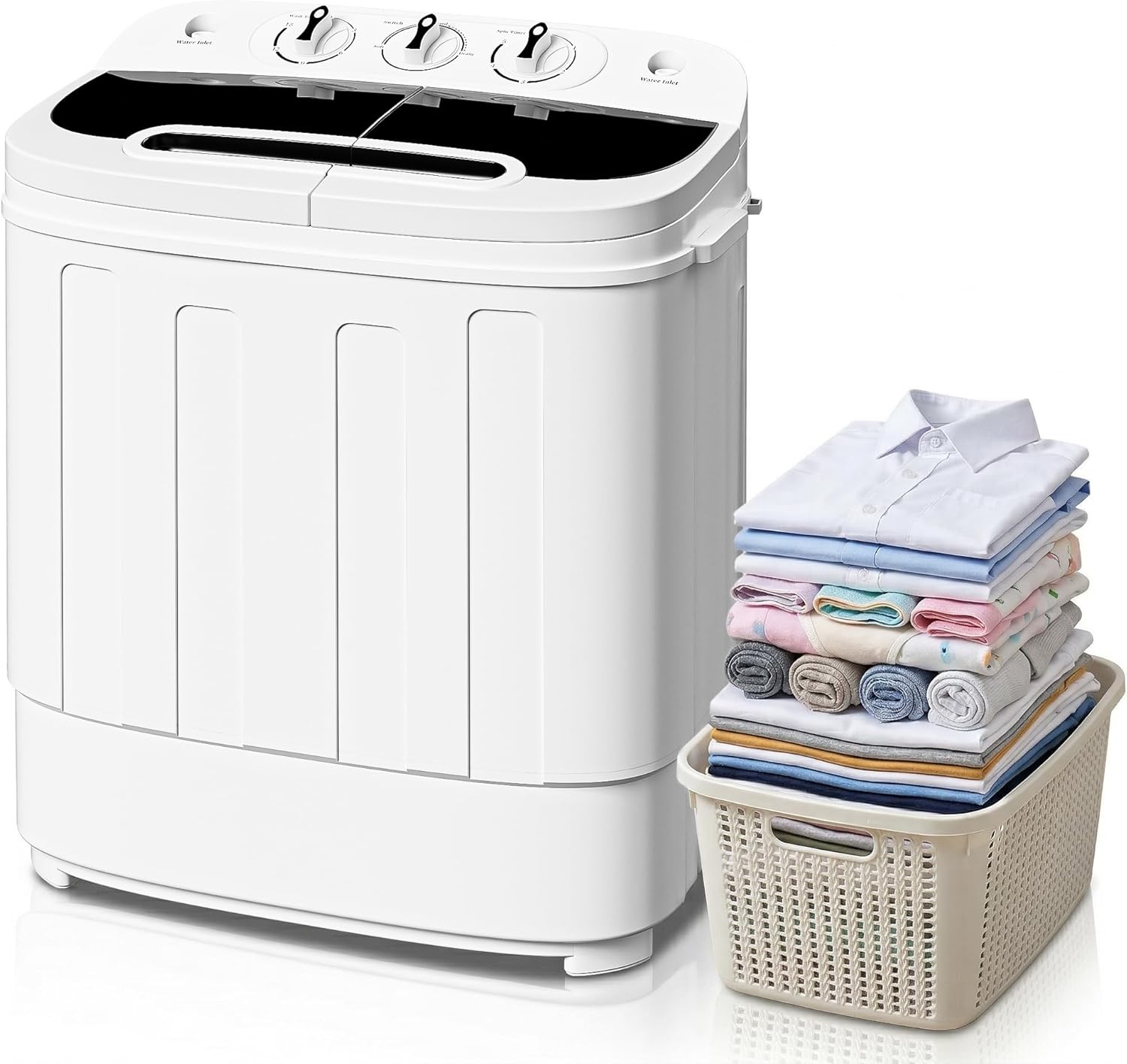
| Capacity | 13 liters |
|---|---|
| Operation Mode | Semi Automatic |
| Max Rotational Speed | 1300 rpm |
| Voltage | 115 volts |
| Cycle Options | Drain, Spin |
This compact twin-tub washer pairs a wash tub and a spinner so you can wash and spin-dry loads at the same time or move items between tubs manually. It is designed for small-space use—dorms, RVs, and apartments—and offers a straightforward experience with rotary knobs, an LED display, and a translucent tub window so you can monitor progress. The 1300 RPM spin delivers fast water extraction for shorter drying time, and the included drain hose and lint filter simplify cleanup. Because it is semi-automatic, you set separate timers for wash (up to 15 minutes) and spin (up to 5 minutes), which gives control but requires a bit more hands-on attention than a fully automatic machine. The plastic body and drum keep the unit lightweight and rust-resistant, but that construction plus the small 13-liter capacity means it is best for light loads rather than large family laundering. Energy-efficient and portable, it handles basic cleaning tasks well but is intentionally minimalist in features and capacity.
Best for: Buyers looking for an inexpensive, portable washer for occasional or light loads who prioritize low cost and space savings over full automation.
Less Ideal for: Do not choose this if you need high-capacity, fully automatic commercial-style laundering or heavy daily loads for multiple people.
- Twin-tub design lets you wash and spin simultaneously to save time
- 1300 RPM spin helps remove more water for quicker drying
- Compact, lightweight plastic body is easy to move and resists rust
- Simple knob controls and LED display make operation straightforward
- Includes lint filter and drain hose for easier maintenance
- Small 13-liter capacity limits load size to light or single-person laundry
- Semi-automatic operation requires manual transfer or monitoring between cycles
Verdict: A budget-friendly, space-saving twin-tub washer that handles light, frequent loads and speeds drying with a high-speed spinner.
COMFEE' Portable Washer CLV24N2AMG

| Capacity | 2.4 cubic feet |
|---|---|
| Operation Mode | Fully Automatic |
| Max Rotational Speed | 780 rpm |
| Noise | 62 db |
| Number of Programs | 8 |
The COMFEE' 2.4 cu ft portable washer is a freestanding top-load machine designed for small spaces like apartments, RVs, and dorms. It offers eight programs, a stainless steel inner drum, and a Turbo Wash mode that increases water flow for faster cleaning, plus a Hygiene+ mode that adds extra rinses for deeper decontamination. Controls are push-button with an LED display and a child lock for safety, and the see-through glass lid and soft-close design make loading and monitoring simple. Practical touches include wheels for moving the unit and an auto-clean feature that helps keep the drum fresh. At 780 rpm spin speed and a reported noise level around 62 db, it balances decent water extraction with moderate sound. The main compromises are its size and weight: while roomy for a portable unit at 2.4 cu ft, it is not built for heavy commercial cycle loads and will be slower than full-size laundromat machines for large baskets of laundry. For everyday residential laundry where space and hygiene matter, it performs reliably and cleanly.
Best for: Buyers who prioritize a dependable, hygiene-focused portable washer for residential or small-space use and value simple, durable controls and easy maintenance.
Less Ideal for: People who need heavy-duty, high-capacity machines for frequent commercial or laundromat-style loads should look at full-size washers instead.
- Generous 2.4 cu ft stainless steel drum suitable for apartment-sized loads
- Multiple programs including Turbo Wash and Hygiene+ for stronger cleaning and extra rinses
- LED display with push-button controls and child lock for simple, safe operation
- Soft-close glass lid and wheels make loading and placement convenient
- Auto-clean feature helps maintain a hygienic drum between uses
- Not intended for high-volume commercial or laundromat throughput
- Moderate noise level around 62 db may be noticeable in very quiet spaces
Verdict: Choose this portable COMFEE' washer if you want a reliable, hygiene-oriented machine that handles apartment-sized loads with practical features for easy home use.
Giantex Twin Tub Washing Machine
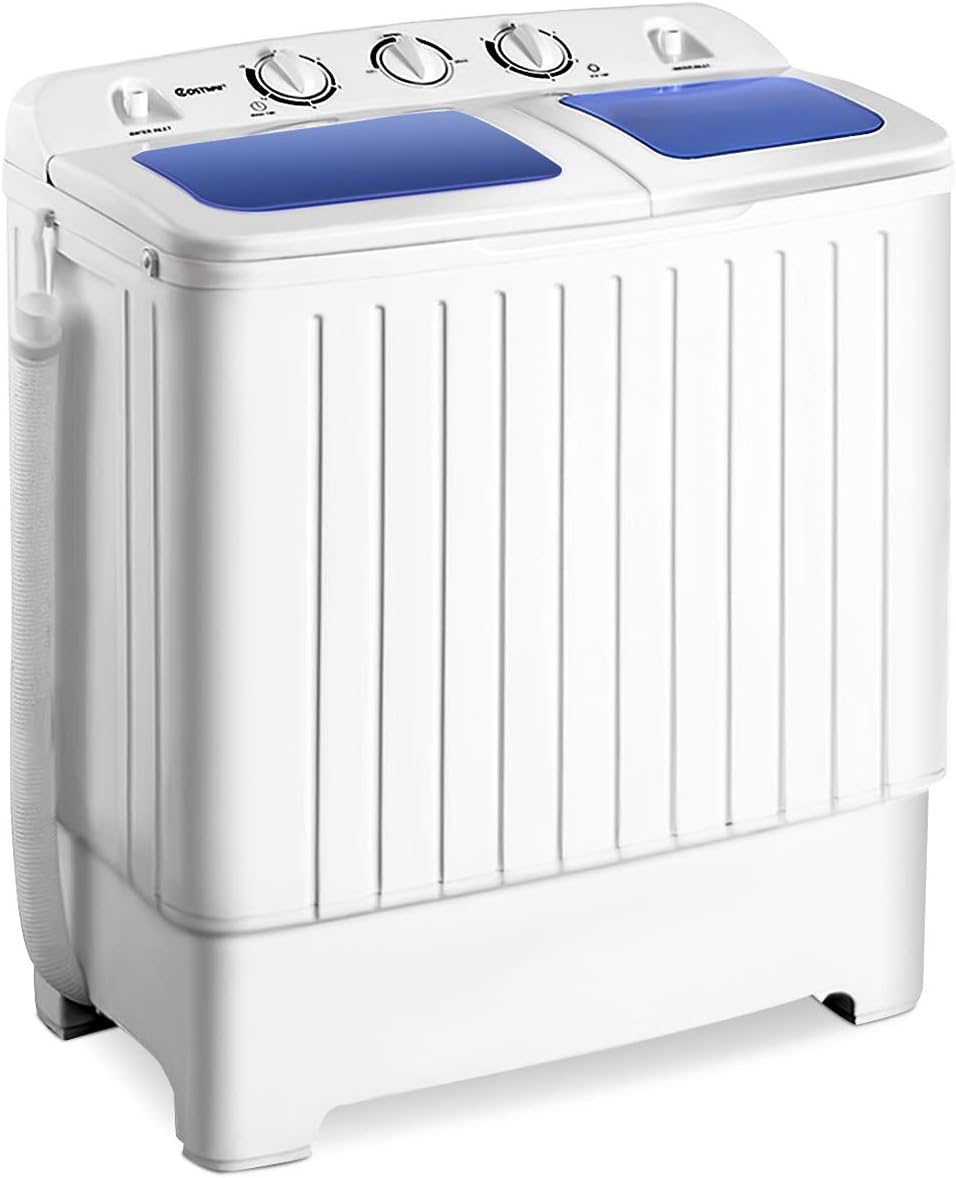
| Capacity | 20 pounds (12 lb wash, 8 lb spin) |
|---|---|
| Wash Power | 300W |
| Spin Power | 110W |
| Spinner RPM | 1350 rpm |
| Voltage | 120 volts |
The Giantex Twin Tub is a semi-automatic portable washer with separate wash and spin tubs that handles small loads without a built-in dryer cycle. You load the washing tub, set the 15-minute washer timer and up to a 5-minute spin, then move clothes into the 8 lb spinner for high-speed moisture removal at up to 1350 RPM; the spinner typically leaves garments 80 to 90 percent dry. It runs on standard 120V power with a 300W wash motor and a 110W spin motor, and includes useful touches like two water inlet holes, a removable lint filter, and a gravity drain hose. The unit is compact and lightweight for apartments, RVs, or dorms and gives you manual control over wash intensity and timing, but it is not a full automatic machine so you must transfer loads between tubs and manage water flow manually. Expect modest capacity meant for small or frequent loads rather than heavy commercial use.
Best for: Buyers who prioritize inexpensive, space-saving laundry for apartments, RVs, or small-scale operations and who prefer manual control over fully automatic machines.
Less Ideal for: Not a good fit for high-volume laundromat use or buyers who need fully automatic, unattended commercial washers that handle large loads.
- Separate wash and spin tubs let you wash and spin concurrently for faster throughput on small loads
- Compact, lightweight design and two inlet options simplify placement near different faucets
- Removable filter net and hang-up drain hose make maintenance and draining straightforward
- Adjustable washer and spin timers provide manual control for delicate fabrics and short cycles
- Semi-automatic operation requires manual transfer of clothes and active supervision during cycles
- Rated capacities are small, so multiple loads are needed for larger households
Verdict: Choose this compact twin-tub if you need a portable, low-cost washer that gives manual control and fast spin-drying for small loads.
Auertech Portable Twin Tub Washer

| Capacity | 40 pounds |
|---|---|
| Operation Mode | Semi Automatic |
| Max Rotational Speed | 1300 rpm |
| Additional Features | drain pump |
| Access Location | Top Load |
This twin-tub portable washer separates washing and spinning so you can run a wash and a spin at the same time, which speeds small loads for apartments, dorms, and RVs. It is semi-automatic with simple dial controls and a 1300 rpm motor that delivers reasonably fast spin cycles; the package includes inlet and drain hoses plus a drain pump for flexible drainage. The polypropylene body and transparent lids keep the unit lightweight and corrosion-resistant, and adjustable wash/spin timers let you tailor cycles for different fabrics. Expect modest convenience rather than full automation: you need to move laundry between tubs and manually set timers, and its control set is basic compared with full automatic machines. The machine is best for occasional or space-constrained use where portability and low water usage matter, but it lacks the advanced cycles, capacity management, and robust build you would want for heavy, frequent commercial-style laundering.
Best for: Buyers who prioritize a compact, portable washer for occasional household loads and need a reliable, low-maintenance unit that saves space and water.
Less Ideal for: Those who need a heavy-duty, fully automatic machine capable of handling continuous high-volume laundromat-style workloads should look at commercial washers instead.
- Separate wash and spin tubs let you wash and spin simultaneously to save time
- Included drain pump and inlet/drain hoses provide flexible drainage options
- 1300 rpm motor gives strong spin performance for faster drying
- Polypropylene body resists rust and keeps the unit relatively lightweight
- Semi-automatic operation requires manual transfer between tubs and manual timer adjustments
- Not designed for heavy, frequent commercial use or large laundromat loads
Verdict: Choose this portable twin-tub if you need a space-saving, rust-resistant washer that handles small, frequent household loads efficiently.
Choosing the Right Washing Machine for Laundromat: Key Factors to Consider
Drum Capacity and Load Type
Capacity determines how many items you can process per cycle and directly affects throughput and customer wait times. Larger drums handle bulkier items and more individual loads, reducing cycle count for equivalent volume.
Different laundromats will have different load mixes, from bedding and towels to mixed small-item customer loads. Choose machines whose capacity and drum geometry match your typical load profiles to avoid under- or overloading, both of which harm cleaning performance and component life.
Commercial-Grade Components
Machines built with heavy-duty bearings, reinforced drums, and industrial motors withstand continuous operation and abuse common in public-use settings. Commercial components resist wear and minimize the frequency of major repairs.
Investing in proven drivetrain and suspension designs reduces unexpected downtime and keeps labor and part costs predictable. Ask about rated duty cycles and expected lifespan under multi-shift operation when evaluating options.
Extraction Efficiency and Cycle Time
High spin speeds and efficient extraction shorten drying time, which improves machine turnover and lowers energy spent in commercial dryers. Faster cycles increase throughput and customer satisfaction when combined with consistent cleaning performance.
Balance extraction with fabric care. Extremely high spin speeds can stress garments and linens. For laundromats, prioritize machines that offer selectable extraction profiles so operators can tailor speeds for different load types while maintaining cycle efficiency.
Serviceability and Parts Availability
Frequent access panels, modular replaceable parts, and clear diagnostic readouts reduce repair time. In a laundromat, faster repairs mean less lost revenue and a lower need for backup capacity.
Confirm local parts distribution and technician familiarity before committing. Machines that allow common repairs without full disassembly greatly reduce labor hours and service costs over the life of the equipment.
Energy and Water Efficiency
Utility costs are a major ongoing expense for laundromats. Machines with efficient water use and optimized wash algorithms lower per-cycle utility consumption and reduce total operating cost.
Consider models with programmable cycles that match load types and supply-side controls that minimize wasted water. Look for clear efficiency metrics and estimate annual utility impact based on your expected cycle volume.
User Interface and Payment Integration
Machines in public spaces must be intuitive for customers and integrate with the payment infrastructure you use. Clear cycle indicators, audible alerts, and straightforward program selection reduce operator intervention and customer confusion.
If you use centralized payment systems, ensure machines support required communication protocols or have compatible retrofit modules. Simpler interfaces also lower the number of support calls and improve the overall customer experience.
Sizing for Peak Demand
Estimate your busiest hour throughput and choose a mix of capacities that meets that peak without excessive queuing. Combining a few large-capacity washers with mid-size units often balances bulk loads and smaller customer loads effectively.
Factor in recovery time between loads. Machines with shorter cycle times allow fewer individual units to handle the same volume compared to slower machines. Also consider space, plumbing, and electrical constraints when planning unit counts.
- Calculate peak loads per hour based on historical foot traffic or expected business.
- Plan for one or two backup machines to cover service downtime.
- Match machine footprints to available floor space and utility routing.
Installation and Utility Considerations
Commercial washers require adequate water supply lines, properly sized drains, and electrical circuits rated for continuous duty. Early coordination with contractors prevents costly rework.
Check floor load limits and vibration isolation needs. Proper anchoring and anti-vibration mounts reduce noise and structural stress in multi-story buildings.
- Verify inlet water pressure and flow for simultaneous operation of multiple machines.
- Confirm drain piping slopes and trap sizes to avoid backups.
- Plan electrical capacity for full simultaneous load plus a buffer.
Maintenance Planning and Downtime Management
Create a maintenance schedule that includes routine inspections of seals, drive belts, bearings, and water valves. Preventive service reduces the chance of sudden failures that force machine removal from service.
Keep a small inventory of high-failure wear parts and maintain relationships with qualified service technicians. Rapid response protocols and on-site spares minimize lost revenue from out-of-service units.
- Log cycle counts and maintenance actions to predict part replacement intervals.
- Train staff on basic diagnostics and safe isolation procedures.
- Establish a preferred vendor for expedited parts delivery.
Laundry Program Selection and Fabric Care
Offer clear program options for different fabric types and soil levels to protect customer items while achieving consistent cleanliness. Programs that allow adjustable water levels and temperature control help tailor cycles for towels, linens, and delicates.
Educate customers through signage about recommended cycles for bulk items versus mixed loads to reduce damage claims and improve results.
- Provide at least three program tiers: heavy, standard, and delicate.
- Use timers or indicators to show remaining cycle time to customers.
- Avoid overly complex controls that lead to misuse in self-service environments.
Managing Operating Costs
Track utility consumption per cycle and calculate cost per pound or per load to understand profitability drivers. Small efficiency gains in water use or shorter cycles add up at commercial scale.
Consider the total cost of ownership, including expected service intervals and parts costs, not just upfront purchase considerations. Machines with slightly higher efficiency and easier maintenance often yield lower long-term operating costs.
- Monitor utility bills against cycle volume monthly to spot efficiency trends.
- Negotiate service agreements that include preventive maintenance.
- Use programmable scheduling to avoid peak utility tariffs where applicable.
How We Chose the Best Washing Machine for Laundromat
We focused on attributes that matter for high-use commercial laundry operations. Our selection filtered for machines designed for continuous cycles and larger-than-residential loads, then prioritized proven durability and serviceability. Key evaluation criteria included drum capacity and load type, commercial-grade drivetrain and motor design, cycle speed and water extraction efficiency, ease and cost of regular maintenance, and energy and water efficiency ratings that affect operating expenses. We excluded residential or semi-commercial units not specified for laundromat or multi-shift operations, machines lacking clear service access, and models with limited parts availability. Each shortlisted machine also needed documented installation flexibility for standard commercial utility hookups and safety features appropriate for public use. The result is a practical list focused on uptime, throughput, and controllable operating costs.
Our full evaluation process is outlined in our review methodology.
FAQ
How large should drum capacity be for a busy laundromat?
It depends on your typical load mix, but commercial laundromats often favor larger drums to handle bedding and bulk items. Estimate peak hourly load and choose capacities that let you clear that volume with a reasonable number of concurrent machines.
What maintenance tasks should be done weekly versus annually?
Weekly checks usually include visual inspection of seals, drains, and hoses plus cleaning door gaskets and lint traps. Annual service should cover bearings, motor mounts, deep inspection of suspension components, and a parts inventory review.
Are higher spin speeds always better for laundromats?
Higher spin speeds reduce drying time and improve throughput, but very high speeds can stress fabrics and the machine. Prefer units with selectable extraction profiles so you can balance fabric care and efficiency.
How important is parts availability when selecting machines?
Very important. Readily available parts and local service expertise minimize downtime. Machines with common, modular parts typically result in faster repairs and lower labor costs.
Can energy-efficient machines reduce operating costs significantly?
Often yes. Reductions in water and energy per cycle scale across thousands of cycles and can meaningfully lower utility expenses. However, calculate expected savings against your cycle volume to assess payback.
Final Verdict
For laundromat owners, prioritize machines that match your peak throughput needs while offering commercial-grade durability and straightforward service access. Balance extraction speed and capacity to keep drying costs manageable without compromising fabric care. Finally, evaluate total cost of ownership by considering efficiency, parts availability, and routine maintenance needs so you choose units that deliver reliable uptime and predictable operating expenses.