
Note: This article contains affiliate links. If you click on these links and make a purchase, we may earn a small commission at no extra cost to you. This helps support our research and content. Read our full affiliate disclosure here.
If you want cleaner drinking water without the bulk and wait time of a reservoir, a water filter without storage delivers on-demand filtration that fits tight countertops and busy routines. These systems pass water through cartridges or membranes as you run the tap or dispenser, so you get fresh-treated water instantly rather than drawing from a stored tank that can sit stagnant. This guide shortlists six top water filter designs that use inline or direct-flow filtration. We evaluated them across factors that matter for daily use, including filtration efficiency, flow rate, installation complexity, and cartridge life. Read on to find the style and features that fit your sink setup and water quality goals, then move to the product list for details on each shortlisted option.
Top Picks at a Glance
| Best Overall The best all-around choice for most situations | iSpring US31 Under-Sink Filter |  |
| Best Quality Built to a higher standard if you want something more solid | Waterdrop G3P600 Tankless RO |  |
| Best Value The sweet spot between price and what you get | Waterdrop WD-15UA Under-Sink Filter |  |
| Best Budget The cheapest option that still gets the job done reliably | Amazon Basics Under-Sink Water Filter |  |
| Top Rated A top-rated pick with lots of positive feedback | iSpring CU-A4 Ultra-Filtration |  |
| Most Popular A crowd favorite that many people choose with confidence | Camco TastePure RV Water Filter |  |
iSpring US31 Under-Sink Filter

| Purification Method | 3 Stage (PP, GAC, CTO) |
|---|---|
| Maximum Flow Rate | 1 gpm |
| Filter Life Cycle | 6-12 months |
| Capacity | 10000 gallons |
| Upper Temperature Rating | 100 °F |
The iSpring US31 is a 3-stage under-sink filtration system designed for point-of-use drinking water with a brushed-nickel faucet and above-counter install option for easier mounting. It uses a sediment prefilter, granular activated carbon, and a CTO carbon block to cut chlorine, odors, and many chemical contaminants while preserving dissolved minerals and not lowering TDS. With a rated flow of 1 gpm it fills glasses and pots quickly compared with pitcher-style filters, and the clear first-stage housing makes visual checks of the sediment filter straightforward. Filters are advertised to last 6 to 12 months depending on water quality, which keeps maintenance simple but does require periodic replacements. The system runs on water pressure alone so no electricity is needed, and it includes housings, tubing, faucet, and mounting hardware for DIY installation if your feed pressure is within the 30 to 70 psi range. It does not remove total dissolved solids or replace a reverse-osmosis unit for heavy mineral or scale concerns, and larger installations may need a different capacity.
Best for: Buyers who want a reliable under-sink filter that balances good contaminant reduction with fast, on-demand water delivery and straightforward DIY installation and maintenance.
Less Ideal for: Users who need significant TDS reduction, heavy mineral removal, or near-complete deionization should choose a reverse-osmosis system instead.
- Three-stage filtration (PP sediment, GAC, CTO) that reduces chlorine, sediment, and odors
- 1 gallon per minute flow rate for on-demand filling and cooking use
- Above-counter-friendly faucet mounting simplifies installation
- Clear first-stage housing allows quick visual inspection of sediment buildup
- Does not lower TDS or act as a reverse-osmosis system for dissolved mineral removal
Verdict: A balanced, fast under-sink 3-stage filter ideal for buyers who want clear-tasting, low-chlorine water without a storage tank or electricity.
Waterdrop G3P600 Tankless RO
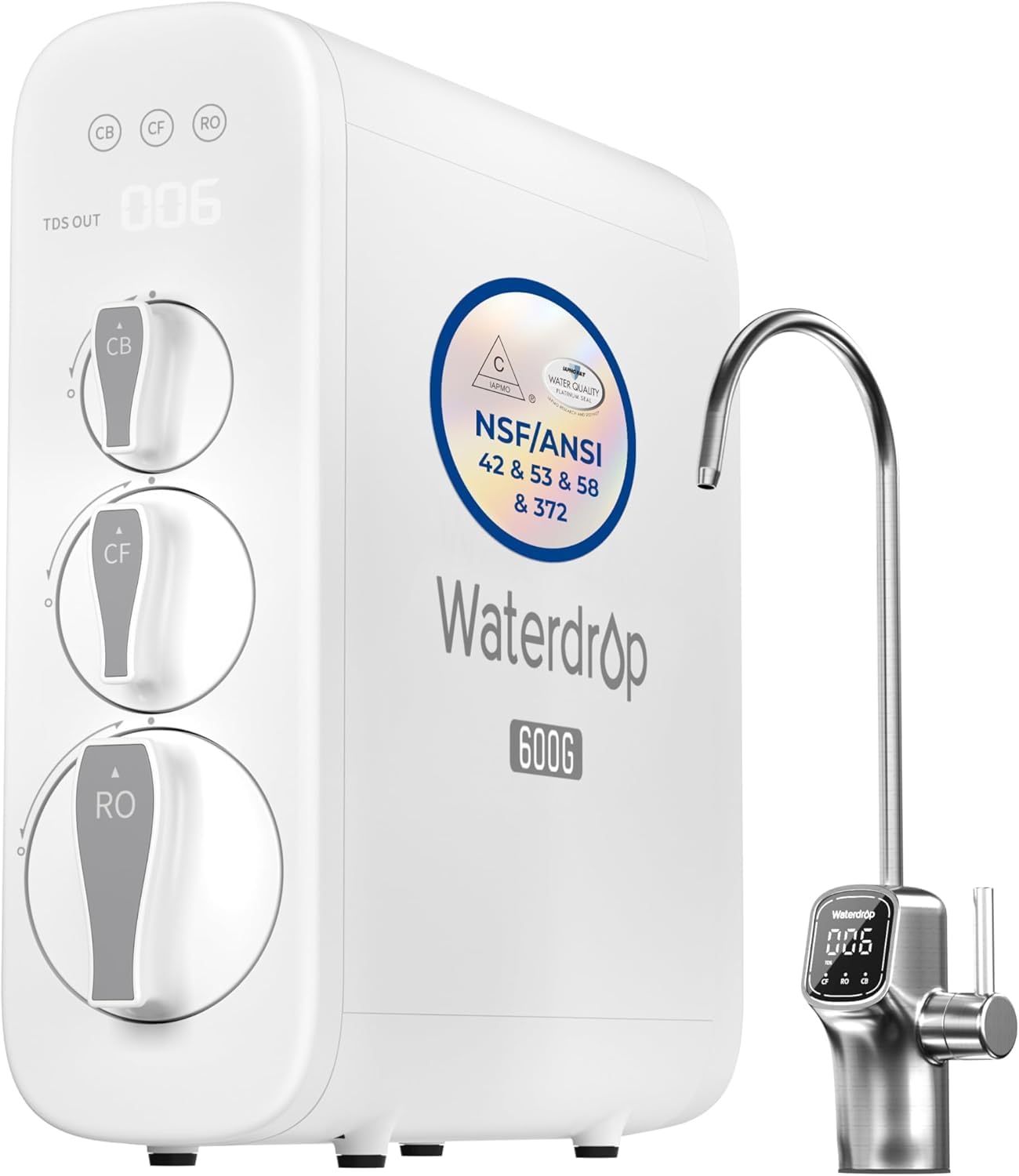
| Filtration stages | 8-stage Filtration |
|---|---|
| Flow rate | 600 GPD |
| Pure to drain ratio | 2:1 |
| Purification method | Carbon Block, Reverse Osmosis |
| Power source | Corded Electric |
The Waterdrop G3P600 is a tankless reverse osmosis system designed for high-flow, point-of-use drinking water without an under-sink storage tank. It uses an 8-stage filter train including a carbon block and RO membrane to remove common contaminants such as chlorine, heavy metals, fluoride, PFAS and particulates, and its smart faucet shows TDS and filter life so you can monitor performance. The unit produces up to 600 gallons per day with a claimed 2:1 pure-to-drain ratio and can fill an 8 oz cup in about eight seconds, making it practical for frequent drinking and prep use. Tankless construction frees up under-sink space and the cartridge twist-change design simplifies filter swaps. The system requires a plug-in power source and under-sink clearance for the unit and faucet drilling, and while the 2:1 ratio is efficient compared with many RO units, it still produces some waste water and needs periodic membrane replacement to maintain high TDS reduction performance.
Best for: Buyers who prioritize fast, high-capacity RO performance and real-time water-quality feedback and want a tankless under-sink solution that frees cabinet space.
Less Ideal for: People who cannot provide an under-sink electrical outlet or who prefer a zero-waste or whole-house treatment solution should consider alternatives.
- High output capacity up to 600 GPD for fast, on-demand purified water
- 8-stage filtration that targets chlorine, heavy metals, fluoride, PFAS and particulates
- Smart faucet with TDS readout and filter-life indicators for real-time performance monitoring
- Tankless design saves under-sink space and allows quick, tool-free filter changes
- Requires under-sink electrical power and two drilled holes for installation
- Still generates waste water despite an improved 2:1 pure-to-drain ratio
Verdict: Choose the G3P600 if you want tankless, high-output RO water with smart TDS monitoring for frequent drinking and kitchen use.
Waterdrop WD-15UA Under-Sink Filter
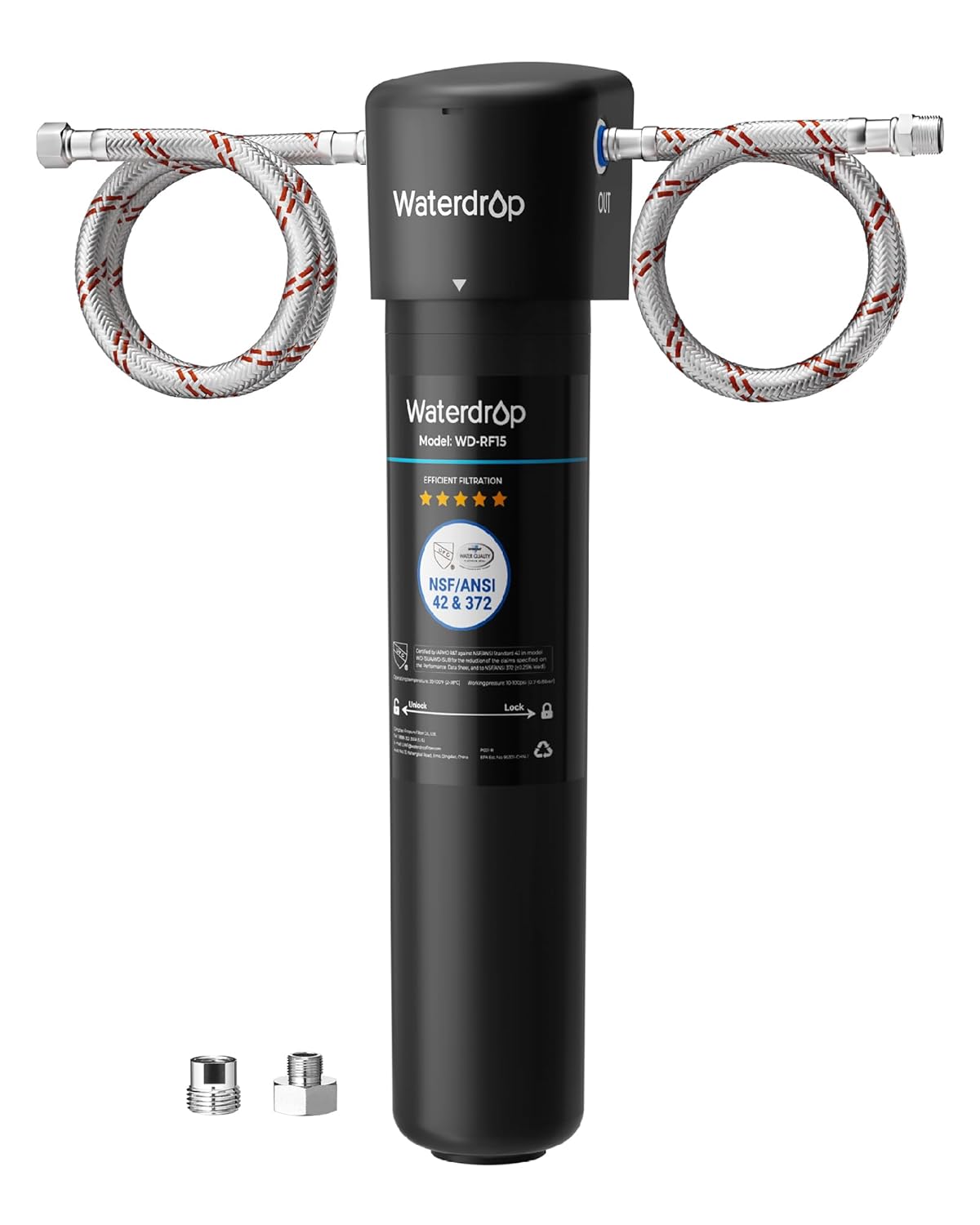
| Purification Method | Activated Carbon |
|---|---|
| Capacity | 19000 gallons |
| Filter Life Cycle | 24 months |
| Maximum Flow Rate | 0.75 gpm |
| Power Source | Mechanical Water Pressure |
The Waterdrop WD-15UA is an under-sink activated carbon filtration system that connects directly to cold water lines and delivers filtered tap water without a storage tank. It is built for easy DIY installation with push-to-connect fittings and includes adapters for 3/8" and 1/2" lines, so it typically fits standard kitchen or RV setups. Notable features include a long service life rated up to 19,000 gallons or 24 months with municipal water, NSF/IAPMO certifications for chlorine and lead reduction, and a tested flow rate of about 0.75 gallons per minute at 60 psi for steady faucet performance. The filter uses coconut-shell activated carbon and a larger filtration area intended to reduce clogging and prolong usable life. Practical benefits are simpler maintenance because the cartridge swaps quickly and the system retains beneficial minerals while removing unwanted contaminants. Limitations are that it is intended for cold municipal water only, is not suitable for well or hot water, and requires checking under-sink clearance due to the larger cartridge size.
Best for: Buyers who want a low-maintenance, tankless under-sink filter that delivers steady filtered water and long cartridge life with a simple DIY install.
Less Ideal for: Those with well water, hot-water filtration needs, or very limited under-sink space should consider other systems tailored to those conditions.
- Long rated service life up to 19,000 gallons or 24 months with municipal water
- NSF/IAPMO certifications for chlorine and lead reduction
- Push-to-connect direct-attach installation with 3/8"–1/2" adapter for fast DIY setup
- Maintains essential minerals while reducing taste, odor, and common contaminants
- Steady flow rate around 0.75 gpm for regular faucet use without a tank
- Designed for cold municipal water only and not suitable for well or hot water
- Larger cartridge size may require verifying under-sink clearance before purchase
Verdict: Choose this tankless under-sink filter if you want certified contaminant reduction with long cartridge life and a straightforward, fast DIY install.
Amazon Basics Under-Sink Water Filter

| Installation Type | Under Sink |
|---|---|
| Purification Method | Activated Carbon |
| Capacity | 11000 gallons |
| Supported Water TDS Level Maximum (PPM) | 500 |
This Amazon Basics under-sink water filter is a straightforward, budget-focused option for improving tap water taste and odor. It uses an activated carbon block and is certified to NSF/ANSI 42 and 372 standards, and the system connects directly to standard 3/8" or 1/2" cold water lines with included fittings. Installation is simple thanks to a twist-and-lock housing and push-to-connect fittings, letting most DIYers mount it under the sink in minutes without a wrench-heavy plumbing job. The cartridge is rated for up to 11,000 gallons or about 12 months of typical household municipal water use, which keeps replacement frequency low. Because it is a manual, inline under-sink unit there is no storage tank, so you get filtered water at the tap without extra under-sink bulk. Limitations are its focus on chlorine, taste, and odor removal rather than broader contaminant reduction, and it requires cold-water only operation and periodic cartridge replacement to maintain performance.
Best for: Buyers who want an inexpensive, no-tank under-sink solution to improve drinking water taste and odor with easy DIY installation and low annual maintenance.
Less Ideal for: Homes needing broad-spectrum contaminant protection, well water treatment, or certified reduction of metals and microbes should consider a more advanced filtration system.
- NSF/ANSI 42 and 372 certified for chlorine, taste, and odor reduction
- Twist-and-lock housing with push-to-connect fittings enables quick DIY installation
- High service life rated at 11,000 gallons or 12 months per cartridge
- Includes adapters and hoses for direct connection to common 3/8" and 1/2" feed lines
- Only designed for basic contaminant reduction, not for heavy metal or microbiological removal
Verdict: A simple, cost-conscious under-sink filter that delivers NSF-certified chlorine and taste improvement without a storage tank or complicated installation.
iSpring CU-A4 Ultra-Filtration

| Filtration stages | 4-stage (Sediment, Ultrafiltration, KDF/GAC, Carbon) |
|---|---|
| Membrane pore size | 0.01 μm |
| Capacity | 8000 gallons |
| Filter life cycle | 6 months |
The iSpring CU-A4 is a tankless under-sink water filter that combines a 4-stage filtration stack—sediment, ultrafiltration membrane (0.01 μm), KDF/GAC, and activated carbon—to deliver filtered drinking water without producing wastewater or needing a storage tank. It installs under the sink and feeds a dedicated brushed-nickel faucet, and push-to-connect fittings plus twist-on/twist-off cartridges make setup and filter changes straightforward. The ultrafiltration membrane removes very fine particles and many bacteria and cysts while the KDF/GAC and carbon stages reduce chlorine, chloramine byproducts, heavy metals and odors, so water tastes and smells noticeably better for drinking and coffee. Filters are rated for roughly 6 to 12 months depending on use and source water, and the system is rated for about 8,000 gallons capacity. Because it is not reverse osmosis it preserves beneficial minerals and does not reduce TDS. If you want a compact, low-maintenance, reliable tankless option for consistent point-of-use drinking water, the CU-A4 is a practical choice.
Best for: Buyers who prioritize a compact, dependable point-of-use system that delivers high-quality drinking water without a storage tank and with minimal maintenance.
Less Ideal for: People who need to significantly lower TDS or want the highest possible contaminant rejection that only reverse osmosis systems provide.
- Tankless design produces no wastewater and saves under-sink space
- 0.01 μm ultrafiltration membrane removes very fine particles and microorganisms
- Multi-stage stack (KDF/GAC + carbon) reduces chlorine, heavy metals, odors and chloramine byproducts
- Push-to-connect fittings and twist-on cartridges simplify installation and filter changes
- Not a reverse osmosis system so it does not reduce total dissolved solids
- Filter life varies with source water and may require replacements every 6 to 12 months
Verdict: A compact, tankless 4-stage ultrafiltration system that delivers reliable, low-maintenance drinking water without wastewater.
Camco TastePure RV Water Filter

| Model Number | 40043 |
|---|---|
| Included Components | Adapter |
| Material Type | Polypropylene (PP) |
| External Testing Certification | NSF/ANSI 42, NSF/ANSI 53, NSF/ANSI 372 |
The Camco TastePure RV Water Filter is an inline, no-storage water filter designed for campers and boats that connects directly to a standard garden or drinking water hose. It combines granular activated carbon and KDF media with a 20-micron sediment stage to cut chlorine taste and odor, trap silt, and inhibit bacterial and mold growth when the filter is idle. The filter's wide-body, high-flow design maintains good water pressure for filling tanks, drinking, or showering, and the included flexible hose protector reduces kinks and strain at the connection. NSF/ANSI 42, 53, and 372 listings and its made-in-USA construction give extra confidence for health-sensitive users. Expect periodic replacement cartridges and some flow reduction compared with an unfiltered hose, and the filter is intended for temporary inline use rather than permanent plumbing integration. For travelers who want tested, on-demand filtration without a holding tank, this unit is a practical, easy-to-install choice.
Best for: Buyers who prioritize independently tested filtration and social-proof reliability for on-the-road drinking water and want an easy, tool-free inline solution for camping, boating, or gardening.
Less Ideal for: People seeking a permanent home plumbing filter, a tank-style stored-water system, or the absolute highest flow rates without any pressure drop should look elsewhere.
- NSF/ANSI 42 and 53 certified for reduction of taste, odor, chlorine, and some contaminants
- High-flow wide-body design preserves usable water pressure for filling and showers
- Includes flexible hose protector to prevent kinks and reduce strain on fittings
- Made in the USA construction with KDF plus GAC media for combined chemical and bacterial control
- Will reduce flow compared with an unfiltered hose and requires periodic cartridge replacement
- Not designed as a permanent inline plumbing fixture for long-term installation
Verdict: A tested, easy-to-install inline filter that delivers better-tasting, lower-chlorine water for RVs and boats without any storage tank.
Choosing the Right Water Filter Without Storage: Key Factors to Consider
Filtration Performance and Contaminant Range
How thoroughly a direct-flow water filter removes contaminants is the single most important factor. Different cartridges and membranes target different pollutants such as chlorine taste and odor, lead, VOCs, cysts, and sediment. A filter that only reduces chlorine may improve taste but will not protect against heavy metals or microbial particles.
Understanding the specific contaminants in your supply helps you choose the right technology, whether activated carbon, specialty media, or a fine membrane. Check independent test claims or certifications where available, and prioritize filters that clearly list reduction percentages or the classes of contaminants they handle.
Flow Rate and Real-World Delivery
Flow rate determines how quickly treated water is available on demand and affects tasks like filling a pot or running a refrigerator dispenser. Because systems without storage treat water as it flows, the internal restriction created by the cartridge or membrane directly impacts flow. Some designs deliver near-tap speed, while finer membranes slow water substantially.
Consider how you use filtered water daily. If you frequently fill large containers or use a dedicated filtered tap, prioritize higher flow ratings. If you mostly want drinking water and are willing to wait a little longer for finer filtration, a slower but more thorough system may be acceptable.
Installation Complexity and Plumbing Requirements
Direct-flow filters vary from simple faucet-mounted units to under-sink assemblies that require a dedicated faucet and some plumbing work. Ease of installation affects whether you can fit the system yourself or need a plumber. Look at the connection types—threaded faucet adapters, quick-connect fittings, or hard-plumbed lines—and whether an adapter for your sink is included.
Also check physical footprint and hose routing. An under-sink direct-flow filter needs space for the cartridge and room to change it. If you rent or prefer a no-modification setup, choose models designed for tool-free installation or faucet-mount options that connect without altering existing plumbing.
Cartridge Life and Replacement Ease
Because filtration happens during flow, cartridge capacity and replacement frequency directly affect ongoing maintenance. Short-lived cartridges increase long-term cost and inconvenience, while long-life cartridges reduce the number of service interruptions. Some manufacturers rate life by gallons, others by months under typical household use.
Consider how easy it is to buy and replace cartridges: look for tool-free twist-and-lock elements, clear end-of-life indicators, and widely available replacement parts. Also factor in whether the cartridge media is designed for single-use or offers scalable options for different contaminant loads.
Materials, Durability, and Certification
Materials used in housings, fittings, and cartridges affect longevity and safety. Food-grade plastics and corrosion-resistant metals are preferable in contact with potable water. Durable construction supports higher operating pressures and reduces the risk of leaks at connections.
Third-party certifications or test data can confirm performance claims and materials safety. While not every direct-flow filter will have full certification, documented test results and clear materials information help validate longevity and health-related claims.
Maintenance Footprint and Operational Noise
Maintenance footprint covers everything you do to keep the system operating smoothly: flushing, cartridge swaps, and occasional faucet or hose cleaning. Systems that require frequent flushing or that have complex purge procedures will demand more active involvement.
Operational noise is usually modest but can be noticeable when flow is restricted by fine media. If the filter is installed near frequently used areas, make sure the design does not produce high-pitched or vibrating noises during normal use. Lower-maintenance and quieter units are generally better for busy kitchens.
Types of Direct-Flow Water Filters
Direct-flow filters come in several practical formats: faucet-mount adapters, inline filters that attach to the cold-water line, and dedicated under-sink units with a separate tap. Each form factor balances convenience, appearance, and filtration capability differently.
Faucet-mounted units are the simplest to fit and ideal for renters or minimal-install situations. Inline filters are discreet and can serve multiple fixtures with proper plumbing. Under-sink direct-flow systems usually offer the broadest contaminant coverage but require a small dedicated faucet and enough cabinet space.
- Faucet-mounted: Tool-free, compact, best for quick taste improvements.
- Inline: Hidden installation, can feed a single appliance or tap.
- Under-sink direct-flow: Higher filtration potential, dedicated tap required.
Matching Filter Media to Your Water Concerns
Not all filter media treat the same contaminants. Activated carbon excels at removing chlorine, organic compounds, and improving taste and odor. Granular or block carbon formats also affect flow and capacity. For heavy metals or fluoride, look for media specifically formulated for those elements.
Membrane technologies such as ultrafiltration or microfiltration remove very small particles and some microbial risks. These membranes can reduce flow rate but offer a different protection level than carbon alone. Choose a media that aligns with your water quality goals rather than assuming one type fits all.
- Activated carbon: Good for taste, odors, and many organic chemicals.
- Specialty media: Targeted reduction of lead, mercury, or fluoride.
- Membranes: Small-particle and microbial reduction, often slower flow.
Practical Installation Tips
Before buying, measure under-sink space, note the cold-water shutoff location, and check whether your faucet uses a removable aerator or has room for a separate filtered faucet. If your sink lacks a dedicated hole for a third faucet, faucet-mount or inline options may be preferable.
When installing, use the included adapters and verify all connections for leaks at low pressure before returning to full use. Keep replacement cartridges and a basic wrench or quick-connect tool on hand for future swaps. If you are unsure about cutting or soldering supply lines, consult a professional to avoid damage.
- Measure cabinet depth and clearance for cartridge swaps.
- Turn off the water supply and relieve pressure before connecting.
- Test for leaks at low pressure, then run water to flush new cartridges.
Maintenance Routines That Keep Performance Consistent
Develop a calendar for cartridge replacement based on either gallons filtered or months in service. Mark your expected replacement date when you install a new cartridge to avoid performance drop-offs. Some households may need more frequent changes if source water is heavily treated or sediment-laden.
Regular flushing after installation and after long idle periods reduces biofilm or stagnant water issues. Inspect fittings and hoses periodically for wear or mineral buildup and replace any components that show cracking or persistent leaks. Simple preventative care keeps flow steady and maintains contaminant reduction levels.
- Replace cartridges per gallon or month rating, whichever comes first.
- Flush new cartridges for the manufacturer-recommended time before use.
- Inspect fittings and hoses every 6 months for wear or mineral buildup.
When On-Demand Filtration Is Not Ideal
On-demand filters are excellent for immediate access but are not always the best choice for applications that need large volumes of filtered water quickly, such as filling large pitchers repeatedly or serving events. In those cases, systems with storage tanks or pitchers may be more convenient.
Also, if you need the absolute highest level of multi-contaminant reduction for laboratory-style needs, stackable systems that include multiple stages or larger membranes may be necessary. For most household drinking and cooking uses, direct-flow systems hit the right balance of convenience and performance.
- Not ideal for quickly producing large filtered volumes.
- May offer less multi-stage reduction than larger or tanked systems.
- Better suited for daily drinking and cooking needs rather than bulk dispensing.
How We Chose the Best Water Filter Without Storage
We focused on systems that provide direct-flow filtration without any internal storage tank. Editorial filters excluded any product that relies on a reservoir or pressurized storage container. We prioritized real-world decision criteria that affect everyday use and long-term ownership. Our primary evaluation criteria were measurable and relevant to on-demand systems: filtration performance, which reflects the range of contaminants removed and the reduction rates claimed; flow rate, because one main advantage of no-storage filters is immediate delivery; installation complexity, covering required tools, fittings, and compatibility with standard sinks; and cartridge life and replacement simplicity, which determine ongoing hassle and cost. We also considered build quality and materials for durability and NSF/third-party verification where available. Finally, we removed options that only offered minimal particulate reduction or that required extensive plumbing modifications, since those do not suit most buyers seeking straightforward, storage-free filtration.
Our full evaluation process is outlined in our review methodology.
FAQ
How long do cartridges typically last in a direct-flow filter?
Cartridge life usually ranges from a few hundred to several thousand gallons, or from three to 12 months, depending on usage and source water quality. Heavier sediment or higher contaminant loads shorten life, so monitor flow and taste changes as indicators.
Will a filter without storage slow down my water flow a lot?
It depends on the media and design. Fine membranes and dense carbon blocks reduce flow more than coarser media. Many direct-flow units are engineered for near-tap flow, but extremely fine filtration will typically reduce speed and may produce some noise.
Can I install a direct-flow filter myself?
Many faucet-mount and quick-connect inline units are designed for tool-free or basic DIY installation. Under-sink direct-flow systems that require a dedicated faucet may need drilling or modifications if no extra port exists, and some buyers hire a plumber for hard-plumbed setups.
Are on-demand filters effective against lead and heavy metals?
Some direct-flow filters include media specifically rated to reduce lead and other heavy metals. Look for explicit reduction claims and third-party test data. Not all carbon-only filters will reliably remove heavy metals, so verify the cartridge's targeted contaminant list.
Do I need to flush a new cartridge before use?
Yes. Flushing new cartridges removes manufacturing dust and primes the media for proper flow and filtration. Follow the recommended flush volume and time in the product instructions to avoid taste issues and ensure peak performance.
Final Verdict
For most homeowners who want instant access to filtered drinking water without the space or maintenance of a storage tank, direct-flow filters are a practical choice. Prioritize filtration performance and flow rate based on whether you value faster delivery or finer contaminant reduction. Also weigh installation constraints and cartridge lifecycle to avoid surprises after purchase. Choose the configuration that matches your sink layout and daily usage patterns. If you need steady, immediate delivery for regular drinking and cooking, pick a higher-flow direct-flow option. If your main concern is removing a specific contaminant, select a cartridge media rated for that substance even if it sacrifices some flow.