
Note: This article contains affiliate links. If you click on these links and make a purchase, we may earn a small commission at no extra cost to you. This helps support our research and content. Read our full affiliate disclosure here.
If your home struggles with rusty stains, discolored fixtures, or metallic-tasting water, a properly chosen whole-house water filter for iron water can make a big difference. The right system protects plumbing and appliances, improves water appearance and taste, and reduces the need for frequent softener or appliance repairs. This guide shortlists seven top-performing whole-house water filters for iron-laden supplies and explains the practical tradeoffs you should consider. Below we evaluate each shortlisted system on capacity, iron removal effectiveness, and ongoing maintenance so you can match a solution to your household size and water chemistry.
Top Picks at a Glance
| Best Overall The best all-around choice for most situations | PRO+AQUA Elite Series PRO-100-E |  |
| Best Quality Built to a higher standard if you want something more solid | DuraWater Air Injection Iron Eater 1.0 cu ft |  |
| Best Value The sweet spot between price and what you get | Waterdrop WHF21-PG Whole House Filter |  |
| Best Budget The cheapest option that still gets the job done reliably | PUREPLUS 1-Stage Whole House Filter |  |
| Top Rated A top-rated pick with lots of positive feedback | iSpring WGB32B 3-Stage Whole House Filter |  |
| Most Popular A crowd favorite that many people choose with confidence | iSpring WGB32BM 3-Stage Whole House Filter |  |
| Best Seller A high-volume bestseller chosen again and again | A. O. Smith AO-WH-Filter |  |
PRO+AQUA Elite Series PRO-100-E

| Maximum Flow Rate | 15 gpm |
|---|---|
| Operating Pressure Range | 80 psi |
| Supported Water TDS Level Maximum (PPM) | 500 |
| Filter Life Cycle | 6 months |
| Material Type | Coconut Granulated Carbon |
The PRO+AQUA Elite Series PRO-100-E is a three-stage whole-house filter meant to sit at the main water line and deliver filtered water to every outlet in small to medium homes. It uses a clear sediment stage to trap rust and dirt, a proprietary CRK media stage aimed at reducing iron, hydrogen sulfide and dissolved heavy metals, and an activated coconut shell carbon stage to cut chlorine, VOCs and bad tastes or odors. Stainless steel pressure gauges make it easy to monitor differential pressure and know when to replace the cartridges, and the manufacturer recommends filter change roughly every six months for best flow and performance. The system is built with commercial-style fittings and 1 inch ports to support typical household plumbing flow without backwash or chemical regeneration, so maintenance is limited to swapping filter cartridges. It will not reduce TDS and is sized for homes with 1 to 3 bathrooms, so larger households or properties with very high iron loads may need a higher-capacity or backwashing iron removal system.
Best for: Buyers who want a straightforward, low-maintenance whole-house filter that noticeably reduces iron odor and common chemical tastes throughout a small to medium home and prefer equipment they can visually monitor and service.
Less Ideal for: Homes with very high iron concentrations, those needing water softening, or large properties requiring higher gpm capacity or an automated backwash iron-removal system should consider more specialized solutions.
- Three-stage design targeting sediment, iron/hydrogen sulfide/heavy metals, and chemical/taste contaminants.
- Clear first-stage housing for quick visual checks of sediment buildup.
- Stainless steel pressure gauges for easy monitoring of filter life and flow issues.
- No regeneration, backwash, or chemicals required so routine maintenance is limited to cartridge changes.
- Not designed to reduce total dissolved solids so it will not soften water or lower TDS.
- Recommended capacity and flow target small to medium homes so very large households may outgrow it.
Verdict: A simple, serviceable three-stage whole-house filter that reduces iron odor and common contaminants with minimal maintenance, ideal for small to medium homes.
DuraWater Air Injection Iron Eater 1.0 cu ft

| Filter media volume | 1.0 cu ft |
|---|---|
| Tank size | 10 x 54 inches |
| Included bypass | 1 inch plastic |
| Control | Digital control valve |
This DuraWater Air Injection Iron Eater is a whole-house treatment package built to oxidize and filter iron, manganese, and hydrogen sulfide using air injection media in a 10×54 inch mineral tank. The kit ships as a complete system with 1.0 cu ft of filter media, a 1-inch plastic bypass, and a digital control valve so it can be plumbed inline with a pressure tank or well system. In use the air pocket formed by the media helps convert dissolved iron and manganese to particulate form so the tank can trap and remove them, and the digital valve simplifies backwash timing compared with manual setups. Benefits include a factory-matched media volume and control valve that reduce sourcing headaches and a DIY-friendly installation path for homeowners with basic plumbing skills. Limitations are that it is a tank-based, single-media iron filter so it relies on regular backwashing and eventual media replacement, and the listed package does not include detailed flow rate or warranty information so sizing to high-flow households needs checking before purchase.
Best for: Buyers prioritizing strong iron and sulfur removal who want a ready-to-install, tank-based solution they can plumb themselves and configure via a digital valve.
Less Ideal for: Those who need guaranteed high flow rates for very large houses or who prefer cartridge-based point-of-use options should consider other systems.
- Complete kit with 1.0 cu ft media plus 10×54 in mineral tank and control valve for easier installation
- Air injection oxidation helps convert dissolved iron and manganese into filterable particles
- Digital control valve automates backwash cycles and reduces manual maintenance
- Includes a 1-inch bypass for straightforward plumbing and isolation during service
- No published flow rate or capacity specs included for sizing high-demand homes
- Media will require periodic replacement and the system depends on regular backwashing
Verdict: Choose this kit if you want a performance-focused, air-injection whole-house iron filter that arrives as a ready matched tank, media, bypass, and digital valve for straightforward installation.
Waterdrop WHF21-PG Whole House Filter

| Purification Method | Granular Activated Carbon, Sedimentation |
|---|---|
| Maximum Flow Rate | 15 gpm |
| Operating Pressure Range | 25 psi |
| Upper Temperature Rating | 100 °F |
| Filter Life Cycle | 6 months |
The Waterdrop WHF21-PG is a compact two-stage whole-house system built around a 10" x 4.5" polypropylene sediment cartridge and a granular activated carbon (GAC) cartridge that together deliver practical, everyday filtration for municipal tap water. It is installed inline at the main water supply and maintains flow up to 15 gpm while targeting sediment, chlorine, taste and certain heavy metals. The GAC uses coconut-shell carbon to improve taste and odor, and the system passed extensive water-hammer testing for stable operation under normal household pressure. Cartridges are user-replaceable with the included wrench and the manufacturer recommends changing the GAC roughly every six months and the PP filter every 3–6 months depending on water quality. The unit does not require power, keeps plumbing protection in mind, and is sized for easy DIY installation, but it is not designed specifically for high-iron well water and will not remove dissolved iron or manganese effectively without an additional iron-specific stage.
Best for: Buyers who want an affordable, easy-to-install whole-house filter to cut chlorine, sediment and bad taste on municipal water and who prioritize stable flow and simple cartridge maintenance.
Less Ideal for: Homes with high dissolved iron or manganese levels that need oxidizing or dedicated iron-removal media should choose a system specifically designed for iron treatment instead.
- Two-stage PP and GAC combination reduces sediment, chlorine, taste and odor
- Supports up to 15 gpm flow suitable for typical household demand
- No electricity required and compact housing enables DIY installation
- Coconut-shell GAC improves water taste and targets certain heavy metals
- Not specified to remove dissolved iron or manganese effectively by itself
Verdict: A straightforward, DIY-friendly whole-house two-stage filter that reliably improves taste and cuts sediment for municipal water but is not a substitute for an iron-specific treatment system.
PUREPLUS 1-Stage Whole House Filter
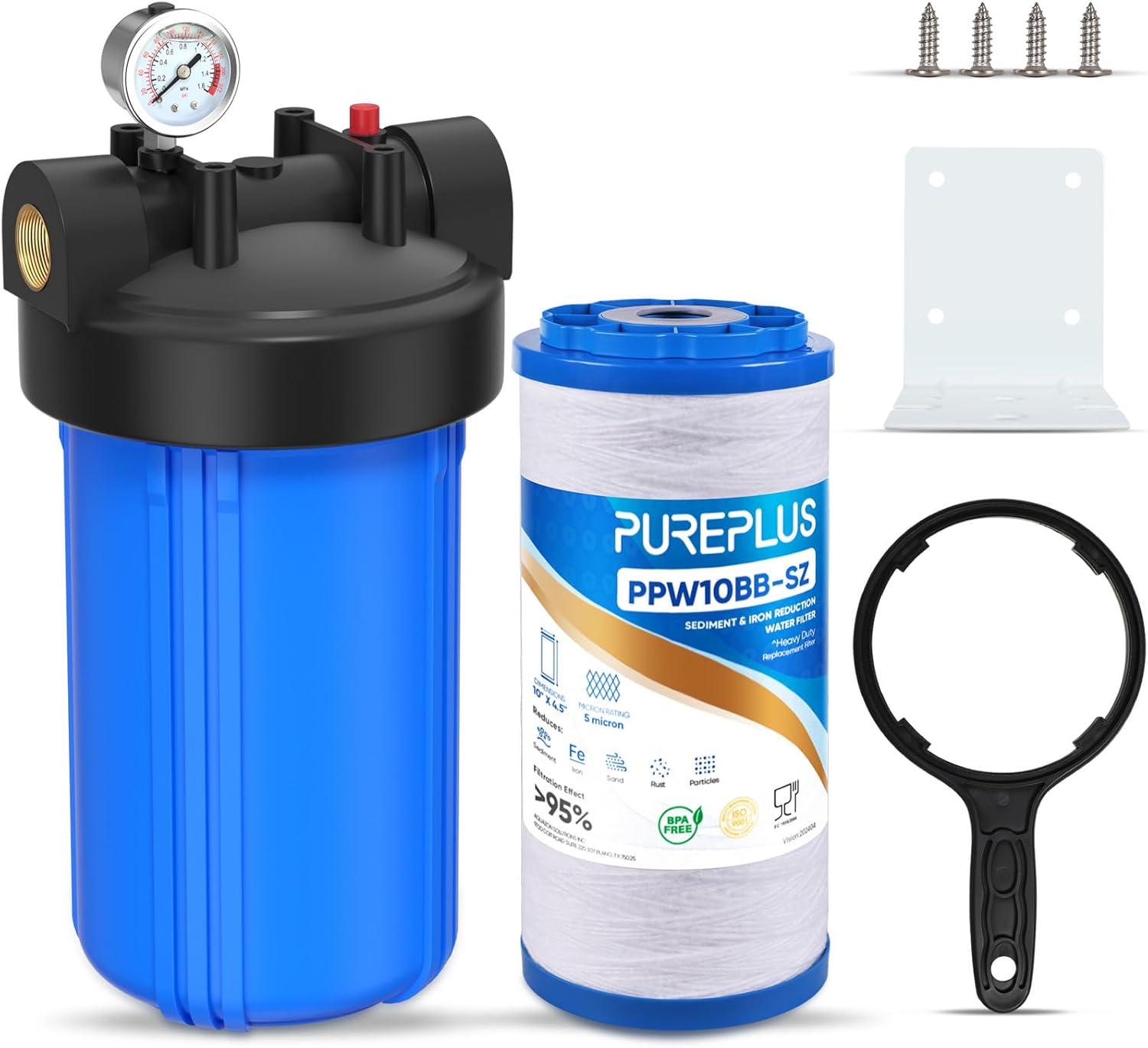
| Filter size | 10"x4.5" |
|---|---|
| Purification method | Sedimentation, Iron Removal |
| Upper temperature rating | 100 °F |
| Supported Water TDS Level Maximum (PPM) | 500 |
The PUREPLUS 1-stage whole-house unit is a budget-friendly pre-filtration housing sold with a composite cartridge intended for well water. It accepts standard 10"x4.5" cartridges, includes a wrench, mounting bracket, pressure relief valve and pressure gauges so you can install it at the main line and monitor flow pressure. The cartridge media targets sediment and iron/manganese reduction, which helps protect downstream appliances and improves water clarity and taste. Because it is a single-stage system the unit is simple to maintain and cartridge changes are straightforward once pressure is released with the red valve. Expect solid flow rates for normal household use, but heavy iron loads will exhaust a single cartridge faster than multi-stage systems, so more frequent replacement may be necessary. The housing is made from food-grade polypropylene and rated for typical home temperatures up to 100°F, making it a durable basic solution for iron-prone well water without the complexity of larger systems.
Best for: Buyers on a tight budget who need a straightforward whole-house filter to reduce visible iron and sediment from well water and who prefer an easy DIY install and low upfront cost.
Less Ideal for: Homes with very high iron concentrations or users who want certified multi-stage removal of chlorine, VOCs, or dissolved metals without frequent cartridge swaps should consider more advanced systems.
- Fits standard 10"x4.5" cartridges for easy replacement and wide media choice
- Includes installation tools, mounting bracket and pressure gauges for straightforward setup
- Composite cartridge formulated to reduce sediment and iron/manganese for well water protection
- Durable food-grade polypropylene housing rated to 100°F
- Single-stage filtration may require frequent cartridge changes under high iron concentrations
- Not a certified multi-stage system for broad contaminant removal beyond sediment and iron
Verdict: A cost-conscious, easy-to-install single-stage housing that gives basic iron and sediment reduction for well water using standard replaceable 10"x4.5" cartridges.
iSpring WGB32B 3-Stage Whole House Filter

| Maximum Flow Rate | 15 gpm |
|---|---|
| Operating Pressure Range | 25 – 80 psi |
| Operating Temperature | 40 – 100 °F |
| Supported Water TDS Level Maximum (PPM) | 300 |
| Filter Life Cycle | Up to 100,000 gallons / ~12 months |
The iSpring WGB32B is a tankless, 3-stage whole-house filter built around a 20×4.5-inch big blue sediment cartridge followed by two coconut-shell carbon block filters for chemical and chlorine reduction. It is installed on the main line and is intended to deliver treated water to every tap while maintaining strong flow up to 15 gpm, so it is practical for multi-fixture households and light commercial use. The first stage traps sand, rust, and larger particulates down to about 5 microns, which protects the downstream carbon stages and household plumbing. The carbon blocks are lab-tested for chlorine removal and improve taste and odor without stripping dissolved minerals. The system is pressure-driven and DIY-friendly with a 1-inch female NPT inlet/outlet and clear replacement guidance; filters are rated for up to 100,000 gallons or roughly 12 months under typical conditions. Important limits: the WGB32B does not soften water or remove dissolved iron in ferrous form or very fine particulates below the sediment rating, so homes with heavy iron or hardness should plan a pre- or post-treatment step. Expect annual filter replacement and a moderate physical footprint during installation.
Best for: Buyers who prioritize dependable, whole-house chlorine and sediment removal and want a factory-quality, pressure-driven system that preserves water flow across multiple fixtures.
Less Ideal for: Homes with significant dissolved iron, severe hardness, or manganese issues that require water softening or iron-specific treatment should consider dedicated iron removal systems instead.
- Three-stage setup with a big-blue sediment prefilter plus two carbon block stages for thorough chlorine, taste, and odor reduction.
- Rated flow up to 15 gpm supports multi-fixture homes and maintains household water pressure.
- Cartridges use coconut-shell carbon with lab-tested chlorine removal for reliable contaminant reduction.
- DIY-friendly design with 1" female NPT connections and included wrench and manual for in-home installation.
- High rated capacity up to 100,000 gallons or about 12 months between replacements under typical conditions.
- Does not reduce water hardness or remove dissolved iron, so additional water softening or iron-specific treatment is needed for iron-heavy supplies.
- Physical unit is sizable and requires indoor, sheltered installation and space for servicing.
- Filter lifespan depends on incoming water quality so heavy sediment can shorten cartridge life significantly.
Verdict: Choose the iSpring WGB32B when you need a reliable, high-flow whole-house system to remove chlorine, sediment, and bad tastes while keeping steady household water pressure.
iSpring WGB32BM 3-Stage Whole House Filter
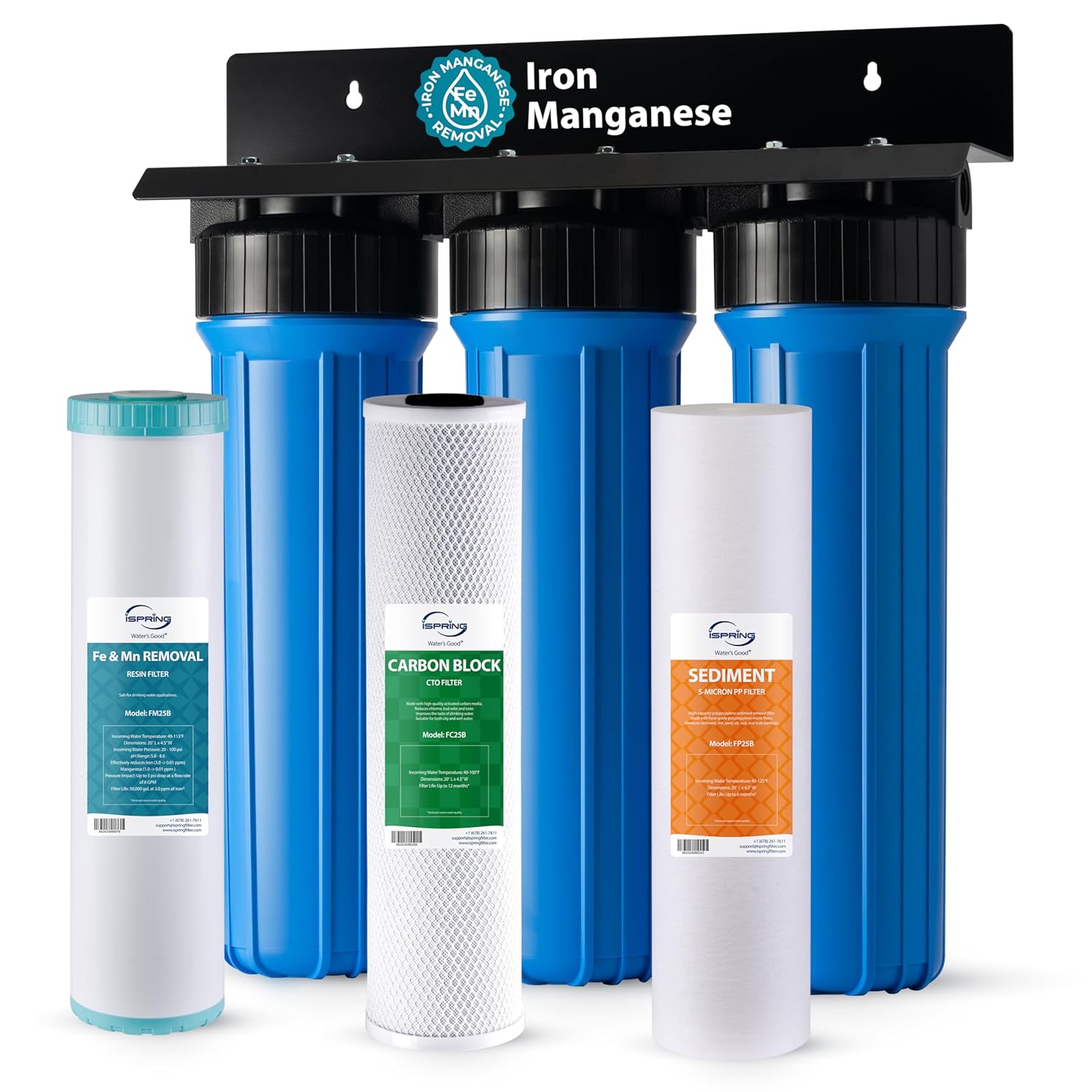
| Maximum Flow Rate | 15 gpm |
|---|---|
| Operating Pressure Range | 25 – 80 psi |
| Operating Temperature | 40 – 100 °F |
| Inlet / Outlet | 1 inch NPT |
| Capacity | 100000 gallons |
The iSpring WGB32BM is a tankless, 3-stage whole-house filter built to remove sediment, chlorine, and low-to-moderate iron and manganese from municipal or well water before it reaches fixtures and appliances. It uses a big-blue polypropylene sediment stage, a coconut-shell carbon block stage for chlorine, taste and odor, and a catalytic iron/manganese stage rated to reduce iron from up to 3.0 ppm and manganese up to 1.0 ppm. The unit supports flows up to 15 GPM and is intended for permanent installation on a 1-inch inlet/outlet main line; the manufacturer provides replacement cartridge part numbers and DIY installation guidance. Practical benefits include high capacity (up to 100,000 gallons or about 12 months for some cartridges), minimal pressure loss at normal household flows, and fewer service intervals compared with single-stage alternatives. Important limits are that it does not soften water or remove dissolved solids, and it is not recommended for iron or manganese levels above the stated maxima, so homes with very high concentrations will need a specialized iron treatment or preconditioning.
Best for: Buyers who want a proven, high-capacity whole-house filter to reduce modest iron and manganese plus chlorine and sediment across all fixtures while relying on documented performance and manufacturer support.
Less Ideal for: Homes with very high iron or manganese levels or users seeking a water softening solution should look at specialized iron removal systems or add a softener before this filter.
- Three-stage filtration targets sediment, chlorine/taste/odor, and iron/manganese for whole-house protection
- High cartridge capacity rated up to 100,000 gallons or about 12 months for carbon and sediment stages
- Supports up to 15 gpm peak flow with minimal pressure loss suitable for typical household plumbing
- Includes replacement part references and DIY-friendly installation guidance with a wrench included
- Does not reduce water hardness or total dissolved solids
- Not intended for iron above 3.0 ppm or manganese above 1.0 ppm
Verdict: A high-capacity, three-stage whole-house filter built specifically to cut modest iron and manganese along with chlorine and sediment for reliable year-long protection.
A. O. Smith AO-WH-Filter

| Purification Method | Activated Carbon |
|---|---|
| Other Special Features | Chlorine Reduction, NSF/ANSI 42 Certified |
| Maximum Flow Rate | 7 gpm |
| Operating Pressure Range | 20-100 psi |
| Filter Life Cycle | 6 years |
The AO-WH-Filter is a single-tank whole-house activated carbon system intended to reduce chlorine taste and odor across every tap in the home. It installs inline on the main water supply and is supplied with a shut-off valve, nipple and hose adapter to support a DIY install for homeowners comfortable with basic plumbing tools. The key selling point is long service life: the carbon media is rated for about 600,000 gallons or six years under typical use, and the system is NSF/ANSI 42 certified for chlorine reduction. It handles up to 7 gpm and works with city or well water but does not soften water or remove iron, sulfur, or TDS, so it should be paired with additional treatment if those contaminants are present. Built from fiberglass with a manual operation design and a 6-year limited warranty, the unit offers low maintenance for buyers who prioritize reliable chlorine removal and long intervals between cartridge changes.
Best for: Homeowners who want a low-maintenance, factory-quality whole-house chlorine filter that minimizes upkeep and provides long service life without hiring a pro.
Less Ideal for: Homes with iron, significant sulfur odor, or hard water that need iron removal or water softening; those households should consider dedicated iron filters or softeners instead.
- NSF/ANSI 42 certified to reduce chlorine taste and odor
- Long service life rated at 600,000 gallons or about six years
- Supplied hardware and DIY-friendly installation for homeowners
- Handles up to 7 gallons per minute suitable for typical household flow
- Fiberglass tank construction with a 6-year limited warranty
- Does not remove iron, hardness, sulfur, or reduce TDS
- No active softening or scale removal functionality
Verdict: Choose this AO Smith whole-house carbon filter if you want a long-lasting, low-maintenance system that reliably removes chlorine taste and odor from every tap.
Choosing the Right Whole-House Water Filter for Iron Water: Key Factors to Consider
Iron Type and Concentration
Iron appears in water in two primary forms: clear soluble iron (ferrous) and suspended particulate iron (ferric or iron oxide). Knowing which form dominates your supply changes which media and system design will work best. For example, soluble iron often responds to oxidation followed by filtration, while particulate iron may only need sediment filtration and mechanical removal.
Measure total iron concentration using a lab test or DIY kit before buying. Higher concentrations require larger-capacity media or an oxidizing pretreatment stage to avoid rapid media fouling. Estimating iron load helps size the system so media life and backwash frequency remain manageable for your household.
System Capacity and Media Life
Capacity is the volume of water a system can treat before backwash or media replacement is required. A higher-capacity unit reduces maintenance frequency and operating hassles for busy households. Published capacity figures are usually tied to specific iron concentrations and should be adjusted upward if your iron levels are higher than the test conditions.
Consider media life in terms of both gallons and time. Media designed for iron removal can become exhausted or clogged faster than standard sediment filters. Look for systems with replaceable media or easy-to-service tanks so you can refresh the media without complex plumbing work.
Flow Rate and Household Demand
Whole-house systems must maintain adequate flow for simultaneous uses such as showers, laundry, and kitchen fixtures. A system with low peak flow capability can cause pressure drops when demand spikes. Check the system's peak and continuous flow rates and compare them to your household's typical simultaneous fixture usage.
Homes with larger families or multiple bathrooms often need higher flow capacity and larger filter tanks. If flow is a concern, prioritize systems that specify minimal pressure loss at realistic flow rates and that are sized for the number of bedrooms or expected gallons-per-minute use.
Maintenance Needs and Backwash Requirements
Different iron-removal technologies have different upkeep patterns. Mechanical sediment filters typically need cartridge changes, while media-based iron filters require scheduled backwashes or periodic media replacement. Systems with automatic backwash valves reduce hands-on maintenance but need a reliable drain and power source.
Consider access when placing the system. Units that need frequent manual interventions should sit where you can reach them safely. Factor in the availability of replacement media or specialized parts in your region to avoid long downtime.
Installation and Plumbing Compatibility
Whole-house installations require plumbing connections at the main water line and sufficient space for tanks and valves. Verify that the system's inlet/outlet sizes match your home plumbing or be prepared to fit adapters and possibly hire a professional for proper installation. Some systems require a dedicated drain for backwash or a nearby electrical outlet for timer valves.
also check for cold-climate considerations. If your utility area experiences freezing conditions, locate the system indoors or in an insulated enclosure to prevent damage during winter months.
Water Chemistry and Pre/Post Treatment
Iron rarely exists in isolation; manganese, hydrogen sulfide, hardness minerals, and pH levels influence which treatment approach will be effective. For example, certain oxidizing filters perform poorly at low pH or with high manganese without auxiliary treatment. Testing for a broad panel of parameters gives a clearer picture of required pretreatment.
Plan for post-treatment if needed. After iron removal, you may still want a carbon filter to improve taste or a softener if hardness causes scale. Ensuring the whole treatment train is compatible prevents one system from undermining another and extends overall equipment life.
How Iron Affects Home Plumbing and Appliances
Iron in water can form rust deposits that discolor fixtures, stain laundry, and abrade valves and pumps over time. Particulate iron settles in low-flow areas and can accumulate inside water heaters and softener tanks, accelerating wear and reducing efficiency.
Addressing iron at the point of entry protects the entire plumbing system by keeping solids and oxidized particles out of pipes and appliances. A whole-house filter reduces staining and can reduce cleaning frequency for fixtures and textiles.
- Particulate iron causes visible rust flocs and can be trapped by sediment filtration.
- Dissolved iron often requires oxidation before filtration.
- Left untreated, iron accelerates corrosion and increases maintenance on pumps and valves.
Common Iron Removal Technologies
There are several practical methods used to remove iron at the whole-house level. Mechanical sediment filtration captures visible particles but will not remove dissolved iron. Oxidizing media convert soluble iron into particulates that can then be filtered out. Other approaches combine catalytic media with oxygenation or chlorination steps to precipitate iron for removal.
Each method has tradeoffs in complexity, maintenance, and effectiveness depending on water chemistry. Selecting the right technology depends on whether your iron is mostly dissolved or particulate and whether you have other contaminants that require simultaneous treatment.
- Sediment filters: good for particulate iron and protecting downstream equipment.
- Oxidizing media: convert dissolved iron into filterable solids.
- Catalytic media and aeration: often used for consistent removal without chemical feed.
Sizing a Whole-House Filter System
Proper sizing balances daily water use and the system's rated capacity. Estimate your peak simultaneous demand in gallons per minute and choose a system whose continuous and peak flow specs meet or exceed that rate. Oversizing avoids pressure loss during busy periods but increases upfront footprint and sometimes cost.
Also size media and backwash cycles to the measured iron concentration so media exhaustion does not occur prematurely. If in doubt, choose the next size up for households with variable demand or higher-than-expected iron loads.
- Calculate household peak flow from fixture usage.
- Match media capacity to measured iron concentration.
- Allow space for maintenance access and drain connections.
Placement, Drain, and Electrical Considerations
Whole-house filters need a stable, level location with access to the main water line and a drain for backwash cycles if the system uses automatic regeneration. Some systems also require a 120V outlet for control valves or timers. Preparing these utilities before installation saves time and avoids do-overs.
If you live where freezing is possible, install the system inside heated space or provide insulation. Make sure the system location allows easy media replacement or cartridge swaps without dismantling surrounding plumbing.
- Confirm drain location and capacity for backwash flows.
- Provide electrical access when needed for timers or control valves.
- Locate the system in a frost-free, accessible area for service.
Maintenance Tips to Extend System Life
Follow the manufacturer-recommended backwash and media replacement intervals. Regularly inspect inlet strainers and prefilters to prevent premature fouling of media beds. Keep a simple log of backwash cycles and any changes in water appearance to catch degrading performance early.
Use replacement parts specified for your system, and avoid makeshift repairs that can introduce air or leak paths. For complex systems, schedule an annual check to verify valve timing, media condition, and pressure differentials across stages.
- Keep spare cartridges or basic media on hand for timely swaps.
- Monitor water clarity and odor as early warning signs.
- Document maintenance to support consistent long-term performance.
How We Chose the Best Whole-House Water Filter for Iron Water
Our shortlist focused on systems designed specifically to address dissolved and particulate iron in municipal and well supplies. We prioritized units with documented iron-removal mechanisms, measured capacity, and clear regeneration or backwash procedures suitable for residential plumbing. Performance criteria emphasized iron removal efficiency across a range of concentrations, total filtration capacity before media replacement, and the presence of prefiltration or sediment stages that protect downstream plumbing. We also weighed flow rate and pressure drop to ensure systems meet typical household demand without frequent throttling, and we reviewed the clarity of maintenance requirements, such as media change intervals, backwash frequency, and access for DIY servicing. Durability of housings and valves was considered to reduce long-term service calls. Systems that only addressed taste but not iron solids, or those with unclear service needs, were excluded. The resulting picks balance removal effectiveness, reasonable upkeep, and whole-home flow performance.
Our full evaluation process is outlined in our review methodology.
FAQ
How do I tell whether my iron is dissolved or particulate?
A clear glass test can be telling: dissolved iron often leaves water clear when drawn and then forms red-brown stains after exposure to air, while particulate iron appears as visible flakes or cloudiness immediately. For precise determination and concentration, use a lab test or comprehensive water test kit.
Will a whole-house filter for iron remove hardness too?
Not necessarily. Iron-specific filters focus on iron removal and may not address calcium and magnesium that cause hardness. If hardness is a concern, plan for a separate water softener or a combined treatment strategy designed for both issues.
How often do iron media beds need replacement or service?
Maintenance frequency depends on iron concentration and system design. Some media require media replacement every few years, while others rely on periodic backwash to maintain function. Expect more frequent service with higher iron loads and monitor differential pressure to time interventions.
Can I install a whole-house iron filter myself?
DIY installation is possible for experienced homeowners comfortable with plumbing and electrical hookups, but many installations benefit from a professional to ensure correct piping, drain tie-ins, and valve programming. Mistakes can affect flow rates and void warranties.
Do iron filters need a drain line?
Yes for most automatic backwash systems. Backwash cycles require a drain to remove flushed iron and media fines. Passive or cartridge-based systems that do not backwash may not need a drain but require more frequent cartridge changes.
Final Verdict
When choosing a whole-house water filter for iron water, match the technology to the iron type and measured concentration, size the system for your household flow demands, and prioritize a system with clear maintenance procedures. Balance capacity against space and backwash requirements so upkeep stays manageable. Focus on reliable iron removal efficiency, sufficient flow capacity, and accessible maintenance. That approach helps you pick a solution that protects plumbing and improves water clarity and taste without frequent intervention.