
Note: This article contains affiliate links. If you click on these links and make a purchase, we may earn a small commission at no extra cost to you. This helps support our research and content. Read our full affiliate disclosure here.
If your home relies on a private well, the right well water filter protects your household from sediment, bacteria, and chemical contaminants while keeping plumbing and appliances safe. Choosing the correct system matters because well water quality varies widely by location and by how the source is used. This guide shortlists the top well water filters for common household needs and explains the tradeoffs between sediment, chemical, and biological filtration. We evaluated systems for filtration effectiveness, ease of maintenance, and long-term reliability. Read on for quick guidance on which types of filters suit different well conditions and what to expect in everyday use.
Top Picks at a Glance
| Best Overall The best all-around choice for most situations | Ziwshom Whole House 3-Stage Filter |  |
| Best Quality Built to a higher standard if you want something more solid | Aquasana Rhino Well Water WH-WELL-CT-UVS |  |
| Best Value The sweet spot between price and what you get | Membrane Solutions 20 Micron Pleated 10" |  |
| Best Budget The cheapest option that still gets the job done reliably | AquaWeaver 5 Micron 10" x 2.5" Filter |  |
| Top Rated A top-rated pick with lots of positive feedback | iSpring WGB21B 2-Stage Whole House Filter |  |
| Most Popular A crowd favorite that many people choose with confidence | Membrane Solutions String Wound 10" |  |
Ziwshom Whole House 3-Stage Filter

| Purification Method | Sedimentation |
|---|---|
| Maximum Flow Rate | 15 gpm |
| Supported Water TDS Level Maximum (PPM) | 1000 |
| Filter Life Cycle | 6 months |
| Capacity | 10000 gallons |
This Ziwshom whole-house system is a three-stage filter package meant to improve water quality across a home without altering dissolved solids. It installs on 3/4" plumbing and uses water pressure to run through a polypropylene housing and three filter types (PP, GAC, CTO) to capture sediment, reduce chlorine taste and remove odors. The kit includes three full sets of cartridges—enough for roughly 1.5 to 2 years—plus a wrench, tape, faucet connectors and two built-in shut-off valves that let you change cartridges without shutting off the main line. With a rated maximum flow of 15 gpm and a 10,000-gallon capacity per filter set, it is sized for whole-house use and everyday tasks like drinking, cooking, laundry and showers. Limitations: it does not lower TDS or soften hard water, so it will not address dissolved minerals or scale. For buyers wanting straightforward sediment and chlorine control on well water, this is a practical, ready-to-install option; for mineral removal or advanced contaminant reduction you will need additional treatment.
Best for: Buyers who want a straightforward whole-house solution to remove sediment, chlorine and odors from well or city water and prefer spare cartridges included so replacements are not needed for a year or two.
Less Ideal for: Homes that need TDS reduction, water softening, or removal of dissolved minerals and advanced contaminants should consider additional or different treatments.
- Complete 3-stage cartridge set included (9 filters) for up to 1.5–2 years of use
- Built-in shut-off valves make cartridge changes quick without turning off the main water line
- Designed for whole-house flow with a high 15 gpm maximum flow rate
- Includes installation accessories (wrench, tape, connectors) so no extra parts are required
- Does not reduce total dissolved solids or soften water
- Filter life specified in months/gallons may vary with highly turbid well water
Verdict: A ready-to-install whole-house three-stage filter that delivers practical sediment, chlorine and odor removal for well water households with two years of replacement cartridges included.
Aquasana Rhino Well Water WH-WELL-CT-UVS

| Maximum Flow Rate | 14.7 gpm |
|---|---|
| Filter Life Cycle | 5 years |
| Capacity | 500000 gallons |
| Operating Pressure Range | 20-100 psi |
| Supported Water TDS Level Maximum (PPM) | 1000 |
The Aquasana Rhino Well Water WH-WELL-CT-UVS is a multi-stage whole-house system built for well water: a 20" pre-filter, a carbon+KDF media tank with salt-free scale control, a 10" post-filter, and an integrated UV purifier. It is installed on the main line and is intended to reduce chlorine, bacteria, viruses, and scale while leaving beneficial minerals intact. In practice it provides continuous treated water to every tap at flow rates up to 14.7 gpm and is sized to last about five years or 500,000 gallons before major media replacement. The included installation components and integrated drain valve make flushing and commissioning easier, and the corded UV unit adds active disinfection for microbial concerns common in well supply. Expect lower maintenance compared with backwashing systems since the scale control is salt-free and there is no brine cycle, but full microbial protection depends on proper UV power and periodic lamp replacement. This system is optimized for moderate hardness and specified iron and TDS limits, so it performs best when your well falls within those ranges.
Best for: Buyers who need a performance-focused whole-house system for well water that reduces microbes, chlorine and scale while supporting household flow demands and low-maintenance operation.
Less Ideal for: Homes that require actual water softening, have very high iron or TDS above the stated limits, or need filtration beyond the manufacturer’s specified chemistry ranges should consider other solutions.
- Multi-stage filtration including carbon and KDF media for broad contaminant reduction
- Integrated UV purifier for active disinfection of bacteria and viruses
- High flow capacity (up to 14.7 gpm) suitable for whole-house demand
- Long service life rated for 500,000 gallons or about five years before major media replacement
- Salt-free scale control that conditions water without salt or backwashing
- Not a water softener so it will not remove hardness minerals
- Performance depends on water chemistry limits (iron, TDS, hardness) specified by the manufacturer
- UV lamp and some filter elements require periodic replacement and power for ongoing disinfection
Verdict: Choose this system if you want a high-flow, long-life well-water solution that combines carbon/KDF media, salt-free scale control, and UV disinfection for whole-house protection.
Membrane Solutions 20 Micron Pleated 10"

| Material Type | Polyester |
|---|---|
| Micron Rating | 20 |
| Placement | Whole House |
| Flow Rate | 5-10 gpm |
| Max. Operating Temp | 167°F |
This 4-pack of 20-micron pleated sediment cartridges is designed as a first-stage whole-house filter for well water and other sediment-heavy supplies. The pleated polyester construction increases surface area compared with spun sediment cartridges, so it traps sand, silt, rust, and larger particles while maintaining steady flow and keeping pressure drop low. Typical use is as a prefilter ahead of carbon or finer-stage filters to protect valves, softeners, and fixtures. The cartridges are washable for limited reuse and are rated to handle up to roughly 15,000–30,000 gallons depending on configuration and water quality, with a practical service life of about 3–6 months under normal conditions. They do not remove chlorine, dissolved minerals, or bacteria, so they must be paired with appropriate downstream treatment when taste, hardness, or microbiological issues exist. Installation fits standard 10" whole-house housings noted in the product compatibility list and requires flushing before first use.
Best for: Buyers who want a durable, easy-to-install sediment prefilter to protect well-water systems and extend the life of downstream treatment components.
Less Ideal for: If your primary concern is taste, chemical contaminants, or disinfection, choose a product that targets dissolved contaminants or includes certified carbon and microbiological filtration.
- Pleated design offers larger filter area for longer service life between changes
- Compatible with many 10" whole-house sump-style housings for easy replacement
- Washable construction allows limited reuse and reduces waste
- Rated for high temperature operation up to 167°F and NSF tested
- Does not remove chlorine, dissolved minerals, or microorganisms
- Performance and lifespan vary significantly with raw water quality
Verdict: A practical, pleated sediment prefilter that protects whole-house well-water systems by trapping sand and rust while keeping flow and maintenance simple.
AquaWeaver 5 Micron 10" x 2.5" Filter
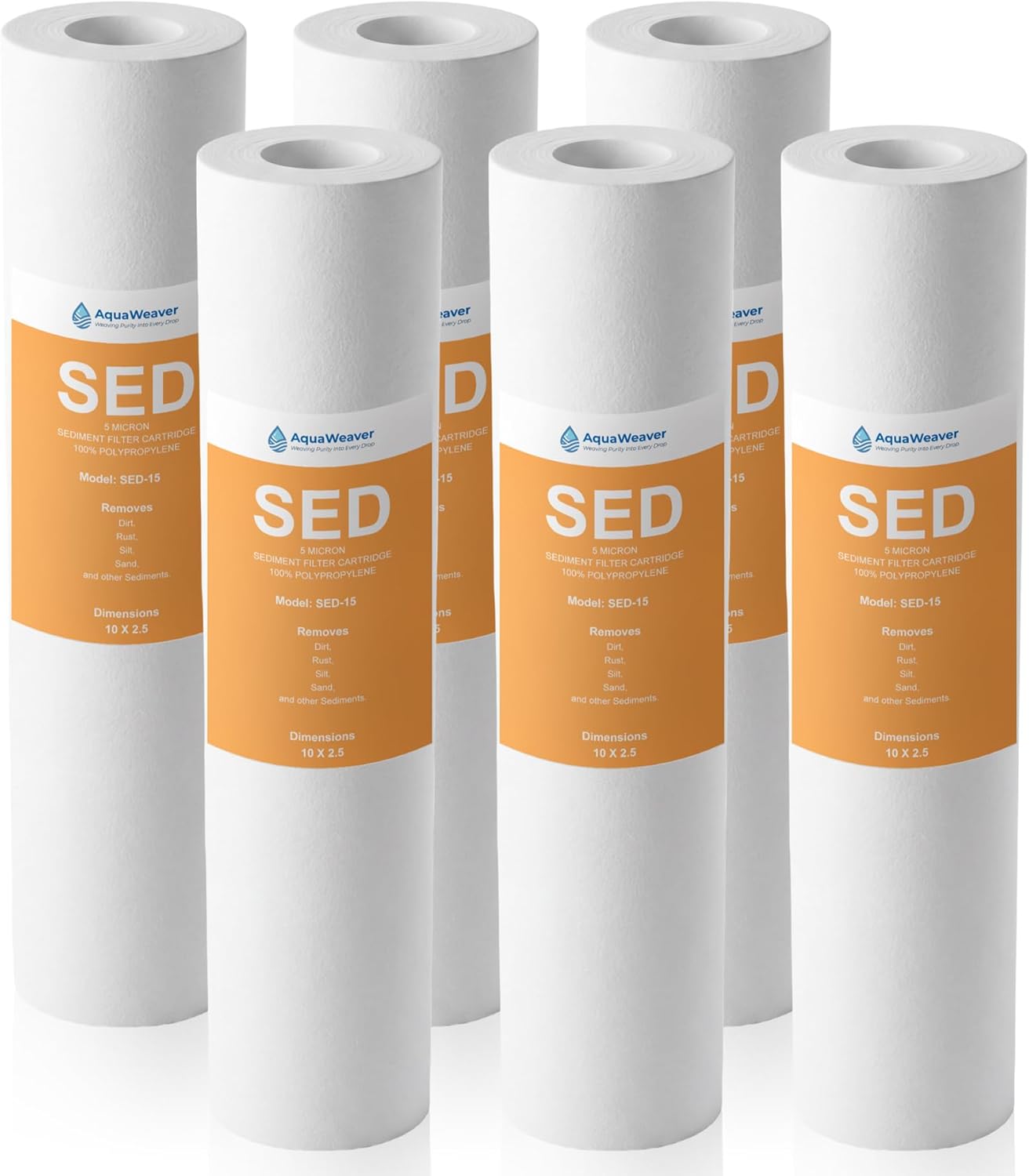
| Micron rating | 5 Micron |
|---|---|
| Material Type | Polypropylene (PP) |
| Included Components | 6 Count Polypropylene Melt-Blown Sediment Filter Cartridge |
| Compatible Water Purifier Models | 3M, A.O. Smith, Culligan, Whirlpool models listed |
This six-pack of AquaWeaver 5-micron melt-blown sediment cartridges is intended as a first-stage filter for whole-house, under-sink, and RO systems that use standard 10" x 2.5" housings. Installation is straightforward because the cartridges use the common 10×2.5 form factor and fit many OEM housings from Culligan, Aqua-Pure, Whirlpool, and AO Smith. The polypropylene construction and multi-layer graded-density design capture larger particles on the outside and finer sediment toward the core, which increases dirt-holding capacity and helps the cartridge last several months in typical well-water conditions. Because it is a sediment-only filter, it will not remove chlorine, taste, or dissolved contaminants, so plan to use it ahead of carbon or membrane stages. The pack of six keeps per-filter cost low and reduces the hassle of frequent reordering for budget-focused households. Buyers should expect routine replacement depending on sediment load and monitor pressure to know when the element is exhausted.
Best for: Buyers on a tight budget who need an affordable, compatible sediment prefilter for well or municipal water systems and want to stock replacements to avoid frequent reordering.
Less Ideal for: Anyone seeking a combined chemical or microbial treatment should look for cartridges with activated carbon or specialty media instead of this sediment-only replacement.
- Fits standard 10" x 2.5" housings for wide compatibility with common systems
- Multi-layer melt-blown PP construction captures a range of particle sizes and increases dirt-holding capacity
- Six-pack lowers per-filter cost and reduces replacement frequency for budget buyers
- Certified food-grade polypropylene and RoHS compliance for basic safety assurance
- Sediment-only design does not address chlorine, taste, or dissolved contaminants
- Lifespan varies with well-water sediment load so replacements may still be frequent in very dirty water
Verdict: A low-cost six-pack of standard 5-micron PP sediment cartridges that delivers wide compatibility and strong dirt-holding performance for budget-focused well water prefiltration.
iSpring WGB21B 2-Stage Whole House Filter
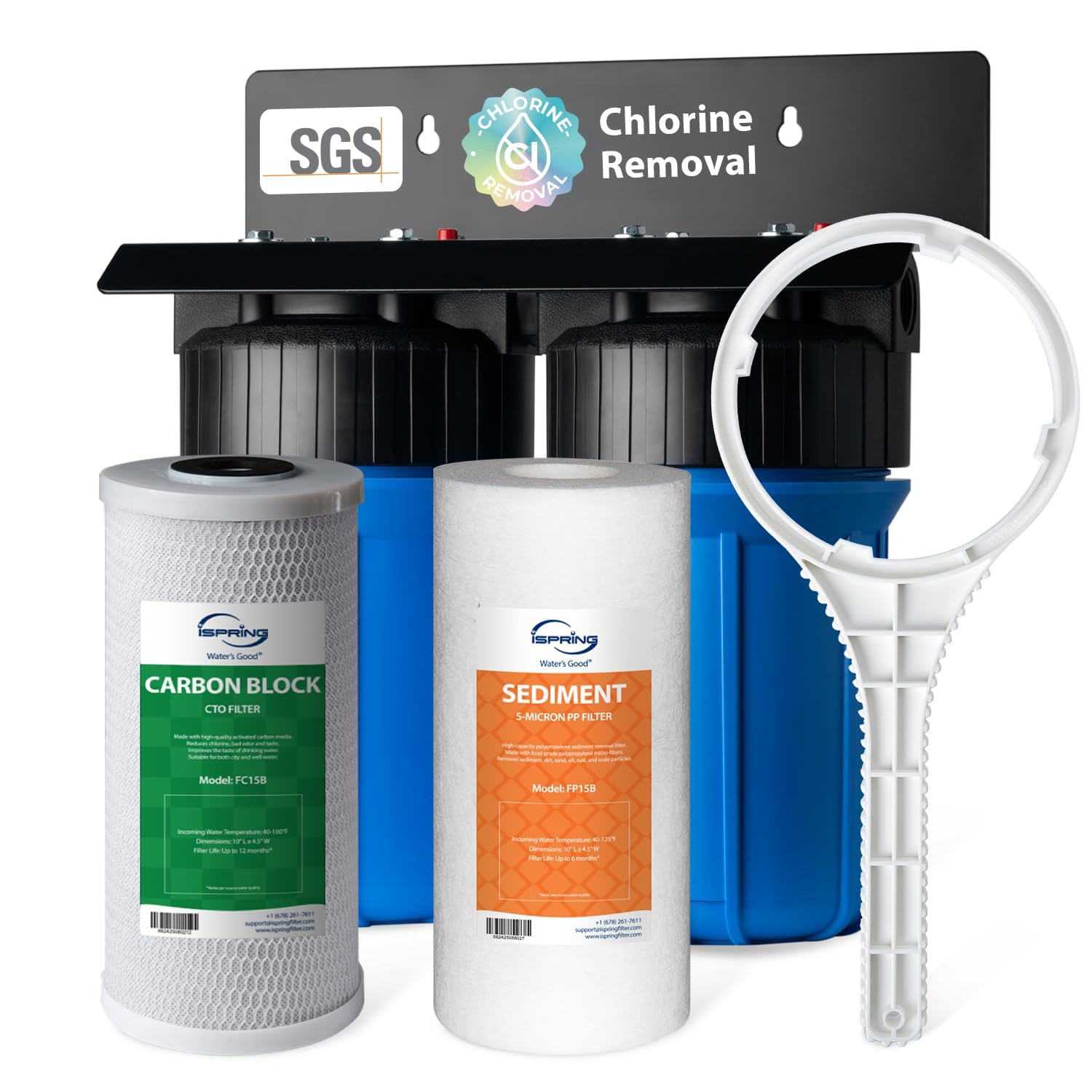
| Capacity | 50,000 gallons |
|---|---|
| Filter life cycle | 12 months |
| Maximum Flow Rate | 15 gpm |
| Operating Temperature | 40-100 °F |
| Inlet / Outlet | 1 inch Female NPT |
The iSpring WGB21B is a two-stage point-of-entry filter built to clean water for an entire house using a 5-micron polypropylene sediment cartridge followed by a coconut-shell carbon CTO cartridge. Install it at the main supply to trap sand, rust, silt and large particles in stage one while the carbon stage cuts chlorine, taste and odors and reduces many VOCs. The system ships preassembled on a mounting bracket and includes a filter wrench and a pressure-relief valve to simplify DIY installs and cartridge changes. With a stated capacity up to 50,000 gallons or about 12 months of service for a typical family, it minimizes how often you need to swap filters and helps protect appliances and plumbing from sediment. It does not lower TDS, so it keeps dissolved minerals intact. The housings are made from sturdy materials and the 1-inch ports support high flow with minimal pressure loss, but professional help may speed installation in more complex plumbing or well systems. For well-water use, its emphasis on heavy sediment capture and chlorine/VOC reduction makes it a practical, reliability-focused prefilter or whole-house solution.
Best for: Buyers who prioritize a dependable, low-maintenance whole-house filter to protect plumbing and appliances from sediment and to remove chlorine and taste issues without changing to RO-level treatment.
Less Ideal for: Homes that need TDS reduction, softening, or full contaminant removal should choose reverse osmosis or specialized treatment systems instead.
- Two-stage design pairs 5-micron sediment removal with coconut-shell carbon for chlorine and odor reduction.
- High stated capacity up to 50,000 gallons or about 12 months between filter changes under typical use.
- Preassembled mounting bracket, included wrench, and pressure-relief valve streamline DIY installation and maintenance.
- 1-inch inlet/outlet and rated for up to 15 gpm to maintain household water flow with limited pressure loss.
- Housing built from durable materials and designed for continuous whole-house service.
- Does not reduce total dissolved solids (TDS), so it will not soften water or remove dissolved minerals.
- Maximum operating pressure and temperature limits require attention in atypical plumbing conditions.
Verdict: A rugged, two-stage whole-house filter built for reliable sediment protection and effective chlorine and odor reduction across a household plumbing system.
Membrane Solutions String Wound 10"

| Micron Rating | 5 Micron |
|---|---|
| Material Type | Polypropylene (PP) |
| Set Name | 6-Pack |
| Compatible Water Purifier Models | GE GNSV70R, Whirlpool WHKF-GD05 |
| External Testing Certification | NSF |
This 6-pack of 5-micron string-wound polypropylene cartridges is designed as a sediment prefilter for whole-house and under-sink systems that use standard 10" x 2.5" filter housings. In typical use you install one cartridge as the first-stage filter to capture sand, rust, silt, and other particulates before water reaches finer cartridges or equipment. The graded string-wound construction increases dirt-holding capacity so each cartridge lasts longer than a simple melt-blown element, and the manufacturer rates filter life up to 15,000 to 20,000 gallons depending on feed water. The cartridges are NSF-tested for material requirements and are made from food-grade polypropylene, which helps avoid taste or chemical leaching. Important limits: this is a sediment-only filter so it will not remove chlorine, hardness, or dissolved contaminants, and longevity depends heavily on how dirty your well supply is. Also make sure your housing accepts the 1.1" inner diameter and the 10" x 2.5" form factor before buying.
Best for: Buyers who want a reliable sediment prefilter to protect downstream filters and equipment and who prefer products with strong customer feedback and material testing.
Less Ideal for: Households needing chemical, microbial, or dissolved contaminant removal should choose cartridges with activated carbon, antimicrobial, or specialty media instead.
- High dirt-holding graded string-wound design extends service life compared with basic sediment cartridges
- Food-grade polypropylene construction that is lead- and BPA-free
- Sold as a 6-pack which reduces replacement frequency and supply runs
- Fits most standard 10" x 2.5" filter housings for easy swaps
- Only removes physical sediment, not chlorine, taste, odor, or dissolved contaminants
- Actual lifespan varies a lot with well water quality and may require frequent changes in very sandy supplies
Verdict: A workhorse sediment prefilter with high dirt capacity and solid third-party testing that keeps well-water particulates out of downstream systems.
Choosing the Right Well Water Filter: Key Factors to Consider
Filtration Type and Target Contaminants
Different well water filters use different methods: sediment filters trap particles, carbon filters reduce taste and organic chemicals, specialized medias address iron, manganese, or hydrogen sulfide, and UV systems inactivate bacteria and viruses. Knowing which contaminants are present in your water is essential before selecting a system.
A treatment train is common: a sediment prefilter protects downstream media and UV units, while targeted media or chemical removal stages handle specific problems. Matching the filter type to the actual test results prevents overspending on unnecessary features and ensures the chosen system solves the real issues in the well.
Flow Rate and Household Demand
Whole-house well water filters must support peak household flow without dropping pressure excessively. Consider simultaneous use scenarios such as showers, washing machines, and irrigation. Filter systems are rated for maximum continuous flow and may list recommended household sizes or fixtures served.
Undersized systems can restrict water delivery and cause frustration, while oversized units increase cost and footprint. Balance rated flow capacity with your household peak demand and allow some margin for future changes.
Maintenance Frequency and Consumables
Every system requires upkeep: cartridge changes, media replacement, periodic backwashing, or UV lamp replacement. Maintenance frequency varies widely by filter type and by how dirty the well water is. Readily available, inexpensive consumables and straightforward replacement steps reduce long-term hassle.
Also consider whether maintenance tasks are DIY-friendly or require a technician. Systems that allow visual indicators or easy-access housings make it simpler to track when service is needed and lower the risk of neglect.
Installation and Plumbing Compatibility
Some well water filters are designed for whole-house in-line installation at the pressure tank or point-of-entry, while others are meant for point-of-use. Check pipe size compatibility, mounting requirements, and whether a bypass or shutoff is included for servicing. Proper installation affects system performance and lifespan.
If your well system uses a pressure tank, verify that the filter arrangement and any backwash cycle do not interfere with pump cycling or pressure settings. Professional installation can avoid common pitfalls, but many homeowners can install simple housings with common tools.
Contaminant Testing and Certification
Start with a certified water test from a reputable lab or an accurate home test kit to identify which contaminants and the concentration levels present. Some filter media have laboratory-verified removal rates for specific contaminants; look for data sheets or third-party test summaries when available.
Certification by an accredited organization for specific claims, such as particulate removal or reduction of specific chemicals, provides additional confidence. Match the tested capabilities of a filter to the measured contaminants to ensure the system will meet your needs.
Durability and Long-Term Reliability
Well water can be abrasive or corrosive depending on mineral content and pH. Materials used in housings, seals, and fittings should resist corrosion and wear. Robust construction reduces the chance of leaks and prolongs service life, especially in harsher water conditions.
Consider warranty length, availability of replacement parts, and whether the system has user-replaceable elements versus sealed units. A durable system may cost more upfront but often reduces lifetime maintenance and replacement costs.
How to Test Your Well Before Buying
Testing your well water is the first step to selecting an appropriate filter. A basic panel should check for bacteria, nitrates, pH, iron, manganese, hardness, and common volatile organics if you suspect contamination from nearby land use.
Collect samples following testing provider instructions to avoid contamination and get representative results. If you detect bacterial contamination, address source protection and shock chlorination protocols before relying on filtration alone.
- Order a comprehensive municipal or private well test panel when in doubt
- Repeat testing seasonally or after flooding or nearby construction
- Keep a record of test results to trend changes over time
Common Filter Configurations and When to Use Them
Sediment prefilters protect downstream components and are essential for any well with visible turbidity or sand. Granular activated carbon is effective for taste and many organic compounds. Media beds and catalytic filters target iron and sulfur, while softening or ion-exchange systems handle hardness.
UV disinfection is the go-to for microbiological control, but it does not remove particles or chemicals, so it is best used after effective sediment removal. Choose a configuration that addresses your highest-priority contaminants in sequence.
- Pre-filter with a coarse cartridge, then install specialty media or UV downstream
- Use backwashing media filters where iron or manganese loads are high
- Consider a whole-house arrangement for treatment ahead of all fixtures
Maintenance Best Practices
Establish a routine maintenance schedule based on the system's instructions and your water quality. Keep replacement cartridges and lamps on hand, and log service dates so you replace parts before performance drops.
Flush and disinfect components after any raw water intrusion event, and visually inspect housings and fittings for signs of wear. For systems with backwashing, verify the backwash frequency aligns with sediment load and iron accumulation.
- Replace cartridges on schedule and tighten housings to manufacturer torque recommendations
- Replace UV lamps and sleeves per hour-rating intervals even if the lamp still lights
- Use a bypass valve to avoid service interruptions and simplify servicing
Dealing with Specific Problems: Iron, Sulfur, and Hard Water
Iron and hydrogen sulfide often require targeted media or oxidation followed by filtration. Direct filtration may clog quickly if concentrations are high, so many systems combine oxidation or aeration with a media trap to reduce fouling and extend runtime.
Hardness is best addressed with softening systems or template-assisted crystallization, depending on whether you want a salt-based approach. Consider how each method affects appliance maintenance and your water chemistry.
- High iron benefits from oxidation plus a backwashing media bed
- Hydrogen sulfide often needs oxidizing media or aeration before filtration
- For hardness, weigh salt-based softeners against salt-free conditioners for maintenance and wastewater implications
Installation Tips for Smooth Performance
Place whole-house filters at the point of entry after the pressure tank and ahead of water heaters to protect plumbing and appliances. Ensure a bypass is installed for each major stage to allow servicing without shutting off the household water.
Verify inlet and outlet pipe sizes match existing plumbing and include shutoff valves and pressure gauges to help monitor system health. Proper placement and straightforward access reduce the likelihood of neglected maintenance.
- Mount housings securely and leave clearance for cartridge removal
- Install pressure gauges before and after the filter to monitor pressure drop
- Label service dates and replacement intervals near the installation
How We Chose the Best Well Water Filter
We focused on systems designed specifically for private well use and prioritized attributes that matter to homeowners with on-site water sources. Our selection criteria emphasized measurable filtration performance, practical maintenance needs, and system robustness under variable well conditions. Key evaluation points included particulate removal efficiency, the ability to reduce iron and sulfur or common chemical contaminants, flow rate compatibility with typical household demand, and the clarity of maintenance requirements such as cartridge replacement frequency and disinfection procedures. We also considered durability of housings and fittings, compatibility with standard well plumbing, and whether the design minimizes pressure drop. Systems that require specialized, hard-to-find consumables or complex professional-only servicing were deprioritized. We excluded point-of-use devices meant solely for single taps and systems unsuitable for whole-house integration. The final list reflects systems that balance filtration capability with homeowner-friendly upkeep and installation practicality.
Our full evaluation process is outlined in our review methodology.
FAQ
How often should I test my well water?
Test at least annually for baseline contaminants and more frequently if you notice changes in taste, color, or odor. Test after events like flooding, heavy rains, or nearby construction as these can change water quality rapidly.
Can a single system handle sediment, iron, and bacteria?
A single integrated system can include stages that address sediment, iron, and bacteria, but it is typically a multi-stage arrangement. UV is effective against bacteria but must be paired with sediment removal and appropriate iron treatment to work reliably.
Will installing a filter reduce my water pressure?
All filters add some pressure drop, but properly sized whole-house systems minimize noticeable effects. Monitor pressure before and after installation and choose a filter rated for your household flow to avoid significant losses.
Do well water filters remove nitrates?
Many common filter medias do not remove nitrates. Nitrate reduction often requires specialized ion-exchange, reverse osmosis, or targeted treatment approaches. If nitrates are present, select a system rated specifically for nitrate removal.
Can I maintain my well water filter myself?
Many maintenance tasks like cartridge replacement, backwashing, and basic inspections are DIY-friendly. Tasks such as complex media replacement or system disinfection may be best handled by a qualified technician depending on your comfort level.
Final Verdict
Selecting the right well water filter means matching the system to measured contaminants, household flow needs, and your willingness to perform routine maintenance. Prioritize filtration stages that address your most problematic contaminants first, then balance flow capacity and ease of upkeep. A thoughtfully chosen system protects plumbing and improves water quality with manageable upkeep. Focus on demonstrable contaminant removal, serviceability, and durable construction to choose confidently for reliable home well water treatment.