
Note: This article contains affiliate links. If you click on these links and make a purchase, we may earn a small commission at no extra cost to you. This helps support our research and content. Read our full affiliate disclosure here.
If you want consistently clean, low-contaminant drinking water at home, a reverse osmosis system can be one of the most effective under-sink options. Choosing the right Reverse Osmosis Water Filter matters because systems vary in filtration stages, daily production, and ease of maintenance. This guide shortlists the top options you should consider and explains the practical differences that affect everyday use. Below are our top picks, each evaluated for filtration performance, flow rate, and maintenance demands to help you select the best fit for your kitchen and household needs.
Top Picks at a Glance
| Best Overall The best all-around choice for most situations | APEC Water RO-90 | 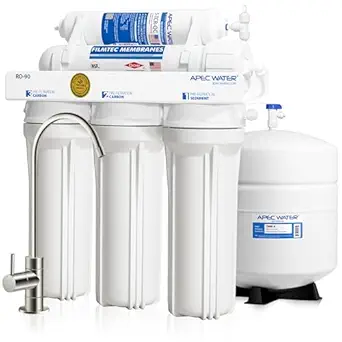 |
| Best Quality Built to a higher standard if you want something more solid | Waterdrop G3P600 Tankless RO |  |
| Best Value The sweet spot between price and what you get | APEC Water ROES-50 |  |
| Best Budget The cheapest option that still gets the job done reliably | FS-TFC 5-Stage RO System |  |
| Top Rated A top-rated pick with lots of positive feedback | iSpring RCC7-BN 5-Stage RO System |  |
| Most Popular A crowd favorite that many people choose with confidence | iSpring RCC7AK-BN 75 GPD RO System |  |
| Best Seller A high-volume bestseller chosen again and again | DREO RO Water Filter 113 |  |
APEC Water RO-90

| Purification Method | Activated Carbon, Reverse Osmosis |
|---|---|
| Installation Type | Under Sink |
| Power Source | Manual (Water Pressure) |
| Operating Pressure Range | 40-85 psi |
| Capacity | 90 gallons_per_day |
The APEC Water RO-90 is a 5-stage under-sink reverse osmosis system designed to deliver high-capacity purified drinking water for a household. It uses sediment and dual carbon block pre-filters to remove particles, chlorine, taste and odors, a FILMTEC RO membrane to strip out dissolved solids and heavy metals, and a post-carbon polishing filter to improve taste. The system is fed by household water pressure and comes with a storage tank, dedicated faucet, tubing and installation fittings for a standard DIY install under most sinks. Practical benefits include a 90 GPD production rate that supports everyday drinking, cooking and beverage needs, long-life high-capacity filters that reduce change frequency, and WQA testing for broad contaminant reduction. Limitations are typical for traditional RO: it requires adequate inlet pressure, produces waste water to drain, and needs periodic filter and membrane replacement and space under the sink for the tank and components.
Best for: Buyers who want a high-capacity, proven under-sink RO system that reliably removes a wide range of contaminants and are comfortable with a DIY install and routine filter maintenance.
Less Ideal for: People who need a zero-waste or tankless countertop solution, those with very low inlet water pressure, or users who cannot accommodate under-sink installation space.
- High 90 gallons per day production suitable for household drinking and cooking
- Five-stage filtration including a FILMTEC RO membrane for broad contaminant removal
- Includes storage tank, faucet and full installation hardware for DIY setup
- High-capacity filters designed to extend time between replacements
- Requires sufficient home water pressure and space under sink for the tank
- Produces wastewater as part of the reverse osmosis process
Verdict: Choose the RO-90 if you want a robust, high-capacity under-sink RO system that delivers broadly purified, great-tasting water for everyday household use.
Waterdrop G3P600 Tankless RO
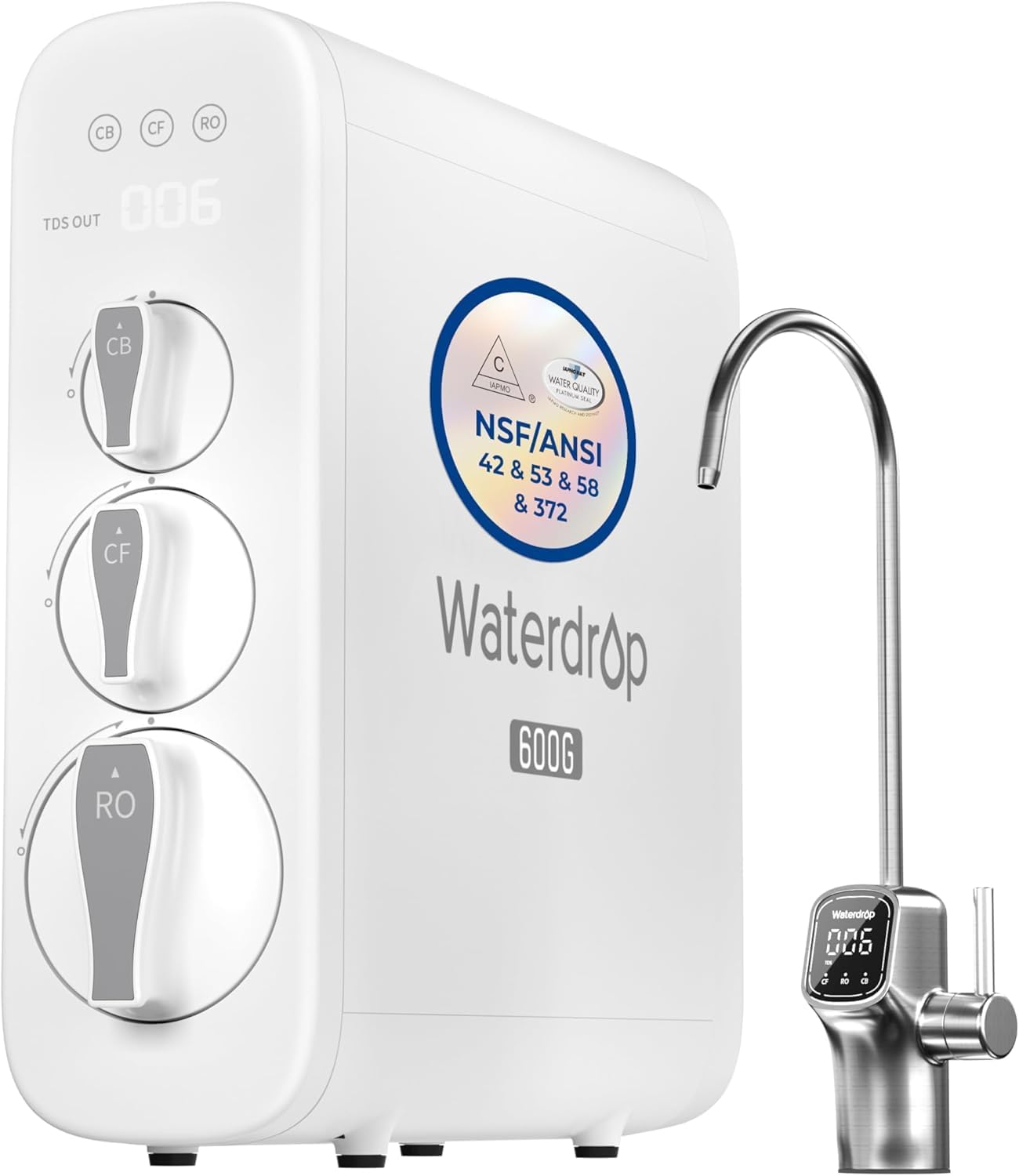
| Filtration stages | 8-stage |
|---|---|
| Flow rate | 0.42 gpm |
| Pure to drain ratio | 2:1 |
| Supported TDS max | 1500 ppm |
| Power source | Corded Electric |
The Waterdrop G3P600 is a performance-focused tankless RO designed to deliver fast, high-volume purified water for households that use a lot of drinking and cooking water. It uses an 8-stage filtration stack including RO membrane and carbon block elements plus a smart faucet that displays TDS and filter life. The system produces up to 600 GPD and fills an 8 oz cup in about eight seconds while running at a low 2:1 pure-to-drain ratio, which reduces wastewater compared with traditional RO units. Tankless architecture frees up under-sink space and makes filter swaps quick thanks to a twist-out cartridge design, but the unit requires a dedicated electrical outlet under the sink. Notable practical benefits are strong contaminant reduction (NSF-referenced certifications noted), real-time water-quality monitoring at the tap, and steady flow for filling containers or rinsing produce. Limitations to consider are the need for under-sink power, plumbing/drain hole prep for installation, and regular replacement of multiple filters on the published schedule.
Best for: Buyers who prioritize high daily throughput and measurable water quality for heavy household use, and who want fast dispensing plus real-time TDS feedback at the faucet.
Less Ideal for: People without convenient under-sink power or those seeking a purely passive, non-electrical filter solution should look elsewhere.
- High output capacity up to 600 gallons per day for fast dispensing
- 8-stage filtration that targets TDS, heavy metals, PFAS and chlorine taste/odor
- Smart faucet with TDS readout and filter life indicator for real-time monitoring
- Tankless design that saves under-sink space and allows tool-free filter changes
- Requires under-sink electrical power and a second drilled hole for drain connection
- Multiple filter elements mean periodic replacements and associated cost
Verdict: Choose the G3P600 when you need a high-capacity, tankless RO that delivers fast, monitored drinking water with strong contaminant reduction.
APEC Water ROES-50

| Filtration Method | Reverse Osmosis |
|---|---|
| Filtration Stages | 5-Stage |
| Capacity | 50 gallons per day |
| Operating Pressure Range | 40-85 psi |
| Filter Life Cycle | 6 months |
The APEC ROES-50 is a five-stage under-sink reverse osmosis system designed to deliver very pure drinking water at roughly 50 gallons per day. It installs under the sink and includes a storage tank and dedicated faucet, with quick-connect fittings and color-coded tubing that make DIY installation and routine filter changes straightforward. The five filtration stages combine sediment and carbon prefilters with an RO membrane and post-filter to remove chlorine, heavy metals, fluoride, PFAs, microplastics and other common tap-water contaminants, producing noticeably cleaner taste and lower TDS. Filters are large-capacity items intended to run months between changes, and the system is WQA/NSF-certified for materials and contaminant reduction. Limitations are the low maximum flow rate to the drain and the need for occasional filter and membrane replacements based on incoming water quality, plus the unit requires sufficient under-sink space for the tank and housing. For a homeowner who wants near-bottled-water purity without complicated maintenance, this is a reliable factory-quality option.
Best for: Buyers who want a practical, no-frills home RO that reliably produces very pure drinking water and are willing to perform periodic filter changes themselves.
Less Ideal for: People without adequate under-sink space, those who need very high daily output, or users who prefer a countertop system with no installation.
- Five-stage filtration removes a broad set of contaminants including heavy metals and PFAs
- Includes storage tank and dedicated faucet for steady access to filtered water
- DIY-friendly quick-connect fittings and color-coded tubing simplify installation and service
- WQA/NSF-certified materials and performance for verified contaminant reduction
- Relatively low maximum flow rate to drain which may slow production during heavy use
- Requires under-sink space for the tank and components
Verdict: A practical, certified 5-stage under-sink RO that delivers near-bottled-water purity with straightforward DIY installation and maintenance.
FS-TFC 5-Stage RO System

| Purification Method | Reverse Osmosis |
|---|---|
| Maximum Flow Rate | 18 liters per hour |
| Capacity | 100 gallons |
| Operating Pressure Range | 30-85 psi |
| Supported Water TDS Level Maximum (PPM) | 500 |
The FS-TFC 5-stage RO System is an under-sink reverse osmosis purifier designed to deliver high-purity drinking water without electricity. It uses a five-stage filtration train and a pressurized storage tank to reduce dissolved solids, chlorine, heavy metals, fluoride and many other contaminants, producing up to 100 gallons per day (about 18 liters per hour). Installation is intended to be DIY-friendly with included fittings and illustrated instructions so most users can fit the compact unit under a standard kitchen sink in roughly ten minutes. Notable practical benefits are the system's high claimed contaminant removal, a low 1:1 drain ratio that reduces wastewater compared with many RO units, and four extra replacement filters included to lower first-year maintenance cost. Limitations to consider are the stated supported TDS ceiling of 500 ppm and the one-year nominal filter life that requires routine cartridge changes; you will also need enough under-sink space for the tank and housing. For buyers wanting a budget-conscious, compact RO setup that removes a broad set of impurities and keeps operating costs low, this model is a strong contender.
Best for: Buyers prioritizing low long-term operating cost and high contaminant reduction who want a compact, DIY-install under-sink RO for everyday drinking and cooking water.
Less Ideal for: Homes drawing from very hard well water or sources above 500 ppm TDS, or households that cannot spare under-sink space for a tank.
- Claims ultra-high contaminant reduction including chlorine, heavy metals, fluoride, and VOCs
- Compact under-sink design fits standard sinks and suitable for small spaces
- Low 1:1 drain ratio reduces wasted water compared with many RO systems
- Includes four extra replacement filters to cover nearly a year of filter changes
- Filter life and capacity listed as one year and 100 gallons may require frequent replacement in high-use households
- Supported TDS up to 500 ppm limits use with very hard or heavily contaminated source water
Verdict: A compact, budget-friendly under-sink RO that delivers broad contaminant removal with low ongoing water waste and included spare filters to cut first-year costs.
iSpring RCC7-BN 5-Stage RO System

| Purification Method | Reverse Osmosis, Activated Carbon, Carbon block |
|---|---|
| Power Source | No Power Needed |
| Maximum Flow Rate | 3.4 liters per minute |
| Supported Water TDS Level Maximum (PPM) | 750 |
| Capacity | 75 gallons |
The iSpring RCC7-BN is a traditional 5-stage under-sink reverse osmosis system built to produce bottled-quality drinking water at home. It uses three prefilters (sediment, GAC, carbon block), a reverse osmosis membrane that filters down to 0.0001 microns, and a final GAC polishing filter, delivering water that reduces TDS and removes hundreds of contaminants including PFAS, chlorine, and lead. Installation is aimed at DIYers: push-to-connect fittings, a top-mounted faucet design, and clear first-stage housing for visual filter checks simplify setup and maintenance. A 75 gallon-per-day membrane and included pressurized tank mean steady flow for kitchen use without electricity. Practical strengths are the NSF/ANSI 58 certification, lead-free designer faucet, and online support resources. The system is designed for municipal tap water and is not intended for untreated well water without preconditioning. It also requires periodic filter and membrane replacements and occupies typical under-sink space, so plan for the tank and housings when evaluating fit under smaller cabinets.
Best for: Buyers who prioritize a reliable, certified under-sink RO that consistently delivers low-TDS, great-tasting water and who prefer a system with clear serviceability and manufacturer support.
Less Ideal for: Homes drawing from untreated well sources without prior whole-house filtration or buyers who cannot allocate under-sink space for a tank and housings.
- Certified to NSF/ANSI 58 for RO performance and contaminant reduction
- Five-stage filtration including a 0.0001 micron RO membrane and final polishing filter
- Transparent first-stage housing for easy visual inspection
- Push-to-connect fittings and top-mounted faucet simplify DIY installation
- No power required and includes a pressurized storage tank for steady output
- Not recommended for raw well water without additional pre-filtration
- Takes under-sink space and includes a pressurized tank that must be accommodated
- Requires regular filter and membrane replacements to maintain performance
Verdict: Choose the iSpring RCC7-BN if you want a proven, NSF-certified 5-stage under-sink RO that reliably delivers low-TDS drinking water with straightforward DIY installation and serviceability.
iSpring RCC7AK-BN 75 GPD RO System

| Purification Method | Reverse Osmosis, Alkaline, Activated Carbon, Carbon block |
|---|---|
| Power Source | No Power Needed |
| Maximum Flow Rate | 284 liters_per_day |
| Supported Water TDS Level Maximum (PPM) | 750 |
| Filter Life Cycle | 6 months |
The iSpring RCC7AK-BN is an under-sink reverse osmosis system that combines a 6-stage filtration train with an alkaline remineralization stage to deliver low-TDS, mineral-balanced drinking water. It is typically installed under a kitchen sink and pairs with the included brushed nickel faucet and storage tank to supply drinking water and fridge hookups. Notable features include NSF/ANSI 58 system certification, a transparent first-stage housing for visual sediment checks, push-to-connect fittings and color-coded tubing to simplify DIY installation, and a patent-pending top-mounted faucet fastener that makes countertop faucet installation easier. The system runs without electricity and claims a 75 gallon per day capacity with broad contaminant reduction including lead, fluoride, PFAS, chlorine, and many heavy metals. Expect routine filter maintenance on the specified intervals and occasional tank flushing; replacement filter sets are available in 6-month to multi-year kits. The main compromises are the under-sink footprint and the need to plan for periodic filter and membrane replacements, but for buyers prioritizing certified performance and mineral-balanced water, this system delivers reliable, testable results.
Best for: Buyers who want a tested, certified under-sink RO that delivers low-TDS water with added minerals and who prefer a system with clear installation guidance and visible components.
Less Ideal for: People who need a zero-maintenance or countertop solution or who lack under-sink space or willingness to perform periodic filter changes should consider other formats.
- NSF/ANSI 58 certified for whole-system RO performance
- 6-stage filtration with alkaline remineralization for balanced pH
- Electricity-free operation suitable for any kitchen
- Transparent first-stage housing for easy visual monitoring
- DIY-friendly push-to-connect fittings and top-mounted faucet fastener
- Under-sink footprint requires cabinet space and some plumbing work
- Routine filter and membrane replacements are required to maintain performance
Verdict: Pick this certified six-stage under-sink RO if you want electricity-free, lab-verified contaminant removal with a mineral-boosted finish and clear, DIY-friendly installation.
DREO RO Water Filter 113

| Purification Method | Reverse Osmosis |
|---|---|
| Capacity | 5 liters |
| Other Special Features of the Product | Built In TDS Meter, Change Filter Indicator, Reduce TDS, Touch Control |
| Pure to Drain Rate | 3:1 |
The DREO RO Water Filter 113 is a plug-in countertop reverse osmosis purifier designed to deliver low-TDS drinking water without plumbing work. It uses a 7-stage RO cartridge and a 3:1 pure-to-drain ratio to reduce dissolved solids and common contaminants, and it includes two autofill pitchers so one stays full while the other refills automatically. The unit shows raw and purified TDS on a built-in meter and has a filter-life indicator to make maintenance straightforward, and the self-cleaning flush helps limit internal buildup. Setup is simple since it sits on the counter and requires no hard plumbing, and replacement filters twist in for quick swaps. Limitations to note are the modest 5L reservoir and the reported 265-gallon lifespan for a single filter, which means regular cartridge changes for larger households, and countertop placement takes bench space. For buyers who prioritize tested contaminant removal, easy monitoring, and no-install convenience, this system provides practical RO performance with user-friendly features.
Best for: Buyers who want a verified RO-level reduction in contaminants without under-sink installation and who value simple monitoring and plug-and-play convenience.
Less Ideal for: Those needing high daily output or whole-house treatment should look at larger plumbed systems or under-sink RO options.
- 7-stage RO filtration with SGS-tested impurity reduction
- Built-in TDS meter and filter-life indicator for real-time monitoring
- Auto-fill dual-pitcher system for hands-free refills and continuous access
- Self-cleaning auto-flush to help reduce internal fouling
- Installation-free countertop design that requires no plumbing
- 5L tank capacity may be small for larger households or heavy daily use
- Filter rated lifespan (~265 gallons/1000L) requires relatively frequent replacements
Verdict: A user-friendly countertop RO that delivers lab-tested contaminant reduction and easy monitoring without plumbing.
Choosing the Right Reverse Osmosis Water Filter: Key Factors to Consider
Filtration Stages and Contaminant Removal
The number and type of filter stages determine what the system removes. A basic multi-stage setup usually includes a sediment prefilter to catch particulate matter, activated carbon to reduce chlorine and organic compounds that affect taste and odor, and the reverse osmosis membrane to remove dissolved solids and many inorganic contaminants.
Knowing which contaminants you want to reduce is important. If your water has specific issues such as high dissolved solids, lead, or fluoride, check that the system's membrane and any dedicated postfilters are rated for those contaminants. More stages can improve taste and removal breadth but may require more frequent cartridge changes and slightly lower flow rates.
Daily Production Capacity and Flow Rate
Reverse osmosis systems are rated by gallons per day (GPD). A higher GPD rating means the membrane can produce more purified water under standard test conditions, but real-world flow at the faucet depends on tank size, tank pressure, and postfilter routing.
Consider household needs: a single person has different daily use than a family that fills pitchers or cooks regularly. Systems with higher production and larger storage tanks reduce wait time for filtered water. If you need near-instant flow, look for systems with faster recovery rates or integrated booster pumps to improve faucet output.
Ease Of Maintenance and Filter Replacement
Regular maintenance is required to keep RO systems performing well. Prefilters typically need replacing every 3 to 12 months depending on water quality, while membranes last longer but should be checked annually. Ease of access, clear indicator systems, and availability of replacement cartridges affect long-term ownership convenience.
Choose systems with straightforward cartridge housings or quick-change filter cartridges if you prefer tool-free service. Readily available replacement parts and clear maintenance schedules reduce the chance of degraded performance due to neglected service.
Installation Requirements and Space
Under-sink reverse osmosis systems vary in size and required countertop or under-sink space. Some compact units are designed for tight cabinets, while multi-stage systems with large tanks require more room. Installation typically involves connecting to the cold water line, adding a dedicated faucet hole if absent, and fitting a drain saddle for wastewater.
Assess your under-sink space, plumbing accessibility, and willingness to perform or hire installation. Systems with simpler tubing color-coding and clear instructions reduce installation time and potential for leaks.
Wastewater Ratio and Efficiency
RO systems produce a wastewater stream as they reject contaminants. The wastewater-to-purified-water ratio varies by design and operating pressure. More efficient membranes and systems with permeate pumps can reduce wasted water, which matters for environmental impact and utility costs in areas with metered water.
If water conservation is a priority, compare the system's wastewater ratio under typical household pressures and consider systems that include efficiency-enhancing features or that are designed to operate well at lower pressure without huge waste volumes.
Materials, Fittings, and Long-Term Durability
Materials used in housings, fittings, and tubing influence both water taste and system longevity. Look for NSF-listed materials where specified and corrosion-resistant metal or high-grade plastic fittings. Poor-quality fittings can lead to leaks, while low-grade plastics may impart off tastes.
Consider whether key components such as the membrane housing and shutoff valves are serviceable and replaceable. Better materials and standardized fittings make long-term upkeep easier and reduce the likelihood of mid-life failures.
How Reverse Osmosis Works
Reverse osmosis uses water pressure to force feed water through a semi-permeable membrane that blocks dissolved solids and many contaminants. Before the membrane, sediment and carbon stages protect the membrane and remove larger particles and chlorine that can damage the membrane over time.
After the membrane, water typically passes through a postfilter for taste polishing and is stored in a pressurized tank for on-demand use. Understanding this flow helps explain tradeoffs between production rate, tank size, and faucet flow.
- Pre-filtration removes sediment and chlorine to protect the membrane.
- RO membrane rejects dissolved solids and many ions based on pore size.
- Postfilters polish taste and reduce any remaining volatile compounds.
- A storage tank balances production rate with immediate access to filtered water.
Sizing a System for Your Household
Match system GPD and tank size to your daily consumption patterns. For occasional drinking and cooking use, a modest GPD rated system with a medium tank is usually sufficient. For heavy use or larger households, choose systems with higher production ratings or consider units with larger tanks to reduce waiting time.
Also factor in countertop or under-sink space, and whether you want a dedicated faucet or a system that integrates with existing fixtures. Portable or compact designed RO systems can suit small apartments while full under-sink systems are better for family kitchens.
- Estimate daily filtered water use by totaling drinking, cooking, and small appliance needs.
- Allow extra capacity for unexpected usage or guests.
- Account for tank recovery time when multiple people may draw water in succession.
Installation Tips and Common Pitfalls
Plan for routing cold water feed, drain connection, and the filtered water faucet. Use the provided color-coded tubing and check all crimps and push fittings for secure seating. If you are uncomfortable with plumbing work, professional installation reduces the risk of leaks and warranty issues.
Common mistakes include mounting the tank upside down, over-tightening plastic fittings, and neglecting to flush new filters and membranes per instructions. Leave easy access to housings for future filter changes and label tubing for easier servicing.
- Turn off the cold water feed and relieve pressure before beginning work.
- Follow manufacturer instructions for initial flush cycles to prevent premature fouling.
- Verify drain saddle placement to avoid slow drain or sewer gas issues.
Maintenance Schedule and Best Practices
A proactive maintenance schedule keeps performance consistent. Replace sediment and carbon prefilters regularly to protect the membrane and maintain flow. Check the membrane annually or per manufacturer guidance and replace it when rejection rates decline or after the recommended interval.
Sanitize the system during major filter changes and inspect O-rings and fittings for wear to prevent leaks. Keep a simple log of replacement dates to avoid inadvertent neglect.
- Prefilter: typically every 3 to 12 months, depending on water quality.
- RO membrane: usually 2 to 5 years, variable with feed water conditions.
- Postfilter and polishing filters: often annually.
Improving Efficiency and Reducing Waste
If wastewater is a concern, consider systems designed for better efficiency or add-ons like permeate pumps that reduce reject flow. Operating pressure also affects efficiency; higher feed pressure generally improves membrane efficiency and lowers wastewater volume.
Some builders route reject water to alternative uses such as irrigation where appropriate, reducing the environmental impact. Evaluate local codes and practical logistics before reusing wastewater.
- Check system wastewater ratios and consider permeate pumps for low-pressure homes.
- Use reject water for non-potable tasks if safe and code-compliant.
- Maintain filters to keep membrane performance optimal and reduce unnecessary waste.
How We Chose the Best Reverse Osmosis Water Filter
We evaluated Reverse Osmosis Water Filters to identify reliable systems that remove common contaminants while remaining practical for daily home use. Our selection filters prioritized systems with multi-stage filtration that include a sediment prefilter, activated carbon stages, and a dedicated reverse osmosis membrane. Flow and daily production capacity were key, since adequate faucet output and tank recovery affect real-world convenience. We also scored ease of maintenance based on how simple filter and membrane changes are and whether common replacement cartridges are readily available. Durability and build quality were considered, focusing on corrosion-resistant fittings, reliable shutoff valves, and standardized connection hardware. Installation complexity and compatibility with typical under-sink setups were evaluated to reflect what a typical homeowner can expect. Systems that required uncommon plumbing modifications or lacked clear maintenance guidance were excluded. Finally, we assessed filtration certification claims and specification transparency to ensure each shortlisted system provides verifiable performance metrics aligned with buyer expectations.
Our full evaluation process is outlined in our review methodology.
FAQ
How often should I replace the RO membrane?
The membrane typically lasts between 2 and 5 years depending on feed water quality and prefilter maintenance. If you notice reduced output or poorer tasting water, test TDS or follow the system's recommended schedule.
Will a reverse osmosis system remove chlorine and bad taste?
Yes. Carbon prefilters and postfilters are responsible for reducing chlorine and improving taste. The RO membrane removes dissolved solids that affect taste as well, but pre- and post-filtration stages are important for comprehensive taste improvement.
How much water does an RO system waste?
Wastewater ratios vary widely, commonly ranging from about 1:1 to 4:1 purified-to-waste under typical conditions. Systems with permeate pumps or higher-pressure operation can be more efficient and produce less waste.
Can I install a reverse osmosis system myself?
Many homeowners can install an under-sink RO system with basic plumbing skills, following the included instructions. If you are uncomfortable with drilling or making cold-water connections, professional installation is a safe option.
Do RO systems remove minerals from water?
Yes. Reverse osmosis removes many dissolved minerals and salts, which lowers total dissolved solids. Some users choose to add a remineralization stage if they prefer mineral content for taste or dietary reasons.
Final Verdict
Prioritize filtration effectiveness, daily production capacity, and ease of maintenance when choosing a Reverse Osmosis Water Filter. Balance the system size and tank capacity with your household usage and available under-sink space. Expect routine prefilter changes and periodic membrane checks, and weigh wastewater efficiency if water conservation is important. By focusing on these tradeoffs you can select a system that reliably delivers clean, great-tasting water while matching your installation and upkeep preferences.