
Note: This article contains affiliate links. If you click on these links and make a purchase, we may earn a small commission at no extra cost to you. This helps support our research and content. Read our full affiliate disclosure here.
If your home draws from a private well, the right whole-house water filter can protect plumbing, appliances, and your family from contaminants that municipal systems do not address. Choosing a system built for well water matters because well supplies vary in sediment, iron, hardness, and microbial risk. This guide spotlights seven shortlisted well whole-house water filters that cover a range of flow rates, contaminant removal strategies, and maintenance styles. You will find products selected for common well-water problems and for practical homeowner concerns such as filter life, required space, and flow capacity. Below we outline what we evaluated so you can match a filter to your household usage and the specific challenges in your well water. Next up are the top picks and what makes each option suitable for different well conditions.
Top Picks at a Glance
| Best Overall The best all-around choice for most situations | Express Water 3-Stage Whole House System |  |
| Best Quality Built to a higher standard if you want something more solid | Aquasana Rhino WH-WELL-CT-UVS |  |
| Best Value The sweet spot between price and what you get | PRO+AQUA Elite Series PRO-100-E |  |
| Best Budget The cheapest option that still gets the job done reliably | iSpring WGB21B 2-Stage Whole House Filter |  |
| Top Rated A top-rated pick with lots of positive feedback | iSpring WGB32BM 3-Stage Whole House Filter |  |
| Most Popular A crowd favorite that many people choose with confidence | Culligan WH-HD200-C Whole House Filter |  |
| Best Seller A high-volume bestseller chosen again and again | SimPure DB10C 10" x 4.5" Housing |  |
Express Water 3-Stage Whole House System

| Purification Method | Activated Carbon, Granular Activated Carbon |
|---|---|
| Maximum Flow Rate | 17 gpm |
| Operating Pressure Range | 20-80 psi |
| Supported Water TDS Level Maximum (PPM) | 800 |
| Filter Life Cycle | 6 months |
The Express Water 3-stage whole-house system filters incoming water at the point of entry to deliver cleaner water to every faucet and protect plumbing and appliances. It uses a sediment prefilter plus granular activated carbon and activated carbon block stages to cut chlorine, sediment, and bad tastes and smells, and the manufacturer rates the filters for roughly 100,000 gallons or 6 months of typical service. The unit ships with a heavy-duty stainless steel mounting frame, pressure gauges and pressure-release buttons to simplify cartridge changes, and it supports up to 17 gpm flow and 20-80 psi operating pressure so it should not noticeably reduce household water pressure. This model does not lower total dissolved solids, so it is not a substitute for reverse osmosis if you need TDS reduction, but it is a practical option for well owners who want comprehensive chlorine and sediment control and appliance protection. Installation requires a point-of-entry hookup and occasional filter replacements, but the build and monitoring features make maintenance straightforward.
Best for: Homeowners seeking a balanced whole-house filter that improves taste and protects pipes and appliances without sacrificing flow are the primary fit.
Less Ideal for: If you need to remove dissolved solids or achieve drinking-water-level purification, choose a reverse osmosis or specialized heavy-metal/TDS reduction system instead.
- Three-stage filtration (sediment, GAC, ACB) targets chlorine, sediment, and tastes/odors
- NSF-certified filters provide independent verification of performance
- Heavy-duty stainless steel frame with pressure gauges and release buttons for easier maintenance
- High flow capacity up to 17 gpm to avoid noticeable pressure loss in most homes
- Does not reduce total dissolved solids so it will not remove dissolved minerals or salts
Verdict: A well-built, high-flow three-stage whole-house filter that reliably removes chlorine and sediment for homeowners who want balanced, housewide water improvement.
Aquasana Rhino WH-WELL-CT-UVS

| Maximum Flow Rate | 14.7 gpm |
|---|---|
| Operating Pressure Range | 20-100 psi |
| Filter Life Cycle | 5 years |
| Capacity | 500000 gallons |
| Supported Water TDS Level Maximum (PPM) | 1000 |
The Aquasana Rhino WH-WELL-CT-UVS is a dedicated whole-house well water system designed to reduce chlorine, bacteria, viruses, and scale across every tap. It installs on a 3/4" or 1" main line and pairs pre- and post-filters with copper-zinc (KDF), activated carbon, a salt-free conditioner, and an inline UV unit to tackle biological contaminants and control scale without softening the water. Typical use is continuous whole-house filtration for drinking, cooking, bathing, and appliance protection; the included installation kit and integrated drain valve simplify flushing and maintenance. The system is built for long service life with a 500,000-gallon/5-year filter cycle and supports up to 14.7 gpm flow at normal household pressures, which suits larger families. Limits to consider are that it conditions rather than softens hard water, so it will not remove dissolved hardness minerals, and installation for some homes will require professional plumbing work and space for the tank and UV module. For buyers focused on well water safety and performance, this system offers broad contaminant reduction and low run-rate maintenance compared with many point-of-use options.
Best for: Buyers who need a high-capacity, performance-focused whole-house solution for well water and prioritize biological contaminant removal and long service intervals over water softening.
Less Ideal for: Households that need true water softening or those who cannot accommodate a whole-house tank and UV module should consider alternative or additional systems.
- Multi-stage filtration including KDF, carbon, salt-free scale control, and UV for biological contaminant reduction
- Long service life rated for 500,000 gallons or five years reducing frequent filter changes
- Supports high flow rates up to 14.7 gpm so it can handle larger households without major pressure loss
- Includes pre- and post-filters plus an installation kit and integrated drain valve to simplify setup and maintenance
- Does not soften water or remove dissolved hardness minerals
- Requires space and likely professional installation for homes without existing whole-house plumbing accommodations
Verdict: A high-capacity, well-focused whole-house system that prioritizes broad contaminant and biological reduction for performance-minded well water households.
PRO+AQUA Elite Series PRO-100-E

| Maximum Flow Rate | 15 gpm |
|---|---|
| Operating Pressure Range | 80 psi |
| Supported Water TDS Level Maximum (PPM) | 500 |
| Filter Life Cycle | 6 months |
| Capacity | 100000 gallons |
The PRO+AQUA Elite Series PRO-100-E is a 3-stage whole-house filter meant for small to medium homes that delivers filtered water to every outlet without regeneration or backwashing. It uses a sediment stage in a clear housing to trap rust and dirt, a proprietary CRK media stage to reduce heavy metals and hydrogen sulfide, and an activated coconut shell carbon stage to cut chlorine, VOCs, pesticides, taste and odor down to about 5 microns. Stainless steel pressure gauges make it straightforward to monitor differential pressure and know when to replace cartridges, and the manufacturer recommends replacing filters about every six months for best flow. The system is built with pro-grade components and 1 inch ports for decent flow, and it is suitable for both well and city water where TDS reduction is not required. Limits to note are that it does not reduce total dissolved solids and it is intended for professional installation, so DIYers without plumbing experience may need a contractor.
Best for: Buyers who want a practical, low-maintenance whole-house filter that removes sediment, odors and common contaminants in well water and delivers filtered water to every outlet without regeneration.
Less Ideal for: Homes that need TDS reduction, reverse osmosis drinking water, or owners seeking a purely DIY install should consider other solutions.
- Three-stage filtration targets sediment, heavy metals and hydrogen sulfide, and chemicals/odors
- Clear sediment housing and stainless steel pressure gauges make maintenance monitoring easy
- Designed for whole-house delivery so every outlet gets filtered water
- Factory-quality 1 inch ports and pro-grade components support solid household flow rates
- Does not reduce total dissolved solids (TDS)
- Professional installation recommended, which adds installation cost and complexity
Verdict: A straightforward, three-stage whole-house filter that reliably removes sediment, odors and heavy metals for small to medium well or city-water homes without complex maintenance.
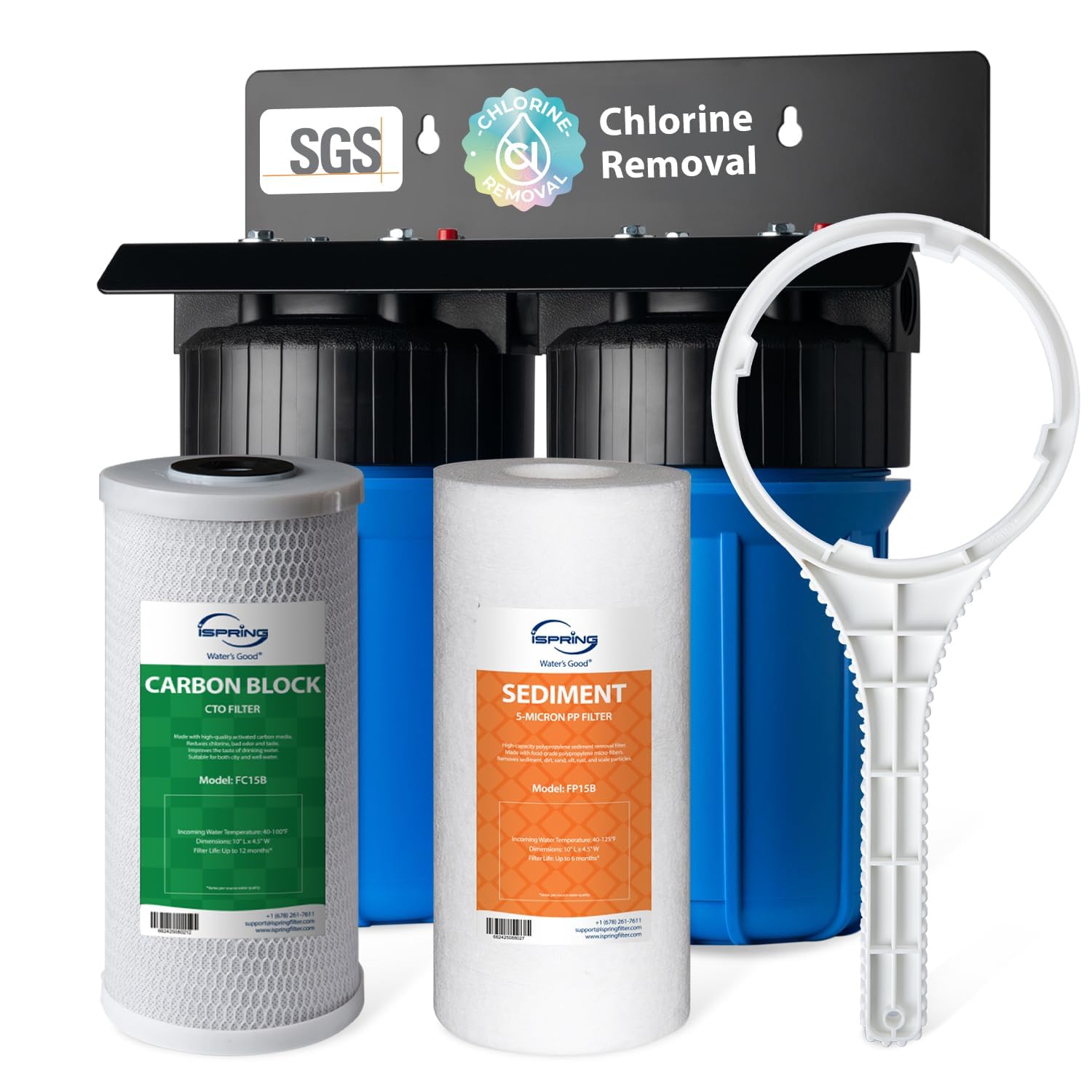
iSpring WGB21B 2-Stage Whole House Filter
| Capacity | 50,000 gallons |
|---|---|
| Filter life cycle | 12 months |
| Inlet / Outlet | 1 inch Female NPT |
| Maximum Flow Rate | 15 gpm |
| Operating Temperature | 40-100 °F |
The iSpring WGB21B is a point-of-entry two-stage system that pairs a 5-micron polypropylene sediment filter with a coconut-shell carbon CTO cartridge to remove sediment, chlorine, bad tastes and many VOCs for every faucet in a home. It installs at the main water line with 1 inch female NPT connections and comes premounted on a bracket with a filter wrench and pressure relief valve to simplify DIY installs and cartridge changes. With a claimed life of up to 50,000 gallons or roughly 12 months under typical use, it can reduce routine maintenance compared with smaller point-of-use filters and helps extend the life of appliances and plumbing by trapping sand, rust and particulates up front. It does not lower TDS, so it keeps dissolved minerals in your water but will not soften or desalinate it. The housings are built from polyethylene and steel and are rated for normal household temperatures and pressures, but professional installation can help ensure leak-free performance in tighter plumbing setups. For well owners who want a durable, no-electricity pre-filter plus chlorine and taste control on a budget, this is a practical whole-house option.
Best for: Buyers on a budget who need robust whole-house sediment reduction plus chlorine and taste removal for well or municipal water and prefer a simple, mostly DIY installation and low annual filter swap frequency.
Less Ideal for: Homes seeking water softening, TDS reduction, or advanced contaminant removal such as dissolved salts and heavy metals should consider RO, water softeners, or specialty media systems instead.
- Two-stage setup removes sediment and over 90% of chlorine to improve taste and protect plumbing
- Large 10"x4.5" Big Blue cartridges with up to 50,000-gallon/12-month life reduce replacement frequency
- 1" inlet/outlet and 15 gpm max flow support high household water flow with minimal pressure loss
- Pre-assembled mounting bracket, included wrench and pressure relief valve simplify DIY installation and filter changes
- Does not reduce total dissolved solids so it will not soften water or remove dissolved salts and minerals
- Housings are intended for indoor, protected installation and may need insulation or waterproofing for outdoor use
Verdict: A budget-friendly whole-house prefilter that delivers durable sediment protection and strong chlorine/taste removal with easy DIY installation and year-long cartridge life.
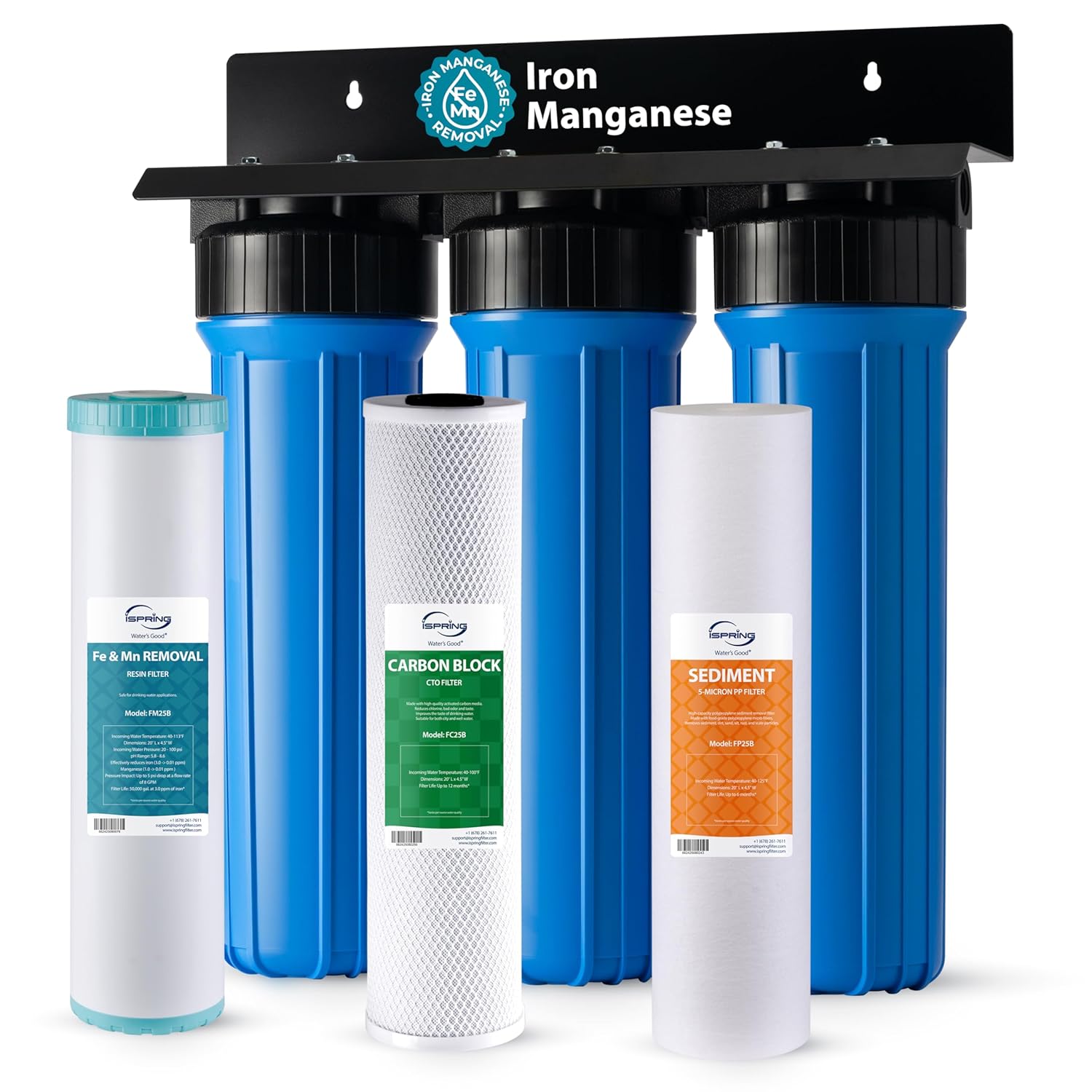
iSpring WGB32BM 3-Stage Whole House Filter
| Maximum Flow Rate | 15 gpm |
|---|---|
| Operating Pressure Range | 25 – 80 psi |
| Operating Temperature | 40 – 100 °F |
| Inlet / Outlet | 1 inch NPT |
| Capacity | 100000 gallons |
The iSpring WGB32BM is a tankless, permanent whole-house filtration system that combines a big-blue sediment stage, a coconut-shell carbon block, and a catalytic iron and manganese reduction cartridge to treat incoming well or municipal water. It is typically installed at the main supply line to protect plumbing and appliances and to provide cleaner water for cooking, bathing, and laundry. Notable features include a high-capacity first-stage sediment filter to reduce clogs, a carbon block that reduces chlorine, taste and odor, and a third-stage catalytic media that lowers iron and manganese to trace levels when inlet concentrations are within the specified range. The system supports flow up to 15 gallons per minute with minimal pressure loss and uses 20-inch x 4.5-inch replaceable cartridges rated for long service life (up to 100,000 gallons or 12 months for some stages and 50,000 gallons for iron reduction under specified iron loads). Practical benefits are robust contaminant reduction, fewer maintenance cycles compared with smaller cartridges, and DIY-friendly installation aided by online guides. Important limitations are that it does not soften water or remove dissolved solids, and its iron/manganese effectiveness is limited to specified maximum inlet concentrations, so very high iron requires a different model or pretreatment.
Best for: Buyers who prioritize a durable, low-maintenance whole-house filter to reliably protect plumbing and appliances from sediment, chlorine, and modest iron or manganese levels.
Less Ideal for: Homes with very high iron or manganese concentrations, or households that need water softening or TDS reduction should consider systems with dedicated softeners or reverse osmosis solutions instead.
- Three-stage filtration targets sediment, chlorine/taste/odor, and iron/manganese specifically
- High-capacity 20-inch cartridges with long rated life reduce replacement frequency
- Supports up to 15 GPM flow with minimal pressure loss for whole-house coverage
- Tankless, permanent installation protects appliances and plumbing throughout the home
- Does not reduce water hardness or total dissolved solids
- Iron and manganese removal is limited to inlet concentrations within the system's specified maximums
Verdict: Choose this system if you want a reliable, high-capacity whole-house filter that reduces sediment, chlorine, and moderate iron and manganese while minimizing maintenance.
Culligan WH-HD200-C Whole House Filter

| Maximum Flow Rate | 10 gpm |
|---|---|
| Supported Water TDS Level Maximum (PPM) | 600 |
| Capacity | 16000 gallons |
| Material Type | Stainless Steel |
The Culligan WH-HD200-C is a stainless steel-capped whole-house filter housing built to hold heavy-duty sediment and particulate cartridges (sold separately) and install at a 1-inch main water line. It is used as the primary point-of-entry filter to reduce visible sediment, sand, rust, silt and common aesthetic tastes and odors before water reaches appliances and fixtures. The clear sump lets you visually inspect cartridge condition without disassembly, and the included mounting bracket, built-in bypass/shut-off, pressure relief valve and housing wrench make installation and routine cartridge swaps straightforward. The unit is not a complete filtration solution on its own since you must select a compatible cartridge to target specific contaminants, and size limits like the 10 gpm flow rating and 1-inch fittings mean it is aimed at typical residential mains rather than larger commercial feeds. For homeowners who want a durable, serviceable point-of-entry housing with visible monitoring, this is a practical option.
Best for: Homeowners on well or municipal supplies who want a durable point-of-entry housing to remove sediment and protect appliances and who prioritize visible filter monitoring and serviceability.
Less Ideal for: Buyers seeking a turnkey multi-stage contaminant removal system or those needing higher flow capacity for large properties should consider integrated multi-cartridge systems or commercial-grade housings instead.
- Universal 1" housing fits standard residential main lines and many heavy-duty cartridges
- Stainless steel cap and WQA-tested construction for durability
- Clear sump enables quick visual checks of filter condition
- Included bypass, shut-off, pressure relief valve and mounting bracket simplify installation and servicing
- Filter cartridges are sold separately so additional purchase is required
- Rated for up to 10 gpm which may be limiting for very large households or high-flow systems
Verdict: Choose the WH-HD200-C when you want a robust, serviceable whole-house housing that visibly protects plumbing and appliances from sediment with industry-tested construction.
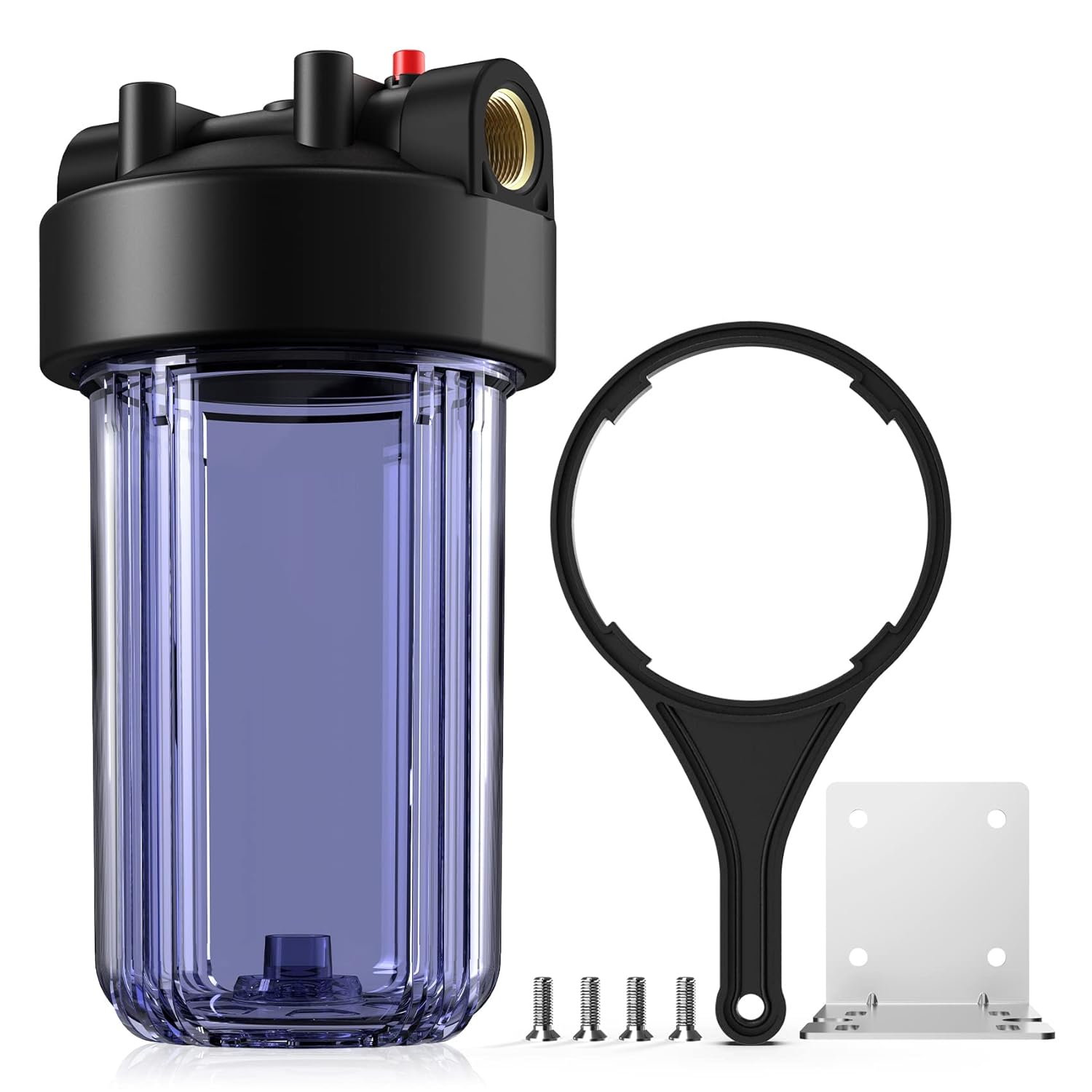
SimPure DB10C 10" x 4.5" Housing
| Inlet/Outlet | 1" NPT Brass Port |
|---|---|
| Compatible Filter Dimensions | 10" x 4.5" |
| Maximum Flow Rate | 20 gpm |
| Working Water Pressure Range | 15-90 PSI |
| Applicable Water Temperature | 41-104 °F |
The SimPure DB10C is a replacement whole-house filter housing designed to hold standard 10" x 4.5" cartridges for sediment or carbon pre-filtration. It mounts inline on a 1" NPT supply using the included heavy-duty bracket and comes with a wrench and screws for installation. The clear reinforced polypropylene bowl makes it easy to see cartridge condition and the brass inlet/outlet ports plus double O-ring design reduce leak risk. A built-in red pressure-relief button speeds cartridge changes and the housing is rated for typical residential water temperatures and pressures, with a quoted maximum flow of 20 gpm. This housing does not include filter cartridges, so you will need compatible sediment or carbon filters for particle removal or chlorine taste reduction. The unit is practical for protecting downstream appliances and water heaters on well or municipal systems, though its larger size requires planning for installation space and cartridge access. It is a straightforward, durable pre-filter housing for buyers who want visible filter monitoring and robust plumbing connections.
Best for: Homeowners who want a reliable pre-filter housing to protect plumbing and appliances on well or municipal supplies and value visible cartridge monitoring and sturdy plumbing connections.
Less Ideal for: Buyers who need a complete filtration system out of the box or have very limited installation space where a 10" housing cannot fit.
- Clear housing lets you visually inspect cartridge condition without disassembly
- 1" NPT brass ports and double O-ring design improve sealing and durability
- Includes mounting bracket, wrench, and installation screws for a complete housing install
- Built-in pressure-relief button simplifies safe cartridge changes
- Compatible with standard 10" x 4.5" sediment and carbon cartridges for flexible pre-filtration
- Filter cartridges are not included so additional purchase is required
- Requires enough clearance for the 10" housing and cartridge changes during maintenance
Verdict: Choose the SimPure DB10C if you want a sturdy, visible 10" whole-house housing with brass ports to protect downstream appliances on well or municipal water.
Choosing the Right Well Whole-House Water Filter: Key Factors to Consider
Contaminant Profile
Know what is in your well water before choosing a system. A basic sediment problem calls for a different media than dissolved iron, manganese, or biological contaminants. Start with a comprehensive water test that reports turbidity, iron levels, hardness, pH, and any microbial indicators.
The contaminant profile dictates media type and stage count. For example, sediment filters are rated by micron size, while iron often requires oxidation or specific iron-removal media. Biological issues may require disinfection steps; dissolved organics may need activated carbon. Matching the filter technology to the test results avoids unnecessary expense and ensures targeted performance.
Flow Rate and Household Demand
Measure peak flow demand in your home to avoid pressure drops. A single shower, dishwasher cycle, and toilet flush can add up; factor in simultaneous use when sizing a whole-house system. Manufacturers list nominal flow rates in gallons per minute; choose a system with a continuous flow capacity above your household peak to preserve water pressure.
Also consider peak surge capacity for short high-flow events. Undersized systems throttle water flow and create user frustration, while oversized systems increase upfront cost and footprint without proportional benefits.
Filter Media Life and Maintenance
Understand how often media or cartridges must be replaced and how easy that process is. Some systems use long-life media beds that need professional regeneration or periodic backwashing, while cartridge-based systems are homeowner-serviceable with regular swaps. Maintenance frequency affects total cost of ownership and convenience.
Check whether replacement parts are proprietary, how widely available they are, and whether routine maintenance requires special tools. Systems that allow visual inspection or include service indicators make it easier to keep performance within spec and avoid unexpected failures.
Installation Requirements and Space
Whole-house filters can be large and may need floor space, clearance for service, and suitable inlet/outlet plumbing. Consider whether installation will be in a basement, utility room, or near the pressure tank. Some systems require a dedicated drain for backwash or regeneration; others are closed-loop and need only inline plumbing.
Assess whether you will perform the installation yourself or hire a pro. Complex installs involving electrical connections, drain hookups, or modifications to pressure systems are best left to trained technicians. Verify local code requirements for well-water equipment and any necessary permits.
Corrosion Resistance and Climate Considerations
Well systems are often installed in damp basements or unconditioned spaces. Materials that resist corrosion and rust—stainless steel, coated steel, or durable plastic housings—extend service life. Consider freeze risk if the filter will be placed in an unheated area and whether insulation or relocation is necessary.
Also account for water chemistry that can accelerate corrosion or clog media. High acidity or very hard water may require upstream conditioning or sacrificial components designed to be replaced rather than corroded through the main system.
Certifications and Test Data
Look for independent lab test results or certifications that confirm contaminant reduction claims. Certifications are more common for point-of-use devices but lab reports and third-party testing for whole-house media can demonstrate effectiveness against specific contaminants.
While certifications do not replace proper water testing and system sizing, they provide objective evidence that a particular media or configuration has been tested under defined conditions. Use those results to align expectations about which contaminants the system will reduce and by how much.
Common Well Water Problems and How Filters Address Them
Private wells can present a mix of issues that whole-house filters are designed to manage. Sediment and turbidity are the simplest problems and are typically handled by mechanical prefilters rated in microns. Iron and manganese may be present in dissolved form or as particulates and often require oxidation or specialized media to remove effectively.
Biological contamination, while less common, poses health concerns and usually requires disinfection or media that can trap and remove cysts. Organic compounds and tastes or odors respond well to activated carbon stages. A well-configured system often combines multiple stages so each media targets a specific contaminant class without compromising flow.
- Sediment: mechanical filtration 1–50 micron
- Iron and manganese: oxidation or catalytic media
- Biologicals: disinfection or cyst-rated media
- Taste and odor: activated carbon stages
Sizing a System to Your Home
Calculate household peak demand and choose a system with a continuous flow rate above that number. Typical families need systems rated anywhere from 10 to 20 gallons per minute depending on simultaneous use. Remember to include irrigation or outbuildings when applicable.
Also consider pressure drop at typical flow. Some high-filtration media create more resistance; check manufacturer specifications for expected pressure loss at various flow rates and plan plumbing to maintain adequate water pressure to fixtures.
- List fixtures and estimate simultaneous use
- Allow headroom above calculated peak flow
- Review pressure drop specs for chosen media
Installation Tips for Reliable Performance
Place the whole-house filter at the point the water enters the home, after the pressure tank but before branch plumbing. Provide sufficient clearance for replacing cartridges or pulling media tanks if needed. If backwashing is required, ensure a nearby drain can accept the discharge without violating local codes.
Label shutoff valves and install bypass plumbing so water can be routed around the filter during service. Consider a sediment pre-filter to protect finer media downstream and extend service intervals. If you are not confident with plumbing or electrical hookups, hire a qualified technician to prevent leaks or malfunctions.
- Install at main inlet after pressure tank
- Include bypass valve for maintenance
- Provide dedicated drain for backwash when required
Maintenance Schedules and What to Expect
Service intervals vary widely by media type and incoming water quality. Mechanical sediment cartridges may need replacement every few months in high-silt wells, while catalytic or ion-exchange media can last years before media replacement or regeneration. Systems with automatic backwash reduce manual intervention but still require periodic inspection.
Budget for consumables, clamps, seals, and occasional professional service. Regular maintenance preserves flow performance and contaminant reduction, and catching issues early prevents damage to downstream appliances and plumbing.
- Replace sediment cartridges based on turbidity levels
- Monitor pressure drop to detect clogging
- Schedule professional checks for media beds or regenerating systems
When to Add Pretreatment or Post-Treatment
Some well waters need staged approaches. Highly turbid or iron-rich water benefits from a coarse sediment trap ahead of finer media to prevent premature fouling. Very hard water may require a separate softening step if scale buildup threatens plumbing or appliances.
Post-treatment such as point-of-use polishing filters or UV disinfection provides added protection for drinking water at the tap. Consider adding these stages where drinking water safety or taste is a priority, while retaining whole-house filtration for appliance and plumbing protection.
- Use coarse pre-filtration for high sediment wells
- Consider softening before media that is sensitive to hardness
- Add point-of-use polishing or UV for drinking water safety
How We Chose the Best Well Whole-House Water Filter
We focused exclusively on systems designed for private well water and prioritized features that matter for long-term household protection. Evaluation criteria included: filtration performance across common well contaminants such as sediment, iron, chlorine byproducts, and cysts; nominal and peak flow capacity to match household demand without pressure loss; filter media longevity and replacement frequency to gauge ongoing maintenance; system durability and corrosion resistance for continuous outdoor or basement installations; and installation complexity plus serviceability for typical homeowner or technician installs. We also considered certifications or test data where available to verify contaminant reduction claims. We excluded point-of-use devices and systems intended only for municipal or city-supplied water. We did not include softeners or systems that require extensive pretreatment beyond typical well scenarios unless that pretreatment was integral to handling common well issues. The result is a curated set of well whole-house water filters that balance contaminant removal, flow performance, and practical upkeep for private wells.
Our full evaluation process is outlined in our review methodology.
FAQ
How often should a whole-house filter on a well be tested or inspected?
Test well water annually for a baseline and after events like flooding or drilling. Inspect the filter and check pressure drop monthly at first, then adjust frequency based on observed sediment load and system performance.
Can a whole-house filter remove dissolved iron from well water?
Some media and configurations are designed to remove dissolved iron, often using oxidation followed by media capture. Effectiveness depends on iron concentration and whether the iron is dissolved or particulate.
Do all well whole-house systems require a drain for backwashing?
Not all systems require a drain. Cartridge-style systems are closed-loop and do not need a drain, while backwashing or regenerating systems discharge rinse water and typically require an appropriate drain or leach field.
Will a whole-house filter fix cloudy or discolored water immediately?
A properly matched whole-house system can resolve turbidity and discoloration, but results depend on correct sizing and media choice. Very severe contamination may require staged pretreatment before the filter can restore clarity consistently.
Is professional installation necessary for well whole-house filters?
Professional installation is recommended for systems involving electrical controls, drain hookups, or when modifications to pressure systems are required. Simpler cartridge installs can be DIY if you are comfortable with basic plumbing.
Final Verdict
When selecting a well whole-house water filter, prioritize a system that addresses your specific water test results while matching household flow demands and maintenance expectations. Expect tradeoffs between filtration depth and flow resistance: deeper contaminant reduction often requires more stages or media that can increase pressure drop and maintenance needs. Focus on contaminant-specific media, realistic service intervals, and durable materials that suit the installation environment. With a correctly sized and maintained system, you can protect plumbing and appliances and improve water quality across the home, making a single well-focused investment deliver long-term benefits.