
Note: This article contains affiliate links. If you click on these links and make a purchase, we may earn a small commission at no extra cost to you. This helps support our research and content. Read our full affiliate disclosure here.
If you want dependable hot water throughout a home while cutting standby heat loss, a whole-house electric tankless water heater can be a smart upgrade. These units deliver on-demand hot water and can reduce energy wasted by traditional storage tanks, but sizing and electrical requirements matter a lot. This guide shortlists the top whole-house electric tankless water heaters across common household needs. We focus on units that balance flow rate, energy efficiency, and practical installation considerations. Read on for the criteria we used and what to look for when choosing the right tankless water heater for your home.
Top Picks at a Glance
| Best Overall The best all-around choice for most situations | Rheem RTEX-24 Tankless Electric |  |
| Best Quality Built to a higher standard if you want something more solid | Stiebel Eltron Tempra 36 Plus |  |
| Best Value The sweet spot between price and what you get | WINTEMP 27kW Tankless Water Heater |  |
| Top Rated A top-rated pick with lots of positive feedback | EcoSmart ECO 18 Tankless Water Heater |  |
| Best Seller A high-volume bestseller chosen again and again | Rheem RTEX-18 Tankless Electric Water Heater |  |
Rheem RTEX-24 Tankless Electric

| Wattage | 24 KW |
|---|---|
| Voltage | 240 volts |
| Flow Rate | 5.9 gpm |
| Maximum Temperature | 140 °F |
| Mount Type | Wall |
The Rheem RTEX-24 is a wall-mounted tankless electric water heater built to provide continuous hot water for multiple fixtures, rated at 24 kW and up to about 5.9 gallons per minute in warm-climate conditions. It uses self-modulating power control and a front digital temperature display so the unit adjusts electrical draw to meet required heating and lets you set outlet temperature precisely. With no venting required and a compact stainless steel design it frees up space compared with tank heaters and is intended as a whole-home solution for two showers and additional sinks. Installation requires substantial electrical capacity — three 40 A double-pole breakers and a recommended 200 A household service — so expect higher upfront installation complexity and panel/work upgrades in many homes. The unit heats on demand and eliminates standby losses, improving operating efficiency, but peak flow and achievable temperature rise depend on incoming ground water temperature and home plumbing layout.
Best for: Homeowners who want a whole-house electric tankless heater that delivers continuous hot water to bathrooms and sinks while prioritizing efficiency and space savings.
Less Ideal for: Homes without adequate electrical service or limited breaker room capacity, or buyers who need higher flow in very cold climates without supplementary systems.
- High maximum output (24 kW) supports multiple fixtures simultaneously.
- Self-modulating power control improves efficiency by using only required power.
- Digital temperature control for precise outlet temperature adjustment.
- Compact wall-mounted design saves space and requires no venting.
- Stainless steel construction for durable indoor installation.
- Requires significant electrical capacity and multiple 40 A breakers, which may need panel upgrades.
- Flow rate and temperature rise vary with incoming water temperature and climate.
Verdict: Choose the RTEX-24 when you need a compact, efficient whole-home electric tankless unit that delivers reliable on-demand hot water for multiple fixtures.
Stiebel Eltron Tempra 36 Plus

| Wattage | 36 KW |
|---|---|
| Voltage | 240 volts |
| Flow Rate | 1.5 gpm |
| Maximum Temperature | 140 °F |
| Maximum Pressure | 150 psi |
The Tempra 36 Plus is a high-performance electric tankless water heater engineered for whole-home use where consistent hot water delivery matters. It uses self-modulating German technology to adjust power to demand, maintaining set temperature even during simultaneous draws, and the LED display makes temperature control straightforward. The unit requires 240V hard wiring and substantial circuit capacity, and its compact wall-mount design needs no venting, which simplifies placement. In warm climates it can support three to four showers at once and in cooler climates around three, so sizing should match your household demand and incoming water temperatures. The heater claims up to 99% efficiency and lower operating costs versus storage tanks, and installation is cleaner since there is no tank to maintain. Trade-offs include the need for significant electrical capacity and dedicated breakers, and performance will drop with very cold incoming water or if the unit is undersized for heavy simultaneous use.
Best for: Buyers who prioritize consistent, high-capacity electric tankless performance for whole-house hot water and are prepared to provide the necessary electrical infrastructure.
Less Ideal for: Homes without sufficient electrical capacity or buyers who need guaranteed high flow in very cold climates without upsizing or supplemental heating.
- High 36 kW heat output suitable for whole-home hot water in many climates
- Self-modulating technology maintains set temperature under varying flow
- Compact wall-mounted design requires no venting
- LED display for easy temperature monitoring and adjustments
- Requires substantial 240V electrical service and multiple dedicated breakers
- Hot water output depends on incoming water temperature and may be limited in very cold climates
Verdict: Choose the Tempra 36 Plus when you need a powerful, factory-quality electric tankless unit that reliably supplies whole-house hot water with smart self-modulation.
WINTEMP 27kW Tankless Water Heater
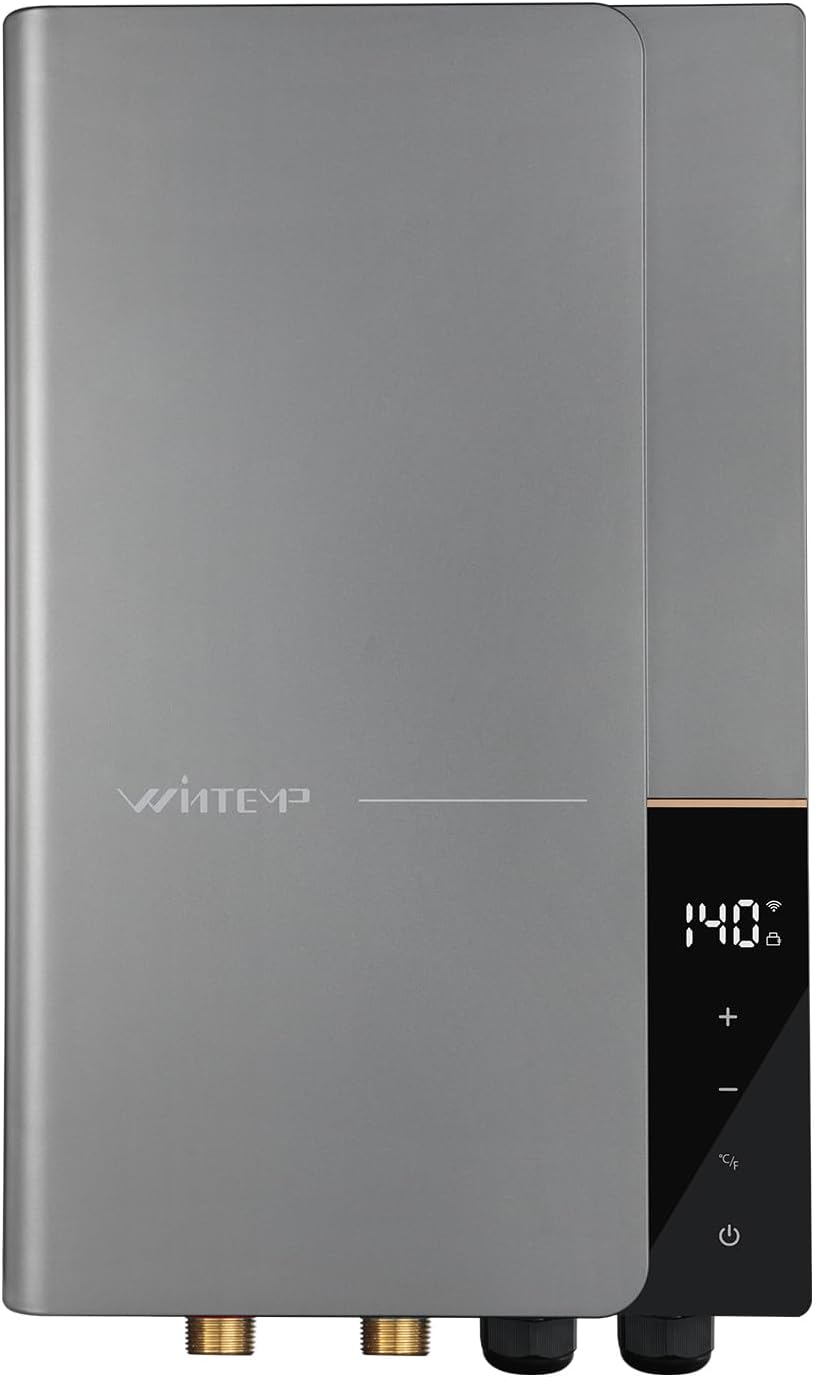
| Wattage | 27 KW |
|---|---|
| Voltage | 240 volts |
| Flow Rate | 6.5 gpm |
| Maximum Temperature | 140 °F |
| Special Features | LED Display, Overheat Protection |
The WINTEMP 27kW tankless water heater is a compact wall-mounted electric unit that provides on-demand hot water for whole-house or multi-point applications. It uses self-modulating control to adjust power to real-time flow and temperature demands, so it can heat water quickly to a maximum of about 140°F while reducing energy use when flow is low or idle. Typical installation ties into a 240V supply with three 40A double-pole breakers and heavy-gauge wiring, and the unit includes an LED display plus safety features such as overheat, leakage, and dry-fire protection and ETL certification. Practical benefits include a small footprint that saves space compared with tanks and virtually endless hot water for two to four points of use. Important limitations are the high electrical service and wiring requirements—it needs substantial panel capacity and correct sized breakers/wire—and its 6.5 gpm rating means very high simultaneous demand (multiple showers plus appliances) could exceed output. The unit ships with basic installation hardware and instructions but professional electrical and plumbing installation is recommended for safe, reliable performance.
Best for: Buyers who prioritize energy efficiency and space savings and who can provide or upgrade household electrical service to meet high amperage requirements for reliable whole-house hot water.
Less Ideal for: Households without the required electrical panel capacity or those needing very high simultaneous flow beyond about 6.5 gpm should consider other solutions or higher-capacity units.
- High continuous heat output suitable for whole-house or multi-point use.
- Self-modulating control that reduces power draw when flow is low for better efficiency.
- ETL certified with multiple safety protections including overheat and dry-fire protection.
- Compact wall-mounted design that saves space compared with tank heaters.
- Requires significant electrical capacity and specific breaker/wire configuration for installation.
- 6.5 gpm maximum flow may not support many fixtures at once in very high-demand households.
Verdict: A compact, energy-efficient 27kW electric tankless designed to deliver virtually endless hot water for 2–4 points of use when your home can meet its heavy electrical requirements.
EcoSmart ECO 18 Tankless Water Heater

| Heat Output | 18 KW |
|---|---|
| Wattage | 18000 watts |
| Voltage | 240 volts |
| Flow Rate | 3.51 gpm |
| Efficiency | 99.8 % |
The EcoSmart ECO 18 is a compact, wall-mounted electric tankless heater built to deliver on-demand hot water in climates where incoming water is about 62 degrees F or warmer. It uses self-modulating technology to adjust power draw to flow rate, and the unit provides digital temperature control with 1 degree increments so you can dial in a consistent outlet temperature. In typical use it can run one shower and a sink simultaneously at the stated inlet temperature and will support two showers in hotter regions where inlet temps exceed 70 degrees F. Installation requires a 240V feed with two 40A double-pole breakers and 8 AWG wiring, so plan for compatible electrical capacity. The practical benefits are continuous hot water without a storage tank, a small footprint for tight mechanical spaces, and factory-grade lifetime coverage on core components. Limitations are the modest flow rate for cooler climates and the need for proper electrical infrastructure, so it is best for homeowners in warmer regions or as a point-of-use replacement rather than a high-demand whole-house solution in cold climates.
Best for: Homeowners in warm-weather regions who want a reliable, compact electric tankless heater with precise temperature control and long-term component protection.
Less Ideal for: Homes in cold climates or properties with high simultaneous hot water demand where a higher-capacity or gas tankless unit is required.
- Self-modulating technology adjusts power to demand for consistent temperature control
- Digital temperature control with 1 degree increments for precise setpoint management
- Compact, wall-mounted design saves space compared with tank heaters
- Lifetime warranty on electronics, heat exchanger, and element for long-term component coverage
- Rated flow (around 2.5–3.5 gpm) assumes warm inlet water and drops in colder climates
- Requires significant electrical capacity (two 40A breakers and 8 AWG wiring) which may need panel upgrades
Verdict: Choose the ECO 18 if you need a compact, factory-backed electric tankless heater that reliably supplies on-demand hot water in warm climates with precise temperature control.
Rheem RTEX-18 Tankless Electric Water Heater
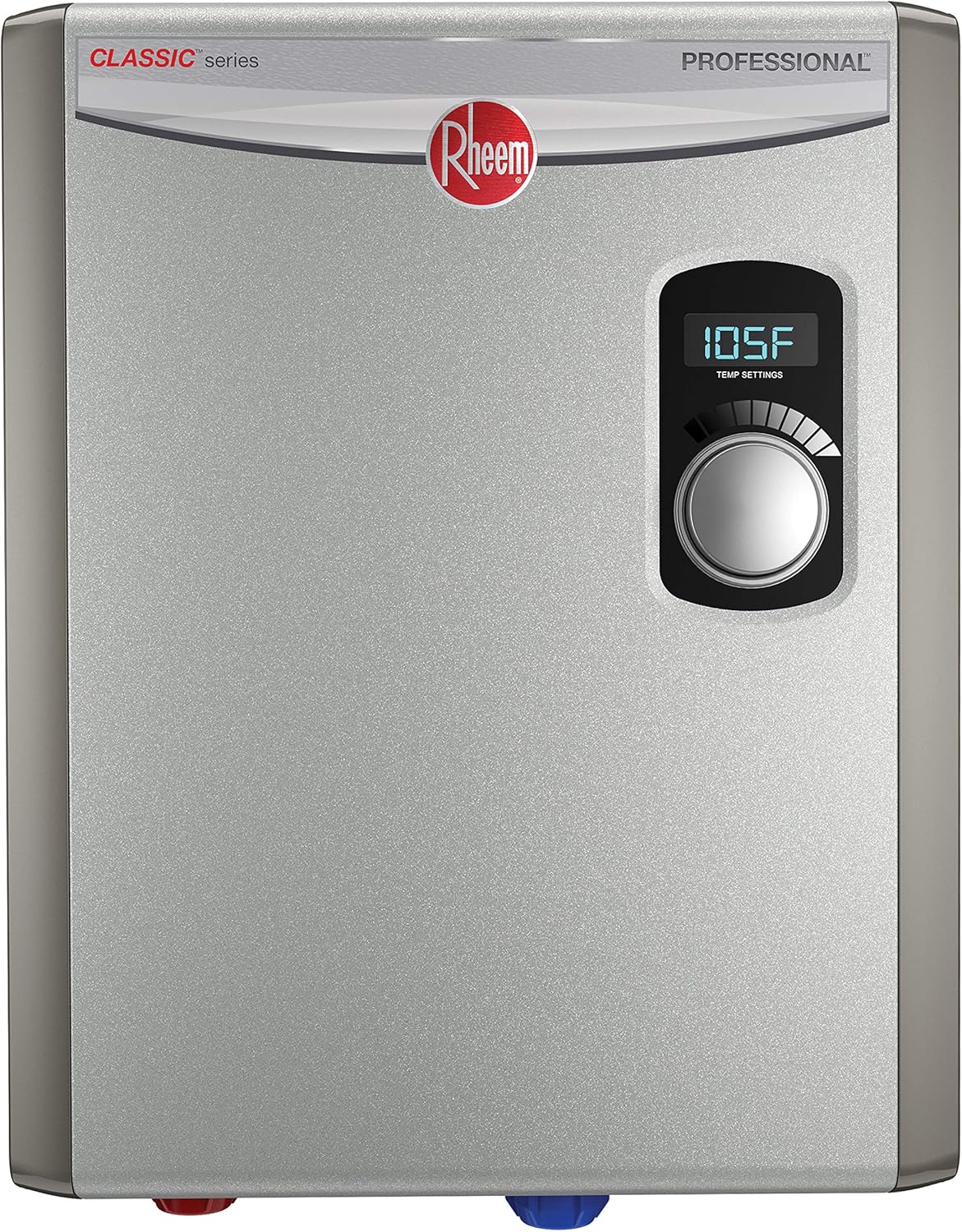
| Wattage | 18000 watts |
|---|---|
| Voltage | 240 volts |
| Flow Rate | 4.4 gpm |
| Maximum Temperature | 140 °F |
| Efficiency | 99.8% |
The Rheem RTEX-18 is a compact, wall-mounted tankless electric water heater built for whole-home or mid-range applications. It heats water on demand using two copper immersion heating elements with self-modulating control so the unit only draws the power needed to reach the set temperature, helping reduce energy use compared with tank models. The front LED display gives precise temperature adjustment and the unit supports up to 4.4 gallons per minute, which makes it suitable for a single shower plus a sink in average inlet temperatures. Installation is straightforward with bottom 3/4 inch NPT water connections and no venting required, and the serviceable heating elements make maintenance easier. Important limitations are the 18 kW output and 4.4 GPM flow rate, which may be insufficient for simultaneous high-demand fixtures in colder climates, and the unit requires appropriate 240V electrical service and breaker capacity. For buyers wanting compact, efficient on-demand hot water with simple controls, the RTEX-18 is a practical choice; larger households in cold regions should size up to a higher kW model.
Best for: Buyers who prioritize reliable, energy-efficient whole-home hot water in a compact, low-maintenance package and who prefer straightforward digital controls and proven technology.
Less Ideal for: Large households that need multiple showers running at once or homes in very cold areas where higher flow at larger temperature rises is required should choose a higher kW unit or a different solution.
- On-demand heating with self-modulating control reduces standby energy use
- Digital LED thermostatic control allows precise temperature setting
- Compact wall-mounted design saves space and needs no venting
- Serviceable copper immersion heating elements simplify repairs
- 4.4 GPM max flow limits simultaneous high-demand fixtures
- Requires adequate 240V electrical supply and breaker configuration
Verdict: The RTEX-18 is a compact, energy-smart whole-home tankless electric heater ideal for buyers who want precise digital control and lower operating waste without a bulky tank.
Choosing the Right Whole-House Electric Tankless Water Heater: Key Factors to Consider
Flow Rate and Temperature Rise
Flow capacity determines how many fixtures a unit can serve simultaneously. Manufacturers rate electric tankless water heaters by gallons per minute at a given temperature rise. In colder climates or when feeding multiple showers and appliances at once, you need a higher flow rating or a unit engineered to maintain temperature at higher flow.
Estimating your household peak demand helps translate flow ratings into real-world performance. Calculate the combined flow rates of simultaneous fixtures you expect to run, then match that number to the unit's specified flow at the temperature rise typical for your incoming groundwater temperature.
Electrical Service and Wiring Requirements
Whole-house electric tankless units often demand significant electrical capacity and multiple dedicated circuits. Confirm your home's main service amperage and panel space before choosing a unit. Some models require 200 amps or substantial multi-circuit configurations to deliver advertised flow rates.
Installation complexity affects cost and feasibility. If your panel lacks spare capacity, factor in potential service upgrades, conduit, and the need for licensed electrical work. Carefully review installation specs to ensure the chosen heater's circuit and breaker needs match what can be practically installed.
Energy Efficiency and Operating Cost
Electric tankless heaters avoid standby losses associated with storage tanks, which usually reduces energy waste. However, efficiency still varies by design and control strategy. Look for models with good heat-transfer efficiency and responsive temperature controls to avoid over-heating or temperature swings.
Estimate operating cost by combining the unit's efficiency data with your local electricity rates and typical hot water usage. Efficiency also influences how much electrical input is required to reach a target temperature rise, which ties back into electrical service planning.
Installation Location and Plumbing Compatibility
Where you mount the unit affects both performance and convenience. Locate the heater near the main hot-water distribution or the highest-demand area to minimize delivery lag. Consider inlet water hardness and the need for water treatment; scale can impair heat element longevity in some electric units.
Plumbing compatibility includes pipe sizes, fittings, and ease of access for maintenance. Verify clearances required by the manufacturer for servicing and ensure you can meet those constraints in your chosen location.
Controls, Safety Features, and Diagnostics
User-friendly controls and built-in diagnostics simplify setup and troubleshooting. Temperature setpoint accuracy, digital displays, and fault codes help fine-tune performance and alert you to issues. Safety features such as over-temperature protection, ground-fault protection, and automatic shutoff matter for reliable household use.
Advanced control features can also support temperature stabilization during variable flow conditions and may allow integration with external sensors for better system performance.
Warranty, Support, and Expected Lifespan
Warranty length and scope indicate manufacturer confidence and provide protection against early failures. Check what components are covered and whether labor or shipping is included for replacements. Also assess the availability of replacement parts and the clarity of service documentation.
Expected lifespan for electric tankless units depends on maintenance and water quality. Units with robust materials and clear maintenance guidance tend to last longer and incur fewer unexpected repair costs.
Sizing a Unit for Your Climate and Demand
Water inlet temperature varies by region and strongly affects how much heating power a unit needs to reach your desired hot-water temperature. Start by estimating your incoming groundwater temperature for the coldest season, then choose a heater with the flow-versus-rise performance that meets your peak simultaneous demand at that temperature.
If your household runs multiple fixtures at once, size for the combined peak flow rather than average usage. For smaller homes or mild climates, a more modestly rated unit can suffice. For cold climates or larger homes, prioritize higher flow at larger temperature rises.
- Estimate peak simultaneous fixture flow (showers, dishwasher, washing machine).
- Use regional groundwater temperature to determine required temperature rise.
- Match desired flow at that temperature rise to the unit's performance chart.
Electrical Planning and Upgrades
Electric tankless heaters are electrical loads first and water heaters second. Consult a licensed electrician early to confirm service capacity, panel space, and breaker configurations. The installation may require dedicated circuits, multi-pole breakers, and specific wire gauges.
Plan for potential additional costs and timelines if your home needs a service upgrade. Some installations route multiple cable runs or require subpanels to distribute load safely and cleanly.
- Verify main service amperage and panel spare capacity.
- Confirm required breaker sizes and wire gauge in installation documents.
- Account for conduit runs and potential subpanel needs.
Maintenance Needs and Longevity
Routine maintenance keeps electric tankless heaters operating reliably. Where water hardness is elevated, periodic descaling or inline water treatment prevents scale buildup on heating elements. Check maintenance intervals recommended by the manufacturer and plan access to the unit for servicing.
Pay attention to component accessibility, replaceable parts, and the availability of service documentation. Regular inspection of electrical connections and elements helps catch issues early and extend unit life.
- Follow descaling schedule if you have hard water.
- Inspect electrical connections annually.
- Ensure easy access for element replacement or servicing.
Installation Best Practices
Follow manufacturer clearance and mounting requirements to ensure safe operation and accessibility. Use certified technicians for electrical hookup and adhere to local codes for circuit protection and grounding.
During installation, confirm flow direction, pressure compatibility, and correct water filtration if recommended. Properly sized shutoff valves and a softener or scale prevention strategy can prevent common problems post-install.
- Install on a stable surface with required clearances.
- Use recommended strainers or filters on the cold inlet if specified.
- Label dedicated circuits and maintain documentation near the unit.
Realistic Expectations for Performance
Electric tankless water heaters offer continuous hot water but within the limits of their rated flow and available electrical power. Expect temperature to drop if demand exceeds the unit's capacity or if incoming water is unusually cold.
Plan for peak scenarios and understand that some tradeoffs may be unavoidable without increasing electrical capacity or installing multiple units in series or parallel when appropriate.
- Expect consistent delivery up to rated flow at specified rise.
- Understand performance drops when exceeding rated specifications.
- Consider system design options if your home has very high simultaneous demand.
How We Chose the Best Whole-House Electric Tankless Water Heater
We evaluated candidate whole-house electric tankless water heaters using a set of practical, measurable criteria that matter for real-world home installations. Key evaluation areas included flow capacity at realistic temperature rises, energy efficiency ratings and estimated operating cost, installation and electrical requirements, unit reliability and build quality, and available support documentation and warranty coverage. We prioritized products that provide consistent hot-water delivery for multiple simultaneous fixtures and that match common household electrical service scenarios. Units were excluded if they lacked clear performance data for flow versus temperature rise, required impractical electrical service upgrades for typical homes, or had minimal warranty or support information. We also filtered out models intended only for point-of-use or single-fixture use. The resulting shortlist emphasizes balanced performance and installability, so the metrics above drove the decisions rather than marketing claims or unverified performance figures.
Our full evaluation process is outlined in our review methodology.
FAQ
How do I calculate the flow capacity I need for my home?
Add the typical gallons-per-minute flow rates for fixtures you expect to run simultaneously, such as showers and appliances. Compare that total to a unit's specified flow at the temperature rise matching your incoming water temperature.
Will a whole-house electric tankless unit work on a standard 100-amp service?
It depends on the model and the required amperage. Many whole-house electric tankless heaters need substantial service capacity and multi-circuit setups. Consult an electrician to determine whether your panel supports the required breakers and wire sizes.
Do electric tankless heaters need a water softener?
Not always, but in areas with hard water, scale can shorten element life and reduce efficiency. Using a softener or scheduling regular descaling can protect the heating elements and maintain performance.
How often should I schedule maintenance for one of these units?
Maintenance frequency depends on water quality and usage. For typical conditions, an annual inspection is common, with descaling intervals varying from six months to a few years based on hardness. Follow the manufacturer's guidance for specific service tasks.
Can one electric tankless unit serve a large household with many simultaneous showers?
Possibly, but it depends on the unit's flow rating at the necessary temperature rise and your home's electrical capacity. Very high simultaneous demand may require multiple units or a higher-capacity electrical service to meet expectations.
Final Verdict
Choosing a whole-house electric tankless water heater requires balancing flow capacity, electrical practicality, and long-term operating costs. Prioritize the flow rate at the temperature rise you will experience, confirm your electrical panel and wiring can support the unit, and plan for water-quality maintenance to protect elements. Focus on units that align with your peak demand and installation constraints. If electrical upgrades are prohibitive, consider system design alternatives. With careful sizing and proper installation, a whole-house electric tankless heater can deliver reliable hot water and reduce standby energy loss.