
Note: This article contains affiliate links. If you click on these links and make a purchase, we may earn a small commission at no extra cost to you. This helps support our research and content. Read our full affiliate disclosure here.
Picking the right residential water heater affects everyday comfort, utility bills, and how well your household handles simultaneous hot-water demands. Whether you need faster recovery for a large family, better energy efficiency to lower monthly costs, or a compact unit to fit a tight utility closet, the right heater makes a tangible difference. This guide shortlists the top Residential Water Heater options across common home needs. We focused on units that deliver dependable hot water, sensible running costs, and straightforward installation or service. Below you will find our top picks and the evaluation criteria used to compare them.
Top Picks at a Glance
| Best Overall The best all-around choice for most situations | Rheem RTEX-13 Tankless Water Heater |  |
| Best Quality Built to a higher standard if you want something more solid | Rinnai RX160iN Tankless Water Heater |  |
| Best Value The sweet spot between price and what you get | GE 18 Gallon Electric Water Heater |  |
| Best Budget The cheapest option that still gets the job done reliably | xwdzswgs 3000W Tankless Water Heater |  |
| Top Rated A top-rated pick with lots of positive feedback | ThermoMate EH270 27kW Tankless Water Heater |  |
| Most Popular A crowd favorite that many people choose with confidence | Bosch Tronic 3000 T ES2.5 |  |
| Best Seller A high-volume bestseller chosen again and again | Rheem RTEX-18 Tankless Electric |  |
Rheem RTEX-13 Tankless Water Heater

| Power Source | Electric |
|---|---|
| Wattage | 13 KW |
| Voltage | 240 volts |
| Flow Rate | 4.8 gpm |
| Maximum Temperature | 140 °F |
The Rheem RTEX-13 is a compact, wall-mounted electric tankless heater that delivers on-demand hot water using two copper immersion heating elements and external digital thermostatic controls. It is typically used to supply a single point-of-use or serve small multi-point needs where a steady flow of hot water is required without a storage tank. Notable features include a precise LED display with 1°F adjustment increments, self-modulating power control for efficiency, and 1/2 inch compression water connections for straightforward installation. Practical benefits are continuous hot water, high reported energy efficiency, and field-serviceable heating elements which simplify maintenance. Important limitations are its modest flow capacity—listed at around 3.17 to 4.8 GPM depending on source text—so it may struggle to sustain multiple high-demand fixtures at once, and it requires a 240V, 54A circuit which can mean higher electrical requirements and installation cost compared with lower-power units.
Best for: Buyers who want a compact, efficient, on-demand electric heater for single-point use or light multi-fixture needs and value precise temperature control and serviceability.
Less Ideal for: Homes needing high simultaneous hot-water flow for several showers or appliances, or installations where a high-current 240V circuit is impractical.
- External digital LED thermostat with 1°F adjustment for precise temperature control
- Copper immersion heating elements that are field serviceable for easier maintenance
- Self-modulating power control improves energy use and adapts output to demand
- Compact wall-mount design saves space and simplifies installation
- Limited maximum flow rate makes it better suited to single fixtures or light multi-point use
- Requires a high-capacity 240V, 54A electrical supply which may need panel/upgrades
Verdict: Choose the RTEX-13 if you need a compact, energy-efficient electric tankless heater that delivers precise, on-demand hot water for single-point or light residential use.
Rinnai RX160iN Tankless Water Heater

| Power Source | Natural Gas or Propane |
|---|---|
| Flow Rate | 9 gpm |
| Maximum Temperature | 140 °F |
| Heat Output | 46880 watts |
| Mount Type | Wall |
The Rinnai RX160iN is a high-efficiency condensing tankless water heater designed to supply continuous hot water for a busy household. It delivers up to 9 gallons per minute, enough to run multiple fixtures simultaneously, and its convertible design lets installers use natural gas or propane. The unit is made for wall mounting and is compact—about the size of a small suitcase—so it reclaims space compared with traditional tanks. Key practical features include the Smart Sense gas control for reliable combustion and the Quick Flush service mode that simplifies routine maintenance. It is Energy Star qualified with a UEF around 0.97 to 0.98, which helps lower energy use for performance-focused buyers. The heater can be set up indoors or outdoors using the Versa Vent accessory and offers optional Wi-Fi connectivity via a separate module for monitoring and troubleshooting. Trade-offs are typical of high-performance tankless units: professional installation is recommended and upfront costs and install complexity are higher than for tank models, but the result is steadier hot-water delivery and improved long-term efficiency.
Best for: Buyers who prioritize continuous high hot-water output and long-term energy savings and who are prepared to invest in professional installation and a high-performance gas heater.
Less Ideal for: If you want the lowest initial purchase and install cost or prefer plug-and-play electric units, a traditional tank or simple electric heater will be a better fit.
- High flow rate up to 9 GPM suitable for multiple simultaneous fixtures
- Convertible fuel design supports natural gas or propane
- Very high energy efficiency (UEF ~0.97–0.98) for lower operating costs
- Compact wall-mount footprint saves space compared with tank heaters
- Quick Flush and Smart Sense controls simplify maintenance and reliable operation
- Requires professional installation and potential additional venting/parts for outdoor setup
- Higher upfront cost and installation complexity compared with conventional tank water heaters
Verdict: Choose the RX160iN when you need compact, high-flow on-demand hot water with top-tier efficiency for a performance-focused home.
GE 18 Gallon Electric Water Heater

| Power Source | Electric |
|---|---|
| Wattage | 14400 watts |
| Voltage | 120 volts |
| Heat Output | 140 °F |
| Capacity | 45 liters |
This GE 18‑gallon electric water heater is a compact, point‑of‑use storage tank that delivers hot water where space or wiring limits larger units. It installs with standard 3/4‑in NPT plumbing and connects to a 120‑volt supply, so you can set it on the floor in tight spots like a laundry room, garage, cabin, or under a sink. The unit is intended to work standalone for a single fixture or inline with another heater to boost long runs or washing machines. Practical controls let you adjust temperature at a knob, and durable components such as a stainless steel heating element, anode rod, and rust‑proof drain valve improve longevity and corrosion resistance. Its lower capacity means recovery and simultaneous fixture support are limited compared with full‑size tanks, so expect it to favor short runs and single‑fixture use rather than whole‑house demand. The 120‑volt hookup and compact footprint make it an easy retrofit solution when running 240‑volt power is impractical.
Best for: Buyers who need a practical, easy‑to‑install hot water solution for a single fixture, small apartment, or to boost long pipe runs and washing machines where running 240‑volt power is not desirable.
Less Ideal for: Households needing reliable hot water for multiple bathrooms or high simultaneous demand should choose a larger capacity or whole‑house model instead.
- Plug‑in 120‑volt connection for easy retrofit without new wiring
- Compact footprint fits tight spaces like under sinks, garages, or cabins
- Stainless steel heating element and anode rod for improved corrosion resistance
- Simple adjustable thermostat for straightforward temperature control
- 18‑gallon capacity limits simultaneous use and recovery speed compared with larger tanks
- Designed primarily for point‑of‑use or boosting rather than full‑house supply
Verdict: A compact, 120‑volt point‑of‑use water heater that provides an easy retrofit hot‑water boost for single fixtures or small homes.
xwdzswgs 3000W Tankless Water Heater

| Wattage | 3000 watts |
|---|---|
| Voltage | 110 volts |
| Flow Rate | 0.5 gpm |
| Maximum Temperature | 131 °F |
| Mount Type | Wall |
This compact 3000W tankless unit is a point-of-use electric water heater designed to sit under a sink or on a wall and deliver near-instant hot water for single fixtures. It heats quickly at low flow rates (the listing shows up to 0.5 gpm) and uses a touch-button LED display to set and monitor temperature in Celsius or Fahrenheit. The unit includes multiple safety protections such as dry-burn prevention, over-temperature automatic shutoff, IPX4 water resistance, and leakage protection, and it mounts vertically using the supplied screws. Practical benefits include a very small footprint that frees cabinet space, fast warm water for handwashing and small kitchen tasks, and a long power cord for flexible placement. Important limitations are the low flow rate, which makes it unsuitable for showers or simultaneous multi-fixture use, and the requirement for a dedicated wiring recommendation and a 32A trip switch for safe operation. Buyers should also follow the vertical-install instruction to avoid malfunctioning heating elements.
Best for: Buyers on a tight budget who need an inexpensive point-of-use solution for a single sink or small appliance and value compact, easy-to-install hot water without replacing a whole-house system.
Less Ideal for: Households that need hot water for showers, multiple fixtures, or higher flow applications should choose a higher-capacity or whole-home heater instead.
- Very compact wall-mounted design fits under sinks and in tight spaces
- Fast temperature rise at low flow for immediate hot water at a single fixture
- Built-in safety features including dry-burn protection, over-temperature shutoff, and IPX4 splash resistance
- Digital LED display with Celsius/Fahrenheit setting and touch controls
- Low maximum flow rate (about 0.5 gpm) limits use to one fixture at a time
- Requires proper electrical wiring and a recommended high-amperage trip switch for safe installation
Verdict: A budget-friendly, compact point-of-use electric tankless heater that delivers quick hot water for a single sink or small tasks.
ThermoMate EH270 27kW Tankless Water Heater

| Wattage | 27 KW |
|---|---|
| Voltage | 240 volts |
| Flow Rate | 6.6 gpm |
| Maximum Temperature | 140 °F |
| Maximum Pressure | 150 psi |
The ThermoMate EH270 is a high-power electric tankless water heater intended for whole-house or multi-fixture residential use. It provides instant hot water at up to 6.6 gallons per minute and uses a self-modulating control that adjusts output based on flow and inlet temperature to maintain stable delivery between 80 and 140°F. The unit is built around a cast aluminum heating block and alloy elements with an advanced water-and-electricity separation structure to reduce scale and corrosion, and it carries ETL listing and multiple safety cutoffs. Installation requires three 40A double-pole breakers and three runs of 8 AWG copper, so it is best fitted to homes with adequate electrical capacity, and professional wiring is recommended. Practical benefits include near-instant hot water for simultaneous showers and sinks, compact wall mounting that saves floor space, and claimed high thermal efficiency that avoids tank standby loss. The main constraints are the significant electrical requirements and the need to size the unit to local inlet temperatures to reach the advertised flow rates.
Best for: Buyers who prioritize a reliable, durable tankless system for whole-house or multi-fixture use and who can accommodate the required electrical upgrade will appreciate this model.
Less Ideal for: Renters, homes without sufficient main panel capacity, or buyers unwilling to install dedicated high-amperage circuits should consider lower-power or gas alternatives.
- High 27 kW output supports up to 6.6 GPM for multiple fixtures at once
- Self-modulating control maintains stable outlet temperature across varying flow
- Durable cast aluminum heating block and corrosion-resistant alloy elements reduce scale and extend life
- ETL listing with multiple safety protections and factory testing
- Compact wall-mount design frees floor space and fits small utility areas
- Requires substantial electrical capacity: 3x 40A double-pole breakers and three 8 AWG runs
- Performance depends on inlet water temperature so achievable GPM may be lower in cold climates
Verdict: Choose the EH270 when you need a factory-tested, high-capacity electric tankless heater that delivers stable hot water for multiple fixtures and is built for long-term reliability.
Bosch Tronic 3000 T ES2.5
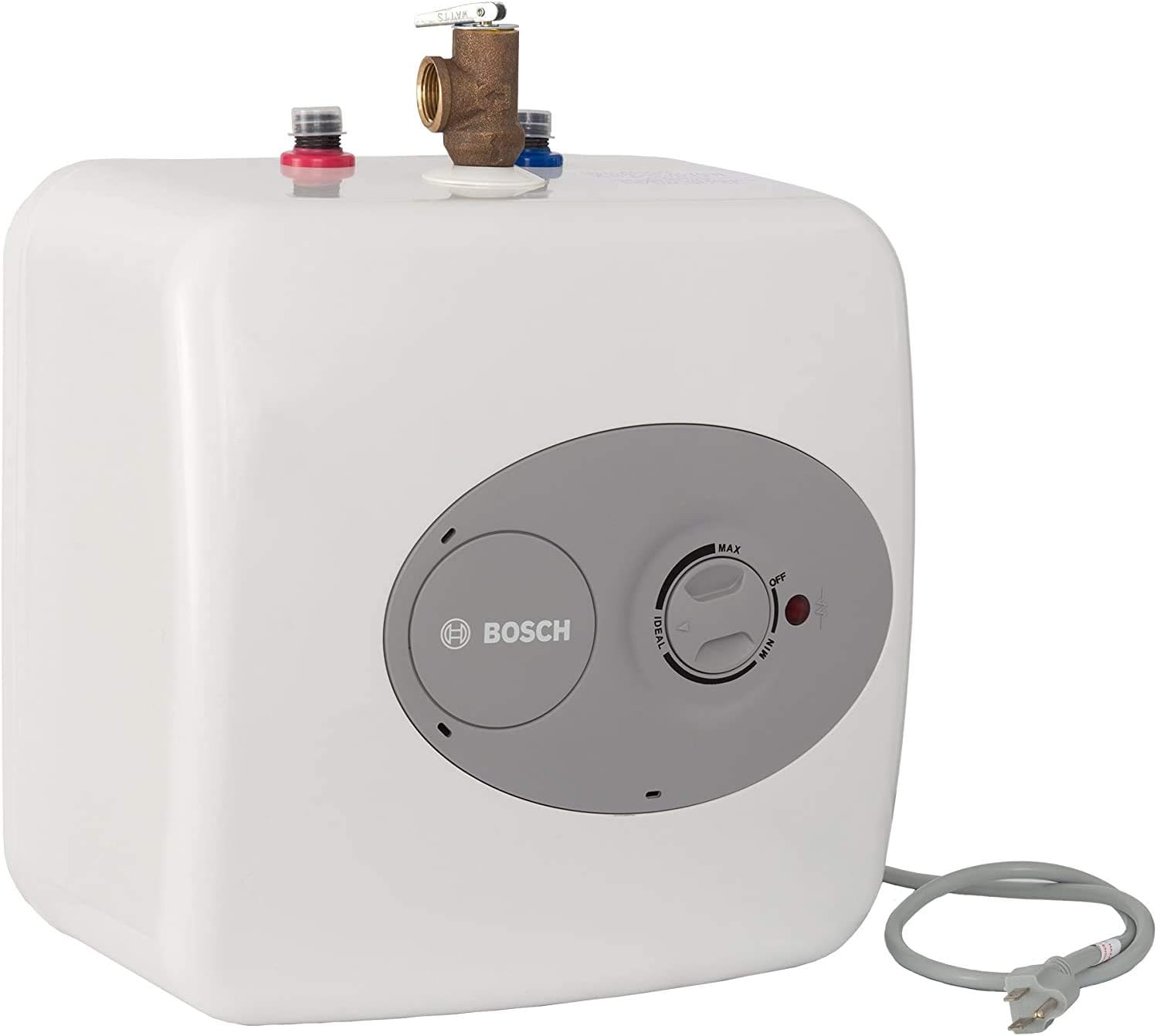
| Capacity | 2.5 gallons |
|---|---|
| Wattage | 1440 watts |
| Voltage | 120 volts |
| Maximum Temperature | 140 °F |
| Efficiency | 98% |
The Bosch Tronic 3000 T ES2.5 is a compact electric mini-tank that sits under a sink or mounts on a wall to provide immediate hot water at the point of use. It is typically used to eliminate long waits for hot water at bathroom or kitchen sinks or to supplement a distant main water heater. The unit runs on 120 volts and 1440 watts, has a glass-lined 2.5-gallon tank for durability and insulation, and an external dial for temperature control; it also includes a temperature-and-pressure relief valve for safety. Its plug-in power cord allows independent installation without changing household wiring, and the claimed 98% thermal efficiency and fast recovery make it practical for supplying hot water to one or two nearby fixtures. Limitations include its small capacity, which means it is not suited for large simultaneous draws or full baths, and it requires space beneath a sink or a suitable mounting surface for neat installation.
Best for: Buyers who prioritize reliable, compact solutions to eliminate wait time for hot water at a sink and who want a unit backed by strong customer feedback and proven performance.
Less Ideal for: Households that need hot water for showers, tubs, or multiple fixtures at once should choose a larger-capacity or whole-house solution instead.
- Point-of-use design provides near-instant hot water at sinks to reduce wait time
- Glass-lined tank improves corrosion resistance and durability
- Plugs into a standard 120V outlet for easy independent installation
- External temperature dial and T&P relief valve add control and safety
- 2.5-gallon capacity is small and not suitable for extended or multiple large draws
Verdict: Choose the Bosch Tronic 3000 T ES2.5 when you want a compact, easy-to-install mini-tank that reliably delivers hot water at the sink on demand.
Rheem RTEX-18 Tankless Electric
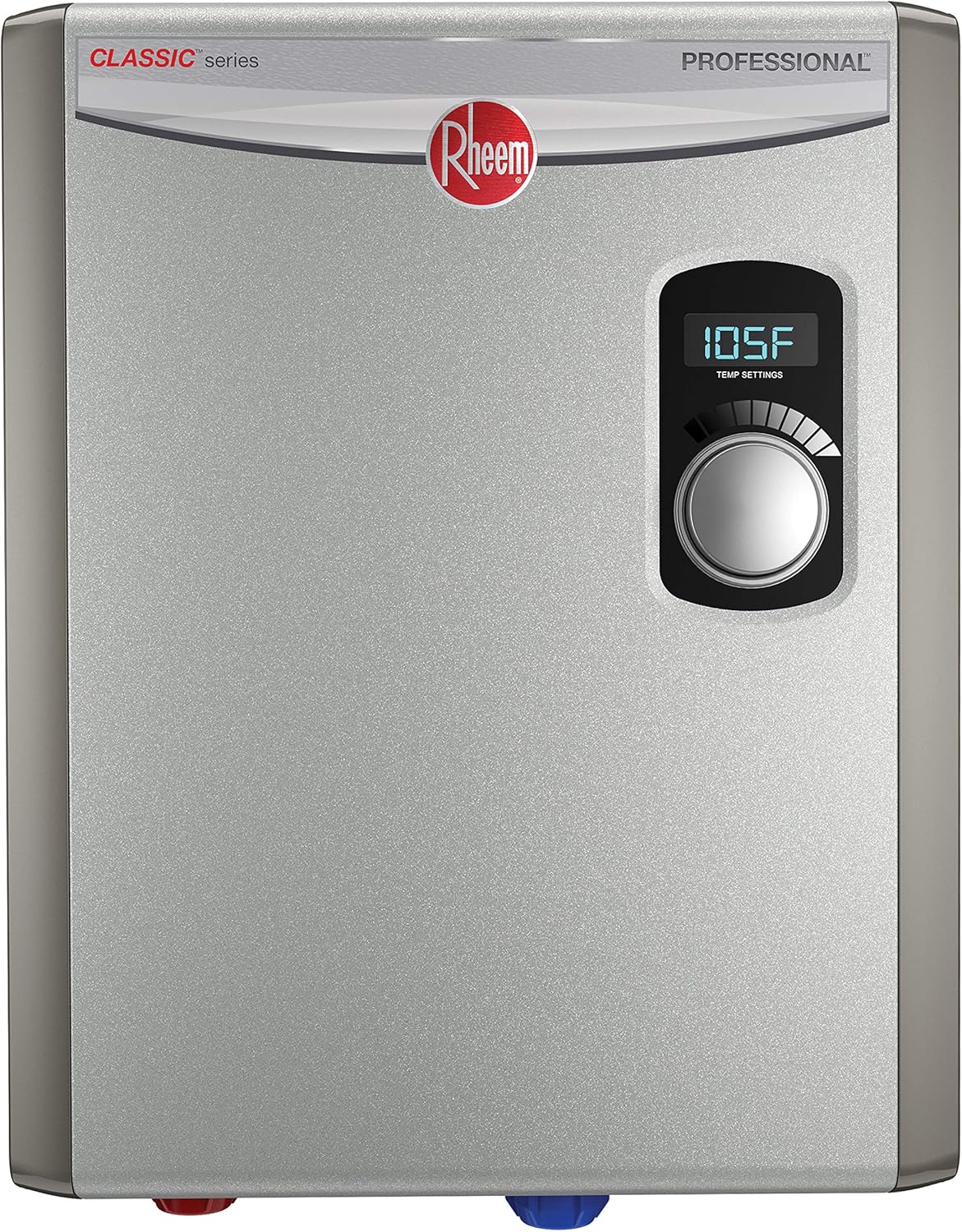
| Power Source | AC Power |
|---|---|
| Wattage | 18000 watts |
| Voltage | 240 volts |
| Flow Rate | 4.4 gpm |
| Efficiency | 99.8% |
The Rheem RTEX-18 is a wall-mounted tankless electric water heater built for mid-range whole-home applications where a 4.4 gpm flow rate is sufficient. It heats water on demand using two field-serviceable copper immersion elements and self-modulating electronics that adjust power to match hot water demand, which reduces standby energy use compared with tank models. The front LED display gives precise temperature control and the unit requires no venting, so it can be installed inside closets or utility spaces. Practical benefits include smaller footprint, lower energy draw when not in use, and simplified plumbing connections with threaded 3/4 inch NPT fittings. Important limitations are its maximum flow of 4.4 gpm and 18 kW output, meaning it may struggle to supply multiple high-flow fixtures at once in colder inlet conditions, and it requires appropriate 240V electrical service and breaker capacity for safe installation. For homeowners seeking a compact, efficient electric option for a single shower or moderate whole-home load, the RTEX-18 is a reliable choice; larger households or those needing higher simultaneous flow should consider higher-capacity units.
Best for: Buyers who want a compact, energy-efficient electric tankless heater that provides reliable on-demand hot water for single showers or moderate whole-home needs and who prefer proven, serviceable hardware.
Less Ideal for: Large households with frequent simultaneous hot-water demands or homes without adequate 240V electrical capacity should look at higher-capacity solutions or gas alternatives.
- On-demand heating with self-modulating control to reduce energy use when demand is low
- Digital LED temperature control for accurate set point adjustment
- Compact wall-mounted design that does not require venting
- Field-serviceable copper heating elements for easier maintenance
- Maximum 4.4 gpm flow and 18 kW output limits simultaneous high-flow fixtures
- Requires 240V electrical service and multiple high-amp breakers for installation
Verdict: A compact, energy-saving electric tankless heater that reliably delivers on-demand hot water for moderate whole-home use or single-shower installations.
Choosing the Right Residential Water Heater: Key Factors to Consider
Capacity and Household Size
Capacity directly affects how much hot water is available before the unit needs to recover. For tank-style residential water heaters, larger gallon capacities provide longer continuous hot-water availability during peak periods such as morning routines or back-to-back showers.
For smaller households or apartments, a compact capacity may be sufficient and saves space and standby energy loss. Large or multi-bath homes should prioritize higher usable capacity and first-hour output so multiple fixtures can run without running out of hot water.
Recovery Rate and First-Hour Output
Recovery rate measures how quickly a heater can heat incoming cold water after the tank has been depleted. This matters when several hot-water draws happen in quick succession, such as laundry and showers running around the same time.
First-hour output combines tank capacity and recovery to estimate how much hot water is available during the first hour of use. A higher first-hour number means fewer interruptions in everyday use and reduces the risk of cold-water surprises when demand spikes.
Energy Efficiency and Operating Cost
Efficiency ratings and standby heat loss determine ongoing energy consumption. More efficient units cost less to run over time and are especially valuable if hot water is used frequently or the household plans to keep the heater for many years.
Consider both the unit's efficiency specification and realistic usage patterns. Reducing standby loss, selecting better insulation, or choosing a higher-efficiency configuration can shrink monthly bills and the system's long-term environmental footprint.
Installation Requirements and Space
Where and how a heater installs affects project cost and feasibility. Tank units need floor space and clearance for venting and servicing. Some configurations require specific venting, gas line sizing, or electrical supply upgrades.
Inspect your utility area for clearance, access, and whether modifications will be needed. Simpler installations reduce labor cost and hassle, while complex installs may require professional assessment to ensure safe, code-compliant hookups.
Durability and Warranty
Build quality, corrosion resistance, and warranty length are indicators of expected service life. A more robust construction and longer warranty can justify a higher initial investment by reducing the likelihood of premature replacement or repairs.
Look for corrosion-resistant materials, accessible service panels, and clear warranty coverage for key components. Consider the ease of servicing common wear parts, since simpler maintenance extends the useful life of the heater.
Safety Features and Temperature Control
Accurate thermostats and safety devices like pressure-relief valves reduce scald risk and prevent unsafe pressure buildup. Reliable temperature control also keeps hot-water delivery consistent, improving comfort and reducing the chance of overheating.
Check the availability of lockable settings, precise temperature adjustments, and quality safety valves. Properly sized and functioning safety components are essential for any residential hot-water system.
Tank Vs Tankless Considerations
Different residential water heater architectures suit different needs. Tank-style heaters store hot water ready for immediate use, which simplifies supply for simultaneous demands but introduces standby heat loss. Tankless systems heat water on demand, offering continuous flow without storage but requiring adequate flow rate and power capacity for high-demand scenarios.
Choosing between the two often comes down to peak demand patterns and installation constraints. Homes with frequent simultaneous draws typically favor higher-capacity tank units or high-flow tankless setups with appropriate power supply. Smaller households that use hot water intermittently may find on-demand units reduce energy waste.
- Tank units: steady immediate supply, simpler plumbing, standby losses.
- Tankless units: no standby loss, compact, require higher upfront infrastructure.
Sizing a Heater for Real-World Use
Accurate sizing prevents both shortages and unnecessary overspending. For tank units, estimate peak hour demand by totaling likely simultaneous uses such as showers, dishwasher, and laundry. Match that to the first-hour output rating. For on-demand units, sum peak flow rates and ensure the unit's flow and temperature rise meet that need.
Also account for future changes. Growing household size or planned remodels that add bathrooms means choosing a larger capacity or a scalable system now can avoid premature replacement later.
- Estimate simultaneous fixture usage to determine tank first-hour needs.
- For tankless, check flow rate at desired temperature rise.
Maintenance Tips to Extend Service Life
Regular maintenance preserves efficiency and reduces breakdown risk. For tank heaters, periodic flushing removes sediment that reduces heat transfer and can shorten element life. Checking the anode rod annually prolongs tank integrity by preventing corrosion.
For on-demand systems, cleaning or descaling the heat exchanger in hard-water areas maintains flow and efficiency. Regardless of type, inspecting pressure-relief devices and verifying thermostat accuracy are key preventive steps.
- Flush tanks annually or per manufacturer recommendations.
- Inspect and replace anode rods when corrosion is evident.
- Descale tankless heat exchangers in hard-water installations.
Installation and Venting Basics
Proper venting and combustion air are essential for gas-fired residential water heaters. Ensure vent runs meet code for length and pitch and that combustion air is adequate for safe operation. Electric heaters avoid combustion venting but require proper circuit sizing and breaker protection.
Location choices affect serviceability. Install units where technicians can access controls and replace common parts without major disassembly. Consider noise, proximity to living spaces, and potential water damage pathways when siting the unit.
- Verify venting requirements early to avoid retrofit complications.
- Ensure electrical or gas supply matches the unit's demands.
- Place heaters where routine service is accessible and safe.
Energy-Saving Upgrades and Controls
Several upgrades reduce operating costs. High-efficiency insulation blankets for older tanks lower standby losses. Temperature setbacks, programmable controls, or smart thermostats can reduce heating during low-use periods. For on-demand systems, modulating burners or proportional controls improve fuel use by matching output to demand.
Evaluate whether additional features are worth the installation complexity. Some controls require professional setup to integrate with existing plumbing or electrical systems.
- Insulation reduces standby heat loss for tank units.
- Programmable controls can lower energy use during predictable low-demand times.
- Modulating controls on on-demand units increase efficiency across variable loads.
How We Chose the Best Residential Water Heater
We evaluated Residential Water Heater candidates using criteria that reflect real-world homeowner priorities. Key dimensions included recovery rate and first-hour output because these determine how well a heater meets simultaneous morning or evening demand. Energy efficiency and annual operating cost projections were considered next, using published efficiency ratings and realistic usage patterns to estimate household energy use. Build quality and warranty coverage were used to assess expected lifespan and serviceability. Installation complexity and mounting or footprint requirements were reviewed to ensure practical fit in typical utility spaces. Finally, safety features and temperature control accuracy were examined to reduce scald risk and maintain consistent delivery. We excluded units intended exclusively for commercial or industrial use, specialty point-of-use devices, and any products lacking verified efficiency or output specifications. Our short list favors models that balance usable hot-water capacity with energy consumption and that can be installed in common residential settings. The scoring labels below match the dimensions we prioritized during selection.
Our full evaluation process is outlined in our review methodology.
FAQ
How large of a tank do I need for a typical four-person household?
A typical four-person household often needs a tank in the mid to high range of residential capacities to cover morning and evening peak use. Focus on the unit's first-hour output rather than tank size alone, as recovery rate affects sustained supply during consecutive uses.
Are tankless residential water heaters better for energy savings?
Tankless designs eliminate standby losses and can lower energy use in households with intermittent hot-water needs. Energy savings depend on usage patterns, incoming water temperature, and the efficiency of the unit. Homes with continuous high demand may not see as large savings without a properly sized system.
What routine maintenance is required for tank-style units?
Routine maintenance typically includes flushing the tank to remove sediment, checking and replacing the anode rod when needed, and testing the pressure-relief valve. Performing these tasks on a regular schedule helps maintain efficiency and prolongs service life.
Can I install a high-capacity heater in a small utility closet?
Possibly, but you must confirm clearance, venting, and service access. Larger units may need additional venting or combustion air and require sufficient space for maintenance. A site inspection will determine whether modifications are necessary for safe installation.
How do I reduce the risk of scalding from a residential water heater?
Set the thermostat to a safe maximum temperature and consider installing thermostatic mixing valves at fixtures to limit hot-water delivery. Regularly verify thermostat accuracy and ensure safety valves are functioning to maintain safe temperature control.
Final Verdict
Prioritize first-hour output and recovery rate if you frequently use multiple hot-water fixtures at once. If your household has intermittent use patterns and you want to minimize standby losses, consider on-demand options that match your peak flow needs. Balance efficiency, installation complexity, and warranty coverage to align with your space and long-term plans. Focus on the metrics that most affect daily comfort and operating cost. With attention to sizing, venting, and maintenance, you can choose a residential water heater that reliably meets your household's hot-water needs for years to come.