
Note: This article contains affiliate links. If you click on these links and make a purchase, we may earn a small commission at no extra cost to you. This helps support our research and content. Read our full affiliate disclosure here.
Picking the right whole-house tankless water heater affects daily comfort, utility bills, and how well your home supplies hot water during peak demand. You want a unit that can deliver enough gallons per minute for showers and appliances, operate efficiently to reduce energy use, and be sized and installed correctly for your plumbing and climate. This guide highlights the top shortlisted whole-house tankless water heaters and explains the key performance and installation factors buyers should weigh. Below you will find our top picks and clear evaluation criteria covering flow capacity, energy efficiency, and installation needs to help you choose the best option for your home.
Top Picks at a Glance
| Best Overall The best all-around choice for most situations | Rheem RTEX-18 Tankless Electric |  |
| Best Quality Built to a higher standard if you want something more solid | Rinnai RX199iN Tankless Water Heater |  |
| Best Value The sweet spot between price and what you get | SIVUATEK V7B-180B 18kW Tankless Water Heater |  |
| Best Budget The cheapest option that still gets the job done reliably | MRNIU 18kW Tankless Water Heater |  |
| Top Rated A top-rated pick with lots of positive feedback | EcoSmart ECO 11 Tankless Heater |  |
| Most Popular A crowd favorite that many people choose with confidence | EcoSmart ECO 27 Tankless Water Heater |  |
| Best Seller A high-volume bestseller chosen again and again | Rheem RTEX-24 Tankless Electric |  |
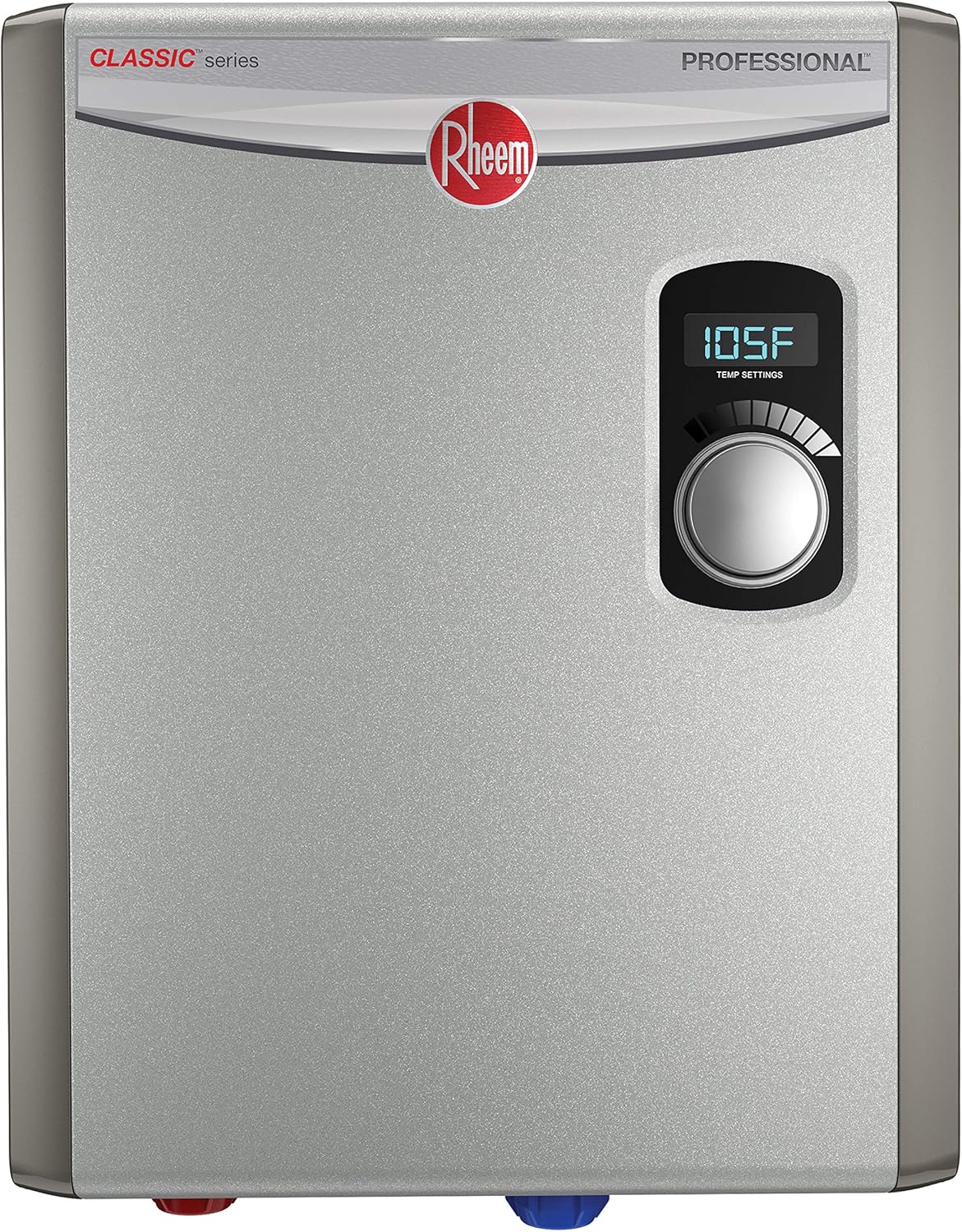
Rheem RTEX-18 Tankless Electric
| Wattage | 18000 watts |
|---|---|
| Voltage | 240 volts |
| Flow Rate | 4.4 gpm |
| Maximum Temperature | 140 °F |
| Efficiency | 99.8% |
The Rheem RTEX-18 is a compact, wall-mounted tankless electric water heater that provides on-demand hot water for mid-range whole-home applications. It uses self-modulating controls and two copper immersion heating elements to match power to demand, with a maximum flow rate of about 4.4 gallons per minute and digital temperature control via an LED display. In practice this unit is suited to one or two simultaneous fixtures in moderate inlet-temperature climates — enough for a single shower plus a sink or two in many homes. Benefits include no venting requirements, a much smaller footprint than tank systems, and potentially lower energy use because it only heats water when needed. Limitations are its 18 kW ceiling and 4.4 GPM flow, so it may struggle to supply multiple hot showers at once in colder regions where ground water is very cold. Installation requires appropriate 240V circuit breakers and proper electrical capacity. For buyers wanting a compact, energy-smart whole-home solution in moderate climates, the RTEX-18 is a practical choice.
Best for: Homeowners who want a space-saving, energy-efficient whole-house electric solution that reliably serves moderate simultaneous demand and values precise temperature control.
Less Ideal for: Homes in very cold climates or larger households that frequently run multiple showers and appliances at once should consider higher-kW models or alternate systems.
- Continuous on-demand hot water without a tank or venting
- Digital LED temperature control for precise setpoint adjustment
- Self-modulating operation that adjusts power to match demand for energy efficiency
- Compact wall-mounted design saves space compared with tank heaters
- Maximum flow rate (4.4 GPM) and 18 kW output limit simultaneous high-demand use in cold climates
- Requires substantial 240V electrical service and correctly sized breakers for installation
Verdict: A compact, energy-smart 18 kW tankless electric heater that delivers reliable on-demand hot water for moderate whole-home needs.
Rinnai RX199iN Tankless Water Heater

| Flow Rate | 11 gpm |
|---|---|
| Heat Output | 199000 BTU |
| Efficiency | UEF 0.98 |
| Power Source | Gas Powered |
| Maximum Temperature | 140 °F |
The Rinnai RX199iN is a compact, condensing tankless water heater built for high-demand whole-house performance. It produces up to 11.1 gallons per minute and a 199,000 BTU output, so it can supply multiple fixtures simultaneously while maintaining high outlet temperatures. The unit is convertible between natural gas and propane and uses Rinnai's Smart Sense gas control with an easy interface for setup. Condensing construction yields an industry-leading UEF of 0.98 for strong efficiency, and the Quick Flush feature simplifies routine maintenance. Versa Vent allows indoor or outdoor installation with the appropriate vent cap, and Wi-Fi control is possible with an optional module. Practical limitations include the need for professional installation, fuel-line and venting work for outdoor installs, and the typical upfront cost and complexity of condensing tankless systems compared with standard tank heaters.
Best for: Buyers prioritizing whole-house hot water performance and operating efficiency who want a compact, high-output gas tankless system that can handle multiple simultaneous demands.
Less Ideal for: If you need a simple, low-cost replacement with minimal installation work or only occasional hot-water use, a basic tank heater or lower-capacity unit may be more appropriate.
- High flow capacity up to 11.1 GPM suitable for multiple simultaneous fixtures
- Very high thermal output (199,000 BTU) for consistent hot-water performance
- Super-high efficiency (UEF 0.98) reduces energy use compared with conventional tanks
- Convertible fuel design supports natural gas or propane and indoor or outdoor mounting with Versa Vent
- Quick Flush and smart-control options simplify maintenance and setup
- Requires professional installation and proper venting adaptations for outdoor use
- Wi-Fi control requires an additional sold-separately module
Verdict: Choose the RX199iN when you need a compact, professional-grade tankless that delivers high flow and top-tier efficiency for whole-house hot water.
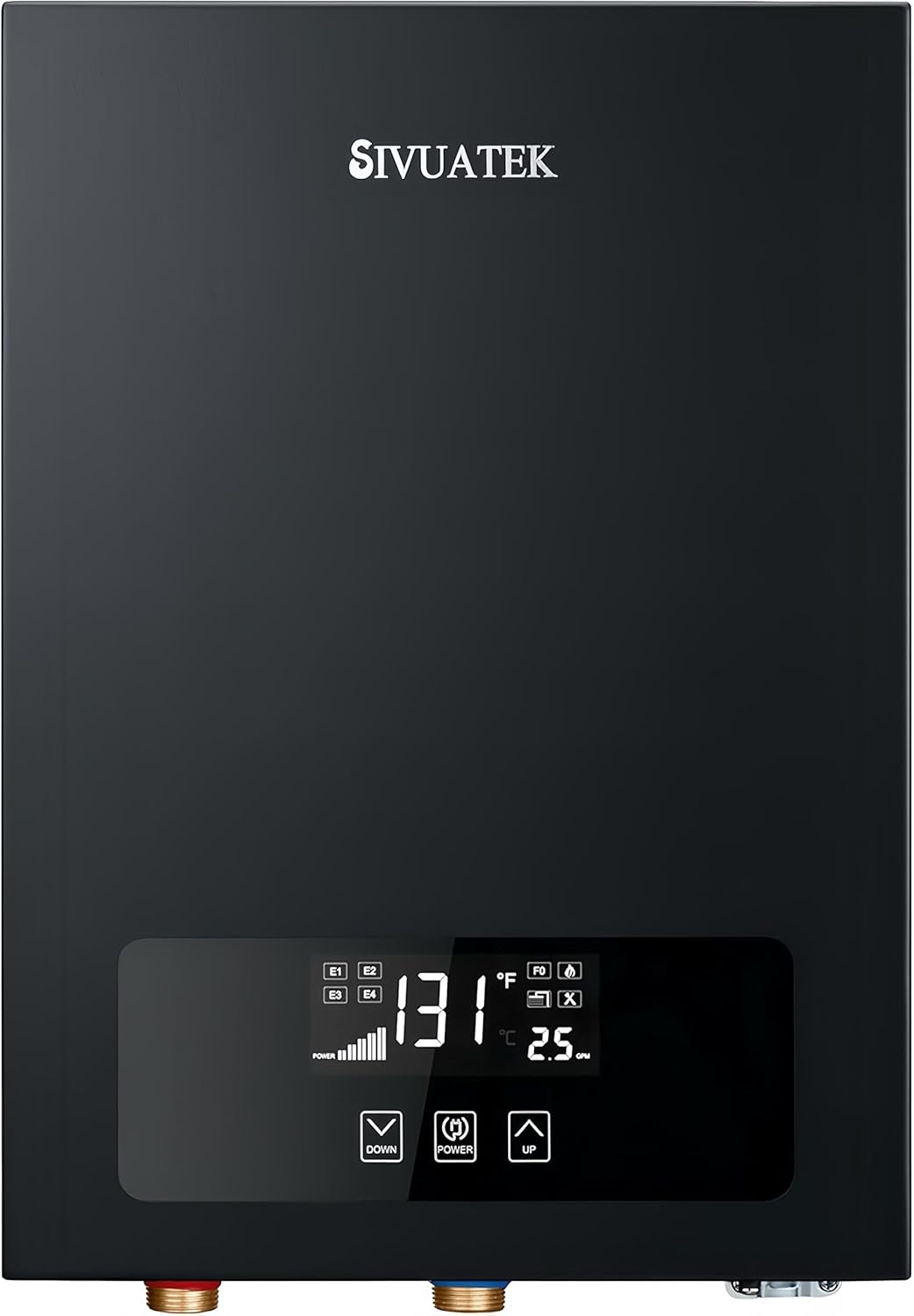
SIVUATEK V7B-180B 18kW Tankless Water Heater
| Power | 18 kW |
|---|---|
| Voltage | 240V |
| Max flow rate | 4.3 GPM |
| Certifications | ETL listed |
The SIVUATEK V7B-180B is a compact 18 kW electric tankless unit intended as a point-of-use or whole-house booster that delivers up to about 4.3 gallons per minute of hot water. It uses self-modulating electronics to adjust power with flow and set temperature, which reduces temperature swings as flow changes and improves energy use compared with a storage tank. The unit is ETL listed and includes several safety protections such as leakage detection, dry-heat protection, and high-temperature shutdown. Its separated heating chamber design keeps water and wiring apart to limit corrosion and scale buildup, cutting maintenance needs. Installation requires a 240V supply with two 40A double-pole breakers and 8 AWG wiring, so proper electrical capacity and wiring are essential. Practical benefits are instant hot water, compact footprint for mounting near showers or laundry, and lower standby losses than tank heaters, while the main limitation is the required high electrical service and modest flow rate that may not support simultaneous heavy demand without careful planning.
Best for: Buyers who prioritize energy efficiency and dependable instant hot water for a single bathroom or targeted whole-house boost and who plan installations with adequate electrical capacity.
Less Ideal for: Homes without a 240V circuit and sufficient breaker/wire capacity or larger households that need high simultaneous hot water flow from many fixtures.
- Self-modulating control for stable outlet temperature under changing flow
- Compact point-of-use design saves space and reduces standby energy loss
- Multiple built-in safety protections and ETL listing for safer operation
- Separated heating chamber to reduce corrosion and scale and lower maintenance
- Requires 240V supply with two 40A breakers and 8 AWG wiring which may need panel upgrades
- Flow capacity (~4.3 GPM) limits simultaneous use of multiple high-flow fixtures
Verdict: Choose this compact, self-modulating electric tankless heater when you want efficient, reliable on-demand hot water for point-of-use or modest whole-house needs and have the electrical capacity to support it.
MRNIU 18kW Tankless Water Heater

| Power Source | Electric |
|---|---|
| Wattage | 18000 watts |
| Voltage | 240 volts |
| Flow Rate | 4.31 gpm |
| Maximum Temperature | 131 °F |
This MRNIU 18kW tankless unit is a compact wall-mounted electric heater designed to deliver on-demand hot water for a small whole-house or point-of-use set up. It heats water instantly when a tap or shower is opened and shows temperature on an LED display for simple control. Notable features include overheat protection, a copper heating element, and a slim profile that saves space and mounts with the included bracket. The unit is best suited where a 240V, 18kW supply can sustain flow; the listed flow rate is about 4.31 gpm and maximum output temperature is 131°F, so it can handle one to two fixtures simultaneously in cooler climates or a single shower in warmer feed conditions. Installation is straightforward for a qualified electrician and plumbing pro, and maintenance is minimal since there is no storage tank. Limitations are that its 18kW rating requires a dedicated 240V circuit and may not deliver high flow and high temperature simultaneously in cold incoming water conditions, so larger households should consider higher-capacity models.
Best for: Buyers seeking a lower-cost whole-house or single-shower tankless option who prioritize compact footprint and energy savings over high simultaneous-flow performance.
Less Ideal for: Large households with multiple high-demand bathrooms or very cold incoming water temperatures should choose a higher-capacity unit instead.
- Compact, wall-mounted design frees floor space and is easy to tuck into small areas
- On-demand heating eliminates a storage tank and reduces standby energy loss
- Built-in overheat protection and automatic shut-off improve safety
- LED temperature display provides clear, immediate temperature feedback
- 18kW power requires a dedicated 240V electrical circuit and professional installation
- 4.31 gpm flow rate may not sustain simultaneous high-flow fixtures in cold climates
Verdict: A compact, budget-friendly 18kW electric tankless heater that gives instant hot water and low standby loss for small homes or single-shower setups.
EcoSmart ECO 11 Tankless Heater

| Flow Rate | 3.1 gpm |
|---|---|
| Heat Output | 11 KW |
| Wattage | 13000 watts |
| Voltage | 220 volts |
| Maximum Temperature | 140 °F |
The EcoSmart ECO 11 is a small, wall-mounted electric tankless water heater intended for point-of-use or low-flow applications such as a single bathroom, sink, or office breakroom. It heats water on demand using self-modulating electronics so the unit only draws the energy needed to reach the set temperature, and the digital control lets you set temperature in one-degree increments. At 11 kW (13 kW rating) it delivers roughly 1.3 to 3.1 gallons per minute depending on inlet temperature, which is enough for one shower or a sink in many climates. The slim footprint saves floor space and the LED display makes adjustments straightforward. Limitations are its modest flow rate and high amperage requirement, so it is not suitable for whole-house use or multiple simultaneous high-flow fixtures without larger models and appropriate electrical upgrades. Installation requires a dedicated breaker and correctly sized wiring to meet the rated amperage.
Best for: Buyers who prioritize a reliable, energy-efficient point-of-use heater for a single bathroom, sink, or small office and want consistent on-demand hot water with precise temperature control.
Less Ideal for: Households seeking a whole-house solution or anyone needing multiple simultaneous high-flow fixtures should choose a larger-capacity model or a professionally sized system.
- Compact wall-mounted design saves floor space and enables point-of-use installs.
- Self-modulating technology adjusts power use to demand for improved energy efficiency.
- Digital temperature control with LED display allows precise temperature setting.
- Sufficient flow for one shower or sink in warmer-climate or low-flow setups.
- Lifetime warranty on electronics, heat exchanger, and element (covers unit cost).
- Flow rate is limited to low-flow or single-fixture use and cannot support whole-house demand.
- Requires a high-amperage dedicated circuit and appropriately sized wiring for safe operation.
Verdict: Choose the ECO 11 when you need a compact, energy-efficient, and dependable point-of-use tankless heater that delivers precise on-demand hot water for a single fixture.
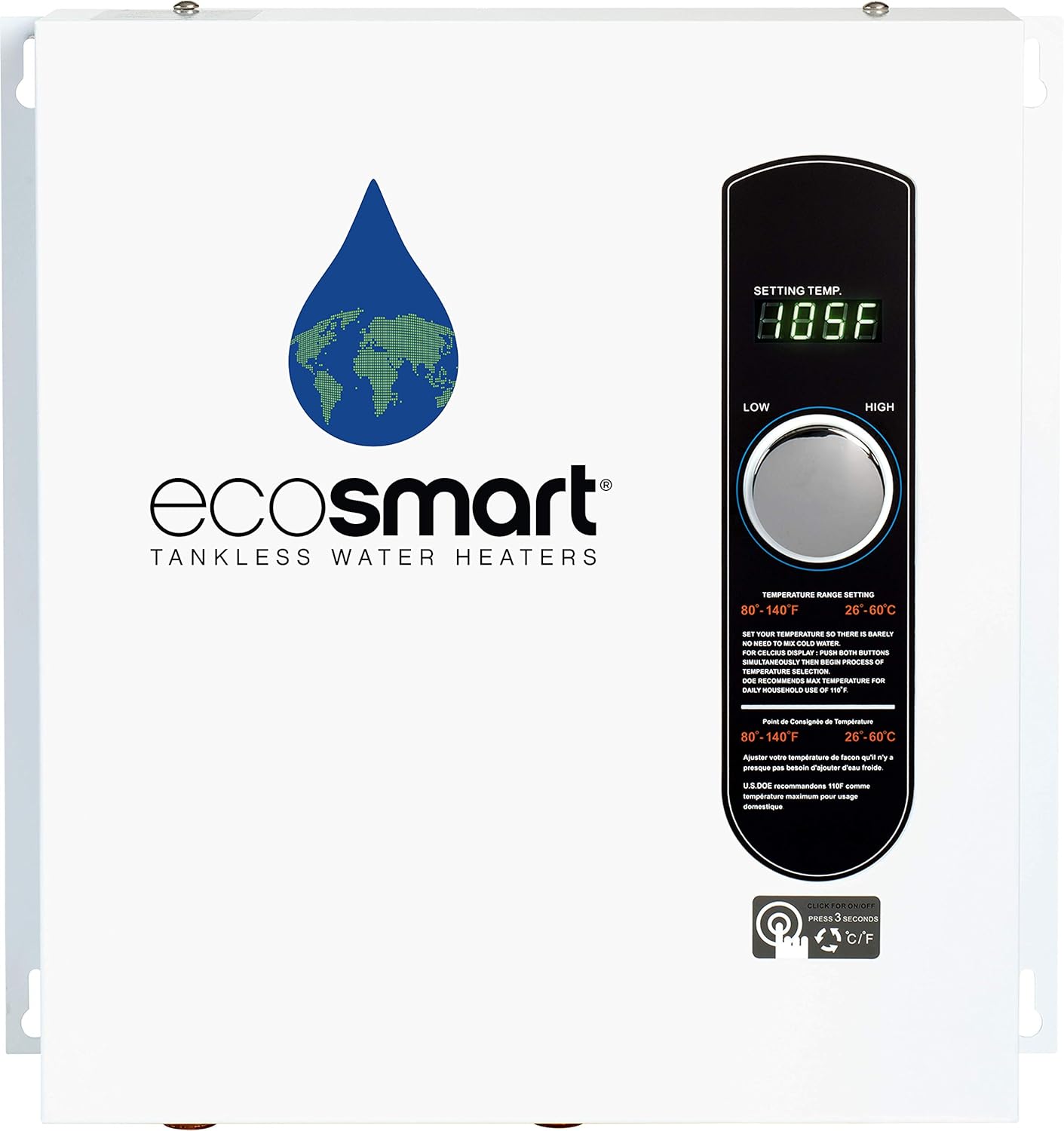
EcoSmart ECO 27 Tankless Water Heater
| Wattage | 27 KW |
|---|---|
| Voltage | 240 volts |
| Flow Rate | 6.6 gpm |
| Maximum Temperature | 120 °F |
| Maximum Pressure | 150 psi |
The EcoSmart ECO 27 is a wall-mounted, 27 kW electric tankless water heater built to provide continuous hot water for demanding whole-house needs in cooler climates. It uses self-modulating technology to adjust power draw based on flow and desired temperature, and the unit offers digital temperature control with 1 degree increments for precise setpoints. In practical use the ECO 27 can deliver roughly 2.7 to 6.6 gallons per minute depending on inlet temperature, making it suitable for multiple simultaneous fixtures or large tubs when sized correctly. Installation requires substantial electrical capacity — three 40 A double-pole breakers and three 8 AWG conductors — so plan for a professional electrical hookup. The compact, wall-mounted design saves space compared with tanks, and the unit is ETL listed and lead-free compliant. Limitations include the need for significant electrical infrastructure and modest flow at very cold inlet temperatures, so verifying sizing for your climate and hot-water habits is essential.
Best for: Buyers who prioritize reliable whole-house on-demand hot water in cooler climates and who want a compact, energy-efficient electric solution backed by widespread user adoption.
Less Ideal for: Homes without the required high-capacity electrical service or buyers who need very high flow rates in very cold climates without upgrading electrical or plumbing systems.
- High 27 kW output suitable for whole-house demand in many climates
- Self-modulating technology adjusts energy use to actual hot-water demand
- Digital temperature control with 1°F increments for precise settings
- Compact wall-mounted design saves floor space and is easy to site
- ETL listed and tested for lead-free compliance
- Requires heavy electrical service and three 40 A double-pole breakers for installation
- Flow rate drops as inlet water temperature decreases, limiting simultaneous high-flow uses
Verdict: Choose the ECO 27 if you need a compact, factory-quality electric tankless heater capable of meeting whole-house hot-water demands when your electrical system can support its heavy power needs.
Rheem RTEX-24 Tankless Electric

| Wattage | 24 KW |
|---|---|
| Voltage | 240 volts |
| Flow Rate | 5.9 gpm |
| Maximum Temperature | 140 °F |
| Mount Type | Wall |
The Rheem RTEX-24 is a 240V tankless electric water heater built for whole-home demand, offering up to 5.9 gallons per minute of hot water in warm climates. It installs on a wall and uses self-modulating power control to adjust output to the required load, which helps efficiency and smooth temperature control through the front digital display. Because it is electric, no venting is required and installation can be more flexible than gas units, though the unit requires significant electrical capacity — three 40A double-pole breakers and a 200A household service are recommended. Its stainless steel construction and compact footprint save space versus a tank heater and eliminate standby heat loss. Expect reliable continuous hot water for two showers plus sinks in appropriate conditions, but plan for electrical upgrades and professional installation in many homes. The RTEX-24 is best where high electric power is available and where buyers value on-demand hot water and simplified indoor mounting.
Best for: Buyers who want a reliable whole-home electric tankless heater and are prepared to ensure adequate electrical service and professional installation for a factory-quality replacement.
Less Ideal for: Households without the required electrical service or those seeking a lower-install-cost option where gas or smaller point-of-use units would be more practical.
- High maximum flow rate up to 5.9 GPM suitable for multiple fixtures in warm climates
- Self-modulating power control improves efficiency by matching energy use to demand
- Digital temperature control for easy, precise setpoint adjustment
- Compact wall-mounted design saves space compared with tank heaters
- Stainless steel construction resists corrosion and supports long service life
- Requires substantial electrical capacity and three 40A double-pole breakers, which may need panel upgrades
- Performance depends on inlet water temperature so actual GPM will be lower in cold climates
Verdict: Choose the RTEX-24 when you need dependable whole-house on-demand hot water and have the electrical capacity to support a high‑power electric tankless unit.
Choosing the Right Whole-House Tankless Water Heater: Key Factors to Consider
Flow Rate and Simultaneous Demand
Flow rate, measured in gallons per minute, determines how many fixtures a tankless unit can serve at once. You should estimate peak simultaneous demand by adding fixture flow rates for showers, faucets, dishwashers, and washing machines. A heater rated for a higher GPM will maintain temperature when two or more fixtures run concurrently.
Underestimating flow needs leads to lukewarm water during busy times. When sizing for bathrooms with multiple showers or homes with high hot-water appliance use, choose a unit with margin above your calculated peak demand to avoid throttling and temperature fluctuation.
Temperature Rise and Cold-Climate Performance
Temperature rise is the difference between inlet water temperature and the desired hot output. It is crucial in colder regions because incoming groundwater can be significantly colder, forcing the heater to deliver a larger temperature increase. Manufacturers publish performance curves showing achievable flow at given temperature rises.
If you live in a cold climate, prioritize units with solid performance at higher temperature rises to preserve flow capacity. In milder climates, the same model will often deliver greater usable flow, so adjust sizing based on your regional inlet water temperature.
Fuel Type and Venting Requirements
Whole-house tankless units may run on natural gas, propane, or electricity, and the fuel choice affects installation complexity and operating cost. Gas models typically provide higher flow rates for large homes but need proper gas supply sizing and exhaust venting. Electric units simplify venting but may require substantial electrical service upgrades for high-flow applications.
Consider existing utility access and whether the home can support required venting or electrical capacity. Upgrades to gas lines, power panels, or venting paths can add significantly to installation time and cost, so factor these into the overall decision.
Installation Accessibility and Maintenance
Tankless water heaters need clearances for service access and may require a condensate drain for high-efficiency gas models. Easy access simplifies routine descaling and component checks, which prolongs service life. Some installations need new venting runs, seismic strapping, or condensate neutralizers depending on local code.
Routine maintenance, like annual descaling in hard-water areas, keeps heat exchangers efficient. Confirm that the installation location permits recommended service clearances and that you can reach serviceable parts without expensive teardown.
Controls, Monitoring, and Usability
User controls range from basic thermostats to digital remote controllers and connectivity features. Precise temperature control helps avoid scalding and improves comfort, while diagnostic readouts and connectivity can simplify troubleshooting. Some systems include flow modulation and prioritization features that optimize performance under varying demand.
When multiple household members adjust settings, consider models with user-friendly controls or remote access. Advanced diagnostics can reduce service calls by revealing error codes and operational trends to a qualified technician.
Durability, Warranty, and Serviceability
Durability hinges on heat exchanger materials and build quality. Units built with corrosion-resistant materials and robust controls typically last longer in demanding environments. Warranty length and coverage scope indicate manufacturer confidence and affect long-term ownership cost.
Check what components the warranty covers and any registration requirements. Also consider local service availability because prompt professional repairs reduce downtime. For areas with hard water, consider models known for accessible heat exchangers and straightforward parts replacement to lower maintenance disruption.
Sizing Your Whole-House Tankless Unit
Accurate sizing blends peak flow demands with the temperature rise you need. Start by listing fixtures and their typical flow rates, then estimate how many will run simultaneously during the busiest period. Use the local groundwater temperature to calculate required temperature rise to reach comfortable setpoints.
Apply a safety margin to the calculated flow to avoid performance shortfalls during unusually high demand or if your household grows. If your calculated need falls between common unit capacities, choose the next higher size to preserve consistent temperature and reduce cycling.
- Add fixture flow rates for peak simultaneous use to estimate required GPM.
- Use local inlet water temperature to calculate needed temperature rise.
- Round up to the next capacity tier rather than sizing to the exact number.
Venting and Placement Considerations
Venting type depends on unit efficiency and fuel. High-efficiency gas units often use PVC or stainless steel for condensate-capable venting, while non-condensing units require direct venting to avoid indoor exhaust. Placement affects run length for venting and proximity to gas or electrical supplies.
Avoid locating the unit where freezing or heavy moisture can damage components. Plan for condensate drainage and service access when picking a wall or closet location.
- Ensure vent runs meet length and material requirements.
- Provide a condensate drain for condensing units.
- Allow service clearance around the unit for maintenance.
Mitigating Hard Water and Scale
Mineral scale shortens heat exchanger life and reduces efficiency. In hard-water regions, scale prevention is a critical maintenance strategy. Options include installing a water softener, a scale-inhibition device, or scheduling more frequent descaling service.
Consider the unit's recommended maintenance interval for areas with high mineral content. Some manufacturers provide accessible heat exchanger designs that make descaling and inspections faster and less costly.
- Test water hardness before choosing a long-term solution.
- Plan for regular descaling if softening is not installed.
- Confirm service access for heat exchanger maintenance.
Reducing Cold-Water Sandwich and Lag
Tankless systems can cause short delays and brief cold-water bursts between uses, commonly known as the cold-water sandwich. Simple remedies include recirculation pumps, small buffer tanks, or dedicated loop systems that keep hot water near fixtures. Each solution balances cost with convenience and energy use.
If immediate hot water is a priority, evaluate recirculation options compatible with your chosen heater. Some systems integrate recirculation controls that reduce energy waste by scheduling pump operation or using demand sensors.
- Recirculation pumps reduce wait times but use additional energy.
- Buffer tanks smooth out short bursts and stabilize output.
- Match the mitigation strategy to household hot-water patterns.
Electrical and Gas Supply Checks
Confirm that your home's gas meter, main gas line, and piping can supply the required BTU input for a high-capacity gas tankless unit. For electric models, verify that the electrical panel and wiring can handle the load; high-flow electric units may require multi-phase service or upgraded breakers.
A pre-installation inspection by a qualified technician identifies necessary upgrades and avoids surprises during installation. Correct supply sizing reduces the risk of underperformance and safety issues.
- Have a professional check gas line capacity and pressure.
- Verify electrical service capacity for high-power electric models.
- Factor utility upgrades into installation planning.
How We Chose the Best Whole-House Tankless Water Heater
We evaluated models based on real-world performance attributes that matter for whole-house installations. Primary criteria included flow rate capacity, which determines whether a unit can meet simultaneous hot-water demands; energy efficiency and certification ratings, which predict operating cost and compliance with efficiency regulations; and temperature rise performance, which shows how well a heater maintains set temperatures at varying inlet conditions. We also considered installation factors such as fuel type compatibility and venting requirements, since those affect retrofit complexity and long-term reliability. Durability and warranty coverage were assessed to estimate expected service life and protect against early failures. Noise and control features were reviewed for household comfort and usability. We excluded point-of-use and small-capacity units that cannot serve whole-home demand. Units with unclear specification data or missing manufacturer performance curves were also omitted. The final list favors models with transparent specs, strong efficiency ratings, and sensible installation requirements that match common whole-house scenarios.
Our full evaluation process is outlined in our review methodology.
FAQ
How do I know if a tankless unit has enough capacity for my home?
Estimate peak simultaneous hot-water flow in gallons per minute and use local inlet water temperature to determine required temperature rise. Match those needs to a unit's published performance curves and choose a model with some margin above the calculated peak.
Do I need a water softener with a tankless system?
In areas with hard water, a softener or scale-management plan is often necessary. Hard water accelerates scaling in heat exchangers, increasing maintenance frequency and potentially shortening unit life.
Can I install a tankless heater in a closet or utility room?
You can if the space meets clearance, ventilation, and condensate drain requirements. Many local codes require specific clearances and combustion air provisions, so consult installation instructions and local regulations before choosing the location.
How often should I schedule maintenance for a whole-house tankless heater?
Maintenance frequency depends on water hardness and usage but typically ranges from annually to every two years. Homes with hard water may need more frequent descaling and inspections to prevent scale buildup.
Will switching to a tankless water heater save energy?
Tankless units eliminate standby losses, which can reduce energy use compared with storage tanks, especially in households with lower continuous hot-water demand. Actual savings depend on usage patterns, fuel costs, and installation efficiency.
Final Verdict
Choosing the right whole-house tankless water heater means balancing flow capacity, temperature-rise capability, and installation realities for your home. Prioritize units that can meet your peak simultaneous demand at the local inlet temperature, while also considering fuel access, venting needs, and routine maintenance requirements. Weigh tradeoffs between higher initial installation complexity and the long-term benefits of continuous hot water and lower standby energy. With proper sizing and an appropriate maintenance plan, you can select a reliable system that delivers consistent comfort and predictable operating costs.